Key Takeaways
- A realistic custom travel tumbler MOQ starts at 1,000 pcs per color for factory-direct OEM production
- 304 stainless steel with 0.4–0.5 mm body gauge is a safer baseline than vague “food grade steel”
- Plan 25–35 days for bulk production after approved sample, plus 7–10 days for pre-production sampling
- AQL 2.5/4.0 inspection should cover vacuum retention, lid fit, coating adhesion, print position, and carton drop tests
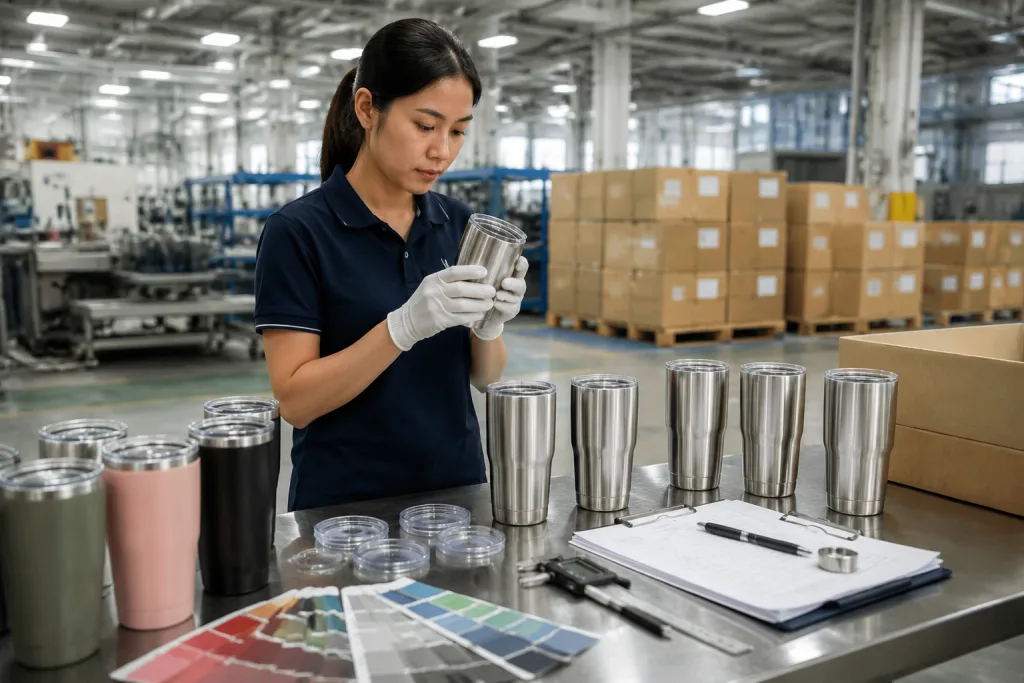
A travel tumbler looks simple until your logo is on 5,000 pieces and the cups end up in cup holders, laptop bags, office sinks, and dishwashers. Buyers often ask us for “a nice finish” first. Wrong first question. Ask whether the spec sheet will protect your brand after delivery: wall thickness in mm, lid leak test method, coating code, carton drop standard, and barcode placement. Last month QC pulled a pre-production sample because the silicone ring sat 0.6 mm high; it looked fine on the desk, then leaked after 3 minutes upside down.
As a travel tumbler manufacturer in Zhejiang, China, we see the same mistakes on repeat: 0.4 mm steel quoted as premium, copied lids with no leak test, coating names like “matte black” with no powder code, and prices that leave out inner cartons or barcode labels. The math doesn’t work if those items appear after PO approval. BottleForge Industrial in Hangzhou, Zhejiang runs OEM and private label tumbler projects from 1,000 pcs MOQ, with normal bulk lead time around 25–35 days after sample approval. We run final checks with AQL 2.5, and one buyer once flagged a PO typo where “gift box” became “white box” on 12,000 pcs—small words, real money.
Capacity Is Not Just Volume
The first line on a travel tumbler spec sheet is usually capacity: 12 oz, 16 oz, 20 oz, 24 oz, or 30 oz. Buyers often call it a merchandising choice. On the line, it changes steel weight, lid diameter, carton size, freight cost, and shelf fit. We run 20 oz tumblers for coffee brands more than any other size because it covers hot coffee, iced coffee, and daily commute use without turning into a gym bottle. Last month QC pulled a 20 oz sample at 86 mm top diameter; the buyer flagged it because their retail sleeve was built for 83 mm.
If you are buying a bulk coffee mug for cafes, nominal capacity is the wrong question to ask. Ask for usable capacity. A tumbler marked 20 oz may hold 590 ml to the rim, but practical fill volume with a lid can be 540–560 ml. That 30–50 ml headspace matters for hot drinks. We tested one café order with a 0.8 mm silicone seal and saw coffee climb into the sip slot when the cup was filled to the rim. Messy counter. Bad repeat order.
For corporate gifting, 16 oz and 20 oz pack cleaner in mailer boxes; we usually see 24 pcs per carton instead of 18 pcs on taller bodies. For a bulk travel mug program sold through distributors, 20 oz gives the best balance between perceived value and freight efficiency. A 30 oz model looks strong in a catalog, but carton cube rises by 20–35% and the math doesn't work on LCL freight. We’ve also seen this go sideways in Europe: the buyer’s sample passed desk review, then failed a 74 mm car cup holder check.
When you compare quotes from a coffee mug manufacturer or coffee mug supplier, ask for the measured height, top diameter, base diameter, and net unit weight. Put those four numbers on the PO. A 20 oz tumbler at 265 g and another at 340 g are not the same product, even if both photos look polished. Our caliper check once found a 2.5 mm base difference between two “same design” samples, and that changed the EVA insert for a 5,000 pcs gift-box run.
Steel Grade And Wall Gauge
Material line items should be boring and exact. For stainless travel tumblers, we usually run 304 stainless steel on the inner cup and 201 or 304 on the outer shell. Coffee touches the inner wall, so specify 304 there. It handles coffee acid, milk film, and daily washing better; QC can check it with an XRF gun in 6 seconds. If a quote only says “stainless steel,” send it back. We have seen buyers approve that wording, then argue about rust spots on the rim after the first 500 pcs sample lot.
Wall thickness is where low quotes hide money. For a coffee mug custom made program, we normally suggest 0.4–0.5 mm inner wall and 0.4–0.5 mm outer wall for mainstream travel tumblers. Some promotional jobs drop steel gauge to hit a target FOB price, but below 0.35 mm the line sees more dents, oval mouths, and vacuum weld rejects. The math does not work for retail. A thin-shell 20 oz tumbler may save USD 0.08–0.12 per piece, then lose it in carton damage, rework, and buyer claims. QC pulled one 0.32 mm sample last year that rocked on the flatness plate before packing.
Vacuum insulation comes from forming, welding, evacuation, and sealing control, not steel grade alone. A usable spec sheet should state the insulation target, for example hot retention above 45°C after 6 hours from a 95°C fill under room temperature around 20°C. Cold retention can be tested with 4°C water and measured after 12 or 24 hours. “Keeps hot all day” is the wrong production standard to ask for. We test with a digital probe thermometer and log the cup number, because one weak laser weld in a 200 pcs pilot run tells us more than a nice catalog claim.
For North America and Europe, ask whether the material can support LFGB, FDA food-contact, REACH, and relevant heavy-metal testing for coatings. China factories can produce to these standards, but the requirement must be written into the purchase order before production. Put the coating color, test item, and lab requirement on the PO, not in a WeChat message. We once had a buyer flag a PO typo where “FDA coating” was written instead of “FDA food-contact,” and that single line cost 9 days of document revision before mass production. Retesting finished goods after shipment is expensive and slow.
Lid Design Decides Complaints
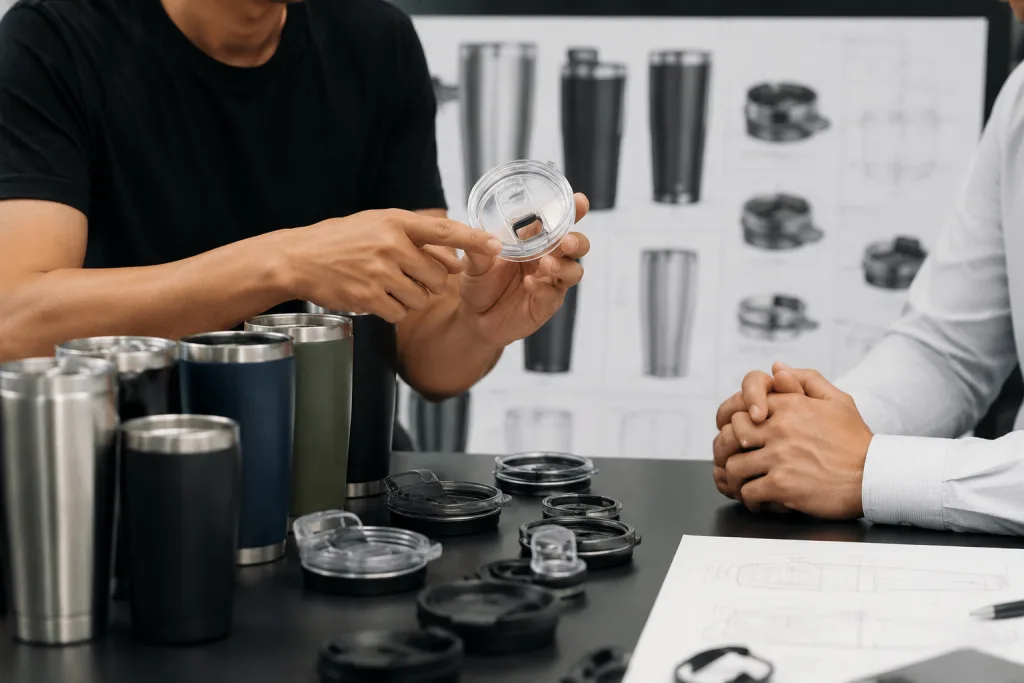
Lids cause more after-sales tickets than the tumbler body. We see it on repeat: a buyer spends 14 days choosing powder-coat colors, then approves a lid in 5 minutes from a PDF. Wrong order. For travel use, define the sip style and sealing level first; then lock gasket material, straw fit, one-hand opening, and spare-part supply. On our line, QC pulled 80 pcs from a 3,000 pcs run last month because the silicone ring sat 0.6 mm proud after assembly.
Most coffee programs run with a sliding sip lid, a flip lid, or a straw lid, but the choice should match the drink and sales channel. A sliding lid is common for a bulk coffee travel mug because it is simple and low cost, usually adding USD 0.35–0.70 depending on material and structure. A flip lid seals better when the hinge pin, spring force, and gasket compression are checked with a push-pull gauge, not just by hand. Straw lids sell well for iced drinks; for hot coffee positioning, the math doesn't work unless the buyer accepts lower sealing claims.
Leak-proof is the wrong word to use unless the lid has passed a real test. Around 60% of travel tumblers we review for buyers are splash-resistant, not fully leak-proof. If your coffee mug customized product will be sold online, write the claim with care. We run a simple bench test: fill the tumbler to 90% capacity, close the lid, invert for 30 seconds, then shake horizontally for 10 seconds. Some lids pass on day one, then fail after 20 dishwasher cycles or after a user removes the gasket and puts it back twisted.
Specify lid material such as PP, Tritan, or AS; specify gasket material such as silicone with the hardness marked, for example 50–60 Shore A. For corporate-gift buyers, ask whether spare lids can be ordered at 2–5% of the bulk quantity. Coffee mug distributors like replacement parts because they cut credit notes, and we have seen this go sideways when a PO typo listed “black lid” while the approved sample had a clear Tritan lid. A coffee mug factory direct quote without spare lids is not supporting your long-term program.
Finish, Color, And Branding Tolerance
Surface finish is where a travel tumbler becomes a brand asset or a return claim. We usually run powder coating, spray painting, electro-polished stainless, matte stainless, and textured finishes, but I would cut that choice down fast: powder coat or bare stainless for most coffee mug customizable projects. Powder coat gives better grip and better scratch resistance than basic paint when the line controls pre-treatment, oven temperature, and film build. Last month QC pulled 32 pcs from a 3,000 pc matte black run, and the weak samples all came from one rack position near the curing oven door.
Ask for coating thickness and adhesion test results before you approve bulk. A normal powder coat layer may be around 60–90 microns, and our QC team checks it with a coating thickness gauge at the body, shoulder, and bottom curve. Cross-hatch adhesion testing, alcohol rub testing, and 3M tape testing should be part of QC for colored tumblers. For darker colors, laser engraving gives a clean stainless reveal. For light colors or multi-color artwork, silkscreen or UV printing is often safer than heat transfer if the buyer will inspect edge sharpness at 30 cm. Tolerance is not the same by process: laser placement can usually stay within ±1 mm, while wraparound prints need wider artwork bleed, often 2–3 mm, or the seam will get flagged.
Coffee brands often ask for Pantone matching. Fair request, but a PDF mockup is the wrong approval tool. Stainless substrate, coating chemistry, and curing temperature all move the final shade, so approve a physical color chip or pre-production sample. We have seen Pantone 7527 C pass on a flat color card and look warmer on a 304 stainless tumbler after 18 minutes in the oven at 185°C. For a coffee mug custom campaign across several SKUs, keep the same coating batch where possible; splitting production over 2 months can create visible shade drift, and the math does not work if the buyer expects retail-shelf consistency from mixed batches.
Logo size matters too. A 60 mm tall logo on a tapered tumbler may distort unless the artwork is curved for the body profile, and this is where buyers sometimes push back because the mockup looked fine on a straight rectangle. It won’t print that way. If you are buying coffee mug promotional products for a corporate event, a simple one-color logo is the safer call. If you are building a coffee mug private labeling line for retail, spend the time on dielines and carton marks, including barcode quiet zone, gift-box laminate, and the PO item code; we once caught a “500ml” typo on a carton mark for a 600ml tumbler during pre-shipment inspection.
Packaging Lines Affect Landed Cost
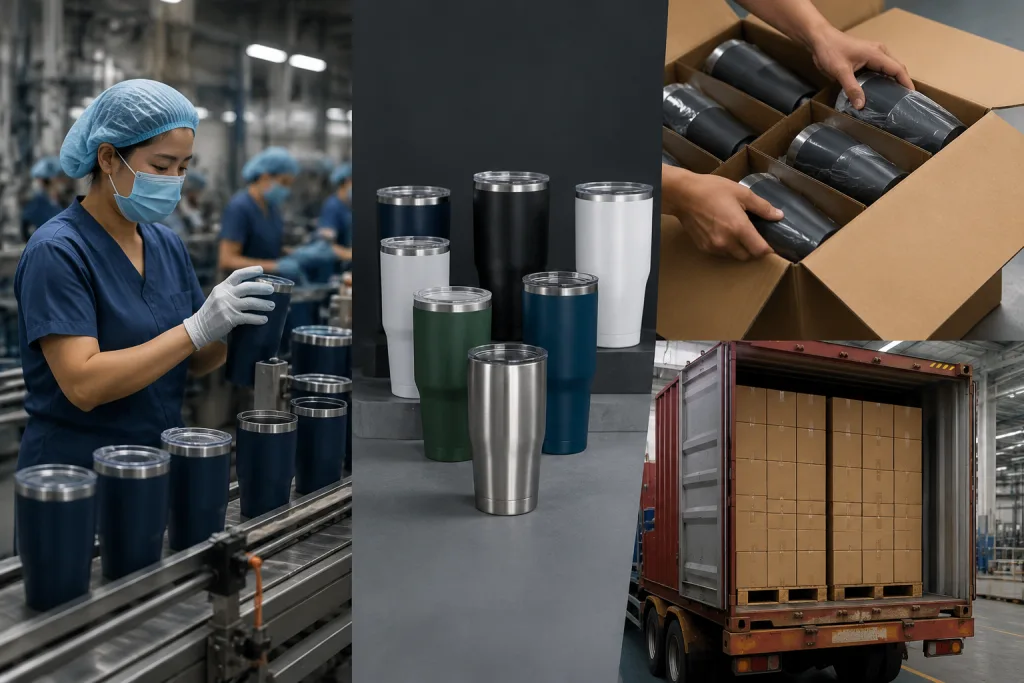
Packaging is not decoration. It changes breakage rate, carton handling, shelf readiness, and landed cost. On our line, a standard export pack for a travel tumbler is one polybag or tissue wrap, one white box or color box, then a 5-layer master carton; QC checks carton burst strength with a Mullen tester before mass packing. For Amazon, retail chains, or distributor warehouses, we ship with FNSKU labels, carton labels, suffocation warnings, recycled paper claims, or drop-test packaging when the PO calls it out.
For a bulk travel tumbler order, switching from a plain white box to a 350 gsm printed color box usually adds USD 0.18–0.45 per unit depending on size and ink coverage. A rigid gift box looks better in a showroom, but the math doesn't work for every buyer: it can push carton volume up by 30% or more. On a 5,000 pcs coffee mug in bulk order, we’ve seen paper cost rise USD 1,100 while ocean freight moved up closer to USD 1,600 after the carton CBM changed.
Corporate buyers often ask for individual mailer boxes. Fair request. It works for direct-to-employee gifting, but it needs a real courier test, not a desk review. A single tumbler in a thin corrugated mailer can pass warehouse handling and still fail courier delivery; last March QC pulled 12 samples after corner crush showed up on a 1.2 m drop test. We normally recommend 3-ply E-flute or stronger mailers with internal support for single-piece shipping.
If you are comparing a coffee mug supplier list or coffee mug supplier directory, make every supplier quote the same packaging spec. This is the wrong question to ask if you only compare FOB unit price. One factory may include barcode labels, reinforced cartons, and 2-side carton marks, while another leaves them off and adds USD 0.06 later after your artwork is approved. For factory-direct China sourcing, unclear packaging is one of the fastest ways to create a false low price; we’ve seen a PO typo say “white box” when the buyer meant “color box,” and that mistake delayed packing by 12 days vs 18 days when the paper mill was full.
MOQ, Price, And Tooling Reality
MOQ is not a sales trick; it comes from coating setup, logo process, carton printing, and line changeover. At BottleForge Industrial in Zhejiang, we run most existing-mold travel tumbler OEM orders from 1,000 pcs per color. Mixed colors are workable. The catch is coating: our powder line loses about 35–45 minutes for a color change, and the coating shop will push back hard if one color drops below 500 pcs.
For existing mold stainless travel tumblers, realistic FOB China pricing often ranges from USD 3.20–6.80 per unit for 16–20 oz models, depending on steel gauge, lid, coating, logo, and packaging. A basic bulk coffee tumbler with a one-color logo and white box sits near the lower-middle range. A coffee mug custom made retail pack with powder coat, laser logo, color box, barcode, and spare gasket lands higher; last month QC pulled a 20 oz sample at 286 g body weight, and that single weight check changed the quote by USD 0.18.
Tooling only makes sense when you change the body shape, lid structure, handle design, or capacity outside our current molds. New body tooling may cost USD 2,000–8,000. A custom lid tool can cost more because moving parts and gasket fit need tighter checks on the CNC sample, usually within 0.2 mm around the sealing groove. If your annual volume is below 20,000 pcs, the math usually does not work; use an existing mold and spend the budget on branding, packaging, and a better lid.
Be careful with quotes from any coffee mug factory that look 20% lower than the market. Sometimes the factory has a real cost advantage. More often, we have seen this go sideways: thinner steel, weak 5-layer carton changed to 3-layer, no spare parts, no third-party test allowance, or a lid that is only splash-resistant. Ask for a line-by-line spec and sample weight before you negotiate price; one buyer once flagged a PO typo that listed “304 stainless” in the title but “201 body” in the spec table.
QC Terms Belong In The PO
Write the QC terms before deposit. Do not leave them for the week before shipment. For coffee mug manufacturers exporting to Europe and North America, the PO should lock 304 stainless grade, capacity tolerance such as ±5%, unit weight tolerance such as ±3 g, finish, logo method, packaging, approved sample reference, inspection standard, and defect definitions. We have had a buyer flag one PO because “matte black” was typed as “mate black”; small typo, 6 cartons of argument.
For most bulk travel mug orders, we run AQL General Inspection Level II with critical defects at 0, major defects at 2.5, and minor defects at 4.0. Critical defects mean sharp rim edges, contamination, unsafe lid cracking, or serious leakage after a 30-second inverted test. Major defects cover failed vacuum retention, wrong logo position over 2 mm, coating peel, visible dents, color mismatch against the approved sample, or carton label errors. Minor defects are small cosmetic marks inside the agreed limit, for example one 0.5 mm speck on the lower body. QC pulled the sample under a 600 lux inspection lamp, not under warehouse shadows.
Pre-shipment inspection should test random samples for lid assembly, gasket fit, capacity, coating adhesion, print durability, vacuum performance, odor, and carton drop resistance. Use real tools: digital scale, vernier caliper, 3M tape, hot water at 95°C, and a 1.2 m carton drop. If your order is for coffee mug distributors, carton marking accuracy is not optional. Wrong SKU labels cost more than a cosmetic mark because the warehouse receives the goods into the wrong bin, then the buyer asks why 480 pieces disappeared.
China manufacturing stays consistent when the standard is specific. It gets risky when the buyer approves a nice sample but never freezes the details. This is the wrong question to ask: “Can you make it like the sample?” Ask instead whether the line has a locked spec sheet, a signed golden sample, and inspection photos before balance payment. If you want coffee mug factory direct savings, take the factory role seriously: lock the spec sheet, approve the golden sample, and inspect against that sample before the balance payment.
Send your tumbler spec sheet for factory review
BottleForge will check capacity, steel gauge, lid, logo method, packaging, MOQ, and FOB cost before you commit.
Frequently asked questions
What MOQ should I expect from a travel tumbler manufacturer?
For existing mold stainless travel tumblers, a practical MOQ is usually 1,000 pcs per color. Some factories accept 500 pcs, but the unit price is often higher because coating, logo setup, and carton printing are inefficient at that level. For a coffee brand testing a new bulk coffee mug, 1,000–2,000 pcs is a sensible starting range. If you need a custom shape, custom lid, or exclusive mold, expect higher commitments, often 5,000–10,000 pcs per production run, plus tooling costs. At BottleForge Industrial in Hangzhou, Zhejiang, standard OEM projects normally start at 1,000 pcs with 7–10 days for sampling and 25–35 days for bulk production after approval.
How much does a custom travel tumbler cost FOB China?
For a 16–20 oz stainless steel travel tumbler using an existing mold, FOB China pricing commonly runs from USD 3.20 to USD 6.80 per unit. The lower end usually means basic lid, simple logo, thinner packaging, and fewer accessories. A coffee mug customized for retail with 304 inner steel, powder coating, laser engraving, printed color box, barcode label, and stronger carton will sit higher. Lid design alone can change cost by USD 0.35–1.20. Packaging can add USD 0.18–0.80. Always compare quotes line by line. A coffee mug factory direct quote is only useful if steel gauge, unit weight, lid type, branding method, and packaging are clearly stated.
Which logo method is best for coffee mug custom orders?
For powder-coated travel tumblers, laser engraving is the most durable option because it removes the coating and exposes stainless steel underneath. It works best for one-color brand marks and gives a premium look. Silkscreen is better when you need a solid printed color on stainless or painted surfaces, but it can wear faster if the ink and curing are not controlled. UV printing handles complex artwork and gradients, though it needs abrasion testing. For coffee mug promotional products, one-color silkscreen is often enough. For coffee mug private label retail programs, laser engraving or well-tested UV printing is safer. Ask for alcohol rub, tape, and scratch testing on the approved sample.
Can I order coffee mug private labeling with retail packaging?
Yes, but private labeling needs more than a logo on the tumbler. A proper coffee mug private labeling project should include brand artwork, packaging dieline, barcode or FNSKU if needed, user insert, carton marks, and compliance wording. For a 1,000–3,000 pcs order, printed color boxes are usually practical. Custom inserts and manuals may have separate MOQs, often 1,000–2,000 sheets depending on print supplier. If you sell through distributors, keep SKU codes and carton labels consistent across every order. For retail packaging, approve a physical box sample before bulk printing. Small mistakes in barcode size, country of origin text, or carton quantity can delay warehouse receiving.
What tests should I request before shipping bulk coffee travel mugs?
At minimum, request AQL inspection with checks for appearance, capacity, unit weight, lid fit, leakage, coating adhesion, logo position, odor, vacuum retention, and packaging. For vacuum performance, test hot water at about 95°C and record temperature after 6 hours under room temperature around 20°C. For leakage, test inversion for 30 seconds and horizontal shaking for 10 seconds if the lid is claimed as leak-resistant. For coating, use cross-hatch and 3M tape tests. For packaging, run a carton drop test based on carton weight and buyer requirement. If selling in Europe or North America, also plan food-contact and coating compliance tests such as LFGB, FDA, REACH, or relevant ASTM requirements.