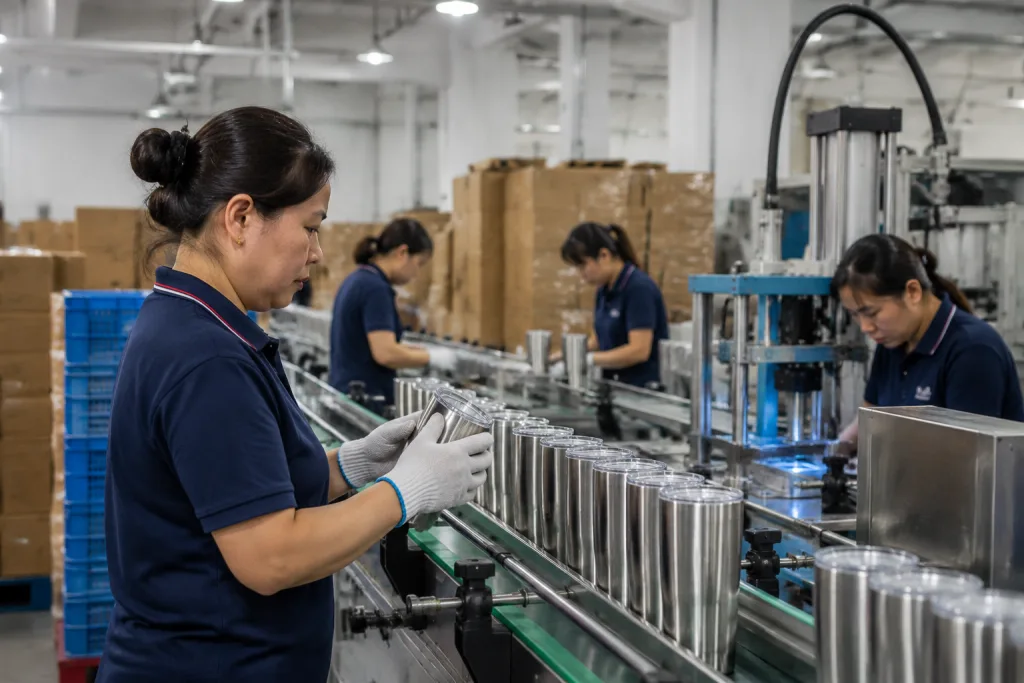
Key Takeaways
- Lock capacity, size, and lid type before price talks; 350 ml, 500 ml, and 600 ml use different tooling economics
- For coffee mug custom orders, expect MOQ from 1,000 pcs per color for common models and 5,000 pcs for new molds
- AQL 2.5/4.0 inspection should cover leak test, vacuum retention, coating adhesion, barcode scan, and carton drop
- Normal lead time from Zhejiang, China is 25-35 days after sample approval for existing stainless travel tumbler models
If you buy tumblers for a coffee brand or a corporate-gift program, finding a travel tumbler factory is the easy part. China has over 2,000 shops that will quote. The real test is whether the factory can hold your Pantone color within Delta E 1.5, keep the logo centered within 1 mm, match the lid fit, print the carton markings from your PO without a typo, and still hit the ship date. One buyer flagged this after QC pulled the sample: the straw hole was 0.8 mm off, and the lid looked cheap.
At BottleForge Industrial in Hangzhou, Zhejiang, we see buyers chase unit price and leave the product spec too loose. This is the wrong question to ask first. A USD 0.18 saving does not work if the lid leaks at 3%, the logo fails a 3M tape test after 50 pulls, or the gift box crushes under a 12 kg stack in the carton drop test. We run the decisions below before quoting final, because a bulk travel tumbler order goes sideways when the small details are left for “factory standard.”
Start with the drinking use
Do not start with logo method or unit price. Start with where the tumbler sits after the campaign. A commuter drinking flat white in a car needs a different build from a conference guest carrying a wide coffee mug in a tote bag. We see this mistake on about 6 RFQs a month: the buyer sends only “custom travel tumbler,” then 4 factories quote 4 different bodies. The comparison is junk. On our sample bench, QC pulled one 500 ml cup last week with a 79 mm base; it looked fine in photos, but it failed our cup-holder gauge.
For coffee brands, we usually cut the brief down to two or three formats. A 350 ml tumbler fits espresso drinks and small café shelves; packed 24 pcs per carton, it also keeps the carton under 13 kg. A 500 ml bulk coffee travel mug is the safer middle size for corporate gifts and loyalty rewards, and it gives enough print area for a 35 mm laser logo without looking crowded. A 600 ml or 20 oz bulk coffee tumbler feels better in hand as a gift, but it is taller, heavier, and shipping cartons cube out faster. For North American cup holders, check base diameter before sample approval: 68-74 mm works for most vehicles, while wider tapered designs often get flagged by buyers after the first fit test.
Lid choice drives complaint rate more than body shape. Sliding lids are simple and low cost, but call them splash-resistant, not leakproof. The math does not work if the buyer expects a bag-safe lid at the cheapest sliding-lid price. Flip lids with silicone plugs perform better in bags, but we run extra checks on hinge strength and gasket compression with a 3 kg pull test and a 30-minute upside-down leak test. Straw lids sell well for cold drinks; for hot coffee programs, we push back because end users may treat them like they are safe for boiling liquid.
Write the use case in one sentence: “500 ml stainless tumbler for hot coffee, corporate desk and commute use, laser logo, packed in gift box.” Put that on the PO, not just in the email thread. It saves 3-5 days of back-and-forth with any coffee mug supplier, and it stops the line from sampling the wrong lid.
Choose the construction before decoration
The second decision is body construction. For coffee programs, we usually quote 304 stainless steel inside, 201 or 304 outside, with double-wall vacuum insulation. Hot coffee sits against the inner wall, so that is where the spec matters. We run 304 food-contact stainless inside, 0.4-0.5 mm wall thickness, and passivation after polishing to cut metallic taste and corrosion risk. Last month QC pulled a 500 ml sample after pickling and found two tiny black spots near the rolled lip; that batch went back to re-polish before decoration.
Vacuum performance is not magic. A solid 500 ml tumbler should keep water above 55°C after 6 hours when filled with 95°C water at 20°C room temperature. Premium builds can beat that, but the math does not work on a cheap liner plus a big 24-hour hot claim. Ask your coffee mug factory direct partner for the test sheet, including fill volume, starting temperature, room temperature, and whether the lid was closed. For cold drinks, marketing numbers are easier to print; we still check condensation on the outer wall after 2 hours and run a 180-degree lid leak test over a white tissue.
Plastic parts deserve the same attention as steel. Lids commonly use PP for basic sliders, AS for clear flip lids, Tritan when buyers want better impact resistance, or stainless shells with PP inner parts. For Europe, ask for LFGB or EU food-contact declaration where needed, plus REACH compliance for coatings and silicone. For the United States, ask about FDA food-contact material documentation and, for some retail channels, California Proposition 65 screening. Corporate-gift buyers often skip full retail files, but a coffee mug distributor selling through 2 or 3 channels should collect them anyway; we have seen a shipment sit 12 days because the buyer flagged a missing silicone gasket declaration.
If you are comparing a coffee mug manufacturer and a trading company, ask for the material stack in writing: inner steel grade with certificate, outer steel grade, lid resin code, gasket material, coating type, and finish thickness in microns. This is the wrong question to leave for later. On our line, the coating gauge reads 38-45 μm for most powder-coated tumblers; if a supplier only says “standard material” on the PI, the quote is not ready for approval.
Match branding to order risk
The third decision is decoration. A coffee mug custom made for a 180-store café chain carries different risk than a one-color conference giveaway of 3,000 pcs. If the logo sits front-center at 42 mm wide, cheap decoration is the wrong place to save money. We have seen a logo pass a WhatsApp photo check, then show edge lift after 20 dishwasher cycles or scuff marks after 7 days in a courier box with loose lids rubbing the cup wall.
Laser engraving is the safest choice on powder-coated or stainless surfaces. No ink. Nothing to peel. We run it on a fiber laser, and QC checks the engraving depth and position with a 0.5 mm tolerance gauge before packing. It works well for coffee mug promotional products where durability matters. The trade-off is clear: the logo color becomes the exposed base tone, not an exact Pantone match. Silkscreen printing costs less for simple one-color marks, usually starting around USD 0.05-0.12 per position depending on size, but it needs adhesion testing with 3M tape and a cross-hatch cutter. UV print supports full-color artwork for coffee mug customizable campaigns, but the surface has to be clean, flat enough, and protected with PE bags or dividers during packing.
For coffee mug private label programs, the decision goes past the tumbler body. You may need logo control on the lid, gift box, instruction sheet, master carton, and barcode label. A coffee mug customized for retail needs one artwork sheet, not five loose email attachments. Send vector files, Pantone C or U values, logo placement in millimeters, and a packing mockup. “Same as sample” is not enough for repeat production; we had one PO typo change a 65 mm side logo into 56 mm, and the buyer flagged it only after the PP sample photo.
At BottleForge in Zhejiang, China, we normally approve a pre-production sample before mass production for coffee mug private labeling. For existing models, sample time is 5-7 days with laser or silkscreen logo. New color coating can take 10-14 days because the powder-coat line must match the approved chip, not the image on your screen. QC pulled the sample under a D65 light box last month, and the first coating batch was close in photos but off by one visible shade against the buyer’s Pantone chip.
Price the whole landed program
The fourth decision is commercial: are you buying the lowest FOB unit price, or the lowest landed risk? A bulk travel mug at USD 3.10 FOB Ningbo can lose to a USD 3.35 item if the cheaper quote hides 0.35 mm body steel, soft K=K cartons, or a lid gasket that needs spare parts after the first shipment. We had one buyer flag a “small” USD 0.08 carton saving after QC pulled the drop-test sample and found 6 cracked lids out of 24. Price the full program, not only the mug.
A realistic FOB China range for a 500 ml stainless double-wall travel tumbler is often USD 2.80-5.20, depending on steel grade, lid design, coating, logo, packaging, and order quantity. Gift box packaging can add USD 0.20-0.60. Individual polybag plus white box is cheaper, but it looks weak on a retail shelf. Color box with insert tray sells better in hand, yet it can push a master carton from 48 pcs to 36 pcs, so your pallet count changes. The math doesn't work if the buyer only compares the unit price in the PI and skips CBM.
MOQ also needs a practical view. For a stock-shape coffee mug in bulk, 1,000 pcs per color is common. For a custom powder color, most coating lines want 2,000-3,000 pcs because the first 80-120 pcs can be lost in color adjustment and gun cleaning. For a new lid or new body mold, 5,000-10,000 pcs is more realistic. If someone promises coffee mug factory direct pricing at 300 pcs with a special color and custom lid, ask what is actually being customized. We’ve seen this go sideways when the PO says “Pantone 186C,” but the approved sample card reads “Pantone 186U.”
Our Hangzhou-area production network can handle about 450,000 stainless drinkware units per month across tumbler, thermos, and bottle lines, with normal lead time of 25-35 days after sample approval for existing models. Peak season before Q4 gifting can push that to 40-50 days, especially if your bulk coffee mug needs custom gift packaging. On the line, a 500 ml powder-coated tumbler usually moves through welding, polishing, vacuum testing, coating, logo, and final packing; if the insert tray arrives 2 mm too tight, packing speed drops fast. We ship cleaner programs when buyers lock artwork, carton marks, and barcode files before the gold sample.
Audit quality like a repeat buyer
A buyer checklist is not finished until it has a quality gate. You do not need to read a metallurgical report, but you do need a written inspection plan that the factory, the inspector, and your own warehouse team can all follow. AQL is the common language here. For travel tumblers, AQL 2.5 for major defects and AQL 4.0 for minor defects is a practical starting point. Critical defects should be zero. On our line in Hangzhou, QC pulls samples by carton number, not by what looks clean on the packing table, because that is where inspections go sideways.
Your checklist should go past appearance. For every bulk coffee travel mug order, specify leak testing method, vacuum retention test, lid fit check, coating adhesion, logo position tolerance, color check, sharp-edge inspection, odor check, barcode scan, and carton drop test. For coating adhesion, we run a cross-hatch tape test with a 1 mm cutter and 3M tape. For logo durability, ask for a 3M tape pull or alcohol rub based on the decoration method. For lids, open-close cycle testing at 300-500 cycles is a fair screen for hinge weakness. Small detail, big problem: last quarter QC pulled a sample where the logo was 4 mm off center, and the buyer flagged it before we sealed the master cartons.
Corporate buyers often ask whether BSCI, ISO 9001, or Sedex is required. This is the wrong question to ask first. Start with your sales channel. If the order is an internal employee gift, ISO-style process control and material documents may be enough. If you supply a national retailer or a large coffee mug distributor network, social compliance audits are hard to avoid. Ask before the PO is signed. We have seen buyers request Sedex in shipment week, then complain when the math does not work because the vessel closes in 6 days and the audit slot is 18 days out.
One practical rule: inspect before final balance payment and before goods leave China. Simple. A failed inspection at the travel tumbler factory can usually be fixed with rework, replacement lids, or repacking. A failed inspection after arrival in Europe or North America gets expensive fast, especially when 1,200 cartons are already sitting in a 3PL warehouse and someone finds leaking lids during inbound scan.
Know when factory direct helps
Buyers often pull 30 names from a coffee mug supplier directory or coffee mug supplier list and assume factory direct will cut cost every time. Sometimes it does. Sometimes you just inherit the follow-up work the trading company used to chase, from Pantone approval to carton label revisions. We have seen a PO stuck for 4 days because the buyer wrote “matte black” in one place and “gloss black” in another. Factory direct helps only when your team can manage specs, approvals, and reorder planning without dropping details.
A travel tumbler factory is usually the better choice when you need stable repeat production, private mold development, strict color control, coffee mug custom documentation, or annual volume above 10,000-20,000 pcs. You can talk through tooling, laser welding, 0.35 mm wall thickness, polishing grade, powder coating, and packing with the people standing beside the line. Fewer handoffs. On repeat bulk travel tumbler orders, we also have more room to hold the same lid fit, logo position, and color standard instead of guessing from an old photo.
A distributor or sourcing agent still makes sense for 250 pcs, mixed-SKU gift kits, or rush orders pulled from domestic inventory. If you need 250 pcs next week, factory direct from Zhejiang is the wrong question to ask. The math doesn't work once air freight, sample approval, and export paperwork enter the job. If you need 8,000 pcs with coffee mug promotional branding, retail gift boxes, FNSKU labels, and carton marks for Amazon FBA or a 3PL warehouse, bring the factory export team in before artwork is locked. QC pulled one sample last month because the FNSKU was 2 mm too close to the box fold.
When screening coffee mug manufacturers, ask five plain questions: Do you make the stainless body in-house, or does another workshop draw and weld it? Which parts are bought out, such as lids, straws, or silicone rings? What is your MOQ by color? Can you share recent AQL inspection reports? Who signs off the golden sample before mass production? Those answers tell you more than a glossy brochure, and a real factory will usually answer with machine names, line photos, and one or two ugly inspection findings they already fixed.
Send your tumbler brief for a factory quote
Share capacity, quantity, logo, color, packaging, and delivery market. We will return a practical MOQ, lead time, and FOB China price.
Frequently asked questions
What MOQ should I expect from a travel tumbler factory?
For an existing stainless travel tumbler model, a practical MOQ is usually 1,000 pcs per color with one logo. Some factories will accept 500 pcs if the color is stock and the logo is laser engraved, but the unit price will be higher. Custom powder coating normally makes sense at 2,000-3,000 pcs per color because the coating line has setup loss. A new body shape, new lid, or coffee mug custom made mold normally starts around 5,000-10,000 pcs, plus tooling cost. If you are buying for a coffee brand launch, start with a stock mold and customize color, logo, and packaging first.
How long does production take after sample approval?
For a standard bulk coffee tumbler using an existing mold, normal production lead time in China is 25-35 days after sample approval and deposit. Add 5-7 days for a logo sample, or 10-14 days if you need a custom coating color matched to Pantone. Peak season before holiday gifting can push lead time to 40-50 days. Ocean freight to Europe or North America can add 25-45 days depending on port and routing. If your event date is fixed, work backward and leave at least 10 days for inspection, rework buffer, and export documentation.
Which logo method is best for coffee mug promotional products?
For most coffee mug promotional orders, laser engraving is the safest method because it resists scratching and does not rely on ink adhesion. It is good for stainless and powder-coated tumblers, but the logo color is not Pantone matched. Silkscreen is cost-effective for a simple one-color logo and can look sharp on cylindrical bodies, but you should require tape and rub testing. UV print is useful for full-color campaigns or detailed artwork, though it is more sensitive to surface shape and packing abrasion. For retail coffee mug private label programs, approve a decorated pre-production sample before mass production.
Can you pack bulk travel tumblers for Amazon FBA or 3PL delivery?
Yes, but the packing brief must be precise. For Amazon FBA or a 3PL warehouse, you typically need individual barcode or FNSKU labels, suffocation-warning polybags where applicable, master carton labels, carton weight control, and drop-test-ready packaging. A 500 ml tumbler in a color box often packs 24 pcs per master carton, but this changes with box size and insert design. Keep master cartons below 15-18 kg if warehouse handling matters. Send the label template, carton mark requirements, and routing guide before production, not after the goods are packed.
How do I compare quotes from different coffee mug manufacturers?
Put every quote into the same spec table before comparing price. Include capacity, inner and outer steel grade, wall thickness, lid material, coating type, logo method, packaging, MOQ, sample time, production lead time, FOB port, payment terms, and testing standard. A USD 0.25 difference may come from a cheaper lid, thinner steel, no gift box, or no inspection allowance. Ask each coffee mug manufacturer to confirm whether they are the actual factory, what parts they outsource, and whether AQL 2.5/4.0 inspection is accepted before shipment. If they avoid written specs, treat the low price carefully.