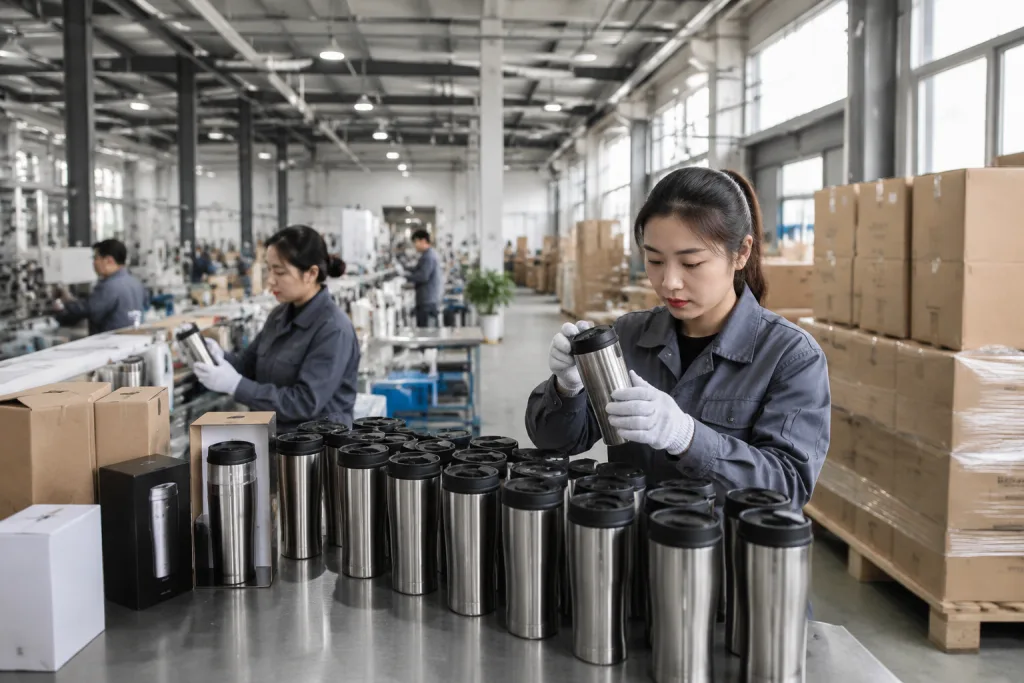
Key Takeaways
- A practical travel tumbler RFQ should specify capacity, steel grade, wall thickness, lid type, coating, logo method, MOQ, and Incoterm
- Factory direct MOQ is usually 1,000-3,000 pcs per color for custom powder coating, lower for stock colors
- A paid sample round normally takes 7-12 days, while bulk production takes 25-35 days after approval
- Your PO should list carton packing, AQL level, test standards, barcode/FNSKU needs, and spare lid percentage
If you buy corporate gifts or retail merch for a coffee brand, a travel tumbler looks simple until 6 RFQs land in your inbox. One supplier writes 304 stainless steel, another only says “food grade,” one includes a 1-color logo, another leaves out the inner carton, and the lid claim is still fuzzy. We see this weekly. Last month QC pulled a 40oz sample from the line, filled it to 90%, tipped it for 30 seconds, and found drops around the slider lid. That USD 3.40 quote became a USD 5.10 landed problem after logo plate fees, carton changes, and rework.
Factory direct sourcing works when the buyer locks the small details before tooling, not after deposit. From our Hangzhou, Zhejiang team, the smoothest orders start with a tight RFQ, a paid pre-production sample, and a PO that names the lid, straw, silicone ring, inner carton, and export carton specs in mm. Ask for “best price” only and the math does not work. We run better when the PO says 304 stainless, 0.5mm body thickness, 24 pcs per carton, and AQL 2.5 inspection before shipment. China has plenty of coffee mug manufacturers; fewer coffee mug factory teams are set up for repeat B2B programs without babysitting.
Start with the real use case
Before you ask for a travel tumbler factory direct quote, pin down what the cup must take in real use. This is the wrong question to ask: “What is your best price?” A commuter coffee tumbler on a retail shelf is a different build from a conference giveaway or a subscription-box insert. Coffee brands ask us about heat retention after 6 hours, 74 mm cup-holder fit, sip feel, and color-box scuffing. Corporate-gift buyers push harder on logo edges, Pantone match under a D65 light box, ship date, and a price that still works at 2,000-10,000 units.
For a coffee brand, we usually run a 16 oz or 20 oz double-wall stainless steel tumbler, 304 inner wall, 201 or 304 outer wall, 0.4-0.5 mm wall thickness, and a push-on or threaded PP lid with silicone seal. For a promotional job, a lighter outer wall and stock lid can pass if the budget is tight. But not for retail. If the tumbler will sit in stores, do not save USD 0.18 by choosing a loose lid; QC pulled 32 samples on one order and found 5 lids with drip marks after a 30-second inverted test. The math doesn't work once returns start.
Your first PO planning line items should look like this:
- Product: 20 oz stainless steel travel tumbler, vacuum insulated, matte powder coating, 74 mm lower diameter checked with a digital caliper.
- Use: retail coffee merch for hot coffee and cold drinks, standard car cup holder, no straw hole unless the buyer approves it on the sample.
- Compliance: LFGB or FDA food-contact test, REACH coating check for EU programs, test name written exactly as shown on the PO.
- Target price: FOB Ningbo or Shanghai, USD 3.20-4.60 depending on lid and finish, with MOQ and carton size confirmed before artwork.
That level of detail cuts out the coffee mug supplier directory noise. A general coffee mug supplier list might hand you 30 contacts, but it will not show which coffee mug manufacturer actually checks vacuum leaks in the water bath, tests coating adhesion with 3M tape, and records carton drop failures after the line packs the first 50 cartons.
Write an RFQ that factories can price
A loose RFQ gets you a loose price. “Please quote coffee mug custom made with logo” gives the sales team too much room to guess. Send enough detail for the factory to cost material, mold status, powder coating, logo process, inner box, AQL 2.5 inspection, and freight basis. We run quotes line by line in our Hangzhou office; the buyer only sees one FOB number, but our costing sheet still has 14 cells behind it.
For travel tumbler factory direct sourcing, write capacity in milliliters and ounces, body diameter, total height, lid style, coating color, logo position, packaging, quantity per color, and destination market. Be exact. If your bulk coffee mug program has four colors, write 2,000 pcs per color instead of 8,000 pcs total. That color split changes MOQ, powder booth setup, carton stickers, and sometimes the unit price; last month QC pulled a matte white sample because the coating thickness hit 82 μm and the lid fit turned tight.
A clean RFQ should include these PO-ready items:
- Item code or reference drawing: if you do not have one, ask the factory to quote a current mold and confirm whether the mold is private or open.
- Material: 304 stainless steel inner, 201 stainless steel outer, BPA-free PP lid, silicone seal.
- Capacity tolerance: 20 oz nominal, acceptable actual fill volume 580-610 ml.
- Logo: laser engraving, one-side, 45 x 35 mm; for silkscreen, state 1 color Pantone Black C and print position from the bottom in mm.
- Packing: 1 pc kraft box, 24 pcs master carton, 5-ply export carton, with carton mark file supplied before mass packing.
- Inspection: AQL 2.5 major / 4.0 minor, critical defects 0, with lid leakage test and barcode scan check included.
If you compare coffee mug factory direct quotes, make every supplier quote the same Incoterm. FOB Ningbo from Zhejiang or FOB Shanghai from eastern China is normal for this category. EXW looks cheaper on the first email, but the math does not work if you forget inland trucking, export handling, and customs coordination; we have seen this go sideways when a PO said “FOB” in the subject line and “EXW” in the price table.
Check the sample before artwork excitement
Buyers often fall in love with logo mockups before the blank cup passes basic checks. Wrong order. A coffee mug customizable program breaks down fast if the lid drips, the powder coat marks after one fingernail test, or the base is 1.5 mm too wide for a Toyota cup holder. For a new project, we ask buyers to approve one blank sample and one logo sample, or sign off a stock sample first, then move to a branded pre-production sample after the body and lid are locked.
A realistic factory sample timeline is 3-5 days for available stock, 7-12 days for logo sampling, and 12-18 days if you need custom coating color. At BottleForge Industrial in Hangzhou, Zhejiang, our travel tumbler line can handle about 280,000 units/month across common SKUs, but the sample room still runs on slots, not wishes. We use a small spray booth and Pantone light box for coating checks, and QC pulled one matte black sample last month because the lid PP color was half a shade off. A paid sample fee of USD 50-150 is normal; it cuts out careless sample requests and is often refunded against a bulk PO.
When the sample arrives, test it like a buyer, not like a photographer. Fill it with 95°C water, close the lid, wait 10 minutes, and check outer wall heat. Turn it upside down for 30 seconds only if the lid is sold as leak-resistant. Most sip lids are splash-resistant, not leakproof; the buyer flagged this on 14 samples in one spring promo run. Put it in a cup holder. Open and close the lid 50 times. Scratch the coating lightly with a fingernail and inspect the rim under a desk lamp. We reject good-looking samples if the mouth rim feels sharp against a 0.2 mm feeler gauge.
Your sample approval line items should include:
- Approved body: exact height and diameter in mm, capacity, carton weight if the buyer has a freight cap.
- Approved lid: color, seal structure, drinking port, spare gasket if the PO calls for one.
- Approved finish: Pantone or RAL reference, gloss level, coating texture, and one approved limit sample kept by QC.
- Approved logo: method, size, print position, location tolerance within ±2 mm.
This protects you when ordering a bulk coffee travel mug, especially for seasonal campaigns where a second production run is not realistic. We have seen this go sideways: one PO typo changed “matte white” to “milk white,” and nobody caught it until the pre-production sample hit the buyer’s desk.
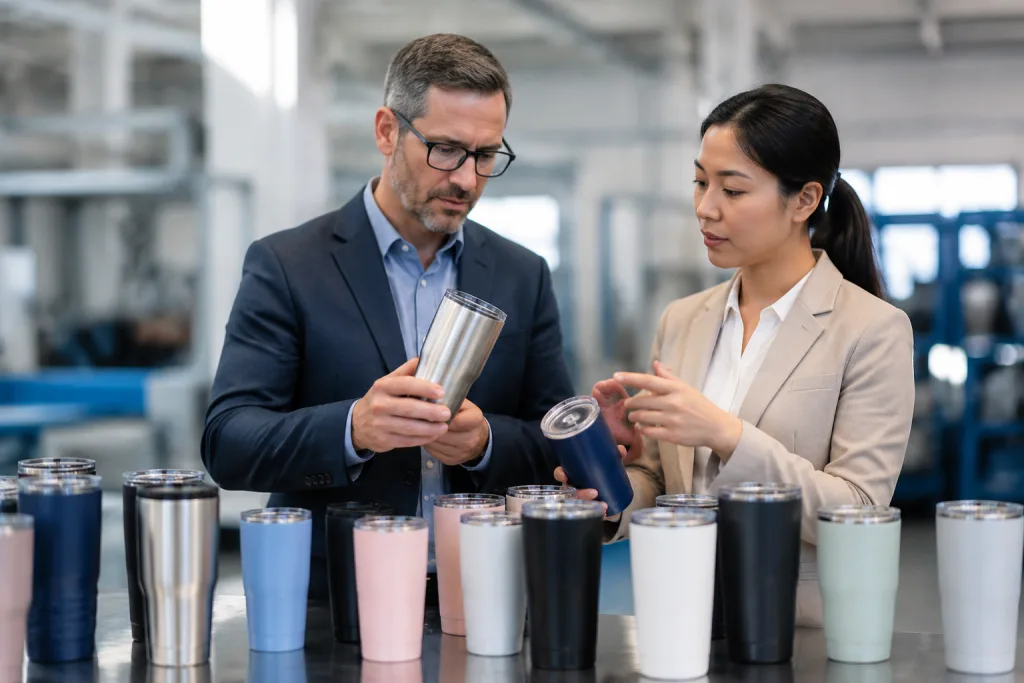
Lock price around actual cost drivers
Factory direct pricing is not magic. We price from the cost sheet: steel grade, body weight, lid structure, finish, logo process, packing style, and quantity. A 20 oz bulk travel tumbler with stock powder color and laser logo may sit around USD 3.30-4.20 FOB China at 3,000 pcs. Add a flip-straw lid with silicone plug, custom Pantone coating, retail color box, and individual barcode label, and the same job can move to USD 4.40-5.60. On the line, QC pulled one sample last month at 278 g body weight instead of the quoted 295 g. The buyer flagged it. Fair enough.
MOQ needs a straight conversation. For stock bodies and stock colors, 500-1,000 pcs may be workable if the color is already on our powder booth schedule. For coffee mug customized powder coating, expect 1,000-3,000 pcs per color because the coating line needs setup, gun cleaning, and 2-3% scrap allowance. For a new mold, you may be looking at 10,000+ pcs or tooling fees from USD 2,000-8,000 depending on lid parts, handle shape, and whether we need a new leak-test fixture. The wrong question is “what is your lowest MOQ?” Ask what quantity keeps the setup cost from eating the margin.
If you are a coffee mug distributor or one of 3 or 4 coffee mug distributors serving regional clients, ask for tier pricing at 1,000, 3,000, 5,000, and 10,000 pcs. The jump from 1,000 to 3,000 pcs usually matters because the same laser fixture, coating setup, and carton artwork proof get spread across more units. The jump from 5,000 to 10,000 pcs can be smaller unless we hit better carton loading, such as 24 pcs per master carton instead of 18 pcs, or can book stainless coil at a cleaner rate. We’ve seen this go sideways when a buyer compares 1,000 pcs EXW against 5,000 pcs FOB Ningbo and calls it a price gap.
Put these commercial PO lines in writing:
- Unit price: FOB Ningbo, USD amount, valid quantity, color split, and whether the price covers 1 logo position or 2.
- Tooling or setup: mold fee, coating setup, film fee, laser fixture if any, with refund terms tied to a clear volume.
- Sample credit: whether sample cost is deducted from bulk order, and whether courier cost is excluded.
- Payment: 30% deposit, 70% before shipment after inspection is common, usually after AQL 2.5 report approval.
- Lead time: 25-35 days after deposit and sample approval for standard programs, not after the PO with the wrong Pantone code typo.
If a quote is 18% lower than every other coffee mug oem manufacturer, check the missing line items first. Did they exclude the gift box, drop the body from 304 stainless to cheaper material, cut the wall by 0.08 mm, change the lid from Tritan to PP, or quote EXW instead of FOB? The math does not work otherwise. We ship plenty of sharp prices, but not by pretending the barcode label and inner box are free.
Confirm branding and retail packing
For coffee brands, branding is not just a logo on steel. It decides whether the tumbler becomes a cheap giveaway or sits beside a customer’s laptop for 24 months. Laser engraving is the safest choice on powder-coated 304 stainless steel; we run a fiber laser at 20W and check the mark under a 10x loupe before packing. Silkscreen is fine for 1-color logos, but weak curing will chip around the rim after 200 tape-pull tests. Heat transfer gives full-color artwork. Test it first against abrasion and dishwasher cycles before your sales team promises retail-grade durability.
For a coffee mug private label or coffee mug private labeling program, confirm each branded part: logo on tumbler, logo on lid, bottom stamp, box artwork, insert card, carton mark, barcode. Buyers often budget USD 0.18 for the tumbler logo and miss the box cost completely; we saw this on a March PO where “UPC sticker” was typed as “CPU sticker” and QC pulled the sample for clarification. A retail color box can add USD 0.25-0.70 per unit depending on paper thickness, print coverage, and order size. A kraft box costs less and fits corporate-gift orders, but on a retail shelf the math often doesn’t work.
Your artwork handoff should include vector files in AI, PDF, or EPS, plus Pantone codes, logo size in mm, placement drawing, and approved mockup. For Amazon or warehouse routing, add FNSKU or UPC labels with exact placement; our packing line usually sets side labels 35 mm from the bottom edge unless the buyer’s routing guide says otherwise. If your distributor needs mixed cartons, say so before the carton layout is made. Mixed SKU cartons slow packing and raise error risk, especially when 6 colors share one outer carton.
Branding PO line items should be boring and precise:
- Logo method: laser engraving, silkscreen, UV print, or heat transfer, with test sample approval before mass production.
- Artwork file: named version, date, and approved color code, not “final-final-new.ai”.
- Retail pack: kraft box or 350 gsm color box with E-flute inner support, with drop-test requirement stated.
- Labeling: UPC, FNSKU, country-of-origin mark, carton SKU label, with placement shown in mm.
- Insert: care card, warranty card, or coffee brewing message if required by the retail channel.
This is where coffee mug custom, coffee mug promotional, and coffee mug in bulk projects split into different cost structures. Treating them as one generic mug is the wrong question to ask. We’ve seen this go sideways when a buyer approved the tumbler sample but forgot the 350 gsm box, then asked us to hold 48 cartons on the line while new artwork was made.
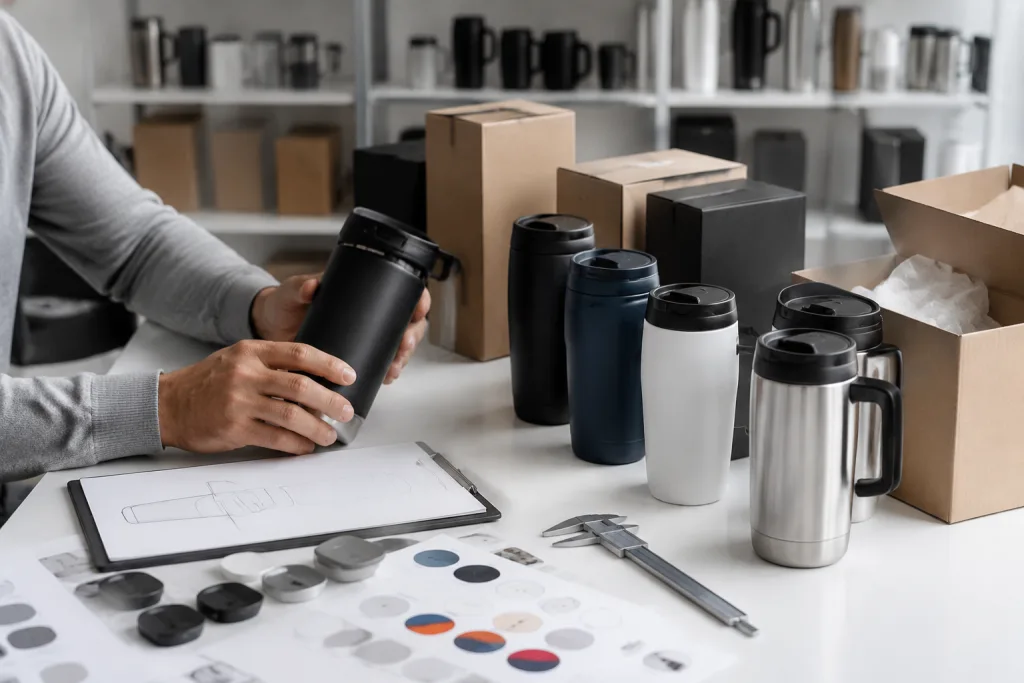
Control quality before final balance
Do not leave quality control to the day the container closes. For bulk coffee tumbler orders, we run 3 checkpoints: incoming material check with a handheld XRF reading on 304 stainless coils, inline inspection at roughly 20-30% production when the line has already shown its real defect pattern, and final inspection when at least 80% is packed. Third-party inspection is fine, but your checklist must match the PO. A generic drinkware checklist misses lid torque in N·cm, silicone odor after hot-water soak, coating edge coverage around the bottom radius, and carton drop direction. We have seen this go sideways when the buyer sent a 1-page “drinkware” form and QC pulled 46 leaking lids from 500 samples.
Use AQL 2.5 for major defects and 4.0 for minor defects as a reasonable default. Critical defects should be 0. Major defects include leaking vacuum insulation, sharp rim, wrong logo, exposed rust, wrong material, and broken lid. Minor defects include small coating specks, slight print misalignment within the signed 0.5 mm tolerance, or minor box dents. If the order is for a premium coffee brand, tighten the cosmetic tolerance and budget for more sorting. The math does not work if you ask for mirror-grade coating on 30,000 pcs but allow no sorting time; our packing team needs space on the table and at least 12 extra cartons for rejects.
Common tests include vacuum retention, heat retention, coating adhesion cross-cut, lid leakage or splash test, odor check, capacity check, barcode scan, carton drop test, and metal composition verification. On our floor, QC uses 95°C water for heat checks, 3M tape for cross-cut coating adhesion, and a 1.2 m drop height for export carton trials when the PO calls for it. For EU buyers, plan LFGB and REACH where applicable. For North America, FDA food-contact expectations and California Proposition 65 review may apply depending on sales channel. Kids’ products need a different compliance route, including ASTM considerations, so do not reuse adult tumbler assumptions.
Quality PO lines should state the items below. Put them in the PO, not only in a WeChat message; we once had a buyer flag “critical 0” after the deposit because the PO file had a typo saying “critcal O.”
- AQL: 2.5 major / 4.0 minor, critical 0.
- Testing: LFGB, FDA, REACH, or customer-specific protocol.
- Retained samples: 2 factory-retained, 2 buyer-retained after approval.
- Spare parts: 1-2% spare lids or gaskets if agreed.
- Inspection hold: final balance paid after passed inspection report.
China has strong drinkware supply capacity, but quality still depends on the inspection standard you write down before production starts. Simple point. If the standard is loose, the line will follow the loose standard, even when the factory owns good leak-test fixtures and calibrated digital calipers.
Ship with documents already aligned
Shipping problems start before the truck reaches our gate. If carton marks, HS codes, invoice descriptions, or warehouse labels do not match, your forwarder or 3PL burns 1–2 days asking for corrections. For a bulk travel mug order, lock the master carton size, gross weight, net weight, units per carton, pallet rule, and carton drop strength before final packing. We run 24 pcs cartons for most 20 oz tumblers; if the buyer chooses a 350 gsm retail box with foam insert, the line often shifts to 12 pcs so the bottom layer does not crush. QC pulled one sample carton last month at 18.6 kg gross weight, and the buyer flagged it because their warehouse limit was 15 kg.
For FOB shipments, your factory should send the commercial invoice, packing list, booking details, and export declaration support without chasing. If you ship to Amazon FBA or a corporate-gift warehouse, call out FNSKU labeling, carton labels, appointment windows, and pallet height limits before production starts. Not after packing. Re-labeling 300 cartons is the wrong place to save time; we have seen one PO delayed 4 days because the warehouse code on the carton label had one extra zero. A Zebra printer can fix labels, but it cannot fix a missed vessel cutoff.
Final PO logistics lines should include:
- Incoterm: FOB Ningbo, FOB Shanghai, DDP quote request, or EXW only if your China pickup team can book the truck and check the loading photos.
- Carton: 24 pcs/ctn, carton dimension, 5-ply board, and max gross weight target such as 15 kg or 18 kg.
- Marks: item number, color, quantity, PO number, made in China, and carton number printed at least 25 mm high for warehouse scanning.
- Documents: invoice, packing list, certificate of origin if required, and test reports with the same item code as the PO.
- Delivery: forwarder contact, cargo ready date, latest vessel or air cutoff, plus the booking email your merchandiser should copy.
A reliable coffee mug manufacturer should tell you carton cube in CBM and loading quantity by 20GP or 40HQ before you pay the deposit. We ship cleaner when the PO matches the packing plan. Factory direct is worth it when it removes confusion, not when it only cuts out the middleman; the math does not work if one label mistake eats the savings.
Send your tumbler RFQ for a factory-direct quote
Share capacity, quantity, logo method, packaging, and destination. We will reply with MOQ, FOB price, sample timing, and practical production notes.
Frequently asked questions
What MOQ should I expect for travel tumbler factory direct orders?
For stock travel tumbler bodies with existing colors, many factories can start at 500-1,000 pcs, especially if you use laser engraving or one-color printing. For custom powder coating, plan 1,000-3,000 pcs per color because coating setup and color changeover create real cost. For a fully custom mold, 10,000 pcs is a more realistic starting point, with tooling fees often from USD 2,000-8,000. If your first program is small, use a stock mold and spend your budget on better lid quality, packaging, and inspection.
How long does sample and bulk production usually take?
A stock blank sample normally ships in 3-5 days. A branded sample with laser engraving or silkscreen usually takes 7-12 days after artwork approval. Custom Pantone coating may take 12-18 days because the coating supplier and line schedule are involved. Bulk production for a standard bulk coffee travel mug order is usually 25-35 days after deposit and approved sample. Add 5-10 days if retail color boxes, special inserts, or third-party lab testing are required before shipment.
Is laser engraving better than printing for coffee brand tumblers?
Laser engraving is usually the safer choice for a coffee brand because it is permanent, clean, and resistant to daily handling. It works best on powder-coated stainless steel and single-position logos. Silkscreen is cheaper for simple one-color artwork, but adhesion depends on coating quality and curing. UV or heat transfer is useful for multicolor graphics, though you should test abrasion before approving bulk. For retail coffee mug custom programs, we often recommend one laser logo plus a branded box instead of over-decorating the tumbler body.
What should I include on the purchase order?
Your PO should name the tumbler model, capacity, steel grade, lid material, coating color, logo method, artwork version, packaging, quantity per color, unit price, Incoterm, payment terms, lead time, AQL level, test requirements, and shipping documents. Add carton quantity, barcode or FNSKU placement, spare lid percentage, and approved sample reference. A strong PO prevents arguments later. If the PO only says “20 oz coffee mug customized,” you leave too much room for substitutions in lid, coating, box, and inspection standard.
Can I use one factory for both coffee mugs and travel tumblers?
Sometimes, but check the factory’s real production base. A ceramic coffee mug factory may not understand vacuum insulation, stainless steel polishing, or lid assembly. A stainless coffee mug manufacturer may handle travel tumblers, sports bottles, and insulated mugs on related lines. Ask for monthly capacity, main materials, in-house processes, BSCI or ISO audit status, and recent test reports. If you are building a coffee mug private label range, one strong stainless drinkware factory in Zhejiang, China can simplify color matching, packaging, and repeat orders.