Key Takeaways
- A 500 ml stainless travel tumbler usually lands at USD 3.10-6.80 FOB China depending on lid, coating, and order volume
- Practical MOQ starts at 1,000 pcs for stock colors and 3,000 pcs for custom powder coating
- Sampling normally takes 7-12 days; mass production takes 25-40 days after deposit and artwork approval
- AQL inspection, REACH/LFGB material checks, and carton drop testing should be priced before you place the PO
If you buy for a coffee brand or corporate-gift program, finding a tumbler is the easy part. The harder question is whether a USD 3.20 quote can survive 304 stainless, a leak-tested slider lid, and a 5-layer export carton. We’ve had buyers send a PO with “matte blakc” printed in the logo line, then ask if approval can still finish in 12 days instead of the normal 18 days. Sometimes it can. Sometimes the math doesn’t work.
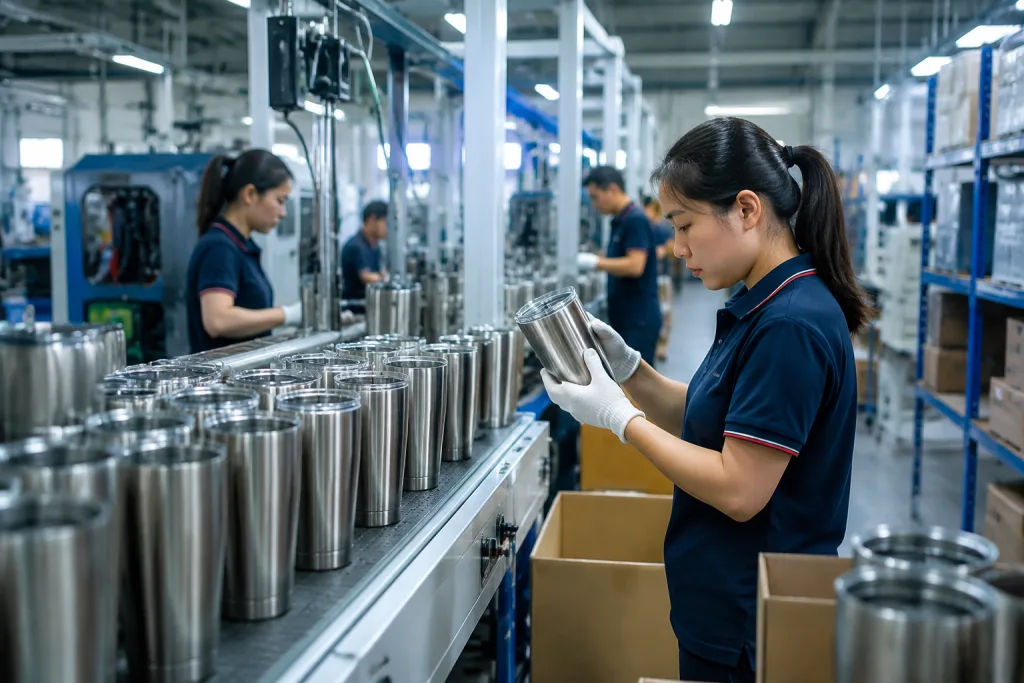
We manufacture travel tumblers in Zhejiang, China, and we see this 6 or 7 times a month: buyers compare unit prices without checking steel grade, lid structure, powder coating thickness, carton burst strength, AQL 2.5 inspection level, or lead time. QC pulled one 40 oz sample last week because the lid gap measured 0.8 mm on one side and 1.6 mm on the other. A coffee mug factory direct price only matters if the goods ship on time and pass your retailer or distributor checks.
Start with the real landed cost
Travel tumbler distributors usually open with “give me your best FOB.” We get it. Still, this is the wrong question to ask first. A custom travel tumbler is not one line on a quote sheet. It is 304 stainless steel, PP or Tritan lid parts, silicone gasket, coating, logo process, packaging, inspection, inland trucking to Ningbo or Shanghai, export handling, and ocean or air freight. Last April, QC pulled 80 samples from a 3,000 pcs run and found 11 lids with loose sliders after the buyer pushed us to cut USD 0.18 on the body. The math didn’t work. They saved USD 540, then spent about USD 1,350 on rework, repacking, and a 12-day shipment delay.
For a typical 500 ml double-wall stainless steel tumbler from China, we would budget FOB Ningbo or Shanghai at USD 3.10-4.20 for a simple stock-color bulk travel tumbler, USD 4.30-5.60 for powder coating with one-position logo, and USD 5.80-6.80 for a premium lid, retail box, and tighter surface finish control. On the line, our caliper check usually targets 0.4 mm inner wall and 0.5 mm outer wall before polishing. A 900 ml handle tumbler normally adds USD 1.20-2.40 because the body uses more 304 stainless steel and the handle lid assembly has more parts to fit, torque-test, and pack.
For coffee brands, the lid decides more complaints than the cup body. We see this every season. A slider lid can be USD 0.18-0.35 cheaper than a leak-resistant flip lid, but it does not belong in every commuting SKU. In one 5,000 pcs order, the buyer flagged three test cups leaking inside a backpack after a 30-minute shake test. If your product is sold as a bulk coffee travel mug for office workers, leakage complaints get expensive fast. If it is a coffee mug promotional item handed out at events, a lower-cost lid can still make sense.
Ask every coffee mug manufacturer to quote the same specification: capacity in ml, 304 or 316 inner wall, outer wall material, body thickness such as 0.4 mm inner and 0.5 mm outer, powder coating or spray paint, lid material, gasket grade, logo method, packaging, test standard, and FOB port. Put it in the RFQ, not in a WhatsApp note. We have seen a PO typo change “matte black box” into “matte black cup,” and QC only caught it when the carton mockup landed on the packing table. Without that list, a coffee mug supplier list is just a pile of numbers.
MOQ tiers that actually change pricing
MOQ is not a supplier mood. It comes from coil purchasing, powder booth setup, carton plate charges, logo fixture time, and how we block the line on the weekly plan. At BottleForge Industrial in Hangzhou, Zhejiang, we run about 450,000 units/month for stainless travel tumblers, but that capacity does not make a 200 pcs custom SKU practical. QC still pulls pre-production samples with a caliper, the coating room still cleans the spray gun, and the carton supplier still asks whether the PO says single-wall or double-wall carton. Stock inventory, semi-custom decoration, and full OEM production sit on different math.
For stock shape and stock color with laser engraving or silkscreen, 1,000 pcs usually works. Start there. It fits a coffee mug distributor testing 12 café stores or a corporate-gift buyer running one regional campaign. The unit price is higher, but you skip custom powder setup and a 3,000-set printed box run. Last month a buyer pushed for 500 pcs with laser logo on a matte black tumbler; the math did not work once we added fixture adjustment and AQL 2.5 inspection time.
At 3,000 pcs, pricing moves because powder coating, carton printing, and line setup spread over enough units. This is our normal MOQ for coffee mug custom made colors, custom Pantone coating, and printed retail boxes. For a coffee mug distributor, 3,000 pcs per color is the point where the order starts to behave like private-label retail, not a promo job. The buyer flagged this once on a Pantone 7499C run because the first spray-out was 1.2 Delta E off under the light box, so we adjusted before mass coating.
At 5,000-10,000 pcs, component pricing gets easier to discuss, production slots are cleaner, and color control is steadier across batches. A coffee mug private label project with custom lid color, embossed logo, and branded gift box belongs here. If you are building an annual program for a coffee chain, forecast 2-3 shipments instead of forcing one oversized first order. We have seen this go sideways: 10,000 pcs packed in one shipment, then the buyer changed the lid insert after 2,400 pcs had already passed final inspection.
- 1,000 pcs: stock color and basic logo, usually laser or silkscreen; fastest route when the PO artwork is clean.
- 3,000 pcs: custom coating with printed box, better FOB cost, and enough volume to justify powder booth setup.
- 5,000 pcs: private label packaging, custom lid parts, and stronger scheduling control on the line.
- 10,000 pcs: best for distributor catalog programs with repeat retail supply and locked carton specs.
Decoration costs buyers underestimate
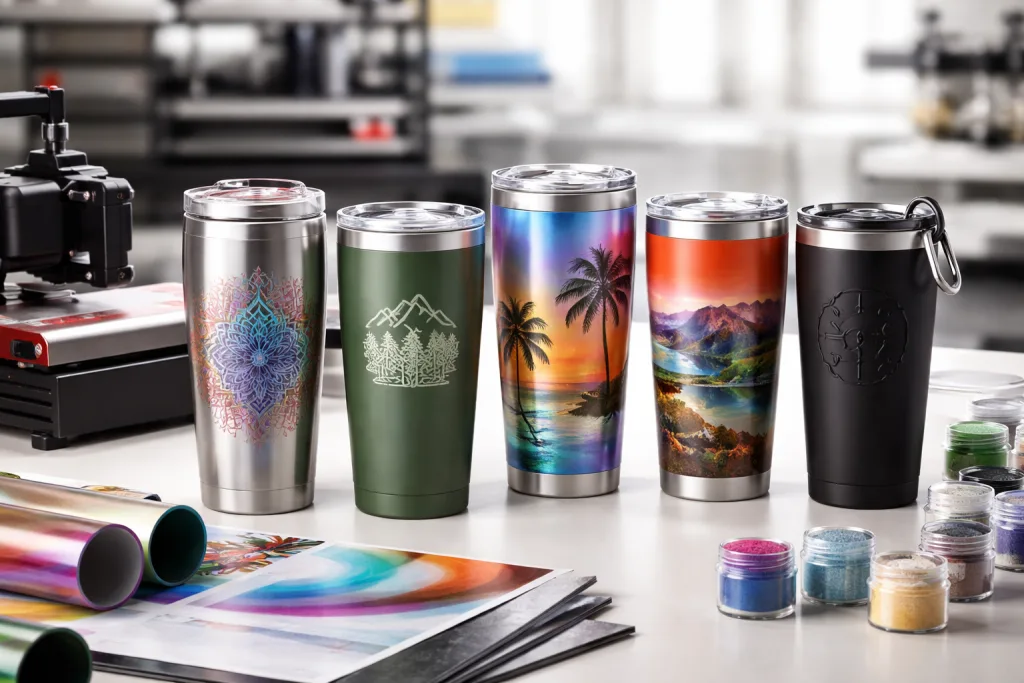
Logo decoration looks simple on a mockup. On a curved 304 stainless tumbler, it becomes a line-control item. We run a radius gauge and a paper position jig before quoting, because a coffee mug custom quote can move by USD 0.08-0.70 per unit depending on the process: laser engraving for permanent marks, silkscreen for one-color logos, or heat transfer, UV print, water transfer, and full-wrap artwork for retail graphics. The wrong question is “which one looks best?” Your channel decides the safe choice.
Laser engraving is clean and stable, usually USD 0.12-0.25 per position after fixture setup. It suits corporate-gift buyers who want a logo that survives daily use and do not need bright colors. Silkscreen is cheaper for one-color artwork, often USD 0.08-0.18 per position, but tapered bodies need tight registration; QC pulled a 40 oz sample last month because the logo drifted 2.5 mm from top to bottom. Heat transfer or UV print works better for colorful coffee mug promotional products, but cost can reach USD 0.35-0.70 per unit, and artwork approval often runs 18 days instead of 12 days when buyers send low-resolution files.
For coffee brands selling retail, packaging is often the hidden cost that breaks the math. A plain white box may cost USD 0.18-0.28. A custom printed kraft box may cost USD 0.35-0.60. A rigid gift box can push above USD 1.00 and may increase carton size by 15-25%, which affects freight. We ship test cartons through a 76 cm drop test, and the buyer usually flags corner dents before they complain about the tumbler. If your bulk coffee tumbler ships to multiple offices, carton labeling and inner protection matter more than a luxury box.
Do not approve a coffee mug customized sample only from a front photo. Ask for a 360-degree video, logo position measurement, coating thickness target, and a tape test on printed logos; our QC team uses 3M 600 tape and checks the rim with a digital caliper. For powder coating, a typical dry film thickness is 60-90 microns. Too thin scratches easily. Too thick can affect lid fit at the rim, and we have seen this go sideways on a 3,000-piece reorder. Good decoration is boring because it repeats correctly across 3,000 or 30,000 pieces.
Lead time by project type
Lead time starts after the unglamorous items are closed: deposit in our account, artwork signed, Pantone chip approved, box die line signed, and compliance notes written on the PI. A quote saying “30 days” is not 30 days from your first email. It is 30 days from production approval. Last month a buyer flagged this after their PO showed “black lid” while the approved sample had a charcoal PP lid, and QC would not release the line until the PO typo was corrected.
A stock-shape bulk travel mug with laser logo can move fast. We run the digital mockup in 1-2 days, pull a physical sample in 7-10 days, finish production in 20-30 days, and book export space in 3-7 days. For a 500 pcs urgent corporate-gift order, air freight can put goods in North America or Europe within 35-45 days from confirmed artwork. The math does not work for every order. Air freight is expensive, often USD 1.80-4.50 per tumbler depending on carton size and destination, and our packing team still has to pass the 1.2 m drop test before we ship.
A coffee mug private labeling program with custom color and box normally needs 45-60 days before vessel departure. The usual split is 3-5 days for artwork and dieline, 7-12 days for pre-production sample, 5-7 days for approval with small fixes, 30-40 days for mass production, then 3-10 days for inspection and export documents. On the floor, QC pulled the sample with a 0.35 mm coating scratch near the bottom radius, so the line had to adjust the spray gun distance before bulk painting. Small delay. Better than repainting 3,000 pcs.
Full OEM is slower. If you need a new lid mold, new body shape, or coffee mug oem manufacturer development, expect 60-90 days before mass production and another 30-45 days for ocean transit to 12-18 Western ports we ship often. Tooling can range from USD 1,200 for a simple plastic insert to USD 8,000-25,000 for a complex lid and body program. For distributors, full OEM only makes sense when you control repeat demand or have a protected retail account. We have seen this go sideways when the first PO is 1,000 pcs but the mold shop needs two T1 trials and a CNC electrode change.
Fast projects use existing tooling. Slow projects invent new parts. Most missed launch dates come from pretending those two are the same.
Quality checks worth paying for
Quality is not a slogan. It is a checklist with numbers. For stainless travel tumblers, we run inspection under ANSI/ASQ Z1.4 with AQL 2.5 for major defects and AQL 4.0 for minor defects, unless your retailer writes a different plan into the PO. A coffee mug factory should understand this before the first carton is packed. If the supplier dodges AQL wording or says “we check 100% by eyes,” the buyer should slow down; we have seen this go sideways on a 3,000 pcs promo order when QC pulled the sample and found 11 leaking lids.
Basic incoming material checks should confirm 304 stainless steel on the inner wall, food-contact plastic grades on lids, and safe silicone gaskets. Use an XRF gun for spot checks on stainless, and keep the material lot card with the production batch. For Europe, buyers often ask for LFGB and REACH documentation. For the United States, FDA food-contact expectations and California Proposition 65 risk review may apply. For children’s items, ASTM and CPSIA questions get stricter, but most adult travel tumblers are not treated the same way. Do not ask only for a certificate. Ask whether the test report matches the exact lid, gasket, coating, and color you are buying.
Functional tests should cover vacuum insulation performance, leak resistance, lid open-close cycling, coating adhesion, odor, and carton drop. Keep it measurable. A practical insulation test uses hot water at 95°C, then checks temperature after 6 hours at room temperature with a probe thermometer. A well-made 500 ml double-wall tumbler should commonly hold above 55-65°C after 6 hours, depending on lid design. We run 24-hour upside-down leak checks on sealed flip lids; slider lids are different, and comparing them is the wrong question to ask. The line also needs a coating cross-cut test with 3M tape, because one weak powder-coating batch can ruin 48 cartons fast.
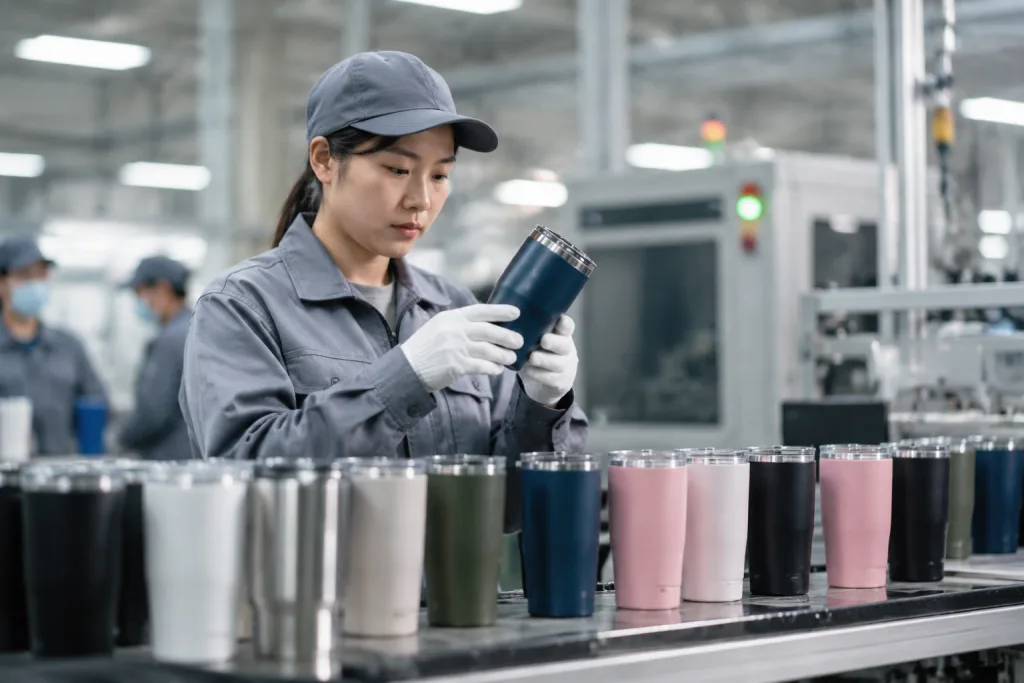
For corporate-gift buyers, cosmetic defects create the noise. Scratches, dust in coating, tilted logos, color difference, and dented gift boxes trigger complaints even when the tumbler works. Set defect limits before production: for example, no visible dent over 1.0 mm on the front logo area, logo deviation within ±1.5 mm, and color difference within an agreed visual range against the approved sample. We also mark the logo position with a simple caliper check during first-article approval, not after mass packing. On one order, the buyer flagged a 2 mm logo tilt on 600 pcs; the math did not work for air rework. This is where coffee mug manufacturers separate themselves from trading desks.
Private label versus promotional orders
A coffee mug promotional order and a coffee mug private label order need different controls. Promo buyers chase three things: event date, logo position, landed cost. Retail buyers ask about repeat SKUs, barcode scans, drop-tested packaging, shelf face, and replacement lids 6 months later. Same tumbler body, different risk. On our line, QC checks the logo with a 0.5 mm film ruler; a promo buyer will reject a crooked logo faster than a small color shade difference.
For promotional programs, a bulk coffee mug or coffee mug in bulk order can run with stock cartons, a single folded instruction sheet, and one-position logo printing. MOQ can stay around 1,000-2,000 pcs, with production in 25-35 days after approval. If the order goes into corporate gift kits, confirm carton dimensions before artwork release. We ship samples in plain kraft mailers for this reason. We have seen good products sit 12 days because the gift box was 8 mm too tall for the buyer’s master carton, and the pack-out team refused to force it.
For retail coffee mug private labeling, plan the boring items early: EAN/UPC barcodes, carton marks, care instructions, country-of-origin marking, and sometimes Amazon FNSKU labeling. Scan the barcode on a curved label before mass production; QC pulled a sample last month where the UPC passed on flat paper but failed after wrapping around a 78 mm tumbler body. Packaging artwork also needs a claims check. Do not print “leakproof” unless the lid structure and test report support it. For slider lids, “leak-resistant” is usually the safer wording.
A coffee mug customizable program for distributors often uses several colors under one shape. Good idea, but the math can go sideways. Each color still needs its own powder coating run, oven setting check, and inspection sample. If you order 3,000 pcs split across six colors at 500 pcs each, the factory may price it like six small runs, not one 3,000 pcs run. We run cleaner with three colors at 1,000 pcs each, then you replenish the winners. That keeps dead stock down and keeps the coffee mug factory direct production line from changing powder every half shift.
How to compare supplier quotes
A coffee mug supplier directory or coffee mug supplier list is only a starting point. It will not qualify a factory for you. Ask for quotes built on the same spec sheet, then ask for proof: business license, workshop photos with date stamps, recent AQL 2.5 inspection records, and a named production contact. Also ask if the company is a real coffee mug manufacturer, a trading company, or a mixed office with outsourced production. Trading companies are not a problem by default, but someone must own the line, QC pull, and corrective action. We once saw a PO with “304 stainless” typed correctly on page 1 and “201 inner” buried on page 4. The buyer flagged it late, and the math did not work after rework.
For China sourcing, get the factory location, audit status such as BSCI or Sedex if your customer asks for it, monthly capacity by model size, main export markets, and test reports for similar lids and coatings. A factory in Zhejiang may be good at stainless steel forming and powder coating, while another China supplier sends polishing, painting, or lid assembly outside. Outsourcing is normal here. Loose control is not. On our line in Hangzhou, QC checks cup mouth roundness with a 0.02 mm vernier caliper before coating, because a small oval mouth can make a lid feel cheap even when the steel body looks fine.
When you compare a bulk coffee mug, bulk coffee travel mug, or coffee mug customized quote, put the same data in one sheet: volume in ml and oz, body material grade, inner and outer wall thickness in mm, lid material code, coating brand or powder type, logo process with print size, packaging drop-test standard, MOQ by color, sample fee, sample time, production lead time, payment terms, FOB port, inspection cost, and quote validity date. If one quote is 18% cheaper, this is the wrong question to ask: do not ask only for a discount. Ask what changed. We have seen the answer come from 0.5 mm thinner steel, a PP lid instead of Tritan, a 5-layer carton cut to 3-layer, or no reserve for failed inspection.
For travel tumbler distributors serving coffee brands, the best supplier is rarely the cheapest one in the first email. Choose the supplier that gives the awkward facts early: matte beige needs 3,000 pcs MOQ because the coating line wastes more powder, a vertical logo will stretch on a 6° tapered body, a push-button lid should not be sold as leakproof, and a 25,000 pcs order needs 32 days after sample approval instead of the 18 days someone promised to win the quote. We ship to promotion calendars all year, and we have seen this go sideways when the buyer accepts a pretty price but skips the production plan.
Send your tumbler spec for a factory quote
Share capacity, quantity, logo, packaging, and target delivery date. We will return a practical FOB China cost and production timeline.
Frequently asked questions
What is a realistic MOQ for custom travel tumblers?
For most travel tumbler distributors, 1,000 pcs is realistic for stock shape, stock color, and a simple laser or silkscreen logo. If you need custom Pantone powder coating, printed retail boxes, or multiple logo positions, plan on 3,000 pcs per color. For private-label retail programs with custom lid color, inserts, barcodes, and stronger carton requirements, 5,000 pcs is a healthier starting point. Smaller runs are possible only if the factory has existing inventory, but unit cost can rise by 15-35% because setup time, inspection, and packaging are spread across fewer pieces.
How much should a custom stainless travel tumbler cost?
A 500 ml double-wall stainless tumbler commonly costs USD 3.10-6.80 FOB China, depending on material, lid, coating, logo, and packaging. A basic bulk coffee mug with stock color and laser logo may sit near USD 3.10-4.20. A retail-ready coffee mug custom made with powder coating, printed box, and better lid may cost USD 4.80-6.20. Large handle tumblers or premium lids can move higher. Always compare wall thickness, steel grade, carton strength, and inspection terms before accepting a low quote.
Can you produce coffee mug promotional products fast?
Yes, if you keep the specification simple. For stock travel tumbler bodies in existing colors, sampling usually takes 7-10 days and mass production takes 20-30 days after artwork approval and deposit. Add 3-7 days for inspection, booking, and export paperwork. Air freight may put goods in Europe or North America in 35-45 days from final approval, but it can add USD 1.80-4.50 per unit. Custom colors, printed boxes, and retail labeling usually push the total schedule closer to 45-60 days before vessel departure.
What compliance documents should coffee brands request?
For adult stainless travel tumblers, request food-contact test reports for the stainless steel, lid plastic, and silicone gasket. European buyers often ask for LFGB and REACH documentation. U.S. buyers usually review FDA food-contact expectations and may request Proposition 65 risk information. You should also ask for an inspection plan using AQL, such as AQL 2.5 major and 4.0 minor. If the tumbler is sold through a large retailer, confirm any extra packaging, labeling, barcode, and carton drop-test requirements before production starts.
Is factory direct always better than using a trading company?
Coffee mug factory direct sourcing can reduce cost and improve technical control, especially when you are managing repeat orders above 3,000-5,000 pcs. You can discuss coating, lid fit, AQL defects, and production timing with the team responsible for the line. A trading company may still be useful for very mixed orders or small catalog programs. The key is transparency. Ask who owns tooling, who performs inspection, where production happens, and who pays for rework if the approved specification is not met.