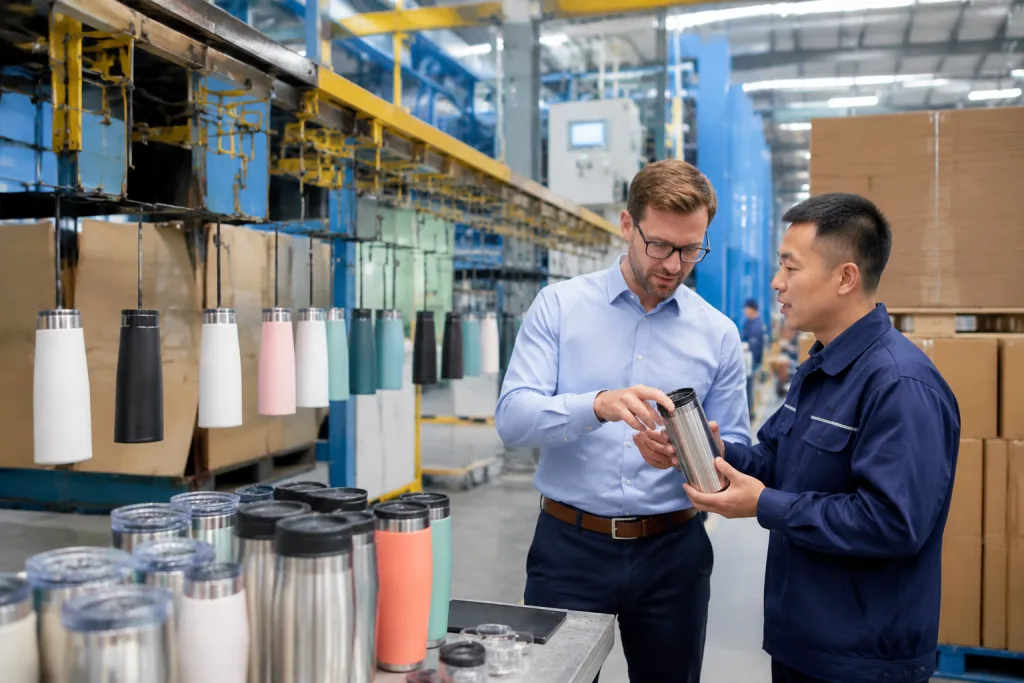
Key Takeaways
- A practical MOQ is 1,000 pcs for stock-shape logo orders and 3,000–5,000 pcs for private-label color runs
- Factory-direct FOB pricing for a 20 oz stainless tumbler usually lands between USD 3.10 and USD 6.80
- Normal production lead time is 25–40 days after deposit, artwork approval, and pre-production sample sign-off
- Custom mold work can add USD 1,200–4,500 and 18–30 days before mass production
If you buy drinkware for a coffee chain, roaster, airport retail program, or corporate-gift catalog, finding a travel tumbler distributor is not the hard part. The hard part is knowing whether a USD 3.20 quote with a 28-day lead time will still hold after your logo file, color box, drop test, and AQL 2.5 inspection are on the table. Last March, QC pulled a 40 oz sample from the line and found the lid gasket 0.6 mm undersize; that one small part turned a cheap quote into a rework discussion.
BottleForge Industrial manufactures in Zhejiang, China, and we see this 6 or 7 times a month: buyers compare a bulk coffee mug, a bulk coffee travel mug, and a bulk travel tumbler as if they are the same SKU. They are not. The math doesn't work. Steel grade, lid construction, coating, carton strength, and logo method can move cost by 20–45% before freight; we ship orders where the same body jumps from 12 days to 18 days just because the buyer switches from pad print to powder-coated laser logo after the PO is signed.
Start with the real selling channel
A coffee brand and a corporate-gift buyer may both ask for a coffee mug custom made with a logo, but the risk sits in different places. A café retail tumbler has to look worth USD 18–28 on a shelf, next to beans and branded cups under bad store lighting. A corporate-gift tumbler has to survive 500 sales reps tossing cartons into car trunks and still arrive with square gift boxes. QC pulled a sample last month with a 0.6 mm corner crush on the color box; the tumbler was fine, but the buyer rejected the packing. Price is the wrong question to ask first.
For coffee retail, we run 12 oz, 16 oz, or 20 oz vacuum insulated stainless steel most often, with 304 stainless inside, a clean powder coat, a drink-through lid, and a logo that looks planned from the first drawing. For office gifting, 20 oz and 30 oz move better, because the buyer wants a larger print area, tighter Pantone matching, and sometimes individual mailer cartons. The line checks coating thickness with a film gauge before packing, because a 10 μm thin spot near the base will show after two weeks of shelf handling. If you sell through a distributor network, carton labels and SKU discipline matter as much as the tumbler.
Do not ask a coffee mug factory for its cheapest model on the first email. Start with the channel: retail shelf, loyalty program, wholesale distributor, event giveaway, or online bundle with beans. A coffee mug promotional products order can live with a simpler lid and one-color silkscreen, especially at 3,000 pcs for a short campaign. A coffee mug private label retail order cannot. We have seen this go sideways when the buyer flagged a lid as “too promo” after the mold sample, then asked to change it 12 days before vessel booking.
Our Zhejiang facility runs roughly 450,000 stainless drinkware units per month across tumblers, bottles, and thermos lines. Capacity helps. It does not fix a thin brief. A usable RFQ states capacity, material, lid type, finish, logo method, packing, test requirements, target FOB port, and delivery date. We also ask for the barcode format and outer carton mark, because one PO once listed “matte balck” and the warehouse printed 86 cartons before the merchandiser caught it. Without those details, any quote from China is only a placeholder.
What actually drives unit cost
Body cost comes first. For a typical double-wall stainless bulk coffee tumbler, 304 stainless steel inner wall is the baseline. Outer wall can be 304 or 201, depending on where the distributor wants to sit on shelf price. A serious coffee mug manufacturer should give wall thickness on the quote sheet, not just write “food grade.” Common inner wall thickness is 0.4–0.5 mm; we run 0.45 mm on about 7 out of 10 mid-range travel tumbler projects. Go thinner and the math looks nice, but QC pulled samples last month with shoulder dents after a 76 cm carton drop test.
For a 20 oz vacuum tumbler ordered at 3,000 pcs, factory-direct FOB Ningbo pricing normally falls into these bands: USD 3.10–3.90 for a standard shape with one-color print, USD 4.20–5.30 for powder coating plus laser engraving or multi-color print, and USD 5.50–6.80 for a premium lid, custom color, retail box, and stronger carton. These are normal China production ranges, not panic pricing for air freight. We ship these from Hangzhou through Ningbo; if the buyer asks for 12 days instead of the usual 18 days production window after artwork approval, the line has to reshuffle, and the cost goes up.
Lids get underestimated. A basic PP slider lid may add USD 0.35–0.55. A better Tritan lid with silicone gasket can add USD 0.60–1.10. If you need leak-resistant performance, a flip lid or threaded lid costs more and needs more testing. We run upside-down checks, gasket pull checks, and a 60°C hot-water shake test; this is where 3 samples can fail even when the cup body is fine. Calling everything a bulk travel mug is the wrong question to ask because the lid often decides the complaint rate.
Decoration also moves the quote. Laser engraving is clean and durable, usually USD 0.20–0.45 per position. Silkscreen can be USD 0.08–0.25 per color, but setup fees apply. Full-wrap heat transfer or 360-degree UV print can add USD 0.60–1.50. For a coffee mug customized for retail, saving the last USD 0.15 on decoration is where we’ve seen projects go sideways; one PO even had Pantone 186C typed as 168C, and the buyer flagged the red after the first pre-production sample.
MOQ tiers that make sense
MOQ is not a punishment. It is the point where stainless coil purchasing, powder-coating color changeover, logo setup, QC checks, and carton packing stop wasting money on both sides. On our line, one Pantone change can eat 45 minutes just for gun cleaning and test panels. If a travel tumbler supplier offers 100 pcs with full custom color, custom box, and a low price, ask the hard question: is it stock goods, or are they mixing your order with leftover shells?
For a stock-shape travel tumbler in bulk with one logo, 500 pcs can work if the color is already running, but 1,000 pcs is the safer starting point. At 1,000 pcs, we usually run stock colors, one logo process, and neutral packing or a simple branded sleeve. At 3,000 pcs, custom Pantone powder coating starts to make sense because the coating room can run a full batch without stopping after two racks. At 5,000–10,000 pcs, travel tumbler private labeling works better because box printing, inserts, carton marks, and production slots are spread across enough units; the math does not work when the buyer wants four-color boxes for 600 pcs.
A custom body shape is a different animal. If you want a travel tumbler oem manufacturer to build a new profile, handle shape, lid system, or proprietary base, expect tooling and a longer sample cycle. Simple lid or accessory tooling may cost USD 800–2,000. A new stainless body mold can run USD 2,500–4,500 or more depending on complexity. QC pulled one 40 oz handle sample last month because the gap was 1.8 mm off the drawing, and that is exactly why MOQ usually starts at 5,000 pcs. For stable pricing, 10,000 pcs is more realistic.
Buyers often ask for a travel tumbler supplier list or travel tumbler supplier directory, then send the same vague RFQ to 20 factories. We have seen this go sideways. You get 20 quotes based on different steel thickness, lid material, packing, and logo methods, so the numbers are not comparable. A cleaner method is to define three MOQ tiers with specs attached: 1,000 pcs launch test with stock color, 3,000 pcs reorder-ready with Pantone coating, and 10,000 pcs annual program with printed box and carton marks. Then compare each travel tumbler factory direct quote on the same sheet; even one PO typo like “matte back” instead of “matte black” can delay the pre-production sample by 2 days.
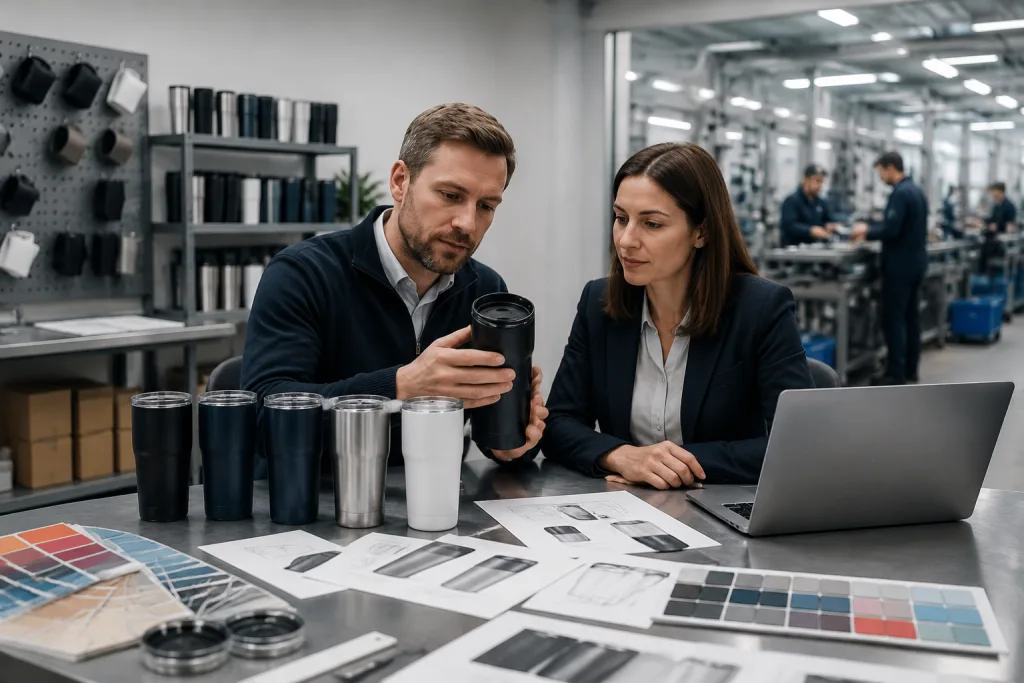
Lead time without wishful thinking
A normal custom bulk coffee travel mug order takes more days than most buyers put on the PO, mainly on the first run. For a repeat order with no artwork change, 25–30 days after deposit is a fair target if the coating code and logo file are still on our job sheet. For a new coffee mug customizable program with color matching, sample approval, printed box, and inspection, plan 35–50 days before vessel departure. We run the first color check under a D65 light box; QC pulled one sample last month that looked fine in the office but was 1.8 Delta E off under the lamp.
A practical timeline looks like this: RFQ and specification clarification, 2–4 days, including lid type, powder coat code, and whether the straw hole needs a silicone plug. Artwork checking and digital mockup, 1–3 days, longer if the AI file has outlined fonts missing or the PO says “black logo” while the PDF shows white. Pre-production sample, 7–12 days for stock color or 12–18 days for custom coating. Buyer approval, often 2–5 days if your team answers the same day. Mass production, 20–35 days depending on quantity and finish; 10,000 pcs matte powder coat does not queue like 1,000 pcs laser logo. Final inspection and loading, 2–4 days. Ocean freight to North America or Europe is separate and can run 25–45 days port to port.
Peak season matters. From August to November, corporate-gift orders and holiday retail orders fight for the same coating booths, heat-transfer machines, and 5-layer carton suppliers. Around Chinese New Year, production in Zhejiang and across China slows down sharply. If you need delivery in March, approving samples in late January is the wrong move. We have seen this go sideways: the buyer flagged a 0.3 mm lid fit issue on January 24, but the line workers were already leaving Hangzhou for the holiday.
For Amazon or distributor warehouse delivery, add labeling time. FNSKU labels, master carton barcodes, pallet labels, and routing guides can add 2–5 working days if they arrive after cartons are sealed. We ship cleaner when the buyer sends the label pack before mass production, not after final inspection. If your bulk travel tumbler has a gift box, ask for a carton drop test before shipment; our QC table uses 76 cm for the standard corner and edge drops. A pretty box that collapses during ocean freight is not a packaging solution. It is a claim waiting to happen.
Decoration choices and brand risk
The logo method has to fit where the tumbler is sold and how hard it will be handled. For a 5,000 pcs coffee mug promotional giveaway, one-color silkscreen is usually enough; we run it on a 200-mesh screen, it cures fast, and it sits cleanly on smooth powder coating. For a coffee brand selling merchandise beside the POS machine, laser engraving or a tight pad print gives a cleaner shelf look. For a coffee mug customized with a large illustration, full-wrap heat transfer or UV print is the safer route, but ask for a 1 pc pre-production sample first. We have seen this go sideways when the buyer approved a flat PDF and then flagged a 3 mm seam shift on the curved cup.
Durability is the dull part that saves your margin. We recommend cross-hatch adhesion testing on coating, 3M tape pull on printing, and dishwasher simulation only if the product is sold as dishwasher safe. QC pulled one black powder-coated sample last month after the print lifted at the rim during tape pull; that was a cheap fix before mass production, not after 80 cartons were packed. Many tumblers survive hand washing for 2–3 years but fail 20 aggressive dishwasher cycles. Do not print “dishwasher safe” unless the test report backs it up.
Color matching has limits. Pantone on paper, powder coating on curved steel, and a digital proof on a laptop screen will not match exactly. A reasonable tolerance is normally Delta E under 2.0–3.0 for controlled color work, but chasing Delta E 1.0 on powder coating is the wrong question to ask; the math does not work once the line changes powder batch and oven temperature by 5°C. If the coffee mug distributor sells to 12 corporate accounts, set a written color approval standard before production. Use a signed metal swatch, not only a screenshot.
For private-label programs, check the small marks early: bottom logo, capacity mark, care instructions, recycling information, carton marks, and country of origin. One PO we received had “Made in Chine” on the carton artwork, and the buyer only caught it after our carton supplier made the cutting die. REACH, LFGB, FDA food-contact requirements, or California Prop 65 labeling may apply depending on destination and claim. A responsible coffee mug manufacturer will ask for the selling market, MOQ, and lid material before quoting the cheapest ink.
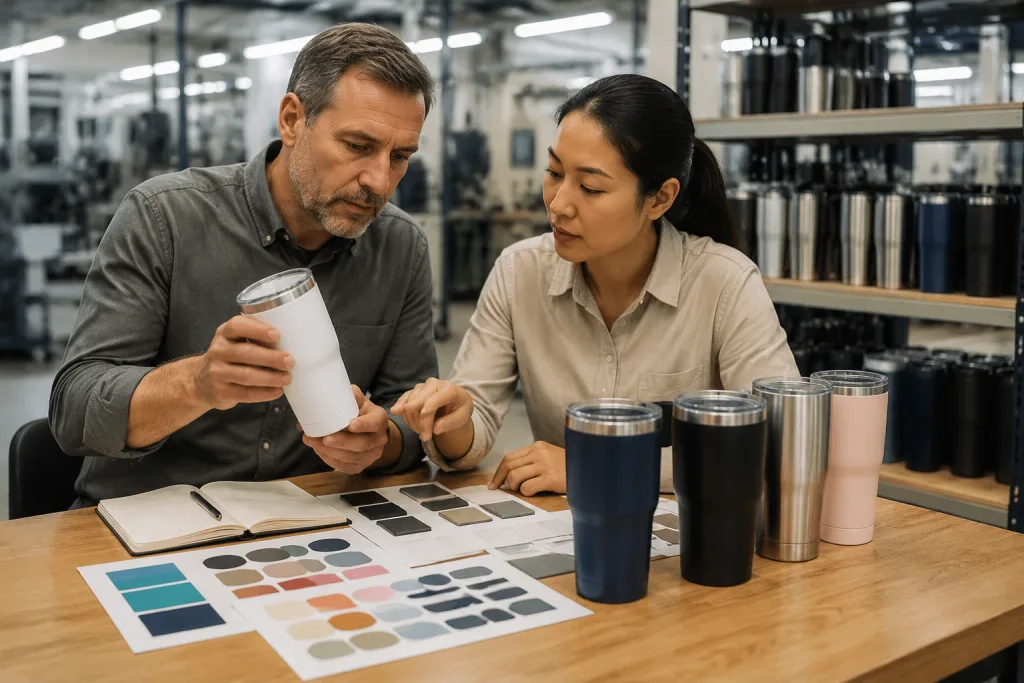
Quality control before final payment
Travel tumblers usually fail in the same spots: vacuum insulation, lid fit, coating adhesion, print alignment, odor, dents, or crushed cartons. Put the test method on the purchase order, not just the defect name. If a supplier says “we inspect 100%,” ask whether that means every cup went through the vacuum tester, or one worker just looked down the line with a flashlight. We run into this argument at least 3 times a month. QC pulled a 40 oz sample last week with a 1.8 mm lid gap; the cup looked fine in photos, but the buyer flagged leakage during their own shake test.
For most coffee mug bulk orders, we suggest pre-shipment inspection under ANSI/ASQ Z1.4, General Inspection Level II, with AQL 2.5 for major defects and 4.0 for minor defects. Critical defects should be 0. Vacuum performance should be checked by hot water temperature drop over a fixed period, usually 6 hours for production screening and 12 hours or 24 hours for product validation, depending on the SKU and claimed insulation time. Lid leakage tests must match the lid design. A sip lid is not a sealed bottle lid. The math does not work if a buyer asks for “no leakage” on an open slider lid, so we write the angle, water volume, and test time into the QC checklist.
Ask for material declarations for 304 stainless steel, silicone gaskets, PP or Tritan lids, and coating compliance. For children’s or youth-oriented programs, ASTM and CPSIA questions can enter the discussion. For corporate-gift buyers in Europe, REACH and LFGB documentation may be requested. BSCI or ISO 9001 factory documentation can also matter if your customer has vendor onboarding rules. On the factory floor, we match these documents against the BOM and incoming material labels; one PO typo, “304 inside / 201 outside,” once held up 6,000 pcs because the buyer’s compliance team read it as mixed steel instead of a copy-paste mistake.
Final payment should not happen just because production is “finished.” Review inspection photos, packing list, carton dimensions, gross weight, and shipping marks before releasing the balance. Check the carton, too. We have seen good tumblers lose the order because a 17 kg master carton split at the tape line during loading. If you work with coffee mug distributors, send them the same technical documents, including the inspection report and packaging spec. Fewer service tickets. Faster reorders.
How to compare factory quotes
“Who is cheapest?” is the wrong question to ask. Build one cost sheet for every China coffee mug factory quote: unit FOB, logo setup, sample fee, mold fee, packaging spec, spare lid allowance, AQL 2.5 inspection, Hangzhou-to-Ningbo inland freight, export carton size, estimated ocean freight. Then price the delay. We had one buyer save USD 0.30 per tumbler on paper, then lose the margin when the line waited 12 days for a 0.4 mm lid gasket that should have been confirmed with a caliper before mass production.
For a 3,000 pc coffee mug promotional products order, a clean comparison might show Supplier A at USD 3.65 FOB with a basic lid and 3-ply carton, Supplier B at USD 4.10 FOB with a tighter lid fit and 5-ply export carton, Supplier C at USD 4.60 FOB with custom retail box plus laser logo. None is automatically bad. QC pulled samples last month where the cheaper carton crushed at 18 kg stack pressure, so the math only works if your sales channel accepts dented boxes or no-box replacement claims.
If you are building a multi-year program, treat your coffee mug supplier as a technical partner, not a vending machine. Share forecast ranges, not fake annual volumes. If you expect 30,000 pcs per year, say whether that means three 10,000 pc runs or twelve 2,500 pc runs. The line plans polishing wheels, 304 stainless coil purchasing, silicone color matching, and warehouse space differently for those two schedules.
BottleForge Industrial, based in Hangzhou, Zhejiang, works best with buyers who want the numbers checked before the PO is placed. Send the target retail price, required delivery window, artwork, and compliance market. We run the quote against the BOM, carton CBM, logo process, and last inspection notes, then tell you where cost can move and where cutting cost will come back as leakage, color mismatch, or a buyer flag on the first shipment.
Price your custom travel tumbler program correctly
Send capacity, artwork, MOQ target, delivery date, and compliance market. We will return a factory-direct cost and lead-time breakdown.
Frequently asked questions
What MOQ should a coffee brand expect for custom travel tumblers?
For a stock-shape travel tumbler with one logo, plan on 1,000 pcs as a practical MOQ. Some stock orders can start at 500 pcs, but color choice, logo method, and carton printing will be limited. For custom Pantone coating, printed retail box, or coffee mug private labeling, 3,000 pcs is a better starting point. If you want a new mold or proprietary lid, expect 5,000–10,000 pcs. Smaller orders usually carry higher decoration setup costs, less control over materials, and weaker leverage on inspection terms.
How much does a factory-direct 20 oz travel tumbler cost?
For a 20 oz double-wall stainless bulk coffee tumbler, a realistic FOB China range is USD 3.10–6.80 depending on steel grade, lid, coating, logo, and packing. A basic powder-coated tumbler with one-color print may be around USD 3.50–4.20 at 3,000 pcs. Laser engraving, premium Tritan lid, printed gift box, or stronger export carton can push it to USD 5.00 or more. Air freight, duty, warehousing, and distributor margin are not included in FOB pricing.
Can we use our exact brand color on the tumbler?
Yes, but it should be handled as a controlled production step, not a casual request. Custom powder coating normally becomes efficient at 3,000 pcs and above. You should provide Pantone or physical color standards, then approve a coated metal sample, not just a digital mockup. Expect 7–12 extra days for color sampling. For strict brand programs, agree on Delta E tolerance before production. Very bright, matte, metallic, or textured finishes can cost USD 0.20–0.80 more per unit.
What documents should corporate-gift buyers request?
At minimum, ask for a proforma invoice, product specification sheet, material declaration, artwork proof, packing details, and pre-shipment inspection report. For Europe, REACH and LFGB food-contact documents may be needed. For the United States, FDA food-contact suitability and California Prop 65 review may apply depending on material and claim. If your customer has vendor compliance rules, ask early about BSCI, ISO 9001, carton drop test, FNSKU labeling, and pallet requirements. Late compliance requests can add 3–10 working days.
How do we avoid delays on a holiday gifting order?
Lock the specification before sampling and build a timeline backward from the required warehouse date. For ocean freight programs, allow 35–50 days for first production plus 25–45 days port-to-port shipping. Approve artwork within 48 hours, confirm carton marks before production ends, and book inspection at least 7 days before the planned ship date. Avoid changing lid color, box artwork, or logo position after sample approval. From August to November and before Chinese New Year, add a 7–14 day buffer.