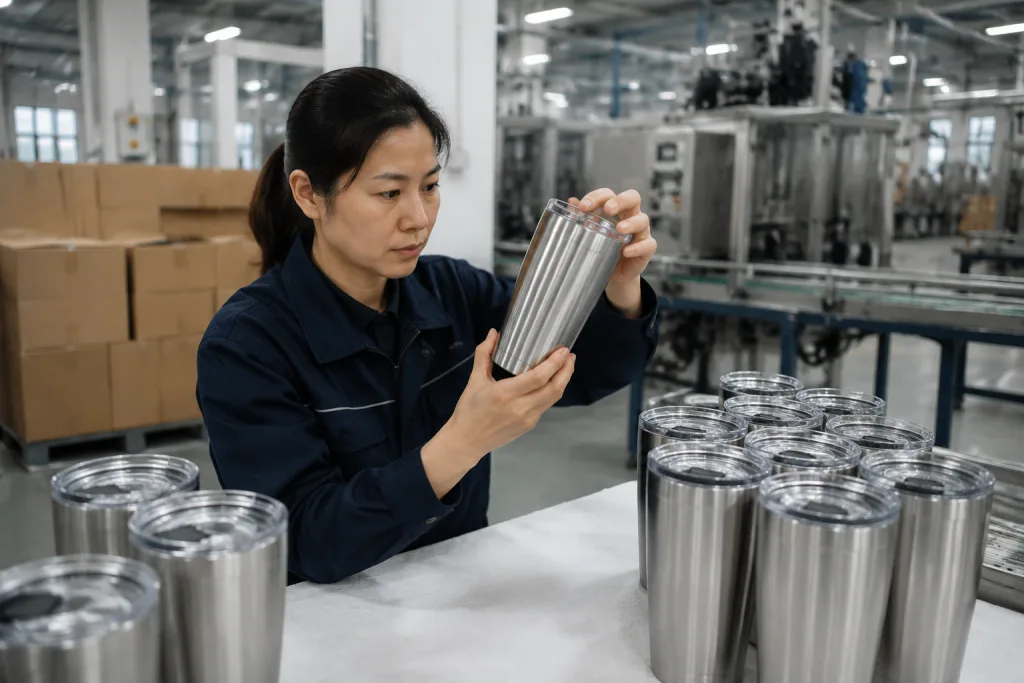
Key Takeaways
- A practical first MOQ is 1,000 pcs per color for a stainless steel travel tumbler customized order
- Expect 7-10 days for pre-production samples and 30-40 days for mass production after approval
- For coffee gifts, 500 ml and 600 ml sizes usually balance desk use, car cup holders, and shipping weight
- Use AQL 2.5/4.0 inspection with real leak, coating, logo adhesion, and carton drop checks
You have a campaign date, a logo file, and a buyer asking if the travel tumbler customized order can arrive before the next coffee subscription drop or corporate gifting season. The cup photo is the easy part. The risky part is fixing the size, lid fit, powder coating, logo method, carton plan, test standard, and delivery terms before QC pulled the sample and finds the straw hole is 1.5 mm off after 8,000 units are packed.
At our Hangzhou, Zhejiang factory, we see this with about 7 out of 10 new buyers: too much time spent on renderings, not enough on sample control and carton details. The buyer flagged it last month when a PO said “matte black” but the approved sample was Pantone 426C with a semi-gloss clear coat. China can ship good drinkware at scale, but the order file has to be specific. Treat your tumbler like a manufactured product, not a catalog photo.
Start with the buyer scenario
Start with a real order file. A coffee brand is preparing 2,400 holiday subscription gifts, or a corporate-gift buyer is sourcing for a 5,000-person employee program. You need a travel tumbler customized with a front logo, matte powder coating, a leak-resistant lid, and retail-ready packaging that survives a 1.2 m carton drop test. The target is not luxury. It still cannot feel cheap. Your customer will drink coffee from it every morning, and if one lid leaks inside a laptop bag, the buyer flagged it on LinkedIn before our sales team even finishes breakfast.
The first decision is quantity. For our Zhejiang line, we run stainless steel tumblers with custom coating at 1,000 pcs per color as a sensible start, and 3,000 pcs if you want a custom mold lid or an unusual body shape. We can make 200 pcs sample runs, but the math doesn't work for mass pricing. If a coffee mug distributor asks for 300 pcs split into six colors, QC still pulls coated samples color by color, the spray booth still needs cleaning, the logo screen still needs setup, and the carton printer still charges a plate fee.
A factory-direct order file should say this: 600 ml double-wall stainless steel tumbler; 304 inner wall for food contact; 201 or 304 outer wall depending on budget; 0.4 mm inner gauge and 0.5 mm outer gauge checked by micrometer; PP lid with silicone seal; powder coating; one-color silk screen logo; individual kraft box; 24 pcs master carton; FOB Ningbo or Shanghai. Clear specs beat “premium coffee mug custom made.” We have seen POs arrive with “mat black” typed instead of “matte black,” and that one typo can hold artwork approval for 2 days.
For coffee brands, this item sits between promo merchandise and reusable drinkware. Your team might call it a bulk coffee mug or a bulk coffee travel mug; another buyer might write bulk coffee tumbler, bulk travel mug, or bulk travel tumbler on the RFQ. The name matters less than the data. Before price negotiation gets serious, the factory needs specs, vector artwork, the compliance market such as FDA or LFGB, packing rules, and inspection rules like AQL 2.5 written in the quote sheet.
Define the tumbler before pricing
Pricing before specs is theater. We see it every week. A coffee mug manufacturer in China can quote USD 2.20 or USD 6.80 for a travel tumbler that looks the same in a PDF, and both prices may be honest. The gap usually sits in 304 stainless steel vs 201 outer, 0.4 mm vs 0.5 mm wall thickness, powder coating pass rate, lid structure, logo method, insulation test result, packaging, AQL 2.5 inspection, and whether the seller is factory direct or just pulling from a coffee mug supplier list. Last month QC pulled a 500 ml sample where the PO said “SS tumbler” only; the buyer thought full 304, the supplier priced 201 outer. That is the wrong question to ask after deposit.
For coffee-gift orders, we run three body sizes first. A 380 ml tumbler works for espresso-based office use, but US buyers often flag it as small in hand. A 500 ml tumbler is the safest retail size. A 600 ml tumbler gives stronger shelf value, then the freight math starts to bite. If you ship by air, 100 ml is not just 100 ml. A 600 ml tumbler with individual box may pack 24 pcs per carton at roughly 52 x 35 x 48 cm, with gross weight near 9-11 kg depending on lid and steel gauge. On the line, we check this with a carton drop gauge and a scale before quoting 5,000 pcs, because one wrong carton size can change air cost by USD 0.25-0.40 per piece.
State the steel choice in plain words. Food-contact inner wall should be 304 stainless steel. The outer wall can be 201 stainless steel for cost-sensitive promotional products, but for a higher-end coffee mug private label program, 304 outer is cleaner to explain to your buyers. Do not accept “stainless steel” as a complete material description. We ask the buyer to write “304 inner / 201 outer” or “304 inner / 304 outer” on the PO; one typo, like “304 liner” without outer material, has already delayed one approval sample by 12 days vs the normal 5 days.
Logo work changes the quote fast. Silk screen is practical for one or two solid colors and works well for coffee mug promotional products, as long as the logo height stays within the flat print area, usually 55-70 mm on a tapered cup. Laser engraving lasts longer and looks cleaner on powder coating. Heat transfer handles gradients, but it needs tighter artwork control and abrasion testing; we use 3M tape pull and a simple 500-cycle rub check before mass production. If you need a coffee mug customizable program with names, departments, or store locations, laser is usually easier than screen printing because there is no separate screen for each name. We have seen this go sideways when a buyer sent 312 staff names after screens were already made.
Ask for price lines by option. For example: 5,000 pcs, 500 ml, 304 inner and 201 outer, silk screen logo, white box, FOB Ningbo: USD 3.10-3.80 depending on lid. Upgrade to 304 outer, laser logo, custom color box, and the same coffee mug customized order may move to USD 4.20-5.10. These are planning ranges, not a purchase order, but they stop the budget conversation from drifting. We usually quote 2 lid options side by side, because buyers push back on USD 0.35 for a better flip lid until they see the leak test result from a 45-degree tilt for 10 minutes.
Sample the actual production version
The sample stage is where disciplined buyers save money. Do not approve a glossy 3D rendering or a stock tumbler with your logo pasted into a PDF. Ask for a pre-production sample using the planned steel construction, lid, coating color, logo process, and packaging structure. At BottleForge Industrial in Hangzhou, Zhejiang, we run pre-production samples in 7-10 days after artwork and Pantone references are confirmed. If custom tooling is involved, add 15-25 days. Last month QC pulled a 40 oz sample where the lid gasket was 0.6 mm loose in the groove; the photo looked fine, but the cup leaked on the bench.
Send vector artwork in AI, EPS, or PDF format. For silk screen, keep fine lines above 0.25 mm and avoid reversed text under 5 pt. For laser engraving, confirm whether the final mark shows stainless steel silver, dark oxide, or a contrast layer under coating. On powder coating, Pantone is a target, not a lab promise. A Delta E tolerance of 1.5-2.5 is realistic for about 70% of standard colors, while coffee-beige and muted clay tones are easier to argue about. We check the panel under a D65 light box before the line starts, because warehouse lighting can make the same beige look like two different SKUs.
For a coffee mug custom or coffee mug custom made order, the sample approval document should include photos and measurable checks. Record total height, diameter, mouth opening, capacity to brim, practical fill capacity, empty weight, logo size and position, lid fit, carton dimensions, and box print layout. Simple table. No guessing. If your sales team later says the logo is 8 mm too low, the factory will look at the signed sample approval. We have seen this go sideways after a PO typo changed “logo center 95 mm from bottom” to “85 mm,” and the buyer flagged it only after 3,000 pcs were packed.
Do a real use test before mass production. Fill with 95°C water, close the lid, invert for 30 seconds, shake lightly for 10 seconds, and place it on white tissue. Then run a 2-hour hot retention check with a probe thermometer, not a hand feel test. A typical double-wall vacuum travel tumbler should keep water above 60°C after 4-6 hours depending on capacity and lid design. Do not promise your customers 12 hours hot unless the tested structure supports it. The math does not work if the lid has a wide drinking slot and only a thin PP slider.
Good sampling is not about making one perfect cup. It is about freezing the version that 5,000 or 20,000 cups must match.
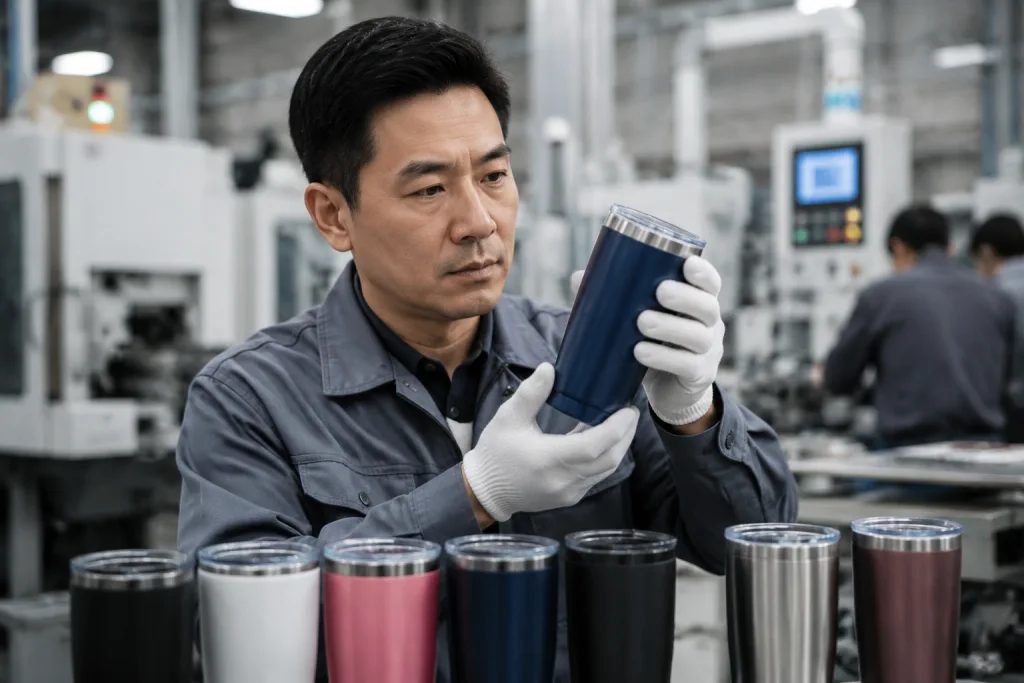
Lock compliance and packaging early
If you sell into Europe or North America, compliance is part of the tumbler spec, not a PDF chased on the last shipping week. For EU orders, we confirm LFGB or the right food-contact test, REACH for powder coating and silicone parts, plus packaging heavy-metal limits before we open the material PO. For US programs, ask for FDA food-contact expectations and, if the logo or coating goes to California, Proposition 65 review. Kids’ bottles and straw lids need a harder look at ASTM and choking hazards; QC once pulled a straw stopper sample because the silicone plug measured 31 mm and the buyer flagged small-part risk. Adult corporate-gift tumblers move faster, but the sales market still belongs on the purchase order. No market, no clean test plan.
Factory audits also matter when you sell to large companies. Some buyers require BSCI, Sedex, ISO 9001, or their own social-compliance checklist, and the math does not work if you ask after mass production is packed. We run into this every quarter: the buyer asks for Sedex under one legal company name, while the PI shows another Hangzhou trading entity. Check the audit scope, expiry date, factory address, and legal company name before deposit. One wrong letter on a PO can cost 7 days of document correction.
Packaging gets less attention than it deserves. A bulk coffee mug for a trade show can ship in a plain white box with a 30 x 30 mm shipping mark label. A coffee mug private labeling program usually needs a printed color box, barcode, QR code, insert card, and master carton marks with the exact SKU from the buyer’s ERP. Online orders need FNSKU or retailer labels, and you must say whether the label goes on the unit box or the polybag; we have seen Amazon cartons rejected because the FNSKU was placed under the shrink wrap seam. For split shipments to 2 or 3 warehouses, carton marks should show SKU, color, quantity, PO number, carton number, gross weight, net weight, and dimensions.
For breakage and dents, specify carton strength in writing. A 5-layer export carton with 170-200 gsm liners is common for drinkware, but this is the wrong place to save 0.08 USD per carton. Individual boxes should hold the tumbler snugly; if there is 12 mm of empty space around the body, courier handling will find it. For a 5,000 pcs order, we normally suggest one packaging drop test before final carton sealing: 10 drops from 76 cm on edges, corners, and faces for a loaded master carton. QC pulled the sample after one test last May because the lid rubbed a crescent mark into the coating, so we changed the PE bag thickness and added a paper insert before shipment.
Control mass production, not excuses
After the deposit lands, the job stops being a sales chat and becomes a production-control file. In our Hangzhou, Zhejiang plant, we run about 450,000 drinkware units per month across bottles and tumblers; mugs share some polishing and packing capacity, so your slot still needs to be locked on the line plan. A standard travel tumbler customized order of 5,000-20,000 pcs usually takes 30-40 days after sample approval and deposit. For Q4 gifting orders, late booking can add 7-15 days; last October one buyer pushed artwork approval by 6 days, and the shipment moved from a 12-day buffer to a 3-day scramble.
Mass production breaks in predictable places. Steel forming has to keep the body round enough for the lid gauge to drop in cleanly; if the mouth runs 0.4 mm out, the cup may still look fine on a table but fail the lid-fit check. Vacuum sealing must hold. A failed vacuum cup often looks normal and still loses heat fast, which is the kind of defect customers post online. Powder coating needs the right oven curve, or the coating chips at the bottom rim after a few knocks in a carton. Logo printing must pass adhesion and abrasion checks. Lids need clean molding, with no flash on the drinking edge and no silicone odor when QC opens the sealed polybag.
Use a production checklist. This is not paperwork theater. During incoming material control, verify steel thickness with a micrometer; our QC table uses a Mitutoyo caliper and records readings to 0.01 mm when the buyer specifies wall thickness. Check silicone hardness where relevant. During forming, check dents, weld line appearance, and mouth diameter with a go/no-go gauge. During coating, inspect color against the approved sample under D65 light, not under the yellow factory lamp near the curing oven. During logo application, run a 3M tape test after curing. During assembly, test lid fit and leak resistance from each line, not just the first 20 pcs packed in the morning.
For inspection, AQL is the language most coffee mug distributors and corporate buyers understand. A common setup is Critical 0, Major 2.5, Minor 4.0 under ANSI/ASQ Z1.4 general inspection level II. Critical defects include sharp edges, contamination, failed food-contact material, and serious leakage. Major defects include wrong logo, wrong color, vacuum failure, lid not fitting, visible dents, and carton quantity errors; we once had QC pull a sample because the master carton showed 24 pcs while the PO said 25 pcs, a small typo that would have wrecked warehouse receiving. Minor defects include small specks, slight print deviation within agreed tolerance, or minor box scuffing.
If a coffee mug oem manufacturer says inspection is unnecessary because “we checked everything,” smile and keep the inspection. The math doesn't work. Factory QC protects the line; buyer QC protects the purchase order. We ship with internal QC, third-party inspection, or your own inspector at the packing area. What matters is simple: agree defect definitions before production starts, not when 186 cartons are already wrapped on pallets and the truck is waiting outside the loading dock.
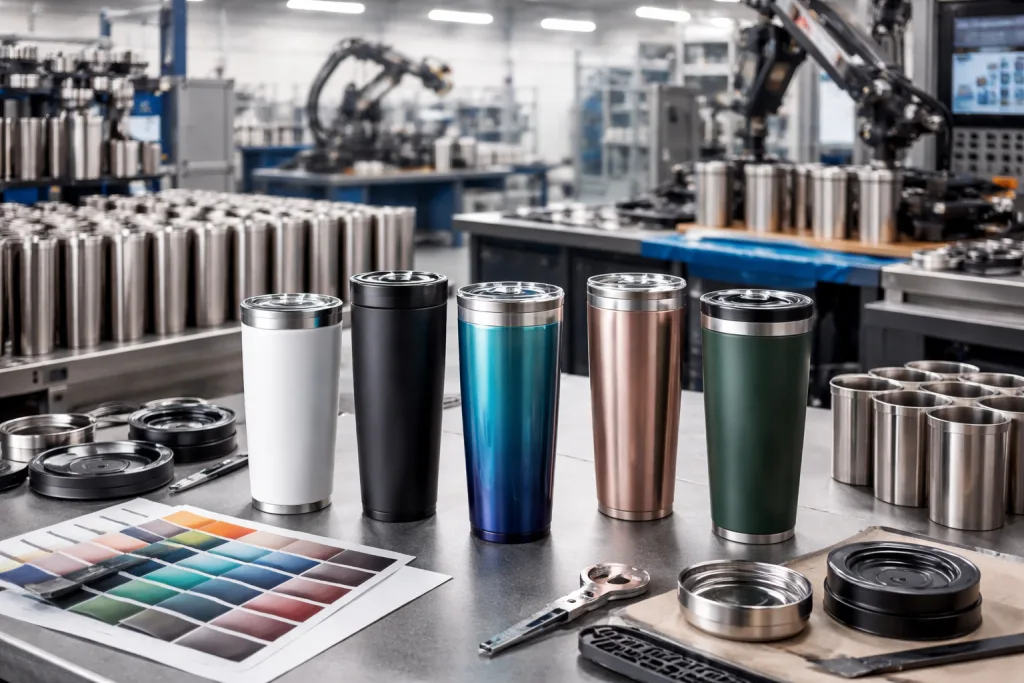
Price the order like a buyer
Unit price is only the first line on the cost sheet. If you compare a coffee mug supplier directory, a coffee mug supplier list, and a factory-direct quote, put every offer on the same basis: EXW, FOB Ningbo, FOB Shanghai, CIF, or DDP. Then check the small charges: logo setup, sample refund, inner box, carton printing, barcode labeling, palletization, and inspection support. We had one buyer flag a quote that looked USD 0.25 cheaper, but after a 350 gsm color box, EAN sticker, and 1.2 m pallet requirement were added, the math did not work.
For a 5,000 pcs bulk travel tumbler order, we usually run 30% deposit and 70% balance before shipment after inspection. Repeat buyers with stable monthly volume can ask for better terms, but new buyers should expect this structure in China. Tooling, if any, is usually paid 100% before mold opening. Sample fees may be USD 80-200 per design for standard shapes with custom logo, higher for custom lids or color matching. On our line, QC pulled one 600 ml sample last month because the laser logo sat 2 mm off center; fixing that before mass production is cheaper than arguing after cartons are sealed.
Freight planning starts with the launch date. Sea freight is the right answer for most coffee mug in bulk orders because tumblers eat carton space fast. Air freight only makes sense for urgent launch quantities or samples. A 600 ml tumbler in retail box can push dimensional weight hard; one 12 kg carton priced like 19 kg by air is not rare. Work backward from the shelf date: 10 days sample, 3 days approval, 35 days production, 5 days inspection and booking, 25-35 days ocean transit to the US West Coast or 30-45 days to ports like Hamburg, Rotterdam, and Felixstowe, plus customs and inland delivery.
Decide early who owns the export paperwork. For FOB orders, the factory handles China-side export clearance and delivery to port. You or your forwarder handle ocean freight, destination clearance, duties, and inland trucking. For DDP, ask what is included and whether the provider has handled drinkware HS codes and food-contact goods before. We have seen this go sideways when a forwarder used the wrong HS code on a PO file named “mug plastic,” while the product was 304 stainless steel. Cheap DDP is the wrong place to save money on a serious coffee mug promotional program.
Close the file before shipment
The final week is where 6 out of 10 delayed orders get messy. Finished goods photos are not inspection. Before balance payment, match the packed goods against the approved sample and the PO. QC should pull cartons from the first pallet face and from the rear stack, then cut open sealed cartons with a safety knife. Check SKU, color, logo position in mm, inner box, carton marks, packed quantity, and gross weight on a floor scale. Run leak tests again, at least 10 pcs per SKU. If the order includes straws, brushes, inserts, or instruction cards, count them before the tape gun closes the cartons.
For a travel tumbler factory direct shipment, ask for the final packing list, commercial invoice, HS code suggestion, carton dimensions, total CBM, gross weight, net weight, and loading photos. If you ship to 3 retail accounts, ask the factory to split pallets or carton number ranges by destination before packing starts. We have seen this go sideways after sealing: one buyer flagged a PO typo on “matte balck,” and the warehouse had to relabel 420 cartons by hand. Planned carton ranges cost little. Rework after packing burns a day.
Retail and corporate gift buyers should keep a golden sample, a production sample, and a final shipment sample with different jobs written on the label. Mark each one with PO number, date, color code, lid version, and logo size. A caliper reading of a 42 mm logo saves arguments later. If your customer reorders after 6 months, these samples settle disputes about shade, print scale, and lid fit. For a travel tumbler private labeling program, archive artwork, dielines, Pantone references, inspection reports, and test reports in the same folder as the signed PI.
The cleanest orders are not the ones with the longest email threads. They have a clear spec sheet, an approved physical sample, a real production lead time, and inspection criteria the line can follow. Asking “can you make it fast?” is the wrong question to ask. Tell the factory the use case first: 3,000 pcs for a coffee launch, US market, 18-day delivery window, target price, logo method, and retail box or bulk carton. Then we can tell you what works, what needs a 500 pcs MOQ adjustment, and what will fail on the packing table instead of simply saying yes.
Send your tumbler brief for a factory quote
Share quantity, deadline, logo file, market, and packaging needs. We will return a practical spec, MOQ, lead time, and FOB price.
Frequently asked questions
What MOQ should I expect for a customized travel tumbler order?
For stainless steel travel tumblers, a practical MOQ is 1,000 pcs per color when using an existing body and lid with custom logo and coating. If you need a custom lid, special handle, molded grip, or exclusive body shape, expect 3,000-5,000 pcs because tooling and line setup become heavier. For a coffee brand testing a campaign, we usually suggest one color at 1,000-2,000 pcs instead of four colors at 500 pcs each. The unit price, color consistency, and inspection control are usually better.
Which logo method is best for a coffee mug promotional program?
For a coffee mug promotional order, silk screen is the most cost-effective for simple one-color logos, especially at 2,000 pcs and above. Laser engraving costs more but is cleaner, more durable, and better for executive gifts or coffee mug private label products. Heat transfer works for full-color artwork but needs careful abrasion testing because travel tumblers are handled daily. If your logo has tiny text under 5 pt, gradients, or thin lines below 0.25 mm, send the artwork before quotation so the factory can recommend the safest method.
How long does production take after I approve the sample?
For an existing tumbler model, plan on 7-10 days for the pre-production sample and 30-40 days for mass production after sample approval and deposit. Add 5-7 days for final inspection, balance payment, and shipment booking. If you are ordering before Q4, add a buffer of 7-15 days because coating, printing, and carton suppliers are busier. Custom tooling can add 15-25 days before sampling even starts. A fixed corporate event date should be shared at the quotation stage, not after production begins.
Can I use one supplier for coffee mug bulk and travel tumbler bulk orders?
Yes, if the supplier has the right production range and quality control system. A coffee mug manufacturer may specialize in ceramic mugs, stainless steel tumblers, glass cups, or plastic bottles, so do not assume every coffee mug supplier can handle every material well. For stainless steel coffee mug bulk and travel tumbler programs, ask for monthly capacity, food-contact test reports, AQL inspection process, coating options, and recent export markets. A factory in Zhejiang or elsewhere in China should be able to show real production photos, not only catalog renderings.
What should I check during final inspection?
Use AQL inspection, commonly Critical 0, Major 2.5, Minor 4.0 under general level II. Check logo position, color, coating defects, dents, scratches, lid fit, leakage, odor, vacuum performance, carton quantity, barcode accuracy, and master carton strength. Pull samples from different cartons, not only the top layer. For a 5,000 pcs order, also check at least 20-32 pcs for leak resistance and several units for hot water retention. If the order is for online sales, verify FNSKU or SKU labels before the cartons leave China.