Key Takeaways
- A realistic travel tumbler customizable MOQ is 1,000 pcs per color for powder coating and 3,000 pcs for custom molded lids
- 304 stainless steel with 0.4 mm inner wall and 0.5 mm outer wall is a practical baseline for most bulk travel tumbler programs
- Laser engraving lasts longer than silkscreen, but silkscreen is usually USD 0.08-0.25 cheaper per logo position
- AQL 2.5/4.0 inspection should cover vacuum retention, leak testing, coating adhesion, barcode scan, and carton drop checks
If you’re sourcing a customizable travel tumbler for a coffee chain, roaster, loyalty campaign, or corporate gift set, finding a shape is the easy part. We have 1,200+ open molds on file, and 40 mm lid thread differences can decide whether the cup passes a tilt test or leaks in the buyer’s sample room. The real work is locking down the dull stuff: lid fit, logo abrasion, carton compression, and why the landed cost jumps by 18% after sampling. We’ve seen this go sideways.
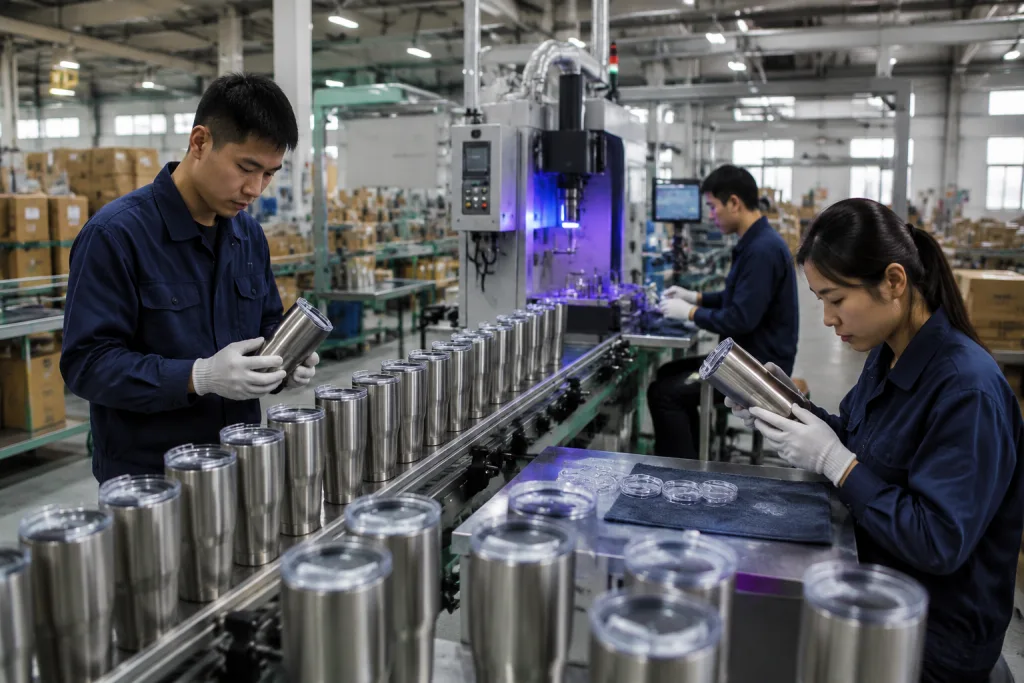
At BottleForge Industrial in Hangzhou, Zhejiang, we run into this every week: a buyer asks for a bulk coffee travel mug, then the buyer flagged lid tooling cost, powder coating thickness, AQL inspection, FNSKU labeling, and 350 gsm vs 400 gsm gift-box board. Our Zhejiang factory network can produce 450,000 stainless drinkware units/month, but the line still needs a clean spec sheet before pricing means anything. Ask for a price too early, and the math doesn’t work.
What should you specify first?
Start with the drinking occasion, not the catalogue photo. This is the wrong question to ask: “Which model looks best?” A commuter coffee mug custom made for car cup holders is usually 12 oz, 16 oz, or 20 oz, with a narrow base around 68-74 mm; our QC team checks that base with a digital caliper before pilot packing. A desk tumbler for corporate-gift buyers can be 15-25% heavier because it is not moving through a subway turnstile every morning. A retail bulk coffee tumbler for a roaster needs stronger shelf appeal, so coating, barcode position, and color-box print matter more than cutting USD 0.20 from FOB.
Your first RFQ should name the real specs: capacity in oz and ml, lid type with photo reference, insulation target, logo method with artwork size, finish, packaging, destination market, and order quantity. If you only ask, “How much for coffee mug in bulk?” you will get a cheap-looking number with hidden assumptions. We have seen this go sideways: one buyer wrote “matte black” on the PO, the approved sample was powder coating, and the factory quoted spray paint. A coffee mug factory direct quote for 20 oz double-wall stainless may range from USD 3.10 to USD 5.80 FOB Ningbo depending on steel grade, lid complexity, coating, and carton rules.
Buyer checklist:
- Capacity: 12 oz, 16 oz, 20 oz, 24 oz, or 30 oz
- Material: 304 inner stainless, 201 or 304 outer stainless, PP lid, silicone gasket
- Vacuum performance: 6 hours hot above 55°C or stronger retail-grade claim
- Opening: sip lid, sliding lid, flip lid, straw lid, or leak-resistant screw lid
- Packaging: white box, kraft box, color box, mailer box, or display carton
For coffee brands, I usually push for a tighter launch: 2 sizes, 3 colors, 1 logo method. Clean start. You can add more after 30-45 days of sell-through data instead of guessing from a meeting room. A coffee mug distributor may ask for six colors on the first PO, but mixed cartons and color-by-color MOQ can quietly damage margin; last month the line held 1,200 pcs of sage green because the buyer flagged the shade under a D65 light box.
Which construction actually works?
For serious travel tumbler customizable orders, we usually run double-wall vacuum stainless steel. The working spec is 304 stainless steel inside, 0.4 mm inner wall, 0.5 mm outer wall, and food-contact silicone that passes LFGB or FDA extraction requirements for the target market. For EU buyers, ask for REACH and LFGB files before the deposit; our QC once pulled a lid gasket sample where the silicone batch code on the test report did not match the PO. For North America, ask for FDA food-contact compliance, California Prop 65 risk review, and ASTM packaging checks if children may use the item.
“Premium” is the wrong word to chase. Ask where the grams go. A 20 oz tumbler can be 260 g or 360 g, and we have seen buyers reject the heavier one after testing it in a Toyota cup holder because the filled cup leaned forward on braking. Extra weight can feel solid in hand, but the math does not always work. For a bulk travel mug shipped to Europe, an extra 80 g across 10,000 pcs adds 800 kg before cartons and pallets. That cost lands in the freight line.
Lid design needs more attention at sample stage. A slider lid drinks well, but it is rarely fully leakproof; a screw lid with a silicone seal holds better in a bag, but commuters complain it takes two hands. Straw lids sell in summer and gym channels, then the buyer asks for spare straws, cleaning brushes, and replacement lids at 3% of order quantity. If your campaign says “leakproof,” we run a 30-minute inverted test and a pressure check after hot filling. QC pulled the sample. If the supplier hesitates, change the claim to “splash-resistant.”
Do not approve a sample only because the coating looks good. Fill it with 90°C water, close the lid, shake it, leave it in a car cup holder, then wash it 10 times.
A capable coffee mug manufacturer should explain these trade-offs before quoting. If a coffee mug supplier only sends catalogue photos, you are buying decoration, not engineering support.
How do logo options compare?
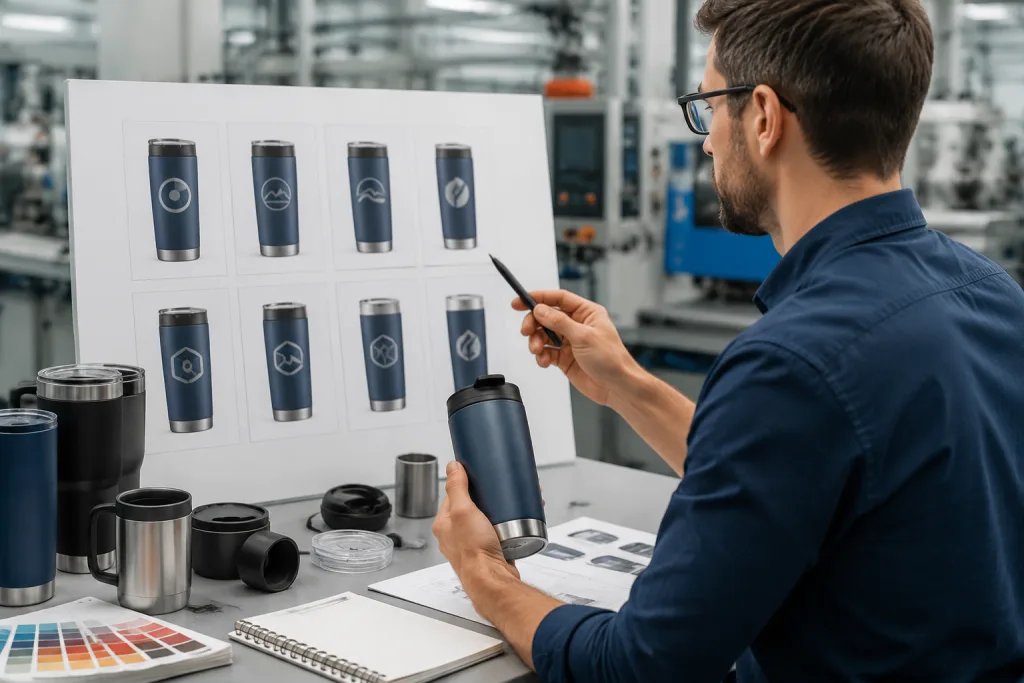
Logo method is where a travel tumbler customizable order starts to look like shelf stock or cheap giveaway stock. For a coffee chain buyer, we usually run laser engraving, one-color silkscreen, or a powder-coat body matched to the logo Pantone with the mark kept simple. Corporate-gift buyers ask for full-color UV printing, and that works on straight walls; on a 6 mm taper, QC pulled samples last March because the round logo looked oval after wrapping.
Laser engraving holds up best on 304 stainless tumblers. It cuts through the coating and shows the metal, so there is no ink film for a fingernail or key test to lift. Cost is usually USD 0.12-0.35 per position depending on logo size and line speed; our 30W fiber laser runs about 1,200 small logos per shift. Silkscreen is cheaper for simple marks, often USD 0.06-0.18 per color, but adhesion depends on ink, curing temperature, coating texture, and how clean the cup is before printing. UV printing handles gradients and 5 pt text. I would not put dishwasher-safe on the carton unless the factory has wash-cycle data, not just a supplier promise.
If your brief uses phrases like coffee mug custom, coffee mug customized, coffee mug promotional products, or travel tumbler customizable, first say where the item will go: resale shelf, staff onboarding kit, conference table, or subscription-box insert. This is the wrong question to ask if the only concern is “which logo is cheapest.” A retail coffee mug private label program needs tighter Pantone control, barcode placement, and packaging consistency; on one 8,000 pcs order, the buyer flagged a 1.5 mm barcode shift because their scanner missed it. A one-off corporate event can accept a wider shade tolerance if the delivery date is the hard stop.
Artwork checklist before sampling:
- Vector file in AI, PDF, or EPS format, with fonts outlined so prepress does not replace a missing typeface
- Pantone code for logo and coating, not only CMYK; send TCX or C code if your brand book has both
- Logo size in mm, with exact distance from rim or base; “centered” caused a 12 mm placement argument on one PO
- Print position photo or dieline, not a verbal instruction; we mark it against a paper ruler before making the sample
- Decision on front-only, two-sided, or full wrap, with wrap width and safe gap listed in mm
For coffee mug private labeling, check whether the bottom mark, user manual, hangtag, and carton label carry your brand name. Buyers remember the cup logo and forget the export carton; we see this on about 3 out of 20 private-label projects. The math doesn't work when 24 mixed SKUs land in a distributor warehouse and the outer carton only says “stainless tumbler.” Add the SKU, color code, and logo version to the carton mark before sampling, not after the line has packed 60 cartons.
What MOQ and pricing are fair?
MOQ is not a punishment; it is usually the setup cost showing up on the factory floor. For a standard travel tumbler customizable using an existing mold, our normal MOQ in Zhejiang is 1,000 pcs per color with one logo. For a custom Pantone powder coating, 1,000-2,000 pcs per color is normal because the coating line needs a clean spray booth, fresh powder, and 2-3 trial cups before QC signs off the color under a D65 light box. For a new lid mold, expect 3,000-5,000 pcs minimum, plus tooling that may run USD 1,200-6,000 depending on structure. The math doesn't work at 300 pcs if the line has to stop for setup.
FOB pricing for a 20 oz stainless bulk coffee mug usually sits in a practical range of USD 3.20-5.50 when the quote includes a decent lid, powder coating, and one logo. A cheaper quote can be real, but check steel thickness, vacuum rejection rate, carton grade, lid material, and whether testing is included. We run into this often: a coffee mug factory can cut USD 0.30 by changing the outer wall from 0.5 mm to 0.4 mm or switching to a 5-ply carton with weaker edge crush. You may not notice until QC pulled the sample and found dents after a 76 cm drop test.
Buyers often search for a coffee mug supplier directory or coffee mug supplier list, then compare 12 spreadsheet prices. This is the wrong question to ask if the specs are not locked. Most quotes are not apples to apples. Ask each coffee mug oem manufacturer to confirm the same assumptions: 304 inner wall, 201 or 304 outer wall, 0.5 mm outer thickness, 1C logo, individual white box, 24 pcs/master carton, FOB Ningbo or Shanghai, and AQL inspection included or excluded. We have seen a PO typo list “304 outer” while the approved quote said “201 outer”; the buyer flagged it 2 days before deposit, which saved a messy claim later.
Lead time is also part of price. A realistic timeline from China is 7-10 days for counter sample, 25-35 days for mass production after deposit and artwork approval, and 3-7 days for final inspection and export booking. For repeat orders with the same powder code and carton artwork, we sometimes ship in 28 days vs 35 days, but only when lids and silicone rings are already in stock. Ocean freight to the US West Coast may add 18-28 days port-to-port; to Europe, 30-40 days is a safer planning number. Air freight saves time and destroys margin on stainless drinkware.
How should packaging be planned?
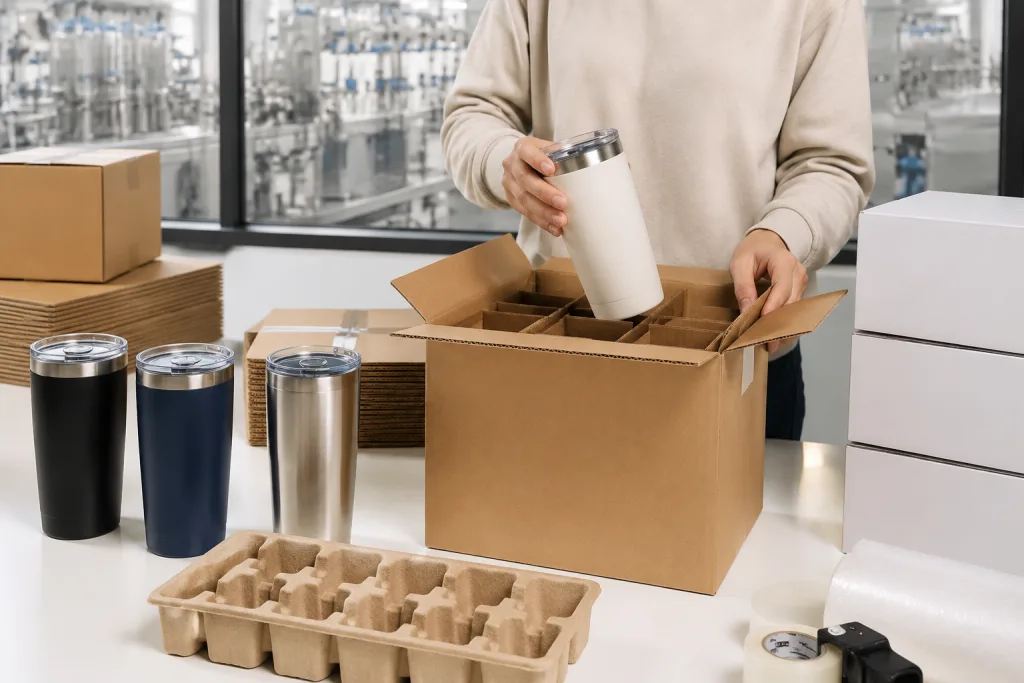
Packaging is not the pretty part after production. For a bulk coffee travel mug, the box affects breakage claims, shelf presentation, Amazon intake, warehouse scanning, and customs papers. We run plain white boxes at about USD 0.12-0.25 when the order hits 3,000 pcs. Printed color boxes land around USD 0.25-0.60 depending on 350 gsm paper, matte lamination, and print run. A rigid gift box can pass USD 1.00 before the cup reaches the packing table; QC pulled one sample last month where the foam insert was 2 mm too tight and scratched the powder coating.
Coffee brands need packaging that can sit beside beans and brewers without looking like a factory spare part. Corporate-gift buyers ask for individual gift boxes, no price marks, and clean outer cartons for kitting; one buyer flagged a PO typo where “no logo carton” became “logo carton,” which would have ruined 1,200 event sets. Distributors usually care more about carton strength and SKU ID than tissue paper inside the box. One packaging design rarely works across all sales channels. We’ve seen this go sideways.
For ecommerce or FBA, confirm FNSKU labeling, suffocation warning if polybags are used, carton weight below your warehouse limit, and barcode placement that scans from 300 mm away. A 20 oz tumbler in a color box commonly packs 24 pcs per master carton. Keep carton gross weight around 10-14 kg if manual handling is expected; the math doesn’t work when a warehouse team rejects 18 kg cartons at unloading. Ask for 5-ply export cartons if shipping by sea. 3-ply can pass domestic China transport, but it is risky on a 35-day export route with two transshipments.
Packaging checklist:
- Individual box dieline approved before mass printing, with cup height and lid clearance checked in mm
- Barcode tested by phone and warehouse scanner, not just read from the artwork PDF
- Master carton mark includes SKU, color, quantity, N.W., G.W., and carton size
- Drop test performed from 60-80 cm on corner, edge, and face, with photos kept in the QC file
- Retail claims match actual test results and legal requirements, especially insulation time and material wording
If you need coffee mug promotional products for an event, do not overbuild packaging. Spend on the cup. If you need coffee mug customized goods for retail, do not underbuild the box; returns cost more than better board. The right box depends on how the tumbler is sold, shipped, opened, and sent back, and we usually lock it before PP sample approval to avoid a 7-day printing delay.
What quality checks prevent trouble?
Write the QC standard before deposit, not after the line is already polishing cups. For a travel tumbler customizable order, we ask the buyer to sign the pre-production sample, then we run a during-production spot check once 20% to 30% of the order is packed, and we close with final random inspection under AQL. For drinkware, we usually use AQL 2.5 for major defects and 4.0 for minor defects, with critical defects set to zero tolerance. Critical means unsafe material, a sharp rim found by cotton-glove wipe, severe leak, wrong food-contact component, or mold contamination inside the lid gasket.
The inspection sheet needs real test points, not “looks OK” comments. Check appearance under a D65 light box, capacity with a measuring cylinder, weight on a 0.1 g scale, coating adhesion, logo position within a 1.5 mm tolerance, lid fit, leak test, vacuum performance, odor check, barcode scan, packaging, and carton drop. For powder coating adhesion, use a cross-hatch tape test with 3M 600 tape. For vacuum performance, fill with hot water, measure starting temperature, then check after 6 hours. For leak testing, we run room-temperature water and hot water because heat softens silicone seals and changes pressure inside the cup.
Factory photos are not enough. We have seen coating dust disappear under bright phone lighting, and one buyer flagged a “black” tumbler that matched the photo but failed against their Pantone chip by two shades. For coffee mug manufacturers in China, a clear inspection standard protects both sides. The factory knows what QC will reject; you avoid a shouting match at the loading date when 312 cartons are already stacked near the roller door. If you are a coffee mug distributor handling multiple clients, build one QC template and reuse it across SKUs, then adjust logo size and carton marks per PO.
Paperwork matters too. Ask for material declarations, test reports within the last 12 months if available, BSCI or similar social compliance if your customer requires it, and photos of production cartons before booking. We also check the shipping mark against the PO because one missed hyphen in an item code can hold a pallet at the warehouse. If your order ships to the EU, ask REACH and LFGB questions before tooling or sample approval. If it ships to North America, check FDA food-contact declarations and retailer packaging rules such as suffocation warnings, UPC placement, and carton gross weight limits.
A good coffee mug supplier will not promise zero defects. That promise is the wrong question to ask, and the math does not work on a 10,000 pcs run. What you want is traceability by production date, stable process control on the welding and vacuum line, and fast containment if QC pulled the sample and found a leak before shipment.
How do you choose the supplier?
Choosing between coffee mug distributors, a trading company, and a coffee mug factory direct setup depends on who will control the details. A factory works well if your team already has a written spec sheet, artwork files in AI format, and someone who understands pre-shipment inspection. A trading partner earns its margin when you have 6 SKUs with different lids or gift-box inserts that must land in the same container. The name card is the wrong question to ask. Ask whether the team can answer why a 0.35 mm wall, a PP lid, and a silicone ring behave differently after a 95°C hot-water leak test.
Ask direct questions. What is your monthly capacity for this shape? What was the vacuum defect rate last quarter, in percent, after the 24-hour temperature hold test? Can you share the lid material grade? Which port do you normally use from Zhejiang or nearby China production areas? How many days from deposit to finished goods at 5,000 pcs? Who signs off on color tolerance, and do you use a Pantone book or a spectrophotometer? If every answer is “no problem,” the math does not work; last month QC pulled 12 lids from a sample set because the buyer flagged a 0.6 mm gap at the slider.
For BottleForge Industrial, a typical bulk travel tumbler order is quoted FOB Ningbo or Shanghai, MOQ 1,000 pcs per color, sample time 7-10 days, mass production 25-35 days after approval, with third-party inspection welcome. That is not the cheapest promise in China. It is a procurement plan we can actually run. On the line, we usually lock the sample after the buyer signs the color chip, barcode position, and carton mark, because one PO typo in “matte black” versus “metallic black” can waste 1,000 pcs of powder coating.
Supplier decision checklist:
- Can they quote against a written spec with capacity, diameter, lid type, coating, and packing details, not only a photo?
- Can they explain lid leakage limits honestly, including test angle, water temperature, and whether the slider is open or closed?
- Can they support coffee mug custom made packaging with dielines, barcode placement, carton marks, and drop-test notes?
- Can they provide AQL inspection cooperation before balance payment?
- Can they scale from 1,000 pcs to 30,000 pcs without changing materials?
If you are building a long-term coffee mug promotional or coffee mug private labeling program, choose the supplier who pushes back on weak specifications. We have seen this go sideways when a buyer approves a photo but not a lid drawing. Polite resistance before production is cheaper than explaining to your customer why 18 cartons have mixed handles, wrong stickers, or a color that passed in the office but failed under the lightbox.
Send your tumbler spec for a factory quote
Share size, quantity, logo, packaging, and destination. We will reply with MOQ, FOB pricing, sample timing, and QC notes.
Frequently asked questions
What is the best size for a customizable travel tumbler for coffee brands?
For coffee brands, 16 oz and 20 oz are the safest starting sizes. A 16 oz tumbler fits most daily brewed coffee and keeps the body slimmer for car holders. A 20 oz version gives better perceived value for retail shelves and corporate gifts. If you are ordering coffee mug in bulk for resale, start with one size unless you have proven demand. Two sizes double inventory decisions, carton planning, barcode management, and color MOQ exposure. For a first China production run, 1,000 pcs per color in 16 oz or 20 oz is more practical than splitting 2,000 pcs across four sizes.
Can I order a bulk travel tumbler with my own Pantone color?
Yes, but Pantone coating is not the same as choosing a color on screen. For powder coating, the normal MOQ is 1,000-2,000 pcs per color because the line needs setup, spraying, curing, and cleaning. Expect a color tolerance of about Delta E 1.5-2.5 depending on texture and lighting. Always approve a physical color plate or pre-production sample before mass production. Matte, gloss, and textured coatings reflect light differently, so the same Pantone number can look different on stainless steel. For coffee mug customizable programs, lock the color standard in writing before deposit.
Is laser engraving or printing better for corporate gift tumblers?
Laser engraving is usually better when durability matters. It does not peel because it removes the coating and exposes the stainless layer underneath. It is ideal for executive gifts, employee kits, and coffee mug promotional products that should look good after months of use. Silkscreen is cheaper and works well for simple one-color artwork, especially on large orders above 3,000 pcs. UV printing is useful for full-color logos but needs adhesion testing. If the tumbler will be washed often, avoid making dishwasher-safe claims unless the supplier can show test data, not just confidence.
How long does a coffee mug factory in China need for production?
For an existing mold, plan 7-10 days for samples and 25-35 days for mass production after deposit, artwork approval, and packaging approval. Add 3-7 days for final inspection, balance payment, and export booking. If you need custom lid tooling, add 20-35 days before production starts. Zhejiang and other China production regions can move quickly, but rush orders increase mistakes in coating, logo placement, and carton labeling. For seasonal corporate gifts, start sourcing at least 90 days before the required delivery date if ocean freight is involved.
What information should I send to get an accurate factory quote?
Send capacity, quantity, color count, logo method, packaging type, destination country, required compliance, and target delivery date. A good RFQ might say: 20 oz stainless travel tumbler, 5,000 pcs total, 2 matte colors, one laser logo, individual color box, FOB Ningbo, EU market, REACH/LFGB needed. If you only send “quote coffee mug bulk,” suppliers must guess, and every guess changes the price. Also attach artwork in vector format and mention whether you need barcode labels, FNSKU labels, palletization, or distributor carton marks.