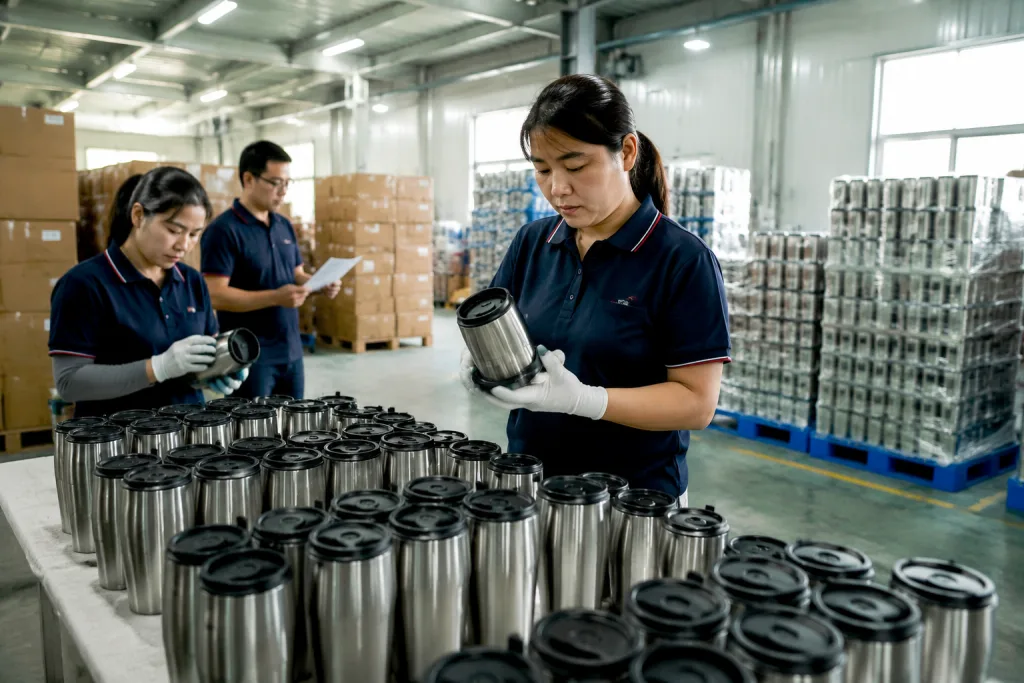
Key Takeaways
- For most coffee brands, 500–600 ml with 304 stainless steel and 0.4–0.5 mm inner wall is the safest spec
- Expect practical FOB China pricing from USD 3.20–6.80 depending on lid, coating, and logo method
- Laser engraving suits 1-color premium logos; full-wrap UV or heat transfer suits retail-style artwork
- Use AQL 2.5/4.0 inspection and confirm lid leakage tests before paying the balance
If you are buying a travel tumbler custom program for a coffee brand or a corporate-gift run, shape is the wrong question to ask first. Start with the parts that create complaints: heat retention after 6 hours, lid thread fit within 0.3 mm, logo wear, carton drop strength, FDA or LFGB paperwork, and the target shelf price. QC pulled one 500 ml sample last month where the body looked clean, but the push-button lid leaked after 20 shakes on the test bench.
From our factory network in Zhejiang, China, we see the same mistake in about 6 out of 10 buyer briefs: they compare FOB price and capacity only. A USD 3.20 tumbler and a USD 5.10 tumbler can look similar in a PDF, but the math does not work if the cheaper one fails on leakage, powder coating thickness, cup-holder fit, or repeat orders. Our Hangzhou team supports MOQs from 1,000 units per color and typical production lead times of 25–35 days after sample approval; on the line, we run calipers, torque checks, and carton weight checks before we ship.
The real tumbler comparison table
For a travel tumbler custom order, compare by use case first, not the catalog photo. This is the wrong question to ask in RFQ stage: “Which one is cheapest?” Coffee brands and event agencies do not need the same build. We see this on the line every month. A retail coffee mug private label item has to pass daily dishwasher use, shelf rub checks, and a picky 2.5 mm logo-position tolerance under our caliper. A conference giveaway can run a lighter inner wall if the logo is sharp and the vessel ships on the fixed event date. A corporate executive gift needs better hand feel, tighter lid tolerance, and gift-box packing that does not collapse after 5 cartons are stacked.
| Spec route | Typical capacity | Best fit | FOB China guide | Risk to check |
|---|---|---|---|---|
| Slim travel tumbler | 350–450 ml | Office coffee, women’s retail gift sets | USD 3.20–4.60 | Small print zone; buyer may say it feels too light in hand |
| Classic bulk coffee travel mug | 500–600 ml | Coffee brands and daily commute programs with repeat use | USD 4.10–5.80 | Lid sealing, 72–75 mm car-cup fit, and silicone ring flash |
| Handle travel mug | 600–900 ml | Outdoor buyers, drivers, warehouse teams using gloves | USD 5.20–7.40 | Carton volume jumps fast; freight math can break the target price |
| Ceramic-lined tumbler | 400–500 ml | Premium coffee taste positioning with higher retail margin | USD 5.80–8.20 | QC pulled samples for rim chips before; packing needs stricter drop-test control |
If you want one safe answer, we run a 20 oz / 590 ml stainless model with double-wall vacuum insulation, powder coating, and a push-on or screw lid tested at 45°, 90°, and upside down for 30 seconds. Boring spec. Good seller. It is large enough for a coffee chain menu, still fits most car holders at 72–75 mm bottom diameter, and leaves enough straight body height for coffee mug customized artwork without squeezing the logo into the taper.
Do not let a supplier push the cheapest open-stock coffee mug in bulk unless the use case is nailed down on the PO. We have seen this go sideways when the buyer wrote “matte black” but the attached artwork file said “gloss black”; QC flagged it only after the first 200 pcs came off the coating line. A coffee mug promotional order for a one-day event can be cost-led. A coffee mug custom made item sold beside roasted beans needs a better lid and coating, or your brand gets the leak complaint, not the factory.
Stainless steel specs that matter
“304 stainless steel” is a start, not a spec sheet. For most travel tumblers, we run 304 stainless steel on the inner liner, 201 or 304 on the outer shell based on target price, and 0.4–0.5 mm inner wall thickness. Our caliper check is simple: if the wall drops under spec by 0.03 mm, QC pulled the sample before polishing. Too thin saves maybe USD 0.08–0.15 per piece, then the cup dents in a 60 cm drop test and feels cheap in the buyer’s hand. Too heavy pushes carton weight up, and for a corporate-gift order the math doesn’t work.
A practical coffee mug manufacturer should put the material grade, insulation test, capacity tolerance, and surface finish in the quotation. No guessing. For vacuum insulation, ask for a 6-hour test at 95°C fill temperature; we log it with a probe thermometer, not just a sticker on the sample box. A decent 500 ml tumbler should keep water above 55–60°C after 6 hours at room temperature. If the supplier only writes “keeps hot 12 hours” with no test method, treat that as sales copy, not engineering.
For cold drinks, 7 out of 10 bulk coffee tumbler buyers we meet overrate extreme insulation. Office and commuter users complain first about leaks, one-hand drinking, odor control, and lid cleaning. We’ve seen this go sideways: a sliding lid looked nice in the render, then the buyer flagged milk residue trapped in the 2 mm cavity after a latte test. A removable slider works better for coffee brands selling reusable cups, and a simple sip lid is easier for retail staff to explain.
From Zhejiang production lines, China factories can usually hold capacity tolerance within ±5% on standard molds. We check it with water weight on a digital scale, and a 500 ml cup landing at 485–515 ml passes our normal range. Custom body tooling is possible, but it changes the economics: mold cost can run USD 1,500–6,000 and add 20–30 days before mass production. Unless you need a signature silhouette, factory-direct existing molds are usually smarter for first orders; we ship faster, and the first PO has fewer places to go wrong.
Logo methods head to head
A travel tumbler custom order is judged from 80 cm away, before the buyer checks the steel grade. Pick the wrong logo process and a solid cup looks like a giveaway from a gas station. This is the wrong question to ask: “Which method is best?” Start with the artwork file, coating type, real order quantity, and use case. On our Hangzhou line, QC pulled 12 samples last month where the logo passed on a flat PDF but looked 3 mm off-center after printing on the tapered body.
| Logo method | Best for | MOQ reality | Cost guide | Durability |
|---|---|---|---|---|
| Laser engraving | Simple marks, boardroom gifts, hotel programs | 500–1,000 units | USD 0.15–0.35/unit | Excellent, cannot peel |
| Silkscreen printing | Clean 1–2 color logos with Pantone targets | 1,000 units | USD 0.08–0.25/color | Good if cured properly |
| UV printing | Full-color artwork, QR codes, staff names | 500–1,000 units | USD 0.40–1.20/unit | Medium to good |
| Heat transfer | Wraparound retail graphics with large coverage | 1,000–3,000 units | USD 0.45–1.50/unit | Good with correct film |
Laser engraving is the safe choice for corporate buyers because it looks tidy and takes abuse in bags, dish racks, and office sinks. No peeling. The trade-off is color: most jobs show exposed stainless tone or a dark gray mark, depending on the powder coating. If the buyer says the logo must hit Pantone 186C, the math does not work with laser. Use silkscreen or UV. For travel tumbler custom promotional orders, we run silkscreen when the artwork is simple and the quantity is above 1,000 units; our pad printer operator checks the first 20 pcs with a 0.5 mm registration tolerance before the line speeds up.
For private label travel tumblers, packaging carries almost the same selling pressure as the cup. A kraft box with one-color print might add USD 0.18–0.35. A full-color retail box can add USD 0.45–0.90 depending on board gauge and finish. We ship plenty of blank white boxes for price-first campaigns, but we have seen this go sideways for café and gift-shop buyers. One buyer flagged a PO typo where “matte black box” became “white box,” and the rework cost 6 days before loading.
One practical warning: confirm logo size on the real curve, not only on a flat artwork file. A 90 mm wide logo may look fine on a tumbler render but stretch near the taper, especially on 600 ml bodies with a narrow bottom. Ask for a pre-production sample photo from three angles before approving mass production. Better yet, ask QC to place a steel ruler next to the logo in the photo; that 30-second check has saved us from reprinting 1,200 units.
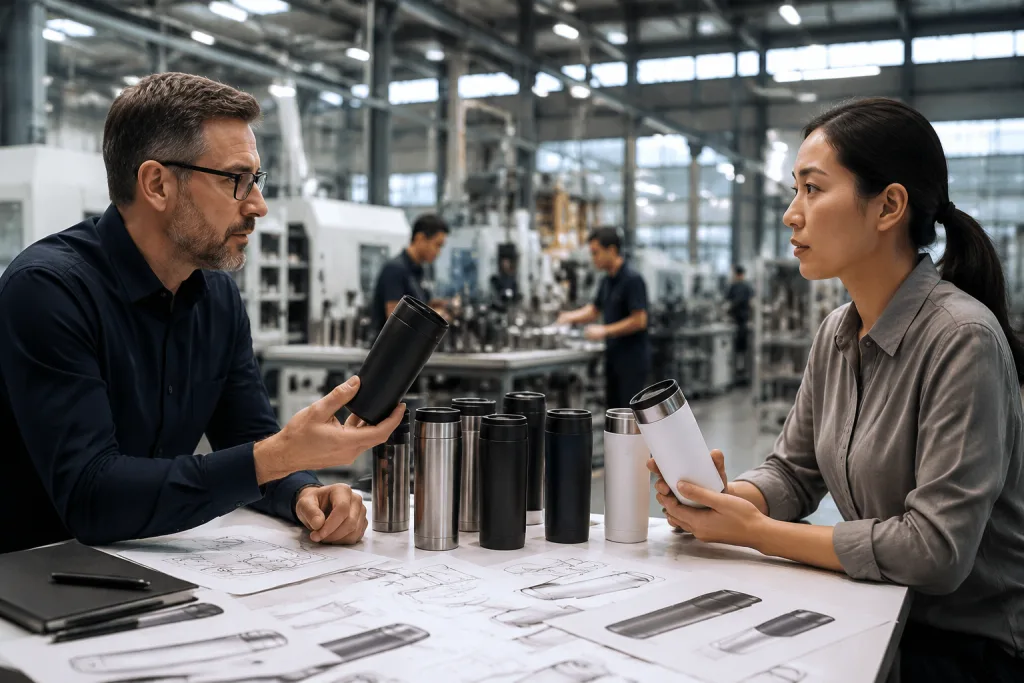
Use-case fit for buyers
A coffee brand and a corporate-gift buyer may both say “bulk travel mug,” but quoting them the same spec is the wrong question to ask. For a coffee brand, the tumbler sits inside the drink experience. We check mouth opening in mm with a caliper, lid flow after a 90°C hot-water fill, and whether the liner leaves any steel taste. A ceramic-lined option can justify the extra USD 1.20–2.00 when the brand sells flavor clarity, but QC pulled two samples last quarter with chipped rims after a 1.2 m drop, so the packing and user card need to be stronger.
For a corporate gift, the buyer usually cares about perceived value and delivery date before specialty coffee details. A 500 ml powder-coated travel tumbler with laser engraving and an individual kraft box is a sensible choice, as long as the master carton passes ISTA-style handling; we run a 12 kg carton drop check on the line before mass packing. If HR or marketing wants staff names printed one by one, UV personalization works, but do not squeeze the approval calendar. Variable-name printing often adds 3–5 working days after the final name list is locked, and we have seen this go sideways when the PO spells “Katherine” three different ways.
For distributors, the spec has to protect repeat orders. A coffee mug distributor does not want returns because the lid gasket pops out or the coating scratches during LCL transit. Ask the coffee mug factory for spare lid availability and gasket material, then ask for 20 pcs of loose gaskets from the same mold cavity for fit checking. Silicone gaskets should sit tight after hot-water washing and should not carry a sharp smell when the carton is opened. A small replacement-lid plan saves retail accounts; the math works better than air-shipping one angry customer a full new mug.
If you are building a coffee mug supplier list or comparing a coffee mug supplier directory, do not rank factories only by catalog range. Ask each coffee mug supplier for current monthly capacity, recent audit status such as BSCI or Sedex where relevant, and export compliance experience for your market—then make them prove it with a shipment record or inspection report number. Our Zhejiang partner lines produce about 450,000 stainless drinkware units per month across tumblers, bottles, and mugs, with 304 stainless coils checked by thickness gauge before forming. That capacity matters when your reorder needs to ship before Q4 and the buyer flags a hard delivery window.
Price, MOQ, and landed cost
Do not treat factory price as the whole travel tumbler custom budget. For a coffee mug factory direct order, we usually run 1,000 units per color on standard molds; 500 units is possible on some lines, but the math gets worse and PMS color choices shrink fast. For a 500 ml double-wall 304 stainless tumbler, FOB Ningbo or Shanghai often lands around USD 4.10–5.80 with powder coating and one logo. Better lids add USD 0.20–0.60, upgraded packaging adds USD 0.30–0.90, and full-color decoration needs a separate quote after we check the artwork file. Last month QC pulled a sample because the PO said “matte black,” but the approved sample was Pantone 426C gloss. Small typo, real cost.
Landed cost is where we see new buyers get caught. A handle mug with a larger gift box may look cheaper at the factory gate, then lose the saving on ocean freight because the carton cube is too high. For North America, a 20 oz tumbler usually packs 24 pieces per master carton. Carton dimensions vary, but a common range is 58 × 40 × 32 cm with gross weight around 9–12 kg. Ask for carton size before comparing prices. No carton data, no real comparison. We had one buyer flag a USD 0.18 unit-price gap, then the cheaper option needed 18 CBM instead of 12 CBM for the same 10,000 pcs order.
Payment terms change your risk, not just your cash flow. A normal China factory term is 30% deposit and 70% before shipment after inspection. Established buyers can sometimes get different terms, but skipping inspection to save two days is the wrong question to ask. We run AQL 2.5 for major defects and 4.0 for minor defects as a practical baseline. Critical defects such as leakage, sharp edges, contamination, or wrong logo should be zero tolerance. On the line, a simple 3-minute inverted leak test and a caliper check on lid fit can catch problems before they become 1,200 cartons of arguments.
If you are searching for coffee mug manufacturers or a coffee mug oem manufacturer, separate trading-company speed from factory control. Trading teams can move fast, but they still need to show clear specs, signed samples, production photos, and inspection access. A cheap quote with vague steel grade, no lid test, and no packaging detail is not a quote. It is a placeholder. We have seen this go sideways when a buyer approved “stainless steel” in email, then expected 304 stainless after the deposit was paid.
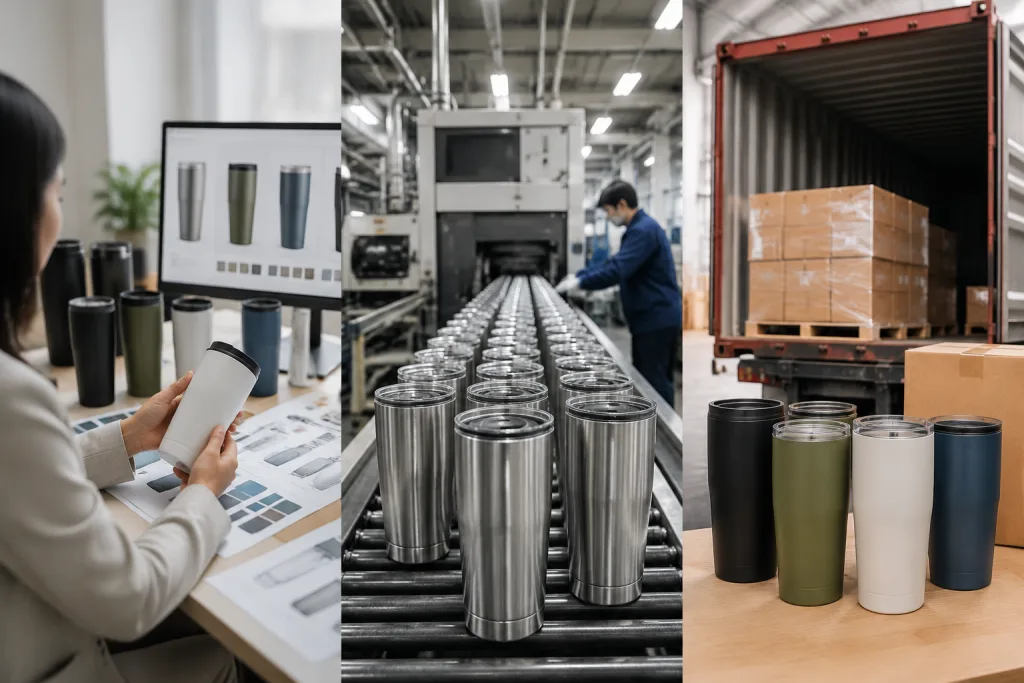
Compliance and inspection checks
For Europe and North America, treat the tumbler as a food-contact product, not a giveaway with a logo. For EU orders, we ask the testing lab for LFGB or the right food-contact migration report, REACH coverage for coating and restricted substances, and retail-packaging checks if the cup goes on shelf. For the US, FDA food-contact expectations still matter; if the artwork or listing targets children, ASTM or CPSIA can come into the file. Adult travel tumblers usually do not need kids’ bottle testing, but 304 stainless, silicone seals, PP lids, and label claims still need to match the report. QC pulled a lid gasket last month because the PO said “silicone” and the BOM showed TPE. Small line item. Big argument.
A pre-shipment inspection has to go past surface scratches. The inspector should fill samples with 95°C water, invert or tilt each lid style for 30 seconds, check vacuum hold on random units after 6 hours, measure capacity with a graduated cylinder, verify barcode or FNSKU placement for e-commerce cartons, and match carton marks against the purchase order. For powder coating, we run a 1 mm cross-hatch adhesion check where the finish allows it, then rub the printed logo with alcohol and a white cotton cloth. Pretty cups still fail. We have seen 2 cartons held because the outer mark had “500ml” while the approved spec was 600ml.
For coffee mug customizable orders, color control causes real buyer pushback. Powder coating shifts between batches, especially matte beige, cream, sage green, and soft retail colors with low gloss. Give a Pantone reference, then approve a physical color chip or pre-production sample under the same light box setting, usually D65. Pantone paper is the wrong question to ask by itself; powder on curved stainless steel reads darker at the shoulder and lighter near the base. On the line, a 0.3 mm coating thickness change can move the shade enough for the buyer to flag it.
Good procurement is boring: signed sample, clear spec sheet, production schedule, inspection plan, and no balance payment until QC pulls samples that match the approved cup.
China export drinkware production is mature, but mature does not mean automatic. The buyer who writes details down gets the cleaner shipment. The buyer who says “same as sample” without defining sample number, lid version, logo size, carton mark, and AQL 2.5 limit often gets an argument at 7 p.m. before vessel closing. We’ve seen this go sideways over one typo on a PO: “matte black” in the email, “gloss black” in the attached sheet.
How to brief the factory
A clear brief saves more money than another 3% squeezed out in negotiation. In the first email to a coffee mug factory, send capacity, order quantity, target market, logo file, packaging request, compliance rule, and delivery date. Better yet, attach the AI/PDF logo and tell us if the logo is 45 × 35 mm or 30 × 20 mm; our pre-press guy checks it on a 600 dpi print before the sample room burns time. If you ask only for “best price for bulk coffee mug,” the quote will be cheap because the assumptions are cheap.
Use plain numbers. Say “500 ml, double-wall vacuum, 304 inner, powder coated black, laser logo 45 × 35 mm, individual kraft box, 2,000 units, FOB Ningbo, delivery before 15 September.” We can price that. The line can check body stock, lid fit, powder loss, carton CBM, and laser time per piece. A vague request like “premium tumbler for gifts” usually gets 3 suppliers quoting 3 different cups, then the buyer asks why one price is 18% lower. Wrong question. The spec is not the same.
For coffee mug distributors, ask for a repeat-order file after the first production run. It should include the final spec sheet, approved artwork, Pantone or powder code, carton details, inspection report, and spare-parts note. QC pulled one reorder sample last year where the lid gasket changed by 0.6 mm because nobody kept the old sealing-ring note; the buyer flagged it after 12 cartons had already packed. For coffee mug private labeling, keep dielines and barcode placement controlled on your side, especially if you sell through retail or e-commerce.
Factory communication should also spell out acceptable substitutions. If your chosen lid is delayed, can the factory use a similar lid? If yes, write who approves the counter sample, how many photos we send, and whether one physical sample must be couriered before mass production. If no, put “no lid substitution” on the purchase order, not only in a WeChat message. In Hangzhou and wider Zhejiang supply chains, production teams move fast, and we ship better when the written limits are clear. Speed does not fix an approved product turning into a different product.
For a first travel tumbler custom order, keep the project tight: one body, one or two colors, one logo method, one packaging format. We run this cleaner at 1,000–3,000 units because the powder line, laser fixture, and carton label stay consistent. After you have sales data, expand into ceramic lining, handle mugs, gift sets, or seasonal colors. We have seen this go sideways when a new buyer launches 8 SKUs at once, then reorders only 2 and leaves odd-color spare lids sitting in our warehouse.
Send your tumbler brief for a factory quote
Share capacity, quantity, logo file, market, and deadline. We will return a practical Zhejiang factory option with MOQ, price, and lead time.
Frequently asked questions
What is the best MOQ for a custom travel tumbler order?
For standard stainless travel tumbler molds, 1,000 units per color is the most practical MOQ. At this level, a factory can run powder coating, logo setup, packaging, and inspection without pushing the unit cost too high. Some coffee mug supplier teams accept 500 units, especially for laser engraving on stock colors, but expect a higher FOB price and fewer coating choices. If you need full-color printing, custom box printing, or a special lid color, 1,000–3,000 units is more realistic. For new coffee brands, we usually suggest starting with 1,000–2,000 units in one proven size before adding more colors.
How much should a bulk coffee travel mug cost from China?
A reliable 500–600 ml bulk coffee travel mug from China usually falls between USD 4.10 and USD 5.80 FOB for 304 stainless inner wall, double-wall vacuum insulation, powder coating, and one simple logo. Cheaper options around USD 3.20–3.80 exist, but they often use lighter walls, simpler lids, or less durable coating. Premium versions with ceramic lining, full-wrap artwork, or retail packaging can reach USD 6.50–8.50. Always compare carton dimensions, logo method, lid structure, and inspection terms. A USD 0.30 saving can disappear quickly if the carton volume is high or the lid causes returns.
Which logo method is best for coffee mug promotional products?
For coffee mug promotional products, silkscreen printing is usually the best price-performance option if your logo has 1–2 colors and the order is at least 1,000 units. Laser engraving is better for executive gifts because it will not peel and looks more premium on powder coating. UV printing works for full-color artwork or individual names, but it costs more and needs careful adhesion checks. Heat transfer is best for large wraparound graphics. If the tumbler will be sold by a coffee brand, ask for a decorated pre-production sample and run a rub test before approving mass production.
Can I use the same tumbler for retail and corporate gifting?
Yes, but the packaging and decoration should change. A 500 ml stainless travel tumbler with powder coating can work for both retail coffee shelves and corporate gifts. For retail, use a full-color box, barcode, care instructions, and clear capacity labeling. For corporate gifting, a kraft box or rigid gift box with laser engraving may be enough. The product spec can stay the same, which helps MOQ and repeat ordering. If you split one 2,000-unit run into two packaging styles, confirm packing-line costs and carton marks early because mixed packing can add 2–4 days.
How do I check if a coffee mug factory is reliable?
Ask for current monthly capacity, business license details, audit information, food-contact test reports, and recent export references for your market. A serious coffee mug factory should provide a clear spec sheet, not just catalog photos. Before mass production, approve a physical sample with the final logo and lid. Before shipment, use AQL inspection, commonly 2.5 for major defects and 4.0 for minor defects, with zero tolerance for leakage and sharp edges. If the supplier refuses inspection access or cannot state material grade, lid test method, carton size, and lead time, keep looking.