Key Takeaways
- Start with 1,000-3,000 pcs MOQ for most stainless travel tumbler custom made projects
- 304 stainless steel at 0.4-0.5 mm inner wall is the normal baseline for coffee use
- Powder coating usually adds 7-12 days versus plain stainless or single-color spray finish
- Use AQL 2.5/4.0 inspection and request 20-30 retained samples before shipment
A travel tumbler custom made project looks easy until the quotes land. One coffee mug factory writes 3,000 pcs MOQ, another writes 5,000 pcs, and both promise stainless steel, double wall, leak resistant, gift box. Same words, different risk. Last month QC pulled a 420 ml sample from the line and found the lid gasket 0.4 mm too thin; that one detail would have turned “leak resistant” into carton returns. The wrong question is “who is cheapest?” Ask which choices change your landed cost, inspection pass rate, and shelf sell-through.
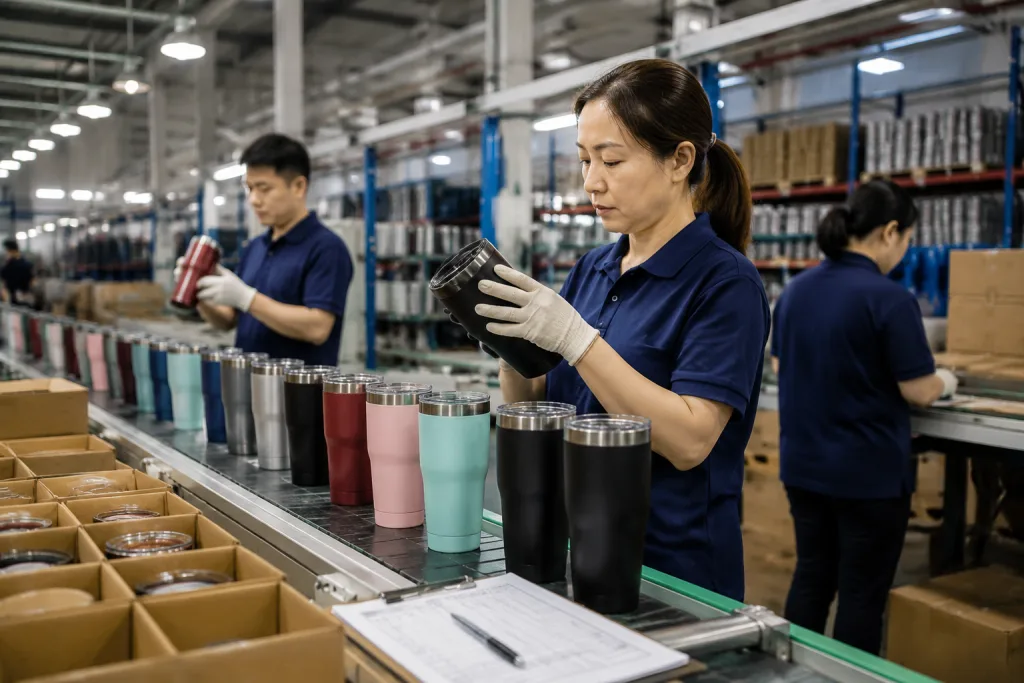
If you buy for a coffee brand, hotel group, event agency, or corporate-gift program, the tumbler has to work as packaging and as a billboard. We ship these as finished retail items, not blank metal cups. BottleForge Industrial in Hangzhou, Zhejiang builds OEM drinkware for export buyers in Europe and North America, with travel tumbler capacity around 450,000 units/month and standard custom MOQ from 1,000 to 3,000 pcs depending on finish. On our floor, a powder-coated order usually needs 12 days for coating approval versus 18 days when the buyer adds gradient color plus laser logo; the math changes fast.
Start With The Use Case
The first decision is not shape or color. It is where the cup goes after it leaves your warehouse. A coffee brand selling retail merch needs a different spec from a corporate-gift buyer packing 5,000 welcome boxes on a 9:00 a.m. kitting line. A retail bulk coffee tumbler has to survive dishwasher abuse, 72 mm car cup holders, and side-by-side shelf checks. A promotional bulk travel mug might only run for a 30-day campaign, but if QC pulls the sample and the lid seeps after a 45-degree tilt test, the buyer will flag it. Laptop bags are unforgiving.
For coffee programs, we run the project in three practical lanes. A 12 oz or 350 ml café tumbler is usually squat, easy to drink from, and better for espresso-based drinks; our caliper check is often on rim roundness because a 0.4 mm lip difference feels cheap. A 16 oz or 470 ml commuter cup is the safer bulk coffee travel mug size because it fits most holders and keeps unit cost under control. A 20 oz or 600 ml travel tumbler works for outdoor, fleet, or field-team buyers, but the math can go sideways fast: one buyer gained 18% more carton volume just by choosing the taller body.
If you plan coffee mug private label retail, ask for a lid that can be replaced later and a body shape we can keep in the mold room for more than one season. This is the wrong question to ask: “What is the cheapest custom cup?” For coffee mug promotional products, push decoration clarity, gift-box fit, and a lead time tied to real line capacity, not a pretty promise on a PI. We once had a PO typo list “matte black logo” instead of “matte black body,” and QC pulled the pre-production sample before 3,000 pcs were printed. A coffee mug custom made for loyalty members can carry a higher unit cost than a one-day trade show giveaway, so decide that before asking any coffee mug manufacturer for a quote.
Choose The Body Construction
The second decision is body construction. For hot coffee programs, we usually run double-wall vacuum insulated 304 stainless steel, with 201 stainless on the outer wall when the buyer is chasing a lower target price. For Europe and North America, 304 inner wall is not where I would save money. Our line checks inner wall thickness at 0.4 mm to 0.5 mm with a digital micrometer, and the outer wall is normally 0.5 mm; a few retail programs ask for 0.6 mm outer because the cup feels heavier in hand.
Weight changes the quote fast. A heavier cup feels better on the shelf, but the math does not work if the buyer ignores steel weight and carton weight. A 16 oz straight tumbler may land around 240-300 g before lid; a handle tumbler or wide-base design can exceed 380 g. Last month QC pulled two samples from the same drawing and found a 37 g gap because one supplier thinned the outer shell near the base. If you are comparing coffee mug factory direct quotes, ask for product weight in grams, not only capacity. Two quotations that differ by USD 0.18 may not be comparable if one cup is 35 g lighter.
Lid design is the quiet failure point. Sliding lids sell well for office use, but they are usually splash resistant, not fully leakproof. Flip lids with silicone plugs seal better, but they add 3 to 5 small parts and more assembly time, so AQL inspectors spend more time on silicone fit. For a coffee mug customized with a premium retail promise, test the lid at 45 degrees, upside down for 30 seconds, and after 300 open-close cycles. For a bulk travel tumbler used in gift packs, confirm whether the buyer expects leakproof or only spill resistant. Write those exact words into the purchase order. We have seen this go sideways over one PO typo: “spill proof” instead of “spill resistant.”
Decoration Drives Cost And Risk
The third decision is decoration. A lot of buyers ask first, “Is the coffee mug customizable area big enough for our logo?” Wrong first question. Ask what the logo has to survive: 500 dishwasher cycles, a buyer’s thumb rubbing the same spot every morning, a strict Pantone check under a D65 light box, or retail photos on a white background. Last month QC pulled a 900 ml tumbler sample because the logo sat 3 mm lower than the approved drawing, and the buyer flagged it before we even discussed price.
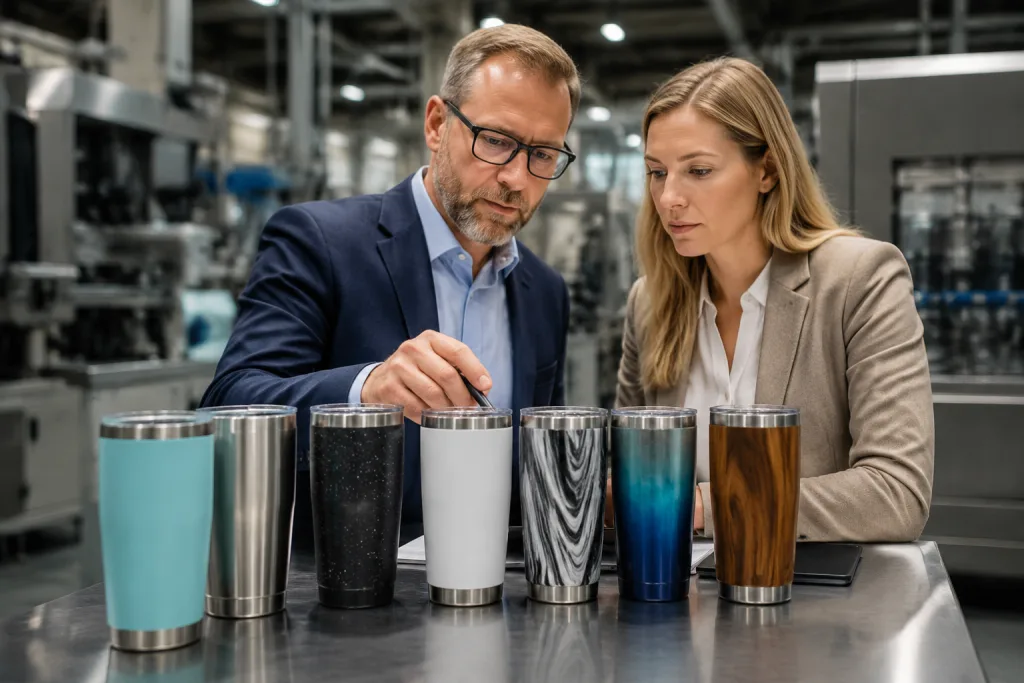
Laser engraving is clean, durable, and fast on powder-coated or stainless surfaces. We run it for a coffee mug custom project when the branding is one color and the order is around 1,000-5,000 pcs. Silk screen costs less for simple logos on smooth bodies, but curved walls and textured powder coat can push the print out of register by 1-2 mm. Heat transfer and water transfer handle larger artwork, gradients, or wrap designs, but the line adds hand alignment, film soaking, drying racks, and extra reject checks. For 3,000 pcs, expect sampling to take 7-10 days for laser or screen print and 12-18 days for full-wrap transfer artwork.
Powder coating is the standard finish for a bulk coffee mug because it feels current and hides fingerprints. The catch is powder batch control and curing temperature; the math doesn’t work if a buyer expects plastic-level color sameness on coated metal. If your brand color is strict, send Pantone references and accept that metal coating can vary by Delta E 1.5-2.5 even on a controlled line. For a coffee mug promotional order, that tolerance usually passes. For coffee mug private labeling sold beside your roasted coffee, approve a physical color chip, not a phone photo. We use a BYK gloss meter and color chip under the light box before releasing the coating batch.
At our Zhejiang facility, we keep golden samples for approved logo size, position, coating color, and carton marks. Boring work. It saves orders. We’ve seen this go sideways when a PO says “logo: black” but the approved sample was dark gray, so now QC tapes the signed sample and the carton mark printout to the inspection table before mass production starts.
Set Your Commercial Boundaries
The fourth decision is commercial: MOQ, price basis, payment, packing, and lead time. For a travel tumbler custom made program, we usually set 1,000 pcs for laser engraving on an existing model, 3,000 pcs for custom color and logo, and 5,000-10,000 pcs for a new lid, new mold, or exclusive shape. Mixed colors need a hard check: is the MOQ per style, per color, or per logo? We had one PO where “3 colors” was typed in the remark line, not the item table, and the buyer flagged the extra USD 420 setup cost after PI approval. That goes sideways fast.
For reference, a standard 16 oz stainless vacuum tumbler with powder coat and laser logo might quote around USD 3.20-4.80 FOB Ningbo or Shanghai at 3,000 pcs, depending on lid, coating, packaging, and steel weight. A retail gift box can add USD 0.25-0.55. A kraft tuck box costs less, but this is the wrong question to ask if the tumbler ships by courier. We run a 76 cm drop test on 3 sides and 1 corner; last month QC pulled the sample after two gift-box corners crushed at 11.8 kg carton weight. If you sell through marketplaces, confirm drop-test packaging at 76 cm and lock FNSKU labeling or carton barcode rules before artwork release.
Do not pick from a coffee mug supplier list or coffee mug supplier directory by the lowest line price alone. Ask each coffee mug oem manufacturer for the same quote sheet: EXW and FOB price, carton dimensions, gross weight, sample charge, mold charge if any, lead time after deposit, lead time after artwork approval, and HS code. Normal production lead time in China is 25-35 days after sample approval for repeat models, and 45-60 days when a new mold or custom lid is involved. On the line, a repeat 304 stainless body can move in 12 days after coating approval, but a new PP lid with a 0.3 mm fit issue can hold shipment to 18 days before packing even starts.
Check Compliance Before Artwork
Check compliance before your designer spends 12 days polishing a logo grid, then finds out the coating spec is wrong. For drinkware sold into the EU, we normally prepare LFGB food contact testing or material declarations matched to EU food contact rules, plus REACH review for powder coating, silicone rings, ink, gift boxes, and PE bags. For the U.S., buyers ask for FDA food contact compliance; retail orders going into California often need Proposition 65 review as well. Kids artwork is where we see orders go sideways. Last year QC pulled a 500 ml travel tumbler sample with a bear-face print, and the buyer flagged it because the PO said “adult promo mug” but the artwork looked like a children’s item.
Factory audits matter too. BSCI, Sedex, ISO 9001, and internal quality systems will not make a bad cup good, but they show whether the line is used to export paperwork, CAP reports, and buyer follow-up. If you buy corporate gifts for banks, airlines, or technology companies, your end client may ask for social compliance PDFs before they release the order. Get those files before the 30% deposit. Not during final inspection week. We have seen a shipment sit 9 days because the buyer’s compliance team wanted the latest Sedex report, and the PO had the factory name typed as “Hangzou” instead of Hangzhou.
Write quality control in numbers, not wishes. Use AQL 2.5 for major defects and AQL 4.0 for minor defects unless your client gives another standard. Define critical defects clearly: leakage after a 30-second upside-down test, sharp edges on the rim or handle, rust spots inside 304 stainless, wrong material grade, logo position off by more than 2 mm, or coating peel after a 3M tape pull. For insulation, we run 95°C water and check temperature after 6 hours in a 20-25°C room with a probe thermometer. The pass level depends on the model, but this is the wrong question to ask if you compare it with a single-wall coffee mug; a proper vacuum tumbler must beat it by a wide margin in bulk. Ask for pre-production samples, inline photos from the same assembly line, and final inspection photos from the same China factory that will ship the goods.
Decide Who Owns The Program
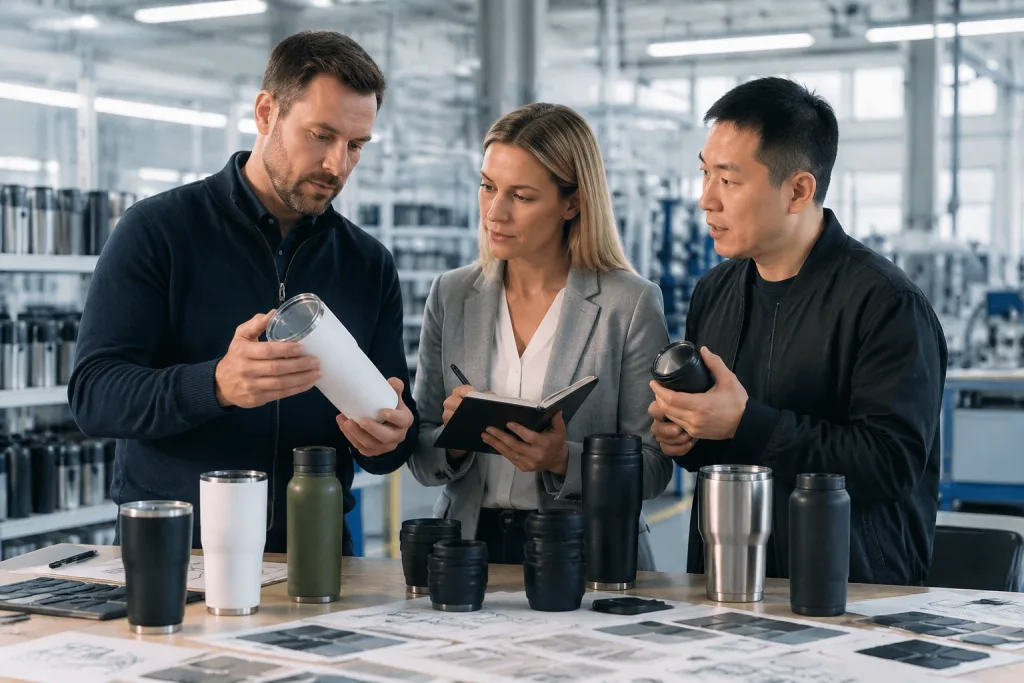
The last call is ownership. Are you buying 1 promo run, or setting up a repeat program for 4–6 drops a year? If you are a coffee mug distributor, or one of 12 coffee mug distributors feeding regional accounts, flexibility matters more than a fancy spec sheet: 500 pcs MOQ, stock powder-coat colors, and pad print or laser logo that we can run without opening new tooling. If you own a coffee brand, coffee mug private labeling needs a steadier setup: one locked body shape, custom insert card, retail barcode, and a quarterly replenishment forecast. We had a buyer last March change from matte black to PMS 426C after the PO was signed; QC pulled the pre-production sample under the D65 light box, and the line lost 2 days waiting for written approval.
Factory direct buying gives you control. It also gives you homework. You approve 2D drawings, logo artwork, box dielines, AQL 2.5 inspection points, and shipping documents before we ship. A trading company can make the emails feel easier, but you still need to know which coffee mug factory is welding the cups and whose name is on the material test report. This is where buyers get fooled. The phrase coffee mug factory direct means nothing if the supplier cannot show production photos, 304 stainless batch records, and the same factory name on the LFGB or FDA paperwork. We once saw a PO with the model code typed as “TM-900” instead of “TM-90”; that 1 zero would have put the wrong lid into 38 cartons if our packing clerk had not flagged it.
The practical choice is not complicated. Pick the use case first, then lock construction and decoration before you argue over 3 cents. Compliance and commercial terms come next. If 2 options look close, choose the one that lowers repeat-order risk; we’ve seen this go sideways when a buyer falls in love with a custom mold before checking reorder volume. A custom mold sounds strong in a meeting, but an existing stable body with your coating, logo, and packaging often sells better and launches 30 days faster. From Hangzhou, Zhejiang, we usually tell new buyers to start with 1 proven bulk travel mug model, 2 colors, 1 logo method, and a clean retail or gift box. Prove sell-through first. Then add handle versions, seasonal colors, or a higher-margin coffee mug customized set after the second PO clears inspection.
Send Us Your Tumbler Brief For Factory Review
Share capacity, quantity, logo files, target market, and deadline. We will check feasibility, MOQ, packaging, and FOB pricing before sampling.
Frequently asked questions
What is a realistic MOQ for a travel tumbler custom made order?
For existing models, 1,000 pcs is usually workable for laser engraving or simple one-color printing. If you need custom powder coating, expect 3,000 pcs because coating lines and color setup need volume. For a new lid, new handle, or exclusive body shape, the realistic MOQ moves to 5,000-10,000 pcs, plus mold charges that may run from USD 800 to over USD 5,000 depending on complexity. If you need four colors at 750 pcs each, ask whether the factory accepts 3,000 pcs total or requires 3,000 pcs per color. That single point changes your budget fast.
How long does custom travel tumbler production take in China?
For a repeat stainless steel travel tumbler with approved artwork, normal production lead time is 25-35 days after deposit and sample approval. Add 7-10 days for logo sampling, or 12-18 days for complex transfer artwork. If you require a new mold, plan 45-60 days before mass production is ready, sometimes longer if the first mold trial needs adjustment. Sea freight to North America or Europe can add 25-45 days depending on port and season. For fixed event dates, work backward from the delivery date and keep at least 10 days for inspection, customs paperwork, and booking.
Which logo method is best for a coffee brand tumbler?
For most coffee brands, laser engraving on powder coat is the safest balance of durability, cost, and premium look. It does not peel, and it handles daily use better than low-cost printing. Silk screen works well for simple one-color logos on smooth surfaces and can be cheaper for 3,000 pcs or more. Heat transfer is better for large artwork, gradients, or wraparound designs, but it adds cost and more inspection risk. If your coffee mug custom made project will be sold retail, approve physical samples under normal café lighting, not only studio photos.
Can you pack custom tumblers for corporate gifts or marketplace sales?
Yes, but packing should be specified early because it affects price, carton size, and damage rate. A plain white box may add around USD 0.12-0.20, while a printed retail box often adds USD 0.25-0.55 depending on paper weight and finish. For corporate gifts, buyers often request individual polybags, instruction sheets, belly bands, or custom inserts. For marketplace sales, you may need FNSKU labels, master carton barcodes, 76 cm drop-test packaging, and carton weight under 15 kg. Confirm whether the factory applies labels or whether your forwarder handles them after arrival.
How do I compare quotes from different coffee mug manufacturers?
Make every supplier quote the same specification. Ask for capacity, steel grade, body weight, wall thickness, lid material, logo method, finish, packing, carton dimensions, gross weight, MOQ, lead time, and FOB port. A USD 3.60 cup may be worse value than a USD 3.90 cup if it uses a lighter body, cheaper lid, or weak packaging. Also compare sample lead time, AQL terms, test report availability, and whether the supplier is the actual coffee mug manufacturer or only a reseller. Good factories answer these details directly; vague answers usually mean risk later.