Key Takeaways
- A 20 oz double-wall 304 tumbler usually lands at USD 3.20-5.80 FOB China depending on lid, coating, and packaging
- For coffee retail, choose 0.50-0.60 mm inner wall steel and a lid tested to 180° inversion for 30 seconds
- For corporate gifts, logo method and carton drop testing matter more than exotic insulation claims
- AQL 2.5/4.0 inspection and REACH/LFGB documents should be agreed before paying a 30% deposit
If you buy travel tumbler bulk for a coffee brand or a corporate-gift program, supplier search is the easy part. China has thousands. The real job is reading quotes that use the same words but mean different builds: 18/8 steel at 0.45 mm or 0.50 mm wall thickness, powder coat with 2H or 3H pencil hardness, “leakproof” lids that pass a 30-minute upside-down test or only a quick desk shake. We’ve seen a USD 0.80 cost gap hide inside those details, and the math doesn’t work when QC pulls 3 leaking lids from a 50-piece pre-shipment sample.
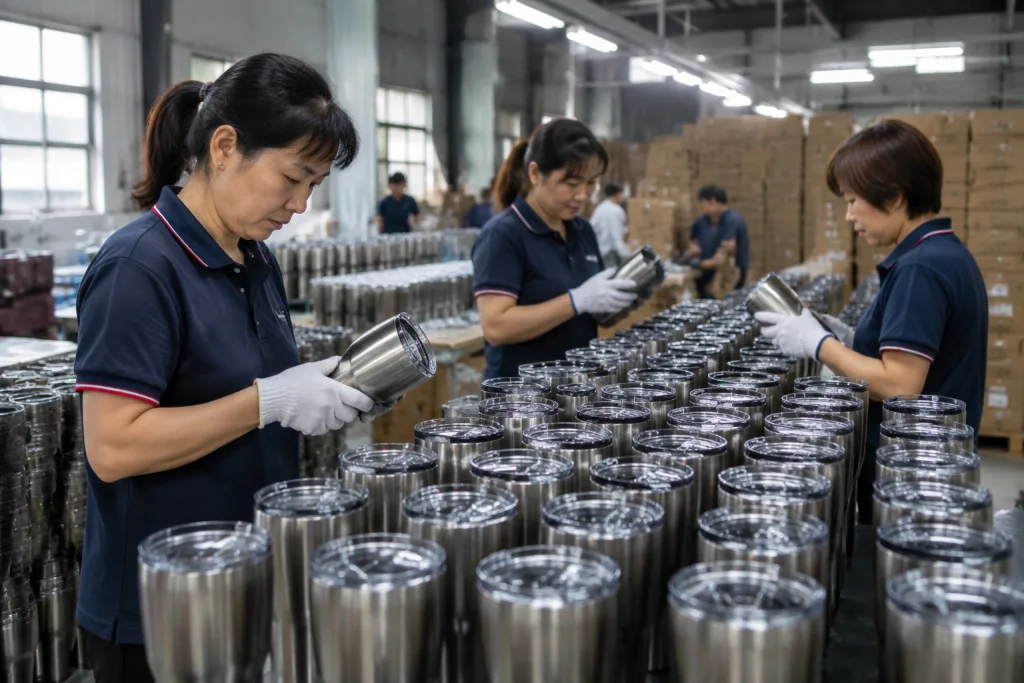
BottleForge Industrial is based in Hangzhou, Zhejiang, so we hear both buyer arguments every week: coffee brands want a premium bulk coffee travel mug, while gift buyers need the price to fit a fixed campaign budget. We run 480,000 units/month, normal MOQ starts at 1,000 units per color, and standard custom lead time is 25-35 days after sample approval. Last month, one buyer flagged a PO typo on “matte sand beige” versus “matte beige sand”; small wording, big problem once the line mixes powder in a 25 kg batch.
The head-to-head spec table
Cheap travel tumbler bulk quotes usually fall apart once we line up the BOM. Use this table before asking any coffee mug factory for a proforma invoice. We run the same check on our Hangzhou sample bench with a 0.01 mm micrometer, because “same 20 oz tumbler” can hide 6 or 7 cost gaps.
| Spec | Coffee retail line | Corporate gift line | Budget event line |
|---|---|---|---|
| Capacity | 16 oz or 20 oz, retail shelf size | 20 oz, safest for gift programs | 12 oz or 16 oz, lower freight weight |
| Steel | 304 inner, 201 or 304 outer | 304 inner, 201 outer | 201 inner not advised for coffee |
| Wall thickness | 0.50-0.60 mm inner, better dent control | 0.45-0.50 mm inner, common promo grade | 0.38-0.45 mm inner, price-driven build |
| Lid | Sliding or flip lid with silicone seal | Splash-resistant slider | Basic PP lid |
| Branding | Laser, 1-color print, or full wrap with artwork proof | Laser or pad print for logo jobs | 1-color silkscreen, simple position mark |
| Typical FOB | USD 4.10-5.80 | USD 3.50-4.90 | USD 2.65-3.40 |
If a coffee mug supplier quotes USD 2.90 for a 20 oz stainless double-wall tumbler with full-color print, retail box, and 304 steel, the math doesn't work. Something is missing. We have seen it show up as 0.38 mm inner steel, no lid gasket, powder coating that fails a 3M tape pull, or a 5-layer carton crushed after one courier cycle. Factory direct price only means something when the scope is complete.
For a coffee mug distributor, the retail line usually wins because repeat buyers notice lip feel, lid rattle, and coating scratches after 30 dishwasher cycles. QC pulled one black sample last month where the buyer flagged a 1.5 mm logo shift before we even packed the master carton. For a one-time corporate event, the middle column is often the better buy. You still get a respectable bulk travel tumbler without paying for features the recipient will never test.
Coffee brand or gift buyer
A coffee brand and a corporate-gift buyer are not buying the same cup, even when both type travel tumbler bulk into Google. The coffee brand needs a tumbler that can sit beside beans, capsules, or RTD cans without looking like a cheap add-on. The tumbler has to carry the brand. A corporate buyer is solving a packing job: 3,000 staff gifts, 200 event boxes, or a seasonal client pack. We see this mix-up often. The buyer flagged it once because the PO said “matte black,” but the reference photo showed a gloss lid, and QC pulled the sample before the line started.
If you sell through cafés, ecommerce, or subscription bundles, a coffee mug private label program usually fits better. You need stable colors, spare lids, barcode control, and packaging that survives shelf handling. A coffee mug custom made project might include an embossed lid, Pantone powder coating, and an insert card with care instructions. The extra USD 0.35-0.70 per unit makes sense if your retail margin is 55-65%. Ask for a color plaque first. On our Hangzhou line, we check powder-coat color under a D65 light box, because “cream white” can shift 1-2 shades after curing.
If you buy for HR, events, banking, insurance, or tech clients, treat the tumbler as coffee mug promotional products. Your priority is on-time delivery, clean branding, and fewer defect claims. A 20 oz bulk coffee tumbler with laser logo, kraft box, and 24 pcs/master carton is safer than a gradient print with three screens and tight registration. Simple wins here. We ship cartons at about 13-15 kg gross weight for this size, and the math does not work if a 5,000 pcs order gets held because the gradient edge has a 0.8 mm color drift.
One practical split: retail coffee mug customized orders should start with 2-3 pre-production samples and color plaques. Corporate orders can usually approve one golden sample plus a logo placement proof. In Zhejiang, China, our sampling cycle is normally 7-10 days for standard shapes and 15-20 days if you change lid tooling or add a molded accessory. We run the logo proof at actual size, not just on a PDF, because a 45 mm logo can look fine on screen and too heavy on a tapered wall.
Material choices that affect returns
Stainless steel travel tumblers look easy until the first 37 complaints land: metallic taste, rust dots near the weld line, or lids that wiggle after two weeks in use. For hot coffee, BottleForge recommends 304 stainless steel on the inner wall; we check incoming coil with an XRF gun before the line starts. Some low-cost coffee mug manufacturers push 201 stainless inside because it reduces cost by roughly USD 0.18-0.35 per unit. Fine for a dry outer shell. Bad math for coffee contact surfaces.
Double-wall vacuum insulation is the standard build for a bulk coffee mug made for commuting. We normally run 304 inner wall, 201 or 304 outer wall, optional copper lining, and a vacuum sealed base checked on the helium leak tester. Test it properly: 95°C water, room temperature 20-22°C, lid closed, no pre-heating trick. A good 20 oz tumbler should hold above 55°C after 6 hours. If a coffee mug manufacturer claims 12 hours hot but cannot show the test conditions, the buyer should push back for the report.
Coating drives returns faster than most buyers expect. Powder coating usually beats spray paint for scratch resistance on darker matte colors; QC pulled 24 black samples last month and the spray-painted batch showed edge chips after carton rub testing. We use cross-hatch adhesion testing and 3M tape pull after curing. For North America, ask about FDA food-contact materials. For Europe, request LFGB or EU 1935/2004 food-contact documentation, plus REACH statements for coatings and silicone parts.
Lid material should be named on the PO, not guessed from a sample photo. Tritan, AS, PP, and PS behave differently under heat and drop impact; we have seen one PO typo change “Tritan” to “transparent AS,” and the buyer flagged cracking after the 1.2 m drop test. Silicone rings should be removable for cleaning but not so loose that they fall out during packing. A coffee mug oem manufacturer should show lid gasket drawings or confirm the seal geometry in mm. This is where cheap bulk coffee travel mug projects go sideways.
Branding methods compared clearly
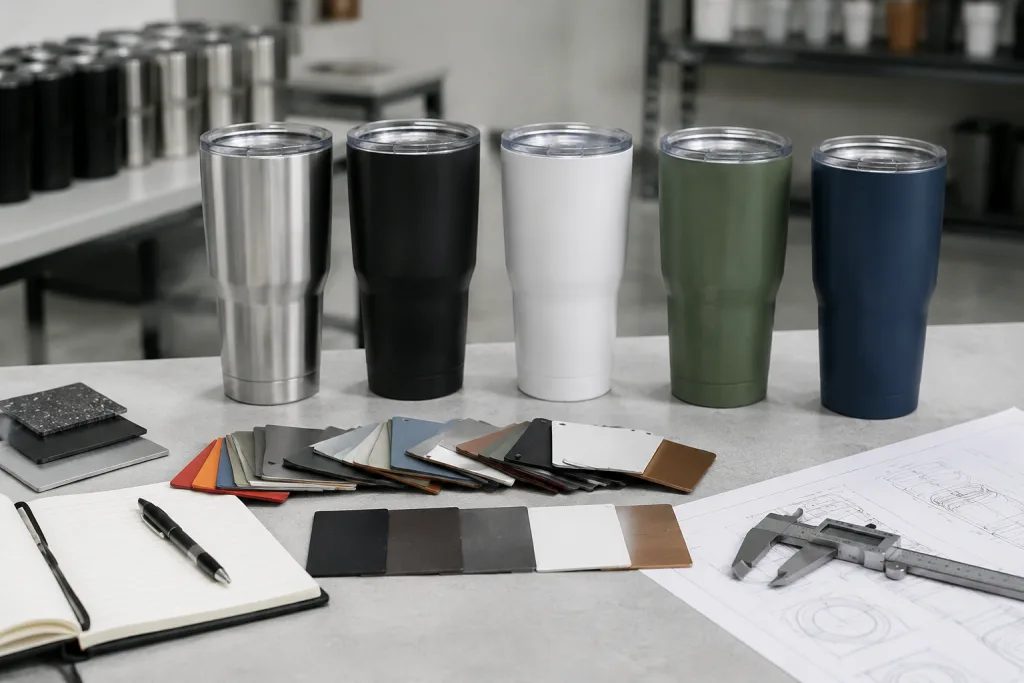
Logo decoration is where a coffee mug customizable project looks gift-ready or cheap. Laser engraving is our default for powder-coated stainless steel: the 20W fiber laser cuts through the coating and shows the 304 stainless underneath. No ink to migrate. No curing oven to blame. For corporate-gift buyers, laser is usually the first choice for 500-10,000 pieces because setup is fast, and QC pulled fewer than 8 rejects in a recent 3,000 pcs run.
Silkscreen printing works well for simple one- or two-color logos on straight walls. It is cost-effective, often USD 0.08-0.18 per position, but curved tumblers and tapered bodies limit the print area; our jig leaves about 3 mm safety space near the bend. Pad printing fits small marks on lids or uneven surfaces. Heat transfer and water transfer can create full-wrap artwork, but the math does not work for every travel tumbler bulk order: expect 1,000 pcs MOQ, sampling around 12 days vs 5 days for laser, plus 3M tape and scratch checks before we ship.
For coffee mug custom retail packs, color accuracy matters. Do not approve color from a phone photo; this is the wrong question to ask, because every phone makes the same beige look different. Ask for a coated steel color plaque or a physical sample under D65 lighting in a light booth. Pantone matching on powder coat is not the same as paper printing; a tolerance of Delta E 1.5-2.5 is realistic for many colors. Metallic, neon, and pale matte finishes need a sprayed plaque first, especially when the buyer flagged a “cream white” sample that measured 2.8 Delta E on our spectro.
Private-label buyers often ask for logo on tumbler, lid, bottom stamp, box, manual, and shipping carton. Fine, but every mark needs artwork control, or we have seen this go sideways at pre-shipment inspection. Provide vector AI with outlined fonts, EPS with spot colors, or PDF with the final logo size in mm. If you rely on a coffee mug supplier directory or coffee mug supplier list, filter out suppliers who cannot explain artwork limits. A trading listing may say yes to everything; a real coffee mug factory direct team will tell you what fails before production, like the PO typo “matte balck” that once delayed carton printing by 2 days.
MOQ, price, and order math
MOQ is not just a factory rule. It is where the math starts. For travel tumbler bulk orders, it comes from coating line changeover, steel coil purchasing, logo setup, and carton printing plates. At BottleForge in Hangzhou, Zhejiang, standard MOQ is 1,000 units per color for existing molds, 3,000 units for custom powder colors, and 5,000-10,000 units if you need a new lid mold or special retail packaging. We run the powder booth with a 28-minute color cleanout, so a 300-piece “test color” usually burns more labor than buyers expect. Smaller trial orders are possible, but the unit price climbs because the setup cost is spread over fewer pieces.
A realistic FOB China price for a 20 oz bulk travel mug starts around USD 3.20 for a standard body with a simple lid and 1-color logo. A stronger retail-grade bulk coffee mug usually lands at USD 4.10-5.80 when the spec includes tougher coating, 304 inner steel, a better lid seal, barcode label, and printed box. QC pulled one sample last month where the buyer wanted a USD 3.60 target, matte gradient coating, gift box, and laser logo. The math did not work. New tooling for a custom lid may cost USD 2,000-6,000 depending on complexity. Body mold changes can run higher, especially when the diameter shifts by 2 mm and the current welding fixture no longer fits.
For coffee mug private labeling, calculate landed cost before chasing the lowest FOB. Add ocean freight, duty, customs brokerage, local trucking, inspection, and Amazon or 3PL labeling if needed. A USD 0.25 cheaper mug can become expensive when the master carton is oversized or fails drop testing. We have seen this go sideways: one carton measured 62 cm on the long side, and the buyer flagged the warehouse surcharge after the PO was already approved. For FBA or retail distribution, carton weight should usually stay below 15 kg for easier handling.
Payment terms for new buyers are commonly 30% deposit and 70% before shipment after inspection. Established distributors may negotiate credit after 3-4 clean orders with no late balance payment and no AQL dispute. If a coffee mug distributor asks for exclusivity, tie it to annual volume, not geography alone. This is the wrong question to ask if the buyer only says, “We will promote your brand.” For example, 30,000 units/year per model is a more practical condition than a vague promise to promote the product. We once had a PO with the model code typed as BF-20T instead of BF-20L; the line caught it before carton artwork went to print.
Inspection before the balance payment
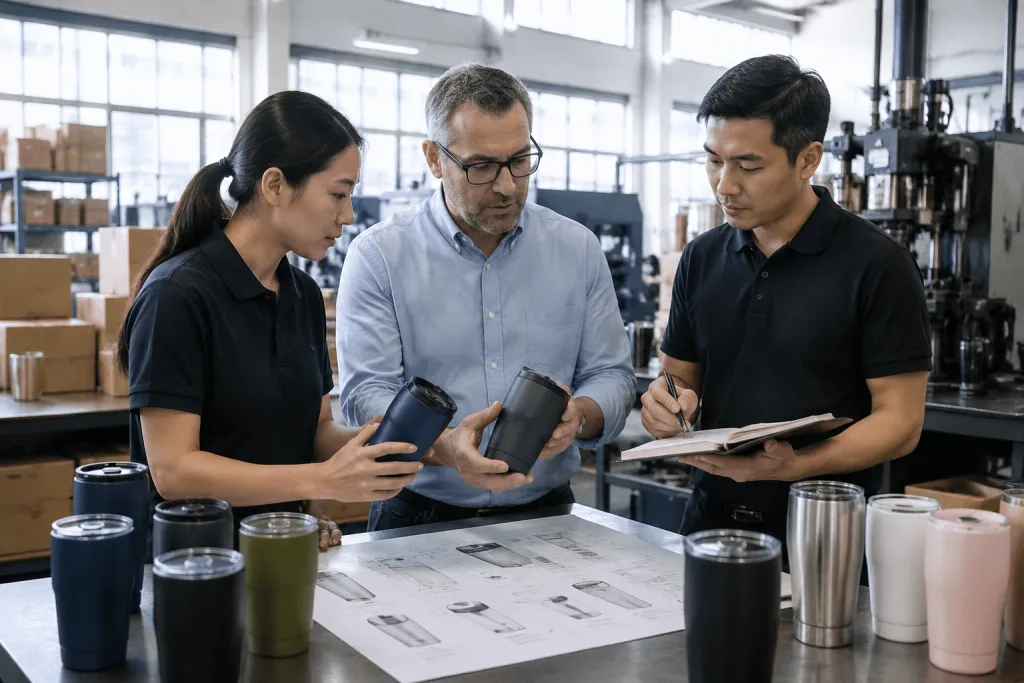
Do not leave QC until the cartons land in your warehouse; by then the balance is paid and the math does not work. For travel tumbler bulk, pre-shipment inspection should be booked when 80-100% of goods are packed. We run AQL sampling, commonly Critical 0, Major 2.5, Minor 4.0, and QC pulls sealed cartons from the pallet stack, not the tidy samples sitting on the office table. Critical defects include unsafe sharp edges, contamination, wrong material, or severe leakage. Major defects include logo shift over 2 mm, lid failure, dents bigger than 5 mm, coating peel, and wrong capacity.
A practical inspection checklist covers capacity check, vacuum performance, lid inversion, odor test, coating adhesion, barcode scan, carton drop, and packaging count, but each item needs a pass/fail rule. For a bulk coffee travel mug, we like a 180° inversion test for 30 seconds after filling with room-temperature water; QC writes the result on the inspection sheet and photographs the lid seam. For splash-resistant slider lids, do not call them leakproof unless they pass a more aggressive bag test, such as 10 minutes inside a polybag with 300 ml water filled. Buyers get into trouble when marketing language outruns the lid design. We have seen this go sideways.
Ask your coffee mug manufacturer for production photos, but photos are not inspection. A line supervisor can send 12 nice WeChat images and still miss a mixed lid color in carton 47. A third-party inspector in China can usually inspect one day for USD 250-350 plus travel if needed, using calipers, a scale, a barcode scanner, and the sealed golden sample. That is cheap insurance on a 5,000-unit order worth USD 20,000-28,000 FOB.
Collect documents before shipment: commercial invoice, packing list, bill of lading draft, test reports, material declarations, and factory audit if required. Some European buyers request BSCI, Sedex, or ISO 9001 evidence. Not every good coffee mug factory has every audit, but a serious supplier should answer clearly and send the current certificate, not a blurry PDF from 2019. We once had a PO typo on the consignee name caught before balance payment; after vessel departure, that small mistake costs 3 days and extra amendment fees. If the answer is vague, pause before paying the balance.
Best fit by use case
For coffee roasters selling merchandise, we usually steer buyers to a 16 oz or 20 oz coffee mug custom design with 304 inner wall, powder coat, laser logo, and printed retail box. Clean shelf look. QC pulled a 20 oz sample last month and checked the laser mark at 55 mm wide against a Pantone-matched matte black body; that kind of control helps the mug sell at retail instead of looking like a free event item. If you run 4 seasonal drops a year, keep the mold stable and change color or artwork. New tooling for every drop is the wrong question to ask. The math doesn't work.
For corporate gifting, the safer value is a 20 oz bulk coffee tumbler with 304 inner wall, 201 outer wall, slider lid, laser logo, and kraft box. We run this spec often because it feels professional, keeps coffee warm through a 45-minute commute, and avoids the artwork problems that show up on curved bodies. The buyer usually flags two things: lid fit and gift-box dents. If the program needs individual mailing, add mailer cartons and run 10-drop checks from 76 cm before you approve the packing.
For distributors building a catalog, do not list 12 near-identical models and expect the sales team to explain them. Pick one slim cup-holder model, one handle tumbler, one ceramic-lined option, and one lower-cost event mug, then give each model a clear job. On the line, the difference is real: handle tumblers need extra fixture checks so the handle sits straight within 2 mm, while event mugs need faster packing and a realistic MOQ. Coffee mug distributors make better margins when they sell use-case differences instead of pushing every inquiry to the cheapest quote.
For buyer teams using a coffee mug supplier list, ask 3 factories for the same spec sheet and compare line by line. Include steel grade, thickness, lid resin, silicone grade, coating method, logo size, box type, carton size, MOQ, lead time, and FOB port. In China, Ningbo and Shanghai are common export ports for Zhejiang factories. We have seen this go sideways when a PO says “304 stainless” but the attachment says 201 outer only, so check the PDF, the PI, and the carton mark before deposit. The supplier who answers with numbers, like 0.5 mm inner wall and 18 days lead time, is safer than the supplier who only says, yes, no problem.
Send your tumbler spec and target landed cost
BottleForge will review the construction, logo method, MOQ, and packaging before you commit budget to a bulk production run.
Frequently asked questions
What is the normal MOQ for travel tumbler bulk orders?
For existing travel tumbler molds, a practical MOQ is 1,000 units per color with one logo. Custom powder coating normally starts at 3,000 units because coating lines waste time and material during color changes. If you need a new lid mold, molded grip, or custom body shape, expect 5,000-10,000 units and tooling charges from USD 2,000 upward. Some suppliers accept 300-500 units, but the price may be 20-45% higher and color options are limited. For coffee brands testing a new product, we usually suggest 1,000 units in one core color rather than splitting into four weak colors.
How much should a 20 oz bulk coffee travel mug cost?
A standard 20 oz stainless bulk coffee travel mug usually costs USD 3.20-5.80 FOB China. The lower end normally means standard color, simple lid, 201 outer wall, 304 inner wall, and basic white box. The higher end covers stronger powder coating, better slider or flip lid, laser logo, barcode label, retail packaging, and stricter inspection. Ceramic lining, handle lids, full-wrap graphics, or individual mailer cartons can add USD 0.40-1.50 per unit. If a quote is far below USD 3.00 for a double-wall 20 oz tumbler, check steel grade, wall thickness, lid seal, and carton strength before you compare it as equal.
Which logo method is best for coffee mug promotional orders?
For coffee mug promotional orders, laser engraving is usually the safest method on powder-coated stainless steel. It is clean, permanent, and fast for 500-10,000 units. Silkscreen is cheaper for large one-color artwork, often USD 0.08-0.18 per print position, but it needs a smooth print area and proper curing. Full-wrap heat transfer looks impressive but adds cost, sampling time, and scratch-test risk. If your delivery date is fixed, choose laser or simple silkscreen. If the tumbler is for retail sale at USD 18-30, invest in physical logo samples before approving production.
Can you handle coffee mug private labeling for retail?
Yes, private labeling can include logo on the tumbler, bottom mark, care card, printed retail box, barcode label, master carton mark, and pallet label. For coffee mug private labeling, we ask for vector artwork, Pantone references, barcode files, and packaging dielines if you already have them. Standard private-label sampling takes 7-10 days for existing models and 15-20 days for special packaging or lid changes. For retail and ecommerce, confirm carton quantity, carton dimensions, gross weight, and scannable barcode placement before mass production. These details affect warehousing, distributor intake, and FBA-style receiving more than many first-time buyers expect.
What tests should we require from a coffee mug factory?
For a coffee mug factory order, require food-contact material checks, vacuum performance testing, lid fit testing, coating adhesion, odor review, and carton drop testing. For Europe, request LFGB or EU 1935/2004 food-contact documents and REACH statements for coating and silicone. For North America, ask for FDA food-contact compliance and, if relevant, ASTM or CPSIA review for child-oriented designs. Use AQL inspection before shipment, commonly Critical 0, Major 2.5, Minor 4.0. On a 5,000-unit order, paying USD 250-350 for a third-party inspection in China is usually cheaper than handling returns after delivery.