Key Takeaways
- A practical travel mug wholesale MOQ starts at 1,000 pcs per color for powder coating and 3,000 pcs for custom molded lids
- 18/8 stainless steel with 0.45-0.55 mm outer wall is the usual safe range for reusable corporate gifts
- Laser engraving is stable for 5,000+ handling cycles, while low-grade transfer print often fails before 100 dishwasher cycles
- AQL 2.5/4.0 inspection plus LFGB, REACH, and FDA food-contact checks should be locked before deposit
Buying travel mug wholesale for a coffee brand or corporate-gift program is not about picking the best studio photo. The hard part is spotting the spec line that creates 6% returns, adds USD 0.18 per carton in freight, or makes a laser logo look washed out after 90 dishwasher cycles. We see this on the line: QC pulled a black powder-coated sample last month, and the logo edge was already fuzzy under a 10x loupe.
Our Hangzhou, Zhejiang team sees this same mix-up every season. A buyer compares one bulk coffee travel mug at USD 2.10 with another at USD 4.20, then asks why the cheaper one cannot pass the same drop test. Wrong question. A coffee mug factory in China can build both, but the quote sheet often hides 0.4 mm vs 0.6 mm wall thickness, PP vs Tritan lid material, spray coating vs powder coating, and whether we run basic in-line checks or AQL 2.5 final inspection. You need to know what you are approving before the PO lands with “matte balck” typed in the color line.
Start With Capacity And Use Case
Capacity looks simple on a spec sheet, but it decides most of the money in travel mug wholesale: mold choice, carton size, freight, shelf price, and refill frequency. For coffee brands, 12 oz and 16 oz are the safe sizes because they match common café portions and pass the cup-holder gauge we keep beside the packing table. For corporate gift buyers, 20 oz usually works better; it feels heavier on a desk, but the carton still stays inside a sensible courier weight.
Do not approve a bulk travel mug just because the catalog says 500 ml. Ask for filled weight, brimful capacity, and recommended serving capacity, then have QC pull the sample and weigh it with water and lid fitted. Small gap, big complaint. A 500 ml tumbler can hold only 450 ml comfortably once the lid and drinking clearance are counted. If your campaign promises a 16 oz coffee mug custom made for commuters, that 50 ml shortfall gets flagged fast.
For coffee mug promotional products, shape changes the logo area as much as capacity does. A straight-wall tumbler gives a wider print window, usually 70-90 mm high, and our pad-print fixture holds it steadier during logo alignment. A tapered car-cup style photographs well in a cup holder, but it leaves less room for wraparound artwork and small legal text. If you sell through a coffee mug distributor network, pick a capacity that covers two sales channels, not one trendy SKU. We have seen that go sideways.
In Zhejiang, we run a common production split: 12 oz for café retail, 16 oz for subscription-box gifts, and 20 oz for corporate orders. A practical first order is 1,000 pcs per color, with 30-35 days production after artwork and pre-production sample approval. Last month a buyer typed “matte balck” on the PO, so we now confirm color codes against the sample card before the line opens.
Steel Grade Is Not Decoration
The material line should never stop at “stainless steel.” For a credible bulk coffee tumbler, ask if the inner wall is SUS304, also sold as 18/8 stainless steel. It contains about 18% chromium and 8% nickel, so coffee, milk, tea, and weak acids do less damage over time. SUS201 looks fine in a new sample room photo, but it is a cost-down steel. We do not recommend it for coffee mug private label programs in Europe or North America. Last April, QC pulled 12 inner cups from a trial lot and the XRF gun showed 201 on 3 pieces, even though the PO typed “304 stainless” on line 6. That shipment stopped.
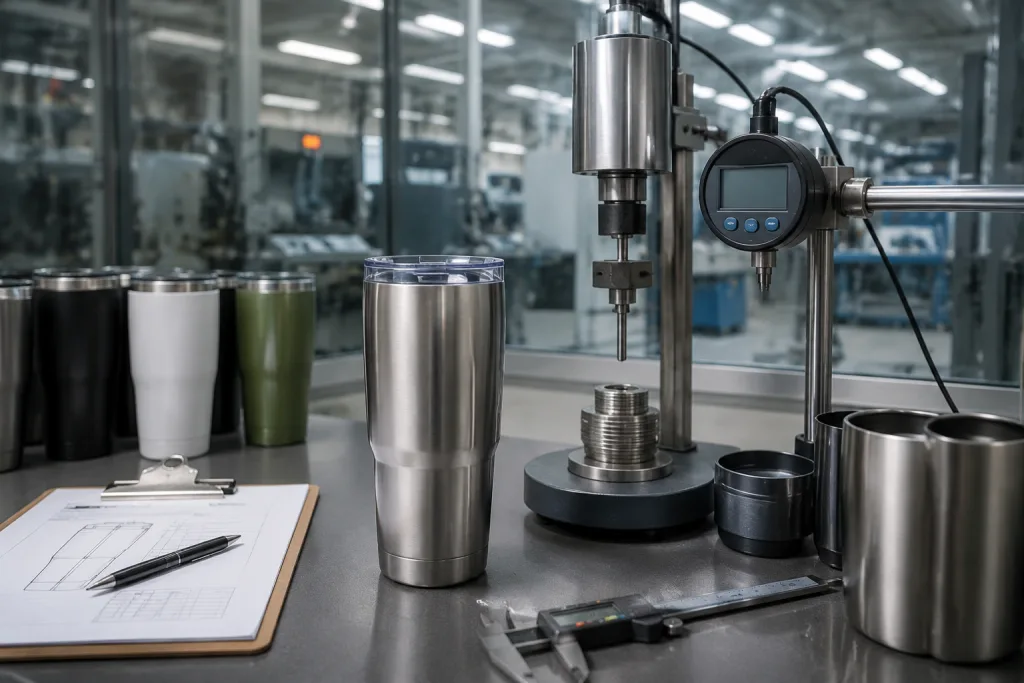
Wall thickness is another quiet cost driver. A common durable build is 0.45-0.55 mm for the outer wall and 0.35-0.45 mm for the inner wall. Thin walls reduce USD 0.10-0.25 per piece, depending on size, but dents show up faster during shipping and retail handling. We run a simple carton drop from 76 cm before mass production; on thin 500 ml bodies, the buyer flagged 7 dented cups out of 80 after the third edge drop. If your customers throw the mug into backpacks, this is the wrong place to save money.
Ask the coffee mug manufacturer to declare steel grade on the quotation and keep material test reports on file. For the EU, LFGB and REACH documentation is often requested by distributors. For the US, FDA food-contact compliance is standard, and some buyers ask for California Proposition 65 review depending on the decoration and coating. Put it in writing. We prefer seeing “inner SUS304 / outer SUS201 or SUS304” on the quote, not a loose WhatsApp reply, because one missing steel note can add 5-7 days when the merchandiser has to chase the mill certificate.
A real coffee mug oem manufacturer should be comfortable discussing gauge, steel origin, passivation, and salt spray expectations. If a coffee mug supplier only replies “food grade, no problem,” push harder. The math doesn't work if the sample passes but the line switches steel after deposit. Factory direct buying in China gives you better control, but only if you define what “food grade” means before tooling, sampling, or deposit. On our side, we write it into the BOM and let QC check the first 30 pcs before polishing starts.
Vacuum Performance Needs Numbers
Insulation claims are where 7 out of 10 new coffee mug distributors get burned. “Keeps hot 12 hours” means nothing unless the test method is written on the spec sheet. We run this with a calibrated probe, not a finger check: starting liquid temperature, room temperature, fill level, lid position, and measurement intervals all go into the test log. For a 16 oz double-wall vacuum tumbler, a realistic target is hot water starting at 95°C, still above 60°C after 6 hours at 20°C room temperature. Cold performance is easier to pass. Water at 4°C should stay below 10°C for 8-12 hours depending on lid design; last month QC pulled a slider-lid sample that missed by 1.8°C because the silicone plug sat 0.6 mm proud.
Vacuum quality comes from welding, evacuation process, and base sealing, not from a nice catalog photo. We check the base weld bead with a 0.02 mm feeler gauge when the line starts, because one weak seam can turn a 12-hour claim into a 4-hour complaint. Copper lining can improve performance by cutting radiant heat transfer, but it adds cost, often USD 0.15-0.35 per piece. For a premium coffee mug customized program, copper lining is worth considering. For a low-budget bulk coffee mug promotion handed out at a conference, the math usually doesn’t work; a standard vacuum chamber is enough if the reject sorting is tight.
Buyer impact is practical. If the tumbler is sold by a coffee brand, insulation is part of the promise printed on the sleeve. If it is a one-time corporate gift, leak resistance and surface finish may matter more than a 2-hour difference in heat retention. Do not over-spec a product your user will drink within 45 minutes. We’ve seen this go sideways: a buyer pushed for copper lining on a 3,000 pcs event order, then flagged a USD 0.28 increase per piece after the PO was already typed with the wrong “matte balk” color note.
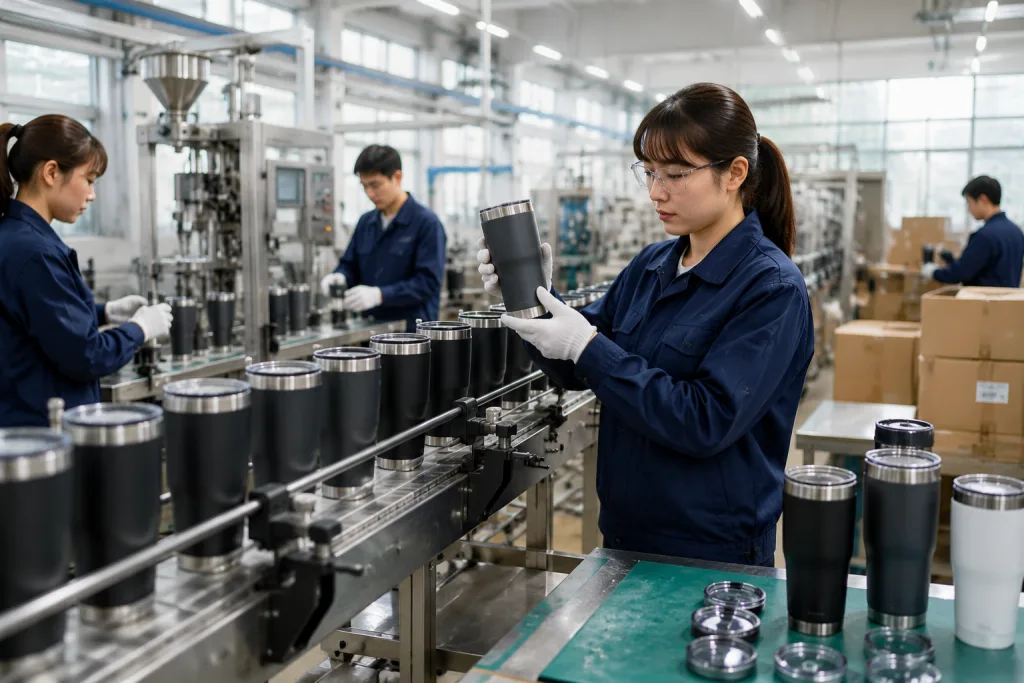
At BottleForge Industrial in Zhejiang, our travel tumbler lines can output about 420,000 units/month across standard molds. We still recommend insulation testing on pre-shipment inspection, not just during sampling. A factory can make one excellent sample and still drift in mass production if vacuum rejection sorting is weak. On the floor, we run vacuum checks by batch, and QC marks failed cups with a paint pen before packing; on one 18,000 pcs run, 312 pcs were pulled before carton sealing because the base plug test showed slow heat loss.
Lid Design Decides Daily Complaints
The lid is where a bulk travel tumbler wins the reorder or gets blamed by the buyer. The stainless body is the easy part. The lid has PP or Tritan, silicone, sliders, threads, gaskets, and sometimes a small spring that the line operator has to seat by hand with tweezers. One loose gasket at final QC means odor calls, leakage photos, rattle complaints, or “hard to clean” feedback within the first week. For coffee mug in bulk orders, we run PP or Tritan on drinking contact parts, with silicone gaskets that can pass FDA or LFGB testing.
Be careful with the word “leakproof.” Buyers push on this word hard, and we’ve seen it go sideways. A flip lid with a silicone plug is leak-resistant when upright or tilted for 10-15 seconds. A threaded bottle-style lid can be tested inverted for 30 minutes and still pass. A slide lid on a desk tumbler is splash-resistant, not bag-safe. QC pulled one slide-lid sample last season after 6 ml leaked during a simple backpack shake test. If your corporate buyer wants employees to carry the mug inside a laptop bag, don’t choose a sliding sip lid and call it leakproof.
For coffee mug customizable programs, lid color gets missed until the PO is almost finished. Matching a custom Pantone lid may require 3,000-5,000 pcs MOQ because the plastic part needs its own color run, its own masterbatch, and a cleaned injection machine. Black and clear usually move faster because factories keep them in stock; smoke gray and white are also common on our shelf bins. If you need 800 pcs with a special blue lid, the math doesn’t work without a surcharge or a compromise. We once had a PO typo, “Panton 2935C,” and the buyer flagged the shade only after the first T1 lid samples came out.
Ask for lid cycle testing. Don’t ask only for a pretty sample. A reasonable internal benchmark is 3,000 open-close cycles for flip mechanisms and 24-hour gasket compression recovery checks, measured after the silicone ring sits compressed in the groove. We use a small cycle jig on the line and record the hinge looseness in mm before packing. Also request spare gasket availability. A coffee mug supplier directory will list 40 vendors in 10 minutes, but only a real coffee mug factory direct partner will tell you which lid design has the lowest after-sales risk.
Finish And Logo Are Not Afterthoughts
Surface finish changes the shelf feel more than buyers expect. We run powder coating on most travel mug wholesale orders because it gives a steadier grip, deeper color, and a matte finish that looks better under retail lighting. Standard powder coating adds roughly USD 0.25-0.55 per piece compared with polished stainless, depending on color, size, and order quantity. On the line, QC checks coating thickness with a 0-500 μm gauge; for 30 oz tumblers we usually see 55-75 μm after curing. Spray paint can save USD 0.08-0.18 per piece, but the math doesn't work if the buyer later rejects cartons for scuffs after a 3M tape pull or 1 kg rub test.
For coffee mug custom decoration, start with the user and the logo artwork. Laser engraving is clean and permanent on stainless or powder-coated bodies; we use it for executive gifts and coffee mug private labeling where the logo should feel cut into the product, not pasted on. Silkscreen printing suits one- or two-color artwork once the order reaches about 1,000 pcs per color, and the screen frame cost is easier to spread. Heat transfer handles gradients and full-color designs, but QC pulled the sample twice last month because the edge lifted near the curved wall after 24 hours in the adhesion test.
Dishwasher claims need proof. Many powder-coated mugs are sold as hand-wash recommended because dishwasher detergent and heat attack coating and printed logos. If dishwasher safety is part of your sales copy, ask for 50-100 cycle test results, and ask which detergent, water temperature, and rack position were used. We have seen this go sideways: a buyer approved “dishwasher safe” on the carton, then the lab found logo fading at cycle 38 and the PO had to be revised before mass packing.
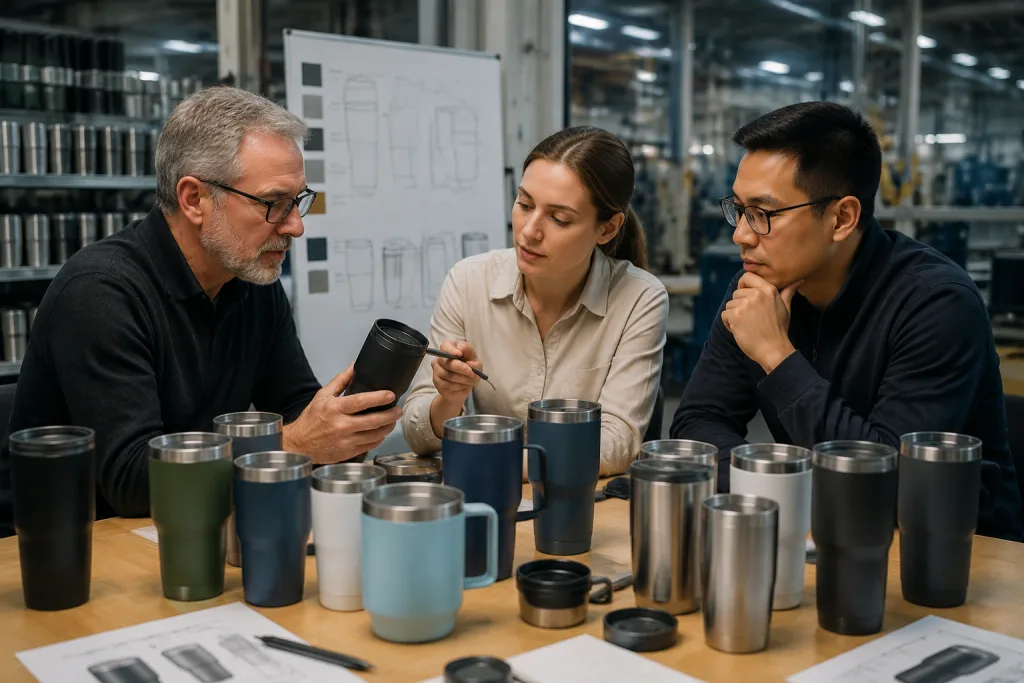
Artwork control matters. Send vector files, Pantone references, exact logo position, and print size in millimeters. For a coffee mug custom made order, approve a physical pre-production sample, not only a 3D mockup. A mockup hides curvature, seam alignment, color shift, and how small text actually reads on a 75 mm print area. Last week one PO said logo 70 mm wide, but the PDF showed 78 mm; the buyer flagged it only after we placed the film on the body with a caliper, which saved 3 days of rework.
Packaging, Cartons, And FBA Rules
Packaging is not just a box around the mug. It controls breakage, warehouse scans, and landed cost. For a standard 16 oz bulk coffee travel mug, we usually run a white tuck box or 350 gsm kraft box for corporate gifting. Retail buyers ask for a printed color box with E-flute protection when the shelf face matters. Gift sets can use EVA inserts, paper sleeves, or mailer cartons, but this is where the math often fails: one buyer pushed for a foam insert and the carton grew from 51 cm to 58 cm high, cutting the container load by 9%.
Typical master carton packing is 24 pcs or 48 pcs, based on tumbler diameter and box style. A 20 oz mug in individual retail packaging may ship at 0.018-0.024 CBM per piece after master carton calculation. That changes the FOB Ningbo or FOB Shanghai comparison fast. We once had QC pull a 20 oz sample packed in a 92 mm wide color box; the mug was fine, but the empty space pushed the master carton past 15 kg gross weight at 24 pcs. A USD 0.20 cheaper mug can cost more if the packaging wastes container space.
If you sell through marketplace channels, lock the barcode plan early. Put FNSKU labeling, suffocation warnings for polybags, carton weight limits, and the drop-test standard into the purchase order. Better yet, attach the label artwork as a PDF, not a WeChat screenshot. We have seen this go sideways: the PO said “Amazon lable,” cartons were sealed, and the line had to reopen 312 cartons with a carton knife and tape gun. Do not ask the coffee mug factory to add Amazon labels later after cartons are sealed. Rework costs and delays are not a surprise.
For coffee mug distributor and coffee mug distributors serving multiple corporate clients, neutral packaging can beat branded retail boxes. You can hold stock and relabel for different programs. Simple wins. For coffee mug factory direct sourcing, ask for a packing diagram, carton dimensions, gross weight, and HS code before final quote approval. Our packing table lists carton size in mm, GW/NW in kg, and pcs per carton; if a supplier only says “standard export carton,” push back before paying the deposit.
Quality Plan Before The Deposit
A specification only earns its keep when the factory checks against it on the line. Before the deposit, lock the quality plan in writing: material certificates, sealed pre-production sample, inline inspection, final random inspection, and AQL levels. A common standard is AQL 2.5 for major defects and 4.0 for minor defects. Critical defects such as sharp edges, contamination, serious leakage, or unsafe materials should be zero tolerance. We run this off a signed QC checklist, not a WeChat promise; last month QC pulled the sample and found one lid gasket was 0.6 mm thinner than the approved PP/TPE drawing.
Define defects in writing. Be blunt. A 0.3 mm black dot on the base is not the same as a 22 mm scratch across the logo, and a lid that leaks after 10 seconds inverted is not the same as one drop from condensation. If defect judgment stays vague, the supplier and inspector will make their own calls, and we have seen this go sideways during final random inspection. One buyer once wrote “logo must be nice” on the PO; the inspector had no standard for color shift, so we now ask for Pantone code, logo position tolerance in mm, and one approved golden sample on the QC table.
Payment terms belong in the buyer plan too. For first orders from a coffee mug manufacturer in China, 30% deposit and 70% before shipment is common. For repeat programs with stable volume, better terms can be discussed, but payment pressure is the wrong substitute for inspection. If the goods are wrong, the math does not work; a 3% discount will not repair 6 cartons of leaking mugs already sitting in your Amazon 3PL. We have had buyers push back on pre-shipment inspection cost, then ask us to sort 1,200 lids by hand after QC found loose flip caps with a simple torque test.
Use a coffee mug supplier list as a starting point, not a sourcing strategy. Shortlist factories that answer technical questions clearly, give lead times they can actually hit, and support your SKU after launch. Our Hangzhou, Zhejiang factory typically quotes standard travel tumblers at MOQ 1,000 pcs/color, sample time 7-10 days, and mass production 30-35 days after sample approval and deposit. On our line, we check carton drop marks, inner box fit, barcode scans, and lid thread feel before we ship; one PO typo changed “matte black” to “mate black,” and the buyer flagged it only because we sent the pre-production label photo before printing 1,000 color boxes.
Send your travel tumbler spec for a factory quote
Share capacity, logo, lid type, quantity, and target market. We will return a practical FOB China quote with MOQ and lead time.
Frequently asked questions
What is a realistic MOQ for travel mug wholesale orders?
For standard molds, a realistic MOQ is 1,000 pcs per color for powder-coated stainless travel mugs. If you choose stock colors and laser engraving, some factories in China may accept 500 pcs, but the unit price will usually rise by USD 0.30-0.80. Custom Pantone coating is normally 1,000-2,000 pcs per color because the coating line has setup loss. Custom molded lids, special silicone colors, or exclusive body shapes often start at 3,000-5,000 pcs. For coffee brands testing retail demand, I usually suggest starting with one 16 oz model, two colors, and one decoration method instead of spreading 2,000 pcs across five weak SKUs.
How much should a custom bulk coffee tumbler cost?
For FOB China pricing, a 16 oz double-wall stainless bulk coffee tumbler usually falls around USD 3.20-5.80 depending on steel thickness, coating, lid type, logo method, and packaging. A very basic polished stainless unit may sit near the low end. Powder coating, copper lining, retail color box, and laser engraving push the quote upward. Do not compare only unit price; compare carton CBM, defect allowance, test reports, and whether the supplier includes pre-production samples. A coffee mug factory direct quote can be cheaper than a trading quote, but only if the specification is complete. Otherwise, the cheapest quote often removes material or QC you assumed was included.
Which logo method is best for coffee mug promotional products?
For coffee mug promotional products, laser engraving is the safest choice when the body is stainless or powder coated and the design is simple. It will not peel and handles daily abrasion better than most prints. Silkscreen printing works well for 1-2 color logos when you need lower cost on 1,000-10,000 pcs. Heat transfer is useful for full-color artwork, but you should request adhesion testing and at least 50 dishwasher-cycle evidence if dishwasher claims matter. For corporate gifts, I prefer laser on matte black, navy, or white. For café retail shelves, a clean silkscreen logo plus printed color box often gives better brand visibility.
Can I use one tumbler for both retail and corporate gifts?
Yes, but choose the spec carefully. A 16 oz or 20 oz stainless travel mug with 18/8 inner steel, powder coating, and a reliable sip lid can work for both retail coffee sales and corporate gifting. The packaging is the bigger issue. Retail wants a color box, barcode, product claims, and sometimes multilingual compliance text. Corporate gifts often want neutral kraft packaging or a presentation box. You can solve this by producing the same tumbler body and splitting packaging during production. For example, 3,000 pcs total can be packed as 1,500 retail color boxes and 1,500 corporate kraft boxes if this is planned before carton printing.
What checks should I require before shipment?
Require a final random inspection using AQL 2.5 for major defects and 4.0 for minor defects. The checklist should include capacity, weight, logo position, color match, coating scratches, lid fit, leakage, odor, insulation, carton markings, and barcode scanning. For leakage, test a defined sample size inverted for 30 minutes if the lid is sold as leakproof. For insulation, test hot water at about 95°C and record the temperature after 6 hours. Also check documents: FDA or LFGB food-contact reports, REACH where needed, and BSCI or ISO factory information if your customer asks. Do this before the 70% balance payment, not after the container leaves China.