Key Takeaways
- A 3,000-unit MOQ usually starts near USD 3.20-5.80 FOB for stainless travel tumblers
- Custom tooling can add 15-25 days before mass production if the lid or mold changes
- Laser engraving is slower but durable; silkscreen is cheaper for 1-2 color logos
- Plan 45-75 days door-to-door for China production plus sea freight to Europe or North America
If you are buying travel mugs for a coffee brand, staff gift, loyalty campaign, or retail bundle, finding a mug is the easy part. The real question is why one quote comes in at USD 2.85 and another at USD 6.40 when the PDF photos look almost the same. We see this every week. The gap usually sits in 304 stainless thickness, lid mold complexity, powder coating pass rate, gift-box paper weight, logo process, AQL 2.5 inspection time, and how many hours the line must block for your order. Last month QC pulled a 20 oz sample with a 0.35 mm body wall against a buyer’s requested 0.42 mm; the photo looked fine, but the cost was not the same product.
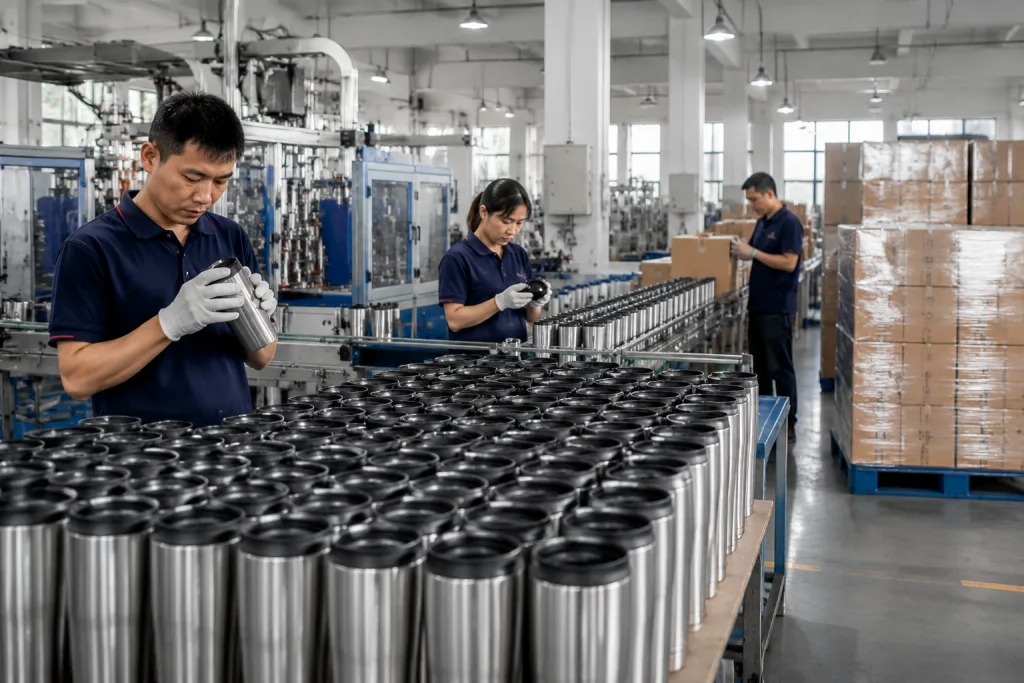
BottleForge Industrial manufactures drinkware in Zhejiang, China for distributors, coffee brands, and corporate-gift programs. We run practical orders from 3,000 to 80,000 units, with normal production lead time of 25 to 45 days after sample approval. For a coffee mug custom made without surprises, the catalog photo is the wrong place to start. Start with target cost, delivery date, logo method, and carton requirements. We ship from Hangzhou-area lines, and one typo on a PO—“matte balck” instead of “matte black”—has delayed a color sample by 3 days before, so the boring details matter.
Start with the landed cost
For travel mug wholesale bulk buying, the FOB unit price is just the opening line on the sheet. Build the landed cost before you approve a shape: mug body, inner box, master carton, logo process, barcode label, inspection, sea or air freight, duty, local trucking. We run this check on every new item because a USD 0.40 “saving” disappears fast if the 5-ply carton crushes at the corner, QC pulls a leaking lid after a 1.2 m drop test, or the buyer’s warehouse rejects pallets over 1.65 m.
For a common 350-500 ml stainless bulk coffee travel mug, factory-direct FOB China pricing usually sits in these working bands: single-wall stainless at USD 2.20-3.80, double-wall vacuum at USD 3.20-6.50, powder-coated retail-grade tumblers at USD 4.20-8.20. Not a promise. These ranges come from 3,000-20,000 units with 304 stainless inner wall, PP or Tritan lid, and standard color options; last month our line quoted 5,000 pcs matte black, and the buyer flagged a USD 0.12 jump after changing from spray paint to powder coating.
Packaging moves the number more than 7 out of 10 new buyers expect. A plain white box may add USD 0.18-0.35. A full-color gift box often adds USD 0.45-0.90, with the real swing coming from 350 gsm versus 400 gsm paper, matte lamination, and whether the insert is folded E-flute or molded pulp. If your coffee mug promotional products need individual mailer protection, add another USD 0.25-0.60. For Amazon or distributor programs, quote FNSKU labeling and mixed-SKU packing early; we have seen a PO typo on “24 pcs/ctn” versus “12 pcs/ctn” add 18 cartons and mess up the freight math.
Ask every coffee mug supplier for FOB price, carton dimensions, gross weight, HS code, and sample cost in the same email. Without those details, you are comparing decoration photos, not actual procurement cost.
What changes the unit price
Construction moves the unit price first. A double-wall vacuum bulk travel tumbler uses more 304 stainless, extra drawing and trimming on the line, copper coating if the buyer specs it, vacuum sealing, and a 95°C hot-water thermal check. A single-wall bulk coffee mug costs less. It also burns fingers with hot coffee and feels cheap for a premium coffee brand; we had a German buyer reject a 220 g sample for exactly that reason. For most corporate-gift buyers, 0.4 mm inner wall and 0.5 mm outer wall is a sensible starting point. Go thinner and the math looks better on the quote sheet, but QC pulled 37 dented pieces from one 3,000 pcs pre-shipment lot after carton drop testing.
Lid design is the second price swing. A basic push-on lid is cheap and fast; we can usually run it on existing tooling with a 3-5 day color chip check. A slider lid, flip lid, or leak-resistant button lid adds mold parts, silicone fit control, and reject risk at assembly. If you ask for a coffee mug custom design with a new lid color, silicone ring, or sip opening, expect a higher MOQ and 2-3 sampling rounds. A lid that costs USD 0.22 more is often worth it if it reduces leakage complaints by even 1-2%. We have seen this go sideways when the buyer picked the lowest lid, then flagged wet inner cartons after the forwarder did a 12-hour truck leg in July.
Surface finish also changes the quote. Spray painting is the low-cost choice for simple colors, and the line can move fast when the Pantone is stable. Powder coating gives better hand feel and scratch resistance, but it costs more and the curing oven has to stay inside a tight temperature window; one 8°C drift gave us orange-peel texture on 600 pcs before QC stopped it. Electro-polished stainless has a cleaner metallic look, while ceramic coating inside the mug adds cost and needs closer adhesion and pinhole checks. A bulk coffee tumbler with gradient coating or rubberized paint may look strong in a showroom, but it slows production and makes color matching harder across 10,000 units. Glitter is trouble.
Decoration should be priced as its own job, not hidden inside the mug cost. Laser engraving works well for long-term brand use and avoids ink migration concerns; we check logo depth with a caliper when buyers ask for fine 0.3 mm lines. Silkscreen is efficient for one-color logos on large flat areas, while heat transfer gives more graphic freedom but needs cross-hatch adhesion testing after curing. A coffee mug customizable program with 8-12 logo variants should be priced as a multi-SKU production plan, not one simple item. This is the wrong question to ask if procurement only says, “same tumbler, different logos?” Each logo change means film, setup time, packing labels, and one more chance for a PO typo like “matte balck” to reach the carton mark.
MOQ tiers that actually matter
MOQ is not a punishment. It is the batch size where 304 stainless coil buying, powder color mixing, fixture setup, and AQL 2.5 inspection hours stop fighting the cost sheet. For an existing travel tumbler mold in Zhejiang, China, we run factory-direct orders from 3,000 units per color in most cases. At 1,000 units, about 7 out of 10 factories will still quote, but expect an 8-18% surcharge because a 2-hour line changeover and one extra QC table check can wipe out the margin.
For coffee mug in bulk programs, use tiers that match the shop floor. At 3,000-5,000 units, keep it simple: standard body, standard lid, one stock powder color, one logo position, usually laser or one-color silk print. At 5,000-10,000 units, PMS matching is easier because the powder room can mix a full 25 kg batch, gift-box printing starts to make sense, and we can split two colors without making the unit price look strange. At 10,000-30,000 units, the math improves on stainless purchasing and carton packing, and QC can assign a fixed inspector instead of borrowing one from another line. Above 30,000 units, talk about production slots, carton CBM reduction, spare lids, and defect replacement terms before the PO is signed.
A coffee mug private label order has a higher real MOQ than a generic logo order. Private label usually means a printed color box, EAN or UPC barcode, retail carton marks, and a leaflet that somebody must proof line by line; last month QC pulled a sample because the warranty card said “dishwasher safe” while the coating spec said hand wash. If you want coffee mug private labeling for retail channels, 5,000 units is the safer floor. For full coffee mug oem manufacturer work, such as a new body profile or molded lid, 10,000-20,000 units is more honest. Asking for 2,000 units with a new lid is the wrong question to ask; the mold and test cost will not behave.
Distributors often ask for a coffee mug supplier list or coffee mug supplier directory, then send the same RFQ to 20 factories. We have seen this go sideways. One buyer flagged a USD 0.22 price gap, then we found two suppliers had quoted a thinner wall and no drop test. You will get better answers if you send target volume, sales market, certification needs such as FDA or LFGB, lid preference, logo method, and acceptable FOB range. Serious coffee mug manufacturers can then tell you what is workable instead of sending a fantasy price that fails at pre-shipment inspection.
Sampling and approval timing
Lead time starts after the details are frozen, not after the first email. For an existing bulk travel mug, we can usually ship a stock sample in 3-5 days. A logo sample takes 7-12 days after artwork confirmation, assuming the AI file opens cleanly and the buyer has not changed the print area twice. For a PMS-matched coating sample, plan 10-18 days because the paint supplier mixes a 1 kg trial batch, the line sprays 6-10 test pieces, then QC checks curing and cross-hatch adhesion with 3M tape.
For coffee mug customized projects, the sample stage is where buyers save money or lose a week. Send vector artwork in AI, EPS, or PDF format. Define logo size in millimeters, not “same as mockup.” We had one PO last month with “logo: 5 big” typed in the notes; the buyer flagged the first sample because their idea of “big” was 42 mm, not 55 mm. Confirm whether the logo sits opposite the seam, centered under the lid opening, or aligned to the handle if the mug has one. These small choices affect jig setup and mass-production consistency.
If the project uses a standard mold, mass production after sample approval usually takes 25-35 days for 3,000-20,000 units. Add 5-10 days for complex coating, two logo versions, or gift-box packing with barcode stickers. If custom tooling is involved, add 15-25 days for mold work and trial runs before production; QC pulled one 304 stainless tumbler sample last season because the lid stack-up was off by 0.4 mm. Our Zhejiang facility can produce about 450,000 stainless drinkware units per month across bottles, travel tumblers, and thermos lines, but capacity is not instant availability. August to November fills fast.
Do not approve a sample only by photo if the order matters. This is the wrong question to ask: “Does it look fine on screen?” A physical sample lets you check mouth feel, lid friction, real color under office light, printed box strength, and whether the mug fits your coffee machine or a 72 mm car cup holder. We’ve seen this go sideways when a buyer approved photos, then rejected cartons because the gift box crushed at 18 kg stacking pressure. Those details drive reorders.
Quality checks before shipment
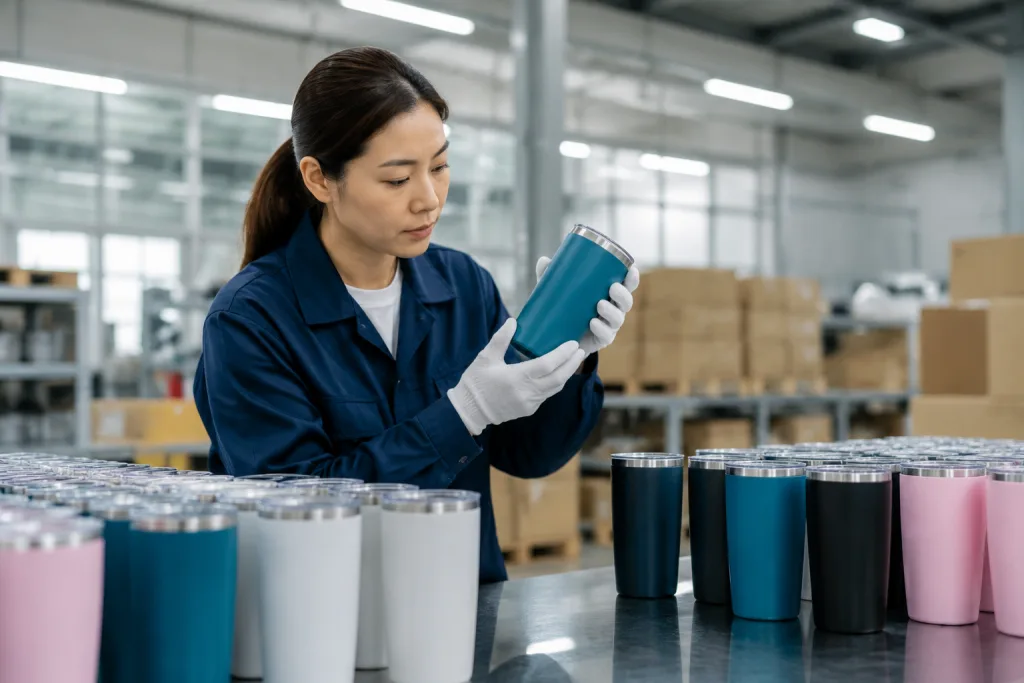
A travel tumbler looks simple until one leaks inside a customer’s laptop bag. For bulk coffee mug orders, lock the QC plan before the first sheet of 304 stainless goes to cutting. We run incoming material checks with a handheld XRF gun for steel grade, in-process checks on body height and mouth ID with digital calipers, and a final AQL inspection before cartons leave Hangzhou. For general corporate-gift orders, AQL 2.5 for major defects and 4.0 for minor defects is common. For retail or premium coffee brand programs, use AQL 1.5 for major defects if the budget allows. QC pulled a sample last month with a 0.6 mm lid gap; the buyer only noticed after we sent the video, and that is exactly why “just send good quality” is the wrong question to ask.
Thermal testing needs shop-floor conditions, not brochure math. A 500 ml double-wall vacuum tumbler may be tested with 95°C water, room temperature 20°C, and a 6-hour reading, using a K-type probe through the lid opening. The exact result depends on body shape, lid opening, and fill volume. A narrow-mouth tumbler will usually retain heat better than a wide-mouth travel mug because less heat escapes at the rim. If your marketing claims “keeps hot for 12 hours,” test that claim before printing cartons; we have seen this go sideways when cartons were already packed, 24 pcs per master carton, and the claim failed at hour 8.
For Europe, check food-contact requirements such as LFGB where applicable, plus REACH for restricted substances in coating, silicone, and plastic parts. For the United States, buyers often ask for FDA food-contact compliance, ASTM-related safety references for certain categories, and California Proposition 65 screening when relevant. A responsible coffee mug manufacturer should be able to provide material declarations and arrange third-party testing through SGS, Intertek, BV, or TÜV. Ask which parts are being tested: inner wall, powder coating, PP lid, silicone ring. We had one PO typo that called the gasket “PVC,” and the buyer flagged it because their lab sheet listed silicone; small wording mistakes can hold a shipment for 3 days.
Factory audits are part of risk control, but do not confuse paperwork with product performance. BSCI, ISO 9001, or social compliance documentation will not make a bad lid good, but it tells you whether the coffee mug factory has basic systems. Ask for recent audit dates, not just a logo on a presentation slide. On the line, I would rather see a torque test record, a leak-test jig with 30 samples per shift, and a clear defect board than a polished PDF with no production date.
Freight and delivery calendar
After production, freight can steal more days than the line itself. For North America, sea freight from Ningbo or Shanghai to the West Coast is usually 18-28 days port to port; East Coast delivery runs 30-45 days depending on the vessel string and rail leg. Europe is often 28-40 days port to port. Then add customs clearance, local truck delivery, and warehouse receiving. We build the calendar at 45-75 days from production start for a China door-to-door order, unless the buyer pays for air. Our shipping clerk still checks 10 packed cartons on a 150 kg floor scale before booking, because a 1.8 kg carton-weight miss can change the quote.
Air freight works for launch shortages. It is the wrong answer for most coffee mug bulk orders. A stainless travel mug ships a lot of empty space inside the cup, so the chargeable weight climbs fast. Air shipping can add USD 1.50-4.50 per unit depending on size, route, and fuel cost. We had a buyer flag a USD 3.20 per unit air quote on a 20 oz powder-coated mug, and the math did not work for the full PO. For corporate gifting with a fixed event date, we ship 300-800 urgent units by air and move the balance by sea.
Carton design changes the freight bill. A 40 oz handle tumbler may sell well online, but it eats container space. A 500 ml slim bulk coffee tumbler packs better because the master carton holds more pieces with less void. Before approving a style, ask for master carton quantity, carton size, gross weight, and estimated units per 40HQ container. QC pulled the packed sample last month and measured 61 x 47 x 54 cm with a tape; that carton count was 12 pieces, not the 18 pieces the buyer assumed. A 15% gap in container loading can wipe out a small FOB saving.
If you work as a coffee mug distributor or supply several coffee mug distributors, settle Incoterms before the deposit. FOB Ningbo is common for Zhejiang suppliers. DDP is convenient, but ask for the duty rate used, importer registration name, VAT handling, and insurance value on the quote sheet. We have seen this go sideways when a PO typo said FOB Shanghai while the forwarder booked Ningbo pickup. Convenience without transparent costs is not procurement control.
RFQ details that prevent rework
A clean RFQ usually cuts 5-10 days of back-and-forth. Don’t ask for “best price for coffee mug promotional.” Send the buying case: target volume, destination country, ship date, retail or gift use, capacity, lid style, color count, logo process, packaging, compliance documents, and target FOB range. If you have a reference sample, send caliper measurements in mm, empty weight in g, photos of the lid underside, and one line on what failed or sold well. Last month QC pulled a buyer’s sample with a 1.8 mm drinking slot, but the PO just said “same lid”; that missing detail cost 6 email rounds.
For coffee mug custom made projects, split must-haves from upgrades. Must-haves might be 304 stainless inner wall, leak-resistant lid, matte black powder coating, one-color logo, individual gift box, REACH documentation, and AQL final inspection. Upgrades can be soft-touch coating, custom insert card, or a color-matched silicone ring with a Pantone number. We run the first costing on the locked spec, then price the extras line by line. This is the wrong question to ask: “How cheap can you make it?” The better question is “Which spec change moves the unit cost by USD 0.20?”
Be careful with ultra-low quotes. If a coffee mug factory direct price is 20-30% below the market, the math doesn’t work unless something dropped out: 0.4 mm steel instead of 0.5 mm, recycled plastic lid material, skipped vacuum testing, weaker carton, unpaid inspection, or freight quoted with the wrong CBM. We’ve seen this go sideways. One buyer flagged a quote after our carton drop test showed corner crush at 18 kg stacking weight; the cheaper supplier had priced a 5-layer carton as 3-layer.
For BottleForge Industrial in Hangzhou, Zhejiang, a practical RFQ for travel mug wholesale bulk normally starts with 3,000-unit MOQ per color, 7-12 days for logo samples, 25-45 days for mass production, and FOB Ningbo pricing. If those numbers fit your calendar and budget, don’t ask for another catalog. Ask for a spec sheet both sides can sign, including capacity tolerance in ml, logo size in mm, carton quantity, barcode position, and the exact artwork file name. We ship cleaner when the PO, PI, and sample tag all match.
Send your tumbler RFQ before locking the budget
Share volume, deadline, logo, packaging, and target FOB range. We will return a practical China factory quote and lead-time plan.
Frequently asked questions
What is a realistic MOQ for travel mug wholesale bulk orders?
For an existing stainless travel mug mold, 3,000 units per color is the realistic starting point in most China factory programs. At 1,000-2,000 units, a supplier may accept the order, but expect an 8-18% surcharge or fewer color choices. For private label packaging, 5,000 units is more practical because printed boxes, barcode labels, and carton marks need their own setup. If you need a new lid mold or body shape, plan for 10,000-20,000 units. A coffee mug distributor ordering multiple colors should ask whether the MOQ is per color, per logo, or per shipment.
How much does a custom bulk coffee travel mug cost?
A standard double-wall stainless bulk coffee travel mug usually falls around USD 3.20-6.50 FOB China at 3,000-20,000 units. A cheaper single-wall mug may be USD 2.20-3.80, but it is not ideal for hot coffee. Powder coating, retail gift box, laser engraving, leak-resistant lid, and third-party inspection can push the landed cost higher. For a corporate-gift buyer, a realistic retail-quality package often lands near USD 5.00-8.50 FOB before ocean freight, duty, and local delivery. Always compare carton size and gross weight, not just the mug price.
How long does coffee mug custom sampling take?
Stock samples can normally ship in 3-5 days if the factory has inventory. A coffee mug custom logo sample takes about 7-12 days after artwork approval. PMS coating samples take longer, often 10-18 days, because paint must be mixed, sprayed, cured, and checked. If you are changing the lid, silicone ring, body mold, or handle design, add 15-25 days for tooling and trial samples. You should approve a physical sample before mass production when the order is above 3,000 units or tied to a fixed launch date.
Which logo method is best for coffee mug promotional products?
For most coffee mug promotional products, one-color silkscreen is the lowest-cost option and works well on smooth powder-coated bodies. Laser engraving costs more per unit and is slower, but it is durable, clean, and good for premium coffee brands. Heat transfer is better for multi-color artwork, gradients, or large wrap designs, but it needs adhesion and dishwasher-resistance checks. At 3,000 units, decoration setup fees are usually small compared with the risk of a poor logo. Ask for a logo sample and a tape test before approving mass production.
What certifications should a coffee mug manufacturer provide?
For Europe, ask about food-contact testing such as LFGB where required, plus REACH screening for coating, silicone, and plastic components. For the United States, buyers often request FDA food-contact compliance and Proposition 65 screening when relevant. Factory-side documents may include ISO 9001, BSCI, or other social audit records, but product testing matters more than logos on a supplier profile. For a coffee mug manufacturer in China, third-party reports from SGS, Intertek, BV, or TÜV are common. Make sure reports match the actual material, coating, and lid used in your order.