Key Takeaways
- For custom travel tumblers, a realistic MOQ is 1,000 pieces per color for powder coating and logo work
- 304 stainless steel at 0.4-0.5 mm wall thickness is the normal baseline for mid-market retail programs
- FOB China pricing often ranges from USD 3.20-7.80 depending on lid, coating, capacity, and packaging
- AQL 2.5/4.0 inspection and 30-45 day production lead time should be written into the purchase order
If you are comparing travel mug vendors, you are not just buying a cup. You are buying repeat orders, retail margin, fixed event dates, and a product your customer will use in cars, offices, hotels, and airport lounges. One weak PP lid or a coating that fails after 48 hours in the 3M tape test can turn a clean coffee promotion into 27 complaint emails by Monday.
From our factory in Zhejiang, China, we see two buyer groups repeat the same mistake: coffee brands spend too much time on Pantone color, while corporate-gift buyers push unit price down by USD 0.18 and lose the lid they needed. Wrong question. Start with the spec match. A 350 ml push-button mug, a 500 ml handle tumbler, and a 600 ml straw tumbler do different jobs; last month QC pulled a 600 ml sample because the straw hole was 1.2 mm off-center, and the buyer flagged it before the pre-shipment photos went out.
Start with the buying job
A travel tumbler for a coffee subscription launch is a different buying job from a bulk travel mug for a bank conference. The coffee brand needs a cup that looks ready for shelf photos, passes the dishwasher debate without angry reviews, and matches the Pantone chip within a tight color range. The bank needs cartons to land before the event date, stay inside the gift budget, and print 2,000 logos without fuzzy edges. We run these as separate RFQs on the line; last month QC pulled a pre-production sample because the “navy” powder coat was 2 shades off under the D65 light box.
If you sell coffee, the tumbler sits next to your beans in the customer’s head. Bad lid, cheap coffee. For a corporate-gift buyer, the risk is different: a leaking bulk coffee travel mug inside 2,000 employee welcome kits becomes a repacking job, not a small defect. Define the job before choosing the shape. We have seen this go sideways when a buyer picked a slim retail body for a field-sales kit, then flagged that 300 pieces tipped over in the carton drop test.
Here is the practical split we use in Zhejiang. Retail coffee brands usually choose 350-500 ml vacuum mugs with screw lids, ceramic-look powder coating, and gift-box packaging printed on 350 gsm white card. Corporate promotions often choose 450-600 ml tumblers with slide lids, a larger flat logo panel, and kraft or white boxes that pack faster at 24 pcs per master carton. If the program is for commuters, check car cup holder diameter; 68-74 mm at the base is safer than a wide straight-wall body. Our caliper check is simple, but it catches mistakes early.
Do not start with a coffee mug supplier directory or a coffee mug supplier list, then send the same RFQ to 30 factories. You will get 30 half-useful prices, and the math does not work when half of them quote a different lid. Send one clear spec sheet to 5-8 qualified suppliers instead: capacity with tolerance; material grade; lid type with leak requirement; logo method and print size; target test standard; packaging style and carton mark; loading port and order quantity. We once received a PO with “500 ml” in the title and “600 ml” in the item line, so production held the mold booking for 2 days until the buyer corrected it.
Spec table for common choices
We use this comparison with first-time tumbler buyers before we talk artwork. “Best style” is the wrong question to ask. The safer question is which spec gives your sales channel fewer complaints, fewer returns, and cartons your warehouse can still handle. Last month QC pulled 24 pcs from a 1,200 pc pre-shipment lot and the buyer flagged the handle tumbler carton size before they flagged the price.
| Style | Typical capacity | Best fit | FOB China range | Main risk |
|---|---|---|---|---|
| Classic travel mug | 350-450 ml | Coffee retail, commuter gift packs | USD 3.20-5.40 | Small logo area; curved body limits print height |
| Travel tumbler | 500-600 ml | Corporate kits, outdoor programs | USD 4.10-6.80 | Lid leakage if silicone ring and sip hole spec are loose |
| Handle tumbler | 800-1,200 ml | Fitness merchandise, lifestyle drops | USD 6.20-9.80 | Higher carton volume; freight math can go sideways |
| Ceramic-lined mug | 350-500 ml | Premium coffee brands | USD 5.80-8.50 | Higher breakage risk during coating and packing |
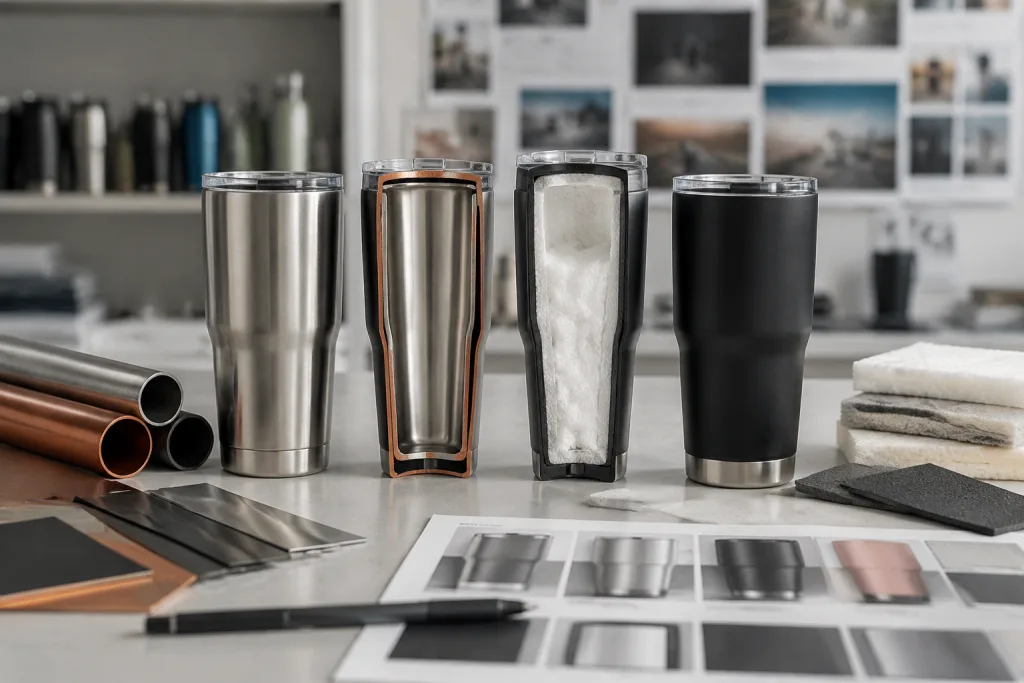
For a bulk coffee mug order, do not buy by capacity alone. A 500 ml tumbler with a 0.4 mm inner wall and 0.5 mm outer wall feels steadier in hand than a 600 ml tumbler using lighter steel. Simple test. We run the caliper check at the mouth rim and base after polishing, because thin steel often shows up there first. Our standard mid-market build is double-wall 304 stainless steel, vacuum insulated, with an exterior wall around 0.5 mm and an inner wall around 0.4 mm. Some low-price offers cut wall thickness or swap in a lighter lid to win the quote. The photo will not show it. Your customer will feel it on day one.
A coffee mug factory direct quotation should split the mug body, surface finish, lid, logo, packaging, and testing. If everything sits inside one number, the math doesn't work for a serious comparison. For 1,000 pieces, the difference between laser engraving and one-color silk screen may be USD 0.12-0.35 per unit. Custom color matching can add USD 80-150 per color for setup, plus 5-7 days on sample approval if the Pantone chip and sprayed plate do not match under the light box. We have seen this go sideways from a PO typo too: “matte black” on the sheet, “gloss black” on the artwork file, then the line has to stop.
Material and insulation trade-offs
Most buyers ask, “Does it keep coffee hot for 6 hours?” Wrong question. We ask for the test sheet: starting water temperature, room temperature, fill level, lid open or closed, and measurement intervals. In our lab we run a 500 ml vacuum bulk coffee tumbler with 95°C water, 20°C room air, 100% fill, lid locked, and a K-type probe reading every 60 minutes; a decent cup should still be above 55°C after 6 hours. A 350 ml mug drops faster. Less water, less thermal mass.
For food contact, 304 stainless steel is the normal inner wall. Some coffee mug manufacturers quote 201 stainless steel on the outer wall to cut about USD 0.18-0.35 per unit, but we push 304/304 for retail and coffee brand programs because the compliance talk stays cleaner. QC pulled one sample last quarter with a PO typo calling for “304 inner / 201 outer,” while the buyer’s spec sheet said 304/304; that small mismatch held the order for 2 days. For North America, ask about FDA food-contact requirements and California Proposition 65 if applicable. For Europe, ask for LFGB or EU 1935/2004 food-contact support, plus REACH checks for coatings and plastic components.
Powder coating is the safer surface for most coffee mug custom programs because it gives grip, stable color, and better scratch resistance in daily handling. Spray paint can look fine on 3 sample cups, then fail after carton rubbing; we have seen black lids leave rub marks on matte white bodies after a 1.2 m carton drop test. Polished stainless steel removes coating risk but shows fingerprints. Ceramic-lined interiors make coffee taste cleaner for premium programs, but the math does not work for every promo order because cost rises and drop handling gets stricter.
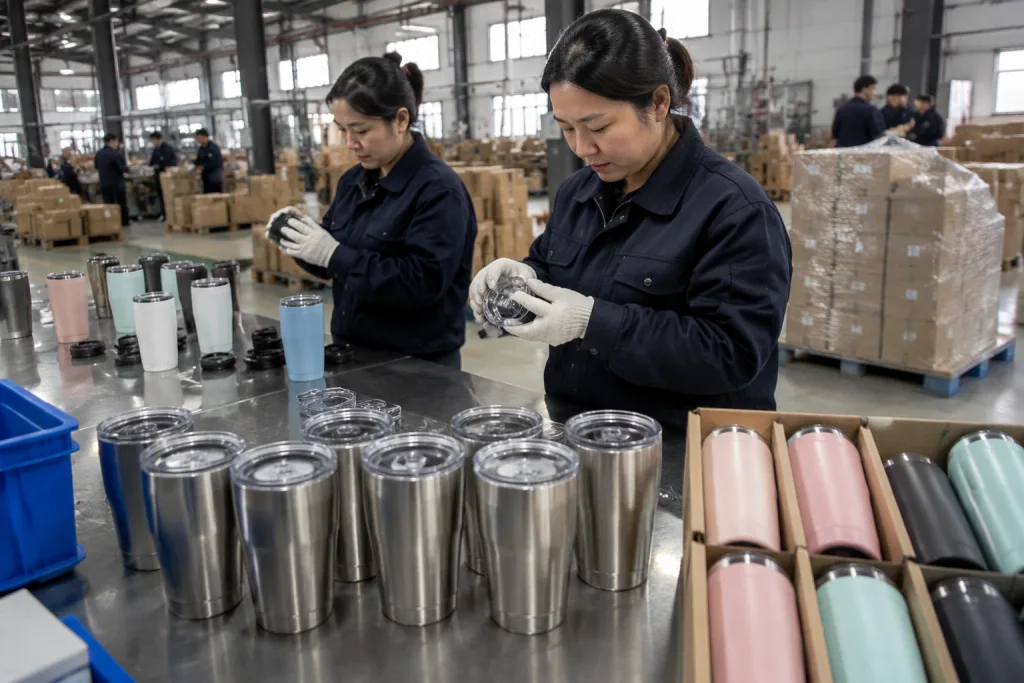
Our Zhejiang line can produce about 600,000 stainless steel drinkware units per month across travel tumblers, sports bottles, and thermos models. For coffee mug customized orders, we usually run 7-10 days for pre-production samples and 30-45 days for mass production after sample approval and deposit. Before September, add 7-15 days. The line is full then, and we have seen this go sideways when a buyer approves artwork on Friday night and still expects the same vessel booking.
Logo methods compared honestly
Branding is where 7 out of 10 coffee mug promotional products either look like retail merchandise or feel like giveaway stock from a trade show carton. Match the logo method to the body finish and order size first, then check how the tumbler will be used: commuter cup, hotel amenity, gas-station promo, or retail shelf item. A coffee mug customizable in five logo methods is not a selling point by itself. The wrong question to ask is “how many logo options do you have?” Last month the buyer flagged a matte-black sample because the logo looked gray under our D65 light box, even though the PDF artwork was correct.
Laser engraving is steady on powder-coated 304 stainless because it cuts through the coating and shows the metal underneath. We run it on a fiber laser, usually with a 0.08-0.12 mm mark depth depending on coating thickness. It looks sharp and holds up well for 1,000-5,000 piece orders, but it will not give you a full-color logo. Silk screen printing costs less for simple one- or two-color artwork and behaves best on straight walls or a light taper under about 3°. Heat transfer handles gradients and wrap designs, but QC needs to check edge lifting after rubbing the seam with a 1 kg load. UV printing suits short runs and complex artwork; I would not choose it first for mugs that get washed every morning.
For a coffee mug custom made retail launch, we usually steer buyers into one clear route, not a menu of decoration tricks. Minimalist brand? Use powder coating with laser engraving, and approve the engraving width on a real curved body, not a flat color card. Strong color logo? Use one- or two-color silk screen and spend the saved cost on a printed gift box; we have seen a nice cup lose shelf value because the box artwork had a PO typo in the barcode line. Full wrap design? Use heat transfer, but ask for a pre-production sample from the line after the oven temperature is set, usually 160-180°C, not just a digital mockup.
Ask your coffee mug oem manufacturer for three decoration checks: a 3M tape test with firm peel angle control, a cross-hatch adhesion test with 1 mm cuts, and a 50-cycle hand-wash simulation on the printed area. Dishwasher claims need caution. Around 60% of complaint photos we receive show lids with silicone seals or sliding parts thrown into dishwashers, even when the insert says hand wash. If your market expects dishwasher-safe drinkware, build that into testing from sample stage; the math does not work if you ask for it after mass production cartons are sealed with 5-ply export boxes.
Private label packaging decisions
Coffee mug private label work is more than a logo on steel. Packaging decides where the tumbler can sell: a café shelf with a hang tag, an online bundle with a barcode sticker, or an employee onboarding box with a message card. A plain white box works for a 500-piece conference giveaway. For retail, we run a printed color box with barcode, warning text, care instructions, and sometimes an insert card that states the insulation claim in plain language. QC pulled one sample last month because the PO said “dishwasher safe,” but the coating spec did not allow it.
For Amazon or marketplace sales, carton discipline matters. A typical 500 ml bulk travel tumbler packs 24 pieces per master carton, with carton weight around 10-14 kg depending on lid and box. Oversized handle tumblers often drop to 12 pieces per carton, and the math gets ugly fast. We measure the packed carton with a tape at the line, because 2 cm over the planned size can change the CBM and push up freight per unit. A USD 0.40 cheaper mug can cost more after ocean freight, warehousing, and parcel shipping.
If you are a coffee mug distributor, or you sell corporate accounts across several coffee mug distributors, standardize the packaging platform early. Use one insert template, one care label format, and one master carton mark layout across models, with the SKU field left clean for each order. Simple wins. We have seen this go sideways when a buyer sent 6 artwork files and one had the capacity typed as 550 ml instead of 500 ml. For FBA-style shipments, set FNSKU labeling, carton limits, and drop-test packaging requirements before the first production run.
Minimum order quantity depends on how deep the customization goes. For stock color with laser logo, 500 pieces may be possible if production slots are open. For custom powder coating, plan on 1,000 pieces per color, because the coating line needs setup time and powder cleaning between colors. For a fully coffee mug customized program with molded lid color, printed box, and insert, 2,000-3,000 pieces is more realistic. China factories can bend on schedule when the line has a gap, but this is the wrong question to ask if the box printer’s MOQ is already 2,000 sets.
Factory checks before payment
A low price from a coffee mug manufacturer means little until you know who is controlling the order. Before deposit, ask for the business license, factory audit documents such as BSCI if your customer requires social compliance, and 6 to 10 clear photos or a short video of the production line for the same product type. We ask for shots of the hydraulic press, polishing stations, powder coating booth, and packing tables, not just a front gate photo. If a supplier claims to be a coffee mug factory but will not show production details, treat them as a trader until they prove otherwise. We have seen this go sideways.
Your purchase order should list the inspection standard. For most bulk coffee mug and corporate orders, AQL 2.5 for major defects and 4.0 for minor defects is a workable baseline. Critical defects such as sharp edges, leakage, wrong material, odor, unsafe coating, or missing warning labels should be zero tolerance. Define leakage testing clearly: for example, fill to 90%, close the lid, invert for 5 minutes, then shake 10 times. QC pulled one 40 oz sample last month with a 0.6 mm burr on the drinking slot; that is not a “minor cosmetic issue” when a buyer’s logo is on it. A slide lid and a sealed screw lid should not be judged by the same expectation.
Payment terms are usually 30% deposit and 70% balance before shipment for new buyers. Larger repeat buyers may negotiate after two or three stable orders, usually after we ship 2 clean POs without artwork changes or late carton mark revisions. FOB Ningbo or FOB Shanghai is common for Zhejiang and nearby China factories; from our Hangzhou line, Ningbo trucking is normally 1 day, Shanghai is often 1 to 2 days depending on the booking. If you ask for DDP, understand that the supplier is adding freight, duty, customs handling, and risk into the unit price. It is convenient, but the math does not always work when the buyer compares only the mug price.
The cleanest sourcing process is simple: approve a physical sample, freeze artwork, confirm a golden sample, inspect during or after production, and keep one retained sample at the factory. A serious coffee mug supplier will not object. We run this with 2 sealed samples: one stays in our sample room with the color card and caliper record, one goes to the buyer or inspection company. The goal is not to make the factory nervous; it is to prevent arguments when 3,000 mugs are already packed.
Send your tumbler spec and target landed cost
We will check the model, MOQ, decoration method, packaging, and realistic FOB China price before you commit to tooling or artwork.
Frequently asked questions
What MOQ should I expect from travel mug vendors?
For stock bodies with a laser logo, some travel mug vendors can accept 500 pieces, especially outside peak season. For custom powder coating, the practical MOQ is usually 1,000 pieces per color because the coating line needs setup time and color loss allowance. If you need a molded lid color, printed retail box, insert card, and barcode label, plan for 2,000-3,000 pieces. A coffee mug in bulk order below 500 pieces is usually handled from inventory, so you get fewer color and lid choices. Always ask whether the MOQ is per model, per color, or per artwork version. Those three details change the real buying quantity.
How much does a custom bulk coffee travel mug cost?
A realistic FOB China price for a custom bulk coffee travel mug is about USD 3.20-5.40 for a 350-450 ml classic vacuum mug and USD 4.10-6.80 for a 500-600 ml travel tumbler. Premium ceramic-lined models or large handle tumblers can run USD 6.20-9.80 before freight. Logo cost may add USD 0.12-0.60 per unit depending on laser engraving, silk screen, heat transfer, or UV printing. Printed gift boxes often add USD 0.25-0.70 per unit. If a quote is 20-30% lower than the market, check wall thickness, steel grade, lid sealing, coating type, and carton packing before you celebrate.
Can I use one tumbler model for both retail and corporate gifting?
Yes, but choose a middle-ground spec instead of the cheapest promotional build. A 500 ml double-wall 304 stainless steel tumbler with powder coating, screw or tight slide lid, and 68-74 mm base diameter works for many coffee retail bundles and corporate gift kits. For retail, add a printed box, barcode, care card, and stronger color control. For corporate gifting, you may simplify the box and use one-color silk screen to control cost. The risk is branding mismatch: retail customers notice finish, weight, and lid feel more than event recipients. If your volume is above 3,000 pieces, consider two packaging versions using the same mug body.
What certifications should coffee mug buyers request?
For Europe, ask for food-contact documentation aligned with EU 1935/2004 and, when required, LFGB testing for stainless steel, silicone, and plastic lid components. REACH is relevant for coatings, inks, and restricted substances. For North America, request FDA food-contact support and discuss California Proposition 65 if you sell into that market. If the product is for children, ASTM and CPSIA concerns may apply, but most travel tumblers are adult-use products. For factory compliance, BSCI or Sedex may matter if your customer is a large retailer or corporate buyer. Do not accept a generic certificate without model photos, material details, and a current test date.
How do I compare a coffee mug factory and a trading company?
A real coffee mug factory should explain production steps, tooling, polishing, vacuum testing, coating, logo application, and packing with specific capacity numbers. Ask for factory videos, audit reports, production line photos, and the address on the business license. A trading company may still be useful if you need mixed small orders, but pricing and problem-solving are usually less direct. Factory direct is better when you need repeat coffee mug bulk orders, color consistency, and technical changes. One practical test: ask for wall thickness, vacuum rejection rate, AQL standard, and daily coating capacity. A manufacturer answers quickly; a reseller often has to ask someone else.