Key Takeaways
- For most coffee gifting programs, 500-1,000 pcs per color is the realistic MOQ for custom travel tumbler production
- A 0.5 mm outer wall and 0.4 mm inner wall usually feels better than ultra-light promotional stock
- Laser engraving is slower but safer for premium coffee mug custom branding on powder coating
- Plan 35-50 days production after artwork and pre-production sample approval
A travel mug vendor can make your buyer meeting smooth or painful. A 20 oz tumbler looks simple, but a lid gap over 0.3 mm, coating under 45 μm, or a 5-layer carton swapped for a soft 3-layer carton will create returns 60 days after everyone praised the FOB price. We see coffee brands and corporate-gift buyers judge samples by hand feel first. Fair start. Wrong question to stop on.
At BottleForge Industrial in Hangzhou, Zhejiang, we see this sourcing mistake about 8 times a month: the buyer asks for a “premium tumbler” but the PO has no wall gauge, lid material, decoration method, carton drop requirement, or AQL level. Last week QC pulled a sample from the line and flagged a PP lid that was written as Tritan on the spec sheet. China can ship sharp custom travel tumblers, but the spec table comes before the quote. Otherwise the math doesn’t work.
The head-to-head spec table
Before you compare any travel mug vendor, put the choices into a table your buyer, accountant, and forwarder can read without a phone call. Skip the mood board. We run this as a procurement sheet: size, coating, logo method, carton size, gross weight, MOQ, and one sample note from QC. Last month QC pulled a 20 oz sample with a 1.2 mm lid gap; the buyer had picked the color before checking the fit.
| Spec choice | Corporate gift fit | Coffee brand retail fit | Watch-out |
|---|---|---|---|
| 16 oz straight tumbler | Works for conferences, onboarding kits, and desk use when the MOQ is 1,000 pcs | Good for espresso commuters and compact café shelves | Lower perceived value than 20 oz; buyers push back on gift price above USD 5.20 FOB |
| 20 oz tapered travel tumbler | Best all-round bulk travel tumbler for staff gifts and event resale | Strong retail shelf fit, especially with 2-color powder coating | Run cup-holder testing; we check base diameter in mm before PP sample approval |
| 30 oz handled tumbler | Too large for most corporate gifting unless it is a wellness or outdoor program | Good for lifestyle coffee bundles and higher-ticket café merch | Higher freight cost per unit; carton CBM is where the math bites |
| Powder coating | Premium hand feel with tighter Pantone control on repeat orders | Best for coffee mug private label and seasonal color drops | Needs adhesion test; the line should run cross-hatch tape test before packing |
| Silkscreen logo | Low cost for 1-color logos on 3,000 pcs and up | Acceptable for promotional drops with short shelf life | Can scratch on rough coatings; QC should rub-test the print area |
| Laser logo | Clean executive look for banks, software firms, and dealer gifts | Good for repeat retail SKU where logo position must stay fixed | Limited color expression; no one should expect a full brand palette from laser |
If you are buying a bulk coffee travel mug for a loyalty campaign, a 16 oz or 20 oz stainless model is the safer lane. If you are building a retail line for cafés, the 20 oz powder-coated tumbler usually gives better margin and stronger shelf value. For oversized 30 oz products, be blunt about freight. A 30 oz handled bulk coffee tumbler can take 25-35% more carton volume than a 20 oz tapered unit, even before gift-box packaging. We ship both, and we have seen this go sideways when a PO says “same carton as 20 oz” with no carton drawing attached.
A serious coffee mug manufacturer should quote each line with FOB Ningbo or FOB Shanghai, carton size, gross weight, material grade, lid material, decoration cost, and lead time. Ask for the boring details. If the quote only says “stainless steel tumbler, logo included,” you do not have enough information to buy safely. This is the wrong place to save 10 minutes; one missing lid material line can turn into 18 days of sample back-and-forth instead of 12 days to PP approval.
Material choices are not equal
Most buyers ask for “304 stainless steel” because it sounds premium. That question is too thin. For a vacuum travel tumbler, we run SUS304 on the inner wall because it touches black coffee, milk tea with sugar, lemon water, and other acidic drinks. The outer wall can be SUS304 or SUS201 if the buyer has a hard price target. A coffee mug factory direct quote with SUS201 outside and SUS304 inside is fine for corporate gifting, as long as it is written on the PI and spec sheet. We have seen this go sideways when a buyer flagged “full 304” on the PO, then QC pulled the sample with an XRF gun and found SUS201 on the shell.
For a mid-market bulk travel mug, we usually recommend 0.4 mm inner wall and 0.5 mm outer wall. Go thinner and the math looks good for one day. Then cartons start coming back. Some low-cost coffee mug promotional products drop under 0.35 mm on the outer shell; they pass a quick visual check, but they dent during parcel shipping or Amazon-style handling. Last season, our line rejected 38 pcs from one trial run after the drop test showed corner dents through a 5-layer export carton. A coffee mug distributor selling into Europe or North America should care, because 2% replacements can eat the margin on the whole order.
- Inner wall: SUS304, typically 0.4 mm, gives stable deep drawing on the hydraulic press and better corrosion resistance after salt-spray testing.
- Outer wall: SUS304 for premium retail programs; SUS201 works for budget promotional jobs when the spec is declared before sampling.
- Vacuum performance: 6 hours above 55°C is a common benchmark for hot coffee in a 20 oz tumbler, measured after the vacuum furnace and water-bath leak check.
- Surface: powder coating suits retail colors, electro-polish fits raw stainless orders, and spray paint is mainly for short promo runs with tight artwork timing.
For compliance, ask for LFGB or FDA food-contact documentation for the stainless body and lid components. EU buyers should also ask about REACH for coatings and plastic parts. US corporate-gift buyers may need Prop 65 review depending on destination and sales channel. China suppliers can provide these documents, but ask before deposit, not after goods are packed. We ship better when the buyer sends the test standard with the first RFQ; finding a missing LFGB lid report after 600 cartons are sealed is the wrong kind of surprise.
Lids decide daily satisfaction
The lid is where about 6 out of 10 problem custom tumbler projects start. The cup body can look sharp in catalog photos, but the user judges it at 8:10 a.m. when coffee marks a laptop sleeve. If you are buying from a travel mug vendor for coffee brands, do not treat the lid as an accessory. On our line, QC pulled one sample last quarter because the slider gap measured 0.35 mm wider than the approved golden sample.
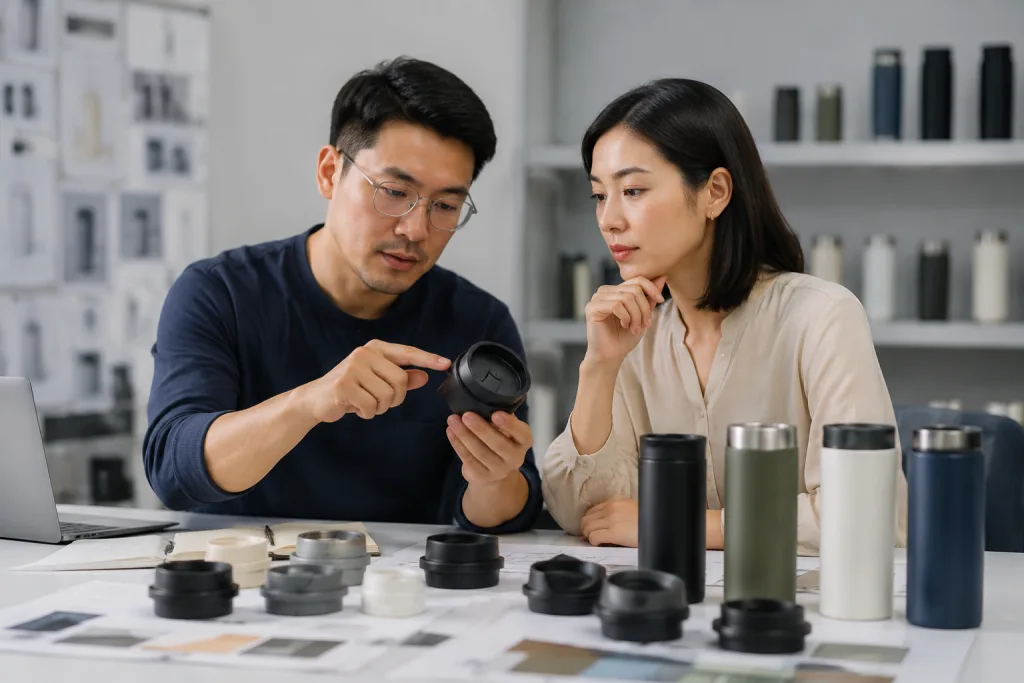
We run two safer options for most coffee orders: slide lids and flip lids. A slide lid is simple, low-cost, and familiar for office gifts, especially when the buyer wants a clean logo print and 500 pcs per color. A flip lid gives better spill resistance, but the hinge pin, spring feel, and gasket compression all need checking with a torque meter and a simple shake test. Straw lids sell well for cold coffee and retail shelves, but this is the wrong question to ask for hot drink programs unless the warning text is printed clearly on the insert card. For coffee mug customized programs, the slide lid is still our default unless the brand brief is built around iced coffee or lifestyle photos.
Ask your coffee mug supplier to confirm the lid material before the PO is signed. PP is common and cost-effective. Tritan looks clearer and takes drops better, but the math changes fast at 10,000 pcs. Silicone gaskets should be food-grade and removable enough for cleaning; we check gasket weight and fit against the lid groove before packing. A tiny price difference looks harmless on an RFQ, but a weak gasket can create a 2-4% complaint rate, and we have seen that go sideways after the buyer flagged leakage in Amazon reviews.
For repeat retail orders, we prefer testing the lid on 20 filled samples: 10 upright shake tests, 10 side-position leakage checks for 30 minutes. It is not a formal lab standard, but it catches bad tolerances early. Last month, one batch failed because two lids leaked at the air vent after 18 minutes.
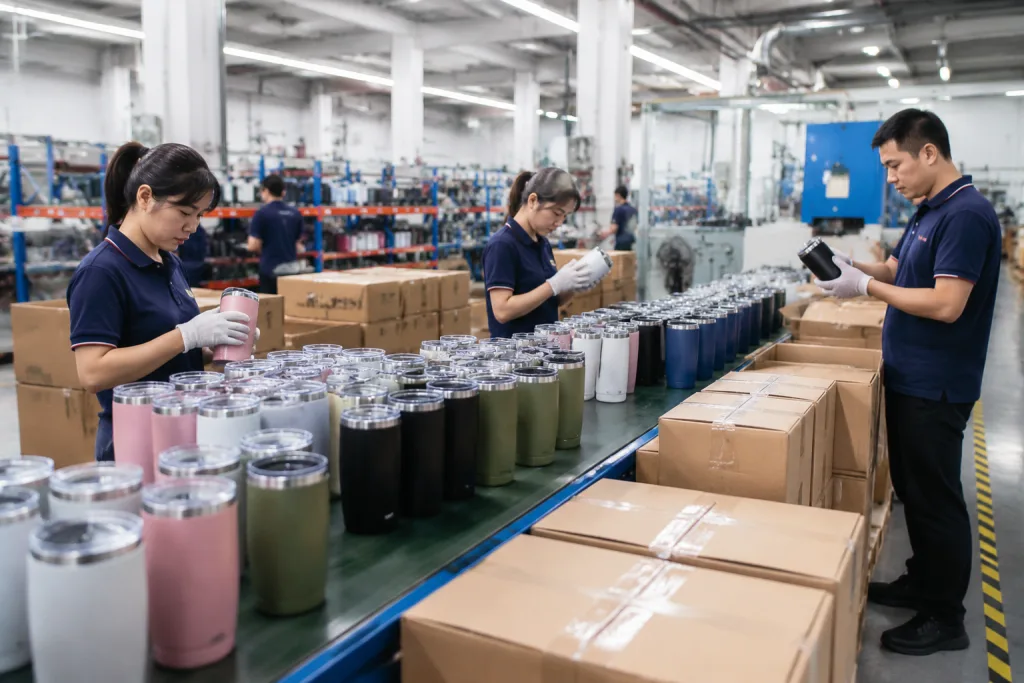
A good coffee mug oem manufacturer in Zhejiang should have lid-fit gauges or at least a documented in-process check. At our Hangzhou facility, monthly drinkware capacity is about 450,000 units across travel tumblers, sports bottles, and thermos lines, with standard custom tumbler MOQ from 500 pcs per color. Volume helps. Process control matters more. We ship repeat orders only after the line records lid fit, gasket seating, and visual defects on the QC sheet, because one loose lid can cancel the saving from a cheaper quote.
Branding method versus use case
Coffee mug custom branding is a production choice, not a decoration menu. You are balancing logo look, wash resistance, plate charge, and lead time. Corporate-gift buyers usually push for a clean 1-position logo and delivery inside 18 days; coffee brands care more about color matching and how the cup looks on a shelf from 1 meter away. Different jobs. On our line, the first question is always the same: is this for a desk gift, a retail shelf, or daily dishwasher use?
Laser engraving works well on powder-coated 304 stainless steel because the 20W fiber laser cuts through the coating and shows the metal below. It feels permanent, the edge is crisp, and there is no ink migration question for QC to chase. If your logo needs 3 Pantone colors, laser is the wrong question to ask. Silkscreen printing is usually the cheaper pick for one-color coffee mug promotional products at 1,000 pcs and up, but adhesion changes fast when the coating is too glossy or the oven curing drops below spec. UV printing gives more color range for coffee mug customizable campaigns; we still run a 3M tape pull and 500-cycle rub test before telling a buyer it is safe for daily use.
For coffee mug private labeling, packaging sells the order before the tumbler is touched. A plain white box with a barcode can work for internal corporate gifting, and we ship plenty of those in 36 pcs master cartons. A retail coffee brand usually needs a color box plus an insert card, care label, FNSKU sticker, and clean carton marks. Make the carton label boring. SKU and color must match the PO exactly; QC pulled one sample carton last month because “matte sage” was typed as “mate sage,” and the distributor flagged it before loading.
Do not release mass production from a digital mockup only. Ask for a pre-production sample with the same coating, the same logo process, and the same lid gasket hardness as bulk production. For coffee mug custom made projects, this sample usually takes 7-12 days after artwork confirmation; skipping it might save 2 days, then cost 18 days if the logo peels after the first dishwasher test. We have seen this go sideways. If a supplier says the sample is not needed, they are moving the risk from their line to your warehouse.
MOQ and price reality
A useful travel mug vendor should quote price bands, not a magic number. For a 20 oz double-wall stainless travel tumbler, factory-direct export pricing from China commonly sits around USD 3.20-5.80 FOB depending on 304 stainless thickness, lid type, powder coating, logo method, packaging. On our line, QC pulled a 20 oz sample last month at 286 g body weight, and the buyer flagged a USD 0.12 jump after changing from silkscreen to laser marking. Fair point. A simple bulk coffee mug with silkscreen logo and white box lands near the lower end. A retail-ready powder-coated tumbler with laser logo, color box, and insert card moves higher because the math doesn't work any other way.
MOQ is not only about the body. Coating color, logo setup, lid inventory, packaging print, and line changeover all carry a real cost. Our standard MOQ is 500 pcs per color for many travel tumbler models, and we run those through the powder booth in full color batches, not 73 pcs here and 127 pcs there. For a new custom mold or unusual lid, the realistic starting point may be 3,000-5,000 pcs, sometimes with a 45-day tooling schedule after drawing approval. If you are building a coffee mug supplier list and every quote says 100 pcs with full custom color, custom box, and low unit price, check what is actually custom. We have seen this go sideways when “custom box” meant a sticker on a stock white box.
Here is a practical buying view from the factory floor:
- 500 pcs: works for pilot corporate gifts, usually with stock colors and one logo position; expect limited logo methods.
- 1,000-2,000 pcs: gives better unit cost and cleaner repeat planning for coffee mug in bulk orders; carton labels and PO line items stay easier to control.
- 5,000 pcs: fits coffee mug private labeling with retail packaging, printed inserts, and barcode control; QC can pull samples by AQL 2.5 without slowing the line.
- 10,000 pcs and above: gives stronger buying room on coating, carton loading, and sea freight; we can optimize master cartons by 12 pcs instead of shipping half-air boxes.
Payment terms matter too. Many China factories work on 30% deposit and 70% balance before shipment. For established coffee mug distributors with repeat orders, negotiated terms can improve after credit review and order history; one German buyer moved to balance against BL copy after 6 clean shipments. New buyers should focus less on squeezing the last USD 0.08 and more on clear specs, inspection rights, and shipment timing. This is the wrong question to ask if the PO still says “blue” with no Pantone code.
Inspection should be written early
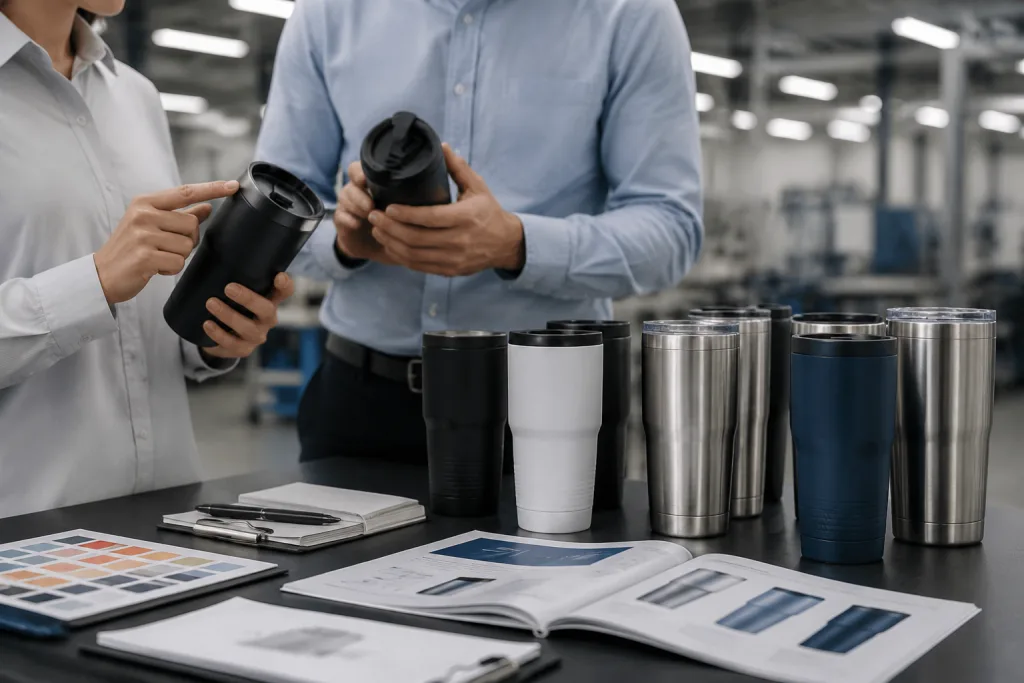
Write the inspection terms into the PO before we cut steel or book the line. For drinkware, we run AQL Level II with critical defects at 0, major defects at 2.5, and minor defects at 4.0. It sounds stiff for a coffee mug bulk order, but the math gets ugly after 86 cartons are stacked in the warehouse and the buyer says the logo is 3 mm too low. Put it in writing early.
Your inspection checklist should not stop at surface finish. Check capacity tolerance in ml, vacuum insulation after 6 hours, lid fit, coating scratches, logo position, Delta E color difference, odor, gasket assembly, carton drop condition, barcode scan, and packaging count. For coffee mug factory direct orders, ask for in-line QC reports with photos from the leak-test station plus a final random inspection before balance payment. Third-party inspection is normal for orders above USD 10,000; we’ve seen buyers save a shipment because QC pulled the sample and found 7 loose silicone gaskets in one carton.
Corporate-gift buyers miss carton strength too often. A gift box can look clean on our packing table and still crush after courier sorting. For export cartons, 5-layer corrugated board is the safer default than thin 3-layer board, especially for heavy 30 oz tumblers. If the order ships to a fulfillment center, ask for a 1.2 m drop test on packed cartons or at least a documented internal drop check; one buyer flagged corner dents after UPS handling, and the 3-layer carton spec was the real problem.
Compliance should match the sales channel, not a generic checklist copied from last year’s PO. EU retail may require LFGB, REACH, and packaging waste documentation. US gifting programs may request FDA food-contact conformity and CPSIA only if the product is clearly intended for children. For adult travel mugs, ASTM child standards usually do not apply, but your legal team should confirm final claims and labeling. A reliable coffee mug manufacturer will not guess; we list the documents on hand, then quote the extra lab cost if SGS or Intertek testing is needed.
Choosing the vendor fit
A coffee mug supplier directory or coffee mug supplier list is only a starting point. It is not a decision tool. Vendor fit depends on the order sitting on your PO. If you need 800 pcs for a sales conference in 28 days, we run that through stock color bodies, a 2-head laser line, and real air-freight timing, not a custom coating promise. If you are building a 12-month retail program, choose a coffee mug manufacturer with coating control measured by Delta E, packaging drawings your team can approve, and repeat-order records we can show by batch number.
Ask blunt questions. How many units did the factory ship last month? What was the powder-coating reject rate at final QC? Can they hold color Delta E inside your signed tolerance? Do they use BSCI-audited production sites? What is the normal lead time after sample approval? At BottleForge in Zhejiang, standard production lead time is usually 35-50 days after pre-production sample sign-off, depending on season and order size. Before Lunar New Year, add at least 15-20 days of buffer in China. Last January, QC pulled a pre-shipment sample with 0.3 mm lid flash, and that small finding still cost the line 2 extra sorting days.
For coffee brands, I would avoid over-customizing the first order. We have seen this go sideways. Start with a proven body, one or two colors, laser or one-color print, and retail packaging that your team can reorder without redesign. For corporate buyers, keep the decision matrix short: delivery date with buffer, logo quality checked against a signed sample, leak risk from a 100% lid fit test, carton strength after a 1.2 m drop test, and landed cost. A bulk coffee mug is only a bargain if it arrives on time and your recipients actually use it.
The best travel mug vendor will push back when your brief is risky. If your requested coating, logo size, lid type, and deadline do not fit together, you want to hear that before deposit. We once had a buyer flag a PO typo calling for matte black on the artwork and gloss black on the item table; catching that before the coating booth saved 5,000 coffee mug customized units from rework. Factory honesty is not always comfortable, but the math doesn't work after production starts.
Send us your tumbler brief for factory review
Share capacity, lid type, logo artwork, quantity, and delivery country. We will return a practical FOB quote and production route.
Frequently asked questions
What MOQ should I expect from a travel mug vendor?
For standard stainless travel tumblers, expect 500 pcs per color as a practical MOQ. That usually allows logo customization, standard powder colors, and normal packaging. If you need a custom Pantone coating, printed retail box, or special lid, 1,000-3,000 pcs is more realistic. For a fully coffee mug custom made project with new tooling, budget for 3,000-5,000 pcs minimum. Very low MOQs like 50-100 pcs are usually stock products with limited logo options, not true coffee mug private labeling.
What is a normal lead time for bulk coffee travel mug orders?
A normal production lead time is 35-50 days after artwork, deposit, and pre-production sample approval. Sampling normally takes 7-12 days if the body and lid are existing models. Add 5-10 days if you need custom packaging proofs. Sea freight to North America or Europe can add 25-40 days port to port, plus local delivery time. If your event date is fixed, brief your China supplier at least 90 days before the required delivery date.
Is laser engraving better than printing for coffee mug promotional products?
Laser engraving is usually better for premium powder-coated tumblers because it is durable, clean, and does not rely on ink adhesion. It works especially well for executive gifts and coffee mug private label retail SKUs. Printing is better when you need exact brand colors, large artwork, or low-cost one-color logos on a big run. For 1,000 pcs, laser may add about USD 0.20-0.45 per unit depending on logo size and machine time, while simple silkscreen can be lower.
Can one coffee mug factory supply both corporate gifts and retail tumblers?
Yes, but check whether the factory understands both channels. Corporate gifts need reliable delivery dates, clean logo placement, and safe packaging for event distribution. Retail tumblers need stronger color consistency, barcode labeling, carton marking, and repeatable SKU control. A coffee mug factory direct partner should be able to quote both a simple white-box version and a retail color-box version, with separate FOB prices, carton dimensions, and inspection standards.
What documents should coffee mug distributors request before ordering?
At minimum, ask for material declarations for SUS304 stainless steel, food-contact documents for lid plastics and silicone, and any available FDA or LFGB reports. EU buyers should request REACH information for coatings and plastic parts. If social compliance matters to your customers, ask for BSCI or similar audit status. For an order above USD 10,000, also write AQL Level II inspection terms into the purchase order, with critical defects at 0 and major defects at 2.5.