Key Takeaways
- For stainless travel tumblers, realistic MOQ starts at 1,000 units per color and 3,000 units for private tooling
- A 0.4 mm inner wall and 0.5 mm outer wall is a practical baseline for 304 stainless vacuum mugs
- Laser engraving lasts longer than silkscreen but usually costs USD 0.12-0.35 more per unit
- Plan 35-45 days for mass production after sample approval, not after the first inquiry
Most coffee brands and corporate-gift buyers do not lose money because they picked matte black instead of navy. They lose money when the tumbler looks fine on the quotation sheet but misses the sip feel, logo rub test, carton limit, or launch date. Simple product? Not after 5,000 units arrive and QC pulled the sample with a 0.4 mm lid gap that leaks after a 1.2 m carton drop.
If you are comparing travel mug suppliers in China, start with four decisions: construction, lid system, decoration method, and packing route. BottleForge Industrial runs production in Hangzhou, Zhejiang, and we see this go sideways about 6 times a month: the buyer pushes for the lowest FOB price first, then pays it back through rework, air freight, or complaints from end users. The math doesn't work.
Start with the drink experience
Before you open a coffee mug supplier directory or build a coffee mug supplier list, pin down how the end user will drink from it. A commuter drinking a flat white in a car is not buying the same mug as a sales team handing out boxed gifts at a dealer meeting. We see this every week. One RFQ last month said “500 ml stainless travel mug, logo printed,” and the buyer expected a leakproof car mug, a retail-ready color box, and a 30 mm logo area on the same price line. That is not a specification. It is a guess.
For coffee brands, start with mouthfeel and the temperature curve. A 12 oz or 350 ml mug fits espresso-based drinks and café shelves. A 16 oz or 480 ml bulk coffee travel mug works better for office refills and drive-through coffee. A 20 oz or 600 ml bulk coffee tumbler looks generous, but it can fail in European car cup holders if the base goes over 74 mm; our QC gauge has caught 76.5 mm bases after polishing. Ask your travel mug suppliers for base diameter, lid diameter, and filled weight, not only capacity. Capacity alone is the wrong question to ask.
The second decision is heat retention. Vacuum insulation with 304 stainless steel normally gives 6-8 hours hot performance when tested with 95°C water at room temperature. That does not mean coffee tastes good for 8 hours. It means the water still reads well on a probe. On the line, we run the test with a calibrated thermometer and check the lid seal after the cup sits upright for 30 minutes. For coffee use, aroma, lid opening, and drinking angle can decide whether the buyer reorders.
Corporate-gift buyers should look at perceived value, then run the freight math. A heavier mug feels premium, but too much weight pushes up carton cost and gets complaints from field teams carrying samples. A 480 ml travel tumbler at 280-330 g is a sensible range. Below 240 g, the body can feel thin when you tap it with a fingernail. Above 380 g, the math does not work; we have seen buyers pay for extra metal, then ask us to cut 12 kg from each master carton after the PO was already approved.
Choose the body construction
The body is where the quote moves. We have seen two coffee mug manufacturers offer the same 500 ml shape with a USD 0.60 gap because one used 304/201 steel, thinner walls, a looser vacuum test, and a quick polish. QC pulled 80 pcs from one trial run last April and found 9 bodies with weak vacuum after the 95°C hot-water test. A clean product photo will not show that cost.
For stainless travel mugs, ask whether both inner and outer walls are 304 stainless steel, or whether the outer wall is 201. 201 cuts cost, but rust complaints show up faster, mainly around the rolled rim and bottom seam. For a coffee mug promotional program used indoors, 201 outer can work if the finish passes tape test and 24-hour salt spray. For coffee mug private label retail or a premium café product, we push buyers toward 304 inside and outside. Common wall thickness is 0.4 mm inner and 0.5 mm outer; when a buyer asked us for 0.32 mm outer to save USD 0.18, the math did not work because dent claims during e-commerce delivery cost more.
Plastic liners are cheaper, but we do not recommend them for hot coffee unless your market accepts the trade-off in writing. Buyers in Europe and North America often need LFGB, FDA, REACH, and sometimes Prop 65 documentation. For a coffee mug custom made with plastic lid parts, specify PP, Tritan, or silicone grades and request material declarations before sampling. We run a simple check at sample stage: the material code on the lid drawing must match the PO, because one buyer once typed “PP lid” while the approved sample used Tritan, and the lab report had to be redone.
Surface finish is another place where low quotes hide trouble. Powder coating looks good and gives grip, but cheap coating chips at the rim after dishwasher cycles; our line checks this with a cross-cut knife and 3M tape before packing. Spray painting costs less and scratches sooner. Mirror polishing shows fingerprints, so it is the wrong question to ask if the buyer wants a clean shelf look after shoppers handle 30 samples. Matte powder coating on a bulk travel mug usually adds USD 0.25-0.55 compared with basic stainless, depending on color and order quantity.
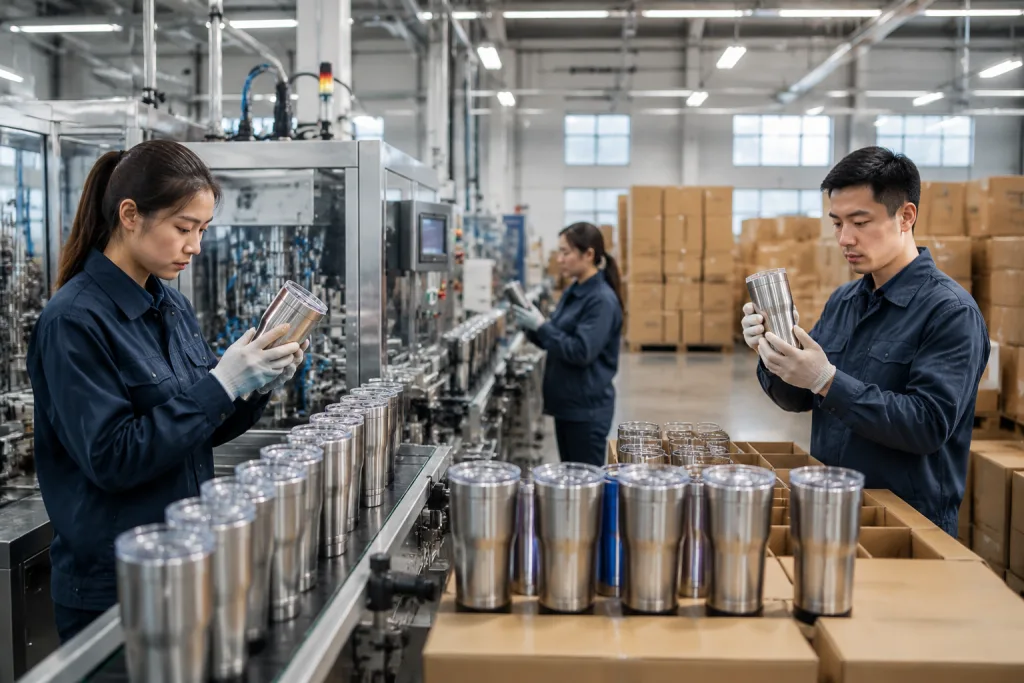
At our Zhejiang production network, a typical travel tumbler line can finish around 300,000 units per month across standard models. That number only helps when your specs are locked. We ship faster when the color card, lid mold, barcode sticker, and carton marks are approved before the deposit lands. If the buyer changes Pantone 18-1664 to 19-1664 after coating powder is mixed, the line waits, and a 12-day schedule becomes 18 days.
Do not treat lids casually
The lid is where complaints start. The body can be clean 304 stainless with a nice powder coat, but one loose slider makes the buyer call it a bad coffee mug factory purchase. We run lid checks before carton artwork, because a 0.3 mm gap at the drinking port is enough for coffee to creep out in a backpack.
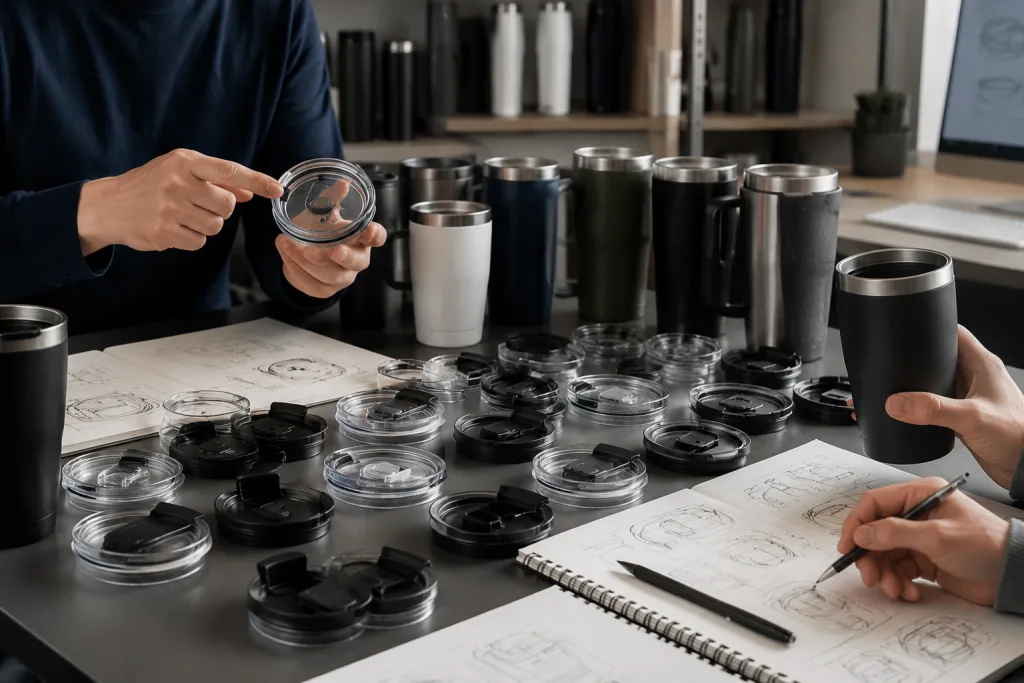
Most projects use one of four lids. A slide lid works for desk use and trade-show giveaways; QC still marks it as splash resistant, not leakproof. A flip lid seals better when the hinge pin and silicone plug are tight, but we have seen hinges loosen after 500 open-close cycles on a bench jig. A screw lid gives the best seal, though one-hand drinking gets slower. A straw lid fits iced drinks and summer kits, not hot coffee. If the item is sold as a bulk coffee mug, do not print “leakproof” on the color box unless the supplier gives you the test method and pass criteria. The buyer flagged that wording on 2 POs last season.
Ask for a 30-minute inverted leak test, a shake test with 60°C water, and a drop test from 80 cm on carton-packed goods. Basic risk control. We usually test 12 samples per color, then cut open the carton to check whether any lid tab cracked during impact. For retail and e-commerce, test the lid after 10 dishwasher cycles if you plan to make dishwasher-safe claims. In our line checks, 3 out of 20 low-cost lids looked fine on day one and warped after heat exposure.
For corporate gifting, the lid still has to carry the brand feel. A clear lid shows the drink, but the scratch marks show up after rubbing against the polybag seam. A black PP lid hides stains and looks safe. A transparent Tritan lid costs more, but it feels cleaner for a coffee mug customized program. For a coffee mug customizable across several campaigns, keep one shared lid and change body color or logo only. That protects MOQ, and it stops spare parts going sideways when the warehouse mixes 86 mm lids with 89 mm lids.
Match branding to the channel
Decoration is not just about appearance. It sets abrasion life, unit cost, sample timing, and whether the logo still looks clean after 90 days bouncing inside a backpack. We run laser engraving for clean stainless marks, silkscreen or pad printing for simple color logos, heat transfer for gradients, and water transfer or full-wrap sublimation when the buyer wants artwork around the whole body; on the line, QC checks the first 20 pcs with a 3M 600 tape pull before bulk packing.
Laser engraving is the safe choice for 304 stainless and powder-coated mugs. It does not peel. It suits logos with clean lines, block letters, and icon marks above 0.3 mm stroke width. The limit is color: the mark comes out stainless silver or a tonal contrast after the fiber laser burns through the coating. For a premium coffee mug private labeling project, laser is often worth the extra USD 0.12-0.35 per unit, especially after a US buyer flagged black print rubbing off on cup holders during a 500 pc pilot order.
Silkscreen printing works better when the brand needs color. It is economical for one or two colors, especially above 1,000 units, but the math changes fast when the logo has four spot colors and tight registration. Abrasion is the weak point. On powder coating, a well-cured print can pass a basic rub check, but you should still request a 3M tape test and alcohol rub test; our QC pulled one sample last month where the red ink lifted after 30 alcohol rubs because the oven was set 8°C low. For coffee mug promotional products, silkscreen is common because the event date matters more than 5-year durability.
Full-wrap designs need more control. A coffee mug custom artwork with gradients, tiny text, or photographic elements may need heat transfer or digital printing, which adds setup time and seam risk. The seam is where we see trouble: 1.5 mm artwork drift looks small on a PDF, then the buyer sees it on a retail shelf. If the mug is a retail SKU, budget for pre-production samples and approve color under D65 lighting. Do not approve from a phone photo sent at 11 p.m. China time; we have seen that go sideways when the PO said “cream white” but the artwork file was named “warm gray final.”
One practical rule: if your logo is the value, simplify the mug. If the mug shape is the value, simplify the logo. Trying to make both complex creates scrap, and scrap is not a design feature. A good coffee mug oem manufacturer should push back here, not just say yes; when the MOQ is 3,000 pcs and the seam reject rate climbs from 2% to 9%, the math does not work.
Read quotations like an engineer
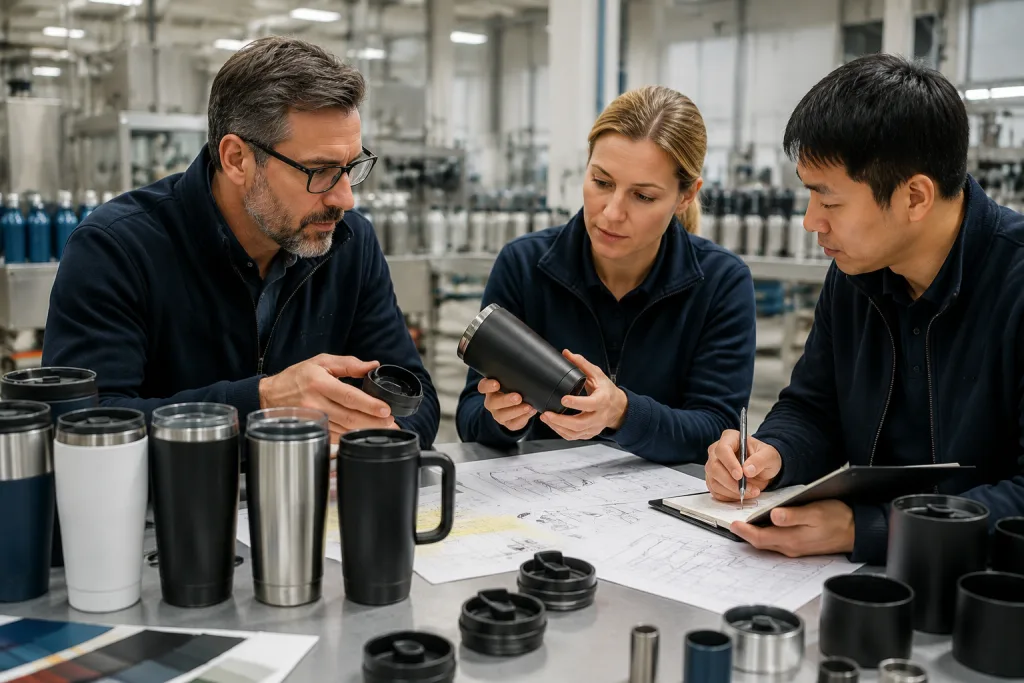
A travel tumbler quote is not a unit price. Ask for the commercial skeleton: MOQ, sample cost, tooling cost, FOB port, production lead time, carton quantity, carton size, gross weight, payment terms, inspection standard, and document package. We run into this every March: one buyer sends 4 supplier quotes, but 2 are missing carton size and 1 has “GW 0” because the sales rep copied last year’s PO. Without these lines, comparing one coffee mug manufacturer with another coffee mug supplier is just theater.
For standard models from BottleForge Industrial in Hangzhou, Zhejiang, a realistic MOQ is 1,000 units per color for stock molds, with sample lead time of 7-10 days after artwork confirmation. Mass production is usually 35-45 days after sample approval and deposit. On the line, we normally check the first logo sample with a 3M tape test and a 0.5 mm position tolerance before we let the carton artwork move forward. New mold projects for a coffee mug custom made body normally start around 3,000-5,000 units, with tooling from USD 1,200 to USD 6,000 depending on lid complexity and body shape.
FOB Ningbo or FOB Shanghai are common for Zhejiang factories. If you are ordering a bulk coffee mug or coffee mug in bulk for North America, ask for HS code, carton drop-test status, and whether the packing supports Amazon FBA if needed. We’ve had buyers flag a 12.8 kg master carton because their warehouse wanted under 12 kg, so this is not paperwork noise. For corporate gifting in Europe, ask for REACH and LFGB or food-contact declarations, plus BSCI audit availability and the AQL inspection plan.
Use AQL 2.5 for major defects and 4.0 for minor defects as a normal starting point. Critical defects, such as sharp edges, wrong material, or serious leakage, should be zero tolerance. QC pulled a sample last season with a burr inside the drinking slot; the caliper showed 0.3 mm raised metal, and we stopped that lid batch. If a factory refuses third-party inspection, that is a signal. If they accept inspection but cannot define defect categories, that is also a signal.
Do not chase the lowest coffee mug factory direct number unless specs are locked. The math does not work. A USD 3.20 quote and a USD 3.65 quote may describe different products: 201 vs 304 stainless, 0.4 mm vs 0.5 mm body wall, powder coating vs spray paint, egg-crate packing vs white box. Ask for the weight, steel grade, coating, lid material, packing, and test reports. Then compare.
Plan freight and retail packing early
Packaging is where 6 out of 10 smart buyers give away margin. A bulk travel tumbler shipped loose in white boxes works for distributor stock; our packing table can run 1,800 plain white boxes per shift without stopping for label changes. A retail coffee mug private label item needs a color box, barcode, warning copy, country of origin, and often French or German instructions. A corporate-gift mug is a different job: kraft gift box, foam insert, greeting card, and an outer carton tough enough for parcel drops. The math does not work if you quote bulk packing first and add retail parts after the PO.
For a 480 ml stainless travel tumbler, a common individual box is around 90 x 90 x 190 mm. A master carton may hold 24 units, with gross weight around 9-11 kg depending on mug weight and packing; QC checks this on a 30 kg platform scale before we seal the carton sample. If your carton exceeds 15 kg, warehouse teams complain and carton corners start showing more crush marks. For e-commerce, double-wall cartons reduce damage but add cost and volume. Simple trade-off.
If you use FNSKU labels, barcode stickers, or mixed-color cartons, tell your supplier before quotation. These jobs look small, then the line loses half a day because the buyer added 4 color splits after artwork approval. A coffee mug distributor may accept neutral cartons; a brand owner usually cannot. For coffee mug distributors serving 5 accounts, we often recommend one master carton design with account-specific stickers, not 5 printed carton versions. We have seen this go sideways when a PO says “blue carton label” but the artwork file is named “black-label-final.pdf.”
Sea freight from China to Europe or North America is usually the right choice for planned programs. Air freight can cost more than the mug; last month a buyer flagged a USD 1.12 mug with USD 1.46 air cost, and the margin disappeared. If your launch date is fixed, work backward: 45 days production, 7 days inspection and export handling, 25-40 days sea freight depending on lane, plus customs and local delivery. Do not approve samples in late August and expect a fully customized Christmas program to land calmly in October. We ship hard, but calendars do not bend.
Shortlist suppliers with hard filters
You can pull 200 supplier names from Canton Fair notes, Alibaba pages, and a coffee mug supplier directory. The working shortlist is usually 8 to 12. Filter travel mug suppliers with questions that force numbers: MOQ, sample lead time, defect rate, and carton drop-test result. On our line, a weak answer shows up fast when the QC clerk asks for the vacuum-test log and the supplier sends a lifestyle photo instead.
Ask for three recent production examples close to your target: a bulk coffee tumbler with capacity, steel grade, and order quantity; a bulk coffee travel mug with lid type, leak-test method, and delivery days; a coffee mug promotional project with logo process and gift-box spec if gifting is your channel. Then ask what went wrong. Did the powder coating scratch at 3H pencil test? Did the buyer flag a PMS color miss? Good suppliers can show the correction sheet. Weak suppliers send 18 catalog pages and hope you stop asking.
Check whether the supplier is a trading company, a coffee mug factory, or a hybrid export office with controlled production. None of these models is automatically bad. A trading company with two stable coating shops can beat a factory that loses PI details every week. The math does not work if nobody owns the mistake. Who approves the pre-production sample? Who signs the PI? Who books re-inspection after AQL 2.5 fails? Who pays if the logo is printed 8 mm off-center? We once saw a PO with “matte black” typed as “mate black,” and the supplier who caught it before spraying 3,000 pcs saved the order.
For coffee mug factory direct sourcing, visit if the annual value justifies a flight, or pay for a third-party audit at around USD 300 to 600. Look for a vacuum tester on the floor, coating oven temperature records, incoming 304 stainless material slips, and finished-goods inspection photos with carton marks visible. For a first order, keep the design conservative: existing mold, one body color, one logo method, standard lid. Boring ships. After the first shipment lands with less than 2% complaint rate, move into coffee mug customized shapes, special coatings, or private tooling.
The best supplier is not the one with the 600-item catalog. This is the wrong question to ask. You want the supplier who says your spec adds USD 0.18, the silicone lid needs 7 extra days, and the gradient coating has a higher scratch risk near the rim. We have seen this go sideways when a buyer approved a fancy lid before leak testing. Pick the partner who gives the bad news early, because your coffee buyer, HR director, or retail account only cares that the mugs arrive on the promised date.
Send your tumbler brief for a factory quote
Share capacity, lid type, logo method, quantity, market, and delivery date. We will flag cost risks before sampling.
Frequently asked questions
What MOQ should I expect from travel mug suppliers?
For standard stainless travel tumbler molds, expect 1,000 units per color as a normal MOQ from a serious China supplier. Some suppliers will offer 500 units, but the unit price may rise by USD 0.40-0.90 because coating, printing, and carton setup are spread across fewer mugs. For coffee mug private labeling with custom color box, 1,000-2,000 units is more realistic. For a new lid or body mold, plan for 3,000-5,000 units and tooling cost from USD 1,200 to USD 6,000. If your first order is for a corporate-gift test, use an existing mold and spend budget on better decoration and packing instead of new tooling.
How much does a custom bulk coffee travel mug cost?
A typical 16 oz stainless vacuum bulk coffee travel mug from a Zhejiang or broader China factory can range from USD 3.10 to USD 6.20 FOB, depending on steel grade, lid design, coating, logo method, and packing. A basic 304 inner and 201 outer mug with silkscreen logo may sit near the low end. A 304 inner and outer mug with powder coating, laser engraving, Tritan lid, and retail color box will cost more. Do not compare prices without weight, wall thickness, lid material, carton size, and test requirements. A cheaper quote can become expensive if it creates 4% leakage claims or requires air freight after delays.
Which logo method is best for coffee mug promotional products?
For coffee mug promotional products, choose the logo method based on campaign life and brand rules. Laser engraving is best for long-term use because it does not peel and handles daily abrasion well. It usually adds USD 0.12-0.35 per unit versus a plain mug. Silkscreen printing is better for colorful logos and event budgets, especially at 1,000 units or more. Pad printing works for small curved areas but is not ideal for large artwork. For retail coffee mug custom packaging, request a pre-production sample and run tape, rub, and dishwasher-related checks if you plan to make durability claims. The cheapest decoration is rarely the best for brand reputation.
Can one coffee mug manufacturer handle retail and corporate gift orders?
Yes, but only if the supplier understands both packing systems. Retail orders need barcode placement, shelf-ready color boxes, compliance copy, and consistent carton markings. Corporate-gift orders often need individual gift boxes, cards, kitting, or delivery to several warehouses. A capable coffee mug manufacturer should quote these services separately instead of hiding them in the unit price. For mixed programs, ask for a packing matrix before production: SKU, color, logo, box type, units per carton, gross weight, carton mark, and label requirement. This avoids the common mistake of producing good mugs and then spending 5 extra days sorting cartons manually before shipment.
How do I verify a coffee mug factory before placing a big order?
Start with documents, then samples, then inspection. Ask for business license, food-contact test reports, BSCI or similar audit status, and photos or videos of vacuum testing and packing lines. For samples, test lid leakage, coating adhesion, drinking comfort, and logo alignment. Before shipment, use AQL inspection, commonly 2.5 for major defects and 4.0 for minor defects, with zero tolerance for critical issues such as sharp edges, wrong material, or serious leaks. If the order value is above USD 20,000, a third-party inspection is cheap insurance. A reliable coffee mug factory direct partner will not object to clear inspection rules.