Key Takeaways
- A useful RFQ should state capacity, steel grade, lid type, decoration method, MOQ, target FOB price, and compliance market
- For custom travel tumblers, 2 pre-production samples and 1 sealed golden sample reduce bulk disputes
- Typical MOQ is 1,000 pcs per color for powder coating and 3,000 pcs for custom mold lids
- AQL 2.5/4.0 inspection plus leak, vacuum, adhesion, and carton drop tests should be written into the PO
A travel mug supplier can quote USD 2.20 or USD 7.80 for what looks like the same 20 oz tumbler. Usually, that gap is not margin. It comes from 304 stainless thickness, vacuum yield after the helium leak tester, lid mold choice, powder-coating scrap rate, 5-layer carton strength, FDA/LFGB test scope, and whether your RFQ says “matte black” or gives a Pantone code.
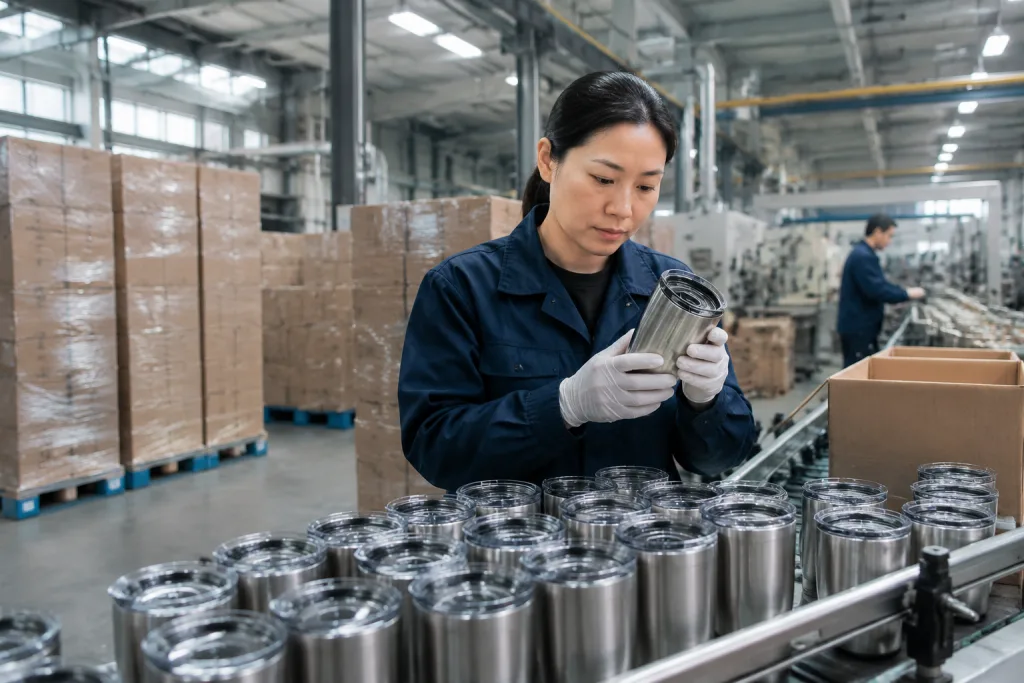
If you buy for a coffee brand, HR gift program, or coffee mug distributor, the risk is simple: a nice sample turns into a late, leaky, color-shifting bulk order. We have seen this go sideways. Our Zhejiang line can run up to 480,000 stainless travel tumblers per month, but QC still pulled 32 pcs last May because the buyer’s PO wrote “20oz” while the artwork file said “600ml.” Good orders start with boring details on paper.
Start With A Clean RFQ
Your first job is not chasing the lowest price. It is killing guesswork. A travel mug supplier quotes faster when your RFQ reads like a production brief, not a mood board. For a bulk travel tumbler order, list capacity in oz and ml, body shape with diameter in mm, lid style, handle choice, target retail channel, and cup-holder fit. A 20 oz tapered tumbler and a 20 oz straight-wall mug do not share the same tooling, carton, or lid; our caliper check on one buyer’s sample showed 72 mm bottom diameter vs 86 mm, and the buyer flagged the carton quote as “too high” because those details were missing.
For stainless travel mugs, state 304 stainless steel inner wall, 201 or 304 outer wall, double-wall vacuum insulation, and expected performance. A realistic requirement is hot above 55°C after 6 hours from 95°C fill, tested at 20°C ambient. If you need a premium claim, say it before quotation. The math does not work if you ask for budget pricing first and copper lining later. Better insulation usually means tighter vacuum control, heavier body weight, or copper lining; on the line, that can move body weight from 285 g to 330 g and change the polishing time.
Decoration details matter. A coffee mug custom project with one-color silkscreen is not priced like a coffee mug customized with wraparound laser engraving and PMS-matched powder coating. Send vector artwork, logo size in mm, print position, and Pantone code. We run a film check before mass printing, and QC pulled one sample last month because the PO said “PMS 186C” while the artwork file named “red logo final” used a different red. If you are checking a coffee mug supplier list or coffee mug supplier directory, send the same RFQ to every factory. Otherwise you are comparing noise.
At RFQ stage, include these PO-style line items: product code or reference photo, quantity by color, Incoterm such as FOB Ningbo or FOB Shanghai, destination country, compliance needs such as LFGB, REACH, FDA, or Prop 65, packaging type, barcode or FNSKU needs, target ship date, and inspection standard. Do not leave inspection as “normal QC”; write AQL 2.5 or your own limit sample rule. In Zhejiang, China, we can quote most standard travel tumbler models within 24 to 48 hours when these details are complete, and we ship cleaner when the RFQ already matches the PO.
Compare Quotes Without Fooling Yourself
A low unit price only helps when the quote is complete. If a coffee mug factory direct quotation comes back at USD 0.10 below the next supplier, check the cost sheet before you celebrate. We see 9 items disappear most often: logo setup, color setup, individual box, master carton upgrade, barcode label, export carton marks, sample freight, third-party testing, and inland truck cost to Ningbo or Shanghai port. Last month QC pulled a pre-shipment file where the buyer thought barcode labels were included; the PO had “lable” typed in the notes, and nobody priced it.
For a 20 oz stainless bulk coffee travel mug, a practical FOB China range is often USD 3.20 to USD 5.80 depending on wall thickness, coating, lid complexity, and packaging. If someone quotes USD 2.35 with custom powder coating, leak-proof slider lid, retail box, and 1,000 pcs MOQ, ask what has been removed. This is the wrong question to ask: “Can you match the lowest price?” Ask: “Is the inner wall 304 stainless, what is the wall thickness, and what vacuum pass rate do you run?” It may be 201 inner steel, thin 0.35 mm wall, poor vacuum yield, recycled carton board, or no compliance testing. A polished product photo will not show that. A 0.35 mm body feels fine on screen; on the line, it dents under a basic drop check from 80 cm.
Ask the travel mug supplier to split the quote into line items. A clean quotation should show unit price, mold charge if any, logo charge, sample cost, sample lead time, bulk lead time, MOQ, payment terms, carton quantity, gross weight, carton size, HS code, and quote validity. For a coffee mug distributor selling to 6 corporate clients at once, this format protects your margin and stops your own sales team from blaming the factory for costs they never saw. We run quotations in a worksheet with carton CBM and kg beside each SKU, because freight math gets ugly fast when a 24 pcs carton changes from 54×36×28 cm to 59×39×31 cm.
Check whether the supplier is a coffee mug manufacturer or a trading office. Trading companies are not automatically bad; some handle 300 pcs mixed-color orders better than a factory line set up for volume. If your program needs coffee mug private label development, lid adjustment, coating tests, or repeated seasonal colors, a coffee mug oem manufacturer with in-house vacuum forming, polishing, coating, and assembly gives you tighter control. We’ve seen this go sideways when a buyer approved a matte sage sample, then the trading office moved bulk coating to another workshop and Delta E jumped past 2.5. Ask for factory audit documents such as BSCI, ISO 9001, or Sedex if your customer requires them. Put document names and validity dates in the PO notes, not only in email chat.
Lock Samples Before Talking Bulk
Sampling is where buyers often run too fast. We see about 7 out of 10 new buyers approve the nicest photo sample, then get nervous when bulk cups come off the line. For a coffee mug custom made project, ask for two physical samples: one plain cup for lid fit and insulation, plus one decorated cup with the real finish. If color matters, approve a coated color chip or 100 mm flat panel before logo printing. Powder coating on curved 304 stainless can shift 5% to 10% from a Pantone book under office lighting; our QC pulled one matte beige sample last month because it looked warm under D65 but grey under the buyer’s meeting-room LEDs.
Normal sample lead time is 5 to 7 days for existing molds with laser engraving or silkscreen, and 10 to 15 days for custom powder coating. A new lid mold can take 25 to 35 days before trial samples. Be blunt here. If you need coffee mug promotional products for an event in 60 days, approving a new mold is usually the wrong move unless air freight is already in the budget. The math gets tight: 35 days for mold and trial, 3 days for buyer comments, 18 days for mass production, then 7 to 12 days by air door to door. One PO we received even had the event date typed as “May 18” in the artwork note and “May 8” in the delivery line; the buyer flagged it only after the lid T1 sample was finished.
Write sample approval like a small PO. Line items should include sample quantity and color code, logo method and size, lid color, packaging mockup, test requirements, courier account, and approved artwork version. No loose WeChat approvals. Label one approved sample as the golden sample and seal it in a PE bag with a signed sticker. The factory keeps one, you keep one. During mass production, QC compares body height in mm, capacity by fill test, coating texture, logo position, lid fit, and packing against that golden sample. On the line, a 2 mm logo drift is easy to miss until 3,000 pcs are packed.
Do not approve a sample only by hand feel. Fill it with boiling water for 5 minutes, close the lid, invert for 30 seconds, shake it over a sink, and leave it on white paper. Check whether the lid smells after hot filling. Test the coating with a 3M tape cross-hatch if the logo is printed. For bulk coffee tumbler programs, we only support a dishwasher claim after the coating and print pass repeated washing tests; otherwise the return math does not work. About 60% of coffee mug customizable finishes we ship are hand-wash only, and pretending otherwise goes sideways when Amazon reviews start showing peeled logos after 12 cycles.

Build The Purchase Order Correctly
The PO is where friendly calls turn into production instructions we can enforce on the line. A weak PO says, "20 oz travel mug, black, logo, 5,000 pcs." That will get questions. A workable PO reads like the checklist our merchandiser, production manager, and QC inspector can all sign off against. We had one buyer write "matte black" on the PO while the approved sample was Pantone Black 6 C with a soft-touch coating; QC pulled the sample at line start and stopped 600 pcs before packing. This matters when you are buying coffee mug in bulk for a corporate launch or a seasonal retail drop.
For each SKU, include item number, product name, capacity, body material, lid material, color code, logo file name, decoration method, packaging, inner carton if any, master carton quantity, barcode, destination market, and quantity. Add tolerance where it matters: logo position ±2 mm, capacity ±5%, carton weight limit, and coating appearance based on approved sample. Don't write "logo on front." Write "laser logo centered 38 mm below rim, file BF-Logo-AI-2025.ai." If your buyer requires coffee mug private labeling, list every private label element with placement and material: bottom stamp size, insert card paper gsm, hang tag string color, retail box flute, care leaflet language, and shipping carton marks. One PO typo we still remember: "carton mark: 50 pcs" while the packing spec said 24 pcs; the warehouse caught it with a tape gun already on the table.
Price terms need the same discipline. State FOB Ningbo, FOB Shanghai, EXW Hangzhou, or DDP only if the supplier is actually handling duties and final delivery. For North America and Europe, about 8 out of 10 new buyers we quote prefer FOB because freight and customs stay visible. Payment terms for new buyers are commonly 30% deposit and 70% before shipment after inspection. Larger repeat accounts may negotiate 20/80 or partial balance against bill of lading copy. Ask for DDP only when you know who is importer of record; otherwise the math doesn't work, and we've seen this go sideways when customs asks for the brand authorization letter.
Add a production schedule to the PO. For example: deposit received day 0, artwork confirmation day 2, pre-production sample day 7, material purchase day 10, mass production day 18, final inspection day 35, shipment day 38. At BottleForge in Zhejiang, our standard lead time for existing travel tumbler molds is 30 to 40 days after deposit and artwork approval, with MOQ from 1,000 pcs per color. If the artwork approval comes on day 6 instead of day 2, shipment is usually day 42, not day 38. We run coating by color batch, and one changeover can cost 90 minutes plus 2 to 3 kg of wasted powder. If you need mixed colors below MOQ, expect a surcharge because coating line changeover wastes powder and labor time.
Control Production While It Runs
After the deposit lands, the order cannot go quiet for 25 days and then suddenly appear at final inspection. Ask your travel mug supplier for dated photos or 10-second videos at the real checkpoints: 304 stainless coil arrival with thickness reading, body forming, seam welding, vacuum test station, polishing line, powder coating, logo print, assembly table, and master carton packing. This is not micromanagement. It is how we catch a black PP lid used on a white-lid PO, a C flute carton printed with the wrong item code, or a Pantone 186C logo drifting toward burgundy before 5,000 pcs are sealed.
Stainless travel mugs fail in boring, expensive places. Body welding can leave pinholes; QC pulled one sample last month where a 0.3 mm pore only showed after the air-pressure dunk tank. Vacuum insulation fails when the base seal is weak. Powder coating shows orange peel or dust nibs if the pretreatment bath is rushed, and the buyer will flag it the second the cup sits under office light. Slider lids leak when a silicone gasket is 1 mm too soft or fitted upside down on the line. A serious coffee mug factory checks during production, not just at the final AQL table.
Ask the exact vacuum-test ratio. For export bulk travel mug orders, 100% vacuum check is the standard we push for; sampling 80 pcs from a 10,000 pcs run is the wrong math. We run hot water filling or temperature decay testing, then reject cups that drop heat faster than the control sample after 30 minutes. For coating, request a cross-hatch adhesion test after curing with 3M tape. For lids, ask for random leak tests by carton, not one pretty sample from the showroom shelf. For capacity, check the fill volume to the practical drinking line with a measuring cylinder; a tumbler sold as 20 oz should not hold only 17.8 oz in normal use.
If you are a coffee mug distributor handling 6 SKUs or more, lock the pre-production sample before mass production starts. This is the first unit made with bulk stainless, bulk color powder, bulk logo screens, and the same 5-layer export carton listed on the PO. Approve it in writing. The PO should say mass production cannot proceed until the pre-production sample is approved. Short sentence. Big teeth. We have seen this go sideways when a buyer approved artwork by email, then the factory ran 3,000 pcs before anyone noticed “matte” was typed as “mate” on the color line.
Inspect Before The Balance Payment
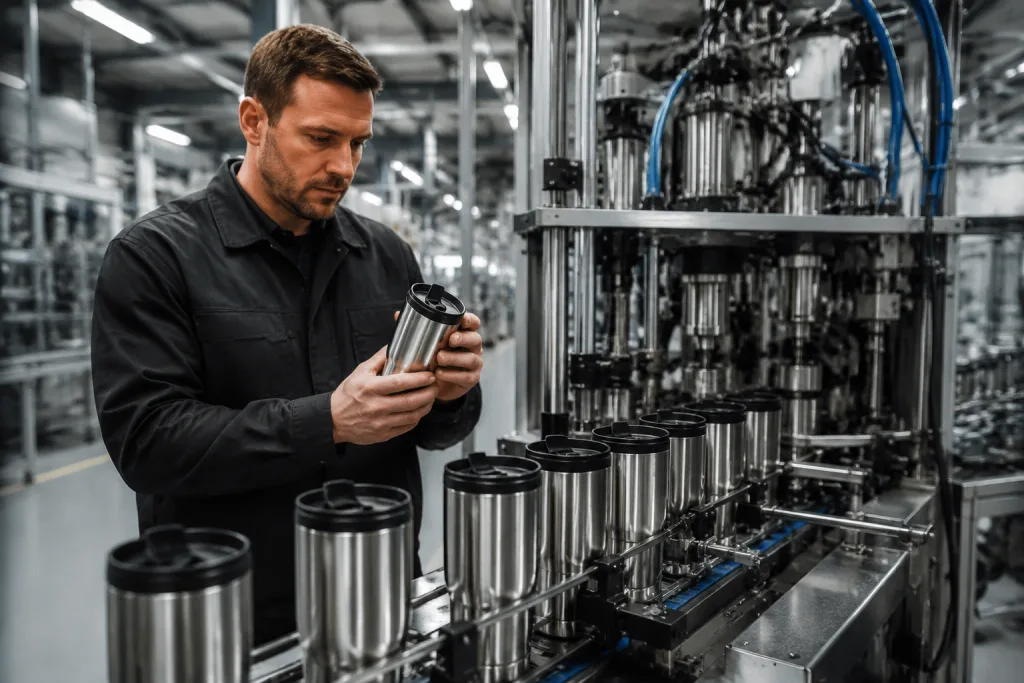
Run final inspection when at least 80% of the goods are packed and 100% are produced. Use AQL, not “looks okay.” For most coffee mug manufacturers, AQL 2.5 for major defects and 4.0 for minor defects is a workable export standard; our QC table usually pulls 200 pcs from a 5,000 pcs lot under the normal inspection level. Critical defects, such as sharp edges, broken glass if applicable, serious leakage, wrong material, mold contamination, or unsafe odor, should be zero tolerance. QC pulled one sample last year with a burr on the drinking rim, 0.4 mm high on the feeler gauge. That carton stopped right there.
Define major and minor defects before production. Major defects include leakage, poor vacuum performance, wrong logo, wrong color, missing barcode, loose lid, rust marks, dented body, failed adhesion, and carton shortage. Minor defects include tiny coating dust, slight color variation within approved range, or small carton scuffing. Be precise. “Logo acceptable” is the wrong wording; write logo position tolerance as ±1.5 mm and color against the approved Pantone chip. If your customer is using the item as coffee mug promotional giveaways, minor cosmetic tolerance can be wider, maybe 3 small dust points under 0.3 mm on the back side. If it is a retail coffee mug bulk program with shelf display, packaging defects matter more because the buyer will flag crushed corners before they even test the lid.
A good inspection checklist includes quantity count, workmanship, dimensions, capacity, coating appearance, logo position, barcode scan, carton drop test, carton marks, smell test, leak test, vacuum test, and packaging check. We run capacity with a digital scale, check height with calipers, and put filled tumblers upside down for 30 minutes on white paper. For Amazon-style shipments, add FNSKU label position, polybag warning if used, carton weight, and pallet requirements; one wrong FNSKU placement by 20 mm can create a warehouse rejection. For EU retail, keep REACH, LFGB, and food-contact declarations ready. For U.S. buyers, ask whether FDA food-contact documentation and Prop 65 statements are needed.
Do not pay the 70% balance just because the factory says goods are ready. Pay after inspection passes or after a written corrective action is completed. A serious coffee mug supplier will accept this structure if it was agreed in the PO. If you introduce it after production, expect pushback. Fair enough. China factories plan cash flow around deposits and balances, and the math does not work if the buyer suddenly holds payment for 12 days instead of the agreed 3 days. Put inspection timing and payment trigger in the first PO draft, not in a late email after the line has packed 186 cartons.
Plan Reorders And Private Label Growth
The first order proves the supplier. The second order proves the system. If the first bulk coffee mug shipment sells through, reorders should not take 18 days of email checking when the first order took 12 days to approve. Keep the technical file from order one: AI artwork, Pantone codes, approved sample photos, 0.52 mm carton board spec, test reports, AQL 2.5 inspection report, and final packing list. We run reorders from this file, not from memory. It saves days.
For coffee brands, private label work grows in clear steps. Start with laser engraving or one-color silk print, then move to custom powder coating and a retail box with barcode placement checked by caliper. After that, add bottom embossing, custom lid color, insert card, or a body shape that needs new tooling. Full coffee mug private labeling can pay off, but the math doesn't work at 500 pcs. Custom mold development makes more sense at 10,000 to 30,000 pcs annual volume because tooling, FDA or LFGB testing, spare lids, and color inventory need enough orders behind them.
If you are comparing coffee mug distributors or building your own coffee mug factory direct program, ask the supplier how they control repeat colors. A retained powder batch, signed color panel, and dated golden sample beat a written Pantone number alone. We have seen PMS 5535C shift after the powder supplier changed resin, and QC pulled the sample under a D65 light box before packing. Ask about spare lids too. For corporate-gift buyers, ordering 1% to 2% spare lids is cheap insurance when end users lose parts.
A practical reorder PO should copy the approved SKU and list only the changes. For example: same as PO BF24031, change body color to PMS 5535C, quantity 3,000 pcs, same logo, same box, shipment before September 10. The buyer once flagged a PO typo where 5535C became 553C; that small miss would have put the line into the wrong powder booth. This keeps your bulk coffee mug, bulk coffee travel mug, and bulk travel tumbler programs consistent across seasons without restarting sourcing each time.
Send Your Travel Tumbler RFQ For Review
Share artwork, quantity, target market, and ship date. We will return a factory-direct quote with sample timing and PO-ready details.
Frequently asked questions
What MOQ should I expect from a travel mug supplier?
For existing stainless travel tumbler molds, expect 1,000 pcs per color for powder coating and 500 pcs for some stock colors with laser logo. If you need a coffee mug custom color, retail box, and private label insert, 1,000 to 3,000 pcs is more realistic. New lid molds usually need 3,000 to 5,000 pcs for the first run, plus tooling cost. A coffee mug factory may accept lower MOQ, but the unit price can rise 8% to 25% because coating, printing, packing, and QC setup costs are spread over fewer units.
How long does a custom bulk travel mug order take?
For an existing model, plan 5 to 10 days for samples and 30 to 40 days for bulk production after deposit and artwork approval. Add 3 to 7 days if you need third-party testing such as LFGB, REACH, or Prop 65 screening. Ocean freight to North America or Europe can add 25 to 40 days depending on port and season. If you need coffee mug promotional products for a fixed event date, work backward from the delivery date and leave at least 10 days of buffer for inspection, customs, and inland trucking.
Which logo method is best for coffee mug custom orders?
Laser engraving is durable and clean, especially on powder-coated stainless steel, but it usually shows the metal or base layer color rather than a Pantone logo. Silkscreen is cheaper for one- or two-color logos and works well for coffee mug promotional projects, but adhesion must be tested. Heat transfer can handle gradients and full-color artwork, though it adds cost and may be less durable under dishwashing. For 1,000 pcs, logo setup is often USD 30 to USD 80 per color or position. Always approve a decorated sample before bulk.
Can I use one supplier for coffee mug bulk and travel tumbler orders?
Yes, if the supplier has the right production range. A stainless coffee mug manufacturer may handle travel tumblers, handle mugs, sports bottles, and insulated cups on similar lines. But glass mugs, ceramic mugs, and plastic cups use different factories and different testing. If you need a mixed coffee mug bulk program, ask for a product capability list, monthly capacity, audit reports, and past export markets. One consolidated China supplier can reduce communication cost, but only if they control QC across every item instead of simply forwarding orders.
What should be included in a private label tumbler PO?
A coffee mug private label PO should list product SKU, capacity, material, color, logo method, logo file, lid color, retail box artwork, insert card, barcode, carton marks, compliance market, inspection standard, and approved sample reference. Add exact quantities by SKU and color, FOB port, payment terms, and ship date. If you need coffee mug private labeling for retail, include packaging dielines and barcode test requirements. For Amazon or 3PL delivery, add FNSKU labels, carton weight limit, pallet height, and any prep instructions before the factory packs goods.