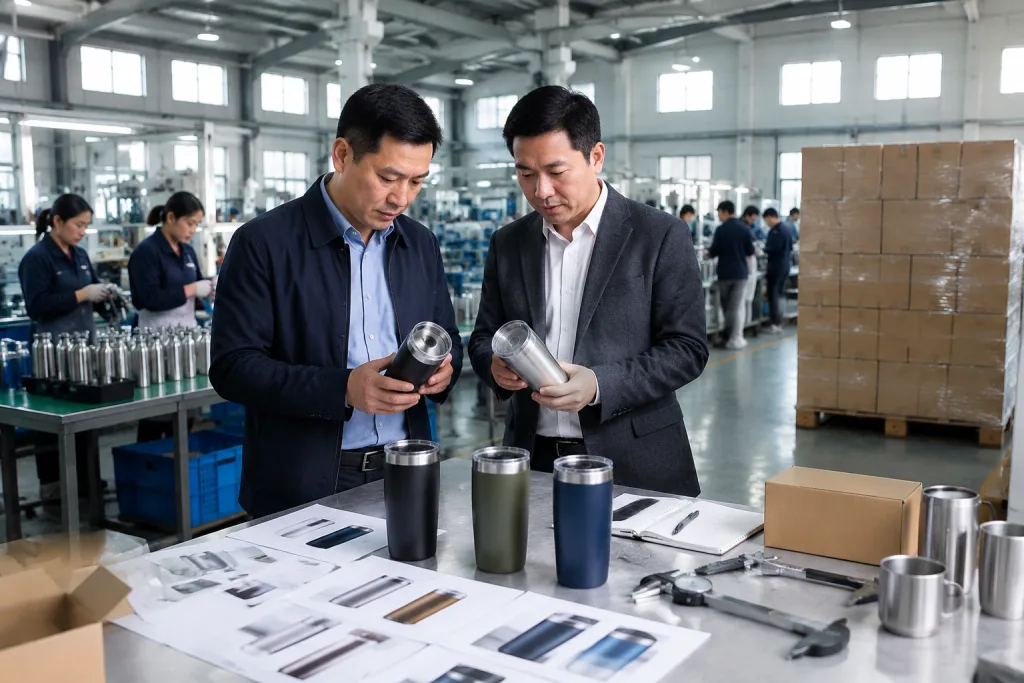
Key Takeaways
- For factory direct stainless travel tumblers, expect 1,000-3,000 pcs MOQ and 35-50 day production after sample approval
- A 0.45 mm inner wall and 0.50 mm outer wall is a practical baseline for 304 stainless steel travel mugs
- Laser engraving suits durable corporate gifts; powder-coated silkscreen suits high-color promotional campaigns
- Coffee brands should verify FDA, LFGB, REACH, and AQL 2.5/4.0 before choosing a coffee mug supplier
A travel mug supplier list earns its keep when it helps you cut the wrong factory in the first 20 minutes. We’ve seen buyers approve glossy photos, then QC pulled the sample and found a 0.6 mm lid gap, a laser logo that looked gray on powder coat, or an MOQ that jumped from 1,000 pcs to 3,000 pcs after the PO added private label boxes.
If you are buying a bulk coffee travel mug for retail shelves, employee gifts, or promotional campaigns, treat suppliers like engineering choices, not catalog pages. BottleForge Industrial manufactures in Zhejiang, China, and we run into the same pattern every season: buyers who check wall thickness with a digital caliper, lid tooling, AQL level, and carton capacity save more than buyers chasing a USD 0.15 quote gap. The math doesn't work when a cheap lid causes 2% leakage claims after shipment.
Supplier types compared side by side
Buyers often type “coffee mug supplier list” or “coffee mug supplier directory” and expect a clean top-10 ranking. That is the wrong question to ask. On our sales desk, we’ve seen a trading company answer in 22 minutes, then fail to confirm whether the lid gasket was silicone or TPE. A coffee mug factory direct supplier may quote 8-15% lower, but the engineer will ask for rim diameter, coating thickness, and carton drop height before giving a serious price. A promotional products agency can make the artwork proof look tidy, then send the PO with “matte balck” typed in the color field. Choose the model that matches your risk, not the one with the fastest reply.
| Supplier type | Best fit | Typical MOQ | Weak point |
|---|---|---|---|
| Factory direct manufacturer | Retail-ready bulk travel tumbler programs with fixed color, lid, carton, and barcode specs | 1,000-3,000 pcs | Needs clear drawings, Pantone code, logo file, and packing instructions from you |
| Trading company | Mixed SKUs, 300-piece market tests, and buyers still checking sell-through | 300-1,000 pcs | Less control over tooling changes, line QC, and rework timing |
| Promotional distributor | One-off corporate-gift campaigns with simple logos and fixed event dates | 100-500 pcs | Higher unit price and fewer options when QC pulls a sample |
| OEM/ODM drinkware factory | Coffee mug private label projects, custom lids, new molds, and retail packaging | 2,000-5,000 pcs | 18-35 days for development before bulk production starts |
For a coffee brand, the factory direct route usually makes sense once the order is above 2,000 units per color. You control the powder coating, logo position, insert card, barcode, carton mark, and 1.2 m drop-test standard. We run the first-off sample under a 3M tape test before the line opens; if the logo edge lifts, production waits. For a corporate-gift buyer needing 400 units in 12 days, a local distributor is more realistic even when the price is 25-45% higher. The math does not work if you need a new lid mold and air freight by Friday.
At our Zhejiang facility, monthly output for stainless travel tumblers is about 420,000 units, with standard MOQ starting at 1,000 pcs per model and 500 pcs per color when using stocked powder colors. Ask every coffee mug manufacturer for the same factory numbers: daily line capacity, sample lead time, AQL level, vacuum test method, and who signs the final inspection report. Last month QC pulled 32 pcs from a 3,000 pcs lot and found 2 lids with flash over 0.4 mm, so the lid supplier re-trimmed before packing. If a supplier will not disclose capacity, sample lead time, or QC process, keep them off the top of your travel mug supplier list.
The spec table that matters
Photos hide too much. A shiny bulk coffee mug can look premium on Alibaba and still come back with complaints because the silicone gasket sits 0.3 mm loose or the base measures 78 mm and jams in a Toyota cup holder. Check the spec sheet before you argue over FOB. We run the base diameter with a Mitutoyo caliper on the pre-production sample, because one buyer flagged this after 2,000 pcs were already packed.
| Spec | Retail coffee brand | Corporate gift | Budget promo |
|---|---|---|---|
| Material | 304 stainless inner and outer | 304 inner, 201 or 304 outer | 304 inner, 201 outer |
| Wall thickness | 0.45/0.50 mm | 0.40/0.45 mm | 0.35/0.40 mm |
| Insulation | 6 h above 60°C, 12 h cold | 4-6 h hot | 3-4 h hot |
| Lid | Tritan or PP with silicone seal | Slide lid or flip lid | Basic sip lid |
| Finish | Powder coat or ceramic-look coating | Powder coat, matte or gloss | Spray paint |
| QC | AQL 2.5 major / 4.0 minor | AQL 2.5 / 4.0 | Reduced inspection only |
For coffee mug custom made programs, wall thickness is where the math starts. A 0.35 mm outer shell cuts cost, but we have seen it dent after a 10 kg master carton drop from 60 cm. The line hates rework. If you sell online or ship through a 3PL, 0.50 mm outer wall is the safer call. For coffee mug promotional products handed out at a conference, 0.40 mm can pass if the gift box and insert are built for it.
Ask how the vacuum is tested. A serious coffee mug factory should check vacuum performance after brazing and again after coating; QC pulled one coated sample last month that looked fine but lost 18°C in 3 hours. We usually test with 95°C hot water and record heat retention at 1, 3, and 6 hours. For North American and European buyers, request FDA food-contact documentation for the liner, LFGB test reports when the mug touches the German market, REACH screening for coatings, plus carton drop-test results using your planned packaging.
Use-case fit beats catalog choice
A bulk travel mug is not one SKU with ten colors. Start with the use case: retail shelf, office gift kit, car cup holder, or short-run event giveaway. Then check the wash method and logo expectation. We see this go sideways at quotation stage when a buyer asks for “the best tumbler” but the PO later says hand-wash sticker, 72 mm cup-holder base, and MOQ 3,000 pcs. That is the wrong question to ask. The right mug is the one that survives the channel without paying for features the buyer cannot sell.
Coffee retail and roastery merchandise
If you sell a bulk coffee tumbler beside beans or subscriptions, we run 16 oz and 20 oz vacuum tumblers first, usually with powder coating that feels dry in hand and does not look cheap under shop lighting. Laser engraving beats pad print here because QC pulled samples after 30 rubs with a 3M tape test and the ink edge started to lift. For a coffee mug private label program, add a printed kraft box, care card, EAN or UPC barcode, plus a master carton under 15 kg so one person can move it in the stockroom. A gift-ready box may add USD 0.28-0.55 per unit, but on shelf it can pay back faster than a heavier lid.
Corporate gift and employee kits
Corporate-gift buyers usually push hardest on delivery date and logo accuracy, not exotic materials. A 20 oz coffee mug customizable design with one-color silkscreen or laser logo is enough for most employee onboarding kits, and the math does not work if you add copper plating for a mug that sits in a welcome box. If the mug ships with notebooks or apparel, confirm carton dimensions before the kitting warehouse books labor. We had one buyer flag a 40 x 40 x 46 cm carton because it fit ocean freight well but jammed their packing bench and forced repack at USD 0.18 per set.
Promotional events
For coffee mug promotional campaigns, do not overspec. Short life, tight budget. A basic 14 oz or 16 oz bulk coffee mug with 201 outer steel, 304 inner steel, and spray coating can work when the campaign runs for 7 days at a trade show. Be honest about dishwasher claims. We ship low-cost coatings as hand-wash only unless the finish passes our dishwasher cycle check, and the buyer should budget for a better coating if their brief says dishwasher safe. The line can make it cheap, but it cannot make cheap coating behave like retail-grade powder coat.
Good sourcing is not choosing the most expensive tumbler. It is matching durability, decoration, packaging, and compliance to the sales channel.
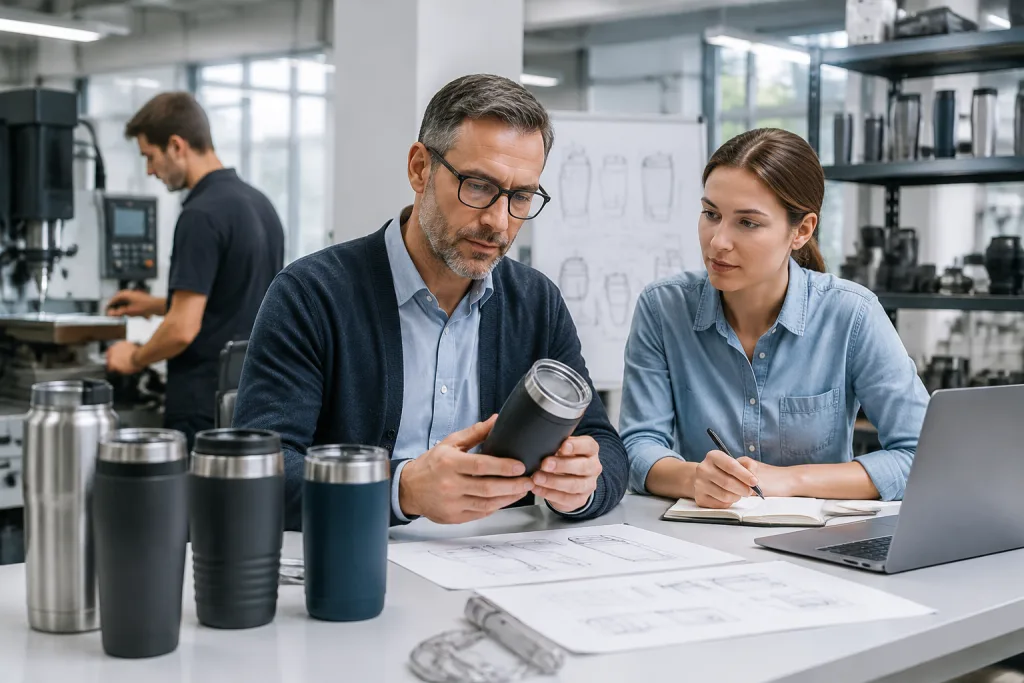
Decoration choices change the quote
“Coffee mug custom” can be a 30 mm laser logo on one side, or a full-wrap heat-transfer print with a color box and barcode sticker. We run both, and the quote changes fast. Last month QC pulled two 40 oz samples from the line: same 304 stainless body, same lid, but the wrap print version priced USD 0.42 higher than the laser version because the artwork needed 2 extra passes and a longer oven setting.
Laser engraving is the safe pick for corporate logos, coffee shop wordmarks, and clean retail designs. It usually adds USD 0.12-0.35 per unit depending on logo size and machine time. It does not peel, and it works well on powder-coated tumblers. The catch is color. A fiber laser removes or changes the surface; it is not laying down ink. We usually check logo width in mm before quoting because a buyer once sent a 65 mm badge logo after the PO said “small logo,” and the math did not work.
Silkscreen printing works for one- to three-color artwork. It is common for coffee mug promotional products because setup cost stays low and the result looks clean on straight walls. On tapered tumblers, registration gets harder. Expect USD 0.06-0.18 per color per position, plus screen charges around USD 35-60 per color. Our print master uses a simple angle jig on tapered cups; if the wall angle is off by 2 mm from the approved sample, the buyer will flag the gap between colors.
Heat transfer and water transfer are better for complex wraparound designs. They fit high-visual coffee mug customized projects, but adhesion testing is not optional. We recommend cross-hatch tape tests and 3M tape pull tests before mass production. For EU buyers, confirm ink and coating compliance under REACH. For children’s or family-oriented gift sets, ask whether ASTM or CPSIA-related testing is relevant to your market. We have seen this go sideways when a buyer approved artwork by PDF only, then found the seam line too visible on a 500 ml tapered tumbler.
Embossed or debossed logos need tooling. They look premium, but they slow the project. Tooling can run USD 800-2,500 depending on body shape, and lead time may add 18-25 days before mass production. This route fits a coffee mug oem manufacturer project, not a rush event order. If your artwork is still changing, stay with laser or silkscreen. On the factory floor, the first thing our tooling guy asks is whether the logo depth is 0.3 mm or 0.5 mm, because that decision affects the mold, the sample date, and the carton plan.
Pricing and MOQ without games
Anyone can email a cheap number in 3 minutes. A quote we can actually ship against needs assumptions: 304 stainless or 201, 20 oz or 30 oz, spray paint or powder coat, slider lid or flip lid, laser or silk print, white box or retail box, AQL 2.5 or loose carton check, FOB Ningbo or FOB Shanghai. Last month a buyer flagged a USD 0.18 gap between two suppliers; QC pulled the sample and found the wall was 0.38 mm instead of our 0.45 mm spec. If you receive a one-line price for a bulk travel tumbler, treat it as a placeholder, not a purchasing basis.
For standard China production in 2026 planning, a 20 oz stainless vacuum travel tumbler often lands around USD 3.10-4.80 FOB Ningbo or Shanghai at 3,000 pcs, depending on lid and finish. A simple bulk coffee mug with spray paint and basic lid may sit closer to USD 2.40-3.20. A premium coffee mug custom made item with powder coat, laser engraving, retail box, and insert card can reach USD 4.60-6.20. Real range, not bait. On the line, we run the powder coat thickness gauge at 60-80 μm, and one extra retail insert can add USD 0.06-0.12 before anyone talks about freight, duty, or destination handling.
MOQ is not factory drama. It comes from coating line changeover, logo setup, packing materials, and carton printing. In Zhejiang and other parts of China, a stocked color can sometimes run at 500 pcs, but a Pantone-matched powder coat may require 1,000-2,000 pcs per color because the booth purge and test spray still eat half a shift. Custom lids or molds usually push MOQ to 5,000 pcs because tooling and resin setup need volume; we have seen this go sideways when a buyer asks for 800 pcs with a new PP lid and expects stock pricing.
For coffee mug private labeling, separate the mug MOQ from the packaging MOQ. This is the wrong question to ask: “Can you do 1,000 pcs with my brand?” Ask for mug MOQ, printed box MOQ, insert MOQ, and spare carton rules as separate lines. A box factory may require 2,000 printed boxes even if the tumbler factory accepts 1,000 mugs, and we once caught a PO typo that said 1,000 mugs but 10,000 color boxes. If you plan multiple SKUs, ask whether neutral boxes can be shared and labeled with 40 x 60 mm SKU stickers. That small packaging decision can save USD 300-800 on a first order.
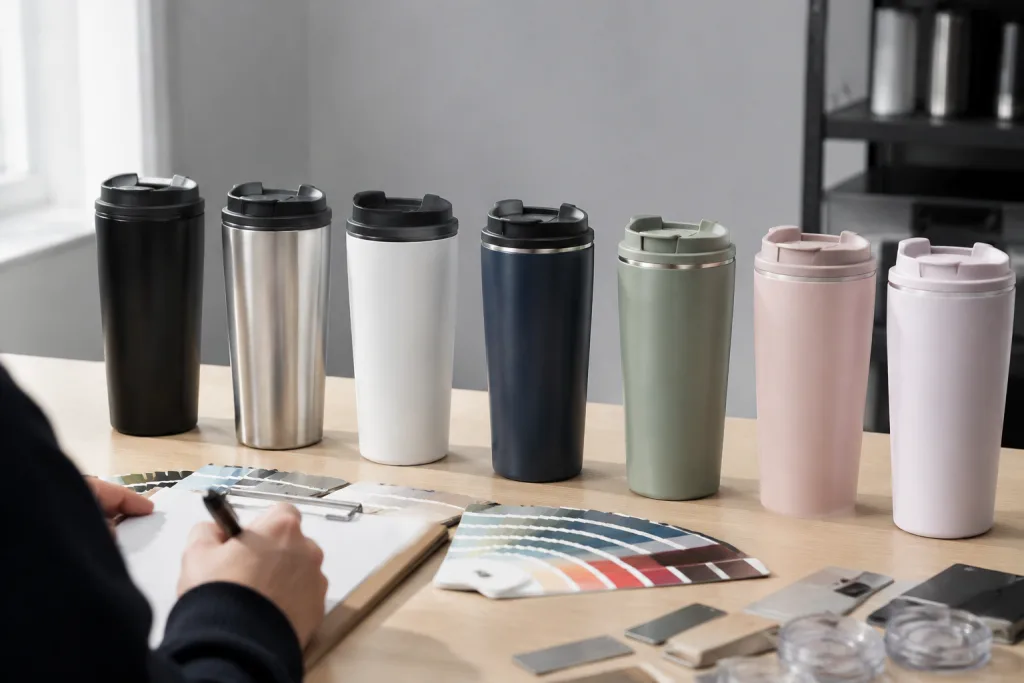
Compliance, inspection, and logistics
Coffee brands and corporate buyers sometimes push compliance back to the drinkware supplier. That is the wrong question to ask. If you import into the EU, US, UK, or Canada, your company is the one placing the tumbler on the market. We can prepare reports, declarations, and sample photos, but the buyer should lock the target standard before we cut tooling or print the first logo film. Last month, one PO had “EU food safe” typed in the remarks, while the artwork file called out FDA only; QC pulled the pre-production sample and we lost 2 days clearing that mismatch.
For stainless travel mugs, ask for food-contact test reports for the inner steel, lid plastic, silicone gasket, coating, and printing ink where applicable. FDA is common for the US. LFGB is often requested by German and wider EU buyers. REACH matters for surface coatings and inks. If the product may be used by children, discuss ASTM, CPSIA, and small-parts concerns. “Food grade” is sales talk, not a document. Ask for the report number, lab name, sample description, and issue date, then match it against the actual 304 stainless body, PP lid, silicone ring, and spray coating we run on the line. We have seen buyers flag reports because the test sample said “black powder coating” while the order shipped with cream color spray paint.
Inspection should be written into the purchase order. For normal export orders, AQL 2.5 major and 4.0 minor is a practical baseline. Critical defects should be zero tolerance: leaking lid, sharp edge, rust inside, wrong material, failed vacuum, missing warning label, unreadable barcode, or incorrect logo. For vacuum mugs, we run hot-water checks at 95°C and leave samples standing upside down for 30 minutes; one leaking lid in the checked set is enough for a serious discussion before shipment. If you are selling through marketplaces, add FNSKU or UPC scanning checks at final inspection. The buyer flagged this twice in 2024: the carton label scanned, but 18 inner retail boxes had a barcode printed 2 mm too low for the handheld scanner.
Logistics also affects product choice. A 20 oz tumbler in a retail box may pack 24 pcs per carton, with carton gross weight around 12-14 kg. Ocean freight is usually efficient above 2-3 CBM. Air freight can kill the margin on a low-cost coffee mug bulk order, though it can still make sense for 300 urgent executive gifts. If your deadline is fixed, reserve 7 days for pre-shipment inspection and corrective action; rushing this to 2 days is where we see coating scratches and mixed-color cartons go sideways. Once the cartons are strapped, weighed, and sitting by the loading door, the factory cannot fix spray defects without opening the whole batch.
Building your final shortlist
Cutting a travel mug supplier list by unit price alone is the wrong question to ask. Rank by fit. For a coffee brand or corporate-gift buyer, we usually keep 3 names on the sheet: 1 factory-direct coffee mug supplier for custom tooling and stable repeat orders, 1 trading partner for mixed SKUs under 1 PO, and 1 local distributor for rush jobs under 500 pcs. We’ve seen this go sideways when a buyer asked a distributor to handle a 12-color powder coat run; the line stopped twice because the approved Pantone chips were never sent to the coating room.
Send the same RFQ format to every supplier. List capacity, stainless grade, wall thickness, lid material, leakproof expectation, coating type, logo artwork, packaging, compliance market, inspection level, delivery address, Incoterm, and target order date. Vague “best price coffee mug bulk” requests get vague pricing. Ask for a 20 oz 304 stainless bulk coffee travel mug, 0.45/0.50 mm wall, powder coat, laser logo, individual kraft box, AQL 2.5/4.0, FOB Ningbo, 3,000 pcs, and the quotes line up properly. We run those details through a caliper check and BOM sheet first; one buyer once typed “0.35 mm” on the PO by mistake, and QC pulled the sample before the cost sheet went off track.
Watch how suppliers answer. A competent coffee mug factory should push back on loose points: does “leakproof” mean upside down inside a laptop bag for 30 minutes, or just splash-resistant on a desk? Does the powder coat need 500-cycle dishwasher testing? Will 0.2 mm logo strokes disappear during laser engraving? Does the master carton need Amazon-style drop testing from 76 cm? These questions slow the first email. Good. The math doesn’t work if you save 1 day on sampling and lose 18 days fixing lids that seep at the silicone plug.
For BottleForge Industrial in Hangzhou, Zhejiang, the usual custom travel tumbler timeline is 5-7 days for digital mockup, 7-12 days for pre-production sample, and 35-50 days for mass production after sample approval and deposit. If your launch date cannot absorb that schedule, say so early. We can adjust color, packaging, or shipping mode, and sometimes split 500 pcs by air while the balance moves by sea. Nobody honest can squeeze coating, 180°C curing, AQL inspection, carton weighing, and export booking into a few days without adding risk.
Send us your tumbler spec for factory review
We will check MOQ, decoration, compliance, packaging, and lead time before you commit budget to a bulk travel tumbler order.
Frequently asked questions
What should I include when asking for a travel mug quote?
Send a complete spec instead of a mood board. Include capacity such as 16 oz or 20 oz, stainless grade, wall thickness, lid type, coating, logo method, packaging, order quantity, delivery country, compliance requirement, and Incoterm. For example: 20 oz bulk travel mug, 304 inner and outer, 0.45/0.50 mm wall, powder coat, laser logo, kraft box, 3,000 pcs, AQL 2.5/4.0, FOB Ningbo. This lets every coffee mug supplier quote the same product. If you only ask for a coffee mug custom price, one factory may quote spray paint and another may quote powder coat, making the comparison useless.
What is a realistic MOQ for coffee mug private labeling?
For standard stainless travel mugs, 1,000 pcs per model is realistic at a China factory if you use existing molds and stocked coating colors. Pantone-matched colors usually need 1,000-2,000 pcs per color. Printed retail boxes may have their own MOQ, often 1,000-2,000 pcs depending on the box supplier. Custom lids, new body tooling, or embossed logos can push MOQ to 5,000 pcs or more. If you are testing a coffee mug private label line, start with existing tumbler bodies, laser engraving, and shared neutral packaging with SKU labels.
Is laser engraving better than silkscreen for corporate gifts?
Laser engraving is usually better for executive gifts, employee kits, and long-use items because it does not peel and handles washing better than most printed logos. It typically adds USD 0.12-0.35 per unit. Silkscreen is better when you need solid brand colors, event graphics, or a lower price on 1,000-5,000 pcs promotional runs. It may add USD 0.06-0.18 per color per position, plus screen charges. For a coffee mug promotional order with a simple one-color logo, silkscreen is fine. For a premium coffee mug customized program, laser is safer.
How long does production take for a bulk coffee tumbler order?
A normal custom bulk coffee tumbler order takes 45-70 days from artwork confirmation to export readiness. Digital mockup is usually 5-7 days, pre-production sample is 7-12 days, and mass production is 35-50 days after sample approval and deposit. Add 3-7 days for final inspection, booking, and customs paperwork. Ocean freight to Europe or North America adds roughly 25-45 days depending on port and season. Rush orders are possible only if you use stocked colors, existing lids, simple logo decoration, and standard packaging.
How do I judge suppliers in a coffee mug supplier directory?
Do not rank suppliers only by the first quoted price. Ask each supplier for monthly capacity, MOQ by color, sample lead time, stainless grade proof, coating options, available test reports, AQL standard, and factory audit status such as BSCI or ISO 9001. Request photos or videos of production lines, not just catalog renders. A useful coffee mug supplier directory helps you identify supplier type, but you still need to verify whether they are a coffee mug factory, trading company, distributor, or OEM manufacturer. The best fit depends on order size, timeline, and compliance risk.