Key Takeaways
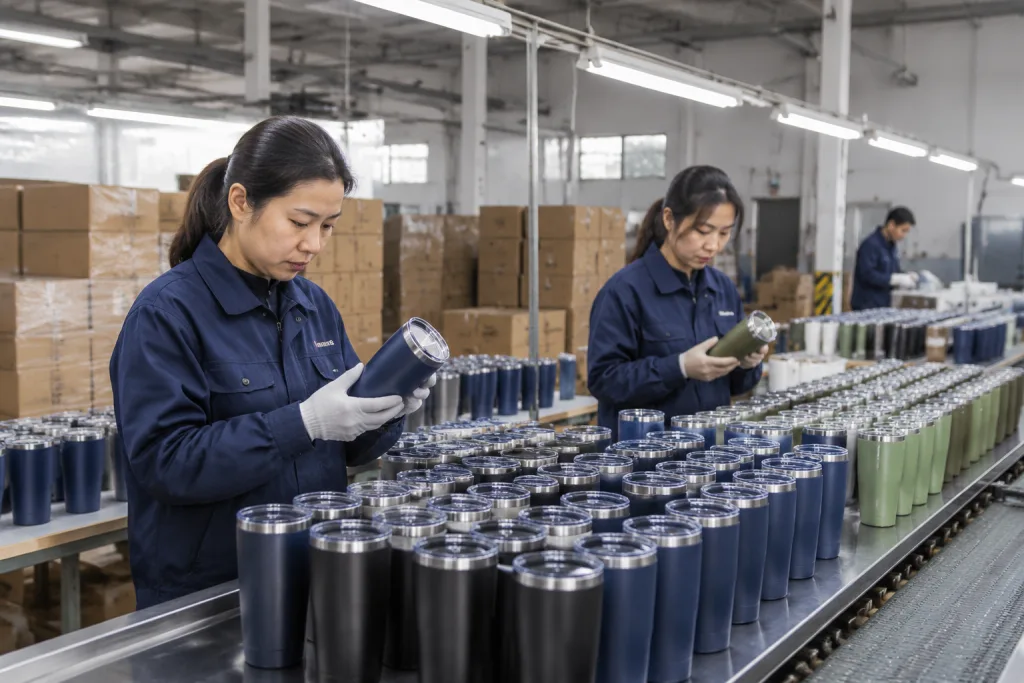
- Shortlist suppliers by platform first: 350 ml, 500 ml, and 600 ml travel tumblers cover most coffee programs
- Expect MOQ from 1,000 pcs for stock colors and 3,000 pcs per custom powder-coated color
- A realistic China factory lead time is 25-35 days after artwork and sample approval
- Use AQL 2.5/4.0, LFGB or FDA, REACH, and drop/leak tests before approving shipment
A travel mug supplier directory only pays off if you filter for the right things. Coffee brands and corporate-gift buyers often start with shape, Pantone color, and logo size. Wrong order. The bills show up later: insulation claims written as “keeps hot longer” instead of 6 hours at 60°C, laser logos that break on tapered cups, FDA files missing the gasket material, or freight based on 1,000 pcs when the PO says 3,000 pcs. We see this on the line when QC pulls a 304 stainless sample and the lid fit is 0.4 mm loose.
Treat the directory like a buying checklist, not a contact list. Before you ask a coffee mug supplier for pricing, lock four items: cup platform, branding method, landed-cost math, and AQL 2.5 inspection standard. Our Hangzhou, Zhejiang team ships from China to Europe and North America, and we ask these same questions before sampling because the math doesn’t work if the buyer changes from powder coating to full-wrap print after tooling. Last month, one PO even had “mat black” instead of “matte black,” and the buyer flagged it only after the pre-production sample.
Start with the use case
The first decision is not “Which coffee mug factory has the lowest unit price?” The better question is: “Where will this tumbler be used?” A retail coffee brand, an employee onboarding kit, and a conference giveaway should not share the same spec just because the buyer found all three in one travel mug supplier directory. We see this mistake on RFQs every week; last month one PO even said “matte black” in the item line and “glossy white” in the artwork note, and QC pulled the sample before the line started.
For a coffee roaster selling merchandise beside whole beans, we run a retail-style build: 18/8 stainless steel, vacuum insulation, powder coating, a clean lid, and a gift box that survives parcel shipping. A common spec is 500 ml, double-wall vacuum, 0.45 mm inner wall, 0.50 mm outer wall, copper lining optional, and a push-on or screw lid with silicone seal. That works for coffee mug private label programs because it feels like a shelf product, not a throwaway promotion. On the floor, we check coating thickness with a film thickness gauge and do a 90-minute carton drop review before we quote the gift box.
For corporate-gift buyers, delivery reliability and decoration consistency beat fancy claims. A bulk travel mug for 2,000 employees must match the approved PMS color closely enough, fit into a kitting carton, and pass a simple leak test. The buyer often cares less about a 12-hour hot claim than whether 2,000 logos align within a 1.5 mm tolerance. We’ve seen this go sideways when the logo jig is 2 mm off-center; the buyer flagged it only after 600 pieces were packed, which is an expensive way to learn.
If you are buying for events, be honest about budget. A bulk coffee mug at USD 2.20 FOB China will not behave like a USD 5.80 stainless travel tumbler. Single-wall stainless, PP liner, or plastic lids can work for coffee mug promotional products, but do not sell them as premium. The math doesn't work. Good suppliers in Zhejiang will say it straight: at that price, we ship thinner walls, lighter lids, and simpler packing, and our incoming inspection will still catch basics like a 0.3 mm lid flash or a leaking silicone seal.
Filter the directory by platform
A supplier directory usually mixes trading companies, mold owners, assembly plants, and true coffee mug manufacturers. Filter by product platform first. Ask each vendor what they run each month on the line, not what the sales PDF shows. Last April, QC pulled 6 “factory” samples from one directory shortlist and found 2 vendors using the same 85 mm lid from a subcontractor in Yongkang.
For travel tumblers, the working platforms are straight-wall tumblers, tapered car-cup tumblers, handle travel mugs, and leak-resistant commuter mugs with silicone plugs or flip lids. A coffee mug manufacturer focused on ceramic drinkware may list stainless tumblers, but the math doesn't work for vacuum products if they cannot show welding jigs, vacuum furnace capacity, and lid tolerance control within 0.3 mm. We’ve seen this go sideways. A factory strong in 1,200 ml sports bottles can still miss a 350 ml café tumbler because the buyer flags lip feel, cup-holder fit, and the small rattle in the PP lid.
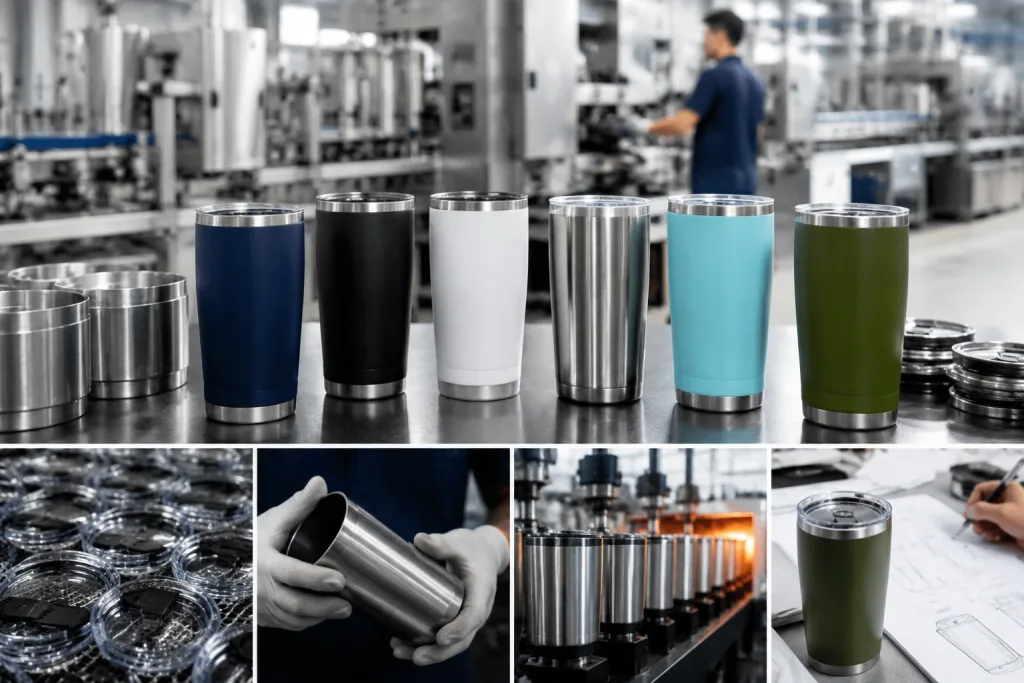
Factory-direct capability matters when you need coffee mug custom made details: a special lid color matched to Pantone Black C, a custom embossed grip, a laser logo on both sides, or a matching retail box with the barcode printed straight. At BottleForge in Zhejiang, a typical monthly output is 450,000 stainless drinkware units, with 1,000 pcs MOQ for stock-color bulk coffee travel mug projects and 3,000 pcs per custom powder-coated color. Those numbers are not decoration. They tell you whether the line is set up for your order size, and whether we ship in 12 days for stock colors or 18 days after coating approval.
When comparing a coffee mug supplier list, ask these questions: Who owns the mold, who controls powder coating, and who signs off the final leak test report? If the answer is split across 3 subcontractors, your schedule risk rises fast; we once saw a PO typo change “matte sand” to “mate sand,” and the coating room still sprayed 2,400 pcs before the buyer flagged it. Not every trader is bad. Some coffee mug distributors manage 500 pcs small runs well. For coffee mug factory direct orders, control of welding, polishing, coating, and packing should be clear before you pay a deposit.
Choose the branding route carefully
The second decision is decoration. Buyers often treat branding like a simple artwork upload. On the line, it changes the MOQ, the reject rate at final QC, the packing flow, and sometimes the dishwasher claim. We had one PO last month with “logo size 45m” typed instead of 45 mm; QC pulled the sample before mass printing, or 3,000 lids would have been wrong.
Laser engraving is the safest route for stainless and powder-coated bulk coffee tumbler programs. Clean result. Permanent mark. The cost usually makes sense from 500-1,000 pcs when we run the rotary laser jig. The limit is color: laser burns through coating or marks the steel, so it will not give you a full-color logo. Silkscreen works for one- or two-color coffee mug promotional orders on straight walls, and the unit price can be lower. Curved tumblers are where we see this go sideways; the buyer flagged a 1.2 mm logo shift on a tapered 20 oz cup after our first pre-production sample. UV printing handles full-color artwork and gradients, but ask for a cross-hatch adhesion test on matte powder coat before you approve bulk.
For coffee mug custom projects with retail ambitions, private mold details can lift the item out of a supplier directory page. A custom lid insert with your pull-tab shape, an embossed silicone base with a 0.6 mm raised logo, or one locked powder color may be enough. Full mold development is the expensive path, and sometimes the wrong question to ask for a first order. A simple lid adjustment may cost USD 800-2,000 in tooling and add 15-25 days. A full coffee mug customized body mold can cost USD 4,000-12,000 and take 35-60 days before mass production, before we even start the salt-spray check on the 304 stainless sample.
Private-label buyers should decide how far branding goes before quotation. Coffee mug private labeling might mean one logo on the tumbler, or it might cover the hangtag with 300 gsm paper, barcode placement, warning label wording, care card text, carton mark size, and retail box dieline. If you sell through e-commerce or distribution, send the full labeling brief at quotation stage. Adding a FNSKU, German recycling mark, or French Triman logo after packing artwork approval is how small projects lose 7 days, because the carton printer will not restart for 200 boxes without a reset fee.
Price the order, not the unit
The third decision is commercial: what will this order cost landed, not what does one tumbler cost on a directory page? A quote that says “USD 3.45” is weak unless it fixes 304 stainless or 201 stainless, 500 ml or 600 ml, slider lid or flip lid, logo process, box spec, MOQ, Incoterm, and quote validity. We had one PO last April where the buyer typed “matte black” but attached a Pantone 426C artwork file; QC pulled the pre-production sample under the D65 light box before the line started.
For a standard 500 ml stainless bulk travel tumbler, a workable FOB China range is USD 3.20-5.20, driven by steel thickness, coating, lid tooling, logo method, and box grade. A lower price can be real if the outer wall drops from 0.5 mm to 0.4 mm, there is no copper lining, the lid is simple PS, and the packing is a white box. That is fine for a conference gift. It is the wrong target if your coffee brand expects repeat retail sales at USD 18-24; the math doesn’t work after returns, dents, and bad lid reviews.
Ask suppliers to quote three clear versions with specs beside each price: stock color plus laser logo, custom powder coating with one-color print, and retail gift box with barcode label. This shows which coffee mug factory understands export costing and which vendor just replies fast. For a 3,000 pcs order, the difference between laser and UV print may be USD 0.15-0.45 per unit. A rigid gift box can add USD 0.35-0.90. If the buyer asks us to remove individual polybags, add a recycled paper insert, or use an FSC carton, we quote it line by line because one missing packing note can stop final inspection at AQL 2.5.
Freight catches buyers late. A 500 ml tumbler in gift box may pack 24 pcs per master carton, around 13-16 kg gross weight, and the carton size we run is often close to 54 x 36 x 27 cm after the drop test. Sea freight suits volume orders; air freight can wipe out margin. If you need 1,000 pcs in Toronto in 18 days, say that before sampling. A serious coffee mug factory direct supplier in China will price that rush job apart from a normal 30-35 day production schedule plus ocean freight, because the line booking, carton booking, and courier handover are different jobs.
Set compliance before sampling
The fourth decision is quality and compliance. Set it before sampling. Do not wait for final inspection to ask whether the tumbler fits your market. At that point, 8,000 pcs may already be packed in master cartons, and the math doesn't work if QC pulls the sample and finds the wrong lid material.
For Europe, ask about LFGB food-contact testing, REACH for coatings and components, and packaging rules if you use printed boxes or recycled claims. For North America, FDA food-contact expectations and ASTM-style performance tests are common buyer requirements. If the product is for children, the standard changes; we have seen this go sideways when a PO said “kids cup” but the artwork file named it “adult tumbler.” Even for adult products, identify lid materials on the spec sheet: PP, Tritan, silicone, stainless, or ABS. “Food grade” is not a test report.
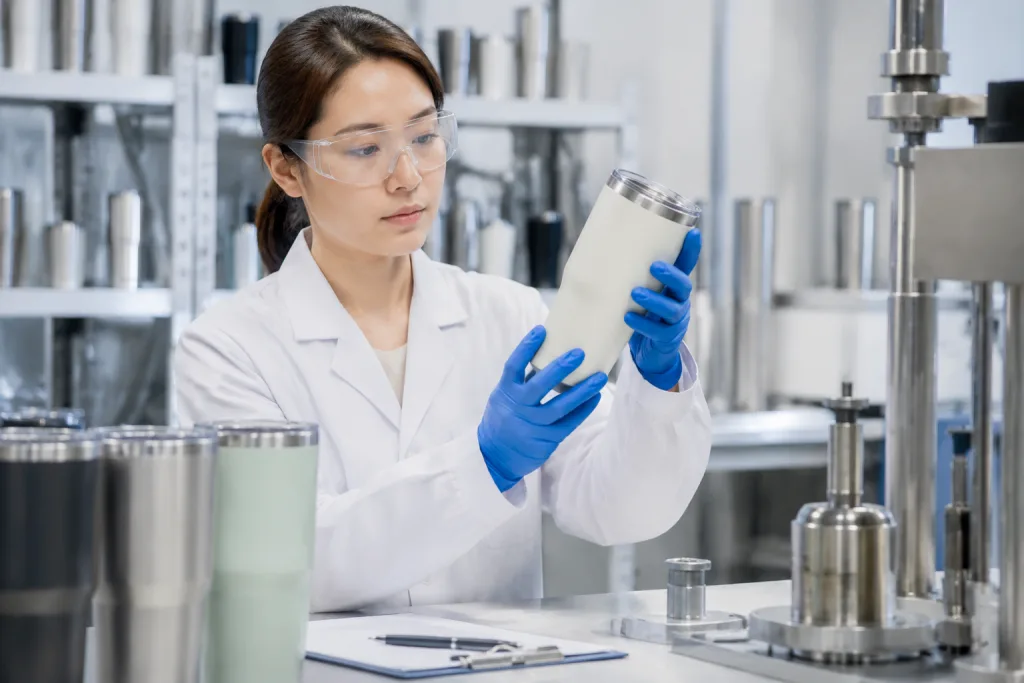
Your purchase order should define inspection criteria. We usually run AQL 2.5 for major defects and AQL 4.0 for minor defects, with 100% functional leak testing on the line for screw-lid or flip-lid designs. Typical checks include vacuum performance with a digital thermometer, coating adhesion cross-hatch, logo rub test with 3M tape, lid torque, odor, sharp edges, capacity tolerance, carton drop test, and barcode scan. For vacuum insulation, many factories test with hot water and measure temperature drop after 2-6 hours; define the water temperature, room temperature, fill level, and test interval instead of accepting “keeps hot 12 hours.”
Social compliance also matters for corporate-gift buyers. BSCI, Sedex, ISO 9001, or factory audit reports may be required by your customer. A coffee mug distributor can help with paperwork, but the underlying plant still needs credible records. If you are sourcing from Zhejiang or another China production base, ask for current documents, not screenshots from three years ago; last month one buyer flagged an audit PDF where the factory address missed one digit in the Hangzhou district code.
Compare suppliers with a scorecard
A travel mug supplier directory only earns its keep when every vendor gets judged on the same sheet. If not, the fastest WhatsApp reply or the glossy PDF wins. That is not buying. Last month, one buyer sent us a directory shortlist with 17 suppliers; 6 had no lid leak-test video, but 2 still ranked near the top because their catalog looked clean.
Use a 100-point scorecard. Put 25 points on product fit: mold numbers that match your target shape, 12 oz to 40 oz capacity coverage, lid structure, plus records for bulk coffee travel mug runs over 5,000 pcs. Put 20 points on factory control: laser welding, inner-wall polishing, powder coating line ownership, assembly stations, leak and vacuum testing. Put 20 points on compliance and QC: FDA or LFGB reports where needed, AQL 2.5 records, real defect photos, and acceptance of SGS, Intertek, or BV inspection. Put 15 points on branding support: AI dielines, PMS chips checked under a D65 light box, sample color accuracy, and export carton artwork files. Put 10 points on commercial clarity: FOB Ningbo or Shanghai terms, tooling charges, payment split, carton size, gross weight, and CBM. Put the last 10 points on communication: reply speed, technical answers, and whether the sales team says “no” when the request will break. We run this check with a caliper, a 3M tape-test strip, and the latest PO on the desk.
This scorecard works for a coffee mug supplier directory, a coffee mug supplier list, or names passed over by coffee mug distributors. It also gives you a fair way to compare a coffee mug factory with a trading company. A trader may win on fast quoting and mixed-SKU consolidation across 8 designs. A factory usually wins on engineering control, coating repeatability, and price stability after the first sample round. Pick by the order. For a 1,200 pcs mixed-color promo job, the trader may be the clean choice; for a 20,000 pcs private-label tumbler with a new lid gasket, the math often points back to the line.
Be careful with suppliers who say yes to every keyword: coffee mug in bulk, coffee mug customizable, coffee mug promotional, retail private label, rush air shipment, all at the lowest price. Good factories have limits. In Hangzhou, Zhejiang, we would rather reject a 10-day custom-color order than ship soft coating that fails a 3M cross-hatch tape test after 24 hours. We have seen this go sideways: QC pulled the sample, the coating peeled at the handle edge, and the buyer still wanted air shipment before Friday. Wrong question. The real question is whether the supplier will protect your launch when the PO pressure gets ugly.
Sampling should prove the decision
Sampling is not a souvenir stage. It is the bench test for the platform choice, logo method, target cost, and QC line items. We run the pre-production sample against the approved spec with a digital caliper, gram scale, and lid leak test; if QC pulled the sample and found a 1.8 mm lid gap, mass production will not be boring.
For coffee mug custom made orders, ask for two samples. Start with a blank physical sample to check hand feel, lid fit, filled capacity, and whether it clears a 72 mm car cup-holder gauge. Then ask for a decorated sample using the real logo, coating, and packaging direction. For laser engraving, check position, size, contrast, and whether the logo twists on tapered bodies; we have seen buyers approve a flat AI file and then flag a 3 mm visual drift on the curve. For silkscreen or UV, check Pantone match, tape-test adhesion, and edge sharpness under a 10X loupe. For coffee mug customized retail packaging, drop-test the box from 80 cm and see if the lid or rim takes the hit.
Sampling timelines are usually 5-7 days for existing blank samples, 7-12 days for laser or silkscreen samples, and 12-18 days for custom powder color or UV artwork. If a supplier promises a custom coated, printed, boxed sample in three days, ask what is being skipped. This is the wrong question to ask: “Can you sample faster?” Ask whether the powder line is already running that color, whether the UV jig exists, and whether the box cutter die is shared. Sometimes speed is real because the color is on the line this week. Often the math does not work, and the sample will not represent bulk production.
Once the sample is approved, freeze a golden sample and a written specification. Include capacity, dimensions, weight tolerance, steel grade, wall thickness target, lid material, coating code, logo size, packaging, carton quantity, and inspection standard. We tape the golden sample, sign the label, and keep one in the QC cabinet next to the AQL 2.5 checklist; one PO typo, like “350ml” instead of “500ml,” can burn 20 cartons before anyone catches it. Whether you call it a bulk coffee mug or bulk travel tumbler, the same rule applies: if it is not written down, it is not controlled.
Send your tumbler brief for a factory quote
Share capacity, logo, quantity, target market, and delivery date. We will reply with practical specs, MOQ, FOB pricing, and sampling options.
Frequently asked questions
What MOQ should I expect from a travel mug supplier directory?
For existing stainless travel mug molds, a realistic MOQ is 1,000 pcs for stock colors with laser engraving or one-color print. Custom powder-coated colors usually start at 3,000 pcs per color because coating lines need setup time and color-change cleaning. Full custom mold work is normally 5,000-10,000 pcs depending on the body and lid. If you need only 300-500 pcs for a corporate event, ask for available inventory and simple logo decoration. The unit cost will be higher, but it avoids forcing a factory into an inefficient run. Be careful with suppliers advertising 100 pcs MOQ for fully custom stainless tumblers; often they are decorating spot goods, not manufacturing to your specification.
How do I choose between a coffee mug factory and a distributor?
Choose a coffee mug factory when you need control over material, coating, lid fit, private label packaging, inspection, and repeat production. Factory direct is usually better for 3,000 pcs and above, especially if you need coffee mug custom made details or stable retail specs. Choose a coffee mug distributor when you need low MOQ, mixed models, local warehousing, or fast domestic delivery. Distributors can be very useful for 500-piece corporate-gift jobs or urgent event orders. The risk is less control over exact factory origin and future repeatability. Ask both sides the same questions: who owns the mold, where is coating done, what test reports are available, and who pays if AQL inspection fails?
What is a normal lead time for custom travel tumblers from China?
For a standard coffee mug in bulk order from China, plan 25-35 days for mass production after deposit, artwork approval, and sample approval. Add 7-12 days for normal logo sampling, or 12-18 days if you need custom powder coating before approval. Ocean freight to North America or Europe can add 25-45 days depending on port, season, and inland trucking. Air freight may arrive in 5-9 days but can cost more than the tumbler on small cartons. If your corporate campaign has a fixed event date, work backward and add a 10-day buffer for inspection, paperwork, and vessel changes. Rush orders are possible, but rush coating and rushed QC are where defects increase.
Which logo method is best for a bulk coffee travel mug?
For most bulk coffee travel mug programs, laser engraving is the lowest-risk option because it is durable, clean, and works well on stainless steel or powder coat. It is best for simple one-color logos, wordmarks, and corporate branding. Silkscreen is better when you need a specific printed color at low cost, but it needs a smooth print area and good curing. UV print is useful for full-color logos, but you should require an adhesion test and a rub test before mass production. For retail coffee brands, consider logo size carefully. A huge logo may satisfy the marketing team but can make the tumbler look cheap on shelf. Ask for a 1:1 artwork proof and a decorated sample.
What documents should a coffee mug private label buyer request?
At minimum, request a formal quotation, product specification sheet, artwork proof, packing details, and current food-contact test reports for the relevant market. For Europe, LFGB and REACH are common; for the United States, FDA food-contact documentation is usually expected. Corporate buyers may also request BSCI, Sedex, ISO 9001, or a factory audit report. For coffee mug private labeling, also ask for packaging dielines, barcode placement, warning label text, and carton marks before sample approval. If selling online, provide FNSKU or SKU labels early. The purchase order should mention AQL 2.5/4.0, inspection rights, approved sample reference, and the agreed remedy for major defects.