Key Takeaways
- A 500 ml stainless bulk travel tumbler usually lands at USD 3.10-6.90 FOB China before premium packaging
- Realistic MOQ is 1,000 units per color for powder coating and 3,000 units for custom lid or private-label tooling
- Standard production takes 25-35 days after sample approval; custom molds can add 20-30 days
- Logo, coating, carton drop testing, and AQL inspection often matter more than a USD 0.20 unit-price gap
A travel mug promotional order looks simple until the RFQ hits the desk. One supplier quotes USD 3.20, another quotes USD 6.80, and both write “factory direct” in the email subject. We see this every week. The gap is usually 304 stainless thickness, lid tooling, spray coating loss at the hanger points, logo process, inner carton spec, LFGB/FDA testing, and whether the price is tied to a real line slot or just a sales number. QC pulled a 40 mm logo sample last month where the print passed rubbing but failed after 8 hours in hot water.
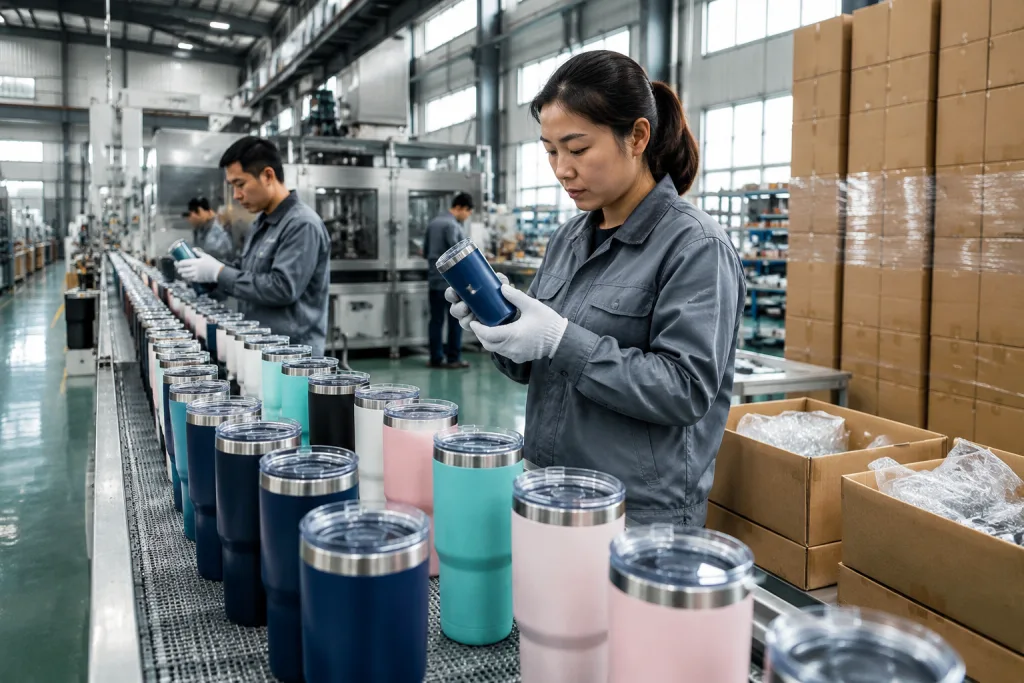
If you buy for a coffee brand, a bank campaign, or a corporate-gift program, comparing unit prices first is the wrong question to ask. Build the cost map first. BottleForge Industrial runs drinkware production in Zhejiang, China, with typical MOQ from 1,000 units per color and monthly capacity around 450,000 stainless tumblers. On our line, a 10,000 pcs powder-coated tumbler order can ship in 28 days if the color is standard; custom Pantone usually pushes it to 35 days because the coating sample needs buyer sign-off before mass production. Here is the practical breakdown.
Start with the landed cost
Ask for the cost split before you ask for the prettiest rendering. We ask buyers to break the quote into FOB unit price plus every add-on: tumbler body, lid, surface finish, logo, insert card, retail box, master carton, testing, and spare parts. If the RFQ line says only “500 ml tumbler, logo included,” the math is already too loose; last month QC pulled a pre-production sample where the PO said matte black, but the artwork file named “BK gloss final.ai” caused a 6,000 pcs finish argument.
For a 500 ml double-wall stainless steel bulk coffee travel mug from a coffee mug factory in Zhejiang, we run realistic FOB China at USD 3.10-4.20 for a basic 201 outer and 304 inner body, sliding PP lid, single-color powder coat, and one-position laser engraving. Move to full 304 stainless steel, better sealing, ceramic interior coating, or a leak-resistant lid and the range becomes USD 4.80-6.90. A coffee mug custom made for a retail coffee brand with molded lid parts and color box can go above USD 7.50 before freight, especially when the lid tool needs a 0.2 mm gasket adjustment after the leak test.
FOB is not your landed cost. For Europe and North America, add ocean freight, port charges, duty, customs brokerage, domestic trucking, and any third-party inspection. On a 5,000-unit coffee mug in bulk order, logistics can add USD 0.55-1.40 per unit by sea depending on carton cube and destination; a 500 ml tumbler often packs 24 pcs per master carton, and one carton size change can shift the container count. Air freight hurts. USD 3.00-6.00 per unit is common for insulated stainless drinkware, so we ship it only for samples, urgent event top-ups, or a 300 pcs executive-gift run.
Practical rule: if your campaign budget is USD 5.00 landed, do not brief suppliers for a retail-style leakproof tumbler with gift box and four-color print. You will burn 10 days collecting quotes that cannot survive production reality, and we have seen this go sideways when the buyer flags the freight line after the deposit is paid.
Material choices change the price
The body spec is where the quote starts to move. Buyers ask us for “stainless steel” on 7 out of 10 RFQs, then leave the grade blank on the PO. That is the wrong question to ask. We run a common build with 304 food-grade stainless steel inside, 201 stainless outside, vacuum insulation, and 0.4-0.5 mm wall thickness checked by a digital thickness gauge at incoming QC. It suits coffee mug promotional products because the drink touches 304, while the outer shell keeps the target price alive.
Full 304 stainless steel body construction usually adds USD 0.35-0.90 per unit depending on size and current coil pricing in China. Size matters fast. Moving from 380 ml to 500 ml can add USD 0.25-0.60, and 900 ml or handle tumblers add more because we use more steel, cartons get bigger, and the powder coating line loads fewer pieces per rack. Last month QC pulled a 900 ml handle sample because the coating was thin near the weld corner, 42 μm instead of our usual 55-65 μm range.
Lids get underpriced in early budgeting. A basic push-on or sliding lid may cost USD 0.25-0.55. A threaded lid with silicone ring and drink-through slider, built for better spill resistance, can be USD 0.70-1.30. If you want a new lid shape for coffee mug private label work, tooling can run USD 2,000-8,000 and add 20-30 days; the first T1 samples usually need 2-3 rounds before the slider feels right. For a 1,000-unit corporate event, custom tooling makes no sense. For a 20,000-unit coffee chain program, the math can work.
For compliance, ask for LFGB or FDA food-contact reports for the materials, plus REACH or Prop 65 screening if your market requires it. A serious coffee mug manufacturer should know which resin, silicone, coating, and ink reports are still valid before quoting. We have seen this go sideways when a buyer flagged Prop 65 after artwork approval, and the PO had “silicon ring” typed instead of “silicone ring,” which slowed the document check by 2 days. If a supplier says they will “check later” after quoting, expect a cost surprise.
MOQ tiers buyers actually face
MOQ is not a punishment. It is how the coffee mug factory keeps the coating booth, assembly benches, and carton line from losing money. For a standard stainless travel tumbler with an existing mold, BottleForge usually quotes 1,000 units per color. At this tier we run laser engraving or one-color print, standard color box, and master carton packing without odd line-change fees; QC pulled a 20 oz sample last week because the engraving sat 3 mm too close to the seam. For mixed colors, expect 1,000 units per powder color unless we already have those colors in stock powder.
At 3,000-5,000 units, pricing improves because steel purchasing, coating setup, and QC labor spread across a real batch. This is the practical tier for a coffee mug distributor, HR gift program, or regional coffee brand testing one new retail item. A bulk coffee mug at 5,000 units might be USD 0.25-0.55 cheaper than the same item at 1,000 units, assuming the same decoration. We see the math break when a buyer asks for 6 colors at 500 pcs each; the spray gun washout alone eats the saving.
At 10,000-30,000 units, coffee mug private labeling becomes a serious discussion: custom PMS coating with a ΔE check under the light box, molded logo on lid, custom insert, retail barcode, and FNSKU application for marketplace cartons. You can also ask for tighter AQL inspection plans if the retail channel charges back for scuffs or barcode errors. A coffee mug oem manufacturer may reserve production capacity if you provide a rolling forecast, but the forecast needs dates and color splits, not just “Q3 big order.”
Below 500 units, factory direct pricing is rarely real factory production. It is usually stock decoration, trading inventory, or a supplier eating inefficiency to win the order. That can work for a small event, but do not use a 300-unit quote to budget a 12,000-unit retail program. We have seen this go sideways: the buyer flagged a PO typo showing 300 pcs, then expected the same unit price after changing it to 12,000 pcs with custom lids, and the math did not work.
Logo and packaging cost traps
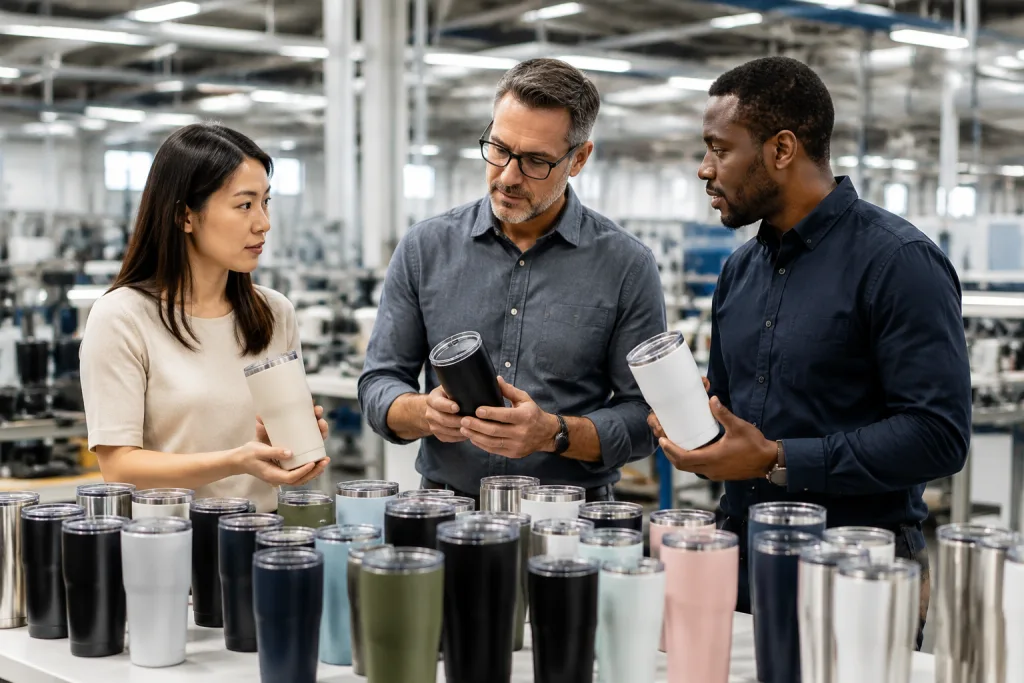
A coffee mug custom project stays affordable when the decoration matches the cup surface and the order size. Laser engraving works well on powder-coated 304 stainless tumblers; we run it with a rotary jig, and QC checks the mark depth under a 10x loupe before packing. At normal promotional volumes, it usually costs USD 0.10-0.25 per position. Silkscreen printing suits bold single-color logos and costs USD 0.08-0.20, but it needs a straighter print window and proper ink adhesion testing with 3M tape. Heat transfer or full-wrap printing can reach USD 0.45-1.20 per unit, and the reject rate jumps when the body taper is over 3 mm from top to bottom.
For coffee mug customized orders, the cheap-looking failure is usually not the mug. It is the logo sitting too small, too low, or printed across a curve. We have seen this go sideways: QC pulled the sample after the buyer flagged a 2 mm tilt on a black tumbler. Send vector artwork early and ask for a 1:1 placement mockup with exact width, height, and distance from the rim. For corporate-gift buyers, a 45-60 mm wide logo on a 500 ml travel mug looks cleaner than a giant billboard print. Coffee brands often do better with a vertical mark and roast details on an insert card.
Packaging is another cost trap. A plain white box may add USD 0.18-0.35. A custom printed color box can add USD 0.35-0.80 at 1,000-3,000 units, depending on board weight and finish. We once caught a PO typo that changed 350 gsm white card to 250 gsm gray-back board; the math looked better, but the box crushed at the corner during a 76 cm drop test. A rigid gift box looks nice but can add USD 1.20-2.50 and increase freight cube by 20-40%. If you are buying bulk coffee tumbler units for a conference table giveaway, spend that money on a better lid. Not a luxury box.
Carton strength matters. For North American parcel handling or Amazon-style routing, specify 5-layer export cartons with inner protection and written carton drop test expectations. We ship 24 pcs per master carton on most 500 ml mugs, and a 17 kg carton with thin K=A paperboard will not forgive rough sorting belts. A damaged carton rate above 2% wipes out any saving from thin packaging.
Sampling to shipment timeline
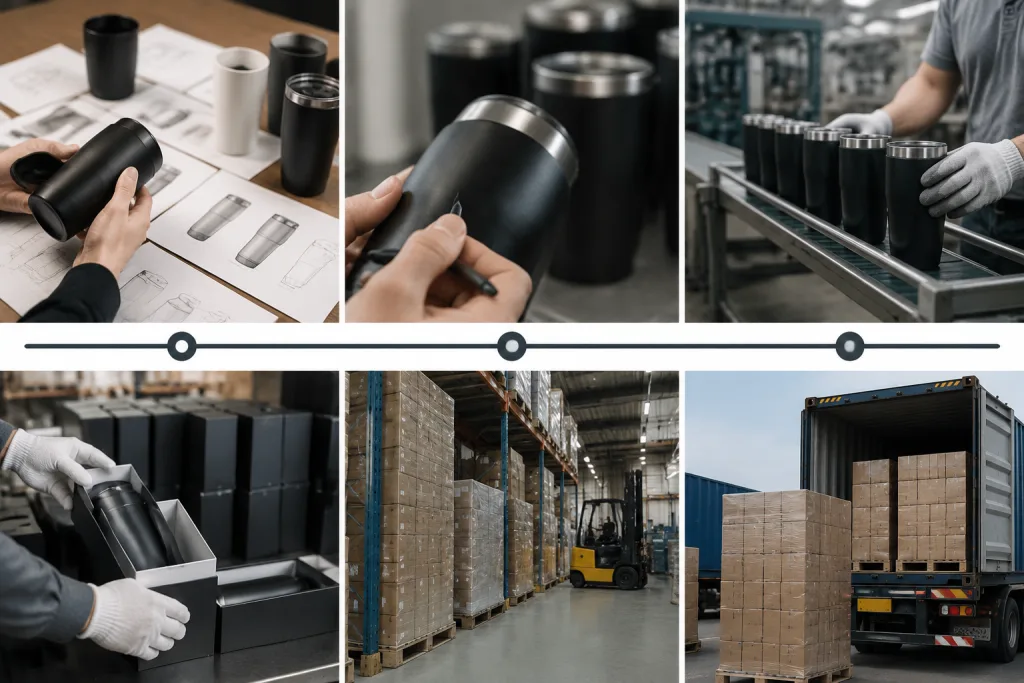
A realistic lead time starts after the brief is complete, not after the first email. Send capacity, size, Pantone color, vector logo file, packaging request, destination port, and compliance market on day one, and a coffee mug supplier in China should quote within 24-48 hours. If the brief says “send your best bulk travel mug,” we usually burn 5-7 days asking basic questions. The buyer flagged this last month on a PO: logo file was a 72 dpi JPG, carton mark missed the SKU, and the destination changed from LA to Toronto after pricing.
For an existing travel tumbler model, pre-production sampling normally takes 5-10 days for laser engraving or silk print approval. Powder-coated custom color samples take 7-14 days because we run coating by color batch, not by one buyer’s schedule. That’s the line reality. If you need a coffee mug customizable item with new lid color, molded silicone, or special retail packaging, expect 10-18 days for the sample set; QC pulled the sample once because the lid ring was 0.6 mm loose after the first silicone shot.
Mass production for standard orders is usually 25-35 days after sample approval and deposit. Peak-season orders before Q4 gift campaigns can push to 40-50 days if you book late, and the math doesn’t work if the buyer still wants 20,000 pcs delivered before the warehouse slot. Add 3-5 days for final inspection, loading, and export paperwork from Zhejiang to Ningbo or Shanghai port. Ocean transit can be 25-35 days to the US West Coast, 35-45 days to US East Coast, and 30-40 days to major European ports, excluding inland trucking; our last Ningbo loading used a 40HQ, and the inspector checked carton drop marks before sealing.
For a fixed event date, work backward. If the mugs must arrive in Chicago or Hamburg by September 15, approve samples by late June for sea freight. Air freight can rescue a late order, but it is an expensive rescue, often 6-8 times the sea freight cost on stainless tumblers. We’ve seen this go sideways when a buyer approved artwork on July 8, then asked us to ship 12,000 pcs for an August trade show. A good coffee mug factory direct partner will tell you when the schedule is risky instead of pretending every date is easy.
Quality control before payment balance
Quality control for travel mug promotional orders needs to be written into the PO, not handled by chat after production. State the inspection level, defect limits, leak test, vacuum test, drop test, carton spec, and barcode rules. For most B2B drinkware, we suggest ANSI/ASQ Z1.4 general inspection level II with AQL 2.5 for major defects and 4.0 for minor defects. Critical defects should be zero tolerance. We run this on the line with a caliper, torque gauge, and 3M tape test; last month QC pulled 80 pcs from a 3,200 pcs order and found 6 lids with loose silicone rings.
Common major defects include vacuum failure, leaking lid, sharp edge, wrong logo position, large coating scratches, mixed colors, and incorrect packaging. Minor defects include tiny dust points in coating, slight print feathering, or small box scuffs within agreed limits. Don’t test one showroom piece. That is the wrong question to ask. A vacuum insulation test should check a defined sample size against the approved sample. For example, fill with 95°C water, close for 6 hours, and record the temperature drop; our QC table uses a probe thermometer and marks each cup body with masking tape so the 304 stainless sample does not get mixed back into bulk stock.
If you buy through coffee mug distributors or a coffee mug supplier directory, still ask who owns QC at the factory. Directory listings and supplier lists give you names; they do not stand beside the packing line at 9 p.m. when cartons are being sealed. For 5,000 units or more, a third-party inspection usually costs USD 250-400 in China. The math works. That is cheaper than finding 600 leaking lids after delivery, and we have seen this go sideways when the buyer flagged the problem only after the Amazon FBA cartons had already been labeled.
Payment terms are typically 30% deposit and 70% balance before shipment for new buyers. Do not release the balance until inspection photos, packing list, carton marks, and any required test reports are complete. Ask for carton dimensions in cm, gross weight in kg, and one clear photo of the shipping mark; a single typo on a PO, such as “matte balck” instead of “matte black,” can still confuse the warehouse. A mature coffee mug manufacturer will not be offended. We ship export orders every week, so these documents should already be sitting in the job folder before the balance invoice is sent.
Choosing a supplier without guessing
China has 800+ coffee mug manufacturers on Alibaba and Global Sources, and they are not built for the same order. Some run cheap promotional stock in 3,000–10,000 pcs lots. Some spend their effort on retail cartons, barcode labels, and clean shelf presentation. Some are a better fit as a coffee mug oem manufacturer when you repeat the same private-label shape every quarter. Chasing the lowest cell in an Excel sheet is the wrong question to ask. On our floor, a 0.18 mm thinner inner wall can make the quote look better, then QC pulls the sample and the hand feel gives it away.
Ask for 3 items before you shortlist: a factory profile showing monthly capacity and audit status, recent product test reports, and photos or short videos from the actual production line. Not showroom shots. The line. BSCI, ISO 9001, or Sedex-style documentation has value, but it does not replace product-specific sampling on the tumbler you plan to buy. If your buyer requires REACH, LFGB, FDA, ASTM, or Prop 65 support, put that in the first RFQ, not after the PI is issued. We have seen a PO delayed 12 days because “FDA” was typed in the email but missed on the spec sheet.
For corporate-gift buyers, speed and decoration repeatability usually beat a new lid design. Pick an existing mold, one coating that has passed tape test, and a simple box that survives a 76 cm drop test. Keep it boring. For coffee brands, the mug sits on the retail shelf and has to match the brand system, so coffee mug private labeling, insert cards, QR codes, and tighter Pantone control can make sense. The math does not work if you ask for a new mold on 1,000 pcs; CNC tooling and lid trial runs eat the margin fast.
Be careful with any coffee mug supplier list that ranks factories without showing how they handle inspection, tooling ownership, or after-sales claims. A real partner should answer the awkward questions: What was the last AQL 2.5 failure? What happens if 2% of lids leak? Can you hold 500 spare lids for repeat orders? What is the exact MOQ for reorder colors, 1,000 pcs or 3,000 pcs? At BottleForge in Hangzhou, Zhejiang, we would rather lose a bad-fit inquiry than quote a bulk coffee mug program we cannot ship cleanly; we have seen this go sideways when a buyer flagged leakage only after the goods reached Rotterdam.
Send your tumbler brief for a real quote
Share quantity, size, logo, packaging, market, and delivery date. We will return a practical FOB China quote with lead-time notes.
Frequently asked questions
What is the best MOQ for a travel mug promotional order?
For most stainless travel tumblers, 1,000 units per color is the practical starting MOQ. It allows proper powder coating, logo setup, carton production, and QC without heavy small-order surcharges. If you need custom PMS color, retail box, or several logo positions, 3,000 units is a healthier tier. For coffee mug private label work with molded lid parts or exclusive body changes, plan around 5,000-10,000 units and tooling costs of USD 2,000-8,000. Orders below 500 units are usually stock decoration rather than normal factory production.
How much should a bulk coffee travel mug cost?
A basic 500 ml insulated bulk coffee travel mug usually costs USD 3.10-4.20 FOB China with 304 stainless inside, 201 outside, powder coating, simple lid, and laser logo. A stronger retail-grade version with full 304 body, better sealing lid, custom color box, or ceramic interior coating often runs USD 4.80-6.90. Premium handle tumblers or special lids can exceed USD 7.50. These prices exclude ocean freight, duty, customs clearance, inspection, and inland trucking, which can add USD 0.55-1.40 per unit by sea.
How long does production take after sample approval?
For an existing bulk travel tumbler mold, mass production normally takes 25-35 days after sample approval and deposit. During Q4 promotional season, allow 40-50 days because coating lines and assembly teams fill quickly. Sampling adds 5-10 days for standard laser or print work, or 10-18 days for custom coating and packaging. If you need new plastic lid tooling, add 20-30 days before production. Sea freight then adds roughly 25-45 days depending on destination port.
Which logo method is safest for coffee mug promotional products?
Laser engraving is the safest choice for many powder-coated stainless coffee mug promotional products because it is durable, clean, and consistent on curved surfaces. Typical cost is USD 0.10-0.25 per position. Silkscreen printing can be cheaper at USD 0.08-0.20 but needs ink adhesion testing and works best with simple artwork. Full-wrap heat transfer gives more color but may cost USD 0.45-1.20 and has higher reject risk on tapered bodies. Always approve a physical pre-production sample, not only a digital mockup.
Should I buy factory direct or through coffee mug distributors?
Factory direct works best when you can manage specifications, artwork approvals, payment timing, inspections, and freight. You may save margin and get better control over materials and packaging. Coffee mug distributors can be useful for very small runs, local warehousing, rush decoration, or buyers who do not want to handle import details. For 3,000 units or more, many coffee brands prefer working directly with a coffee mug factory in China while using a forwarder and third-party inspector. The right choice depends on order size, timeline, and your import experience.