Key Takeaways
- For 12-20 oz stainless travel mug promotional products, expect 1,000 pcs/color MOQ and 25-35 days production
- Powder coating usually adds USD 0.25-0.55 per unit versus basic spray paint but improves scratch resistance
- Laser engraving is cleaner for executive gifts; silkscreen is cheaper for 1-2 color corporate logos
- For North America and Europe, ask for LFGB, FDA, REACH, and AQL 2.5/4.0 inspection terms before deposit
A promotional travel mug looks simple until the PO says 5,000 units, the launch date is fixed, the logo has to pass a 3M tape test, and the lid cannot leak in a rep’s car. Coffee brands and corporate-gift buyers often start with shape and price. That is the wrong question to ask first. Start with the use case: 20-minute hot coffee commute, retail shelf with barcode sticker, conference handout packed 24 pcs/carton, or a private-label loyalty program where repeat orders matter.
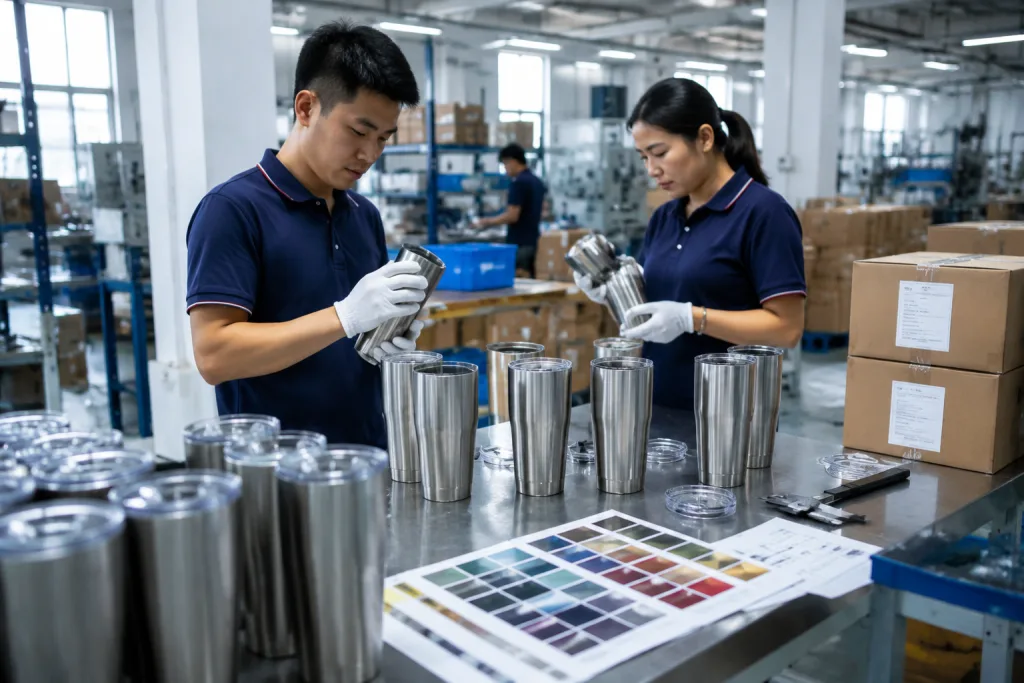
We manufacture in Zhejiang, China, and we run into these trade-offs on the line every week: 18/8 stainless steel against lower-cost grades, powder coat against spray paint, slider lid against flip lid, and factory-direct MOQ against distributor stock. Last month QC pulled a black powder-coated sample with a 0.3 mm logo shift; the buyer flagged it before we approved the gold sample. BottleForge Industrial runs travel tumbler lines at about 450,000 units/month, with typical custom MOQ from 1,000 pieces per color and 25-35 day production after sample approval.
The head-to-head spec table
For travel mug promotional products, skip the lifestyle photo page and open the spec table first. We run samples on a digital caliper at the line, and two tumblers that both look “matte black, logo front” can measure 0.42 mm vs 0.58 mm on the wall. Different cup. Different complaint rate. A coffee mug factory can make 10 similar-looking tumblers, but they will not behave the same in a corporate-gift program or a coffee brand retail drop.
| Spec | Conference giveaway | Coffee retail item | Executive client gift |
|---|---|---|---|
| Capacity | 12-14 oz | 16-20 oz | 14-18 oz |
| Material | 201 or 304 stainless | 304 stainless preferred | 304 stainless, 18/8 |
| Wall | 0.4-0.5 mm | 0.5-0.6 mm | 0.6 mm |
| Insulation | Double wall | Vacuum double wall | Vacuum double wall |
| Lid | Slider | Flip or press-fit | Leak-resistant flip |
| Logo | Silkscreen | Laser or pad print | Laser engraving |
| Target FOB | USD 2.80-4.20 | USD 4.20-6.80 | USD 6.50-9.50 |
For a pure bulk travel mug order at a one-day event, a lighter body and basic slider lid can pass, especially at 3,000 pcs MOQ. For a paid coffee mug custom made retail product, the buyer will test mouth feel, coating, lid seal, and logo wear after dishwashing; last month QC pulled the sample because the powder coating chipped at the rim after a 1.2 m drop test. Cheap gets expensive here. We have seen this go sideways when the buyer saves USD 0.35 on the cup and then pays for 600 replacements.
As a China-based coffee mug manufacturer, we tell buyers to lock three items before decoration: capacity, inner stainless grade, and lid function, with the PO spelling out 304 stainless instead of just “SS.” One typo on a PO, “201/304 optional,” once gave two coffee mug supplier quotes that looked close but were not comparable. This is the wrong question to ask: “Who is cheaper?” Ask what is being quoted. One supplier may price 201 stainless, another 304 stainless, and both will still call it a bulk coffee travel mug.
Capacity is a brand decision
Capacity is not just volume. It tells the recipient what job the tumbler is meant to do. A 12 oz unit reads as a compact commuter coffee mug promotional product. A 16 oz size is the safe mainstream choice for corporate gifting; on our line, it also keeps a 24 pcs master carton under about 13 kg gross weight. A 20 oz bulk coffee tumbler looks more retail-ready and carries stronger perceived value, but carton CBM and sea freight climb fast. The math doesn't work if the buyer wants a cheap giveaway and asks for 20 oz double-wall stainless at the same budget.
For coffee brands, 12 oz and 16 oz fit espresso-based drink positioning better than oversized models. If your café sells an 8 oz latte and a 12 oz drip coffee, a 20 oz travel tumbler can look off-brand on the counter. We saw this go sideways on one PO where the buyer typed “20oz” in the item line but attached 12 oz artwork; QC pulled the pre-production sample, and the logo looked lost on the tall body. For corporate gift buyers, 16 oz is the practical middle: enough for office coffee, still workable for car cup holders, with less fighting when the tumbler goes into a kraft gift box.
- 12 oz: good for conferences and welcome kits; also works for compact coffee mug in bulk orders and airline-friendly gifts where carton weight matters.
- 16 oz: best default for bulk travel tumbler programs and employee gifts, especially when the same item may later be sold as paid merchandise.
- 20 oz: stronger shelf presence, but usually 10-18% higher FOB and larger master cartons, so check freight before approving the size.
Check the bottom diameter, not only the capacity. Most North American and European car cup holders handle 68-74 mm bottoms well. We run this check with a digital caliper at incoming sample review, and a 2 mm miss is enough for the buyer to flag it after the first sales meeting. A tapered body can solve cup-holder fit while keeping the upper body large enough for a logo. For coffee mug customizable programs, we often reserve a flat logo panel of 45-60 mm height so the artwork does not bend around the taper.
Material choices change the quote
Last quarter, 7 buyers asked for a coffee mug factory direct price, then pushed back when three factories landed USD 1.50 apart. Material was the gap in 5 of those quotes. For vacuum travel tumblers, the usual build is 304 stainless steel inside with 201 or 304 outside. Full 304 stainless costs more, but it protects long-term brand trust, especially when a coffee brand sells the tumbler at retail instead of giving it away at a booth.
We run 18/8 stainless steel for most premium travel mugs from our Zhejiang production base. The inner wall is normally 0.4-0.5 mm; the outer wall may be 0.5-0.6 mm depending on shape and size. QC checks wall thickness with a digital caliper before polishing, and a 0.1 mm miss is enough to change both feel and cost. A heavier wall feels better in the hand and dents less during carton drop handling, but the math does not work if the buyer also wants the lowest FOB. Something has to move: wall thickness, coating grade, packaging, or lid quality.
Vacuum performance is not magic. A decent 16 oz vacuum tumbler should keep water above 60°C for about 6 hours under lab conditions when filled with 95°C water at room temperature. On the line, QC pulled the sample after the vacuum furnace and logged the test with a probe thermometer, not a guess from the sales desk. Real coffee cools faster because users sip, open the lid, and add milk. Do not print 12 hours hot in retail copy unless the test report proves it; we have seen this go sideways when the buyer flagged it after shelf launch.
Ask your coffee mug oem manufacturer to state stainless grade, wall thickness range, and vacuum heat test method on the proforma invoice. One PO typo on “201 outside” versus “304 outside” can turn into a 3-day argument after mass production.
Lids decide complaint rates
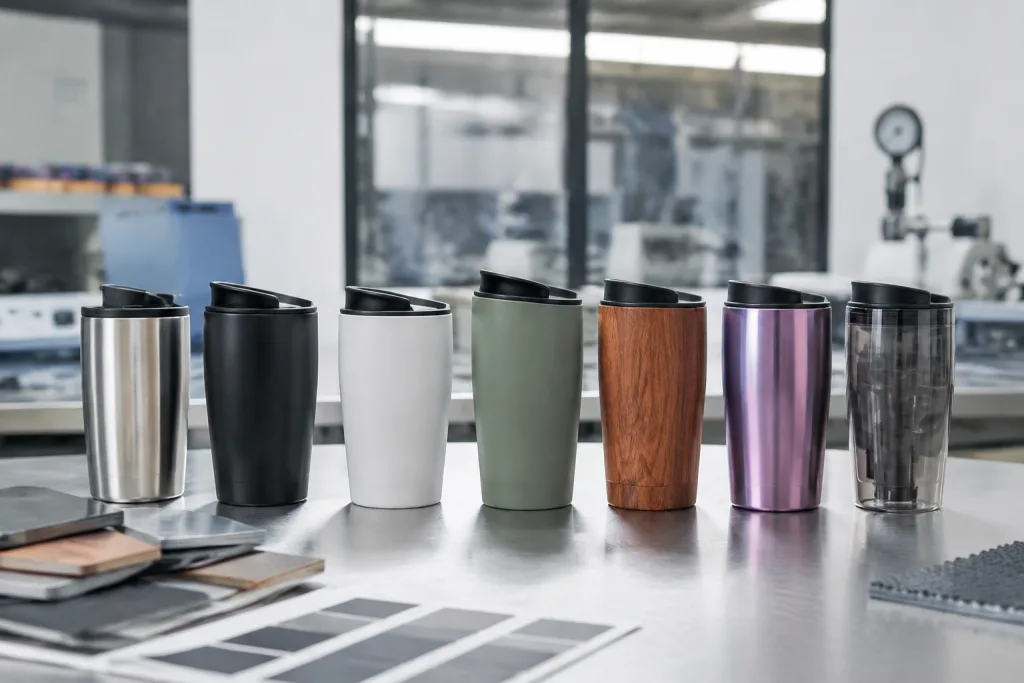
The lid is where travel mug promotional products win or get returned. Buyers often spend 40 minutes arguing about powder-coat texture and 5 minutes on the part the user touches every morning. Wrong priority. A slider lid is low cost, familiar, and simple to rinse under the tap, but in our QC sink test it is usually splash-resistant, not leakproof. A flip lid can seal better, but we run checks on the hinge pin, silicone plug depth in mm, and the drinking angle. A press-button lid feels premium, then adds 3-5 small parts for the inspector to count on the line.
For a corporate desk mug, a slider lid is fine. For a sales team throwing mugs into backpacks, use a leak-resistant flip lid and pay the extra USD 0.35-0.80. The math doesn't work if 2% of users complain and your buyer has to resend gifts one by one. For a coffee mug private label retail program, order pre-production samples and run a basic abuse test: fill with 80°C water, invert for 30 seconds, shake 20 times, then check seepage on white tissue. QC pulled one sample last month where the plug looked seated, but water crept out after the 14th shake. Not a lab test. It catches weak seals before your customer does.
Food-contact parts matter too. Ask for PP or Tritan lid material depending on clarity and temperature requirements, plus silicone gaskets with LFGB or FDA documentation. For Europe, REACH concerns can also touch coatings and plastic components, so we ask the resin supplier for the grade sheet before mass production. One buyer once sent a PO saying “Trian lid”; we stopped it before sampling because the factory clerk read it as generic clear plastic. If your coffee mug supplier cannot identify lid resin, treat that as a warning sign.
Replacement lids are worth discussing before you place the order. For 5,000 units, we normally recommend 1-2% spare lids packed separately, usually 50-100 pcs in a small carton with SKU labels. Cheap insurance. We ship them without individual color boxes unless the distributor asks, because spare lids disappear fast in warehouse picking. It costs little compared with customer service emails, especially for coffee mug distributors shipping to 8 or 12 corporate clients.
Decoration: clean beats complicated
Decoration should fit the sales channel. A one-color silkscreen logo is still the best value for 7 out of 10 coffee mug promotional programs we quote. It runs clean on powder-coated bodies, keeps setup cost low, and gives the buyer an easy approval path from a 1:1 paper proof. Laser engraving costs more per unit but looks permanent and avoids ink adhesion problems; QC pulled one matte-blue sample last month because the white ink lifted after a 3M tape test. Full-wrap heat transfer can look strong on a render. On the line, curves and seams are where the math gets ugly.
For coffee mug custom projects, we usually compare decoration this way: silkscreen for budgets under USD 5 FOB, laser for executive gifts or retail stainless finishes, pad print for a 12 mm mark on a curved lid, and heat transfer only when the artwork needs gradients or big coverage. If a buyer wants a coffee mug customized with a tiny legal line, QR code, and multi-color crest, test it at actual size on the body. This is the wrong place to trust a PDF zoomed to 300%. We’ve seen 0.25 mm gaps close up during printing, and the buyer flagged the QR code only after the pre-production sample arrived.
Powder coating is the default for better bulk coffee mug orders. It gives a harder surface than ordinary spray paint and takes daily handling better; our abrasion check uses a 500 g load on the rub tester before QC signs off. Matte black and navy are safe corporate colors. White and dark green work too, but light colors show coffee stains around the rim sooner. Coffee brands should think twice before choosing pure white for a retail bulk coffee travel mug, because we’ve seen this go sideways after shelf testing.
Typical decoration setup is USD 40-80 per color for silkscreen and USD 50-100 for laser fixture or positioning, depending on artwork. Pre-production decorated samples normally take 7-10 days after artwork confirmation in China. If the PO says “logo: Pantone 186C” but the attached AI file names 185C, we stop and ask; guessing costs 12 days vs 18 days when a sample has to be remade and shipped again.
Compliance and inspection terms
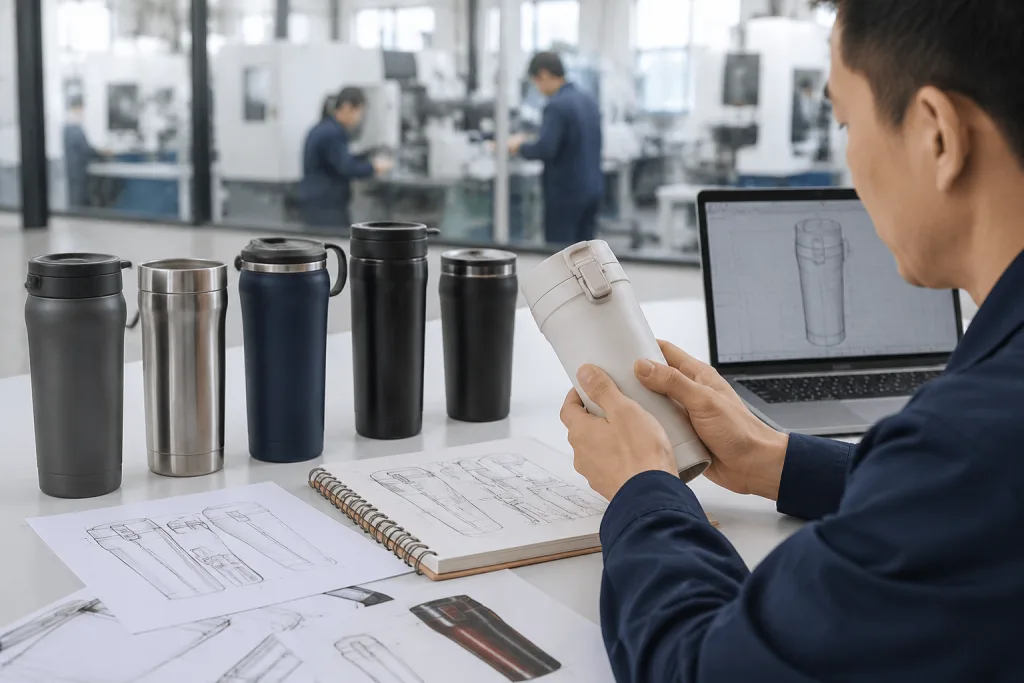
Compliance is not paperwork decoration. If you sell or distribute travel mugs in Europe or North America, the test report has to match the actual build: 304 stainless steel body, PP lid, silicone ring, powder coating, printed logo area. For stainless steel bodies, ask for food-contact testing such as LFGB for the EU and FDA-related testing for the U.S. For coatings and plastic parts, retailers often ask for REACH, BPA-free declarations, and sometimes California Proposition 65 screening. QC pulled a black powder-coated sample last month because the PO said “matte coating,” but the buyer’s artwork file called for rubber paint; that mismatch changes the test scope.
A serious coffee mug manufacturer should be comfortable sending samples to SGS, TÜV, Intertek, or BV. The cost depends on market and scope, but a basic food-contact test package can run USD 250-700. For a new coffee mug custom made design, put testing into the launch calendar before you promise a delivery date to your sales team. Lab testing can add 7-12 working days; if the lid material fails, we change resin or gasket supplier and the line waits. The math doesn't work if you approve artwork on Friday and expect finished inspection the next Tuesday.
Inspection terms should be written before deposit. We recommend AQL 2.5 for major defects and AQL 4.0 for minor defects for most coffee mug promotional products. Critical defects should be zero tolerance: sharp edges, loose internal metal debris, broken lids, unsafe odor, or serious contamination. On the line, we run leak checks with 95°C water, then QC checks rim burrs by hand because a 0.2 mm edge can still get flagged. For cartons, specify drop-test expectations if the order ships by parcel network or Amazon FBA.
Factories in Zhejiang and other parts of China can ship under FOB Ningbo or FOB Shanghai. CIF and DDP are possible, but FOB keeps the product quote clean. If you compare coffee mug supplier directory quotes, make sure all suppliers use the same Incoterm, carton packing, test requirements, and inspection standard. We’ve seen this go sideways: one quote used 24 pcs per master carton at 14.5 kg, another used 36 pcs at 21 kg, and the buyer thought the cheaper unit price was a win until the FBA carton limit got flagged.
Factory-direct versus distributor buying
Buying from a coffee mug distributor is not wrong. Need 200 pieces next week? Buy stock. We ship factory-direct when the order moves into 1,000-50,000 pieces and the buyer needs control over 304 stainless thickness, lid fit, powder-coating Pantone, logo height in mm, inner carton, retail box, and private label details. The trade-off is simple: you lock decisions earlier, and the line needs production lead time. Last month a buyer pushed for a 7-day factory run on 5,000 units with a custom slide lid; the math doesn’t work once QC has to pull leak-test samples from each batch.
At BottleForge Industrial, standard MOQ for a custom bulk travel mug is usually 1,000 pieces per color, with 3,000 pieces giving better leverage on coating color and carton customization. A coffee mug private labeling order with retail box, barcode, insert card, and custom color normally needs 2,000-3,000 pieces to keep unit economics reasonable. For quarterly coffee mug private label programs, we keep approved tooling, golden samples, and color references in the sample room, so reorder sampling can be 6 days instead of 12 days when nothing changes. One PO typo we see too often: “matte black” on the artwork file, “gloss black” on the carton mark sheet.
Corporate-gift buyers often ask whether they should use a coffee mug supplier list or go straight to a coffee mug factory. That is the wrong question to ask. Use a distributor when you need speed, mixed SKUs, or 300 pieces split across 6 colors. Use a coffee mug oem manufacturer when the mug carries your brand promise, such as coffee roasters, hospitality groups, subscription boxes, or enterprise gifting programs where the item will be photographed, reviewed, and reordered. We’ve seen this go sideways when a distributor swaps lids without telling the buyer; QC pulled the sample only after the silicone ring failed a 45-minute inverted leak check.
The best buying process is plain: approve the blank sample, approve the decorated sample, sign off on carton marks, then inspect before shipment. Do not skip the boring parts. If you cut those steps to save five days, you are betting your launch on assumptions, and assumptions are expensive when 80 cartons are already sealed with the wrong side logo position.
Send us your tumbler spec sheet
We will review capacity, lid, logo method, MOQ, FOB target, and compliance route before you commit to a bulk order.
Frequently asked questions
What is the realistic MOQ for custom travel mug promotional products?
For stainless steel travel tumblers from China, a realistic MOQ is 1,000 pieces per color for standard shapes. If you need a custom powder-coat color, custom retail box, or coffee mug private label packaging, 2,000-3,000 pieces is more workable. Below 1,000 pieces, setup costs for logo printing, coating changeover, carton marks, and QC spread badly across the order. For urgent programs under 500 pieces, distributor stock with local decoration may be cheaper and faster, even if the unit price is higher.
How much should a bulk coffee travel mug cost factory direct?
For a 16 oz vacuum stainless bulk coffee travel mug, typical FOB China pricing runs about USD 3.80-6.80 depending on stainless grade, wall thickness, lid design, coating, and packaging. A simple slider-lid promotional model may sit near USD 3.80-4.80. A retail-grade tumbler with 304 stainless, powder coating, laser logo, and individual kraft box often lands around USD 5.20-6.80. Very low quotes usually remove something: 201 stainless, thin walls, cheaper lid resin, lighter carton, or no third-party test support.
Which logo method is best for coffee mug custom orders?
For most coffee mug custom orders, choose silkscreen for one-color corporate logos and laser engraving for premium or long-life branding. Silkscreen is cost-effective, usually USD 0.08-0.25 per position depending on size and color count. Laser engraving is often USD 0.20-0.60 per position but looks cleaner on stainless or powder-coated bodies. For multi-color artwork, pad print or heat transfer may work, but test the actual curved surface first. Avoid tiny text under 5 pt on curved tumblers because ink spread and distortion can make it unreadable.
How long does production take after sample approval?
For standard travel mug promotional products, production normally takes 25-35 days after decorated sample approval and deposit. Sampling usually takes 7-10 days after artwork confirmation, longer if you need a custom lid, molded silicone part, or new coating color. Add 7-12 working days if third-party LFGB, FDA, REACH, or Prop 65 testing is required before shipment. Sea freight to Europe or North America can add 25-45 days port to port, so a safe full timeline is often 8-12 weeks.
What should coffee mug distributors check before placing a large order?
Coffee mug distributors should check five items before deposit: stainless grade, lid leak standard, coating type, AQL inspection terms, and carton strength. Ask for 304 or 18/8 stainless confirmation for the inner wall, plus food-contact documents for the lid and gasket. Confirm whether the lid is splash-resistant or leak-resistant; those are not the same. Use AQL 2.5 major and 4.0 minor for inspection. For orders shipping through parcel networks, request a carton drop test and consider 1-2% spare lids.