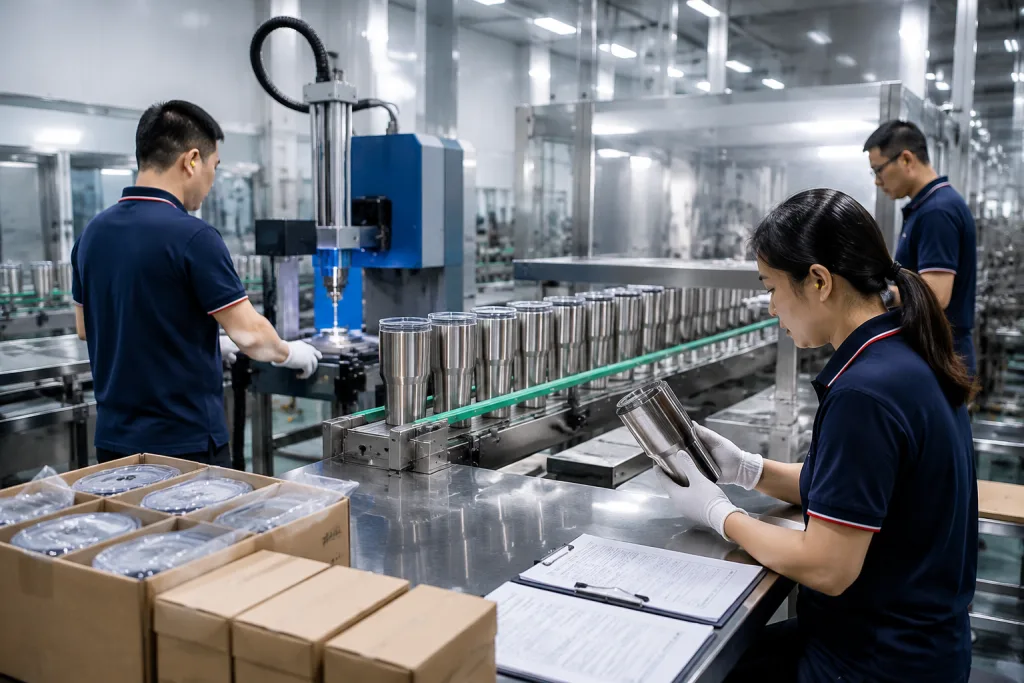
Key Takeaways
- Start RFQ with capacity, steel grade, wall thickness, lid type, MOQ, decoration area, and target FOB USD price
- A practical MOQ is 1,000 pcs per color for stock mold travel tumblers and 3,000 pcs for custom colors
- Approve a physical pre-production sample before paying bulk deposit, even if 3D renderings look perfect
- Use AQL 2.5/4.0, 100% leak testing, and carton drop testing for bulk coffee travel mug orders
Your customer does not care that your tumbler came from a tidy supplier deck. They care if the lid leaks in a laptop bag, if the logo survives 30 dishwasher cycles, and if the mug feels worth the price on your gift catalog or coffee shelf. QC pulled a 600ml sample last month and found a 0.4mm gap at the flip lid gasket. That is where complaints start.
For travel mug private labeling, the costly mistakes happen before the first sample is made. A loose RFQ gives the line too much room: wrong lid type, 0.4mm steel when the buyer expected 0.5mm, decoration that rubs off, or carton size that pushes freight from 12 days by rail planning to 18 days after rework. We see this go sideways with 8 out of 10 first-time coffee brands and corporate-gift buyers sourcing from China through our Hangzhou, Zhejiang export desk.
Start With A Tight RFQ
A useful RFQ for travel mug private labeling should look like a PO draft, not a mood board. If you ask a coffee mug supplier for “a good 20 oz tumbler with logo,” we will send 10 options, and your buyer will spend 2 days comparing lids that were never meant to be compared. Lock the product assumptions first. This is where projects go sideways.
For a bulk coffee tumbler project, put these specs in the RFQ: capacity in ml and oz, body shape with top and bottom diameter in mm, stainless steel grade, inner and outer wall thickness, insulation claim, lid material, drinking method, color finish, decoration method, packing method, target market, compliance requirement, destination port, and expected order quantity. If you need a coffee mug custom made for a retail launch, say clearly whether you want a new mold or only private label decoration on an existing mold. We once had a PO that said “matte black” in the header and “gloss black” in the item table; QC pulled the sample before mass coating, but that typo still cost 3 days.
A realistic factory direct quote for a 20 oz double-wall stainless steel travel tumbler may sit around FOB USD 3.20–5.80 depending on lid, coating, logo process, packaging, and order volume. Cheap quotes are not a sourcing win if the math doesn't work. We have seen USD 2.85 quotes hiding 0.32 mm steel, 201 stainless on the outer wall, loose slider lids, or no real inspection cost under AQL 2.5. BottleForge Industrial in Zhejiang, China runs about 450,000 drinkware units per month across travel tumblers, sports bottles, and thermos lines, but capacity only helps when the RFQ gives the line measurable specs.
RFQ line items to put in writing:
- Product: 20 oz bulk travel tumbler, double-wall vacuum insulated, with target height and base diameter in mm
- Material: 304 stainless steel inner, 201 or 304 outer, 0.4–0.5 mm wall, confirmed by incoming material check
- Decoration: laser engraving, silk screen, heat transfer, or powder coat logo, with artwork file and Pantone code attached
- MOQ: 1,000 pcs per color for stock mold; 3,000 pcs for custom powder color
- Terms: FOB Ningbo or Shanghai, 30% deposit, 70% before shipment, with carton drop test and pre-shipment inspection agreed
Choose The Mug Platform First
Private labeling starts with the mug platform, not the logo. That platform drives return rate, review score, and whether the buyer reorders after the first 5,000 pcs. A corporate-gift buyer usually pushes us on gift box corners, insert card position, and a 25-day ship window before the event date. A coffee brand asks different questions: cup-holder fit at 72–76 mm bottom diameter, ceramic-look coating, and whether the lid feels cheap after 50 open-close checks. A coffee mug distributor needs repeat colors and carton data that stay stable; we have seen buyers flag a PO because the carton changed from 12.5 kg to 14.1 kg after sampling.
Most travel mug private labeling projects land on one of three platforms, but the math is not equal. The classic tapered travel mug with handle, usually 14–18 oz, works for commuter programs and office giveaways. The straight-wall bulk coffee travel mug, often 16–20 oz, gives the printing line an easier full-wrap setup because the jig does not fight the taper. The larger travel tumbler, 30–40 oz with handle and straw lid, sells well on photos, but we ship more air inside the carton and freight cost gets ugly fast. QC pulled a 40 oz sample last month where the handle gap was 4 mm off the drawing; that small miss made the box insert rub the coating.
Ask your coffee mug manufacturer for the body drawing before you approve the quote. You need top diameter, bottom diameter, total height, printable area, lid thread or press-fit structure, and carton dimensions, not just a nice 3D rendering. This is the wrong question to ask: “What is your best FOB price?” Ask how the mug packs. A 20 oz tumbler that fits 25 pcs per master carton may cost less to ship than a slightly larger design packed 20 pcs per carton, even if the unit FOB price is the same. On our line, we check this with a digital caliper and a carton drop test; a 3 mm height change can kill one full layer on the pallet.
For coffee mug private label projects, we usually tell buyers to avoid a new mold unless the annual forecast is above 30,000 pcs. Existing molds are faster and easier to control, with samples often ready in 7–10 days instead of 35–50 days. The math does not work for a 3,000 pcs launch if tooling is USD 3,000–12,000 before the first acceptable sample. A new mold can make sense for a coffee mug customizable line with a special grip, lid, or silhouette, but we have seen this go sideways when the buyer changes the lid color after T1 sampling. One PO even listed “matte black lid” while the artwork file said “gloss black”; QC held the sample until sales confirmed it in writing.
PO draft line items at this stage: model number with factory code; capacity tolerance, such as 20 oz ±5%; approved lid type with gasket material; approved coating and Pantone number; packaging style with box size; barcode or FNSKU requirement; destination market compliance, such as FDA or LFGB if required.
Price The Decoration Honestly
The logo method changes the math on a coffee mug promotional program fast. Laser engraving is durable and neat, but it only cuts through the coating and shows the metal underneath, so the mark comes out silver or steel-colored on most 304 stainless bodies. Silk screen works for one or two solid colors, usually adding USD 0.08–0.25 per position at 1,000 pcs, but gradients are where we see buyers get disappointed. Heat transfer and water transfer can print full-color artwork, but the line needs tighter oven curing and extra tape-test checks; last month QC pulled 18 samples after a 3M tape test lifted ink near the handle-side curve.
For coffee mug custom artwork, approving a quote without a decoration layout is the wrong question to ask. The layout should show logo width, height, distance from rim, distance from bottom, orientation, plus whether the seam will show. A “wraparound logo” on a tapered mug needs distortion correction, or a 90 mm logo can look stretched by 3–4 mm after transfer. If your brand guidelines require Pantone matching, plan for a small color tolerance, usually Delta E below 2.0–3.0 for premium projects, but powder coating will not behave like paper printing. We check this with a colorimeter under D65 light, and the buyer usually flags it when the red looks fine on the mug but darker on the printed box.
Corporate buyers often ask for coffee mug promotional products with individual names. Variable laser engraving is possible, but send a clean CSV file and accept slower output. A 1,000 pcs order with 1,000 unique names may add 3–5 production days and a handling charge, because the operator has to scan each row before loading the rotary jig. Simple names run smoothly. Accents, double spaces, and one typo on the PO can stop the line. For a coffee mug customized campaign with gift boxes, put the mug logo and box print in the same approval package so the sample room is not chasing two approvals from two buyers.
A good coffee mug factory direct quote separates base mug price from decoration, packaging, and testing. If everything is bundled into one number, you cannot see what happens when you move from a one-color logo to full-wrap artwork, or from a white box to a printed retail box. We have seen this go sideways: the buyer approved USD 3.42 all-in, then changed to a 4-color wrap and a 350 gsm color box, and the math did not work after carton weight hit 13.6 kg.
Decoration PO line items: logo file version, Pantone code, print position, process, approved sample photo, abrasion requirement, dishwasher claim if applicable, plus rejection standard for scratches or misalignment above 1.5 mm. Add the actual file name too, because “final_logo_v3.ai” and “FINAL_logo_v3.ai” have caused 2 production holds on our side.
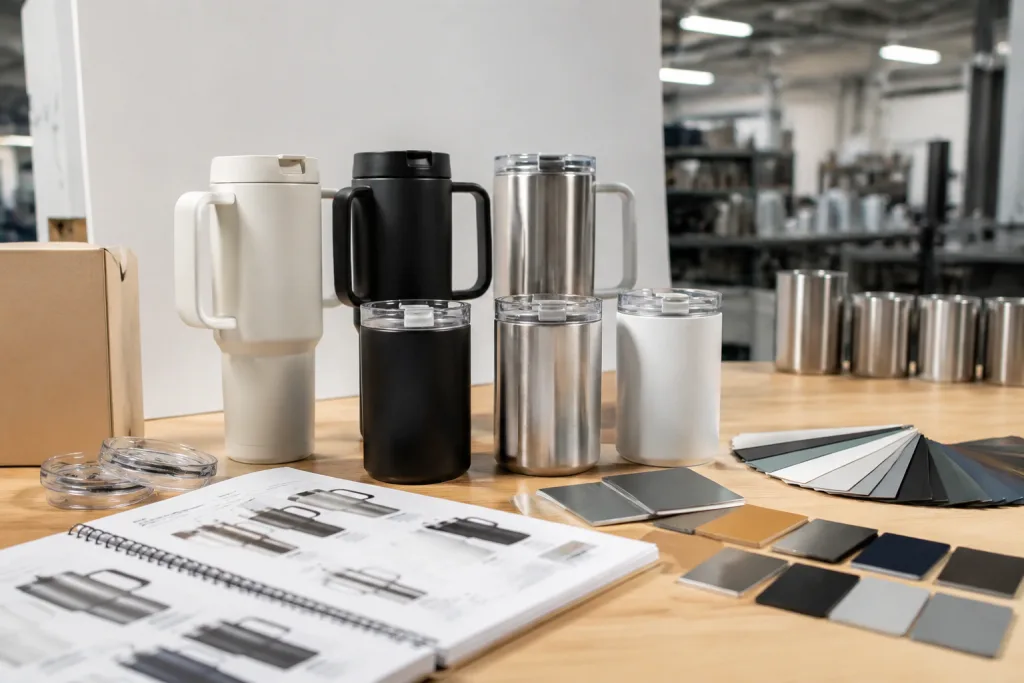
Sample Before You Trust Renderings
Renderings sell the shape; samples catch the ugly stuff. For travel mug private labeling, we run three checkpoints when the schedule has room: a stock sample to confirm the base mug, a logo sample to check the artwork on steel, then a pre-production sample from the same material batch as bulk. Skipping samples because a tumbler “looks standard” is the wrong question to ask. We have seen this go sideways with a 2,000 pcs coffee chain order after the buyer flagged a 1.5 mm logo shift that nobody noticed on the PDF rendering.
A stock sample checks the basic platform: actual weight on the bench scale, hand feel, lid fit on the thread gauge, sip comfort, coating texture, and cup-holder fit in an 80 mm test ring. If the model is in our Zhejiang sample room, we ship it in 3–5 days. A logo sample checks decoration. For laser or silk screen, allow 7–10 days after artwork approval. For custom powder color or full-wrap transfer, 10–15 days is the safer promise. A pre-production sample uses the actual bulk materials and approved process; sign it, photograph it, and keep one sealed on the QC desk before the line starts.
Sample cost is not a scandal. We charge USD 50–150 for logo samples on most travel mug private labeling jobs and refund it after the bulk order, if that is written on the PI. International courier to Europe or North America often costs more than the sample itself; one DHL box with 2 mugs was USD 68 last week. Normal. What is not normal is a coffee mug oem manufacturer asking for sample payment while refusing to state actual weight, steel grade, or lid material.
Test samples like a user, not like a buyer smiling at a trade show booth. Fill with boiling water, close the lid, invert for 30 seconds, shake lightly, check odor after 24 hours, and measure temperature loss after 6 hours with a probe thermometer. QC pulled one sample in March where the silicone plug smelled fine at 2 hours but failed after overnight storage. If the lid is advertised as leak-resistant rather than leakproof, write that into your product page and gift proposal. Overpromising creates claims later.
Sample PO line items: sample model, logo method, sample fee, courier account, approval deadline, required tests, sample ownership, plus a clear rule that bulk cannot start until written PP sample approval. Small detail, big trouble: we once received a PO with “matte black” in the email subject and “gloss black” in the attachment, so the line waited 12 days instead of 3 while the buyer corrected it.
Lock Compliance And Inspection
Compliance feels like desk work until Ningbo customs holds 312 cartons or the buyer asks for a report with their importer name on it. For Europe, put LFGB food contact testing on the table first, then check REACH for powder coating, paint, plastic trims, or silicone parts; packaging rules also need artwork files and recycling marks checked before mass printing. For the United States, buyers usually ask for FDA food contact conformity, and some retail programs add ASTM-related packaging checks or heavy metal screening after their compliance team reviews the item. Kids tumblers are a different job. We once had QC pull a 350 ml straw cup sample because the buyer treated it like a normal travel mug, and the small-part review came back late.
A serious coffee mug manufacturer should explain material control from the line, not send a certificate with another buyer’s name covered by a black box. For stainless steel travel mugs, ask for a 304 stainless steel declaration for the inner wall, PP or Tritan lid material declaration where applicable, silicone gasket information with colorant detail, and coating data tied to the exact finish code on your PO. If your customer requires BSCI, ISO 9001, or factory audit documents, ask at RFQ stage. Two weeks before shipment is too late; the math does not work when the audit PDF is missing, the logo plates are already cut, and 18,000 lids are waiting beside the ultrasonic welding machine.
Inspection terms belong in the PO, not in a WeChat message after packing starts. We run AQL 2.5 for major defects and 4.0 for minor defects on many bulk travel mug orders, with critical defects set at zero tolerance. Critical defects include sharp edges found by cotton-glove wipe, contamination inside the cup, leaking lid when specified leakproof, wrong material, or unsafe packaging staples. Major defects include visible dents over the agreed sample limit, poor coating, misprinted logo, wrong color against the Pantone chip, or lid fit failure on the go/no-go check. Minor defects mean small surface marks within the signed limit, usually checked under 600 lux light at about 30 cm.
For a bulk travel mug order, add functional tests before the cartons are sealed: 100% leak test if the design claims leakproof, random vacuum insulation test, coating adhesion cross-cut test with 3M tape, barcode scan test, carton drop test, and gross weight check. If you sell through online channels, lock FNSKU placement, polybag warning language if used, and master carton label format before the first carton label is printed. We have seen this go sideways over one typo on a PO, “matte balck” instead of matte black, and 64 cartons needed relabeling. China export production is fast. Paperwork and inspection rules should move slower, with names, dates, and tolerances written down.
Compliance PO line items: required standard, test lab, report holder name, AQL level, inspection date window, defect classification, and who pays for re-inspection if the lot fails; add the lab quote number and the approved sample seal number if your buyer has a strict compliance desk.
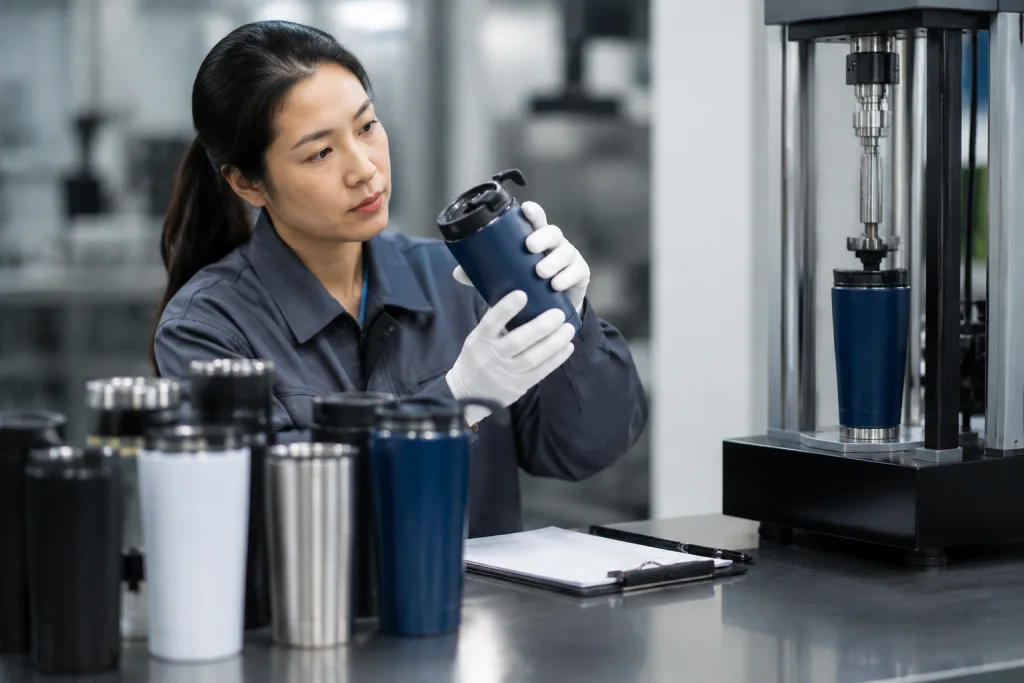
Convert Approval Into Bulk PO
After the PP sample is signed, the bulk PO should leave no room for “we thought.” In our Hangzhou office, QC keeps the signed sample in a sealed PE bag with the buyer name, item code, and approval date on the label. We have seen 6 common arguments on coffee mug private labeling orders: box artwork “similar,” black powder coating off by half a shade, logo 2 mm smaller, ship mark missing, barcode placed on the wrong panel, or lid color copied from an old sample. If your customer checks it, write it into the PO.
A clean PO for coffee mug in bulk needs the basics first: buyer name, supplier name, item code, model number, capacity, and quantity per color. Then lock the commercial terms: unit price, Incoterm, payment terms, production lead time, inspection terms, packaging, carton marks, barcode rules, spare parts if any, and document requirements. For a 3,000 pcs 20 oz bulk coffee mug order, our normal production lead time in Zhejiang is about 25–35 days after deposit and PP sample approval. Printed gift boxes or custom color coating can add 5–10 days. Before Q4, the coating line gets crowded; last October one buyer asked for 18,000 black mugs in 12 days, and the math did not work.
Do not leave shipping until the end. FOB Ningbo works well for Europe and North America importers because the port is about 180 km from our Zhejiang production base, and we run trucks there every week. If you need DDP, air shipment, or Amazon FBA prep, say so before the quote is finalized. A bulk coffee mug with handle can waste carton space; we once measured 9.8 kg gross weight but 14.6 kg volumetric weight on a handle mug carton. Your landed cost can change by USD 0.40–1.20 per unit just from carton efficiency.
If you are building a coffee mug supplier list or checking a coffee mug supplier directory, compare suppliers with the same PO structure, not the same product photo. The wrong question is “who has this picture?” Ask who can confirm coating code, lid material, carton drop-test standard, and AQL 2.5 inspection timing before deposit. The best coffee mug manufacturers will push back on unclear specs before they take your money. We’ve seen this go sideways when a buyer flagged a PO typo after production: “matte back” instead of “matte black.”
Bulk PO line items: final approved sample reference with photo date, order quantity, color split, FOB price, tooling if any, deposit amount, delivery date, shipment port, required documents, inspection booking, and penalty or remedy for late delivery if agreed.
Manage Reorders Like A Program
The first order proves the supplier. The reorder proves whether you built a real product program. We see coffee brands and corporate-gift buyers start with 1 bulk coffee travel mug, then ask for 4 seasonal colors, a Q4 gift box, or a co-branded sleeve. Reorders should be cleaner. They are not, unless the first order file is tight; we have seen a 50,000 pcs repeat get held because the buyer’s PO used “matte blue” while the approved sample tag said Pantone 296C.
Keep one master specification sheet after shipment. Put the final artwork, Pantone color, coating code, approved sample photos, carton size in mm, net weight, gross weight, barcode data, inspection report, and customer complaints in that file. If 2% of lids arrived with loose gaskets, record the gasket OD and the fix before the next PO. QC pulled the sample for one matte navy job and found the white coating marked after 30 rubs on the 3M tape test, so the right move was changing the finish, not repeating the complaint.
For coffee mug private label programs, ask your coffee mug factory to reserve the mold and confirm whether lids, gaskets, and boxes will stay available for 12 months. Small component changes happen in China drinkware supply chains, especially when a lid supplier cuts new tooling or changes a silicone gasket by 0.3 mm. This is where programs go sideways. Your second-order lid should not click, sip, or seal differently from the first-order lid unless the buyer signed off on a new sample.
Reorder pricing needs a fresh check. Do not assume it. Stainless steel, exchange rates, coating costs, and carton paper can move between POs; we run the cost sheet again when 304 stainless changes by even RMB 1,200 per ton. If the model, packaging, and decoration stay unchanged, sampling can be simplified. A confirmed repeat order may need only a color chip or top-of-production photo, saving 7–10 days compared with a full 18-day sample cycle. For distributors, that speed matters.
Reorder PO line items: previous PO reference with factory order number; written confirmation that specs are unchanged; revised forecast by month or quarter; component availability for lid, gasket, and box; complaint corrections with owner and deadline; new color approvals with Pantone or chip photo; target ship week. Treat the project as a controlled SKU, not a one-time souvenir.
Send Your Travel Mug RFQ For Review
Share artwork, quantity, target FOB price, and delivery market. Our Zhejiang team will check specs before sampling starts.
Frequently asked questions
What MOQ should I expect for travel mug private labeling?
For stock mold travel tumblers, a practical MOQ is 1,000 pcs per color for laser engraving or one-color silk screen. Custom powder coating usually starts around 3,000 pcs per color because the coating line needs setup time and powder loss must be controlled. If you need a coffee mug custom made with a new mold, expect 5,000–10,000 pcs per first order, plus tooling cost. Some suppliers will quote 300–500 pcs, but unit prices, color control, and packaging options are usually weaker. For corporate gifts, 1,000–3,000 pcs is the sensible range.
How much does a private label travel mug cost from China?
A 16–20 oz double-wall stainless steel travel mug from China commonly quotes around FOB USD 3.20–5.80 for 1,000–5,000 pcs, depending on steel grade, lid type, coating, logo method, and packaging. Laser engraving may add USD 0.10–0.35 per unit. Printed gift boxes may add USD 0.25–0.70. A handle tumbler or straw lid design can cost more because of extra parts and larger carton volume. Always compare landed cost, not only FOB price. Freight can add USD 0.40–1.20 per unit depending on carton efficiency and route.
Which logo method is best for coffee mug private labeling?
For durability, laser engraving is usually the safest choice because it does not rely on ink adhesion. It works well for coffee brands wanting a clean, premium look. For colorful corporate campaigns, silk screen is economical for one or two colors, while heat transfer is better for full-color artwork or wrap designs. If the mug has powder coating, ask for adhesion and abrasion testing. For a coffee mug promotional order above 1,000 pcs, approve a real decorated sample, not only a digital mockup. Also define acceptable logo position tolerance, usually within 1.0–1.5 mm.
How long does sampling and bulk production take?
A stock sample can usually ship within 3–5 days if the model is available. A logo sample takes about 7–10 days after artwork approval. A custom color or full-wrap sample often takes 10–15 days. Bulk production for a 1,000–5,000 pcs bulk travel tumbler order is typically 25–35 days after deposit and pre-production sample approval. Add 5–10 days for printed gift boxes, complex decoration, or peak season. Ocean freight to Europe or North America then adds roughly 25–45 days depending on port and vessel schedule.
What should I check before paying the bulk deposit?
Before deposit, confirm the signed quotation, final artwork, sample approval, MOQ, unit price, Incoterm, lead time, payment terms, compliance documents, and inspection standard. Your PO should state AQL 2.5 for major defects and 4.0 for minor defects, unless your customer requires stricter terms. Check carton size, gross weight, barcode or FNSKU rules, and shipping marks. If you are using a coffee mug factory direct supplier, ask who owns the test report and whether the report name matches your importer or brand. Small paperwork gaps can become expensive close to shipment.