Key Takeaways
- A realistic travel mug private label MOQ starts at 1,000 pieces per color for standard molds
- 304 stainless steel with 0.4-0.5 mm inner wall is the safe default for daily coffee use
- Plan 25-35 days for production after artwork and pre-production sample approval
- Use AQL 2.5/4.0 inspection plus LFGB, FDA, or REACH checks based on your market
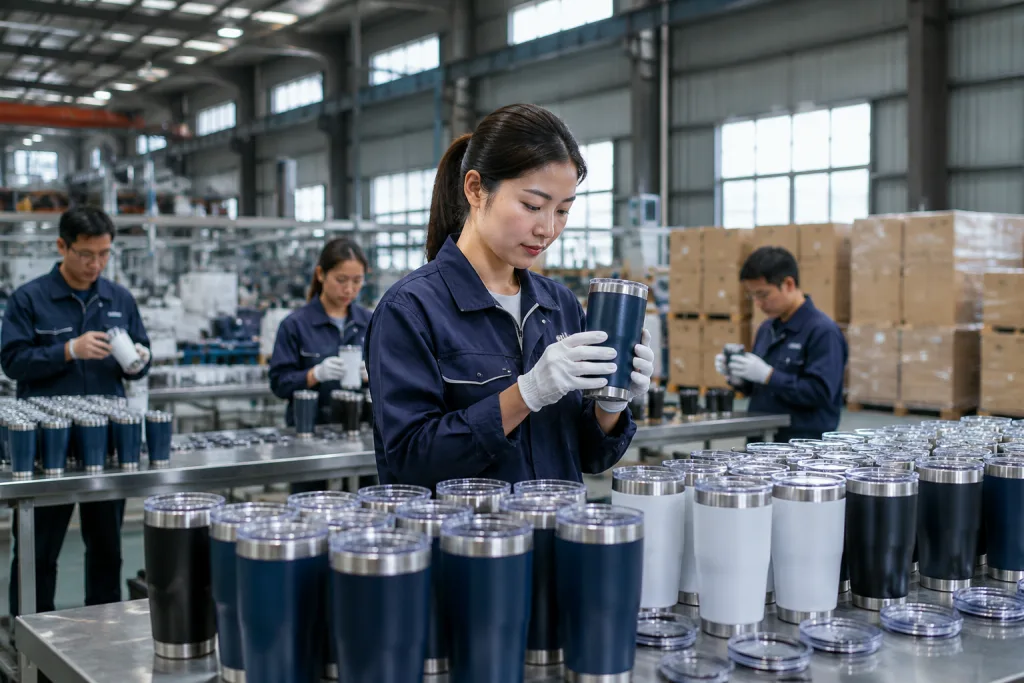
Your travel mug private label project usually starts with a simple brief: put our coffee brand or client logo on a tumbler that looks ready for the shelf. The logo is the easy part. The real work is locking the body shape, lid system, insulation spec, coating, carton pack, and test plan so the second 5,000 pcs order does not eat your margin. Last month QC pulled a 600 ml sample with a 0.4 mm lip gap after powder coating, and that tiny miss was enough for the buyer to flag lid wobble.
From our Hangzhou, Zhejiang export desk, we see coffee brands and corporate-gift buyers make the same mistake: they ask for the cheapest bulk coffee travel mug before they define how people will use it. This is the wrong question to ask. A commuter gift needs a leak-resistant lid tested upside down for 30 minutes, a café retail item needs a cleaner coating finish, and a conference giveaway usually needs a simpler stainless body that can ship 12 days vs 18 days. China can build all three, but your RFQ needs tighter numbers before we run the line.
Start With The Drinking Use Case
Before you ask any coffee mug manufacturer for a quote, answer one plain question: where will the mug be used most often? A café retail tumbler has to look clean under store lighting, so we usually run powder coating with tighter color control and a 350 g white gift box that does not crush on the shelf. A corporate bulk travel mug for an employee kit can use a plain brown box, but the buyer will care more when QC pulls 18 scratched lids from a 2,000 pcs pilot lot. A road-trip bulk travel tumbler is a different job: check the 72-75 mm cup-holder base first, then talk about leak resistance.
For coffee brands, the usual sweet spot is 350 ml to 500 ml. In North America, 12 oz, 16 oz, and 20 oz sell well because they match common coffee servings; for Europe, we ship more 350 ml and 450 ml because they sit better beside beans and capsules on retail shelves. Do not oversize the cup just to look premium. We have seen this go sideways. A 900 ml tumbler looks strong in a photo, but it is awkward for hot coffee, adds roughly 60-90 g of 304 stainless, and raises stainless steel cost by 20-35%.
Procurement checklist: lock volume, lid type, target retail price, gift-box spec, market standard, and first-order quantity before requesting FOB China pricing; one typo on the PO, such as 450 ml written as 540 ml, can stop the line for half a day.
A coffee mug custom made from an existing mold is usually the smarter first move. Standard molds let you test demand with 1,000-3,000 pieces, and our mold room can pull a sample body from the rack before the CNC team touches new tooling. A fully coffee mug customized body can work later, after sales data is real. New tooling can run USD 1,500-8,000 and add 20-30 days before sampling, so the math does not work for a first order with no reorder signal.
Materials Buyers Should Actually Specify
For most travel mug private label orders, write 304 stainless steel for the inner wall. For the outer wall, choose 201 or 304 stainless steel based on your price point. Premium retail lines should run 304/304; the extra cost is easier to defend when the buyer is checking material specs on a GS report. For coffee mug promotional merchandise, 304 inner and 201 outer usually keeps the landed cost workable without putting 201 in beverage contact. Do not put 201 inside for salty drinks, milk coffee, or 12-hour desk use. We have seen this go sideways: QC pulled a cut-open sample after salt-water testing, and the inner seam showed rust spots under a 10x loupe.
Wall thickness is where buyers try to save USD 0.08 and then lose money on dents. A typical vacuum bulk coffee tumbler uses 0.4 mm to 0.5 mm stainless steel on the inner wall and 0.5 mm to 0.6 mm on the outer wall. Go thinner and the math doesn't work once you add freight damage, Amazon returns, or FBA rework fees. Our line checks incoming coils with a Mitutoyo micrometer, and the dent complaints usually start when the outer wall drops below 0.45 mm. Powder coating usually adds USD 0.25-0.55 per piece compared with plain stainless, depending on color and finish. Rubberized soft-touch coating sells well in photos, but it scratches in mixed cartons if the divider board is loose or the mug can move more than 3 mm.
- Inner material: 304 stainless steel, food-contact polished, with no 201 substitution on the inside.
- Lid: PP or Tritan, with silicone gasket; ask for gasket weight and a leak test on 20 pcs before mass packing.
- Compliance: FDA for the US, LFGB for Germany, REACH for EU chemical safety.
- Insulation: request 6-hour and 12-hour test curves from the lab sheet, not a sales photo with steam on top.
As a coffee mug factory in Zhejiang, China, we prefer buyers to write these specs into the purchase order. Put the steel grade, wall thickness, coating, lid material, gasket material, test standard, and packing method in the PO. Short POs create trouble. Last month one buyer's PO said “stainless tumbler, black,” and the buyer flagged the first carton because the approved sample was matte black powder coat while the order sheet never said matte. If the PO only says “stainless tumbler,” the factory has too much room to substitute.
Logo, Color, And Private Label Choices
Coffee mug private label work comes down to logo decoration, color matching, and packaging spec control. On stainless or powder-coated mugs, we push buyers toward laser engraving first. It does not peel, and it gives the mug a cleaner shelf look after 6 months of use. Our QC team checks logo position with a 0.5 mm steel ruler and a simple jig on the line. Silk screen costs less for one-color artwork on large flat panels, usually USD 0.08-0.18 per print, but we have seen it go sideways when pretreatment is weak or the curing oven runs 8°C low. Heat transfer and water transfer work for full-color artwork, but test them on the actual coating before you approve the PI.
If you are buying coffee mug promotional products for events, unit cost may matter more than 3-year brand wear. Fair enough. Single-color screen print on a stock color body is fine for a 5,000 pcs conference order. The wrong question is “what is the cheapest logo?” Ask where the mug will live after delivery. If the tumbler sits on a café shelf at USD 18-28 retail, pay for better coating, tighter logo alignment, and custom gift packaging. Last month, a buyer flagged a 1.2 mm logo drift on a retail sample, and they were right to do it.
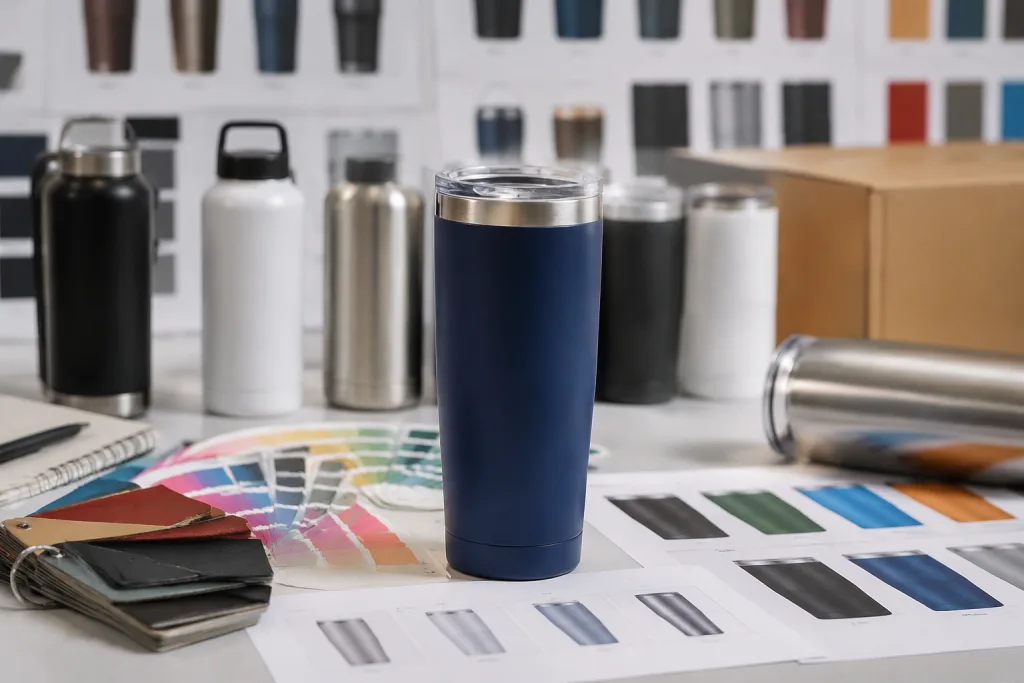
For Pantone powder coating, expect a higher MOQ than basic black, white, navy, or stainless. A realistic MOQ is 1,000 pieces per color for common models and 3,000 pieces per color for unusual finishes. We run small color cards first, then spray 10 pre-production shells before opening full coating. A coffee mug customizable project with individual names is possible, but variable laser engraving slows the line and needs clean spreadsheet control. One typo in column C becomes 300 wrong names. We recommend individual personalization only above USD 12 FOB value or for VIP corporate gifts.
Private labeling also covers the bottom mark, care card, barcode, hangtag, and master carton shipping marks. Small items cause big delays. If you need FNSKU labeling for Amazon or distributor-specific labels, send the label file before mass packing starts, not after inspection. QC pulled the sample carton last week and found the PO number missing from the side mark; repacking 120 cartons took 1 extra day and the math does not work when the vessel cut-off is close.
MOQ, Pricing, And Lead Time Reality
Buyers often ask for a coffee mug supplier list or coffee mug supplier directory, then tell us they need 100 pieces with full Pantone color, logo, gift box, and barcode sticker. The math doesn't work. For a standard travel tumbler mold, sensible MOQ is 1,000 pieces per SKU because the coating line still needs setup, masking, and first-piece color checks with a D65 light box. Some stock programs can start at 300-500 pieces, but the color, logo method, and carton options will be limited. Under 300 pieces, you are usually buying from a trader’s inventory, not true coffee mug factory direct production.
FOB Ningbo or Shanghai pricing for a 16 oz double-wall vacuum tumbler often lands around USD 3.20-6.80, driven by steel grade, coating, lid structure, logo process, and packaging. Real quote work is less tidy. Last month QC pulled one 304 stainless sample at 286 g body weight, and the buyer flagged the lid because the sip hole looked cheap beside their retail mockup. A simple bulk coffee mug for giveaways may be lower. A retail-grade coffee mug private labeling project with 304/304 steel, powder coating, laser logo, custom box, and LFGB report may sit closer to USD 5.50-8.50 FOB.
Our Hangzhou operation in Zhejiang coordinates production lines that can handle about 450,000 stainless drinkware units per month during normal season. Typical lead time is 25-35 days after deposit, artwork confirmation, and approved pre-production sample. Add 7-10 days for complex packaging or custom inserts, especially when the insert needs a 1.5 mm tolerance check before mass cutting. Before Christmas, Chinese New Year, and major North American promo seasons, book earlier. We have seen this go sideways: a PO typo changed “matte black” to “metal black,” and fixing it cost 3 days before the line even opened.
For payment, 30% deposit and 70% before shipment is still common. For repeat buyers with stable forecasts, blanket PO and staggered shipments work better than pushing one oversized order through QC at the last minute. We ship cleaner that way. A 12,000 pcs order split into 3 releases gives AQL 2.5 inspection room to catch lid scratches, carton crush, or wrong warning-label placement before the full batch is sitting at the Ningbo warehouse.
Quality Control Questions To Ask
A travel mug looks simple, but the defect list runs 10 items before lunch: weak vacuum, leaking lids, coating scratches, color mismatch, logo misplacement, dents, odor, gasket deformation, carton compression failure, and lid thread burrs. Your coffee mug distributor or internal sourcing team should not buy from pretty sample photos. Samples are built slowly, often 20 pcs at a time on a side table. Mass production is different. We run 3,000 pcs on the line, QC pulls the sample, and that is when a 1.5 mm logo shift or a loose silicone gasket starts costing money.
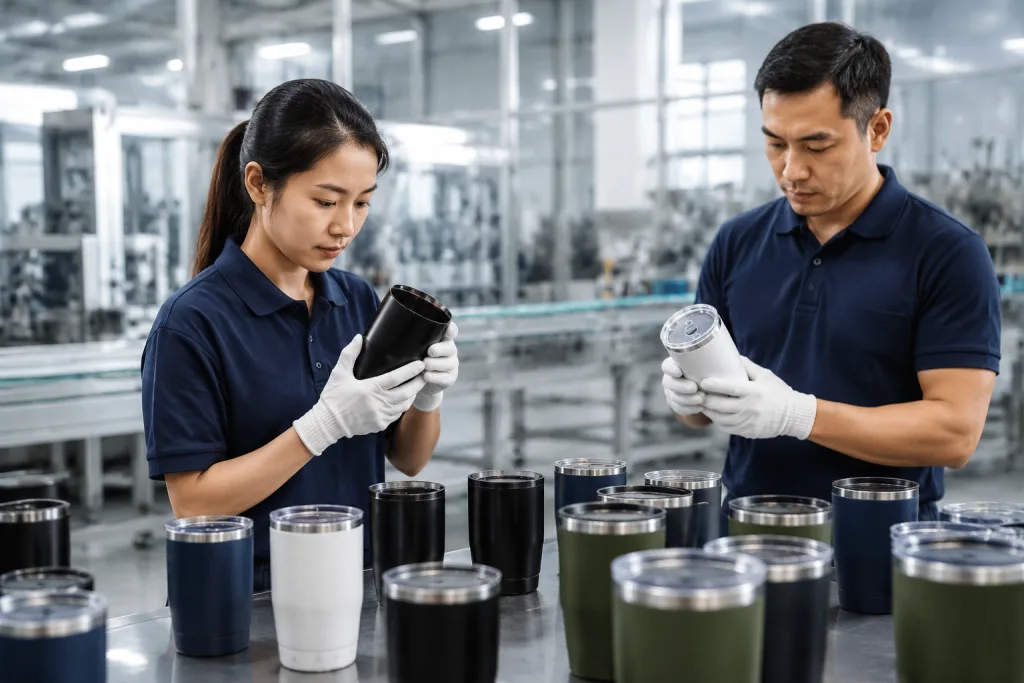
Ask your coffee mug supplier for a written QC plan, not a sales reply saying “we check everything.” At minimum, it should include incoming material checks, vacuum insulation test, lid leak test, coating adhesion test, logo position check, carton drop test, and final AQL inspection. A common final inspection setup is AQL 2.5 for major defects and AQL 4.0 for minor defects. For premium retail programs, tighten visible appearance criteria and approve a golden sample with signed color and logo tolerance. We normally write Pantone tolerance, logo position tolerance within 1 mm, and carton gross weight on the QC sheet. If the buyer says this is too much paperwork, the math doesn't work. One rejected 40HQ costs more than 30 minutes of pre-production checking.
- Vacuum test: hot water temperature drop measured at 2, 6, and 12 hours, with QC recording the start temperature from a calibrated probe.
- Leak test: filled tumbler inverted for 30 minutes, plus shake test for sip lids; we also check the gasket groove for flashing.
- Coating test: 3M tape adhesion and 50-cycle abrasion check, with the rubbed area marked in mm on the report photo.
- Carton test: export carton with 5-ply board for heavy coffee mug in bulk orders, especially when one carton passes 14 kg.
For EU buyers, confirm LFGB or REACH before production if you need a current report under your exact product material combination. For US buyers, FDA food-contact compliance and California Proposition 65 review may be relevant. Do not wait until goods are on the water to ask for documents. We have seen this go sideways when the PO said “PP lid,” the approved sample used Tritan, and the test report covered only 304 stainless. The buyer flagged it 4 days before vessel closing, and nobody enjoyed that call.
Packaging And Distributor Requirements
Packaging is not just decoration. It changes breakage rate, warehouse handling, retail shelf value, and freight cost. We ship plain white boxes for corporate-gift kitting, and that works. For a café retail tumbler, buyers usually ask for a printed color box, care card, EAN-13 or UPC barcode, and sometimes a kraft paper sleeve with a 2 mm bleed on the artwork file. If you sell through coffee mug distributors, get their carton dimensions, barcode format, pallet height, and label placement before artwork lock; we had one PO say “left short side label,” then the buyer flagged the first packed carton because their 3PL wanted it on the long side.
For a 16 oz travel tumbler, individual box dimensions often sit around 90 x 90 x 190 mm, with 24 or 25 pieces per export carton. Master carton gross weight is commonly 8-12 kg depending on wall thickness and packaging. Once a carton goes over 15 kg, the math doesn't work: warehouse teams push back, corners crush faster, and QC starts seeing rubbed color boxes at AQL 2.5 inspection. For Amazon FBA, FNSKU labels, suffocation warnings on polybags, and carton weight limits need to be controlled on the packing line, not fixed later with a sticker gun at the forwarder warehouse.
A coffee mug oem manufacturer should help reduce freight cost by changing box structure, not by squeezing the tumbler into a weak carton. We run carton drop checks from 76 cm for export packing, and the sample tells the truth fast. Switching from rigid gift box to 350 gsm folding color box can cut packaging cost by USD 0.40-0.90 per unit and reduce carton volume by 10-18%. That matters on a 5,000-piece bulk coffee travel mug order; it can mean 12 cartons saved, not just a cleaner quote sheet.
Be careful with over-designed inserts. Foam looks protective, but it is not always recyclable and can hurt sustainability claims. Molded pulp or paperboard dividers work better for 7 out of 10 coffee brands we quote in Europe, especially when the buyer already asks for plastic-free packaging on the RFQ. If your brand message includes lower plastic use, make sure the packaging does not fight it; we’ve seen this go sideways when QC pulled the sample and found a “no plastic” hangtag sitting next to a PE foam tray.
RFQ Checklist Before You Order
A clean RFQ saves more money than hard bargaining. Send only a logo and a target price, and 10 coffee mug manufacturers will fill the gaps 10 ways. Then the quotes are useless. One supplier prices 304/304 stainless with a 0.50 mm inner wall; another slips in 304/201 and a lighter lid gasket. One includes a 350 gsm custom color box, another prices 24 pcs bulk pack. The cheapest line on the spreadsheet is often where the project starts leaking money.
Send your RFQ with the working details: model photo or 2D drawing with dimensions, capacity in ml or oz, steel grade, lid style with straw or slider, coating color with Pantone code, logo method with print size in mm, packaging type with carton qty, compliance market such as FDA or LFGB, target order quantity, delivery term, destination port, barcode format, and inspection requirement such as AQL 2.5. If you have a target FOB price, say it. We run this check on a spec sheet before quoting; last month a buyer flagged a USD 0.18 gap, and the fix was changing from gift box to egg-crate inner pack, not cutting steel thickness.
For first orders, request one pre-production sample using the final logo, coating, lid, and packaging. Approve it in writing. Keep one sample with you and one sealed at the factory; QC pulled the sample from our sealing cabinet twice this year to settle disputes on logo height, both times within 1.5 mm. On a repeat coffee mug customized order, reference the previous PO, Pantone number, logo file version, and packaging dieline version. Small file mistakes hurt. We once saw “matte black” typed as “metal black” on a PO, and the line stopped for 2 days while the buyer confirmed the finish.
Use this buyer rule: if the tumbler carries your brand, do not buy it like a disposable giveaway. This is the wrong question to ask: “Who is cheapest?” A reliable bulk coffee tumbler program needs controlled drawings, locked samples, carton drop-test notes, and clear inspection points before we ship. A coffee mug supplier directory will not catch a loose lid tolerance at 0.30 mm; factory QC will.
Send Your Travel Mug Private Label RFQ
Share capacity, logo, packaging, quantity, and target market. We will return practical FOB options, MOQ, lead time, and compliance notes.
Frequently asked questions
What is the best MOQ for a first travel mug private label order?
For a first order, 1,000 pieces per color is the practical MOQ for most standard stainless steel travel tumbler molds in China. It gives the factory enough volume to set up powder coating, logo printing, packing, and QC without pushing the unit cost too high. If you only need a coffee mug promotional item, some stock-color programs can start at 300-500 pieces, but you may be limited to laser logo or one-color print. For custom Pantone coating, custom box, and retail barcode setup, plan on 1,000-3,000 pieces. Below 300 pieces, you are usually buying decorated inventory rather than real coffee mug private label production.
How much should a private label travel mug cost FOB China?
A normal 16 oz double-wall stainless travel mug private label order usually costs USD 3.20-6.80 FOB Ningbo or Shanghai, depending on steel grade, coating, lid, and packaging. A low-cost bulk coffee mug with 304 inner and 201 outer steel, stock color, and simple logo may sit near the lower end. A retail coffee mug custom program with 304/304 steel, powder coating, laser engraving, custom color box, and compliance testing can reach USD 5.50-8.50. If a quote is 25-35% below the market, check wall thickness, lid material, vacuum performance, and whether packaging is included.
Which logo method is better for coffee brands?
For coffee brands selling retail or subscription merchandise, laser engraving is usually the safest logo method. It is durable, clean, and does not peel after repeated handling. The cost is often USD 0.15-0.35 per position, depending on logo size and production speed. Silk screen is cheaper at roughly USD 0.08-0.18 for simple one-color artwork, and it works well for event gifts or coffee mug promotional products. For full-color artwork, heat transfer can look strong, but you should run adhesion, dishwasher, and abrasion checks. If your tumbler has a premium retail price, do not save USD 0.10 by choosing a weak decoration method.
Can one coffee mug factory handle both retail and corporate-gift packaging?
Yes, but you need to define both packing flows before production. A coffee mug factory can pack the same tumbler into a printed retail box for café shelves and a plain kraft box for corporate-gift kitting. The risk is mixing cartons, labels, or barcodes if the SKU plan is unclear. Use separate item codes for each packaging version, even if the tumbler body is identical. For distributor orders, provide barcode, carton mark, pallet, and delivery requirements early. For Amazon or 3PL shipments, FNSKU labels and carton weight limits should be checked before mass packing, not after final inspection.
What compliance documents should EU and US buyers request?
For the EU, ask for LFGB food-contact testing for stainless steel, plastic lid, silicone gasket, and any coating that may contact lips or hands. REACH is also common for chemical safety, especially coatings and printed packaging. For the US, request FDA food-contact compliance for beverage-contact parts, and consider California Proposition 65 review if you sell into California. If the tumbler is for children, ASTM or CPSIA issues may apply, but most travel mugs are adult products. The key is matching the report to the actual materials used in your production order. A generic old report from a different lid or coating is weak protection.