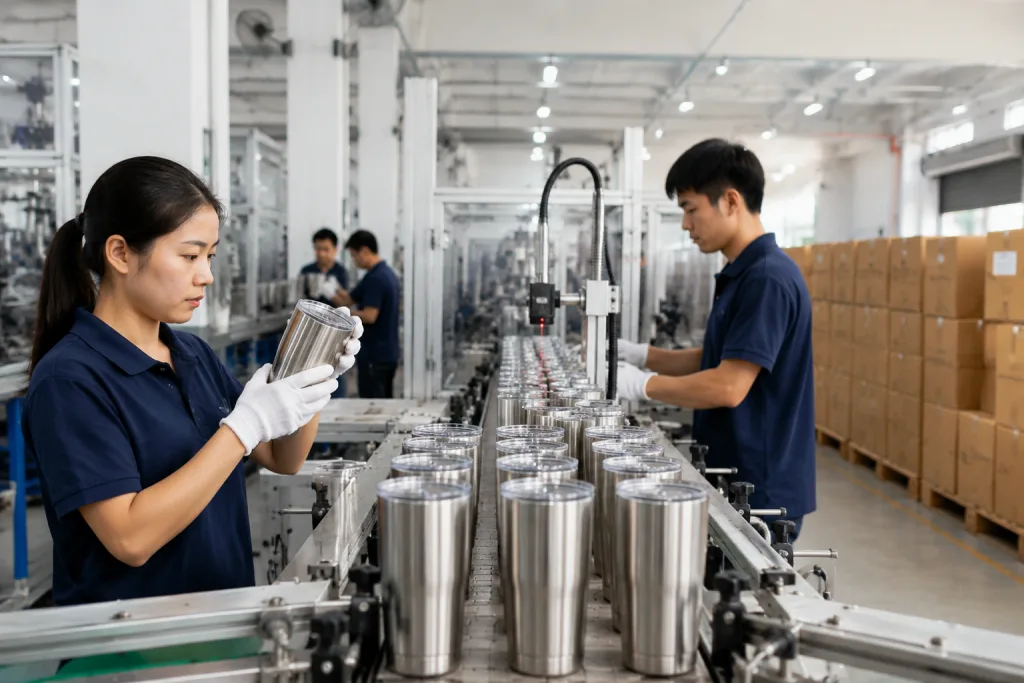
Key Takeaways
- A practical OEM RFQ should include capacity, material grade, lid type, decoration method, packaging, MOQ, and target FOB price within 1 page
- For custom travel tumblers, 1,000-3,000 pcs is a realistic MOQ for standard colors; 5,000 pcs is safer for custom powder coating
- Pre-production samples usually take 7-12 days after artwork confirmation, while bulk production is normally 30-45 days
- A useful PO should list AQL level, carton marks, barcode or FNSKU rules, spare parts, payment terms, and inspection timing
Buying a custom travel tumbler looks simple until one RFQ comes back as 6 mixed quotes, with 3 lid drawings nobody named and a sample that weighs 248 g when the photo looked like a 310 g body. We see this often. If you are a coffee brand or corporate-gift buyer, you are not buying “a cup.” You are buying heat retention, logo adhesion after 3M tape testing, export carton strength, a real ship date, and fewer end-user emails about leaking lids.
As a travel mug OEM manufacturer in Zhejiang, China, BottleForge sees the same problems every month: 500 ml written as “about 16 oz,” artwork sent as a JPG instead of AI/PDF, no AQL level, and POs missing carton marks or even the buyer’s SKU. QC pulled one pre-production sample last week because the silicone ring sat 0.6 mm proud and the lid would not close cleanly. A decent coffee mug factory can run fast, but the math does not work if factory-direct details arrive after tooling, printing film, and packing specs are already booked on the line.
Start With A Clean RFQ
Your RFQ decides whether you get a serious quotation or a pile of guesses. Around 7 out of 10 first emails we see still say “500 ml stainless steel travel mug with logo” and expect the coffee mug manufacturer to fill in the blanks. That is the wrong question to ask. On our RFQ desk in Hangzhou, one buyer even attached a PO with “matte balck” in the color line, and the line leader had to stop the powder-coating sample before we wasted 6 kg of coating powder.
For a travel mug OEM manufacturer, the first RFQ should be short but specific. State the capacity in ml and oz, target retail channel, lid style, insulation test, color finish, logo method, packaging, destination port, and annual forecast. If you already sell a bulk coffee travel mug, send the current sample or a teardown photo with caliper readings on the body wall and lid gasket. If you are switching from a coffee mug supplier directory or a coffee mug supplier list, say what failed: 3% leakage after transit, 12 days late vs 18 days late, coating rub-off after 50 tape tests, or price creep after the first repeat order.
A good RFQ line looks like this: 16 oz / 473 ml double-wall 304 stainless steel travel tumbler, press-fit slider lid, powder-coated black, laser logo on front, individual kraft box, 2,000 pcs trial order, FOB Ningbo, delivery before September 10. That gives a China factory enough data to quote without hiding assumptions. QC can pull the closest stock sample, check the lid fit with a 0.2 mm feeler gauge, and tell sales whether the math works before anyone promises a cheap price.
Your first PO-style checklist should include:
- Item name: bulk travel tumbler or bulk coffee tumbler model
- Capacity tolerance: ±5% is normal
- Inner steel: 304 stainless steel, 0.4 mm typical wall thickness
- Outer steel: 201 or 304, depending on budget
- Logo: laser for clean metal marks; silk screen for 1-2 solid colors; heat transfer or full-wrap print when artwork covers the body
- MOQ: 1,000 pcs for stock color; 3,000-5,000 pcs for custom coating
- Target price: FOB China, not a landed guess
Translate Design Into Factory Specs
A coffee mug custom made project usually fails at the spec sheet, not the logo file. The buyer signs off a nice shape, then nobody fixes the lid gasket size, drinking-hole radius, thread depth, powder-coat thickness, or vacuum test standard. We run into this on the line: QC pulled a 20 oz sample last month with a 0.3 mm gasket gap, and it leaked after 6 upside-down shakes. Returns start there.
For 8 out of 10 coffee brand programs, the safe range is a 12 oz, 16 oz, or 20 oz double-wall vacuum tumbler. Inner 304 stainless steel is the standard for drink contact. Outer 201 stainless can reduce cost by USD 0.20-0.45 per unit, but 304 outer steel fits premium coffee mug private labeling and European programs where the buyer asks for material declarations before paying the balance. BottleForge in Hangzhou, Zhejiang normally recommends 0.4 mm inner wall and 0.5 mm outer wall for balanced weight in hand. Go thinner and the math doesn't work: you save a few cents, then dents show up after a 1.2 m courier drop test.
Decoration has to match the sales channel. Laser engraving is clean and lasts, but it gives only metal contrast. Silk screen works for simple coffee mug promotional logos, usually 1-2 colors; our screen room checks logo height in mm before making the film. Heat transfer or UV print suits coffee mug customized artwork with gradients, but ask for 500-cycle rub testing and clear dishwasher wording. Powder coating should pass a cross-hatch adhesion test and a 3M tape pull after curing, and we like to see 60-80 μm coating thickness on the gauge.
Put these details in the quotation and later in the PO. Do not let “coffee mug customizable” mean “factory chooses whatever is available.” We have seen this go sideways because one PO said “black tumbler” while the approved sample was Pantone Black 6 C matte; the buyer flagged it only after cartons were packed. If you want a bulk coffee mug that repeats from trial order to 5,000 pcs reorder, write the spec like a product engineer, not like a merchandiser.
Useful PO line: “Surface finish: matte powder coating, Pantone Black 6 C reference, logo by laser engraving, coating adhesion minimum 4B by ASTM D3359 cross-hatch test.”
Quote Price Without Hiding Costs
A low unit price can be clean. It can also be missing 6 cost lines. When we compare quotes from coffee mug manufacturers, we check inner box, master carton, logo screen or laser setup, Pantone setup, export carton test, spare lids, local THC, document fee, and Ningbo port charges. QC pulled one quote last month where the buyer saw USD 3.15 FOB, then found USD 0.11 for spare lids and USD 0.16 for color-box packing after the PO. That USD 3.15 FOB quote and a USD 3.42 FOB quote are often the same number once the missing items are added.
For a standard 16 oz bulk travel mug, realistic FOB China pricing often sits around USD 3.20-5.80 depending on steel grade, lid parts count, coating, order quantity, and packaging. We run 304 stainless at different wall thicknesses, and 0.40 mm versus 0.50 mm is not a small factory cost. A simple stock-color bulk coffee tumbler at 3,000 pcs may sit near the lower end. A coffee mug custom made project with molded lid, custom Pantone powder coating, retail box, and insert card can move above USD 6.00. If someone quotes far below market, ask for steel thickness in mm, vacuum failure allowance, and confirmation that the lid is food-grade PP with silicone gasket. The math does not work if those answers stay vague.
For corporate-gift buyers, packaging is not a detail. Individual kraft box may add USD 0.18-0.35. A printed color box may add USD 0.35-0.80 depending on paperboard gauge and print coverage. We have seen this go sideways when a PO says “white box” but the artwork file shows 4C retail packaging. Amazon or marketplace shipments need FNSKU labeling, suffocation warning polybags, carton drop-test planning, and carton weight under 15 kg. Cost these before PO. Arguing during shipment usually burns 3-5 days while the line waits for revised labels.
Your quote comparison sheet should include:
- FOB port: Ningbo or Shanghai are common for Zhejiang factories
- MOQ and price breaks: 1,000 / 3,000 / 5,000 / 10,000 pcs
- Sample fee and refund rule
- Mold fee, if lid or body is exclusive
- Carton dimensions and gross weight
- Lead time after deposit and sample approval
- Payment: usually 30% deposit, 70% before shipment
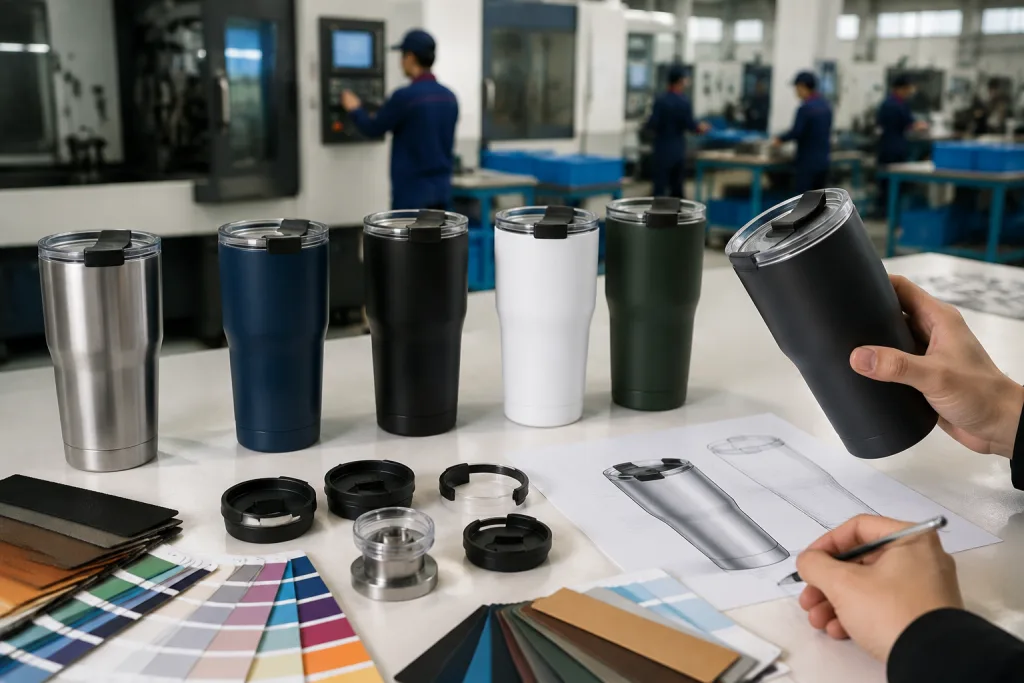
Approve Samples Like A Buyer
Sample approval is where you protect the bulk order. Don’t sign off just because the logo looks clean under office lighting. We run sample checks under a D65 light box and again beside the coating line, because a hand-polished cup can hide orange peel, dust spots, or a thin powder coat. A proper travel mug oem manufacturer should send a sample made with production-grade steel, lid resin, gasket, and coating. If the factory says the final coating will be “similar,” stop and ask for the coating code, spray method, and what will change.
For a standard coffee mug custom project, development samples usually take 7-12 days after artwork confirmation. If a new mold is required, add 18-30 days for tooling and first trial shots. A normal sample package should include at least two pieces: one for visual approval and one for abuse testing. Fill it with hot water at 95°C, close the lid, invert for 30 seconds if the lid is sold as leak-resistant, then put it in a 5 kg test bag and shake it for 60 seconds. QC pulled 12 lids last month after a buyer flagged this exact issue: they were splash-proof, not leak-proof. The wording matters for your website and gift catalog.
Check insulation with numbers. A decent 16 oz vacuum travel tumbler should keep water above roughly 55-60°C after 6 hours at room temperature, depending on shape and lid design. We log this with a probe thermometer in a 23°C inspection room, not by touching the cup wall. Wide-mouth lids lose heat faster; this is the wrong question to ask if the buyer only wants “keeps hot all day” with no test standard. For cold drinks, look for exterior condensation after 30 minutes with iced water. Condensation usually means vacuum failure or poor construction.
Your sample approval PO addendum should list the exact points the line must follow. We’ve seen this go sideways from one typo on a PO, where “logo 42 mm” became “logo 24 mm” and nobody caught it before pad printing.
- Approved sample code and date, such as S-2406-03 signed on 18 June
- Logo size in mm, not just “same as sample”
- Pantone or LAB color reference, checked against the color card used by the coating room
- Lid fit and gasket color, including gasket hardness if the buyer approved it
- Packaging layout version, with barcode and warning text confirmed
- Any allowed deviation, such as logo position ±2 mm
Keep one signed sample at your office and one at the coffee mug factory. Photos help, but physical samples settle disputes faster. We seal our retained sample in a PE bag, mark the carton side with the sample code, and store it on the QC shelf until the order ships.
Lock The Bulk PO Details
The purchase order is not a price note. It is the work order the production planner, packing table, QC team, and export clerk will follow on the line. If the PO says “bulk coffee mug, 5,000 pcs, logo attached,” the math doesn’t work; we’ve seen this go sideways when the buyer flagged missing silicone plugs after QC pulled the sample from carton No. 18.
For a bulk coffee travel mug order, split the PO by line item. Line 1: tumbler body, including capacity, 304 stainless grade, finish, color code, and logo position in mm. Line 2: lid, with material, gasket color, straw hole, and leak-test requirement. Line 3: spare parts, if any, such as extra straws, brushes, or silicone rings packed at 1 set per 50 pcs. Line 4: retail packaging, including box size, insert card, and barcode print area. Line 5: master carton and marks, with carton size, gross weight limit, shipping mark, and “Made in China” placement. Line 6: labeling, barcode, FNSKU, or customer SKU. Boring paperwork saves money. One buyer once sent a PO with “black lid” but the artwork showed a grey slider; that typo cost 12 days vs 18 days because we had to re-open the lid mold schedule.
Quality terms also belong in the PO, not only in email. For drinkware, buyers often run AQL 2.5 for major defects and AQL 4.0 for minor defects under ANSI/ASQ Z1.4 or ISO 2859-1 sampling. Critical defects should be zero tolerance: sharp rim burrs above 0.2 mm, contamination inside the cup, severe leakage after a 3-minute inversion test, or wrong food-contact material. If your market is the EU, ask for LFGB or relevant food-contact testing where applicable, plus REACH compliance for coating and packaging inks. For the US, FDA food-contact expectations and ASTM packaging considerations may apply depending on channel. QC pulled one sample last quarter with powder coating overspray inside the thread; it passed photos, failed touch inspection.
BottleForge Industrial can produce about 450,000 stainless steel drinkware units per month across tumbler and bottle lines, but capacity means little if the PO is loose. A typical MOQ is 1,000 pcs per model for stock finish, and 3,000 pcs per color for custom powder coating. Normal bulk lead time is 30-45 days after deposit and approved pre-production sample. We run faster when the buyer approves the PP sample in 24 hours, not after 6 rounds of “please check attached” with no file name on the artwork.
Useful PO line: “Inspection before balance payment, AQL major 2.5 / minor 4.0, critical defects 0, inspection booking at 80% packed and 100% finished.”
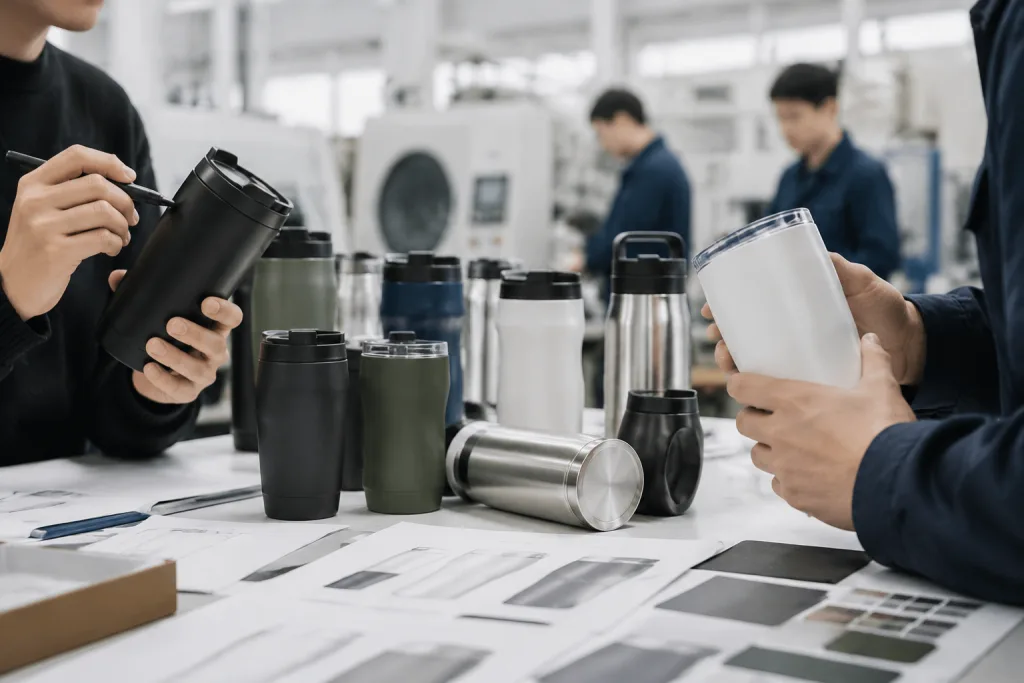
Inspect Before The Balance Payment
Inspection costs less than a dispute after delivery. For the first order with a new coffee mug oem manufacturer, do not skip pre-shipment inspection. Use your own inspector or a third-party agency; for trial orders under 1,000 pcs, we run factory QC with 360-degree video, carton opening shots, and close-ups under a D65 light box. For 5,000 pcs and above, the USD 250-350 third-party bill is usually the cheaper choice. We had one buyer push back on this cost, then QC pulled 47 lids with tight sliders during packing. The math was clear.
The inspection should check drinking function and shelf appearance, not just count cartons. On travel tumblers, inspectors should sample vacuum performance, test lid assembly, confirm gasket fit, measure logo position in mm, look for coating scratches or dents, smell the cup interior, check internal polishing, review carton drop condition, and scan every required barcode. A simple 95°C hot-water hold test catches problems that a desk review will miss. If your order is for coffee mug promotional products, logo defects hurt first because the recipient sees the print before testing heat retention. For retail coffee mug private label, a crushed color box or wrong SKU sticker can cost as much as a scratched tumbler.
Set the inspection timing carefully. At 50% packed, the line may still be sorting coating pinholes, loose gaskets, or mixed-color lids. After the container has arrived, it is too late. The practical window is 100% production finished with at least 80% packed. Then the inspector can pull random cartons from finished goods, not from a clean sample pile beside the packing table. We’ve seen this go sideways when a staged carton passed, while the warehouse stock had a PO typo on the shipping mark.
Your final PO and inspection checklist should include:
- Carton mark layout and destination address
- Inner box count and master carton quantity
- Gross weight and carton size tolerance
- Barcode, SKU, or FNSKU scan requirement
- Spare lid or straw count, if included
- Shipping mark: PO number, item number, color, quantity
If defects exceed AQL, require sorting and reinspection before paying the 70% balance. No drama. A serious coffee mug factory direct supplier will accept this because it protects the buyer’s launch date and the factory’s claim record. We ship cleaner orders when both sides agree on the inspection gate before production starts.
Move From Trial To Repeat Orders
The first PO proves the supplier can build your tumbler once. The second PO proves the line can repeat it without drama. For coffee brands and corporate-gift buyers, repeatability is where margin sits. Same coating gloss at 60° meter, same lid click, same 9 kg master carton, same ship week. We run a golden sample beside the line, and QC pulls 3 cups every 2 hours to catch drift before packing.
After the first shipment, record real feedback. Did 7 out of 500 end users complain about leakage? Did the 74 mm bottom diameter fit common car cup holders? Did the matte coating scratch when cartons rubbed on a pallet corner? Did coffee smell stay after 3 dishwasher cycles? Send this to your travel mug oem manufacturer before the next PO. A good Zhejiang factory can adjust gasket Shore hardness, lid vent size, powder texture, or 5-layer carton dividers, but “make better” is the wrong instruction. We have seen this go sideways.
For repeat bulk travel tumbler programs, lock a master specification sheet. Include model code, material, dimensions, weight, finish, logo file version, packaging dieline, carton pack, AQL level, test reports, and approved sample photos with front, back, lid, and bottom views. QC can then check against a 0.02 mm caliper reading or a Pantone chip, not a sales chat screenshot. This sheet beats any coffee mug supplier list because it compares factories on the same standard, not on promises.
If you are a coffee mug distributor or buying for coffee mug distributors, plan inventory around factory and ocean schedules. A 35-day production lead time plus 28-38 days ocean freight to Europe or North America means replenishment orders need to land 10-12 weeks before stockout. Air freight can rescue a launch, but it can add USD 1.20-2.80 per tumbler depending on weight and lane. The math does not work if the buyer flags low stock with 18 days left and the PO still has the logo file typo “mat black.”
China sourcing is not hard when the process is disciplined. The hard part is refusing vague specs, vague samples, and vague POs. On our floor, the difference shows up fast: one order has a signed sample tag and barcode label, the other has 14 WeChat messages and nobody knows which lid insert is approved.
Send Your Travel Tumbler RFQ For Factory Review
Share capacity, logo file, quantity, packaging, and delivery market. Our Zhejiang team will return a practical FOB quote and sampling plan.
Frequently asked questions
What MOQ should I expect from a travel mug OEM manufacturer?
For standard travel tumbler shapes, a realistic MOQ is usually 1,000 pcs per model if you accept stock colors and existing lids. For custom powder coating, most factories prefer 3,000 pcs per color because coating setup, color changeover, and defect sorting take time. If you need a new lid mold or exclusive body shape, expect 5,000-10,000 pcs for the first run plus tooling cost. BottleForge in Zhejiang can quote smaller trial orders in some cases, but the unit price will be higher because logo setup, packaging setup, and export handling are spread across fewer units.
How much does a custom bulk coffee travel mug cost?
A standard 16 oz stainless steel bulk coffee travel mug often ranges from about USD 3.20 to USD 5.80 FOB China, depending on steel grade, wall thickness, lid design, decoration, packaging, and order quantity. Laser engraving may add USD 0.10-0.25 per unit. A printed retail box can add USD 0.35-0.80. Custom molded lids, full-wrap printing, or premium 304 outer steel can push the price above USD 6.00. Always compare quotes on the same basis: FOB port, MOQ, packaging, test requirements, and lead time.
Which logo method is best for coffee mug promotional orders?
For coffee mug promotional orders, laser engraving is the safest choice when you want durability and a clean premium look. It works well on powder-coated stainless steel and avoids ink peeling. Silk screen is cheaper for simple 1-color logos, but curved tumbler bodies and textured coatings can make registration harder. Heat transfer or UV printing is better for multi-color brand artwork, but you should require rub testing and define dishwasher guidance. For corporate gifts above 2,000 pcs, approve one physical decorated sample before bulk production.
What should be included in my purchase order?
Your PO should include item code, capacity, material grade, color, logo method, artwork version, lid type, packaging, carton quantity, barcode or FNSKU rules, FOB port, unit price, payment terms, delivery date, and inspection standard. Add AQL terms such as major 2.5, minor 4.0, and critical defects 0. Also include carton marks and spare part counts if lids, straws, brushes, or inserts are involved. A clear PO is more useful than a long email thread because production, QC, and export teams can follow it line by line.
How long does sampling and bulk production take?
For an existing model with a standard logo, sample production usually takes 7-12 days after artwork confirmation. If you need custom powder coating, add a few days for color matching. New molds can add 18-30 days before the first proper sample. Bulk production normally takes 30-45 days after deposit and pre-production sample approval. For large retail or coffee mug private labeling programs above 20,000 pcs, confirm production slots early, especially before China holidays when factory capacity and freight bookings get tight.