Key Takeaways
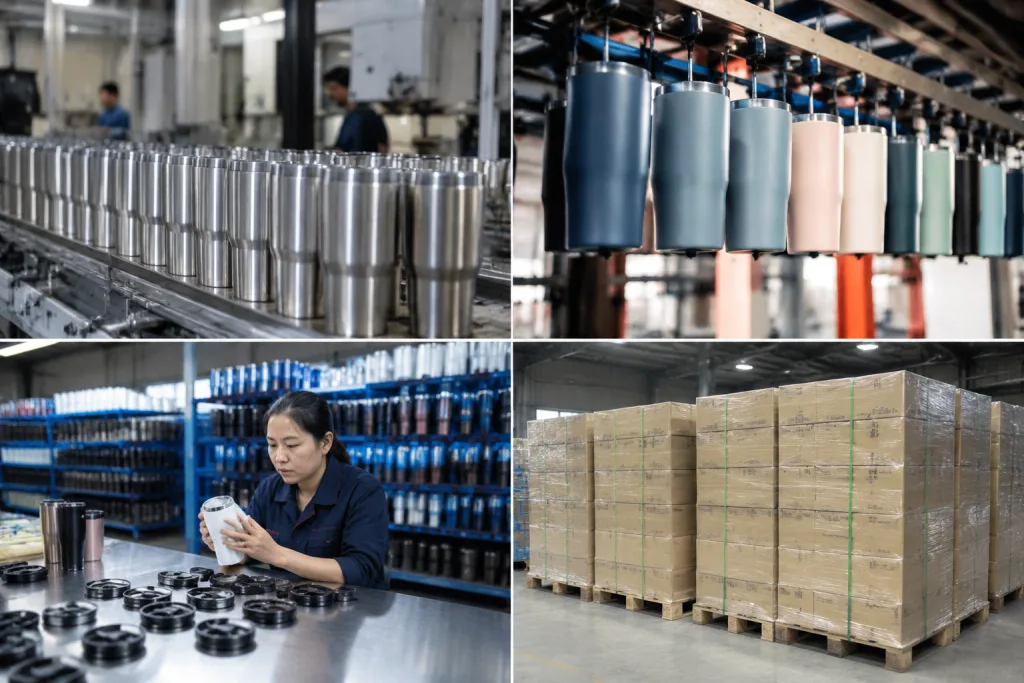
- A 12 oz–20 oz stainless travel tumbler usually lands at USD 2.60–6.80 FOB China before freight and duty
- MOQ is commonly 1,000 units per color for standard models and 3,000–5,000 units for private molds
- Realistic production lead time is 25–45 days after deposit, artwork approval, and sample sign-off
- Logo method, lid design, steel gauge, packaging, and compliance testing move both cost and schedule
If you are sourcing from travel mug manufacturers for a coffee brand, office gift program, or retail promotion, supplier search is not the hard part. The wrong question is “Who quoted cheapest?” We see buyers compare a USD 3.20 mug against a USD 4.10 mug without checking wall thickness, lid fit, carton spec, or whether QC pulled the sample after the laser logo was added. A 25-day delivery promise also needs a reality check: artwork changes, FDA or LFGB testing, and October line loading can turn 25 days into 34 days fast.
BottleForge Industrial is based in Hangzhou, Zhejiang, and we run stainless steel travel tumbler production for export buyers. A normal custom run in our China facility starts at 1,000 units per color, with monthly output around 650,000 units across tumbler and bottle lines. On the factory floor, our team checks mouth diameter with a digital caliper, usually within a 0.2 mm tolerance, before the sample goes back to the buyer. Here is the cost and lead-time breakdown we use when the buyer wants numbers that survive production, not just a clean-looking quotation sheet.
What the quoted unit price includes
Ask travel mug manufacturers for a line-item quotation, not one round number. A loose coffee mug factory direct price does not give corporate-gift buyers enough control over margin or ship date. Your FOB China quote should spell out capacity and material grade; wall structure and lid type; finish and logo method; packaging, carton quantity, MOQ, sample charge, production lead time, payment terms, and Incoterm. We caught one PO last month with “16 oz” in the item line and “500 ml” on the artwork file. Small typo. Big problem.
For a standard double-wall stainless steel travel tumbler, a realistic FOB range is usually USD 2.60–4.20 for a simple 12 oz unit, USD 3.20–5.30 for a 16 oz unit, and USD 3.80–6.80 for a 20 oz insulated tumbler. That range assumes 304 stainless inner wall, 201 or 304 outer wall, powder coating or spray painting, one-position logo, and individual white box or kraft box packaging. On the line, our QC checks wall thickness with a digital caliper; 0.45 mm steel and a 0.35 mm shortcut do not feel the same in hand.
The lowest price is often built on thin assumptions: 0.35 mm outer wall instead of 0.45 mm, basic PP lid instead of Tritan sliding lid, no drop test, no custom insert, and no third-party inspection. That can pass for a low-budget coffee mug promotional campaign. The math does not work for a bulk coffee travel mug sold into cafés or subscription boxes, because 2% returns can wipe out the savings. We have seen this go sideways: QC pulled the sample after a 1.2 m carton drop test and 3 lids cracked at the slider.
Ask whether the quote includes pre-production sample approval and carton drop testing. Ask whether the factory has BSCI audit history and can support LFGB, FDA, REACH, or California Proposition 65 documentation when needed. A proper coffee mug manufacturer in Zhejiang or another export hub in China should answer without acting surprised. We keep the test reports by SKU and PO number, because buyers often ask for the same FDA file again 6 months after shipment.
Material choices that change cost
On a slide, 30 oz custom travel tumblers can look like the same cup with a different logo. On the BOM sheet, they are not the same cup. Steel grade and thickness move the price first. For coffee brands, we run 304 stainless steel inner wall as the safe choice because it touches the drink and stands up better to coffee acidity; QC checks this with an XRF gun before mass production, not by reading the supplier label. The outer wall can be 201 stainless for price-driven promo orders or 304 stainless when the buyer wants a cleaner retail story. Moving from 201 outer to 304 outer can add roughly USD 0.18–0.45 per unit, depending on size and steel market pricing.
Wall thickness is the quiet line item buyers miss. A light promotional tumbler may use 0.35 mm outer wall and 0.30 mm inner wall. A retail-grade tumbler is more often 0.40–0.50 mm outer wall, and our caliper check at incoming inspection will show the difference before the line starts. Small number. Big feel. Across a bulk travel tumbler order of 10,000 units, that thickness changes carton weight, dent resistance, and ocean freight. We have seen this go sideways: procurement pushed for the lower ex-factory price, then the buyer flagged the pre-production sample as “too soft” after one thumb press near the base.
Lids are the next cost trap. A simple press-in PP lid may cost less than USD 0.25. A Tritan lid with sliding closure and a silicone gasket can add USD 0.45–0.90, especially when the mold needs a tighter drinking slot and splash-control rib. If you need a leak-resistant travel lid for commuting, budget for it and run a real tilt test; on our bench we fill 350 ml water, close the slider, then hold the cup upside down over white paper for 30 seconds. This is the wrong place to save USD 0.20. No sane coffee mug oem manufacturer should call a sipping lid fully leakproof unless the structure is built and tested for that claim.
Surface finish changes both cost and rejection rate. Powder coating gives better grip and a stronger retail feel than basic spray paint, but it needs tighter color control; last month QC pulled 42 pcs from a 2,000 pcs pilot run because the beige sample drifted outside the buyer’s Delta E limit. Electro-polished stainless and gradient coating add cost, while rubberized paint, ceramic inner coating, and handle welding add extra process time. For coffee mug private label programs, spend where the user notices it: lid feel, coating durability, and clean logo execution. The math does not work if the cup looks premium in the catalog but the laser logo ghosts after the first dishwasher cycle.
Logo and packaging price math
Logo decoration is where a coffee mug custom project stays clean or starts leaking margin. For simple one-color branding, we run silk screen first; on the line, a 120T mesh screen and a 35 mm logo height usually behave well. On a normal bulk coffee mug or tumbler run, one-position silk screen may add USD 0.06–0.15 per unit after setup. Laser engraving looks sharper on 304 stainless and powder-coated tumblers, adding USD 0.12–0.35 per unit depending on logo size and machine time. The wrong question is “which logo is cheapest?” Ask which one survives handling, washing, and your buyer’s brand review.
Heat transfer works for photo-style artwork. Water transfer is better for irregular curves. Full-wrap UV printing needs a jig that holds the cup within about 0.5 mm, or the seam will drift. 3D embossing means new tooling, so the math changes fast. A full-wrap design may add USD 0.45–1.20 per unit and can extend production by 5–10 days because artwork alignment, film preparation, and curing all need control. If your design has 6 pt text, gradients, or registered color blocks, approve a physical sample. PDF approval is not enough; QC pulled one sample last month where the gold looked fine on screen but printed closer to mustard.
Packaging can be cheap. It cannot be sloppy. A white box may add USD 0.12–0.25. A printed kraft box is usually USD 0.20–0.45. A color retail box with insert, barcode, FNSKU label, and master carton marks may add USD 0.45–0.90. For corporate gifting, a magnetic gift box or sleeve can climb above USD 1.20 per unit. We’ve seen this go sideways when the PO says “gift box” but the artwork file only shows a plain tuck box. If your buyer calls it coffee mug promotional products, they may still expect retail presentation, especially for 500 pcs going to sales reps instead of a warehouse bin.
For distributors, packaging also affects damage claims. We prefer 5-layer export cartons for heavier bulk travel mug shipments, with dividers or tight-fitting inner boxes when the coating is sensitive. A 24 pcs carton over 13 kg needs better corner strength than a 12 pcs carton, and the buyer will flag scratches before they read the carton spec. A carton drop test under ISTA-style handling is cheap compared with explaining scratched mugs to a coffee mug distributor. If you are building a coffee mug customized program for multiple branches or sales regions, standardize the carton spec early so every reorder ships the same way.
MOQ tiers and realistic discounts
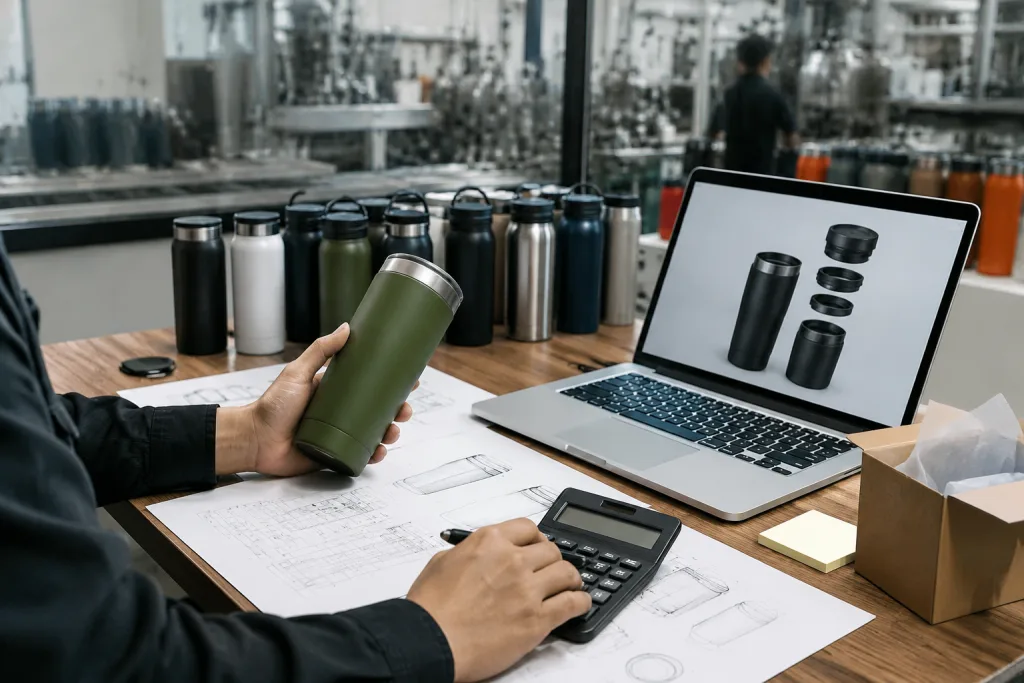
MOQ is not a punishment. It is the point where material buying, powder-coating setup, logo screen setup, labor booking, and QC paperwork stop wasting money. For standard BottleForge travel tumbler models in Zhejiang, MOQ is usually 1,000 units per color for one logo. We run color changeover on the coating line with a spray gun cleanout and oven temperature check; below 1,000 units, that setup cost gets ugly fast. Mixed colors sometimes work at 500 units per color if the PO total stays above USD 8,000, but building a launch budget around exceptions is the wrong question to ask.
A practical MOQ ladder is simple. At 1,000 units, expect the highest unit price and limited flexibility. At 3,000 units, coating powder, cartons, and inner box printing start to price better because the line can run half a shift without stopping. At 5,000–10,000 units, the factory can buy 304 stainless coil in a cleaner batch and book welding, polishing, and packing time with fewer gaps. Above 20,000 units, we can talk about annual pricing, reserved capacity, and customized cartons across 2–4 shipments; last month QC pulled a sample because the carton mark missed one digit from the buyer’s PO, and that kind of detail matters more when containers are split.
For example, a 16 oz powder-coated stainless tumbler might quote at USD 4.35 FOB for 1,000 units, USD 3.95 for 3,000 units, USD 3.72 for 5,000 units, and USD 3.55 for 10,000 units. These are not universal prices. The curve is realistic. The biggest drop usually sits between small commercial orders and stable production runs, because coating loss, logo setup, AQL 2.5 inspection time, and export carton buying get spread across more pieces. After 10,000 units, the math doesn't work like buyers hope; savings move in cents unless steel, PP, or freight changes.
Private tooling is different. A coffee mug custom made body, handle, lid, or proprietary shape often needs 3,000–5,000 units MOQ and tooling charges from USD 1,500 to USD 8,000 for basic components. Complex lids cost more, especially when the leak test needs a silicone ring tolerance under 0.3 mm. If you want coffee mug private labeling without heavy tooling, start with an existing mold, then change finish, logo, box, sleeve, straw, or handle color. We’ve seen this go sideways when a buyer spends USD 6,000 on tooling before testing 1,000 units in retail.
Lead time from sample to shipment
Lead time starts after we have print-ready AI/PDF artwork, a locked spec sheet, deposit receipt, and a sample direction the merchandiser can hand to the line. It does not start when you send a rough inquiry to a coffee mug supplier list or ask ten factories for a ballpark quote. Wrong question. For a standard travel tumbler, our digital mockup usually takes 1–2 working days once the logo file opens cleanly in Adobe Illustrator. A plain stock sample can ship in 2–4 days. A custom logo sample normally takes 5–10 days after artwork confirmation; last month QC pulled a sample because the buyer's PO said "matte black" but the artwork note said "gloss black."
Pre-production sample approval is the first schedule risk. If the logo is too small for silk screen at 18 mm height, if the Pantone color shifts on powder coating after the oven run, or if the lid fit needs a 0.3 mm adjustment, add 3–7 days. This is normal. Better to lose 7 days before mass production than receive 5,000 mugs with a weak logo; we have seen that go sideways when a buyer approved a photo instead of the actual sample.
Mass production is typically 25–35 days for 1,000–5,000 units and 35–45 days for 10,000–30,000 units, assuming normal factory loading. Peak season before Q4 gifting can stretch that by 7–15 days, and the math gets worse when two powder-coating lines are already booked with 40,000 pcs of holiday tumblers. If you need goods for a fixed event, give your coffee mug factory the event date and warehouse deadline upfront, then state whether inspection is AQL 2.5 or your own checklist.
Inspection and logistics need their own time. AQL inspection usually takes 1 day on site, plus 1–2 days to issue and review the report; we have had a shipment wait 2 extra days because the carton mark missed one digit in the SKU. Sea freight from China to major EU or North American ports may take 25–45 days port to port, and final delivery adds more. Air freight moves in 5–10 days, but it often kills the margin on a coffee mug in bulk order. For Amazon or 3PL programs, add time for FNSKU labeling, carton compliance checks, and appointment booking with the warehouse.
Factory checks before paying deposit
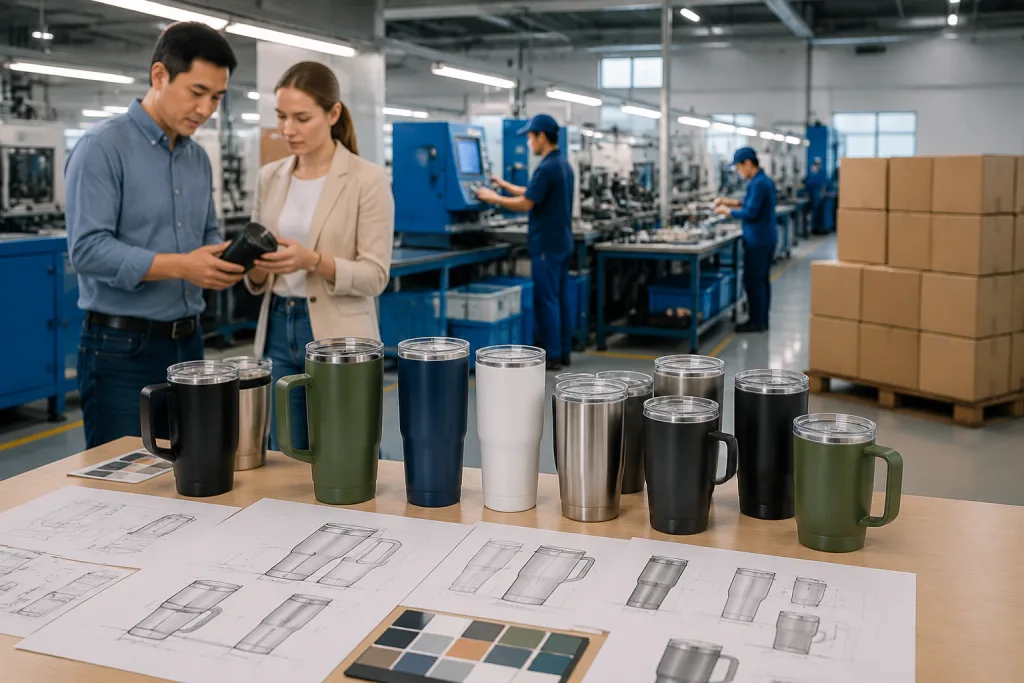
A clean quotation does not prove the line can build your cup. Before paying a 30% deposit, confirm whether the supplier is a real coffee mug manufacturer or a trading desk with a rented sample room. Trading offices are not always bad, but you need to know who signs off on tooling changes and who answers when QC pulls 12 scratched bodies from a 200-piece pre-shipment sample. Ask for the factory address in Chinese, the business license with the same company name as the PI, audit reports within the last 24 months, workshop photos showing the laser-welding and powder-coating areas, plus 3 recent shipment references for the same product type.
A serious coffee mug manufacturers check should start with production capability and traceability, then move into QC rules, compliance paperwork, and response time under pressure. For quality, ask what AQL level they run for appearance versus function; common settings are AQL 2.5 for major defects and 4.0 for minor defects, but premium retail shelves often need tighter sorting on coating dust, lid fit, and logo position within ±1 mm. For drink-contact items, ask for 304 stainless composition reports and food-contact test reports matched to your sales market. We have seen this go sideways when a buyer accepted “FDA okay” by email, then QC pulled the sample and found the inner wall material report was for another SKU.
If you are comparing a coffee mug supplier directory, price-first ranking is the wrong question to ask. Rank suppliers by the questions they ask back. A factory that knows travel tumblers will ask about target retail price, sales channel, dishwasher claim, lid leakage angle, packaging drop height, and compliance region, because each answer changes the BOM or inspection plan. A weak supplier just says yes. The math does not work when the buyer wants a leakproof slider lid, 500 ml capacity, color gift box, and 1,000 pcs MOQ at the same price as a plain open-stock mug.
For corporate-gift buyers, payment terms are usually 30% deposit and 70% balance before shipment, or before bill of lading release for larger accounts. For repeat coffee mug distributors, we can discuss staged shipments or annual contracts after 3 clean orders with no chargeback or late artwork change. New buyers should budget for third-party inspection, especially above USD 10,000 order value. This is not mistrust; it is basic risk control when we ship from China against a fixed campaign date, and a 1-day inspection slot is cheaper than finding 8 cartons with the wrong logo Pantone after the vessel closes.
How to brief manufacturers properly
The fastest way to get accurate pricing is to send a short, complete brief. Put the basics in one table: target capacity, stainless grade, lid style, coating color, logo size and method, packaging type, order quantity by color, destination country, compliance needs, and target ship date. Add dimensions if you have them; even “top diameter 88 mm, height 175 mm” saves a round of guessing on the line. If you need a bulk coffee tumbler for cafés, say whether it goes on retail shelves, gets bundled with 250 g coffee beans, or works as a loyalty gift. Use case changes the spec. It always does.
Do not send only a photo and ask, How much? That is the wrong question to ask. A photo rarely shows wall thickness, lid material, coating system, or carton spec; last month QC pulled a similar sample and found 0.38 mm outer wall where the buyer expected 0.50 mm. If you have a target price, share it. Good travel mug manufacturers can tell you where to adjust: switch full-wrap print to a 35 mm laser logo, change gift box to kraft box, use 201 outer wall, or raise quantity from 1,000 to 3,000 units. Hiding the target price often burns three days.
For a coffee mug customizable program with multiple departments, create one master spec and separate artwork files. File names should include color, logo version, and quantity, not “final-final-new.pdf”; we have seen that typo land on a PO and slow pre-production by 24 hours. Vector AI, EPS, or PDF artwork is best. For Pantone matching, the same color reads differently on stainless, powder coating, plastic lids, and printed cartons. Approve physical color chips for high-visibility brand programs, especially if the buyer flagged brand red or navy before.
If your company is building a long-term coffee mug bulk or travel tumbler program, ask for a costed good-better-best option instead of one quote. For example: promotional 12 oz at USD 2.90, retail 16 oz at USD 4.20, premium 20 oz at USD 5.80. We run this sheet with material, lid, coating, carton, and labor split out, so procurement can see why the math works or does not. That gives procurement and marketing a real decision, not a fake race to the lowest number.
Send your tumbler brief for a costed quote
Share quantity, logo, packaging, and deadline. We will return MOQ options, FOB pricing, sample timing, and production lead time.
Frequently asked questions
What is a realistic MOQ for custom travel mugs?
For standard stainless travel tumbler models, a realistic MOQ is 1,000 units per color with one logo. Some factories may accept 500 units per color if total order value reaches around USD 4,000–6,000, but pricing will be higher. For custom colors, powder coating setup is more efficient at 1,000–3,000 units. For a private mold, special lid, or coffee mug custom made body, expect 3,000–5,000 units minimum and separate tooling charges. If you are testing a corporate-gift program, start with an existing mold and customize logo, color, and packaging before investing in tooling.
How long does a bulk travel tumbler order take from China?
A normal timeline is 5–10 days for a custom sample, 25–35 days for mass production up to about 5,000 units, and 35–45 days for larger runs. Add 1–3 days for inspection and 25–45 days for sea freight to Europe or North America. Air freight is usually 5–10 days but can add USD 1.50–4.00 per unit depending on weight and season. The clock starts after deposit, artwork approval, and sample confirmation. If you need delivery before a trade show or holiday campaign, build in at least 10 extra days.
Which logo method is best for corporate-gift travel mugs?
For simple one-color logos, silk screen is the most economical, usually USD 0.06–0.15 per unit on a bulk travel mug order. Laser engraving costs more, often USD 0.12–0.35 per unit, but it looks cleaner on powder coating and stainless steel and will not peel. Full-wrap printing is better for bold retail graphics but can add USD 0.45–1.20 per unit and 5–10 production days. For executive gifts, we usually recommend laser engraving. For high-volume coffee mug promotional products, silk screen is often enough if the artwork is not too detailed.
Can I order coffee mug private label packaging?
Yes. Coffee mug private label packaging is common, but it affects both MOQ and lead time. A plain white box may be available from 1,000 units. A printed kraft box or color retail box usually works best from 1,000–3,000 units because print setup costs spread better. Custom inserts, sleeves, barcode labels, FNSKU labels, and master carton marks should be included in the brief before quotation. Expect packaging development to add 3–7 days before production if artwork is ready, and longer if your team needs several rounds of design approval.
How do I compare quotes from different coffee mug suppliers?
Put every quote into the same format: capacity, steel grade, wall thickness, lid material, finish, logo method, packaging, carton quantity, MOQ, sample time, production time, Incoterm, and payment terms. A USD 3.40 quote with 304 inner wall, powder coating, Tritan lid, laser logo, and printed box may be cheaper in reality than a USD 3.05 quote with thin steel, basic lid, and no packaging details. Ask for AQL standard, food-contact reports, and factory audit status. If a coffee mug supplier cannot answer these within 24–48 hours, treat the low price carefully.