Key Takeaways
- Set lid leak testing at 100% for flip lids and at least AQL 1.5 for visual defects
- Ask for 304 stainless steel inner walls at 0.4–0.5 mm, not vague food-grade wording
- Powder coat failures usually start at the base radius, rim, and handle weld area
- Factory-direct bulk travel tumbler pricing needs tooling, packaging, and inspection costs separated
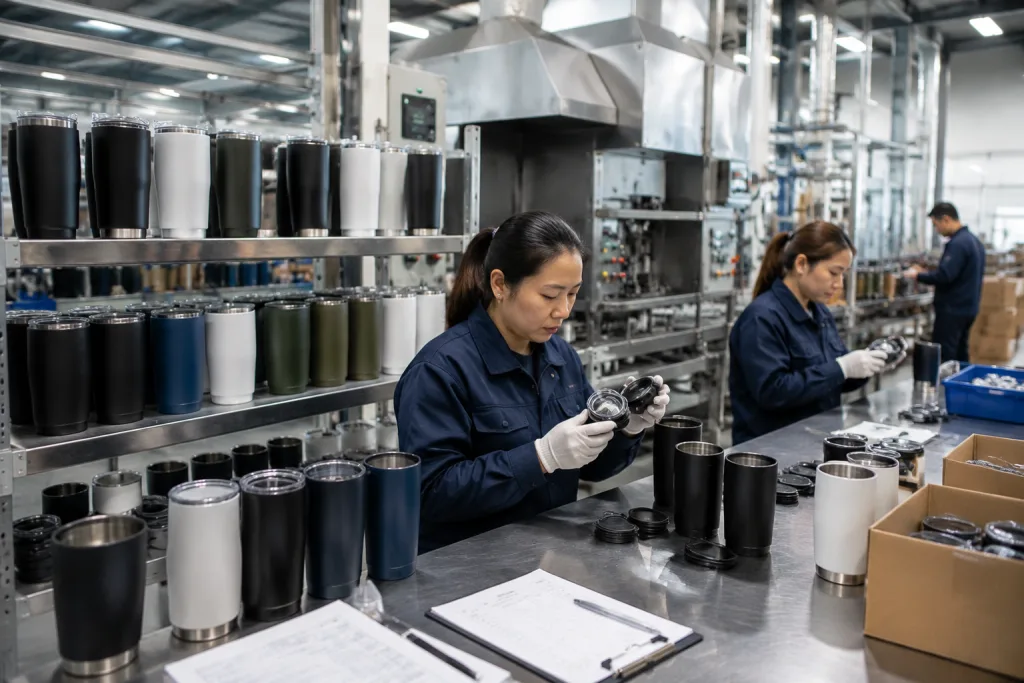
A travel mug order often fails at the dull bench checks: a lid thread that passes the first sample but leaks after 20 dishwasher cycles, or a powder coat that chips on the bottom radius after the drop jig hits the same edge 3 times. We’ve also had buyers approve a logo on matte black, then flag it as muddy on navy blue at pre-shipment. For a coffee brand or corporate-gift program, that means returns and bad calls with the sales team. Nobody enjoys those.
As a travel mug manufacturer in Hangzhou, Zhejiang, we see 6 or 7 preventable mistakes every month from new buyers in Europe and North America. China can make strong coffee mug customized programs, but the spec must go deeper than “500 ml, stainless steel, logo printed.” That is the wrong question to ask. Our Zhejiang line runs about 420,000 drinkware units/month, with typical MOQ from 1,000 pcs per color and 35–50 days lead time after sample approval; QC pulled one sample last week because the PO said Pantone Black 6C but the artwork file showed 426C.
Leak Failures Start With Lid Geometry
Most complaints on a bulk coffee travel mug are not about insulation. They start at the lid. We have had 27 carton-claim photos where the cup body was fine, but coffee crept past the PP or Tritan lid after 2–3 weeks in backpacks. On the line, QC pulled the sample, wiped the rim with a blue lint-free cloth, and found the leak path at the silicone gasket seat. The usual suspects are gasket compression, thread tolerance, vent size, or hinge wear.
For a screw lid, ask your travel mug manufacturer for thread engagement in millimeters, not a cropped drawing screenshot. We run calipers on the thread height and check the go/no-go feel by hand before mass assembly. A practical target is 1.5–2.0 full rotations before lock, with no cross-threading during a 500-cycle open/close test. For a push-on lid, define the silicone gasket hardness, usually 50–60 Shore A. Too soft and it rolls during insertion. Too hard and it loses the seal after hot water expands the lid skirt.
Flip lids need tougher testing because corporate-gift buyers pick them for one-hand use, then blame the factory when a laptop bag gets wet. We recommend 100% functional leak testing for flip-top assemblies: fill with 90°C water, close, invert for 30 seconds, then shake horizontally 10 times. The line needs a timer, a stainless test tray, and one operator who is not rushing to hit 1,200 pcs per hour. That adds labor cost, but the math does not work if you replace a 5,000 pc coffee mug promotional order.
Be careful with “leakproof” claims. A mug with a drinking slot and pressure vent may be splash-resistant, not bag-safe, and this is where we have seen projects go sideways. If your packaging says leakproof, the carton inspection should prove it. Put the claim in the purchase order, define the test, and add it to the final inspection checklist. One buyer once sent a PO with “leak proof” in the artwork note but not in the QC standard; the inspector passed AQL 2.5, then the buyer flagged it after delivery. A good coffee mug factory will accept a clear test. A weak supplier will keep the word soft.
Vacuum Loss Is Hard To See
Double-wall stainless steel travel mugs fail quietly when the vacuum is weak. One golden sample holds coffee for six hours, then 3 cartons from mass production cool down fast because a laser-weld pinhole, dirty sealing powder, or a bad tail plug killed the vacuum. QC pulled a 16 oz cup from line 2 last April; the outside wall warmed up in 9 minutes. By the time a coffee mug distributor hears the complaint, the goods are already in retail packs and the math doesn't work.
Spec the steel first. For normal coffee use, BottleForge recommends 304 stainless steel inside and 201 or 304 outside depending on price target. Inner wall thickness should be 0.4–0.5 mm for most 12–20 oz tumblers; we check it with a digital micrometer before polishing, not after the cup is shiny. Thinner material cuts FOB by USD 0.10–0.25, but dent claims rise, especially for e-commerce and corporate events where one 15 kg master carton gets dropped twice before delivery.
Vacuum testing should not be skipped on coffee mug in bulk orders. We run a hot-water thermal response check after vacuum sealing, then random retention tests after assembly. A common buyer-side spec is: fill with 95°C water, close lid, hold at 20–25°C ambient, and require at least 55°C after 6 hours for a 16 oz travel tumbler. Wide-mouth shapes lose heat faster; test the exact shape you will sell, because one buyer flagged a 6 mm wider mouth after approval and expected the same retention result.
For AQL, do not use only general visual inspection. Add functional checks. For example, Level II with AQL 1.5 major / 4.0 minor for appearance, plus a separate insulation test on 8–13 pcs per lot depending on order size. If you are buying as a coffee mug private label program, request test photos with thermometer readings, timestamps, and carton references; we also mark the carton number on the QC sheet, because a PO typo like “matte balck” is easy to fix, but a missing carton trail is not.
Coating Chips Expose Weak Pretreatment
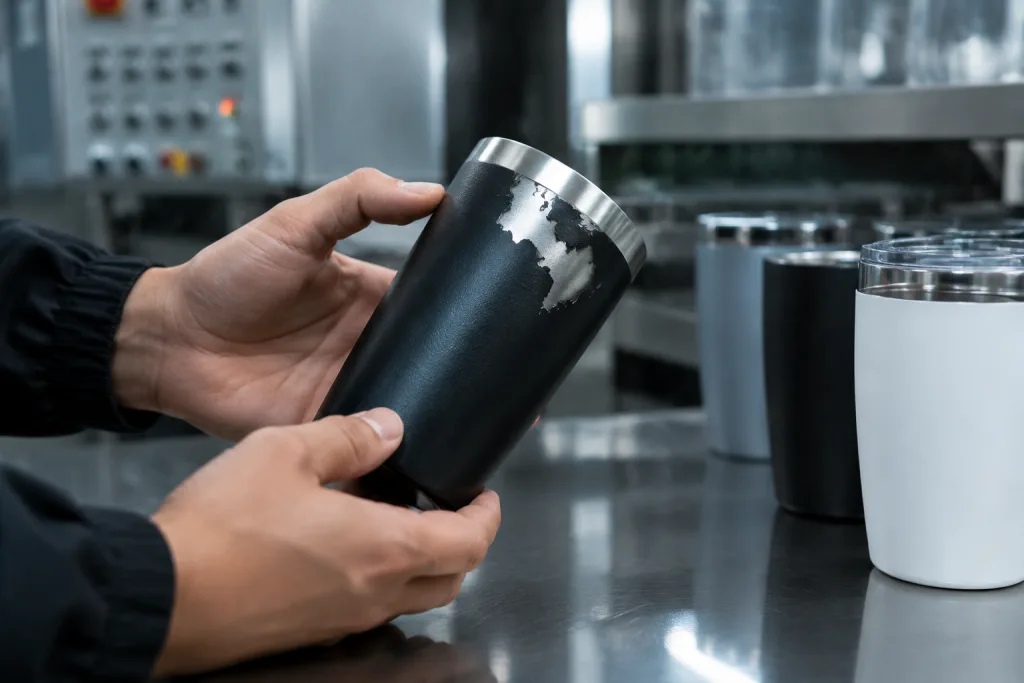
A travel tumbler can pass a showroom rub test and still come back chipped after 14 days in a commuter bag. We see it. Powder coating, spray painting, and UV coating all start with the same boring step: surface prep. If cutting oil stays on the 304 stainless body, if the alumina blasting gun misses the lower curve, or if the oven is pushed too fast, QC usually finds chips at the base ring and scratch lines around the sip rim.
This matters for coffee mug custom made programs because the color carries the brand. One buyer flagged a matte cream sample last April because the base showed silver after a fingernail scrape; the Pantone was right, but the coating stack was not. Ask your coffee mug manufacturer for the actual coating route: degreasing bath time in minutes, roughness target after blasting, powder brand or coating type, oven set point, and belt speed. For powder coat, 180–200°C for 15–20 minutes is common, but the right setting depends on coating chemistry and line speed.
Define tests before production. Do it on the PO, not after the first 3,000 pcs are packed. We run 3M tape cross-hatch adhesion, a 24-hour water soak, 300-cycle abrasion on the underside, and a 1 m drop test on the packed product, not just the bare mug. For dishwasher-safe claims, be careful. The math doesn't work if retail wants a low-cost colored bulk travel mug and also expects the finish to look fresh after 50 cycles. Many finishes handle hand washing but fade or dull after 20–30 dishwasher cycles. If your retail copy says dishwasher safe, test 50 cycles and accept the cost.
Logo decoration has its own failure modes. Laser engraving lasts, but it exposes metal and cannot match a full-color logo. Silk screen looks sharp on a straight tumbler wall; on a 72 mm curved body, the edge can distort if the jig is off by 1 mm. Heat transfer gives richer color for coffee mug promotional products, but QC pulled samples before where the corner lifted after 10 hot-water cycles at 80°C. If you want coffee mug customizable colors across several SKUs, approve decoration on every body color, not only on black or white.
Logo Placement Breaks Retail Consistency
Corporate-gift buyers usually stare at the logo file and miss the fixture setup. That is how we get a 3 mm position drift from mug to mug, or a logo centered on the CAD drawing but looking low after the body taper changes the sightline. On a 10,000 pc bulk coffee tumbler order, that small drift looks messy once 24 mugs sit side by side on the kitting table. QC pulled one sample last month with the logo 2.8 mm off center; the buyer flagged it before we even packed the inner boxes.
For a coffee mug custom program, your spec should call out logo size, distance from rim or base, rotation point relative to handle or seam, and the pass/fail tolerance. For straight tumblers, ±1.5 mm placement tolerance is realistic. For tapered bodies, ±2.0 mm is the safer number unless you approve a tighter fixture and slower line speed. If the mug has a handle, say whether the logo faces the drinker, faces outward when held in the right hand, or sits opposite the handle. Do not leave this to the factory. We run the first 20 pcs against a printed placement jig in mm, not against somebody’s “looks okay” comment on WeChat.
Private-label packaging needs the same discipline. If your coffee mug private labeling order uses belly bands, gift boxes, QR cards, or FNSKU labels for online fulfillment, ask for a packing sample before mass production. We have seen clean China orders lose 12 days because the retail box was 2 mm too short for the lid height. One barcode also landed on a curved shrink-wrap seam and failed scanning in the handheld Zebra scanner. The math does not work if 3% of cartons need relabeling after arrival.
For Amazon-style or distributor cartons, specify master carton drop strength. A common export carton is 5-ply corrugated, 44–48 ECT equivalent depending on carton size and weight. For ceramic-style handles or protruding plastic lids, use dividers or molded pulp trays, and confirm the packed carton weight before the line starts sealing. Coffee mug distributors care about sell-through, but warehouse damage rates hit the reorder just as hard. Packaging is part of the product. We ship enough mugs to know this is where “minor” savings go sideways.
Food Compliance Gets Misquoted
“FDA approved” gets thrown around too loosely in drinkware sourcing. For stainless travel mugs, buyers need material and migration compliance, not a fuzzy approval badge. If you sell into Europe, ask for LFGB or EU food-contact migration reports where the product touches drinks, plus REACH for coatings, inks, and plastic parts. For North America, FDA food-contact expectations and California Proposition 65 screening often come up on retailer POs. Kids or school programs can trigger ASTM or CPSIA review, mainly when the decoration is bright color paint or the lid has small removable parts. Last month QC pulled a 304 stainless sample from the line and the buyer flagged one missing gasket material code on the report.
A serious coffee mug oem manufacturer should split the compliance file by component: stainless body, lid plastic, silicone gasket, coating, ink, straw if included, and packaging carton. Do not accept a five-year-old report for a different lid resin and assume it covers your new sip lid. Resin changes happen. Pigment changes happen. We have seen this go sideways when a buyer approved a black PP lid, then switched to translucent Tritan 12 days before shipment and expected the same report to pass. The report should match the material grade, color family, and supplier where possible; our QC team checks this against the BOM in Excel before the first 20 pcs pre-production run.
If your procurement team is building a coffee mug supplier list, use compliance discipline as a hard filter. Ask whether the factory is ISO 9001 certified, whether social audits such as BSCI are available, and whether test reports come from recognized labs like SGS, TÜV, or Intertek. A coffee mug supplier directory can give you 80 names in one afternoon, but it cannot tell you whether the vendor understands your market’s paperwork burden. We run into this often: the buyer asks for “FDA certificate” on the PO, then their retailer actually wants a migration report with the exact 16 oz tumbler description and lid material shown.
For BottleForge in Zhejiang, we keep standard material declarations for common travel tumbler platforms and quote third-party testing separately when a buyer needs market-specific reports. That is the clean way to price it. If a quote says every test is included at a suspiciously low FOB price, check what is being tested and whether the report will carry your item description. The math does not work on a USD 3.20 FOB tumbler if the supplier claims full LFGB, REACH, FDA, and Proposition 65 testing are all built in for an MOQ of 500 pcs. We ship the sample set to the lab with a marked test request sheet; one typo on a PO color code can add 7 days vs 14 days if the lab asks for corrected documents.
Pricing Fails When Specs Are Missing
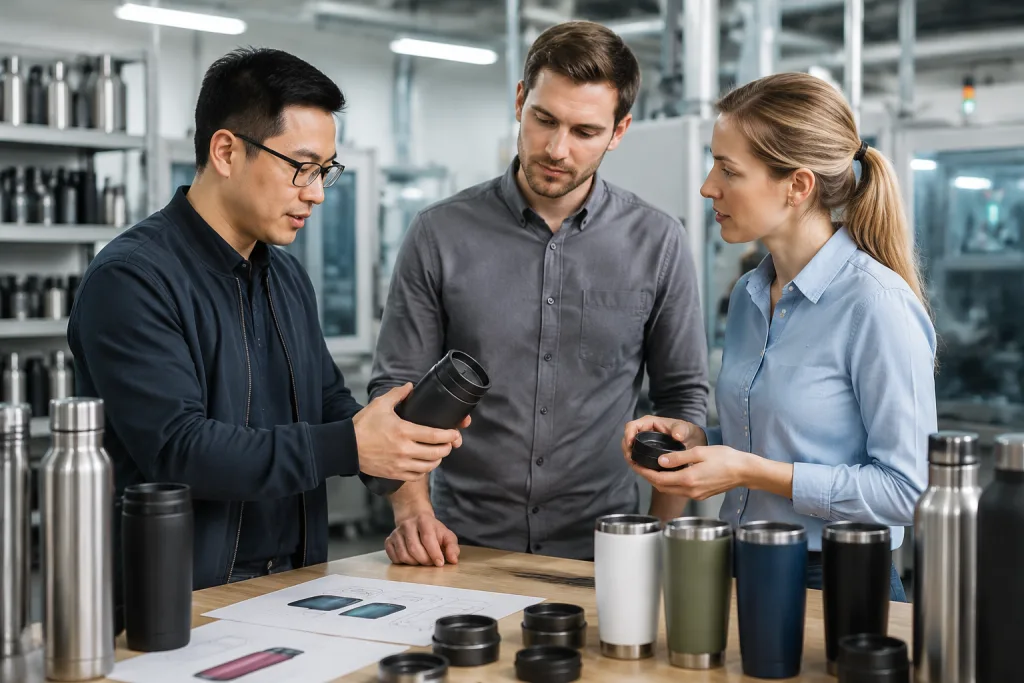
Factory-direct pricing looks easy until two quotes for the same “16 oz travel mug” come back USD 1.20 apart. Usually, they are not the same cup. One quote might be 201 outer steel with a 0.38 mm body, PP push lid, no individual box, and one-color silk print. Another might be 304 outer steel, 0.45 mm body, powder coat, laser logo, retail gift box, insert card, and a 5-layer export carton. Both quotes can be clean. Only one fits your shelf program. We saw this last month when QC pulled the sample and found the buyer’s “matte black” was actually semi-gloss under the D65 light box.
Ask the coffee mug factory direct team for pricing with the commercial frame already fixed: order quantity, color count, logo method, packaging, target market, compliance needs, and delivery term. FOB Ningbo or Shanghai is common for Zhejiang drinkware exports. For a standard 16 oz stainless bulk travel tumbler, realistic FOB ranges often sit around USD 3.20–5.80 depending on lid complexity, coating, packaging, and quantity. Tooling for a custom lid or body can run from USD 1,500 to more than USD 8,000. The buyer often asks, “Can you quote first and confirm specs later?” That is the wrong question to ask; the math does not work when a gift box alone can add USD 0.28 and push carton weight past 14 kg.
MOQ traps buyers fast. A coffee mug in bulk order might be advertised at 500 pcs, but custom color coating often needs 1,000–3,000 pcs per color because the coating line loses 80–120 pcs during spray-gun setup and color change. For coffee mug bulk promotions with four logo versions, ask whether MOQ applies per body color or total order. Simple sentence. Big difference. We run into this on PO revisions all the time, including one PO where “500 pcs assorted” was typed, but the artwork file showed 5 PMS colors across 4 logos.
If you are comparing coffee mug manufacturers, put the numbers in a grid: steel grade with thickness in mm, lid material with sealing ring type, coating process, decoration method, carton spec, test standard, lead time, payment term, and included inspection. A clean quote is not always the lowest quote. It is the one where you can see what will arrive. We ship fewer surprises when the buyer lets us attach the carton drop-test result, AQL 2.5 checklist, and final packing photo before balance payment.
Sampling Should Try To Break It
A nice pre-production sample does not prove the order is stable. It proves 2 pieces were made slowly under a merchandiser’s eyes. During sampling, try to break the mug the same way users will: fill it with 92°C coffee, park it in a car cup holder for 4 hours, run 20 dishwasher cycles if the coating claims dishwasher-safe, drop the packed export carton from 1 m, twist the lid with wet hands, then check the logo under 5000K office lighting. We run this on the line with a torque meter for the lid and a 1 m drop corner test; QC pulled one sample last month because the slider lid leaked after the third shake.
For coffee brands, test taste and smell first. Cheap or under-cured silicone gaskets can hold odor, and we have seen this go sideways after a buyer approved the logo but skipped the gasket check. Fill the mug with hot water for two hours, pour it out, then smell the empty cup and lid separately after 10 minutes. For corporate gifts, test the retail feel: lid click sound, coating grip, weight balance, and box opening. Your buyer may write “bulk coffee mug” on the PO, but the recipient judges it like a retail item; one typo we caught on a gift-box dieline changed “vacuum” to “vaccum,” and that would have killed the unboxing.
A practical sample path is short and strict: choose the 3D drawing or existing mold, confirm a blank sample in 5–7 days if we have stock body parts, approve the decorated sample in 7–12 days, then sign the pre-production sample after deposit and final artwork. Do not start mass production until the signed sample, Pantone color swatch, and packing layout are frozen. This is the wrong question to ask: “Can you start first and we confirm later?” The line needs one approved standard, not 6 WeChat screenshots. For our China factory, normal lead time is 35–50 days after approval; peak season can add 10–15 days, especially when powder coating capacity is already booked by 30,000 pcs bottle orders.
Do not skip third-party inspection for first orders above USD 10,000. Use your own inspector or factory QC plus a third party, but inspect before balance payment. Check AQL, carton count, barcode scan, logo placement, lid function, coating defects, and insulation; expand the checklist with exact limits, such as logo position within 1.5 mm and carton gross weight matching the shipping mark. A good coffee mug supplier will not be offended. We ship with the same internal sheet anyway, and if the buyer flagged it at PSI, we would rather fix 120 pcs in Hangzhou than argue over a claim after the container lands.
Send Your Travel Mug Spec For Factory Review
Share quantity, logo, target market, and packaging needs. BottleForge will return a practical quote, risk notes, and sampling timeline.
Frequently asked questions
What MOQ should I expect from a travel mug manufacturer?
For an existing mold with standard colors, 1,000 pcs per color is a normal MOQ in Zhejiang and other China drinkware clusters. Some factories accept 500 pcs for blank stock or simple laser logos, but custom powder coating, Pantone matching, or retail packaging usually pushes MOQ to 1,000–3,000 pcs per color. If you need four body colors and two logo versions, clarify whether the MOQ is per color, per artwork, or total order. For a coffee mug promotional campaign, we often suggest starting with one body color and multiple logo positions only if the decoration process allows it without resetting the line.
How much does a custom bulk coffee travel mug cost?
A standard 16 oz double-wall stainless bulk coffee travel mug usually falls around USD 3.20–5.80 FOB China, depending on steel grade, lid design, coating, logo method, and packaging. A simple one-color silk print and white box sits near the low end. Powder coat, laser engraving, gift box, insert card, and stronger export carton move the price up. Custom tooling changes the math: a new lid or body mold can cost USD 1,500–8,000 or more. Ask your coffee mug manufacturer to separate unit price, tooling, sample cost, testing, and inspection so you know what you are comparing.
Can I sell the same travel tumbler in Europe and North America?
Often yes, but do not assume one report covers both markets. For Europe, you may need EU food-contact migration, LFGB for certain buyers, and REACH information for coatings, inks, plastics, and silicone. For North America, FDA food-contact expectations are common, and some programs ask for California Proposition 65 screening. If the product is for children or schools, ASTM or CPSIA-related checks may apply. Ask the coffee mug oem manufacturer for component-level documents: stainless body, lid plastic, silicone gasket, coating, ink, and straw if included. Reports should match your actual materials and colors as closely as possible.
Which logo method works best for coffee mug custom orders?
Laser engraving is the safest for durability on stainless or powder-coated bodies, but the result is usually metal-colored and not full-color. Silk screen printing is economical for one- or two-color logos on smoother walls, with typical setup cost lower than heat transfer. Heat transfer or UV printing works better for detailed graphics, gradients, or promotional artwork, but adhesion must be tested after hot-water cycling and abrasion. For coffee mug custom made retail programs, approve the logo on the exact coating color. A logo that looks clean on matte black may look weak on cream, silver, or textured powder coat.
How do I choose between coffee mug manufacturers and trading companies?
A factory gives better control over tooling, QC, and production timing, but a trading company may combine several products for a small mixed order. If your core item is a bulk travel mug or bulk travel tumbler, ask for factory audit documents, production photos, ISO 9001 status, monthly capacity, and whether the business license matches manufacturing. A real coffee mug factory should discuss wall thickness, lid tolerance, AQL, coating process, and carton strength without dodging. If you use a coffee mug supplier directory or coffee mug supplier list, treat it as a starting point, not proof of capability.