Key Takeaways
- For a custom travel tumbler, 500-1,000 pcs is a realistic MOQ; 3,000 pcs gives better FOB leverage
- Double-wall 304 stainless steel with 0.4-0.5 mm inner wall is the safest default for coffee programs
- Laser engraving lasts longest, while powder coating plus silkscreen gives stronger retail shelf impact
- Standard production is 25-35 days after artwork approval, plus 3-7 days for pre-production sampling
You are not just buying a cup. You are choosing the item your customer carries on the train, sets beside a laptop, or leaves next to a hotel coffee machine. If the lid leaks at 45° in our tilt test, the logo scratches after 50 tape pulls, or the cartons arrive 2 days after the event, the unit price on the quotation will not save the order.
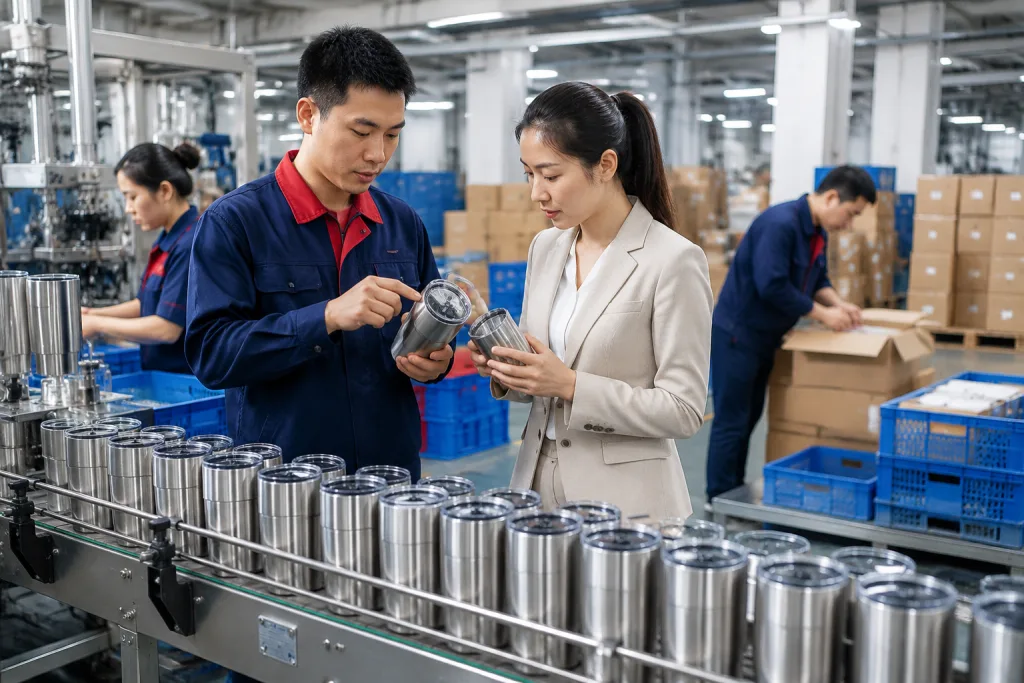
For coffee brands and corporate-gift buyers sourcing a travel mug in bulk, we run the decision through four points: body construction, lid design, decoration method, and fulfillment format. BottleForge Industrial manufactures in Zhejiang, China, and our Hangzhou team sees the same issue every month. Buyers who lock these points before sampling get first samples in 12 days vs 18 days, cleaner PO checks, and fewer inspection arguments. The wrong question is “what is your cheapest tumbler?” QC pulled the sample last week because the buyer wanted a lower price but kept the 304 stainless body, powder coating, individual kraft box, and AQL 2.5 inspection level. The math did not work.
Start with four buying decisions
A bulk travel mug order gets messy when the first email says “send colors and best price” with one catalogue screenshot. Wrong starting point. Start with use case. A coffee subscription brand mailing 5,000 cups to homes does not need the same mug as a corporate buyer giving out 2,000 pieces at a sales conference; we once had QC pull a sample because the buyer’s PO said “car cup,” but the carton mark said “office gift.”
For coffee brands, we usually run 12 oz, 16 oz, or 20 oz stainless tumblers first. A 12 oz bulk coffee mug feels right for espresso drinks and café retail, especially when the cup diameter stays near 76 mm so it sits cleanly under most machines. A 16 oz bulk coffee travel mug is the safer American commuter size. A 20 oz bulk coffee tumbler gives more shelf value for cold brew and office use, but the math changes fast: one 40HQ holds fewer cartons when the carton jumps from 45 cm to 58 cm long.
The second decision is drinking behavior. Driving use needs a one-hand lid with a tighter silicone gasket, not a cheap slide lid that leaks after 3 tilt tests at the packing table. Desk use can live with a push-on lid. Café retail is different again: clear lid material, black vs gray gasket, and powder coating finish decide whether the cup moves on the shelf. We have seen this go sideways when a buyer approved the body color but ignored the cloudy lid sample.
The third decision is brand treatment. A coffee mug custom made for a roasting brand often works better with laser engraving, since it feels permanent and does not shout. A coffee mug promotional order for a corporate event usually needs a larger printed logo, because people need to see it from 2 meters away. On the line, we check this with a 3M tape test after printing; if the logo lifts, the buyer will flag it before the second shipment.
The fourth decision is route to market. If you need FBA labels, barcode stickers, retail boxes, or mixed cartons by branch office, say it before sampling. Not after deposit. A factory can quote coffee mug private labeling accurately only when packing and labeling are fixed; even a 1 mm barcode placement change can slow packing, and one PO typo like “24 pcs/carton” instead of “12 pcs/carton” can add 2 days to carton relabeling.
Choose the body before the finish
The body decides heat retention, dent resistance, cost, and buyer confidence. Start there. For bulk travel tumbler programs, we usually run double-wall vacuum insulated 304 stainless steel, because it passes retail buyer questions faster than mixed plastic bodies. For a mid-market travel mug in bulk order, the structure we see most often is 0.4 mm inner wall, 0.5 mm outer wall, 304 stainless inside, and 201 or 304 stainless outside depending on the price target. QC checks wall thickness with a digital micrometer before polishing; if the outer wall drifts to 0.45 mm, the buyer may not see it, but the dent test will.
Do not treat stainless grades as a decoration detail. The coffee-contact part needs to be food-contact safe and stable with acidic drinks, especially after 2 hours holding black coffee at 85°C. For Europe and North America, buyers usually ask for LFGB, FDA food contact, REACH for coating, and sometimes Prop 65 documentation for California distribution. A responsible coffee mug manufacturer should tell you which test reports are current and whether they apply to the exact coating, gasket, and plastic lid material. We have seen this go sideways when a PO says “black lid” but the test report covers only clear AS plastic.
Plastic travel mugs cost less, but they rarely fit premium coffee brands unless the brief says low-cost promotional from the start. Glass looks clean, yet breakage risk jumps, and the packing needs a stronger inner box, usually 170 g corrugated or better. Ceramic-lined stainless is getting more requests from coffee buyers because it cuts metallic taste, but the cost can rise by USD 0.80-1.50 per piece and the production reject rate is less forgiving. On one matte ceramic batch, QC pulled the sample after finding 7 pinholes under a 500 lux inspection lamp; the math doesn't work if the retail price is already tight.
Capacity also affects real cost. A 16 oz tumbler may quote at USD 3.20-4.80 FOB Ningbo or Shanghai for 3,000 pcs, depending on lid and finish. A 20 oz version may add USD 0.30-0.70, not because steel alone is expensive, but because polishing time, coating area, carton volume, and inspection handling all increase. The line needs a larger fixture for powder coating, and one carton that held 24 pcs of 16 oz may drop to 20 pcs for 20 oz, which changes freight cost before anyone talks about logo printing.
Our Zhejiang production partners can support about 450,000 stainless drinkware units per month across travel tumblers, bottles, and thermos lines, but line scheduling still matters. If your launch date is fixed, lock body size before arguing over Pantone shades. We ship better when the body drawing, lid type, and MOQ are confirmed first; last month a buyer flagged a Pantone typo on the PO, but the real delay was a 6-day mold queue for the 20 oz body.
Lids are where complaints start
Most buyer disputes on a bulk travel mug do not start with the steel body. They start with the lid. Small part, big trouble. It has a slider, hinge pin or thread, food-contact plastic, silicone gasket, and a customer who thinks “leakproof” means tossing it sideways in a laptop bag for 2 hours. If you want leakproof, write the test into the spec: 45° or 180° inversion, 30 minutes, 80°C water, filled to 90% capacity. If you only need splash resistance, say that. The mold structure and unit price move fast once the buyer changes that word on the PO.
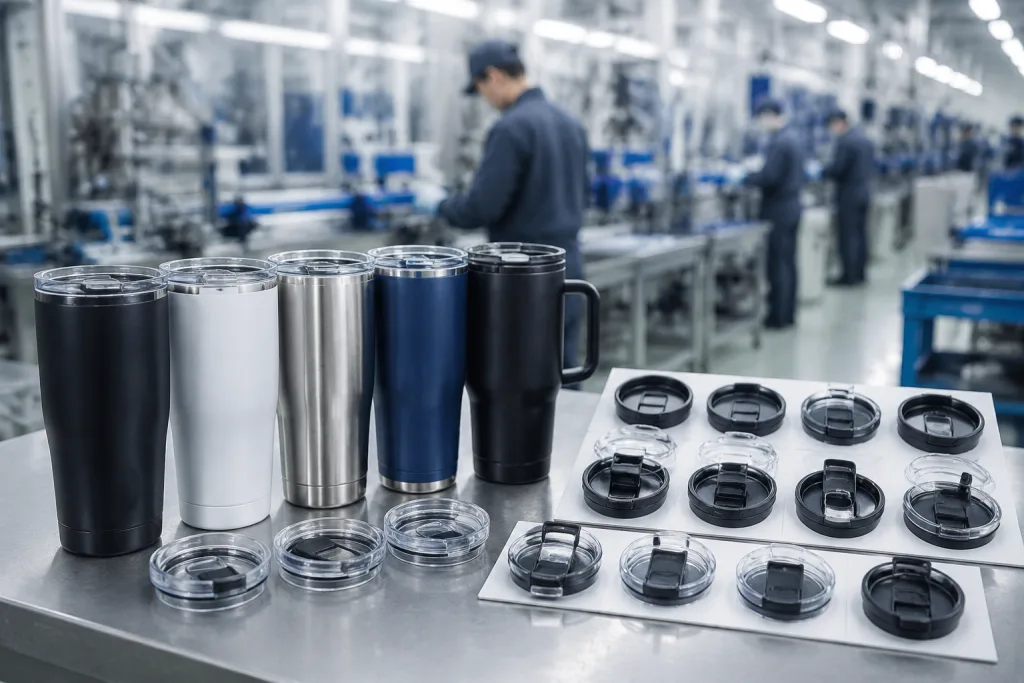
We run three lid routes most often. A slide lid is the cheap one for coffee mug promotional products; QC checks the slider gap with a 0.2 mm feeler gauge, and it is usually splash resistant, not bag-safe. A flip lid with locking tab works better for commuters and corporate travel kits, as long as the tab survives 500 open-close cycles without whitening at the hinge. A screw lid with silicone seal gives the best leak resistance, but some users complain it feels slow at the desk. That pushback is fair. The wrong question is “which lid is best?” Ask where the mug will be used.
For hot coffee, lid material should normally be PP or Tritan, with a silicone gasket. Ask whether the supplier uses virgin material and whether the lid has passed smell testing after hot water exposure. On our line, QC pulled 12 lid samples last month after 80-90°C soaking, and 3 failed the smell check before packing. Cheap lids can smell like plastic at 80-90°C, and that hurts a coffee brand faster than a 1 mm logo position shift.
Straw lids sell well for cold drinks, but they are a poor fit for hot coffee unless the product is positioned as a cold brew tumbler. If one SKU must cover coffee and iced drinks, pack two lid options in the same retail box. We ship this setup often for gift programs: slide lid plus straw lid, each in a separate PE bag, with the straw taped so it does not scratch the powder coating. This raises cost by roughly USD 0.35-0.90 per set, but buyers usually accept it when the retail price is above USD 12.99.
Before mass production, approve a lid sample after 20 open-close cycles, a 30-minute hot water test, and a basic inverted leak check. We also mark the sample with a paint pen, weigh it on a 0.1 g scale, and keep one sealed in the QC room so nobody argues later about “same as approved.” A coffee mug supplier who refuses these simple checks is not ready for a branded program. We’ve seen this go sideways.
Decoration changes both cost and risk
Decoration is not artwork placement on a PDF. It changes lead time, reject rate, dishwasher claims, and the hand feel buyers notice in the first 10 seconds. For a coffee mug customized with a 25 mm brand mark, laser engraving is still the safest call. We run it on the fiber laser after the powder line cools, and QC checks the edge with a 10x loupe because fuzzy burn marks get flagged fast. It works well on powder coating and bare stainless. The catch is color: engraving shows the steel or underlayer, so the math doesn't work if the buyer expects a full-color logo match.
Silkscreen printing fits one- or two-color logos, and we see it often on coffee mug promotional orders. It starts to make sense from 500 pcs upward because the screen charge spreads out, but curved walls punish fine text under about 1.2 mm stroke width. Heat transfer and UV printing handle gradients and more colors, but ask for adhesion testing before signing off, especially on matte powder coating. We use a 3M tape pull and 100-grid cross-cut test; one buyer flagged peeling after a dishwasher cycle, and QC pulled the sample before the line moved to bulk.
Powder coating is the default finish for coffee mug custom programs because it gives grip and color depth. A decent coating thickness is often around 60-80 microns. Too thin, and the cup scratches in carton rub tests. Too thick, and you may see orange peel texture or lid-rim fit problems when the coating builds near the thread area by 0.2 mm. We check it with a coating thickness gauge on three points around the body. For corporate colors, Pantone matching needs a tolerance discussion; exact match on stainless powder coating is not exact match on paper, and we've seen this go sideways on grey-blue shades.
For coffee mug private label retail, use restrained decoration: one front logo, a base volume mark or care icon, then a printed belly band or kraft box. Cleaner sells better. For corporate gifting, a larger logo can pass, but avoid wrapping artwork across tapered bodies unless the factory confirms distortion control with a curved-body jig. We once got a PO with “wrap 360° no distortion” typed in the remarks; the buyer pushed back after seeing the logo stretch 4 mm near the lower taper.
A practical approval flow is simple: digital mockup, blank body sample if needed, logo sample, then pre-production sample. At BottleForge in Hangzhou, Zhejiang, typical logo sample time is 3-7 days after vector artwork and Pantone references are confirmed. Mass production usually runs 25-35 days after final approval. If the buyer changes from laser to UV after the logo sample, do not call it a small edit; it resets fixtures, ink testing, and the production slot, and we usually lose 5-8 days on the schedule.
MOQ and pricing without games
Buyers checking a coffee mug supplier directory or coffee mug supplier list often see a neat unit price with the costly parts left out. We see this every week. A quote for coffee mug in bulk should spell out capacity, steel grade, wall thickness in mm, lid type, coating, logo method, packing, carton quantity, test requirements, Incoterm, and validity period. If the sheet says “16 oz tumbler, logo, FOB Ningbo” and nothing else, the price is not comparable; last month QC pulled a sample that was quoted as 304 stainless but the inner wall measured 0.34 mm, not the 0.40 mm on the buyer’s spec.
For factory-direct China sourcing, MOQ depends on how deep the customization goes. Stock shape with a one-color logo can run at 500 pcs if the line has the blank cup ready. Custom powder color is usually 1,000 pcs because we need to clean the spraying booth and mix enough powder to keep shade stable. For coffee mug custom made tooling, such as a new lid or body mold, expect 3,000-5,000 pcs minimum and tooling cost from USD 1,500 to USD 8,000 depending on complexity. We had one PO typo come in as 300 pcs for a new flip lid; the math does not work after mold trial, silicone gasket fitting, and leak testing.
Typical FOB ranges for a 16 oz stainless travel tumbler are broad, but they help a buyer sort good quotes from bait prices. A simple slide-lid model with one logo may land around USD 2.80-3.80 at 3,000 pcs. A better flip lid with powder coating and retail box may move to USD 4.20-5.80. Ceramic lining, premium packaging, or multi-position print can push beyond USD 6.50. These are decision anchors, not promises; the buyer flagged one quote at USD 3.10 with a color box, then we found the carton was only 5-ply thin board and failed a 12 kg drop check in our packing area.
Be careful with a coffee mug factory direct quote sitting 18% below the market. The saving often comes from thinner steel, recycled plastic lid material, weak coating, loose vacuum testing, or under-declared packaging. Cheap is not the same as efficient. We have seen this go sideways when vacuum retention was checked on the line: 9 cups out of 200 showed heat loss after the 95°C hot-water test, which would not show up in a pretty product photo.
If you are a coffee mug distributor or one of several coffee mug distributors buying for multiple clients, ask for tier pricing at 500, 1,000, 3,000, and 5,000 pcs. Also ask which tier changes the production setup, not just the unit price. We run different packing speeds for bulk egg-crate cartons versus individual kraft boxes, and that can shift lead time from 12 days to 18 days when the box supplier is busy. This is the wrong question to ask if you only say “best price”; give the spec sheet first, then let the factory price the real job.

Compliance and inspection protect your launch
For Europe and North America, travel drinkware compliance is not “paperwork after shipment.” It sits on the BOM. A coffee mug oem manufacturer needs to know food-contact migration testing, coating limits, carton labeling, and the retailer’s document pack before we open the mold file. For EU buyers, LFGB or EU food-contact testing is often requested, plus REACH for coating and external components. For the US, FDA food-contact suitability and Prop 65 review may be relevant. For kids or school campaigns, ASTM and CPSIA questions can appear, even when the cup is sold as drinkware, not a toy. QC pulled one 480 ml straw tumbler last season because the silicone ring was listed as “TPR” on the PO; that one typo cost 2 days of document checking.
Factory audits matter too. BSCI, Sedex, ISO 9001, or similar records do not guarantee perfect goods, but they show whether the production site has basic process control. BottleForge Industrial works from Hangzhou, China, and we are blunt about this: documents should match the actual factory making the goods, not a trading company’s favorite PDF folder. We’ve seen this go sideways when a buyer accepted an audit report with a different address, then the retailer flagged it 12 days before ship date.
Inspection should be locked before production starts. For a travel mug in bulk, standard AQL might be Critical 0, Major 2.5, Minor 4.0. Critical defects include unsafe sharp edges, contamination, broken glass liners if applicable, and serious leakage. Major defects include vacuum failure, coating peeling, wrong logo, poor lid fit, and carton shortage. Minor defects include small cosmetic marks within agreed limits, such as a 1 mm paint dot outside the logo area if the signed sample allows it. The wrong question is “Can we inspect after packing?” We run better when the line knows the AQL board, defect photos, and golden sample are already taped beside the packing table.
Vacuum testing needs extra attention. A factory may test every unit with hot water or machine-assisted vacuum detection, but ask how failed units are separated, marked, and counted. On our line, failed cups go into a red bin with a QC tag, not back beside good stock. A random pre-shipment inspection should include capacity check, lid fit, odor check, coating adhesion, barcode scan, carton drop condition, and sample leak testing. If you are shipping to an event, inspect at least 7 days before vessel cutoff or courier pickup; for air orders, we prefer 10 days because rework plus new carton labels can eat a week fast. Finding problems after goods reach the warehouse is expensive, and the math doesn't work.
Packaging decides landed cost
We see 7 out of 10 buyers fight the tumbler unit price first, then send the packing brief after artwork approval. Wrong order. Packaging changes freight, shelf condition, breakage claims, warehouse picks, and whether Amazon, a distributor, or a corporate mailroom needs extra hands. Last month QC pulled 200 pcs from a pilot carton drop test at 76 cm; the mug passed, but the printed box corner crushed.
A basic bulk coffee mug order can run egg-crate dividers and 5-layer master cartons. That works for internal corporate drops when nobody needs an individual gift box. A retail coffee mug private labeling program usually needs a color box or kraft box, plus a belly band, instruction leaflet, barcode, country-of-origin mark, and sometimes an insert card with the buyer’s campaign code. For FBA or marketplace shipping, FNSKU labels and carton labels need clean placement and scan checks before dispatch; we use a Honeywell scanner on the line because one smudged label can hold 60 cartons.
Carton configuration matters. A 16 oz travel tumbler might pack 24 pcs per master carton, but a boxed 20 oz unit may fit only 12 or 16 pcs. That changes ocean freight and courier cost fast. If you compare two quotes, ask for carton dimensions, gross weight, and CBM, not just EXW or FOB unit price. We measured one “cheaper” box at 530 x 410 x 385 mm, and the math did not work: a USD 0.20 cheaper mug became more expensive after freight because the packaging was bulky.
For corporate gifting, check whether the mug ships alone or inside a kit with coffee beans, a notebook, or apparel. If the mug sits in a kit, the outer box has to protect the lid and coating during mixed-item handling. We have seen this go sideways when a metal keychain rubbed against powder coating for 18 days in transit. A standard export carton is not a parcel box, and buyers flag the retail-box scuffs first.
China export lead times stay under control when the packing brief is clear before the quote. Trouble starts when buyers approve the mug, then add branch sorting, gift notes, or barcode changes after production has started. One PO had “Store 014” typed as “Store 041,” and the re-labeling took 2 workers half a day for 38 cartons. Give your coffee mug factory a packing map before they quote, not after the goods are finished.
Send your tumbler brief for a factory quote
Share capacity, quantity, logo method, packing needs, and delivery market. We will return practical options, MOQ, lead time, and FOB pricing.
Frequently asked questions
What is the best MOQ for a travel mug in bulk order?
For most branded travel tumbler programs, 1,000 pcs is the practical starting point. At 500 pcs, a factory can often use an existing body shape and add laser engraving or one-color printing, but custom powder coating may be expensive. At 3,000 pcs, the FOB price usually improves because coating setup, logo fixtures, and packing labor spread across more units. If you need a coffee mug custom made with a new lid, handle, or body mold, expect 3,000-5,000 pcs and tooling charges. For a first coffee brand launch, I usually suggest 1,000 pcs in one color, one capacity, and one decoration method. It keeps risk controlled while still giving you real factory pricing.
How do I compare quotes from different coffee mug manufacturers?
Do not compare only the unit price. Ask every coffee mug manufacturer for the same specification sheet: capacity, steel grade, inner and outer wall thickness, lid material, gasket material, coating type, logo process, packing method, carton size, gross weight, test standard, MOQ, lead time, and Incoterm. A USD 3.60 quote and a USD 4.20 quote may not describe the same product. The cheaper one may use thinner steel, a splash-only lid, or no retail box. Also ask whether the quote is coffee mug factory direct or through a trading layer. A good supplier in China should be able to explain why each cost changes instead of hiding behind vague catalogue language.
Which logo method is best for a coffee mug customized for retail?
For retail coffee products, laser engraving and powder coating are the safest premium combination. Engraving does not peel, handles daily use well, and gives the product a permanent feel. If your logo needs exact brand colors, silkscreen or heat transfer may be better, but you should request adhesion testing on the final coating. For a coffee mug customizable with customer names, laser engraving is also easier to manage in small batches, although it adds handling time. For large corporate-gift orders, one-color silkscreen is usually the most cost-effective. Budget roughly USD 0.10-0.35 per position for standard logo work, depending on quantity and complexity.
Can you support coffee mug private labeling and distributor packing?
Yes, but the packing rules need to be clear before the quotation. Coffee mug private labeling may include retail boxes, printed sleeves, hang tags, barcode labels, FNSKU labels, master carton marks, country-of-origin text, and mixed-SKU carton plans. For a coffee mug distributor, we often quote separate packing versions: bulk pack, retail box, and e-commerce parcel-safe pack. The cost difference can be USD 0.25-1.20 per unit depending on box structure and inserts. If you need branch allocation for 20 office locations, provide the quantity split before production. Sorting after cartons are sealed is slow, messy, and easy to get wrong.
How long does a custom bulk travel tumbler order take?
A normal schedule is 3-7 days for logo sample, 25-35 days for mass production after sample approval, and then shipping time. Air freight to North America or Europe may take 5-10 days after pickup, while ocean freight can take 25-45 days depending on port and season. If you require custom coating, retail packaging, or third-party testing, add 5-10 days of buffer. For event orders, do not work backward from the event date only. Work backward from the date the goods must be in your warehouse, inspected, sorted, and ready to distribute. For China production, holiday periods around Chinese New Year need much larger buffers.