Key Takeaways
- 304 stainless steel inner walls at 0.4-0.5 mm are the normal baseline for export travel tumblers
- A realistic custom travel tumbler MOQ starts at 1,000 pcs per color for factory-direct production
- Powder coating adds about USD 0.25-0.45 per unit versus basic spray paint but improves scratch resistance
- Production lead time is usually 30-45 days after artwork, deposit, and pre-production sample approval
A travel mug factory quote can look simple: capacity, color, logo, price. It isn’t. If you are buying for a coffee brand, staff gift program, or retail promotion, a 0.3 mm mismatch on the lid thread, coating that fails a 3M tape test, a 5-layer carton swapped for a soft 3-layer carton, or a loose “stainless steel” line on the PI can turn a clean sample into claims after 5,000 units land.
At BottleForge Industrial in Hangzhou, Zhejiang, we still see buyers compare coffee mug supplier options by FOB price only. Wrong question. Last month QC pulled a 500 ml tumbler sample where the PO said 304 stainless, but the inner body test showed 201; the buyer flagged it before deposit, which saved a messy remake. A spec sheet shows where cost is cut, where quality is protected, and where your brand experience gets decided. Below is the line-by-line view we run with buyers sourcing from China.
Start with capacity and use case
The first spec line is capacity: 12 oz, 16 oz, 20 oz, or 24 oz. Don’t treat it as a logo-size choice. 12 oz fits espresso-based coffee sets and airline-style giveaways. 16 oz is still the safest corporate-gift size; we ship it often because the carton weight stays friendly for courier samples, about 9.8 kg for 24 pcs. 20 oz works better for retail shelves and gym commuters who ask for 6-8 hours of heat retention. Above 24 oz, the buyer is no longer buying a coffee mug promotional product; it starts to behave like sports hydration.
For coffee brands, cup-holder fit is the first check. Most North American and European buyers ask for a bottom diameter between 66 mm and 74 mm. We had one buyer flag a 78 mm base after their sales team tested it in a Toyota Camry and a VW Golf. The vacuum data passed. The mug still failed the desk review because it did not sit properly in the car. This is where the math doesn’t work: a bigger base looks stable on a render, but it can create complaints after shipment.
Wall shape matters on the line. Straight-wall tumblers are easier to print with wraparound silkscreen artwork because the jig holds the body evenly and the squeegee pressure stays consistent. Tapered mugs feel better in hand and fit cup holders more reliably, but full-wrap decoration can stretch a 35 mm logo into an oval near the bottom. If you are ordering a coffee mug custom made for a roaster or café chain, decide first: drinking comfort or large logo exposure. Both is possible, but not on every body shape.
Our Zhejiang production lines typically run 300,000-450,000 stainless drinkware units per month depending on the season. For a coffee mug in bulk order, we prefer confirming the final capacity with a 3D drawing before tooling or mold changes. QC once pulled a pre-production sample that was 2 mm wider at the lower body than the approved drawing; fixing that in CAD took one afternoon, while fixing it after 2,000 cartons would have meant sorting, rework, and an ugly email chain. Check the drawing first.
Steel grade and wall thickness
Write the material line on the PO as a real spec, not just “stainless steel.” For Europe and North America, we usually run 304 stainless steel on the inner liner, with 201 or 304 stainless steel on the outer shell. If the drink touches the metal, make it 304. No debate. For budget corporate-gift orders around 3,000-10,000 pcs, 201 outer steel can work if the powder coating passes cross-hatch tape testing and the buyer is not selling it as a premium travel tumbler. Last month QC pulled a sample with “SS” written on the PO; the buyer flagged it because their Amazon listing said 304 inside and outside.
Wall thickness changes dent resistance, welding stability, and how the tumbler feels in hand. A common travel tumbler build is 0.4 mm inner wall and 0.5 mm outer wall. Some cheap coffee mug factory direct quotes drop to 0.35 mm. You save USD 0.08-0.15 per unit, then lose it when cartons arrive with side dents after ocean freight and warehouse stacking. The math doesn't work for most coffee mug private label programs. On the line, our caliper check often shows the weak point near the laser-welded seam, not in the middle of the cup body.
Ask whether the base is single-piece drawn, welded, or made with a separate bottom cap. A cleaner base cuts leak paths and looks better on shelf, but tooling can move from about USD 800 to USD 1,500 depending on shape and diameter. Also ask if the inner surface is electropolished. This is not just a shine issue. A smoother inner wall holds less coffee residue, which matters for dark roast, milk drinks, and flavored syrups. We have seen this go sideways when a buyer approved a matte inner finish from photos only; after 7 dishwasher cycles, QC found brown coffee rings near the bottom radius.
For compliance, ask your coffee mug supplier for food-contact test reports against LFGB or EU 1935/2004 for Europe, and FDA-related food-contact documentation for the United States. REACH applies to coating and plastic components, especially lids, sliders, handles, and silicone seals. Serious coffee mug manufacturers in China should not push back on these documents. If they do, press harder. In our factory, the document pack usually includes the test report, material declaration, and a carton label photo; one buyer once rejected a shipment because the PO typo said “LFBG” instead of LFGB.
Vacuum performance and real testing
Heat retention claims get inflated fast. A travel mug factory can print “keeps hot 12 hours” on a quote sheet and skip the details: starting water temperature, room temperature, lid locked or open, and the fail point. Procurement cannot buy against that. We ask for a clean test line: fill with water at 95°C, close lid, store at 20°C ambient, test after 6 hours, liquid temperature remains above 55°C. For cold testing, use 4°C water and check after 12 or 24 hours. On our line, QC uses a calibrated Testo probe and records the reading to 0.1°C; last month a buyer flagged a “12H hot” claim because the sample was tested at 24°C room temperature, not 20°C.
Vacuum insulation comes down to welding quality, evacuation time, and copper coating inside the vacuum cavity. The weld bead matters. If the inner tank neck is off by 0.3 mm, the vacuum rate drops after the heating cycle. Copper plating improves thermal performance, but the math does not always work. On a 16 oz bulk coffee travel mug, copper coating may add around USD 0.12-0.25 per unit depending on current material pricing and order volume. For a one-week conference giveaway, skip it unless the buyer demands a premium spec. For a coffee mug private labeling range in retail, we usually run copper because shelf reviews punish weak heat retention.
Leak testing is not vacuum testing. A tumbler can hold heat well and still leak from the lid gasket. We run hot-water vacuum checks, air-pressure checks at the lid area, and random drop tests before final packing. QC pulled the sample after a 1.2 m carton-drop last season; the cup body passed, but 7 lids showed seepage at the sip slider. For most export orders, an AQL inspection level of II with critical defects at 0, major at 2.5, and minor at 4.0 is a practical baseline. If the order is going into e-commerce fulfillment, tighten visual defects, because online customers photograph scratches under kitchen lighting.
Do not accept a sample-only promise. Ask your coffee mug oem manufacturer how many units are checked on the line and how failures are recorded. We’ve seen this go sideways: one PO had “vacuum test 100%” typed in the email, but the attached spec sheet said random check only. Factory discipline beats the best sample on your desk. Every time.
Lid construction changes everything
The lid is where 7 out of 10 bulk coffee tumbler complaints start. Buyers spend 20 minutes checking the stainless body, then miss the part that leaks inside a laptop bag. We see it on the line. QC pulled one 480 ml sample last month where the silicone ring sat 0.6 mm proud at the corner, and the whole mug felt cheap the second you snapped the lid shut. Common lid materials are PP, Tritan, AS, and silicone. For Europe and North America, we run PP or Tritan more often because food-contact documents are cleaner and heat resistance is safer for hot coffee. Silicone seals should come out by hand for washing, especially when the drink has milk foam or syrup.
Most orders use one of these lid builds: push-on sip lid, threaded leak-resistant lid, or slide-lock lid with a separate silicone plug. A push-on lid is cheaper, usually USD 0.18-0.28 less than a threaded lid at 3,000 pcs, and it drinks easily. It is splash-resistant. Not leakproof. A threaded lid costs more because the body rim and lid thread need a tight match; our tooling room checks this with a digital caliper before the first trial shot. For a bulk travel mug sold through retail or online, the threaded version is worth checking first. For a desk giveaway handed out at a trade show, push-on is often enough.
Be careful with the word “leakproof.” This is the wrong question to ask if the slider has no positive lock. If you print that claim on packaging, the design and test report need to back it up. We prefer “leak-resistant” unless the product passes inverted testing and 30-second shake testing after hot-fill expansion. Coffee builds pressure, and users do not always close the slider until it clicks. We have seen this go sideways: the buyer flagged 14 Amazon reviews because the copy said leakproof, while the approved sample only passed a desk-tip test.
For corporate-gift buyers ordering coffee mug promotional products, ask for spare lid pricing before the PO is signed. A replacement lid may cost USD 0.35-0.90 FOB depending on structure. If you are a coffee mug distributor with repeat customers, stocking 2-3% spare lids can save an account when a buyer needs replacements six months later. The math works better than air-shipping 120 loose lids after peak season; last November we had one PO typo listing black lids for navy tumblers, and spare stock kept the shipment from slipping 12 days vs 18 days.
Logo method and surface finish
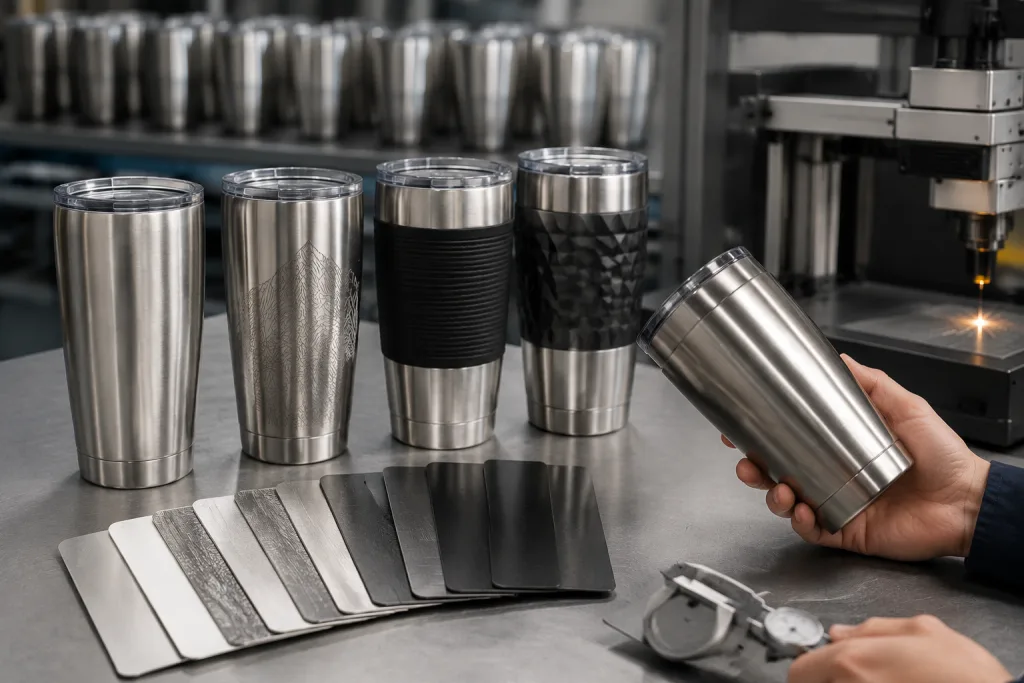
A custom travel tumbler program lives or dies on decoration repeatability. We run laser engraving on powder-coated 304 stainless with a rotary jig, and QC checks the first 12 pcs for logo position, usually within ±0.5 mm from the seam line. Laser looks clean and lasts through daily handling, but it only cuts through to the stainless color under the coating. Fine for corporate names and simple icons. The wrong question is “which logo method is cheapest”; the better question is whether the method can hold your artwork on 5,000 curved cups without drifting.
Silkscreen printing works best for one- or two-color logos on straight walls or a light taper. Expect a setup fee around USD 40-80 per color per artwork, depending on size and complexity. On the line, the buyer often flags the same issue: a 1 mm stroke looks sharp on a PDF but breaks on a curved 900 ml body. Heat-transfer printing handles gradients and café-style illustration better, but it needs smooth powder, a clean carrier film, and tight heat-press control. We check the press head with a surface thermocouple because 165°C vs 175°C changes edge sharpness.
Powder coating is the normal upgraded surface for a bulk travel tumbler order. It feels better in hand and resists scratches better than basic spray paint. A decent powder-coat thickness is often around 60-80 microns. Too thin and it scratches; too thick and it chips around the rim or makes the lid sit tight. QC pulled one sample last season at 96 microns, and the push-on lid needed 3.2 kg force instead of the approved 2.1 kg. Matte finishes look modern but show oil marks. Gloss hides fingerprints better, though some retail buyers say it feels cheaper.
If you are buying travel tumblers in bulk for an event, approve the logo on the real curved cup, not only a flat PDF mockup. Pantone matching on stainless drinkware is not exact like paper printing. We use a D65 light booth and compare the approved color chip beside the coated sample at arm’s length, then record the result on the inspection sheet. A practical tolerance is close visual match under D65 light, because coating texture changes perceived color. We’ve seen this go sideways when a PO says “navy blue” with no Pantone code.
MOQ, pricing, and tooling lines
MOQ is not a trick. It is a cost line. At BottleForge in Zhejiang, we run 1,000 pcs per color for existing travel tumbler models, 3,000 pcs for special coating colors, and 5,000-10,000 pcs if the buyer wants a new body shape or custom lid tooling. Last month a buyer pushed for 500 pcs in 4 Pantone colors; the spray line changeover and 2 kg powder waste per color killed the math. A coffee mug supplier directory or coffee mug supplier list may show lower numbers, but those quotes often mean stock bodies with loose control over color, lid fit, and packaging.
FOB Ningbo or Shanghai pricing for a 16 oz stainless vacuum travel mug commonly ranges from USD 3.20 to USD 6.80 depending on steel grade, lid type, coating, logo method, carton strength, and compliance testing. If a quote lands far below that, ask what disappeared. We have seen copper plating removed, inner steel cut by 0.1 mm, lids downgraded from Tritan to PP, and cartons changed from 5-layer to soft 3-layer board. QC pulled one sample where the lid leaked after 6 turns on the torque tester. A one-line price will not show that.
Private mold costs vary. A simple silicone part may be USD 300-800. A plastic lid mold can be USD 2,000-6,000. A stainless body mold may be USD 3,000-10,000 depending on geometry. For a coffee mug custom made shape tied to a 3-year coffee brand range, tooling can make sense because the cost spreads across repeat POs. For 2,000 units for a campaign, this is the wrong question to ask; use an existing mold, then spend the budget on laser logo, color box artwork, and a stronger 12 kg export carton.
Payment terms for China factory-direct orders are normally 30% deposit and 70% before shipment after inspection. For repeat buyers, terms can improve, but the first order should be controlled by sample approval, written specs, and pre-shipment inspection rather than trust alone. We ship after the buyer signs the golden sample, and the line follows that sample with calipers, color swatches, and an AQL 2.5 checklist. One PO typo changed “matte black” to “metal black”; the buyer flagged it before deposit, which saved 18 days of rework.
Packing, cartons, and delivery details
Packing belongs in the product spec. Put it on the PI and carton mark drawing, not in a WeChat note 3 days before loading. For retail, we usually need a printed color box, EAN or UPC barcode, warning text, country of origin, and recycling symbols; last month QC pulled 12 boxes because “Made in China” was printed 2 mm too close to the tuck flap. For corporate gifts, a white box or 350 gsm kraft box is usually enough. For e-commerce, especially FBA-style warehouses, the master carton has to take parcel handling. We run five-layer corrugated export cartons, 150-175 lb burst strength equivalent, with 24 or 36 pcs per carton depending on mug size.
Individual polybags are still common, but 6 out of 10 European buyers now ask for paper wrap or less plastic. If the sustainability claim matters, write the packaging material by gram weight and recycled content, such as “45 gsm recycled paper wrap” or “30% PCR polybag.” Do not write “eco packaging.” That is the wrong phrase for a factory work order; the packing line needs a material code, a roll width, and a packing photo.
For Amazon or distributor warehouses, confirm FNSKU labels, carton labels, pallet height, and mixed-SKU rules before the line finishes packing. Small detail, big bill. We have reworked 200 cartons in Hangzhou with a label gun and two workers in half a day. After arrival in Germany, Canada, or the United States, the same mistake turns into warehouse labor, missed appointments, and 12 days vs 18 days on final release. The math doesn't work.
Normal lead time for coffee mug factory direct production is 30-45 days after deposit and approved pre-production sample. Add 7-10 days for complex artwork confirmation and 3-5 days for third-party inspection booking. Sea freight from China to the US West Coast may be 18-30 days port to port in normal periods, while Europe can be 30-40 days. If the event date is fixed, work backward with two weeks of buffer, and ask the factory for the real packing completion date, not just the ETD. We ship what passes AQL 2.5, and we have seen bulk coffee mug shipments go sideways over one late logo approval. A nice apology does not move a vessel.
Send your tumbler spec for factory review
Share capacity, logo, target price, market, and delivery date. Our Hangzhou team will check the spec and quote the practical route.
Frequently asked questions
What MOQ should I expect from a travel mug factory?
For an existing stainless travel mug mold, a realistic MOQ is 1,000 pcs per color with one logo. If you need a special powder-coat color, plan for 3,000 pcs because coating suppliers have their own batch minimums. A new lid, new body shape, or coffee mug custom made design usually starts at 5,000-10,000 pcs because tooling and line setup must be spread across enough units. Smaller trial orders are possible with stock colors, but the unit price may rise by 15-35%. If a supplier promises 100 pcs with any Pantone color, any lid, and factory-direct pricing, check whether it is actually a trading stock order rather than controlled production.
How much does a custom bulk coffee travel mug cost?
For a 16 oz vacuum insulated bulk coffee travel mug, FOB China pricing often lands between USD 3.20 and USD 6.80. The lower end usually means stock shape, simple lid, standard coating, and one-color print. The higher end may include 304 stainless inside and outside, copper vacuum layer, threaded lid, powder coating, laser engraving, retail box, and stronger cartons. Testing, special packaging, and third-party inspection also affect the landed cost. For 5,000 pcs, a USD 0.30 difference equals USD 1,500 before freight and duty, so ask what changed in the spec instead of pushing only for a lower unit price.
Can I use the same tumbler for retail and corporate gifting?
Yes, but the spec should be adjusted. Corporate gifting usually prioritizes logo visibility, reliable delivery date, and acceptable price, so a 16 oz mug with push-on lid, powder coating, and laser logo can work well. Retail needs stronger packaging, barcode control, better shelf presentation, clearer care instructions, and more strict cosmetic inspection. If the item will be sold online, ask for drop-test packaging and tighter AQL limits on scratches or coating marks. Many buyers use the same stainless body but change the lid, box, and artwork. That keeps tooling cost down while letting the retail version feel more premium.
What documents should a coffee mug supplier provide?
At minimum, ask for a written product spec sheet, material declaration, food-contact test reports, artwork proof, packing specification, and pre-production sample approval record. For Europe, LFGB, EU 1935/2004, and REACH-related documents may be needed depending on the components. For the United States, ask for FDA food-contact support and Proposition 65 review if selling into California. Factory audits such as BSCI or ISO 9001 are useful but do not replace product testing. A coffee mug supplier with export experience should also provide HS code guidance, carton dimensions, gross weight, and loading quantity for 20 ft and 40 ft containers.
How do I compare coffee mug distributors and factory-direct suppliers?
A coffee mug distributor may be faster for small domestic orders, mixed SKUs, or urgent events under 500 pcs. A travel mug factory in China is usually better when you need 1,000 pcs or more, custom color, private label packaging, controlled testing, and repeat production. Compare them on landed cost, not unit price alone. Include freight, duty, inspection, rework risk, storage, and replacement parts. Factory-direct sourcing gives more control over steel grade, coating, lid design, and cartons, but it also requires clearer specifications from you. If your brand will reorder every quarter, direct manufacturing usually becomes more efficient after the first controlled order.