Key Takeaways
- A 3,000-unit travel tumbler order usually needs 35-55 days after approved sample
- 304 stainless steel double-wall vacuum tumblers commonly quote USD 3.20-7.80 FOB China
- Custom molds, color matching, and retail packaging can add 7-25 days before mass production
- Use AQL 2.5/4.0 inspection and carton drop testing before final balance payment
If you buy travel mugs for a coffee brand or a corporate-gift program, finding a coffee mug supplier is the easy part. The harder job is checking whether the quoted price, MOQ, tooling charge, and delivery date match the product on the line. We’ve seen buyers chase a USD 0.25 lower unit price, then QC pulled the sample and found 0.38 mm outer steel, a loose PP slider lid, and a gift box that split on a 1.2 m courier drop test. The math doesn't work if the mug arrives dented or leaks in the customer’s car.
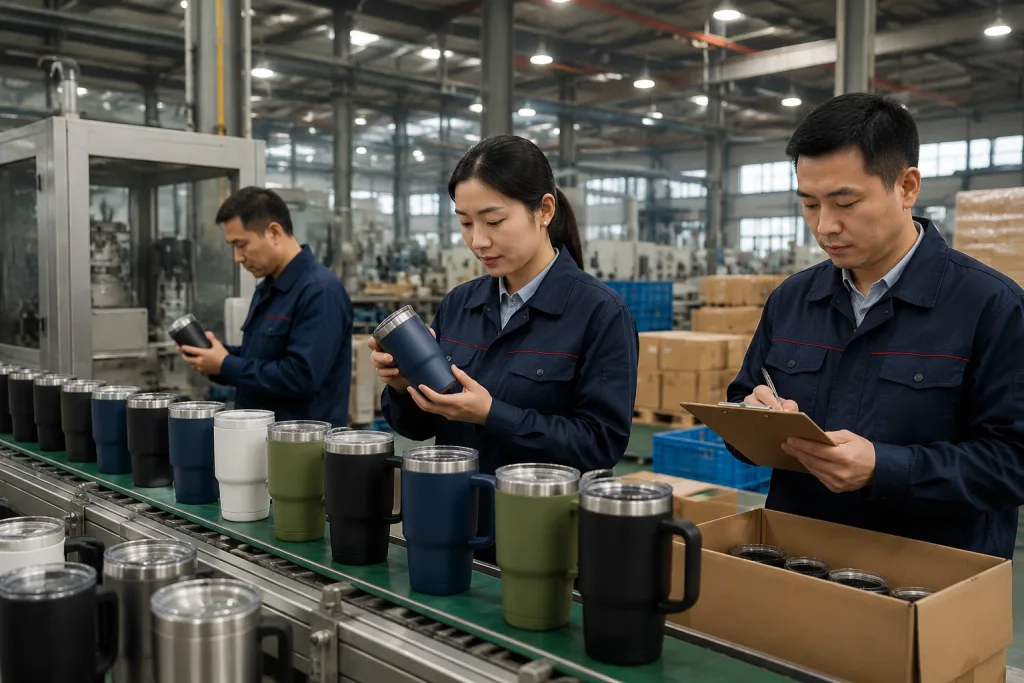
Factory direct sourcing from China works when you price the whole job, not just the mug. From our Hangzhou, Zhejiang team, a normal custom travel tumbler project runs 3,000 to 10,000 units, 35 to 55 days after sample approval, with FOB Ningbo or Shanghai pricing usually between USD 3.20 and USD 7.80 depending on construction and decoration. On a recent 5,000-piece PO, the buyer flagged the delivery date first; we ran the logo film, powder coating panel, carton spec, and lid leak test before confirming the ship date. That saved 9 days against their original packaging revision loop.
Start with the real landed cost
Buyers who search travel mug factory direct usually want one clean unit price. Wrong question. On our quoting sheet, the mug body is line 1, then the line adds powder coating, lid structure, logo method, color box, FDA or LFGB testing, Yiwu-to-Ningbo inland freight, 5-ply export carton, and sometimes a mold or Pantone setup charge. Last week a PO came in with “matte black” typed as “mate black”; QC pulled the sample because that one typo changes the finish approval.
For a standard 14 oz to 20 oz double-wall stainless travel tumbler, a practical FOB China range is USD 3.20 to USD 5.20 for a simple powder-coated body with one-position laser logo. Add a flip lid with silicone seal and slider, and the range often moves to USD 4.10 to USD 6.40. Add a handle, ceramic lining, copper coating, or leak-resistant locking lid, and USD 5.50 to USD 7.80 is not unusual. We run the laser logo at 0.08 mm depth on the test piece before mass production, because one buyer flagged a logo that looked grey instead of clean silver under warehouse lights.
If you are comparing a bulk coffee mug quote at USD 2.10 against one at USD 4.60, check the steel grade and wall thickness before celebrating. We have seen 9 out of 10 low-price samples use lighter 201 stainless outside, 0.35 mm wall stock, loose lids, or basic air insulation instead of vacuum insulation. The math does not work for hot coffee. Your customer notices it after the first commute, and our QC thermometer will show it too: 86°C fill, 6-hour hold, then a weak cup on the bench.
A serious coffee mug manufacturer should show the cost drivers clearly. Ask for body material and inner liner grade, then ask for outer shell grade, lid material, silicone type, coating method, carton size, units per carton, gross weight, and FOB port. If the supplier only says “best price, high quality,” keep moving. China has excellent coffee mug manufacturers, but we still see traders quote from a photo before they know whether the carton is 24 pcs or 36 pcs, and that is where landed cost goes sideways.
MOQ tiers that change your price
MOQ is not a punishment. It is how we spread screen setup, powder changeover, carton printing, and QC time across one run. In our Zhejiang supply chain, a realistic MOQ for a coffee mug custom project is 1,000 units for an existing shape with a laser logo, 3,000 units for custom powder color or retail box, and 5,000 to 10,000 units for private label lid changes or special accessories. A coffee mug custom made from a new mold normally starts higher, often 10,000 units or more; the CNC mold quote alone can make a 2,000-piece trial look cheap on paper but expensive per cup.
At 1,000 units, you can test a corporate gift or a new café merchandise item, but the unit price will sit higher. The line handles more by hand, the coating booth loses efficiency during color change, and packaging choices stay narrow. At 3,000 units, we can run color coating in a cleaner batch and discuss Pantone-matched powder coating with a real tolerance, usually checked under a D65 light box. At 5,000 units and above, buyers have more room to push for carton packing, spare lids, insert cards, and barcode labeling; QC pulled one sample last month because the EAN sticker was 2 mm too close to the carton edge.
For a bulk travel mug or bulk travel tumbler program, chasing the lowest MOQ is the wrong question to ask if you already have distribution. A 3,000-unit order at USD 4.60 may run cleaner than a 500-unit order at USD 6.20 because we can put it into the normal production schedule instead of squeezing it between two export jobs. Small orders get bumped. We have seen a 500-piece logo order move from 12 days to 18 days after a larger EU buyer locked the coating line for matte black.
Be careful with a coffee mug supplier directory or coffee mug supplier list advertising 100-unit OEM production. That can work for blank stock with a logo, but it is not real coffee mug private label manufacturing. For coffee mug private labeling with brand box, care leaflet, barcode, and carton marks, treat 3,000 units as the honest starting point; below that, the math does not work once the PO includes a typo in the carton mark and QC has to hold packing while the buyer confirms artwork.
Logo and finish cost math
Decoration changes the unit price and the ship date. Laser engraving is still the safest call on stainless travel tumblers: no peeling, fewer dishwasher complaints, cleaner pass on a 3M tape pull test. For one-position laser on a bulk coffee travel mug order, the added cost is often USD 0.08 to USD 0.18 per unit, depending on logo size and how fast we run the rotary jig on the line. A 35 mm wide logo is easy. A 90 mm wrap-style mark slows the operator down.
Silkscreen printing is cheaper on simple one-color artwork, usually USD 0.06 to USD 0.15 per unit, but curved tumbler bodies and powder coating need real adhesion testing, not just a nice sample photo. QC pulled one matte black sample last month where the white ink lifted at the rim after 50 cross-hatch cuts. Heat transfer and full-wrap artwork can run USD 0.35 to USD 0.90 per unit. UV print gives brighter detail for coffee mug promotional products, but for heavy daily use we ask for abrasion results first; we have seen this go sideways when a buyer picked UV only because the pre-production photo looked sharp.
Powder coating is the common finish for coffee mug customizable programs. Standard black, white, navy, or grey moves faster because we keep approved powder codes in the spraying room. Pantone-matched coating usually needs a sample panel, approval, and sometimes two rounds of adjustment. Budget 5 to 10 days for color confirmation before production; on our side, 7 days is normal if the buyer signs off the first panel. If your corporate client needs an exact brand orange or green, approving from a phone photo is the wrong question to ask. Ask for a physical coated sample or a signed tolerance range, measured under D65 light if the color is sensitive.
Packaging also belongs in the decoration budget. A plain white box may add USD 0.18 to USD 0.35. A printed retail box with E-flute board can add USD 0.35 to USD 0.85. Gift sleeves, molded pulp inserts sized to the lid diameter, instruction cards with FDA or LFGB wording, and hang tags push higher. For a coffee mug customized for a premium coffee roaster, the box is often worth the cost because it protects the perceived value; the buyer flagged corner crush on a 12 kg drop carton before, and they were right. For a one-day conference giveaway, spend the money on lid reliability instead.
Lead time from sketch to shipment
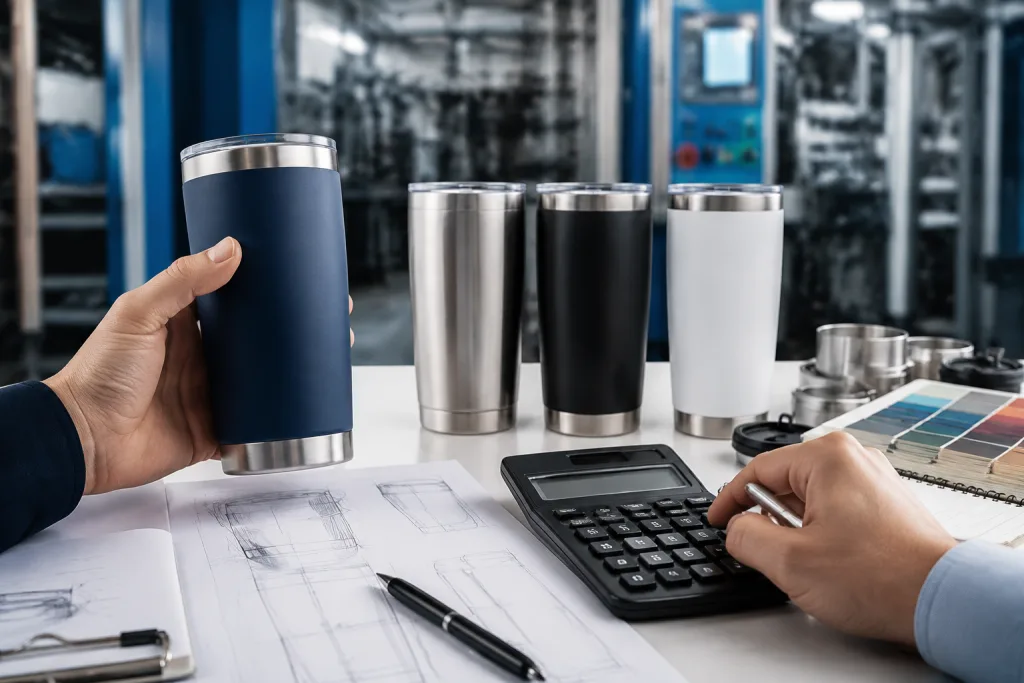
A normal travel mug factory direct schedule has four blocks: quote confirmation, sampling, mass production, then inspection and shipping. For the cleanest job, we run an existing mold, matched stock lid, standard powder-coating color, and laser logo. Fast case: confirmed AI artwork to approved pre-production sample in 7 to 12 days, then mass production in 25 to 35 days for 3,000 to 5,000 units. QC still checks the first 20 pcs on the line with a digital caliper, usually lid fit within 0.3 mm and logo position within 1 mm.
Deeper customization eats calendar days. No shortcut there. A coffee mug oem manufacturer making a new lid insert, handle detail, or body shape usually needs 20 to 35 days for mold development before sample approval even starts. We have seen buyers ask, “Can you just 3D print the lid and start production?” That is the wrong question to ask if the lid must pass leak testing on 5,000 cups. If you require LFGB, REACH, FDA food-contact documentation, or third-party lab testing, add 7 to 15 working days based on test scope and the lab queue; SGS pulled 2 extra samples from us last quarter because the PO listed “matte black” but the approved sample card said “BK-03.”
Here is a realistic sequence for a 5,000-unit bulk coffee tumbler project: 2 to 3 days for technical quote and artwork check, 7 to 14 days for sample, 2 to 5 days for buyer review, 30 to 40 days for mass production, 1 to 2 days for AQL inspection, and 3 to 7 days for factory-to-port and customs handling. That is not padding. On one 40 oz tumbler order, QC pulled the sample after finding 6 pcs with coating dust near the bottom seam, so the line spent half a shift wiping and rechecking before packing. Ocean freight to Europe or North America then adds its own transit time.
Peak season changes the math. Orders placed from August to November compete with holiday corporate-gift demand, and coating rooms get booked fast. Orders placed before Chinese New Year run into labor gaps and subcontractor shutdowns across China; our polishing supplier in Yongkang normally stops 10 to 14 days before the holiday. If your event date is fixed, build in at least 15 days of buffer. A coffee mug distributor promising 20-day delivery for a fully custom 10,000-unit order is either using existing stock or gambling with your deadline, and we have seen this go sideways when the buyer flagged a carton-mark typo two days before vessel closing.
Quality checks buyers should price in
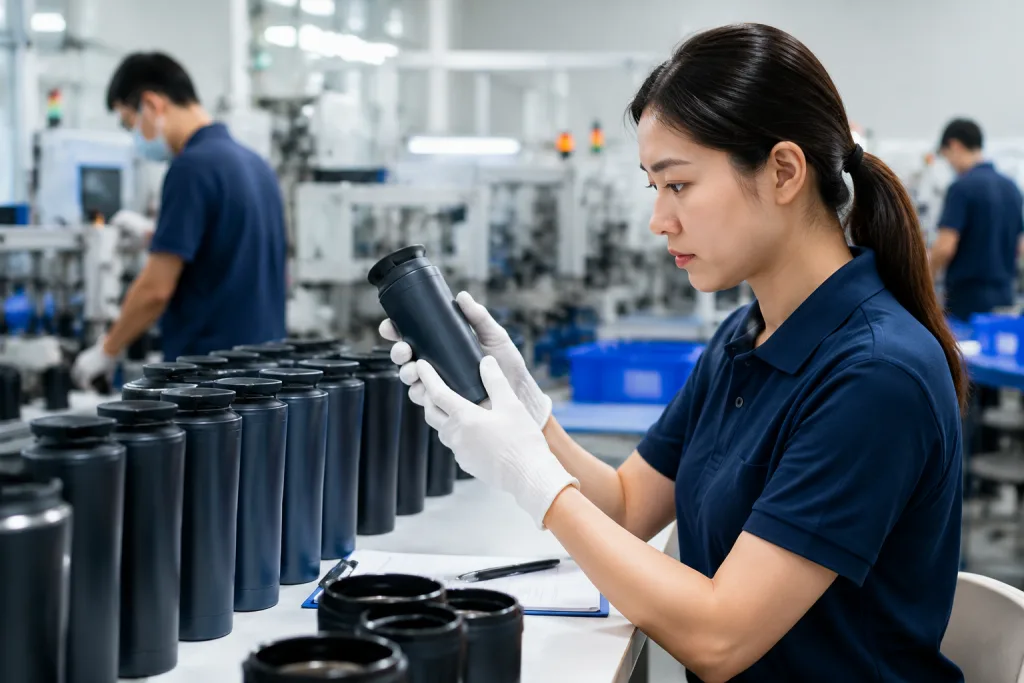
Factory direct does not mean inspection gets skipped. It means you set the checklist instead of trusting a middleman’s checkbox. For travel tumblers, we price the basics: vacuum performance, lid fit, leakage, coating adhesion, logo position, odor, capacity, carton strength, and barcode accuracy. Last March, QC pulled 32 cartons from a 3,000-unit order and found 6 cartons with the wrong EAN label; the buyer flagged it before warehouse booking, which saved a repacking bill bigger than the inspection fee.
Use AQL 2.5 for major defects and AQL 4.0 for minor defects unless your brand contract calls for a tighter level. For premium retail, some buyers use AQL 1.5 major. A practical inspection lot for 5,000 units may sample 200 units under general inspection level II. On the line, the inspector should fill tumblers with 95°C hot water, log temperature on 8 to 13 sample pieces after 6 hours, invert lids for leakage when the design claims leak resistance, and run 3M 600 tape testing on printed logos. Ask for photos. A pass stamp alone is too thin.
Material compliance depends on market. For North America, ask for FDA food-contact compliance covering the 304 stainless body, plastic lid, silicone gasket, and coating where applicable. For Europe, ask about LFGB, REACH, and any client-specific restricted substance list. If it is a kids or school campaign, ASTM or CPSIA-related checks may apply depending on design and market positioning. We’ve seen this go sideways when a PO says “school bottle” but the artwork brief shows a cartoon bear and straw lid, so the compliance scope changes after the deposit.
Our Hangzhou, Zhejiang team normally runs inline checks during coating and final inspection before balance payment. A factory producing 450,000 stainless drinkware units per month should have incoming material inspection, vacuum testing records, and batch traceability. We keep vacuum logs by batch number and test failed cups with a 0.01 g scale after the hot-water hold. If your coffee mug factory direct partner cannot show QC records, you are not buying direct control; you are buying direct uncertainty.
Private label choices that affect risk
Coffee mug private label work stays low-risk when you do not touch the hard parts. We usually recommend an existing body, existing lid, your logo, one powder-coat color from our rack, and your retail box artwork. Simple sells. On the line, that means we can use the current welding jig and lid gauge instead of opening a new trial sheet. For 7 out of 10 coffee brands we quote, this is enough: the tumbler supports a subscription box, café shelf, or holiday bundle without turning into a 45-day product-development job.
Lid changes are where projects start to bite. Buyers do not complain about the catalog photo; they complain when coffee leaks in a backpack. A new slider, straw port, lock, or sip opening needs hot-water testing at 95°C, cold-water testing at 4°C, shake testing, dishwasher exposure if you claim it, and at least 500 open-close cycles. QC pulled one sample last year where the silicone plug was off by 0.3 mm. The buyer flagged one drip on the tissue test, and the math did not work after that. Across 10,000 units, a small tolerance gap becomes a returns problem.
For a coffee mug promotional campaign, price and lead time usually matter more than a fancy lid. We ship those with clear logo placement, stable powder coating, and cartons that survive a 12 kg drop test. For retail resale, put more attention on hand feel, coating scratch resistance, replacement lids, and shelf-ready carton printing. For a coffee mug in bulk order going into employee gift kits, confirm early whether you need individual drop-shipping labels, master carton labels, or FNSKU stickers. Our packing team needs that on the PO, not in a Friday email after mass production. These steps add USD 0.05 to USD 0.20 per unit and 3 to 5 days if the label file arrives late.
Do not over-customize the first order unless your forecast is solid. We have seen this go sideways. A coffee mug custom project at 3,000 units can test demand without tying up too much cash. A coffee mug custom made mold at 20,000 units means mold cost, color sampling, pre-production approval, and a lead time closer to 18 days vs 12 days for an existing body. Good factory direct sourcing is not about proving you can change every part. It is about changing the 2 or 3 details your buyer will actually pay for.
How to compare factory quotes
Quote comparison is where we see buyers lose 3–8% before production even starts. Put every coffee mug manufacturer quote into one sheet: capacity in oz/ml, top and bottom diameter in mm, unit weight in g, material grade, insulation type, lid material, logo method with print size, packaging, carton quantity, MOQ, sample time, production time, FOB port, payment terms, inspection standard. Small line, big money. If one quote says FOB Ningbo and another says EXW Zhejiang, the math doesn't work; last month a buyer flagged this only after our merchandiser checked the PO and found “EXW Zhejing” typed wrong.
Ask for a weight breakdown. A 20 oz vacuum tumbler at 230 g and another at 310 g are different products even if the photo looks close. We run calipers on the body wall and weigh the lid on a 0.1 g bench scale because steel thickness, lid gasket size, and base design change the cost fast. Ask whether the inner wall is 304 stainless steel, whether the outer wall is 201 or 304, and whether the lid is PP, Tritan, or another plastic. For coffee mug factory direct sourcing, technical clarity beats a glossy PDF.
Test the communication early. A competent coffee mug supplier will push back when your artwork is 6 mm tall and too small for clean laser detail, when your delivery date leaves 12 days for a job that needs 18 days, or when your requested coating fails a 3M tape pull on the curved body. That pushback saves orders. A supplier who agrees to everything in the first email may be saving the real argument until after deposit; we’ve seen this go sideways when QC pulled the sample and the buyer said the logo was “approved by email.”
For coffee mug distributors and corporate-gift buyers, the best first RFQ is specific without turning into a 40-line spec sheet. Send target capacity, lid style, logo files, annual forecast, first-order quantity, destination market, compliance requirements, packaging style, and required delivery date. Then ask for two options: cost-optimized and retail-grade. You will see fast whether the factory understands bulk coffee mug economics or is copying catalog numbers; on our line, the difference can be a 48 pcs carton with simple white box versus a 24 pcs carton with color box, insert card, and barcode label.
Send your tumbler brief for factory pricing
Share quantity, logo, lid style, market, and deadline. We will return practical FOB China options, MOQ, sample time, and production lead time.
Frequently asked questions
What MOQ should I expect for travel mug factory direct orders?
For an existing travel mug shape with laser logo, 1,000 units is sometimes workable, but 3,000 units is the more realistic MOQ for stable pricing and production priority. If you need Pantone powder coating, printed gift box, barcode labels, or coffee mug private labeling, plan on 3,000 to 5,000 units. New mold development or a custom lid usually starts around 10,000 units because tooling, testing, and setup costs need volume. Very low MOQ offers such as 100 or 300 units are usually blank stock decoration, not true factory-direct OEM manufacturing.
How much does a custom stainless travel tumbler cost from China?
For a 14 oz to 20 oz stainless vacuum tumbler, typical FOB China pricing is USD 3.20 to USD 5.20 for standard body, standard lid, powder coating, and one laser logo. More complex lids, handles, ceramic lining, copper coating, or full-wrap printing can move the price to USD 5.50 to USD 7.80. Packaging adds another USD 0.18 to USD 0.85 depending on plain box versus printed retail box. Always compare material grade, weight, carton packing, and FOB port before choosing the lowest quote.
How long does production take after I approve the sample?
For a normal bulk travel tumbler order using an existing mold, mass production usually takes 25 to 40 days after sample approval and deposit. Add 7 to 14 days before that for sampling, and another 1 to 2 days for final AQL inspection. Custom colors can add 5 to 10 days if a physical coating sample is required. New molds, special lids, or third-party testing can add 20 to 35 days. For fixed event dates, keep at least a 15-day buffer before ocean or air freight.
Which logo method is best for corporate gift travel mugs?
Laser engraving is usually the safest choice for corporate gifts because it is durable, clean, and works well on powder-coated stainless steel. The cost is commonly USD 0.08 to USD 0.18 per unit for one position. Silkscreen printing can be slightly cheaper for simple one-color logos, but adhesion needs testing. Full-wrap heat transfer or UV printing gives stronger shelf impact, often USD 0.35 to USD 0.90 per unit, but it is better for retail or promotional visuals than rough daily use unless abrasion testing passes.
What should I ask a coffee mug factory before paying deposit?
Ask for material grade, item weight, capacity tolerance, lid material, silicone type, insulation test data, logo method, packaging specification, carton size, MOQ, sample lead time, mass production lead time, FOB port, and payment terms. Also ask which compliance documents are available for your market, such as FDA, LFGB, REACH, or BSCI audit records. Confirm the inspection standard in writing, usually AQL 2.5 for major defects and AQL 4.0 for minor defects. A serious coffee mug factory should answer these points before deposit, not after problems appear.