Key Takeaways
- Specify 304 stainless steel at 0.45-0.55 mm wall thickness for most 16-20 oz travel tumblers
- Use AQL 2.5 for major defects and AQL 4.0 for minor cosmetic defects on bulk travel mug orders
- Plan 35-45 days production after artwork approval for custom logo tumblers from Zhejiang, China
- Do not approve mass production until the lid passes 30 minutes inverted leak testing at room temperature
If you buy drinkware for a coffee brand, corporate gift program, or retail distributor, finding a travel tumbler is the easy part. The harder job is finding one that still looks right after 12,000 km of sea freight, three warehouse moves, 50 dishwasher cycles, and 90 days in a customer’s car cup holder. We’ve had buyers approve a shiny sample, then flag the bulk order because the lid gasket sat 0.6 mm too high. A cheap sample can hide a lot.
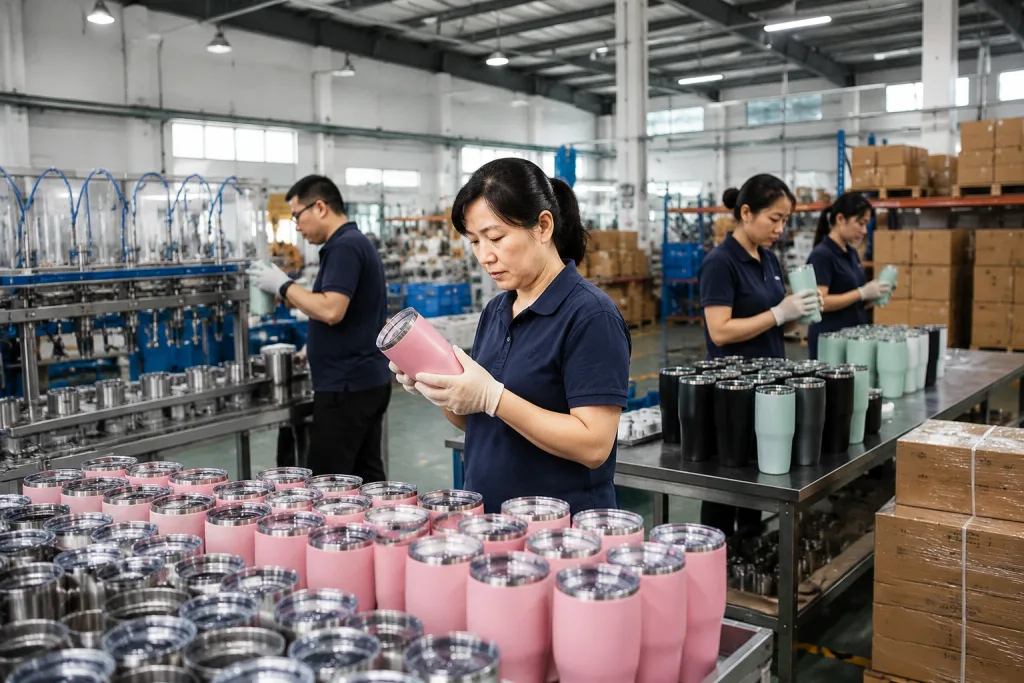
At BottleForge Industrial in Hangzhou, Zhejiang, we see the same failures on the line: leaking lids, powder coating that fails the cross-hatch tape test, stainless walls cut too thin, logos drifting 1.5 mm off center, and export cartons crushed at the bottom row of the pallet. China has serious drinkware capacity. The math doesn’t work, though, if the PO says “same as sample” and the spec sheet leaves out lid torque, coating thickness, carton edge-crush strength, and AQL checks for each batch.
The leak usually starts at the lid
For travel mug distributors, the lid is where margin goes to die. The 304 stainless cup body can pass inspection, then QC pulls 8 lids from the line and finds the slider sitting 0.4 mm loose. That is enough. If the gasket, vent hole, slider fit, or thread tolerance is weak, returns start before the second reorder. Coffee brands catch it fast because their customers carry hot drinks in cars, trains, offices, and bags. A scratch on the cup wall gets argued over; coffee on a MacBook becomes a chargeback.
For a bulk coffee travel mug program, ask the coffee mug manufacturer to name the lid material and gasket material on the spec sheet, not write “PP lid” and move on. Food-contact PP should be declared, and silicone gaskets should be LFGB or FDA compliant depending on your market. If you sell into the EU, put REACH and LFGB expectations on the purchase order. If you sell into the US, confirm FDA food-contact compliance and consider ASTM packaging transit checks for retail cartons. We once had a PO typo that said “silicon ring” instead of “silicone gasket”; the buyer flagged it during document review, and the shipment sat 3 days while sales cleaned up the paperwork.
The practical test is simple. Fill the tumbler to 90% capacity with room-temperature water, close the lid, invert for 30 minutes, then shake for 20 cycles. We run it over a white inspection tray, because one brown droplet near the sip hole tells you more than a clean Excel report. For push-on lids, test again after the gasket has been removed and reinstalled three times. For threaded lids, check cross-threading by opening and closing 30 times. A good coffee mug oem manufacturer will not object; they should already have a bench test with a torque hand tool and a sample log.
Do not specify “leakproof” unless the design is sealed. This is the wrong question to ask on most slider lids. The better question is whether the lid is splash-resistant, spill-resistant, or a sealed screw lid, because those three claims mean different things in a distributor catalog. Most sliding lids are splash-resistant, not leakproof. If you market them as leakproof and sell a 20,000-unit coffee mug promotional program, the math does not work when 600 end users complain. One buyer pushed back on this wording last year; after we showed the inverted-lid test photos, they changed the line copy before mass production.
Thin steel saves cents, not orders
A bulk travel tumbler can look the same in a catalog photo whether the shell is 0.35 mm or 0.55 mm. Pick it up and the difference shows. Drop it from 80 cm onto the concrete beside the packing line, and the difference shows faster. We have seen this go sideways after sample approval: the buyer approved a solid pre-production sample, then QC pulled the sample from mass production and the body felt soft near the logo area. The caliper told the story.
For most double-wall vacuum travel tumblers in the 16-20 oz range, we run 304 stainless steel on the inner wall and outer wall, usually 0.45-0.55 mm sheet thickness depending on the body shape and forming depth. If the quoted price is 8-12% below the market, ask a direct question: is the outer wall 201 stainless? 201 works for some budget coffee mug promotional products, but it resists corrosion less than 304, and hiding it is not acceptable. One buyer once flagged rust spots after a 48-hour salt spray check; the PO only said “stainless steel,” which was the wrong spec.
Vacuum performance is the quiet failure. A tumbler can pass visual inspection, look clean under the LED inspection lamp, and still lose heat because the vacuum seal is weak. For a 16 oz travel tumbler, we use a simple check: hot water at 95°C, lid closed, room temperature 20-25°C, then record the temperature after 6 hours. The pass level depends on the lid and body design, but agree on the number before production. After complaints arrive, the math doesn't work.
At our Zhejiang facility, a normal MOQ for a coffee mug custom made travel tumbler is 1,000 units per color, with monthly capacity around 450,000 stainless drinkware units across tumbler and bottle lines. Capacity only matters when the material spec is locked before we buy coil steel. Put the steel grade on the sales contract, write the wall thickness range in mm, state the capacity tolerance after filling test, and name the vacuum test method with time and temperature. We ship cleaner orders when those four lines are fixed before the deposit hits.
Coating fails before the cup fails
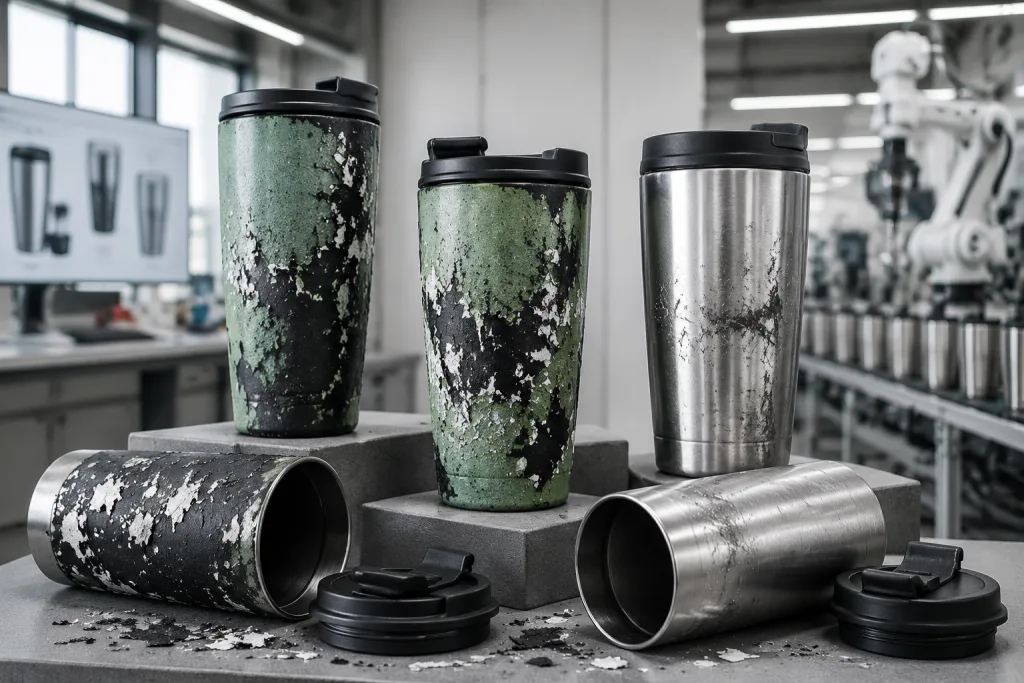
Corporate-gift buyers usually judge the finish before they judge the cup. Fair enough. The recipient sees the coating first, not the vacuum test result. Powder coating, spray paint, and plating fail in different ways: spray paint shows key scratches fast, plating exposes fingerprints and salt-spray issues, powder coat can chip at sharp edges if the line is rushed. For a bulk coffee tumbler, we usually push powder coat because it gives better hand feel and color cover than basic spray paint. But “powder coated” is the wrong spec to put on a PO by itself. Last month a buyer flagged 312 pcs with rim chips because the drawing never called out edge radius before coating.
Ask for coating thickness, adhesion test, and rubbing standard. A common powder coat thickness is 60-90 microns. Too thin, and the finish scratches when cartons slide across the packing table. Too thick, and edges around the rim or base can chip after assembly. We run a coating thickness gauge on the first 10 pcs from the line, then QC pulls the sample for a cross-cut tape test. For rubbing, use 500 cycles with a dry cloth or alcohol rub test if your logo method requires it. If the tumbler will be sold as premium retail, add a 1 m drop test on plywood with controlled acceptance criteria for dents and coating chips. No loose wording like “minor chips acceptable.” The math doesn't work when the distributor pays for rework after shipment.
Color control causes more arguments than buyers expect. “Matte black” can mean 3 different blacks between two coating rooms, especially when one line uses fresh powder and the other runs recovered powder. Use Pantone references for painted colors, and approve a physical color chip or pre-production sample under D65 light if the order is retail-sensitive. For a coffee mug private label line, set a Delta E tolerance if your brand team is strict. We had one reorder where the PO said “same as last time,” but the old sample had been sitting in a sales drawer for 14 months and had faded. The buyer flagged it. If you skip this step, a second reorder may look close on its own but wrong next to the first batch.
For China production, keep the finishing process under one responsible supplier when you can. When a coffee mug supplier sends coating, logo, and packing to 3 workshops, defects start moving in circles: coating blames the laser room, laser blames packing, packing blames the carton pressure. We've seen this go sideways. Factory direct control does not guarantee a perfect shipment, but coffee mug factory direct sourcing makes root-cause correction faster when coating dust, orange peel, pinholes, or uneven gloss show up during inspection. On our floor, QC marks the defect position with a red sticker and checks it under a 6500K lamp before the carton is sealed.
Logo mistakes are rarely random
Logo failures usually start with the file, the jig, or the decoration choice. We had one coffee mug custom logo arrive as a 96 dpi JPG pasted into a PDF; the flat mockup looked clean, but the mark stretched 3 mm on the tapered wall. Do not sign off production from a PDF alone. Ask for a decorated pre-production sample, then have QC pull the sample and check it against the actual lid direction.
Laser engraving works on powder-coated 304 stainless when the buyer wants a durable, sharp mark under 45 mm wide. It fails the brief when the artwork has gradients or four-color mascot graphics. Silkscreen makes sense for one- or two-color logos on a smooth body, as long as the line controls curing time and the 3M tape test passes after 24 hours. Heat transfer handles full-color wraps, but we still run abrasion and dishwasher checks because we have seen this go sideways after 20 wash cycles. UV printing gives bright detail; tight curves and narrow waist tumblers are where the math does not work.
For coffee mug customized programs, write the logo spec in millimeters, not “same as sample.” A workable PO line reads like this: laser logo 38 mm wide, centered opposite lid opening, 72 mm down from rim, tolerance ±2 mm, Pantone reference for any printed color. Boring detail saves orders. One buyer once flagged 5,000 units because the logo faced the palm, not the audience, when the customer drank from the sip hole.
If you are a coffee mug distributor handling 6 or 12 end-client jobs at once, build a decoration matrix before quoting. Put each model and finish in one file, then add logo method, maximum print area, MOQ, setup cost, sample time, and bulk lead time. We run this sheet before sales confirms any coffee mug customizable option, because production cannot hold every method on every coating. It also keeps coffee mug private labeling clean when the buyer wants gift boxes, belly bands, inserts, and barcodes packed together; a wrong barcode digit on the PO can hold a full pallet at final inspection.
Packaging is part of the product
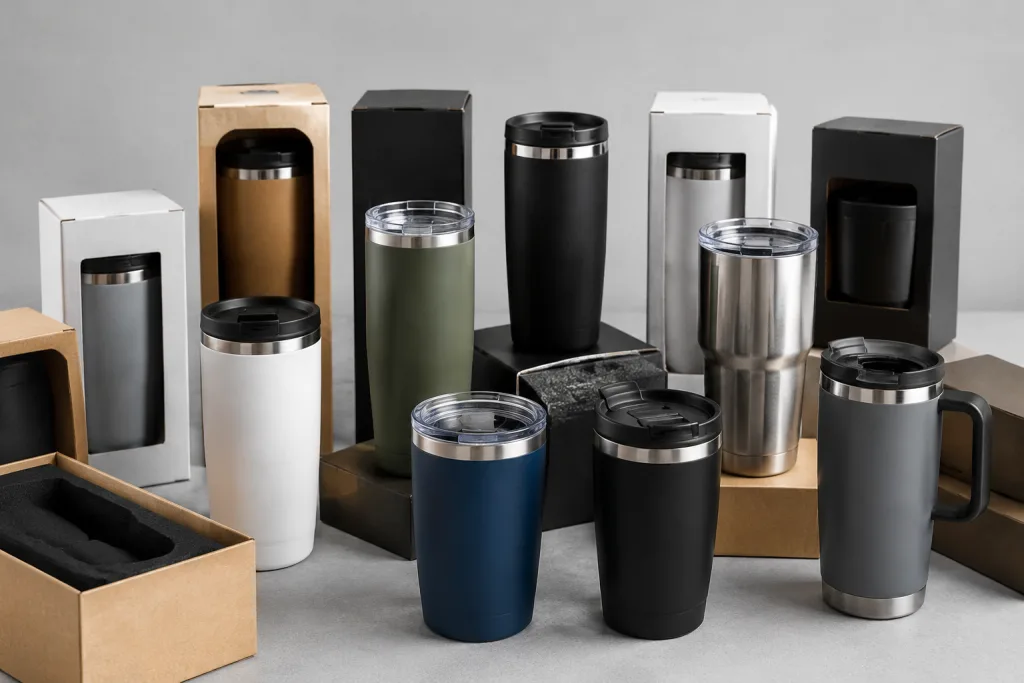
Distributors push hard on the tumbler price and leave packaging for the last email. Wrong question. For export orders, packaging is part of the product. We have seen a travel mug pass AQL 2.5 final inspection in Zhejiang, then arrive with dented bases in Rotterdam or Hamburg because the inner box used 250 gsm board instead of 350 gsm, or the master carton was built like a domestic Taobao carton.
For a bulk travel mug shipment, get the carton structure written on the PI before deposit. We run K=K or K=A corrugated board on most export jobs, but unit weight and stacking height decide the spec. For 20 oz stainless tumblers, our safer setup is individual white box or color box, polybag or paper wrap as required, fitted dividers for powder-coated finishes, and a 5-ply master carton. Keep gross weight under 15 kg where possible. Above 15 kg, the math gets ugly because warehouse staff start dragging cartons, not lifting them; QC pulled one sample carton last May with crushed corners after only 4 stack layers.
If you sell through marketplace fulfillment, lock FNSKU labels, carton labels, suffocation warnings for polybags, and drop-test requirements before quotation. The line can do it. It is not free. Do not send this list two days before vessel closing and expect the same ship date. For corporate gifting buyers, ask whether they need individual mailer boxes; one buyer flagged this after artwork approval, and it pushed packing material lead time from 7 days to 12 days. Mailer-ready packaging can add USD 0.35-0.90 per unit depending on board grade and printing.
Packaging tests should stay simple and strict. Use a 76 cm drop test on one corner, three edges, and six faces for representative packed cartons. Then open the carton and check lid cracks, dented bases, chipped powder coating, and rub marks around the logo area under a 600 lux inspection lamp. If your coffee mug in bulk order ships by LCL sea freight, be tougher because mixed cargo gets stacked badly; we have seen ceramic plates loaded on top of drinkware cartons, and that goes sideways fast.
Cheap quotes hide missing controls
A coffee mug supplier directory or coffee mug supplier list gives you names, not control points. It will not show whether the factory checks incoming 304 stainless with an XRF gun, runs vacuum retention tests, records coating thickness, controls logo positioning, or does a final carton drop check before sealing. Cheap FOB quotes often leave out the parts buyers assume are standard: 0.5 mm better steel, color box, logo setup charge, pre-production sample, third-party inspection support, or the LFGB/FDA file. We’ve seen this go sideways when QC pulled 12 samples and found two lids leaking at the silicone ring.
When comparing coffee mug manufacturers, normalize the quotation. Put every offer into the same sheet: material grade, capacity, lid type, coating, logo method with print size in mm, packaging, MOQ, sample fee, mold fee if any, production lead time, FOB port, payment terms, inspection standard, and document package. Then USD 4.20 vs USD 4.65 means something. For many 16-20 oz custom travel tumblers, a realistic FOB Ningbo or Shanghai range is USD 3.20-6.80 depending on lid complexity, coating, logo, and packaging. If someone quotes USD 2.70 on a powder-coated 20 oz tumbler with box, the math doesn't work; ask what was removed from the line.
Compliance has a cost. BSCI audit status, ISO 9001 process control, LFGB testing, FDA food-contact declarations, REACH screening, and CA Prop 65 review are separate files, separate labs, and separate lead times. Your market decides what matters. A European distributor usually asks first for REACH and LFGB, and our lab booking for LFGB migration testing is usually 5-7 working days after we send the sample. A North American corporate-gift buyer often focuses on FDA food contact, Prop 65 wording, and social compliance. China suppliers can provide these, but request them at RFQ stage, not after the PO; we once had a buyer flag “FDA cert” typed on a PO when they actually needed the material declaration and test report.
Our standard lead time for a coffee mug bulk custom order is 7-10 days for a decorated pre-production sample and 35-45 days for mass production after approval, assuming normal colors and existing tooling. Rush jobs happen. Still, rushing cuts buffers, and this is the wrong question to ask if the buyer only asks “how fast can you ship?” Those buffers catch bad coating, late packaging artwork, and lid fit issues before they become air-freight costs. On the line, a 0.3 mm lid mismatch can turn into 3,000 customer complaints.
Inspection should match the risk
Final inspection is not a stamp on the file. It is the last clean stop before a weak order lands in your customer’s warehouse. For travel mug distributors, we run final inspection when at least 80% of goods are packed and 100% are produced. Use ANSI/ASQ Z1.4 sampling with AQL 2.5 for major defects and AQL 4.0 for minor defects as a normal baseline. Critical defects should be zero. On a 5,000 pcs tumbler order, QC usually pulls cartons from 6 pallet positions, then checks sealing rings with a 0.5 L water fill and 30-second inversion test.
Major defects include leaking lids, poor vacuum performance, wrong logo, wrong color, sharp edges, loose components, cracked lids, and incorrect packaging labels. Minor defects include dust points under 0.3 mm, slight print variation within the approved Pantone tolerance, light scratches inside the signed limit sample, or carton scuffs that do not break the outer paper. Define this before production. Inspection day is the wrong time to argue what “small scratch” means. We have seen this go sideways because a buyer wrote “black logo” on the PO, while the approved artwork file said matte charcoal.
A good inspection checklist for a bulk coffee mug order should include capacity check, weight check, wall finish, rim smoothness, lid fit, leak test, coating adhesion, logo position, barcode scan, carton drop test, and carton mark review. Do not just tick boxes. For a 20 oz mug, QC should confirm the actual fill line with a measuring jug, weigh 10 pcs on a digital scale, rub the logo with 3M tape, and scan 20 barcodes from mixed cartons. If the product is sold as coffee mug promotional merchandise, check individual gift-box appearance too. End users judge the brand before they touch the tumbler.
The point is not paperwork. The point is to make the coffee mug factory behave predictably. China export manufacturing works best when the buyer gives measurable acceptance criteria and the supplier confirms them before taking the deposit. If you want a long-term coffee mug supplier, reward the factory that flags risk early, such as a lid mold with 0.2 mm play or a powder-coating line running 12 days instead of the quoted 8 days. Silence is not quality control. The math does not work after the container has shipped.
Send your tumbler spec before you buy
We will review material, lid, logo, packaging, MOQ, and lead time so your next bulk travel tumbler order is buildable.
Frequently asked questions
What MOQ should travel mug distributors expect for custom tumblers?
For stainless travel tumblers with an existing mold, a practical MOQ is usually 1,000 units per color for logo customization. If you need a custom lid, custom body shape, or exclusive tooling, MOQ often rises to 3,000-5,000 units because tooling setup and line changeover become meaningful. For a simple coffee mug custom logo on an existing 16 oz or 20 oz model, you can usually sample at 1-3 pieces and then move to a 1,000-unit production run. Very small 100-300 unit orders are possible through trading channels, but unit price, color control, and packaging flexibility are usually worse.
How much should a bulk coffee travel mug cost FOB China?
For a normal double-wall stainless bulk coffee travel mug, expect roughly USD 3.20-6.80 FOB Ningbo or Shanghai depending on capacity, lid design, steel grade, coating, logo method, and packaging. A basic 16 oz powder-coated tumbler with one laser logo may sit near the lower-middle of that range. A 20 oz retail-ready tumbler with a complex lid, color box, insert, barcode labels, and stronger carton will cost more. If a quote is 20-30% lower than the others, check wall thickness, outer steel grade, coating type, lid material, and whether compliance testing or inspection support is excluded.
Which logo method is safest for coffee mug promotional products?
Laser engraving is usually the safest for long-term durability on powder-coated stainless steel because it does not rely on ink adhesion. It works well for corporate logos, coffee brand marks, and simple text. Silkscreen is economical for one-color artwork on larger runs, often from 1,000 units, but curved surfaces and matte textures need testing. Heat transfer or UV printing is better for multi-color artwork, but you should run abrasion testing and check dishwasher claims carefully. For coffee mug promotional products, approve a real decorated sample and define logo position tolerance, usually ±2 mm.
Can I use one supplier for private labeling and Amazon-style packing?
Yes, if you specify it early. A coffee mug private label order can include logo decoration, custom color box, instruction sheet, barcode, FNSKU label, carton label, and polybag warning where required. The factory needs your dieline, barcode files, label placement rules, and carton quantity before mass production. For marketplace fulfillment, we normally suggest confirming packed-unit weight and carton dimensions before production because freight and storage fees can change the landed cost. Expect custom packaging to add 7-15 days if artwork approval or printed box production is not ready.
How do I avoid choosing the wrong coffee mug factory?
Start with a controlled RFQ instead of asking for a general price. Send capacity, material, finish, logo, packaging, compliance market, target quantity, and inspection standard. Ask the coffee mug factory for photos of production lines, BSCI or ISO status if relevant, recent test reports, and a pre-production sample timeline. Compare suppliers on total specification, not just price. A serious coffee mug factory direct partner should confirm 304 stainless grade, coating thickness, lid testing, AQL inspection terms, and lead time in writing. If they only answer with a low price, keep looking.