Key Takeaways
- A practical distributor MOQ is usually 1,000-3,000 pcs per color for stainless travel tumblers
- Expect 35-45 days production after artwork approval for custom coating and logo orders
- 304 stainless steel at 0.4-0.5 mm inner wall is the safe baseline for daily coffee use
- AQL 2.5 major / 4.0 minor inspection catches most lid, coating, and logo defects before shipment
If you buy for a coffee brand or a corporate-gift program, the travel mug is not just a container. It is the box, the ad space, and the first sip in one SKU. One loose slider lid, 18μm coating instead of 25μm, or a shipment that misses the vessel cut-off can turn a simple promo order into chargebacks. We have seen QC pull 32 samples from a 3,000 pcs lot because the lid gasket sat 0.4 mm out of groove.
As a travel mug distributor, ask the hard questions before the quote: MOQ, wall thickness, logo size, packing method, and what the coffee mug factory can control on the line. From Hangzhou, Zhejiang, we see around 6 out of 10 new Europe and North America RFQs lose 20-30 days because the first spec says only “500ml stainless mug with logo.” That is the wrong starting point. China can ship fast, but the math only works when the PO, artwork, sample approval, and carton mark all match before we run production.
Start With The Selling Channel
The first question I ask any travel mug distributor is not size or color. It is the sales channel: desk gift, event giveaway, retail shelf, or coffee-shop counter. A corporate-gift order for 5,000 pieces carries different risk than a retail coffee brand launching a premium bulk coffee travel mug in 12 oz and 16 oz sizes. We had one PO last March that said “matte black” in the header and “gloss black” in the packing note; QC pulled the pre-production sample before the line opened. If you treat both orders as the same project, the quote looks neat. The margin gets hit later.
For office gifting, buyers usually push on price, coating stability, and logo visibility from 1 meter away. A 16 oz stainless steel bulk travel mug with powder coating and 1-color silk screen often does the job, as long as the logo clears the handle radius and the screen frame is set straight. For a coffee brand, hand feel, drinking angle, lid seal, carton design, and repeat purchasing carry more weight, so this is the wrong question to ask if the buyer only says “send cheapest.” You may need a coffee mug custom made with a private label color, retail sleeve, barcode, and drop-test-approved master carton. We run a 90 cm carton drop on corner, edge, and face before we approve that packing.
A distributor should define the commercial job before contacting a coffee mug supplier. Write down the target FOB price, retail price, expected order volume, lid type, and compliance market, then add the packing method and logo position in mm. Example: “16 oz double-wall stainless bulk coffee tumbler, powder coated, laser logo 35 mm wide, leak-resistant sip lid, for EU corporate gifts, target FOB Ningbo under USD 4.20 at 3,000 pcs.” That one sentence saves two quotation rounds. We have seen this go sideways when the buyer confirmed the lid after artwork approval, because the new lid needed a different carton insert.
Good factories do not quote magic. They quote metal thickness, lid tooling, coating process, packing, inspection, and lead time.
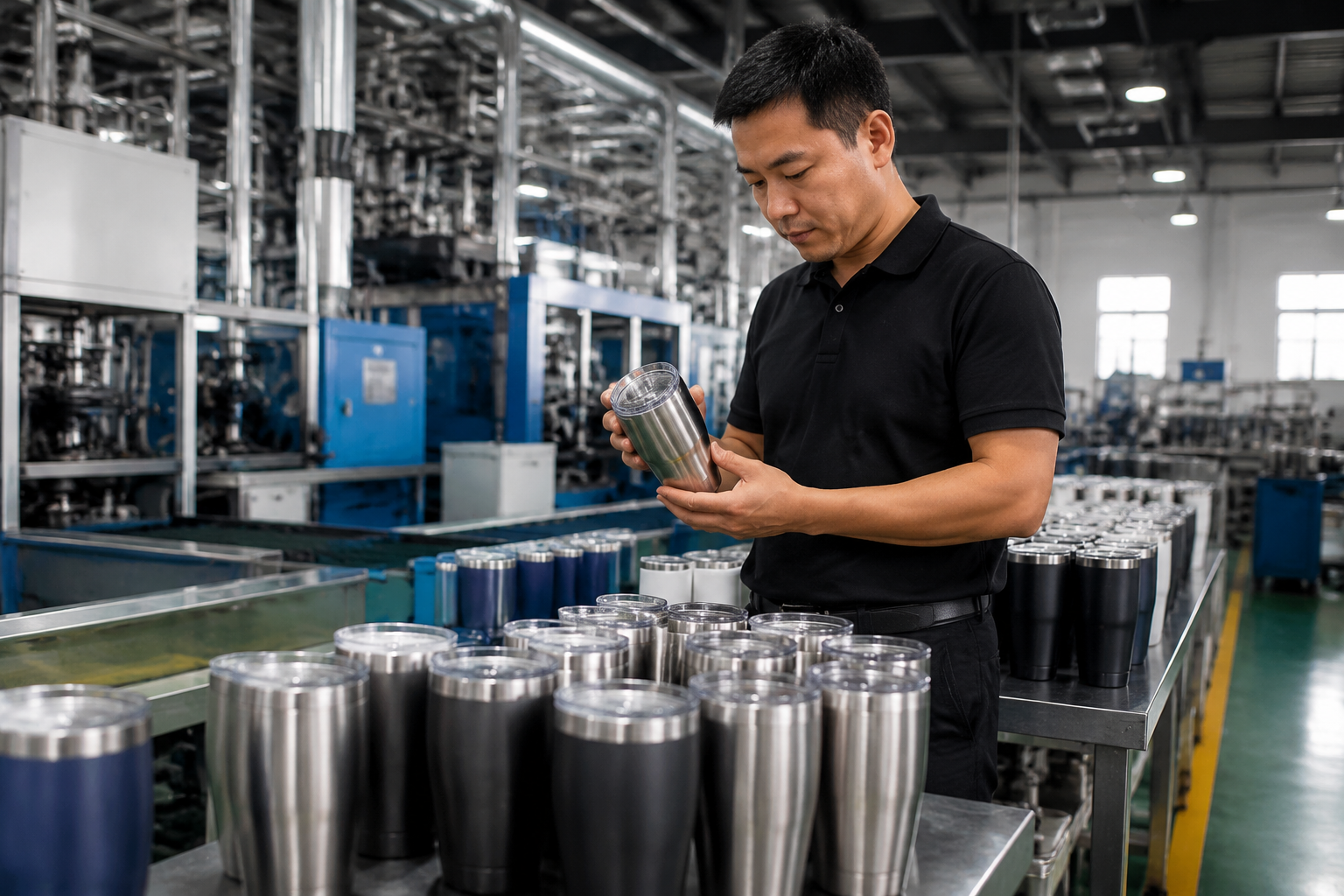
At BottleForge Industrial in Zhejiang, we normally see distributor projects fall into three bands: 1,000-2,000 pcs for test programs, 3,000-10,000 pcs for seasonal corporate-gift campaigns, and 20,000 pcs plus for coffee mug private label retail programs. Our current travel tumbler output is about 280,000 units/month across standard models, so capacity is rarely the problem. The problem is late artwork, unclear packing, or a lid requirement that was never tested with 95°C hot water. Last quarter, the buyer flagged “leakproof” after we had already booked powder coating; the math did not work without moving ship date from 12 days to 18 days.
What Should The Mug Cost
Price is not one number. Buyers ask us for a bulk coffee mug quote, then put a USD 2.80 item next to a USD 4.60 item and say the coffee mug manufacturer is expensive. Wrong question. On our line, QC pulled a 16 oz sample last month that looked fine outside, but the inner wall measured 0.38 mm with a digital caliper, not the 0.5 mm written on the PO. The cheap quote usually saves money through thinner steel, weaker vacuum hold, a basic lid, no spare gasket, soft export carton, or skipped inspection. You can buy those savings. Just write them down before you approve the sample.
For a standard 16 oz double-wall stainless travel tumbler, a realistic FOB China range is USD 3.20-5.20 at 3,000 pcs, depending on structure and finish. A basic plastic-lid model with 201 outer / 304 inner stainless steel and single-color logo may sit near the lower end. A full 304 stainless model with 0.5 mm inner wall, powder coating, slide lid, individual kraft box, and laser logo moves higher because the scrap rate after spraying can hit 3-5% if the booth humidity is off. If you need copper lining, ceramic inner coating, or a custom molded lid, budget more. The mold deposit alone often starts around USD 1,200-2,500, and we have seen this go sideways when a buyer approves artwork but forgets the lid tooling charge.
Cost items to separate
- Body: steel grade and thickness, vacuum insulation target, polishing loss rate after the buffing wheel.
- Lid: PP or Tritan material, silicone gasket hardness, slider design, spare lid replacement rate.
- Surface: spray paint or powder coating, rubber finish, UV print, water transfer film scrap after adhesion tape test.
- Logo: silk screen, laser engraving, pad print, heat transfer, full-wrap print with registration tolerance.
- Packing: white box or kraft box, color box, insert card, master carton strength for 12 kg drop-test cartons.
If you are a coffee mug distributor serving 3-8 brands, ask for a price ladder at 1,000, 3,000, 5,000, and 10,000 pcs. Ask whether the quote is FOB Ningbo, FOB Shanghai, EXW Zhejiang, or DDP. We ship from Zhejiang often enough to know the small lines matter: one buyer flagged a quote because the PO said FOB Shanghai, while the supplier had priced EXW Zhejiang and left out RMB 1,850 inland freight. A coffee mug factory direct quote that excludes inland freight, export carton upgrade, or third-party inspection can look attractive on Monday and hurt by Friday.
Checklist Before You Request Samples
Samples only earn their freight cost when they test the buying decision on the PO. We still get requests like “send your best travel tumbler”; last month QC pulled 5 random stock items for a buyer in Spain, and none matched his 20 oz price sheet. Wrong question. For a coffee mug customizable program, send the supplier a short checklist before dispatch and ask for written answers, even if it is just a marked PDF with model code, MOQ, and lead time.
- Capacity: 12 oz, 16 oz, 20 oz, or 24 oz measured to brim or usable fill line?
- Material: 304 inner stainless steel, 201 or 304 outer shell, PP or Tritan lid?
- Insulation: target hot retention at 6 hours and cold retention at 12 hours?
- Leak expectation: leakproof in bag, splash-resistant in car, or drink-through only?
- Logo size: exact width in mm, placement, and Pantone color.
- Packaging: bulk pack, gift box, retail color box, or e-commerce mailer?
- Compliance: LFGB, FDA, REACH, Prop 65, ASTM if children may use it.
For coffee mug promotional products, order at least 2 blank samples and 2 logo samples before mass production. Keep one clean. Use it for photos and sales approval. Abuse the other one on purpose: 10 dishwasher cycles if the model allows it, 95°C hot coffee, car cup holder fit, 300 lid open-close cycles, and a scratch check with keys. We run this on the line with a caliper, a timer, and a messy test bench because enterprise clients will repeat the same checks after delivery. If you are selling coffee mug in bulk, do it before they do.
A proper coffee mug OEM manufacturer should confirm whether the selected model is an existing mold or private mold. Existing mold is faster: samples in 3-7 days and production mold risk is low. Private mold can take 35-60 days for tooling and first article approval, and we have seen this go sideways when the buyer changes the lid height by 2 mm after the T1 sample. For most distributors, existing mold plus custom finish is the safer first purchase. Move to custom tooling after 2-3 repeat orders prove demand.
How Custom Branding Really Works
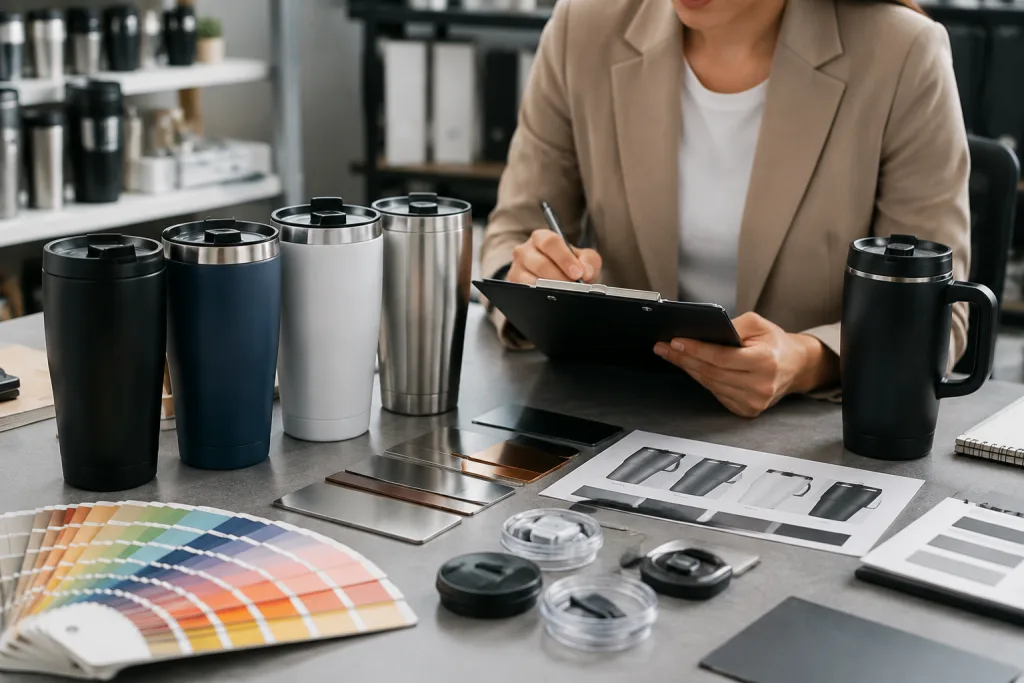
“Coffee mug custom” is too loose for a purchase order. It might mean a 25 mm logo on one side, or a coffee mug customized for retail with private-label PMS color, molded lid, insert card, barcode, carton mark, and Amazon-ready packing. Be precise. Every added item changes the quote sheet, the AQL 2.5 risk, and the lead time; last month QC pulled 32 pcs from a 1,200 pc run because the carton mark missed one digit from the buyer’s PO.
Laser engraving is clean, durable, and works well for metal logos. We run it on a fiber laser, usually at 20–30W depending on coating thickness. On powder coating, the laser cuts through the coating and shows the stainless steel underneath. Silk screen costs less for simple 1-2 color artwork, but it needs a flat print area and tiny lines under 0.3 mm often break or fill in. Full-wrap heat transfer or UV print gives richer color, but setup cost and defect risk go up; we’ve seen this go sideways when a buyer sent a 6-color gradient and expected promo-mug pricing.
For a coffee mug private labeling project, control three brand zones with clear files, not chat screenshots. The mug body needs logo, color, finish, and legal text. The packaging needs color box artwork, instruction sheet, recycling mark, and FNSKU or EAN/UPC label if needed. The shipment identity needs carton marks, PO number, mixed SKU labels, and pallet requirements. A factory in China can make all of it, but the buyer must approve artwork before production starts; our prepress desk checks dielines in AI and flags missing bleed, usually 3 mm, before the line opens materials.
Typical artwork rules are simple. Send vector files in AI, PDF, EPS, or SVG. Provide Pantone Solid Coated references for coating and print colors. Confirm logo size in millimeters, not “make it bigger.” That is the wrong question to ask at sample stage. For coffee mug promotional campaigns, lock artwork 5 working days before production booking. If artwork changes after coating starts, the delay is not usually 1 day; it is often 7-10 days because the coating line must be rescheduled, the spray gun cleaned, and the curing oven slot moved behind other booked colors.
Quality Control Buyers Should Demand
A travel tumbler looks simple on the buyer’s desk. On the line, defects hide in 1-2 mm gaps: lids sitting crooked in the thread gauge, silicone gaskets with flash, black specks in powder coating, TIG weld pinholes, logos shifted 3 mm off center, vacuum failure, or 5-ply cartons that crush after 30 days at sea. You do not need to become a factory engineer. You do need a QC plan the inspector can actually measure.
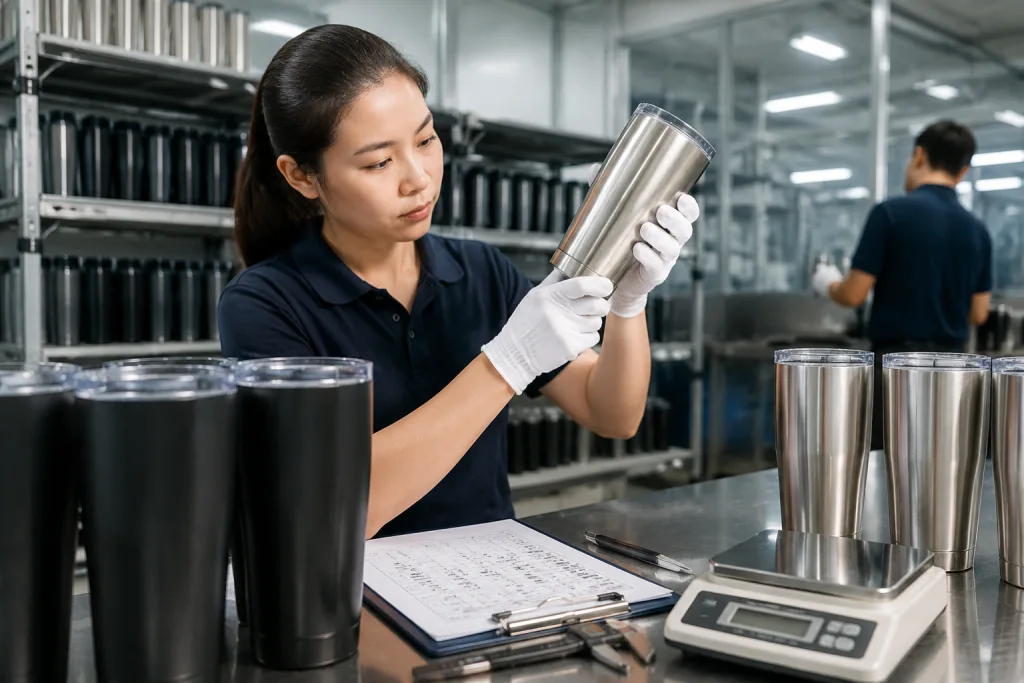
For distributor orders, we run AQL 2.5 for major defects and AQL 4.0 for minor defects unless your retailer contract calls for tighter limits. Major defects include leakage, sharp edges, wrong material, wrong logo, coating peel over the agreed area, failed vacuum insulation, and broken lids. Minor defects include dust marks under 0.5 mm, light scratches inside the approved photo limit, or carton printing that is slightly uneven but still scannable. Set the limit with photos before inspection; last month a buyer flagged “small scratch” on the PO, and QC had no size limit to judge against. “Good quality” is the wrong wording. It fails on the inspection table.
Key factory tests should include vacuum retention test, hot water leak check, coating adhesion cross-hatch test, logo rub test, lid open-close cycle test, and carton drop test, with the test method written on the QC checklist. For stainless coffee mug bulk orders, we normally recommend checking 80-125 pcs during final random inspection for a 3,000-5,000 pcs lot, depending on the selected AQL sampling table. QC pulled the sample after 12 hours in the 95°C hot-water station, then checked leakage by turning each cup upside down for 3 minutes on white paper. If the product is for food contact in Europe, ask for LFGB or EU 1935/2004 related food-contact documentation. For the US, FDA food-contact suitability and Prop 65 review may apply depending on materials and state exposure.
Do not rely only on a coffee mug supplier directory or coffee mug supplier list badge. Certifications matter, but shipment inspection protects your order. We have seen this go sideways: a BSCI or ISO 9001 audited coffee mug factory changed lid gasket material from 55 Shore A to 65 Shore A, and 7 out of 200 checked samples leaked at the rim. A clean audit report did not stop that. A busy coating line before Chinese New Year will not care about your catalog launch date either.
Lead Time, MOQ, And Shipping
MOQ is where the price talk gets honest. For standard color stock, we can sometimes run 500 pcs, but custom color plus logo usually starts at 1,000 pcs per design. Powder coating makes better sense at 3,000 pcs per color because one line change eats 45-60 minutes, and the spray booth still loses paint during gun flushing and color cleaning. Small orders pay for that waste. For a bulk travel tumbler program with 3 colors, do not read 3,000 pcs as the total order. We have seen this go sideways: the buyer wrote “3,000 pcs assorted” on the PO, while production quoted 3,000 pcs per color.
A normal schedule from our Zhejiang operation looks like this: 3-7 days for available samples, 5-10 days for logo sample approval, 35-45 days for mass production after deposit and final artwork, and 3-7 days for booking and customs paperwork. QC pulled one logo sample last month because the laser mark sat 2 mm off center, and that alone added 2 days before approval. Sea freight to North America or Europe can add 25-40 days port-to-port, more if you need inland truck delivery or Amazon FBA appointment handling.
For corporate gifts with a fixed event date, build the calendar backward. If the event is June 15 in Germany, approving the order on May 20 and hoping air freight fixes the schedule is the wrong question to ask. The math does not work. Air freight for stainless tumblers can easily add USD 1.20-2.50 per unit depending on weight and destination, and one 20 oz carton at 24 pcs/carton still carries enough volume weight to hurt. That destroys the margin on a bulk coffee mug order.
Ask your coffee mug manufacturers to confirm carton dimensions, gross weight, units per carton, HS code, and pallet plan before you issue the PO. A 20 oz tumbler may pack 24 pcs/carton, while a handled travel mug may pack only 12 pcs/carton. That changes freight cost fast; we had a buyer flag a 6 kg/carton gap after the forwarder remeasured with a tape and scale at the warehouse. If you are a coffee mug distributor consolidating several customers, request SKU separation, carton labels, and packing photos before shipment leaves China.
Choosing A Factory Partner
A good coffee mug manufacturer is not the lowest line on your cost sheet. For distributors, the better partner is the factory that tells you the risk before the PO is signed. If a supplier accepts 6 lid styles, 12 powder-coat colors, a laser logo, LFGB paperwork, and a 25-day ship date without checking the line schedule, slow down. Drinkware production has limits. We see this on the floor when the vacuum tester pulls 8 pieces from a 500-piece pilot run and 2 fail at the weld seam.
For coffee mug factory direct sourcing, ask for recent production photos, inspection reports, material declarations, coating cards, and the nearest export port. Hangzhou and the wider Zhejiang drinkware supply chain work well for stainless vacuum products because tube forming, powder coating, PP lid molding, carton packing, and Ningbo or Shanghai export trucking sit within a tight radius. Less handoff matters. We run samples from coating to assembly in 12 days; the same job split across two distant provinces can stretch to 18 days after one missed truck slot.
Your RFQ should give every supplier the same data: model number with drawing, capacity in ml, material grade, logo method with artwork size in mm, color code, packing spec, MOQ, target delivery date, Incoterm, compliance market, and inspection requirement. Without that, a coffee mug supplier with a lower price may be leaving out the spare gasket, the inner white box, or the AQL 2.5 final inspection another factory included. The math does not work. If you use a coffee mug supplier list, cut it to factories that can answer wall thickness, lid fit, and coating adhesion questions without passing the file to a trading desk for three days. We once had a buyer flag a PO typo where “304 stainless” became “201 stainless”; QC pulled the sample before mass production, and that saved the order.
For coffee mug distributors and corporate-gift buyers, I prefer a slightly higher FOB price with repeatable output over a low first quote that turns into color drift, lid substitutions, and late shipping. We have seen this go sideways. Your client never sees the 9 p.m. WeChat argument about Pantone Black 6 C or the 0.3 mm gap on a slider lid. They see whether the mug arrives before the event, whether the logo matches the proof, and whether the coffee stays hot on the morning commute.
Send Us Your Travel Mug RFQ Today
Share target price, quantity, logo files, and delivery market. We will return a practical factory-direct quote with MOQ, lead time, and options.
Frequently asked questions
What MOQ should a travel mug distributor expect for custom tumblers?
For most stainless steel travel tumblers, expect 1,000 pcs per logo design as the working MOQ and 3,000 pcs per color for custom powder coating. If you use existing factory colors and a simple laser logo, some programs can start at 500-1,000 pcs. For coffee mug private labeling with color box, insert card, and barcode, 3,000 pcs is more realistic because packaging setup and inspection cost need volume. Private mold projects are different; tooling may require 5,000-10,000 pcs commitment depending on body and lid complexity.
How long does a bulk coffee travel mug order take?
A standard schedule is 3-7 days for blank samples, 5-10 days for logo samples, and 35-45 days for mass production after artwork and deposit approval. Add 25-40 days for sea freight to many Europe or North America ports. If you need a custom lid, new mold, ceramic lining, or multiple retail SKUs, add 15-45 days. The biggest avoidable delay is artwork approval. Confirm Pantone, logo size, carton mark, and barcode before the factory books coating and assembly.
Which logo method is best for corporate-gift coffee mugs?
Laser engraving is the safest premium option for stainless or powder-coated travel mugs because it is durable and clean. Silk screen is better when you need a 1-color or 2-color logo at lower cost, especially on larger flat areas. UV print and heat transfer are useful for full-color artwork, but they need more setup control and stronger inspection. For coffee mug promotional products, ask for a logo rub test, dishwasher guidance, and an approved pre-production sample before mass production.
Can one factory handle coffee mug private labeling and FBA packing?
Yes, if you specify it early. A capable coffee mug OEM manufacturer can apply FNSKU labels, pack individual color boxes, add warning labels, create carton marks, and separate SKUs by carton. For Amazon FBA, confirm label size, carton weight under the required limit, barcode scannability, and polybag or insert requirements before production. Expect an extra USD 0.08-0.35 per unit for labeling and packing complexity, depending on the number of SKUs and whether custom cartons are required.
How do I compare quotes from different coffee mug manufacturers fairly?
Use one RFQ sheet and force every supplier to quote the same specification: capacity, steel grade, wall thickness, lid material, coating, logo method, packing, MOQ, Incoterm, lead time, and inspection standard. Ask if the price includes export carton, inner box, logo setup, sample charge, and inland freight to FOB port. A USD 0.30 cheaper quote may exclude retail packaging or use 201 outer steel instead of 304. Also compare payment terms, sample timing, and whether the factory accepts AQL inspection before balance payment.