Key Takeaways
- For most travel tumbler projects, realistic MOQ starts at 1,000-3,000 units per color
- 304 stainless steel with 0.4-0.5 mm inner wall is the standard safe choice for coffee
- Laser engraving is durable, but full-color UV or silkscreen works better for promotional logos
- Plan 35-55 days production after sample approval for a coffee mug custom made order
If you are buying a travel mug customized for a coffee brand or corporate-gift program, the hard part is not finding a supplier. It is choosing the spec before a coffee mug factory quotes 201 vs 304 stainless, PP vs Tritan lids, powder coating, and laser or silk-screen logos. A 2.5 USD mug and a 7.5 USD mug can look close in a PDF. They won’t act the same after 6 drops in a courier bag, 30 dishwasher cycles, or a week sitting on a retail shelf with a loose flip lid. We’ve seen this go sideways when the buyer only asked, “What’s your cheapest 500 ml tumbler?” Wrong question.
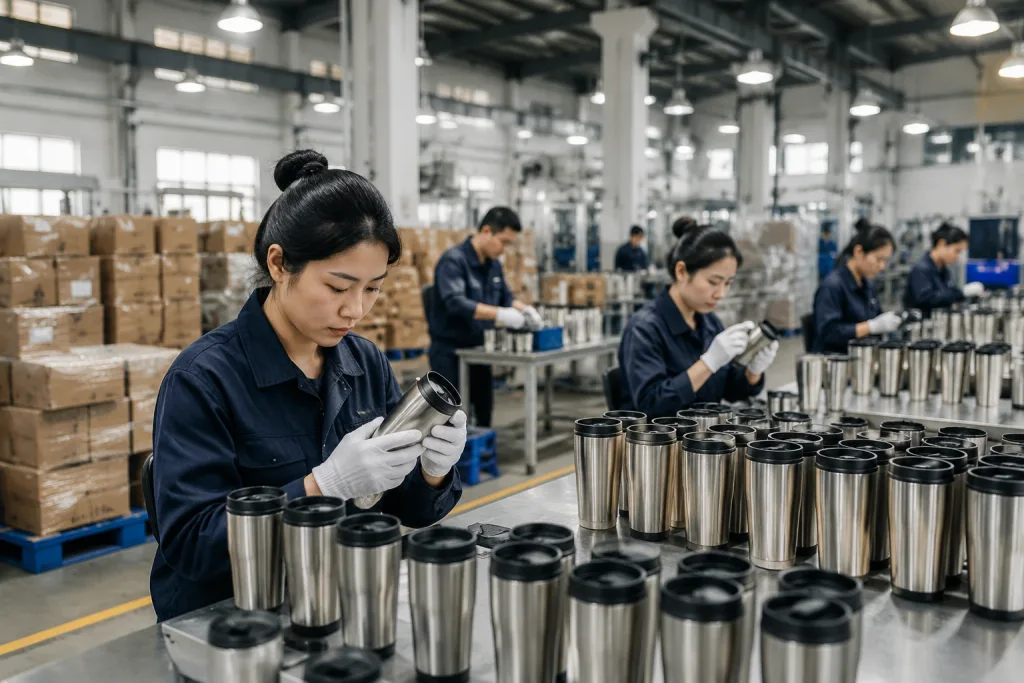
BottleForge Industrial is based in Hangzhou, Zhejiang, and we manufacture in China for distributors, coffee brands, and promotional buyers. We run the line better when the buyer locks four items first: use case, insulation target, decoration method, and compliance route. For one recent 3,000 pcs order, QC pulled the sample after the caliper showed a 0.4 mm lid gap, and the buyer flagged leakage before mass packing. Fix the spec first. Price negotiation comes after those four choices are fixed.
Start with the buyer decision map
A travel mug customized project should start with four buyer decisions, not 26 body shapes on a PDF catalogue. Decide the channel first: retail coffee shelf, corporate gift box, event giveaway, subscription add-on, or distributor stock. We run different specs for each one because weight, coating, carton drop strength, and FOB target do not land in the same place. For an office campaign, a bulk coffee mug can take a simpler flip lid and a one-color pad print; last month QC pulled a 500 pcs sample run where the logo was 1.5 mm off-center, and the buyer accepted it because the mugs were for internal staff. A coffee mug private label product sold online needs tighter outer carton paper, barcode control, and fewer cosmetic rejects. Otherwise the math doesn't work.
Next, pin down the drinking behavior. Is the user drinking black coffee on a train, cold brew at a desk, or tea in a car cup holder? For hot coffee, a 350-500 ml vacuum insulated tumbler usually beats a 900 ml bottle because it fits the hand, fits most cup holders, and ships lighter. For corporate-gift buyers, 500-600 ml is the safe range: it feels like a proper gift without turning into a 420 g brick before filling. For coffee brands, 350 ml and 400 ml often match cafe habits better and cut carton weight; we ship 24 pcs per master carton on most 400 ml models, so the freight quote changes fast.
Then decide whether you are buying a promotional product or a retail product. A coffee mug promotional order is judged by logo visibility, delivery date, and budget. A coffee mug custom made for retail is judged by repeat use, reviews, returns, and margin after platform fees. Same body, different job. We've seen this go sideways when a buyer used an event-grade lid for Amazon stock; during AQL 2.5 inspection, the line found 7 loose sliders in 200 checked pieces, and the buyer flagged it before shipment.
Last, decide how much control you need. Factory direct ordering from China gives you control over logo, color, packaging, and inspection, but only if the PO says it clearly. Write the Pantone code, logo size in mm, lid type, carton mark, MOQ, and inspection standard. One PO came in with “mat black” instead of “matte black,” and our merchandiser had to stop the powder-coating line before 3,000 pcs went the wrong direction. If you only ask for a coffee mug customizable quote, every coffee mug supplier will price a different product.
Pick the body before the logo
The body construction sets the cost before the logo artwork even reaches our pad-printing table. In our Hangzhou line, most travel mug customized orders run double-wall vacuum insulation with 304 stainless steel inside and 201 or 304 stainless steel outside. For coffee, use 304 inner steel. Acidity and milk odor are less forgiving than buyers expect. We check incoming coil with a handheld XRF gun, and QC has pulled samples when the supplier marked 304 on the tag but the reading did not match. Typical wall thickness is 0.4 mm to 0.5 mm for the inner shell and 0.5 mm to 0.6 mm for the outer shell. Thinner metal can look fine in a sample photo, but we have seen 0.35 mm bodies dent after 18 days at sea plus 2 warehouse transfers.
You will usually choose from straight-wall tumblers, tapered car-cup designs, handle mugs, or slim travel mugs. Straight-wall models give 70 mm to 95 mm of clean branding height on 500 ml sizes, and they stack neatly in retail display cartons. Tapered models fit more vehicle cup holders, so they make sense for a bulk coffee travel mug program where the buyer already warned us, “It must fit a Toyota cup holder.” Handle mugs feel closer to desk drinkware and work for office gifting. The trade-off is carton space. Handles increase carton volume and can raise freight cost by 8-15% compared with a similar handle-free tumbler, and the math gets ugly at 3,000 pcs.
Capacity is where buyers overreach. Bigger is not better. A 900 ml bulk travel tumbler looks strong on a spec sheet, but 380 ml, 450 ml, or 500 ml sizes sell cleaner for coffee brands because they match one large drink, not a hiking bottle. For corporate gifting, 600 ml is often the upper limit before the mug feels too large for daily carry. We had one PO typed as 900 ml when the approved sample was 500 ml; the buyer flagged it during pre-production, and that typo would have changed the carton from 24 pcs to 12 pcs.
Ask your coffee mug manufacturer for real measurements: top diameter, bottom diameter, full height, net weight, and carton quantity. A 500 ml tumbler that is 82 mm wide at the base may not fit some car holders. We run this check with a caliper and a standard 75 mm car-holder gauge before mass production. That detail matters more than another glossy render.
Match lid design to usage
The lid is where 7 out of 10 bulk travel mug complaints start. Buyers spend two weeks on powder coating panels and logo size, then pick the lid from a catalog photo. Wrong question. We run lid samples on the bench with a 0.6 mm feeler gauge around the gasket seat because a travel mug for hot coffee needs a controlled sip opening, clean silicone compression, and parts your customer can actually wash. If milk residue sits under a slider plate after one latte, the buyer flags the brand, not the factory.
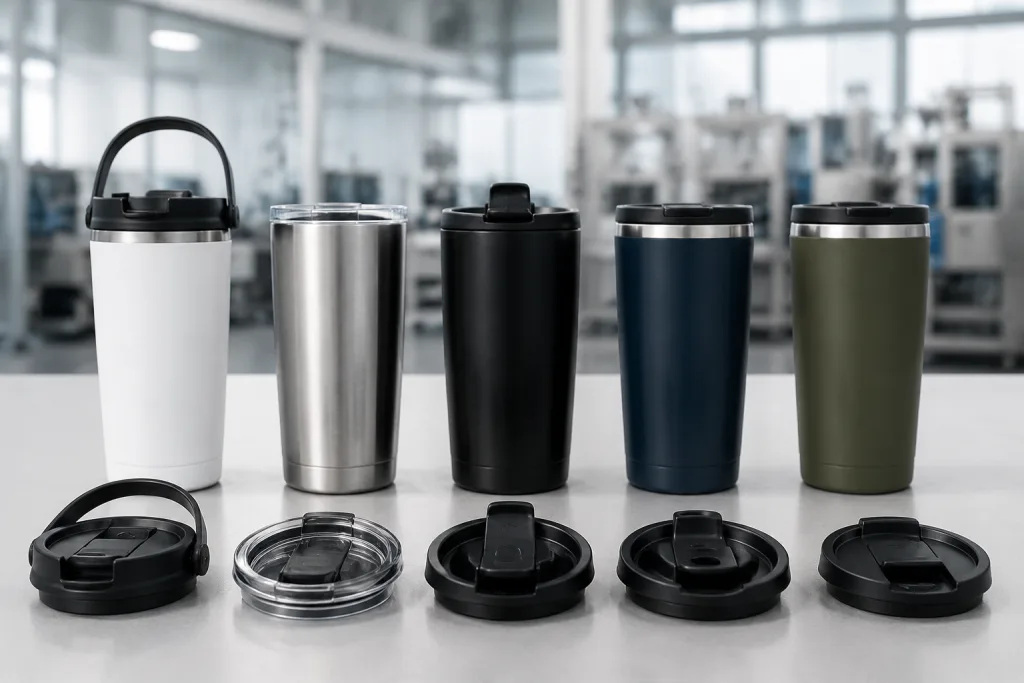
We usually quote two lid directions first, not a fancy menu of options. A simple slider lid keeps cost down and works for office giveaways or event orders, but call it splash-resistant, not leakproof; QC pulled 20 pcs last month and 3 showed seepage after a 45° tilt test. A flip lid with silicone gasket seals better for commuting and feels closer to daily coffee use. A screw lid with carry loop is fine for hiking or carabiner carry, but it changes the sip angle and can feel wrong for cafe customers ordering a coffee mug customized with their logo.
For hot drinks, ask for PP or Tritan components rated for at least 100°C short-term contact. Get the resin grade written on the spec sheet, not only in a WeChat message; we once saw “Trian” typed on a PO and the buyer’s lab held the shipment for 12 days. For Europe, request LFGB or EU food-contact documentation where needed. For North America, buyers often ask about FDA food-contact compliance, plus Prop 65 when selling into California. For children or school programs, ASTM-related safety expectations may apply, though most travel tumblers we ship are adult products.
Test the lid before approving mass production. Our Zhejiang team checks lid assembly, thread fit, gasket position, and 100% vacuum performance at production stages, with the line stopping when torque feels loose by hand or the thread gauge catches. For a 5,000-unit bulk coffee tumbler order, a weak lid design creates more complaints than a beige shade that is 2% off the approved color chip. We have seen this go sideways.
Choose decoration by risk level
Pick the logo method after you confirm the finish, order quantity, and how the cup will be used. Laser engraving is our lowest-risk choice on 304 stainless and powder coating. It will not peel. We run a 20W fiber laser on most tumbler logos, and QC checks the mark depth with a 10x loupe before the pre-production sample is packed. For coffee mug private labeling or executive gifts, the result looks clean and survives daily washing. The limit is color: most engraved marks show the metal or base layer under the coating, so do not expect a bright Pantone logo.
Silkscreen printing works well for one- or two-color logos on smooth walls, especially for coffee mug promotional products where the logo needs to be seen from 2 meters away. The setup cost is reasonable, but curved tumblers are where we see orders go sideways. A 70 mm wide logo on a flat AI file can look stretched on a tapered body, so we ask the buyer to approve both artwork width and centerline position. On the line, the fixture angle matters by 1–2 mm. UV printing handles full-color artwork and gradients, but push for adhesion testing on matte powder coating; QC pulled one sample last year where the blue ink lifted after a 3M tape test.
Powder coating is the finish we see most often for a coffee mug customized project. It adds grip and gives the color more body than plain painted steel. Standard colors can be matched from our powder stock within a practical range, not a lab-perfect match. Custom Pantone powder usually needs higher MOQ, often 3,000 units per color or more, because the coating line wastes powder during cleaning and the math does not work for tiny batches. For a safer first order, we suggest black, white, navy, cream, forest green, or stainless steel with a clear logo; we can usually sample those in 7 days versus 18 days for a new powder match.
If you are checking a coffee mug supplier list or a coffee mug supplier directory, do not compare decoration prices as a single line item. This is the wrong question to ask. Ask what is included: artwork setup, film, laser programming, pre-production sample, logo positioning tolerance, and carton markings. We have seen a PO with “logo same as sample” but no carton mark file attached, and that missing PDF held packing for 2 days.
Separate factory price from landed cost
Factory unit price is only one line on the sheet. This is the wrong question to ask if the buyer only says, “What is your best price?” A coffee mug factory direct quote may be FOB Ningbo or FOB Shanghai; a distributor quote in Germany, the UK, or North America may already include duty, inland trucking, warehouse handling, and local after-sales work. We see this mix-up in RFQs at least twice a month. On one PO last year, the buyer compared our 4.35 USD FOB Ningbo against a local 6.10 EUR delivered price and thought we were 30% cheaper; after 18 cartons were measured with a tape at 58 x 39 x 44 cm, the landed gap was much smaller.
For reference, a standard 500 ml double-wall stainless steel travel tumbler from China might quote around 3.20-5.80 USD FOB depending on 304 stainless steel thickness, lid parts, powder coating, logo method, and packaging. A heavier handle tumbler or retail gift set can move into the 6.00-9.50 USD range. Cheap has a reason. We run into trouble when a quote drops below the math: lighter gauge steel, a two-piece push lid instead of a threaded lid, coating under 60 microns, skipped drop-test cartons, or no pre-shipment inspection. QC once pulled a sample where the lid gasket was 0.4 mm undersized; the buyer flagged leakage after parcel delivery, not during the sales call.
MOQ also affects price. At BottleForge Industrial in Zhejiang, a normal OEM travel tumbler MOQ is 1,000 units for existing color stock and 3,000 units for custom powder color. Our monthly drinkware capacity is about 600,000 units across stainless steel bottles, tumblers, and mugs, but a 300-unit order still needs the same line setup, coating setup, and logo fixture. The math doesn't work. We still load the powder booth, adjust the pad-printing plate, and reserve packing workers for the line, even if the order is only 25 cartons. That is why 300 units at factory direct pricing is rarely efficient.
Lead time should be planned honestly. For a coffee mug in bulk with standard body and logo, allow 7-10 days for sample production, 3-5 days for approval discussions, and 35-55 days for mass production after deposit and artwork confirmation. Add sea freight time separately. If your launch date is fixed, tell the coffee mug manufacturer before you negotiate price. We’ve seen this go sideways when artwork approval took 12 days instead of 3 days because the Pantone code on the PO had one typo, and the buyer still expected the vessel booking to stay unchanged.

Set quality rules before production
Quality control is not a final inspection event. It starts with the purchase order. Your PO should state 304 stainless or other steel grade, capacity tolerance in ml, Pantone coating color, logo size in mm, packing method, barcode format, carton drop height, and inspection standard. We once had a buyer send a PO with “black logo” only; the line printed 12 mm smaller than their Amazon image, and the buyer flagged it at pre-shipment. If you leave these items open, a coffee mug oem manufacturer will make factory choices that pass production, but the math does not work if your sales channel needs tighter shelf or marketplace rules.
For most bulk coffee mug and bulk coffee travel mug orders, we suggest AQL inspection with critical defects at 0, major defects at 2.5, and minor defects at 4.0. Critical defects include leakage, sharp edges, unsafe materials, or failed vacuum insulation. Major defects include wrong logo, coating chips over 1 mm, lid malfunction, or wrong capacity. Minor defects include 1–2 small dust points, slight color variation against the approved swatch, or tiny packaging scuffs within agreed limits. QC pulled one sample last month with a burr on the sip edge; that is critical, not a “polish later” issue.
Vacuum insulation should be tested during production, not only at the end. We run hot water temperature decay checks, surface condensation checks after 30 minutes, and vacuum equipment screening on the line before packing. Do not ask only, “Will it keep coffee hot?” That is the wrong question to ask. Set a test method, such as 95°C water, 20°C room temperature, and a reading after 6 hours, then write the pass range on the QC sheet. For matte coating, small specks show faster than on gloss finish, so tolerance photos with a 0.5 mm reference dot save arguments.
Compliance depends on market. For EU buyers, REACH, LFGB, and packaging rules usually sit in the document pack. For North American buyers, FDA food-contact documentation, CPSIA only if relevant, and California Prop 65 screening are common requests. BSCI or ISO 9001 factory documentation supports corporate procurement files, especially for larger gift programs above 3,000 pcs. We ship these files before mass production when possible, because we have seen orders go sideways when legal asks for LFGB after cartons are already sealed.
Make private label retail-ready
A coffee mug private label order is not done when the logo comes off the pad printer. Retail-ready means our carton can enter your sales system with no relabeling at your warehouse. We normally check item stickers, UPC or EAN barcodes, FNSKU labels for Amazon stock, inner box artwork, warning text, care instructions, and master carton marks against the PO before packing starts. Small stuff bites. Last May, QC pulled 20 inner boxes from the line because the buyer’s PO said “matte black” but the carton mark file still showed “black matt,” and that typo would have created 1,200 wrong warehouse labels. If you are a coffee mug distributor, clean labeling saves 6 to 10 minutes per carton during receiving.
Packaging has to fit the channel. A plain white box is fine for a 500 pcs corporate event where mugs are handed out on tables. A kraft box with one-color print suits sustainable coffee brands, as long as the ink coverage stays under control and the board is not too soft. A color retail box improves shelf presentation, but the artwork file needs bleed, barcode quiet zone, and lid-angle photos checked before we run plates. For e-commerce, we run a 76 cm drop test with the tumbler inside and look for lid cracks, dented rims, and crushed corners. A thin pretty box that fails parcel shipping is not premium. The math does not work.
Reorder discipline matters more than buyers expect. If the first coffee mug customized batch sells through, the second batch has to match the first one on color, lid fit, logo position, and box layout. Keep a technical file with Pantone references, powder coating codes, logo placement drawings in mm, lid version, gasket color, packaging dieline, and approved sample photos. We keep these records in our Hangzhou office, but you should keep your own copy too. We have seen this go sideways when a buyer changed agencies and only sent us a JPG from WhatsApp; the logo shifted 4 mm because nobody had the original AI file.
For coffee mug distributors and brand owners sourcing from China, the best result comes from boring precision: one stable model, clear MOQ, confirmed artwork, realistic lead time, and written inspection rules. Five points, not magic. A bulk coffee tumbler becomes a product customers use when the line knows the spec and QC knows what to reject under AQL 2.5. Browsing another catalogue feels productive, but this is the wrong question to ask once the model is chosen. Ask whether the factory can ship the same mug again 12 months later, with the same lid mold, same carton mark, and no warehouse relabeling.
Send your tumbler brief for a factory quote
Share target quantity, logo, market, deadline, and packaging needs. We will return practical options with MOQ, lead time, and FOB pricing.
Frequently asked questions
What is the best MOQ for a first travel mug customized order?
For a first order, 1,000 units is usually the lowest practical MOQ if you use an existing tumbler body and standard powder color. If you need custom Pantone coating, expect 3,000 units per color because coating line setup and powder loss become inefficient below that point. For coffee brands testing a new retail product, 1,000-2,000 units with laser engraving or one-color silkscreen is a safer start than over-customizing the first batch. Corporate-gift buyers sometimes ask for 500 units, but the unit price can rise 20-40% because sampling, packing, and logo setup costs are spread across fewer mugs.
Is laser engraving better than printing for a coffee mug customized project?
Laser engraving is better when durability and a premium look matter more than full-color branding. It works well on stainless steel and powder-coated travel mugs and will not peel during normal use. Printing is better when your logo needs exact brand colors, gradients, or high visibility for coffee mug promotional products. For a 3,000-unit coffee mug custom order, one-color silkscreen is often the most cost-effective option. For retail coffee mug private labeling, many buyers choose powder coating plus laser engraving because it reduces complaint risk and keeps the product looking good after months of use.
How long does production take for bulk coffee travel mug orders?
A realistic schedule is 7-10 days for a pre-production sample, 3-5 days for approval and artwork adjustment, then 35-55 days for mass production after deposit. Complex lids, custom coating, retail packaging, or third-party lab testing can add 7-15 days. Sea freight to Europe or North America is separate and may add 25-45 days depending on destination port and season. If you need a holiday gift program, start at least 90 days before the delivery deadline. Rush production is possible only when the body, lid, color, and logo method are already confirmed.
What should I ask a coffee mug factory before paying a deposit?
Ask for the exact steel grade, capacity, wall thickness, lid material, gasket material, coating method, logo method, carton quantity, gross weight, and FOB port. Also ask whether the factory can provide food-contact documents such as LFGB, FDA-related declarations, REACH screening, or Prop 65 support if needed. For QC, ask what AQL level they use and whether vacuum insulation is tested during production. A reliable coffee mug supplier should answer with numbers, not just say “high quality.” If they cannot confirm MOQ, lead time, and packaging details clearly, delay the deposit.
Can one tumbler design work for both retail and corporate gifting?
Yes, but you should design around the stricter channel. Retail needs better packaging, barcode control, care instructions, and more consistent cosmetic standards. Corporate gifting needs reliable delivery dates and visible branding. A 500 ml double-wall stainless steel tumbler with powder coating, laser engraving, and a kraft or color box can work for both. The main difference is packing and labeling. For retail, add UPC or EAN codes, product name, material information, and care language. For corporate gifts, you may use simpler packaging and focus budget on logo presentation and on-time shipment.