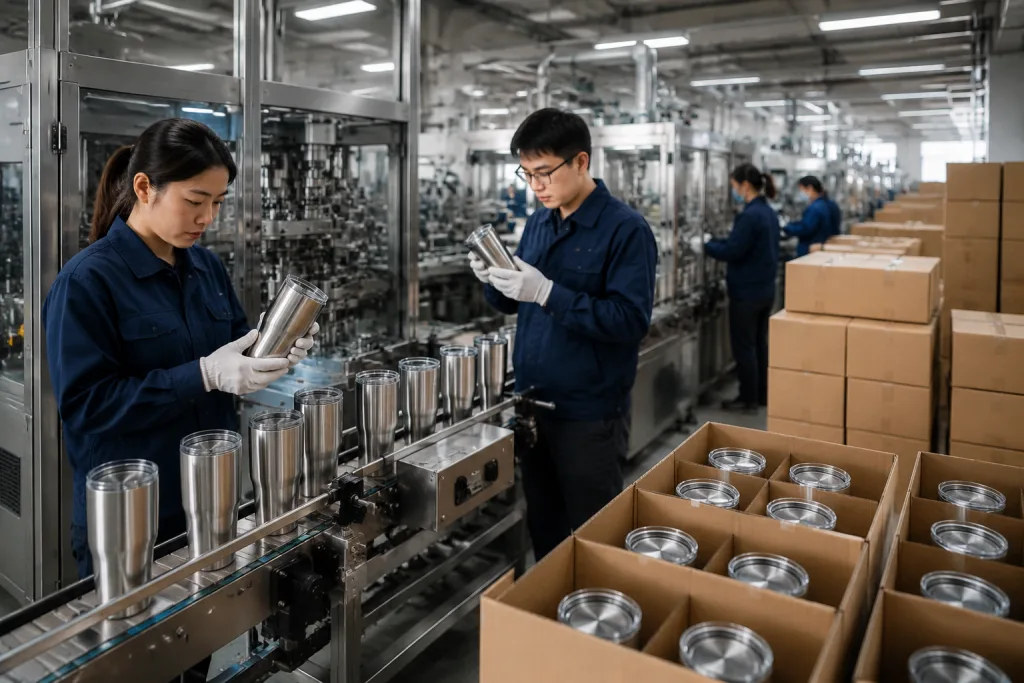
Key Takeaways
- A realistic MOQ for a coffee mug custom made travel tumbler is 1,000-3,000 pcs per color
- 304 stainless steel at 0.45-0.55 mm outer wall thickness is the normal B2B baseline
- Laser engraving is slower but usually cleaner than silkscreen for daily-use corporate gifts
- Plan 35-50 days after deposit and artwork approval for factory direct production in Zhejiang
You are not buying a souvenir mug. You are buying a handled drinkware item that ends up in cup holders, office desks, retail PDQs, onboarding kits, and Amazon FBA master cartons. If the lid leaks at 30° tilt, the coating chips after a 3M tape test, or the logo sits 3 mm off-center, your customer blames your brand, not the coffee mug factory in China. Fair or not, that is how claims land.
For coffee brands and corporate-gift buyers, travel mug customizable sounds simple until the line checks wall thickness, lid tooling, logo method, carton drop test, and private-label insert card. Our Hangzhou, Zhejiang team sees this 6 or 7 times a month: buyers push for the lowest unit price first, then the math breaks when QC pulls the sample, artwork approval takes 12 days instead of 4, and the order needs air freight to save a launch date. Starting with unit price is the wrong question to ask.
What are you really sourcing?
A buyer asking for a travel mug customizable is often starting with the wrong question. Color and logo come later. First we ask where the cup will be used, because a bulk coffee travel mug for a roastery subscription box is not built like a bulk travel tumbler for a 2-day sales conference or a private label retail line. The line setting changes fast: capacity, lid fit, carton burst strength, and what AQL 2.5 will allow on coating dust or tiny laser shadows. Last month QC pulled 80 pcs from a matte black run because the lid gap measured 0.6 mm over spec.
For coffee brands, we usually quote 12 oz, 16 oz, or 20 oz. A 12 oz cup works for espresso drinks and café shelves. A 16 oz travel mug fits most car cup holders; our go/no-go gauge is 74 mm at the lower body. Safe choice. A 20 oz tumbler looks better on a product page, but the math does not always work. One buyer pushed for 20 oz, then flagged the freight: the carton hit volume weight before actual kg became the issue, so the landed cost jumped even though the cup price looked fine.
Corporate-gift buyers usually care about perceived value and delivery date more than exotic tooling. We run a standard vacuum-insulated stainless steel body, powder coating, and laser logo through approval fast, often with a 7-day sample window if the artwork file is clean. Private label coffee mug programs are slower. You may need a custom lid, retail box, insert card, UPC, and color-matched packaging, and one typo on a PO color code can cost 4 days while the coating supplier remixes the powder.
At BottleForge Industrial in Hangzhou, Zhejiang, a normal coffee mug in bulk program starts at 1,000 pcs for existing molds and moves to 3,000-5,000 pcs when custom Pantone coating, private label packaging, or multiple lid colors come in. We ship travel tumbler lines that can produce about 480,000 units/month across standard stainless steel drinkware. Capacity is not the bottleneck if the spec is locked. If the buyer changes from sliding lid to flip lid after sampling, we have seen this go sideways: new leak testing, new foam insert, and 12 days vs 18 days before pre-production sample approval.
Which construction details matter?
Two coffee mug customizable quotes can look 6% apart until we open the BOM line by line. That is where the gap shows up: 0.38 mm steel instead of 0.5 mm, a 19 g lid instead of 28 g, thin spray paint, or a 5-ply carton swapped to 3-ply that fails the 1.2 m drop test. Photos hide this. Last month QC pulled the sample after carton corner crush showed 14 mm deformation on the third drop.
For a practical bulk coffee tumbler, ask for 304 stainless steel on the inner wall and get it written on the PI, not only in the chat. The outer wall can be 304 for better corrosion resistance, or 201 if the target price is tight and the market accepts it. For Europe and North America, we run 304/304 on coffee mug promotional orders meant for daily use, because the complaint math does not work when a buyer saves USD 0.12 and gets rust photos 45 days later. A typical wall thickness is 0.45-0.55 mm. Below 0.4 mm, dent risk rises during container loading and normal bag use; we check this with a digital caliper at incoming steel inspection.
Vacuum performance needs a real sample test, not a catalog promise. A decent double-wall travel mug should hold hot liquid above 55°C after 6 hours when tested from a 95°C fill at room temperature. We log it with a probe thermometer at 0, 2, 4, and 6 hours. Results change with lid opening, capacity, and body shape. A wide sip lid loses heat faster than a sealed screw lid. That is physics, not a factory excuse, and we have seen this go sideways when the buyer approved a slider lid but expected screw-lid heat retention.
- Body: 304 stainless steel inner wall, 0.45-0.55 mm typical thickness; QC checks 3 positions on the shell before polishing.
- Lid: PP, Tritan, or AS, chosen by clarity target and impact test result, not just by unit price.
- Seal: food-grade silicone ring, removable for cleaning when possible; we reject rings with flash over 0.3 mm because they leak after assembly.
- Finish: powder coating for grip, spray painting for bright color, raw steel when decoration risk is the main concern.
If a coffee mug supplier cannot confirm steel grade, coating type, and lid material in writing, the price is not finished. We ask for these 3 items on the quotation sheet before mold or logo work starts. A serious coffee mug manufacturer quotes the product, not just the shape, and the buyer should flag any PO typo like “304 inner / 201 inner” before the line opens.
How should the logo be applied?
Logo method is where 6 out of 10 coffee mug custom projects start to drift. The right choice depends on order qty, artwork line weight, how long the buyer expects the mark to last, and where the tumbler will be sold. For a coffee brand selling a tumbler next to beans and capsules, a weak logo makes the whole SKU feel cheap; we have seen reorders stop after QC pulled samples with uneven print edges under a 10x loupe. For a one-off HR gift, one clean front logo at 45 mm wide often does the job.
Laser engraving is our safest option on powder-coated 304 stainless steel. It cuts through the coating and shows the steel below, so the mark will not peel in a dishwasher test or after bag abrasion. We run it for corporate gifting, coffee mug customized programs, and premium retail items when the buyer wants a sharp, permanent finish. The tradeoff is color. Laser is not full color, and text below 1.2 mm height can look muddy on a curved wall, especially when the fixture is off by even 0.8 mm.
Silkscreen printing keeps cost under control for simple logos, usually 1 or 2 solid colors. It works best on bold artwork and smoother coatings; heavy texture can break small letters, and the buyer flagged this on a matte black sample last April. Heat-transfer printing handles gradients and busier graphics, but we still run a 3M tape test and abrasion rub before we approve it. UV printing suits small colorful batches, while on some coatings it sits on top and looks less built-in than laser or screen print.
For repeat coffee mug private labeling, approve one decoration standard sample and keep it sealed as the factory reference. A PDF mockup is not enough; we have seen one PO spell “Pantone 186C” as “Pantone 168C,” and the line followed the PO.
A coffee mug oem manufacturer should send an artwork proof showing logo size, distance from the bottom, print color code, and tolerance. For standard cylindrical tumblers, ±1.5 mm is a reasonable logo position tolerance if the jig is locked and checked every 200 pcs. For retail-facing coffee mug custom made goods, push for a pre-production sample before mass production, even if it adds 7-10 extra days. The math doesn't work if you save a week and then argue over 5,000 imperfect logos.
What MOQ and price are realistic?
Buyers pull up a coffee mug supplier directory or coffee mug supplier list and see prices that do not line up. We see this every week. One listing is a sample price for 1 pc, another is FOB at 10,000 pcs, and a third leaves out the gift box, logo plate, and AQL 2.5 inspection. The buyer flagged it only after the PO showed “white box” instead of “custom color box.” Compare quotes against one spec sheet, down to lid material, carton size, and logo method.
For a standard 16 oz stainless steel bulk travel mug, a realistic FOB China range is USD 3.20-5.80 per piece for 1,000-5,000 pcs, depending on steel grade, lid design, coating, logo, and box. A basic single-wall or plastic mug can sit below that, but this is the wrong comparison if your brief says vacuum-insulated travel tumbler. Different product. A premium handle tumbler with a complex lid, powder coating, and color box may run USD 6.00-9.50 FOB at moderate volume. On our line, QC pulled one 16 oz sample last month because the lid gap measured 0.7 mm over the approved sample, and that kind of lid is where cheap quotes go sideways.
MOQ depends on the bottleneck, not the sales pitch. Existing body mold with stock coating color can start around 1,000 pcs. Custom Pantone powder coating usually pushes MOQ to 2,000-3,000 pcs per color because the coating line needs setup, powder loss allowance, and a clean changeover. Custom lid tooling may require USD 2,000-8,000 tooling cost and 5,000 pcs+ to make commercial sense. Retail packaging with custom printed boxes may have a 1,000-2,000 pcs MOQ, but special paper or foil stamping can raise it. We run the math by station: body forming, vacuum test, coating, logo, packing. The bottleneck wins.
For coffee mug factory direct purchasing, ask for the price table by quantity: 1,000, 3,000, 5,000, and 10,000 pcs. Ask what changes at each tier, too: carton quantity, logo setup, mold fee, spare lids, inspection charge, and lead time. Sometimes the unit price drops only USD 0.18 from 3,000 to 5,000 pcs, but warehousing cost increases and the math doesn't work. For a corporate event, do not overbuy to chase a small discount. For a coffee mug distributor or coffee mug distributors serving repeat accounts, the higher tier may be worth it because reorder artwork is already stable and we can ship against the approved 1:1 print file without another pre-production sample.
What compliance should you request?
Compliance is not paperwork decoration. If you import into the EU, UK, US, or Canada, the travel mug touches food and hot liquid, so the file needs material safety, coating safety, plus proof the line is controlled. We usually ask QC to pull 2 sealed samples from the pre-production run, mark the cup body and lid with a paint pen, then send them to SGS, TÜV, Intertek, or BV. A responsible coffee mug manufacturer in China should already know this drill.
For Europe, request LFGB or EU food-contact testing based on the selling market, with REACH screening for coating or printed decoration where it applies. For the US, FDA food-contact requirements and California Proposition 65 matter more when the buyer sells through a distributor or Amazon account with 10,000+ monthly units. If the product is for children, ASTM and CPSIA considerations can apply, but most travel mugs for coffee brands are adult-use products. Do not label adult promotional drinkware as kids' drinkware unless it was designed and tested that way. We have seen this go sideways when a PO said “kids tumbler” by mistake and the buyer flagged it during artwork approval.
Factory audits are part of risk control, not a magic pass. BSCI, Sedex, ISO 9001, or a buyer-specific audit helps screen suppliers, but the audit must match the site running your order, not a sister workshop 18 km away. An audit does not guarantee every mug is perfect, but it shows whether the factory keeps process records, worker safety files, and batch traceability. In Zhejiang and nearby production clusters, plenty of factories can show certificates; the wrong question is “do you have a certificate?” Ask for the audited address and compare it with the business license before you pay the 30% deposit.
- Ask for material declarations for stainless steel, plastic lid, silicone seal, and coating, with grade names shown clearly, such as 304 stainless where specified.
- Confirm whether test reports are less than 12 months old and match the same material; a 0.6 mm body wall report should not be used for a different cup body.
- Use AQL inspection before shipment, commonly AQL 2.5 for major defects and 4.0 for minor defects; QC should open cartons, check lids for leakage, and record scratches under normal light.
- For Amazon FBA, confirm barcode labeling, carton weight, FNSKU placement, and master carton dimensions early, because a 16.8 kg carton vs an 18.5 kg carton changes the warehouse pushback fast.
How do you control sampling?
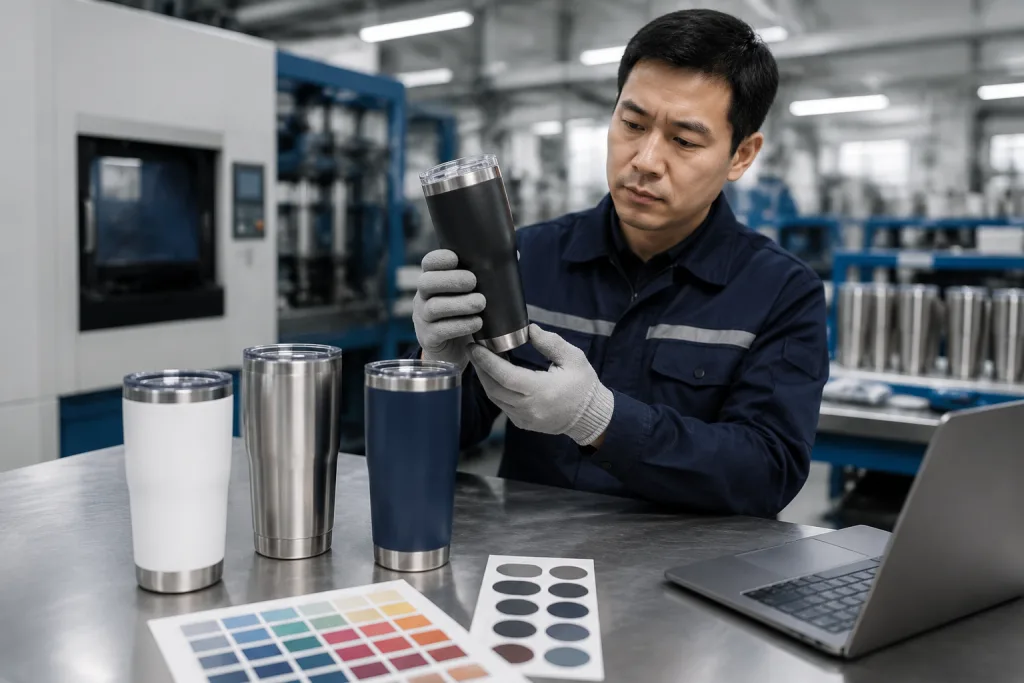
A sample is not a nice-looking mug for the meeting table. It is the first QC file. For a coffee mug promotional order, we often approve one blank sample first, then confirm logo size and position by photo or a decorated sample. For coffee mug private labeling or retail programs, approve the full set: mug, lid, logo, color box, carton mark, insert, barcode label, and the exact polybag spec. QC pulled one sample last month where the PO said “matte black,” but the artwork file named it “satin black”; that typo would have split the order if we had not caught it before coating.
Expect 3-7 days for an existing blank sample if the item is in our Zhejiang sample room. A decorated sample usually takes 7-12 days after artwork confirmation. A custom color sample takes 10-15 days because coating needs line scheduling, and the powder room will not stop a running batch for one sample. New tooling is slower: 25-40 days is common before you see a first article sample. We run the first check with calipers, a scale, and a simple water-fill test before it leaves Hangzhou.
Your approval checklist should be boring and specific. Measure capacity to the rim and the practical fill line. Check if the mug fits a standard car cup holder, usually around 70-75 mm diameter for the lower section. Shake the lid with hot water carefully to test leakage behavior. Rub the logo with a dry cloth, then a damp cloth. Put the mug in a bag for 24 hours and see if the coating marks too easily. One buyer once asked, “Does it look premium?” Wrong question. Ask whether the 0.5 mm logo shift, lid gap, or coating scratch will still pass when the line makes 5,000 pcs.
Once approved, lock the sample with a signed sample tag and photos. The production team should compare mass production against that reference, not against memory or a phone photo in a WeChat chat. If your coffee mug factory direct partner changes coating powder, lid resin, or carton structure after approval, you should be told before production. We have seen this go sideways: a carton changed from 5-ply to 3-ply to save freight space, and the buyer flagged crushed corners at arrival inspection. Silence turns small changes into expensive claims.
What belongs on your checklist?
Before you place a bulk coffee mug or bulk travel tumbler order, put the commercial details and technical specs into one purchase checklist. We see 7 out of 10 quote problems start when the sales quote says “20 oz powder coated,” the artwork file shows a full-wrap print, and the proforma invoice only says “travel mug.” The buyer flagged it too late. On our line, QC pulled the golden sample with a digital caliper and found the lid diameter at 86.4 mm, while the PO typo showed 84.6 mm. That small swap can delay ship-out by 6 days.
Procurement checklist
- Product type: handle travel mug, slim tumbler, car cup tumbler, or sealed commuter mug, with target use such as car holder fit or office desk use.
- Capacity: 12 oz, 16 oz, 20 oz, 30 oz, or metric equivalent, with brimful and usable volume confirmed.
- Material: 304/304 stainless steel, lid plastic type, silicone grade.
- Finish: powder coating, spray painting, polished steel, or electroplated finish, plus Pantone code and scratch-test requirement.
- Logo: laser, silkscreen, heat transfer, UV print, embossing, or debossing, with logo size in mm and print position from the bottom edge.
- Packaging: white box, kraft box, color box, mailer box, gift box, or FBA-ready carton, with carton weight limit if your warehouse caps it at 15 kg.
- Compliance: FDA, LFGB, REACH, Prop 65, BSCI, ISO 9001, as applicable.
- Inspection: AQL level, drop test requirement, carton marking, and defect classification, with AQL 2.5 written if that is your buying rule.
- Terms: FOB Ningbo or Shanghai, EXW, payment split, delivery date, and spare parts policy, including lid replacement rate if the program runs over 5,000 pcs.
If you are comparing a coffee mug supplier list, send the same checklist to every vendor. A low price from a coffee mug factory can be valid, but the math doesn't work if one quote uses 0.38 mm 304 stainless, another uses 0.42 mm, and a third skips individual white boxes. Last month we had a buyer push back on a USD 0.18 difference; after we checked the BOM, the cheaper quote had no silicone dust plug and no inner carton. Ask for the same steel, lid, packaging, logo process, and inspection standard. If one coffee mug supplier answers with a marked spec sheet and another sends 12 catalog screenshots, you already know who will be harder to run production with.
For repeat programs, keep a master specification under your own control. Coffee mug manufacturers change staff, factories change sub-suppliers, and distributors change sales contacts. We have seen this go sideways after a reorder used the old artwork named “final-final-v3.pdf” and printed the logo 5 mm higher than the approved sample. Your spec sheet is the project memory: sample photo, Pantone code, lid drawing, carton mark, barcode, MOQ, spare lid ratio, and the approved AQL 2.5 inspection rule.
Send your tumbler brief for a factory quote
Share capacity, logo, packaging, quantity, and target market. We will return a practical Zhejiang factory quotation with MOQ and lead time.
Frequently asked questions
What MOQ should I expect for a travel mug customizable order?
For existing molds, a practical MOQ is usually 1,000 pcs per style, with 2,000-3,000 pcs per color for custom powder coating. If you need a new lid, handle, or body tooling, expect 5,000 pcs+ and tooling fees from about USD 2,000 to USD 8,000 depending on complexity. For a coffee mug promotional campaign, use stock body shapes to stay fast. For coffee mug private label retail, higher MOQ is often justified because packaging, barcode control, and color consistency matter more.
How long does production take after I approve the sample?
For a standard bulk travel mug using an existing mold, normal mass production is 35-50 days after deposit and final artwork approval. Add 7-12 days for decorated samples before that. Custom Pantone coating can add 5-10 days, and new tooling can add 25-40 days before the first article sample. Ocean freight to North America or Europe is separate, often 25-40 days port-to-port depending on season and destination.
Which logo method is best for coffee mug customized gifts?
For daily-use corporate gifts, laser engraving on powder coating is the safest choice because it does not peel and handles washing better than many printed marks. Silkscreen is better when you need a specific one-color brand mark at lower cost. Heat transfer or UV printing works for complex artwork, but you should approve abrasion testing. For 1,000 pcs, decoration setup costs are manageable; for 5,000 pcs, a pre-production decorated sample is worth the extra week.
Can you make Amazon FBA-ready coffee mug in bulk orders?
Yes, but FBA details must be planned before carton production. You need FNSKU labels, suffocation warnings if polybags are used, carton weight control, and scannable barcodes on the retail unit. A common safe master carton weight is under 15 kg, though your forwarding plan may set a different limit. We also recommend individual drop protection for stainless travel mugs, because FBA handling is less gentle than palletized B2B delivery.
How do I compare coffee mug factory direct quotes fairly?
Ask every supplier to quote the same capacity, steel grade, wall thickness, lid material, coating, logo method, packaging, inspection level, and FOB port. A USD 0.40 cheaper quote may exclude color box packaging or use 201 outer steel instead of 304. Request prices at 1,000, 3,000, 5,000, and 10,000 pcs. Also ask whether the factory is the actual producer or a trading office. Factory direct can save margin, but only when communication and QC are strong.