Key Takeaways
- Use 0.45-0.55 mm 304 stainless steel for most custom travel mug bodies
- MOQ for factory-direct logo colors usually starts at 1,000-3,000 units per SKU
- Vacuum retention should be checked after 24 hours, not only after 6 hours
- AQL 2.5/4.0 inspection catches most cosmetic and functional shipment risks
A travel mug custom project looks simple until the quote sheet lands with 12 half-defined choices: 304 or 316, painted or powder coated, push lid or slider lid, gift box or bulk pack. Those boxes are not decoration. If you sell coffee, handle employee gifting, or run a coffee mug distributor program, each choice shows up later in complaint rate, carton cost, and reorder margin. Last month QC pulled 20 samples from the line because the PO said “black lid” but the approved sample used a smoky gray slider lid.
We manufacture drinkware in Hangzhou, Zhejiang, and 8 out of 10 problems we see start with loose specifications, not bad intent. A buyer asks for a bulk travel tumbler. A supplier quotes the lowest-cost lid and a 0.38 mm body. Nobody catches it until the first container lands in North America or Europe, then the buyer flags loose lids, dented cups, and retail boxes crushed under 11 kg master cartons. We’ve seen this go sideways. The cheap quote is often the expensive one.
Capacity Line Means Real Use
Capacity is the first line on a travel mug custom spec sheet, but treating it as a styling choice is the wrong question to ask. It decides whether the mug clears a Keurig outlet, sits in a 74 mm car cup holder, stays stable on a hotel desk, and fits 24 pcs into a courier carton without crushed corner protectors. For coffee brands, we run 12 oz, 16 oz, and 20 oz most often at retail; if you want fewer headaches, start with 12 oz and 16 oz. For corporate gift buyers, 16 oz is usually the safest pick because it feels solid in hand without turning a daily commute bag into a brick.
Do not approve capacity from the catalog name alone. Ask whether the stated size is brim-full capacity or practical fill capacity. A 16 oz tumbler may hold 480 ml to the rim but only 430-450 ml with the lid installed and 12-15 mm of spill space left. QC pulled the sample last month on a laser-marked order because the PO said “16oz real fill,” while the factory drawing showed brim capacity. If your package says 16 oz and users can only pour 14.5 oz of hot coffee comfortably, reviews will call it out.
For bulk coffee mug campaigns, carton efficiency hits the invoice fast. A straight-wall 20 oz model may look clean, but if it increases master carton volume by 18%, the math doesn't work on DDP quotes. We measured one sample at 89 mm top diameter, and that pushed the master carton from 56 x 43 x 36 cm to 60 x 47 x 41 cm for 24 pcs. A tapered bulk coffee travel mug cuts shipping cube and packs better on retail shelves. In China export quoting, FOB unit price is only half the math; CBM per 1,000 units can move the final cost by USD 0.20-0.60 per mug depending on freight rates.
If you are building a coffee mug private label line, standardize around two capacities first. Too many sizes mean extra lids, inserts, FNSKU labels, and replenishment delays; we have seen this go sideways when a buyer approved 5 sizes and then reordered only 2. The line had to hold 3 lid molds and 4 insert dielines for an MOQ of 1,000 pcs per color. A focused coffee mug customizable range sells better than a broad range nobody can reorder cleanly.
Steel Grade And Wall Thickness
The material line should never read only “stainless steel.” For a coffee mug custom made program, write the inner steel grade, outer steel grade, pre-forming gauge in mm, and the food-contact standard on the PO. We normally run 304 stainless steel for the inner wall from our Zhejiang line, then 201 or 304 outside based on the buyer’s target FOB. Premium retail should be 304 inside and outside. For coffee mug promotional products tied to a 30-day campaign, 304 inner plus 201 outer is workable if polishing, salt-spray checks, and LFGB or FDA testing are locked before mass production. QC pulled one sample last month where the PO said “SS mug” and the buyer flagged rust spots on the outer base after 48 hours. That wording caused the problem.
Typical wall thickness for a good bulk travel mug is 0.45-0.55 mm before forming. Below 0.40 mm, dents show up faster during carton drop tests and daily use; we see it around the shoulder after a 76 cm drop. Above 0.60 mm, the math usually does not work because cost and weight rise while the coffee user feels little difference. For lids, ask for PP or Tritan material with LFGB or FDA food-contact documentation. Silicone seals should be food-grade, then odor-tested after 95°C hot water exposure for 2 hours.
Vacuum construction also matters. Double-wall vacuum insulation is not double-wall air insulation. A real vacuum coffee mug in bulk order should be checked with boiling water, an outer-wall touch test using an IR thermometer, and temperature readings after 6 hours and 12 hours. For most 16 oz travel tumblers, a practical target is hot retention above 55°C after 6 hours under room temperature conditions. Claims like “keeps hot 24 hours” need a written test method, or your customer service team inherits the argument. We have seen this go sideways when a catalog claim used 24 hours, but the lab sheet only showed 12 hours at 20°C.
For buyers comparing a coffee mug supplier list or coffee mug supplier directory, ask each factory to state the steel grade, the exact gauge range such as 0.50 mm ±0.03 mm, and whether the cup is vacuum or air insulated in the quotation. If one coffee mug manufacturer is USD 0.40 cheaper but cannot confirm gauge, you are not comparing the same product. This is the wrong question to ask: “Can you match the price?” Ask, “Can you match the spec and pass AQL 2.5 after production?”
Lid System And Leak Claims
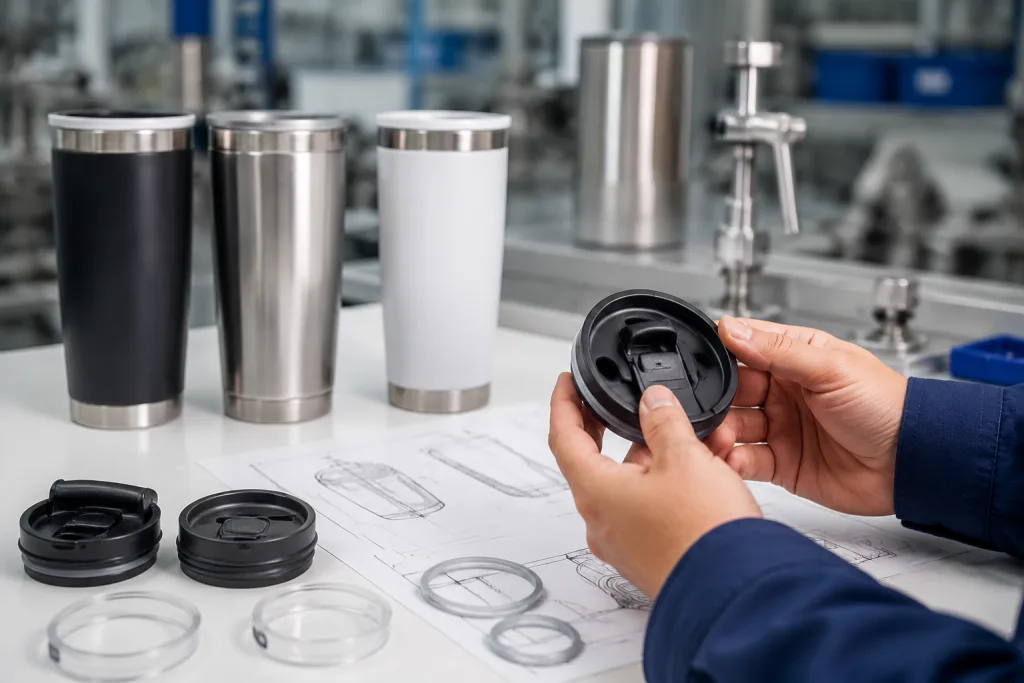
The lid is where most travel tumbler complaints start. The body can pass vacuum and polish checks, then a weak slider or a 0.3 mm gap at the silicone ring makes the buyer call the whole mug cheap. Your spec sheet should name the lid type: push-on, screw-on, flip-top, slider, straw lid, or 2-in-1, with the gasket material and thread pitch if it is screw-on. For coffee, we push buyers toward screw-on lids because leakage risk drops in carton drop tests and daily use. Push-on lids cost less and drink faster, but they live or die by gasket compression and cup mouth tolerance; QC pulled one sample last month where the cup ID was 0.6 mm over drawing, and the lid failed before the body did.
Be careful with the word leakproof. This is the wrong question to ask if nobody defines the test. About 7 out of 10 travel coffee lids we see in buyer briefs are splash-resistant, not leakproof. A slider lid can handle the walk from kitchen to desk, then leak when it sits sideways in a backpack beside a laptop. If your sales copy says leakproof, ask for an inversion test: filled to 90%, lid closed, inverted for 30 minutes, then shaken 20 times. We run this over a dry tissue sheet on the QC bench. If it passes only when upright, call it spill-resistant instead. Honest wording prevents chargebacks.
For a bulk coffee tumbler used in corporate gifting, one-hand operation matters. People use it while commuting, not posing for a catalog photo. A flip button with a lock is more practical than a decorative lid that needs two hands, and we have seen this go sideways when a buyer chose a shiny cap that failed the thumb-open test after 300 cycles. For a coffee mug customized retail line, drinking comfort beats novelty. Check the mouth opening with hot water flow, not just cold water; if the opening is too wide, hot coffee comes out too fast, and the buyer flagged it as a burn-risk complaint during sample review.
Spare parts should be discussed before mass production. A serious coffee mug factory can supply replacement silicone rings and lids, but small runs are not always workable because the lid line needs color changeover, gasket sorting, and separate packing. At BottleForge Industrial, our Hangzhou, Zhejiang production planning usually sets lid accessory MOQ at 1,000 pieces per color. Small detail. Until a distributor asks for after-sales parts six months later and the PO says “black lid” while the approved sample was Pantone 426C.
Finish, Color, And Logo Method
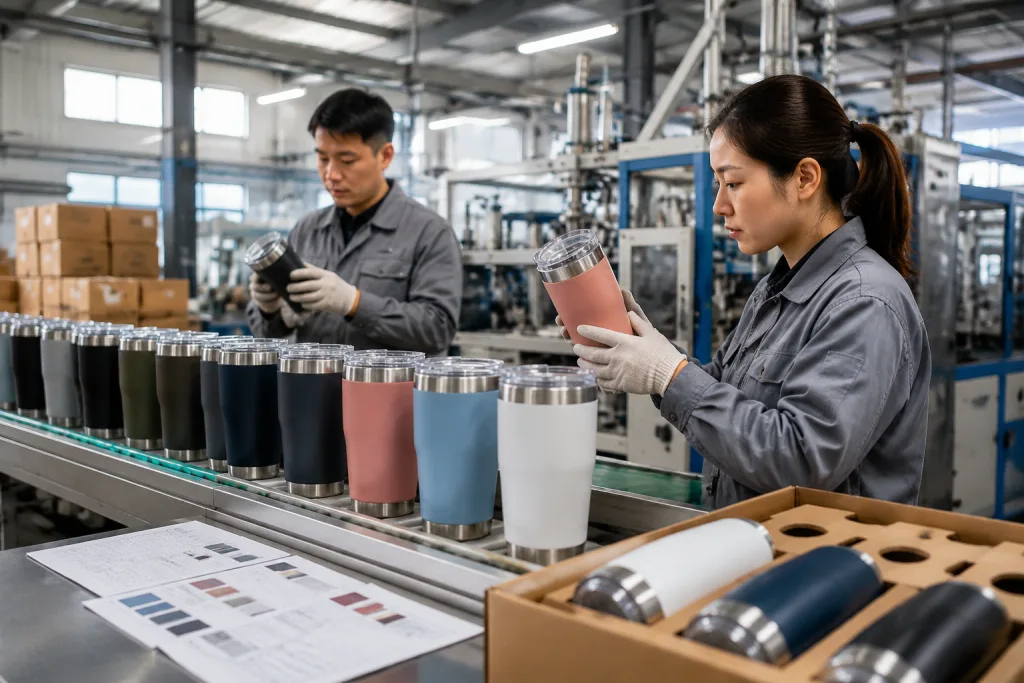
Finish sells the tumbler before the buyer touches it, but it is also where QC rejects start. We run spray paint, powder coating, stainless polish, matte sanding, rubberized coating, and electroplating, although I would not treat them as equal choices. For coffee brands, powder coating is the safer pick because our 3M tape test and 500-cycle rub test usually beat basic spray paint. For budget corporate gifts, spray paint works if the buyer accepts a lighter abrasion standard and stays away from black, navy, and dark green, because QC pulled 37 scuffed samples from one dark-color order last year.
Logo method has to match the finish. Laser engraving stays clean on powder-coated or painted stainless steel because it cuts through the coating and shows the metal below. Silk screen printing gives tighter Pantone color, but it wears faster near the thumb area; we have seen logos lose edges after 300 rubs on the line tester. Heat transfer and water transfer handle full-color artwork, but adhesion testing matters more here, and this is where we have seen things go sideways. For a coffee mug promotional campaign, one-side silk screen is often enough. For coffee mug private labeling in retail, laser engraving or a quality transfer gives the shelf look buyers expect.
Pantone matching is not magic. This is the wrong question to ask if the buyer only sends a JPG proof. On curved stainless steel, color changes with coating thickness, surface texture, and oven setting; a 0.02 mm coating difference can shift a warm gray into a colder tone. Ask for a color chip or pre-production sample, not just a digital proof. We usually allow ±5% visual tolerance for production color against the approved sample because oven temperature, powder batch, and substrate finish all move the final result. QC checks it under a D65 light box, not under the office ceiling lamp.
For coffee mug factory direct orders in China, custom logo MOQ often starts at 1,000 units for one color and one position. Full custom colors usually need 3,000 units per SKU because the coating line loses 2 to 3 hours during gun cleaning and color changeover. Our Zhejiang facility can produce about 450,000 stainless tumblers per month, but a 600-piece custom color run still blocks the line and the math does not work. We ship small runs when the buyer accepts the setup cost, but nobody likes seeing a PO typo that says “mat balck” after the powder has already been booked.
Packaging, Barcodes, And Retail Flow
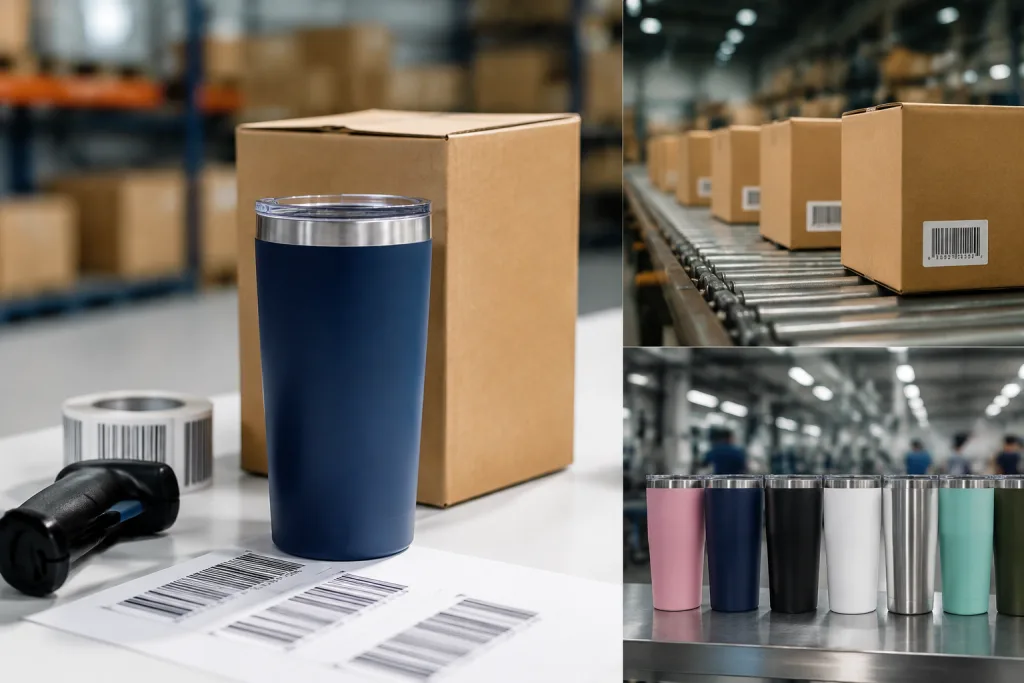
Packaging is not decoration. It sets the breakage rate and decides whether the warehouse team scans the goods straight in or sends them to a relabeling corner. For bulk coffee mug programs going to offices or events, egg-crate bulk packing is often the right call: usually 24 or 48 pieces per master carton, each mug in a 0.03 mm polybag or a paper sleeve. Simple works. For retail coffee mug custom lines, we run an individual color box with insert, barcode, country-of-origin marking, and care instructions printed where the buyer’s receiving team can find them without opening 600 cartons.
If you sell through online marketplaces or retail distribution, lock barcode and label placement before artwork approval. FNSKU, UPC, EAN, suffocation warnings, carton marks, and mixed-SKU carton rules fight for space on a box panel that may be only 85 mm wide. We’ve seen this go sideways. One Amazon buyer flagged an FNSKU placed across a box fold, and the reprint pushed shipment back 7-10 days because the printing factory needed new plates, drying time, and packing line coordination.
Gift buyers often underestimate carton strength. A 16 oz stainless tumbler in a color box may weigh 300-380 g. A master carton of 24 pieces can exceed 10 kg, and the math does not work if the buyer asks for thin cartons just to save USD 0.06 per unit. Use at least 5-ply export cartons for long-distance sea shipment, and ask for a drop test from 60-80 cm depending on carton weight. QC pulled one sample last May with a crushed corner after the third edge drop; for glass-lined or ceramic-coated travel mugs, increase inner protection and reduce carton count.
For coffee mug distributors, mixed-color packing needs discipline. If your purchase order says 4 colors x 250 units, confirm whether cartons are single-color or mixed before the line starts packing. Single-color cartons make receiving and wholesale allocation faster. Mixed cartons help event kits, but counting errors show up fast when one carton has red, blue, black, and white cups under the same PO. A good coffee mug supplier will add carton-level labels showing SKU, color, quantity, PO number, and gross weight; we also check the PO number twice because one buyer once sent “PO 2308-1” on artwork and “PO 2308-I” on the carton mark file.
Testing, Compliance, And Inspection
Testing is where you spot a real coffee mug oem manufacturer, not a catalog trader with 12 borrowed photos. For Europe, we ask for LFGB food-contact testing, REACH restricted-substance checks, and the exact carton/label rules before artwork approval; our lab clerk has caught “LFGB” typed as “LFBG” on a PO more than once. For North America, FDA food-contact expectations and California Proposition 65 screening need to be agreed before the first PP sample. If the mug is for children, ASTM or CPSIA requirements may apply. Most travel tumblers for coffee are adult products, so don’t overbuild the test plan just to look safe.
A workable quality plan covers incoming material checks, in-process vacuum testing, coating adhesion testing, lid fit checks, and final AQL inspection with photos tied to carton numbers. On the line, QC uses a digital caliper to check lid thread height in mm and pulls 304 stainless coil certificates before welding starts. For general drinkware shipments, AQL 2.5 for major defects and 4.0 for minor defects is common. Critical defects such as sharp edges, contamination, cracked lids, or leaking seams should be zero tolerance. Factory photos are not inspection. We have seen that go sideways.
For vacuum performance, sample from finished goods, not only from early production sitting beside the sales office. We run at least 20 pieces per 5,000-unit lot for insulation, lid fit, and cosmetic appearance; QC pulled the sample from sealed export cartons last week, not from the clean top layer. Adhesion can be checked with a cross-hatch tape test using 3M 600 tape. Odor can be checked by filling with 90°C water for 30 minutes, then smelling the lid and silicone. Basic test. Fast answer. It catches cheap plastic problems before the buyer flags the whole shipment.
If you are choosing between coffee mug manufacturers, ask for their last three inspection reports with customer names removed. The format tells you plenty. A factory that records defect type, defect rate, corrective action, and operator line is easier to manage than one that sends six polished photos from a light box. We ship from Hangzhou/Ningbo often, and a 0.8 mm paint chip near the logo can turn into a chargeback if the spec says “no visible scratch at 30 cm.” China has excellent drinkware factories, but written standards still beat friendly promises.
MOQ, Pricing, And Reorder Control
Read a travel mug custom quote line by line. A normal 16 oz stainless vacuum tumbler from a coffee mug factory in Zhejiang usually sits around USD 2.60-4.80 FOB Ningbo or Shanghai, depending on steel grade, lid system, coating, logo method, retail packing, and inspection level. Ceramic coating, handle lids, retail boxes, or full-color wrap printing will move the number up fast; on our line, the coating oven alone adds one setup slot and about 2 hours of color-change cleaning. If one supplier comes in 25% under the market, don’t celebrate yet. Ask for wall thickness in mm, vacuum pass rate, lid material, and carton packing specs.
MOQ is not just a sales rule. It comes from stainless sheet purchasing, powder coating line setup, logo fixture setup, and printed carton runs. For stock colors with a laser logo, 500-1,000 units can work if the warehouse has bodies ready. For coffee mug customized body colors, 3,000 units per color is the number we usually quote, because a 200 kg powder batch does not make sense for 600 pieces. For a fully new mold, expect 8,000-20,000 units depending on tooling cost and body complexity. We’ve seen buyers push for 1,000 pieces on a new shape; the math doesn’t work.
Split the lead time. Sampling usually takes 7-15 days if we run an existing mold, and QC can pull the first sample for leak testing within 24 hours after assembly. Mass production takes 25-40 days after deposit and sample approval. Sea freight to North America or Europe can add 25-45 days depending on port and season. For holiday corporate gifts, place the PO at least 90 days before the delivery deadline; one buyer once typed “Sept 30” instead of “Aug 30” on the PO, and that single typo killed the promo window. Air freight can rescue timing, but it can add USD 1.50-4.00 per unit on drinkware.
Reorder control is where 6 out of 10 coffee mug private labeling programs either protect margin or leak money. Keep the same lid, gasket, coating code, and carton dimensions across reorders unless you mean to change the SKU. The buyer flagged it once when a gasket shifted from 2.8 mm to 2.5 mm; the cup still looked right, but the leak test failed after 3 minutes upside down. Ask your coffee mug manufacturer to keep a golden sample for 12 months. When your second order arrives, compare it against that sample, not against memory.
Send your tumbler spec and target landed cost
We will review capacity, lid, finish, MOQ, packaging, and FOB pricing before you lock the purchase order.
Frequently asked questions
What MOQ should I expect for a travel mug custom order?
For an existing stainless travel mug with stock body color and one laser logo, MOQ is usually 500-1,000 units. If you need a custom Pantone body color, plan for 3,000 units per color because the coating line has setup loss and cleaning time. Retail packaging with custom printing may also require 1,000-3,000 boxes. New molds are a different discussion: most coffee mug factory direct projects need 8,000-20,000 units to justify tooling, unless you pay the tooling cost separately.
Is laser engraving better than printing for coffee mug custom branding?
Laser engraving is usually better for durability, especially on powder-coated stainless steel. It does not peel because it removes the surface coating and exposes the metal. Silk screen printing is better when you need exact logo colors, but it should be tested for abrasion and dishwasher exposure if you plan to claim dishwasher safe. For coffee mug promotional products, one-color printing can be cost-effective. For retail coffee mug private label programs, laser or high-grade transfer normally gives fewer complaints over 6-12 months of use.
How do I compare quotes from different coffee mug suppliers?
Put every quote into the same spec grid: capacity, brim-full volume, 304 or 201 steel, wall thickness, lid material, coating type, logo method, individual packaging, carton quantity, FOB port, lead time, and inspection standard. A USD 3.10 mug and a USD 3.55 mug may not be comparable if one uses 0.38 mm steel and basic spray paint while the other uses 0.50 mm steel and powder coating. Ask each coffee mug supplier to confirm AQL level and compliance documents in writing.
Can a bulk coffee travel mug be dishwasher safe?
Some can, but do not assume it. Stainless bodies usually tolerate washing, but coatings, printed logos, lid sliders, and silicone seals may degrade. If dishwasher-safe claims matter, request testing for at least 20 wash cycles before approval, and test finished production, not only a sample. Powder coating and laser logos perform better than basic spray paint and screen print. Many brands still write “hand wash recommended” because it reduces risk, especially for corporate gift mugs that may be used hard.
What lead time is realistic for a coffee mug customized project?
For an existing model, sample preparation usually takes 7-15 days. Mass production is commonly 25-40 days after deposit and final sample approval. Add 25-45 days for sea freight to Europe or North America, plus local customs and delivery. If you need custom color, retail box printing, or third-party inspection, add buffer. For a holiday gift program, start at least 90 days before the required delivery date. For a new mold, add 25-45 days for tooling and trial production.