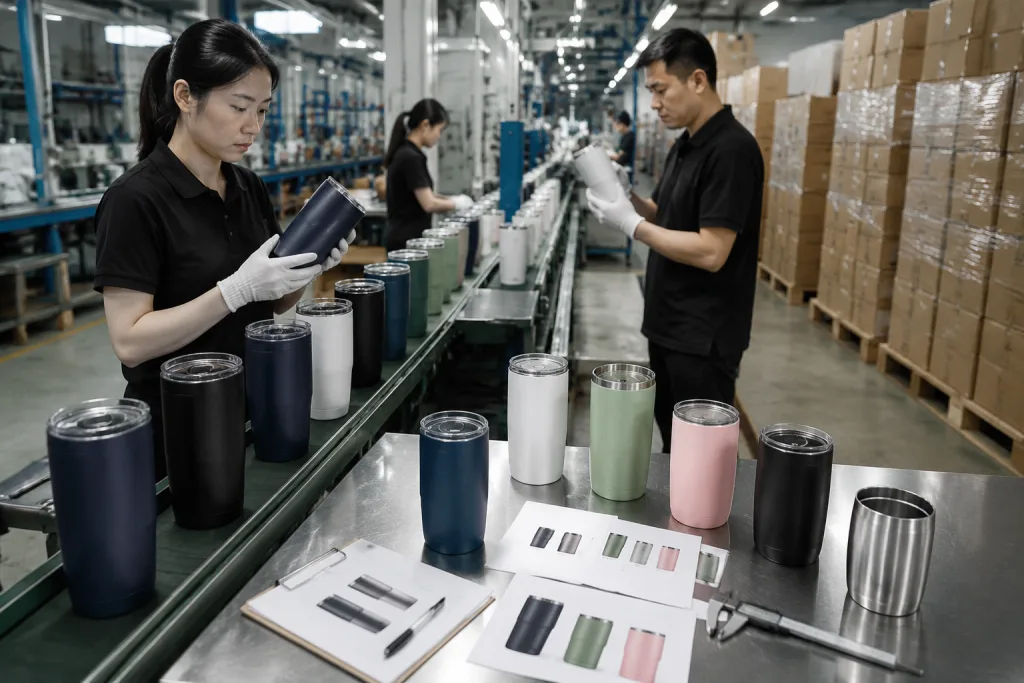
Key Takeaways
- 304 stainless steel travel tumblers usually sit at USD 3.20-6.80 FOB Ningbo at 1,000-3,000 pcs
- Double-wall vacuum is the right baseline for coffee brands; single-wall is rarely worth the complaint risk
- Laser engraving lasts longer than pad print on powder coating, but costs about USD 0.12-0.35 more per unit
- BottleForge Industrial in Zhejiang can produce 450,000 drinkware units/month with a typical 35-45 day lead time
A travel mug custom made for a coffee brand is not a 3-day promo cup order. Your buyer will drink 92°C coffee from it, throw it in a car cup holder, wash it every Monday, and blame your logo if the lid seeps. We’ve seen this go sideways: QC pulled 20 samples from a 1,000 pcs lot, and 3 lids showed tiny leakage after the 45° tilt test.
Sourcing mistakes usually start with a loose RFQ: “500 ml stainless tumbler, logo, good quality.” A coffee mug factory in China can quote that 10 different ways, and the cheapest version often hides a thinner wall or a lid mold nobody wants to discuss. From our line in Zhejiang, the better question is simple: 0.5 mm or 0.6 mm wall, flip lid or slider lid, powder coating or spray paint, FDA or LFGB test, 24 pcs carton or 48 pcs carton, and MOQ 500 pcs or 3,000 pcs.
The head-to-head spec table
If you are comparing a bulk coffee mug, bulk coffee travel mug, bulk coffee tumbler, bulk travel mug, or bulk travel tumbler, don’t open the discussion with the logo method. That is the wrong question to ask first. Start with how the cup will be used. Coffee brands usually care about 6-hour heat retention, lid leak rate below 1.5% in our tilt test, and a hand feel that does not feel like thin promotional stock. Corporate-gift buyers push harder on landed cost, repeat supply, and whether the second PO matches the first; we had one buyer flag a 1 mm color drift on a reorder, and QC pulled the sample under the light box before packing.
| Spec route | Best fit | Typical capacity | FOB China range | MOQ | Risk point |
|---|---|---|---|---|---|
| Double-wall vacuum tumbler | Coffee retail programs, staff gifts with logo engraving, loyalty packs needing 6-hour heat retention | 350-600 ml | USD 3.20-6.80 | 1,000 pcs | Lid seal tolerance, usually checked with a 180° invert test |
| Handle travel mug | Corporate desk programs and commuter sets where buyers ask for a firm grip | 400-500 ml | USD 3.80-7.20 | 1,000 pcs | Handle welding strength and carton breakage after the 80 cm drop test |
| Ceramic-lined stainless mug | Premium coffee flavor positioning where buyers reject metallic taste | 350-480 ml | USD 5.20-9.50 | 1,500 pcs | Liner chipping in drop tests, seen most often around the rim radius |
| Plastic promotional travel cup | Short campaign giveaways with tight event dates and simple one-color print | 350-450 ml | USD 1.10-2.40 | 3,000 pcs | Heat deformation and low perceived value after hot-water filling |
For a coffee mug custom made project, the first row is usually the safer default. We run this spec often. A 500 ml double-wall 304 stainless body with 0.4-0.5 mm outer wall, 0.3-0.4 mm inner wall, PP lid, silicone gasket, and powder coating gives a practical balance between cost and shelf appeal. It is not the cheapest coffee mug in bulk option; the math doesn’t work if the buyer expects retail feel at USD 1.80. On the line, our caliper check at rim rolling catches most thin-wall issues before polishing.
From our Hangzhou, Zhejiang production base, a normal travel mug custom made order runs 35-45 days after sample approval. New tooling for a fully unique body can add 20-30 days, and 12 days for mold adjustment is normal if the lid thread needs correction after the first T1 sample. If a coffee mug supplier promises a new private mold, custom color, retail box, and air shipment in three weeks, ask what is being skipped. We’ve seen this go sideways: one PO even had the Pantone code typed as 186C instead of 168C, and the buyer only caught it after the pre-production sample photo.
Coffee brand versus gift campaign
Coffee brands and corporate-gift buyers ask us for the same travel mug body, then judge the shipment by different yardsticks. The coffee buyer cares about sip feel, heat hold, and whether the cup makes a 90 RMB bag of beans feel cheap. The HR buyer cares about delivery date, landed cost, and whether the CEO’s logo looks clean on 2,000 desks. We saw this on a PO last March: the buyer wrote “matte sand beige,” but the artwork file said Pantone 7501C. QC pulled the sample under the D65 light box before we ran the line.
For coffee brands, I push toward vacuum insulation, a smooth drinking rim, and a lid that can be stripped for washing by hand. Daily use is brutal. Powder coating at 60-80 microns with laser engraving holds up better than a 70 mm printed logo wrapped around a glossy curved wall. If you sell specialty coffee, ceramic lining is worth testing, but do not buy it on a nice sample photo. We run thermal shock checks from hot fill to cold rinse, then a 1 m drop check, because ceramic-lined mugs feel better for flavor-sensitive customers only if the liner stays clean and uncracked.
For corporate gifts, the better call is a standard body with your logo, house color, and retail box spec tied down. You can still call it coffee mug customized if the visual identity is yours, and you skip the 8,000-15,000 USD mold bill. A coffee mug promotional project for 2,000 employees does not need a new lid shape. It needs color tolerance inside Delta E 1.5, readable branding at 5 mm stroke width, and 5-ply export cartons that do not collapse after 28 days on the water. We have seen this go sideways when the buyer spends money on a custom slider lid, then cuts the carton budget.
Here is the practical split we use before quoting:
- Coffee retail: 350-500 ml, premium coating with 60-80 micron target, laser logo, individual kraft box, barcode sticker.
- Subscription insert: 300-400 ml, lighter body around 210-260 g, compact carton to keep the shipping cube down.
- Corporate gift: 450-600 ml, decoration area of at least 70 mm wide, gift box, fast repeatability for reorder runs.
- Event giveaway: stock mold, one-color print, no custom lid, MOQ from 1,000-3,000 pcs.
A good coffee mug manufacturer should tell you when your requested spec is overbuilt. A good coffee mug oem manufacturer should also tell you when it is underbuilt. Both conversations save money. Last week a buyer asked for 304 stainless, ceramic lining, full-color print, and a window box for a 3 USD target price; the math did not work, so we cut the spec before sampling instead of wasting 12 days.
Body, lid, and insulation trade-offs
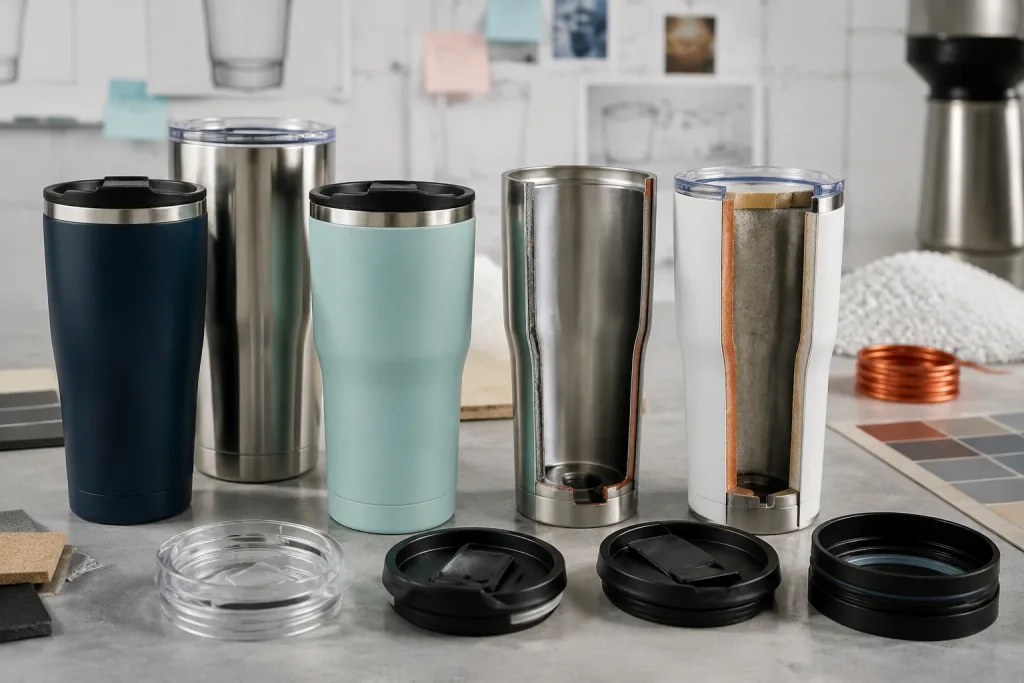
Body construction drives most of the complaints we hear after launch. For a bulk coffee travel mug, 304 stainless steel is the standard food-contact spec we run on the line; our incoming sheet check is usually 0.5 mm wall stock before forming. 316 stainless can be made, but the math often does not work unless the buyer has a marine gift program, high-salt market, or a premium story printed on the shelf card. The price increase can be 8-15 percent without a visible benefit for normal coffee use.
Vacuum insulation is not a slogan. A properly evacuated double-wall tumbler should keep hot water above roughly 55°C for 6 hours under common lab conditions, depending on capacity and lid opening. On our 500 ml sample bench, QC pulled 8 cups from the pilot run and the wide-mouth version lost heat about 9 minutes faster in the first hour than the narrow-mouth version. Wider mouths bleed heat. Slider lids lose more heat than sealed screw lids. Straw lids are the wrong choice for hot coffee, even when a retail buyer pushes for “one lid for everything.”
Lids need more attention than buyers usually give them on the first RFQ. PP is common, Tritan looks clearer on a retail shelf, and silicone gaskets should be food-grade with a clean mold edge; we reject gasket flash above 0.3 mm because it can roll during assembly. For EU programs, ask for LFGB or relevant food-contact testing. For North America, align with FDA food-contact expectations and, where needed, California Proposition 65 screening. If children may use it, ASTM-related safety questions matter more, though this article is focused on adult travel tumblers.
Leak claims need exact wording. “Splash resistant” means it should handle walking and car movement. “Leakproof” means the buyer may throw it into a bag. Those are different lid builds. A push slider lid works for drinking in a car, but we would not sell it as bag-safe unless it passes inversion and pressure tests; we have seen this go sideways when a PO says “leakproof” but the approved sample was only splash resistant. At BottleForge Industrial, we normally run hot water inversion checks, gasket fit checks, and sample aging before mass production.
If you are building a coffee mug private label line, keep the first generation simple: one body, two colors, one lid, one carton. We usually tell new buyers to start with a 1,000 pcs MOQ per color and one inner-box layout, because changing cartons after barcode approval can add 12 days vs 18 days when the artwork file has a wrong Pantone code. After sell-through data, expand.
Decoration methods compared honestly
Decoration is where 7 out of 10 coffee mug custom made projects start to slip. Buyers ask for a sharp logo, low unit cost, dishwasher resistance, 5-day sampling, and zero setup charge on the same PO. The math does not work. Last month our sales desk caught one PO typo listing “laser print” instead of “laser engraving,” and QC had to pull the gold powder-coated sample before the line started.
Laser engraving is the safest choice for stainless and powder-coated travel mugs. It cuts through the coating and shows the metal below, so the logo will not peel like ink. We run it on 304 stainless bodies with a 20W fiber laser, usually set around 600-900 mm/s depending on coating thickness. It suits corporate logos and clean retail marks. The weak point is color. Laser is single-tone by nature, and on matte black or dark green coating the mark can look quieter than the buyer expected. Budget about USD 0.12-0.35 per unit depending on logo size and order volume.
Silkscreen printing works well for one- or two-color artwork on straight walls. It is a good fit for a coffee mug promotional order when the logo line is not thinner than 0.2 mm. Curved bodies and tapered tumblers make registration harder; our screen room rejects more samples on 6-degree tapered cups than on straight 500 ml mugs. Pad printing is fine for a small front logo. I would not choose it for a premium bulk coffee tumbler unless the artwork is simple and the buyer accepts a smaller print area.
Heat transfer and water transfer handle full-color artwork. They sell well in photos, but the finish lives or dies by film quality and top coating. We have seen this go sideways when a buyer approved a studio photo and skipped adhesion testing. If you want a wraparound campaign graphic, ask for cross-hatch adhesion testing, dishwasher-cycle references, and abrasion testing with a 500 g load. QC pulled one sample after 30 dishwasher cycles because the edge lifted near the seam by 2 mm.
For a coffee mug customizable range, the stronger commercial setup is one shared blank body with two or three decoration routes. Distributors can sell laser engraving for executive gifts, silkscreen for event programs, and full-color transfer for seasonal retail if the body diameter stays consistent, say 73 mm at the print zone. That gives your coffee mug distributors room to quote faster without opening three molds or holding 3,000 pcs of slow-moving stock.
A plain tumbler with a durable logo usually beats a complicated design that fails after 20 washes. QC sees it first.
MOQ, tooling, and real pricing
MOQ follows the part you change. For a stock-shape coffee mug factory direct order, we can run one standard powder color from about 1,000 pcs; our coating line normally books a 4-hour color-change window and the spray booth still needs cleaning. Custom Pantone powder coating is usually 2,000-3,000 pcs. Below that, the math doesn't work because powder loss and line setup eat the margin. A new lid mold can start around USD 3,000-8,000, and a new stainless body mold may range from USD 6,000-20,000 depending on shape, drawing depth, and tooling complexity. Last month QC pulled a 500 ml body sample with a 0.4 mm lip variation, and that small number was enough to make the lid fit feel loose.
For a normal 500 ml travel mug custom made project, these are realistic China FOB reference ranges at 2026 material and labor conditions. We quote from a locked spec sheet, not from a WhatsApp photo; one buyer once typed “matte black” on the PO and sent a glossy black artwork file, which cost 2 days before mass production could start.
- Stock stainless vacuum tumbler, one-color logo: USD 3.20-4.80 at 3,000 pcs, with logo position checked by caliper before packing.
- Powder-coated tumbler with laser engraving: USD 4.10-6.20 at 1,000-3,000 pcs, after we run a 20 pcs engraving test on the line.
- Ceramic-lined travel mug with retail box: USD 5.80-9.50 at 1,500-3,000 pcs, with inner coating chips checked under a 600-lux inspection lamp.
- Custom molded premium set with gift packaging: USD 7.50-12.00 before tooling recovery, usually with 1 pilot mold sample round before bulk tooling sign-off.
Prices move with steel cost, exchange rate, packaging, inspection level, and whether you want FOB Ningbo, FOB Shanghai, EXW Hangzhou, or delivered duty paid. Zhejiang sits close to both Ningbo and Shanghai ports, so we can switch routing when a vessel rolls, but freight still needs planning. A 500 ml stainless tumbler with gift box may pack 24 pcs per export carton, around 11-14 kg gross weight. Carton cube matters when you ship 5,000 pcs; we've seen this go sideways when a buyer approved a taller retail box and the container load dropped by 18%.
If you compare a coffee mug supplier directory or coffee mug supplier list, ask each supplier to quote the same spec sheet. Same wall thickness. Same lid test. Same carton burst strength. Otherwise, the cheapest quote is often thinner steel, a weaker lid, no inspection, or a lighter carton. As a coffee mug manufacturer, we would rather lose a quote than win it with an unclear spec; our QC table has too many rejected samples from projects that started with “just match the photo.”
Compliance and inspection checkpoints
For Europe and North America, put compliance into the PO before we run the line. Do not treat it as paperwork after packing. A travel mug touches hot coffee and the buyer’s mouth, so your importer of record will ask for test reports when customs, Costco-style retail QA, or a corporate gift client flags the shipment. We have seen a PO typo change “FDA test required” to “FDA material required”; QC pulled the sample, but the document trail was already messy.
For EU buyers, REACH screening and food-contact documentation are normal requests. LFGB testing comes up often for Germany and stricter retail programs. For North America, FDA food-contact expectations, BPA-free declarations for plastic lids and straws, and Proposition 65 review may apply. If the mug is sold as reusable or sustainable, back the claim with material data. “Eco-friendly” is the wrong word to lead with. “304 stainless steel body, reusable, packed in FSC paper box on request” gives a buyer something they can put into their compliance folder.
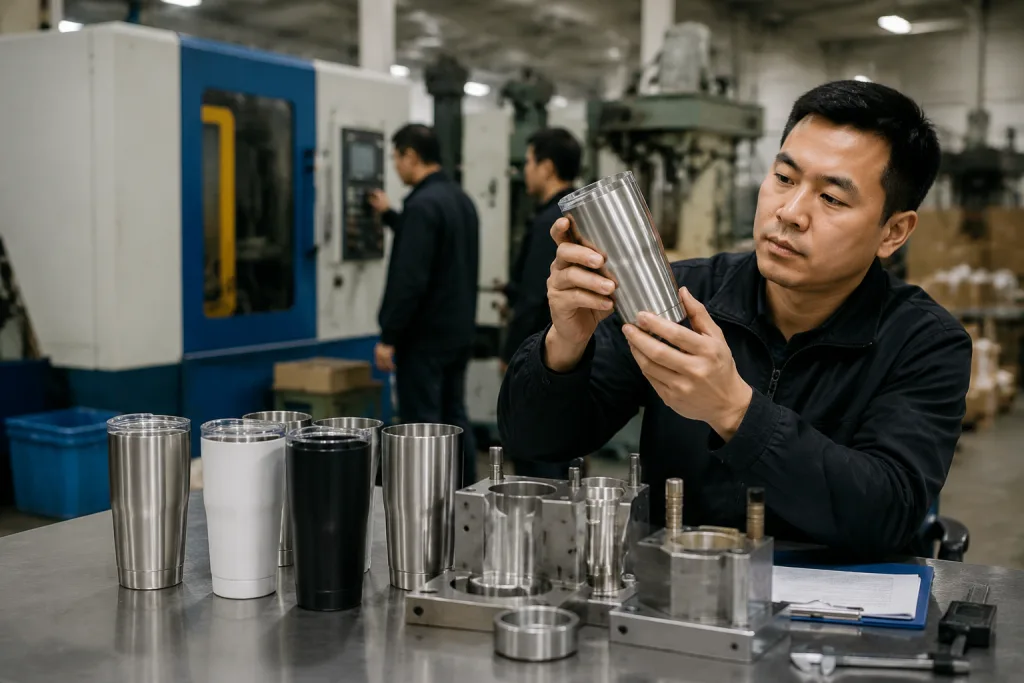
Factory audits matter, but they do not replace product inspection. BSCI, Sedex, or ISO 9001 certification does not guarantee a perfect mug; it tells you the supplier has some process control. In our Zhejiang factory network, we run incoming material checks with a caliper and thickness gauge, vacuum performance sampling after 6 hours, coating adhesion checks with 3M tape, and final AQL inspection. A typical final inspection might use AQL 2.5 for major defects and AQL 4.0 for minor defects, with critical defects set at 0.
Define defects before production. Is a 1 mm coating speck acceptable? What about a logo position tolerance of plus or minus 2 mm? Can the lid have faint flow marks near the injection gate? If these points are not written down, your coffee mug distributor and factory will argue after 8,000 pcs are already packed. We’ve seen this go sideways. The cleaner setup is a signed golden sample, locked artwork file, packaging dieline, inspection checklist, and carton drop standard before mass production starts.
Quality is not a slogan. It is a list of tolerances someone can inspect under a light box at 9 p.m.
Buying route and use-case fit
You can buy through a trading company, a distributor, or the factory that runs the cup line. All 3 can work. The bad route is the one where nobody owns the defect when the lid leaks at 45 degrees in a tilt test. Coffee mug manufacturers fit better when you need engineering control, repeat orders, custom packaging, and fast comments on whether a logo, coating, or lid design will survive production. A local distributor makes sense for a 200 pc rush job, warehouse stock, or a mixed gift kit with notebooks and bags packed in the same carton.
If you are a coffee brand building a permanent merch line, stay closer to the coffee mug factory. You will need repeat color control against a Pantone chip, spare lids packed 50 pcs per inner box, batch codes on the master carton, and the same insert card every reorder. If you are a corporate-gift buyer placing one 800 pc order for a conference next month, a domestic coffee mug distributor may ship faster, even with a higher unit price. Factory direct is not magic. We have seen this go sideways when the buyer approves samples on day 14 instead of day 6, then still expects the same vessel date.
A practical RFQ for coffee mug private labeling should include capacity in ml or oz, target retail price, destination country, order quantity, lid style with straw or flip cap, logo method with print size in mm, packaging type, compliance market, and delivery deadline. If you have a target landed cost, say it early. A serious coffee mug supplier can then show the real savings: use a plain kraft box instead of a rigid gift box, run a stock powder color, avoid a new mold, reduce the logo from 70 mm to 45 mm, or improve carton loading from 24 pcs to 30 pcs per master carton. The math does not work if every saving is expected to come from stainless thickness.
For a first order, I like 1,000-2,000 pcs per color for a standard travel tumbler. That is enough for the line to treat it as production, not a sample-room favor, without forcing you into a container-load gamble. For repeat programs, 5,000-20,000 pcs gives better leverage on coating, packaging, and inspection costs. BottleForge Industrial can support around 450,000 units/month across stainless drinkware lines, but your lead time still depends on approved samples, component availability, and peak-season capacity in China. In our factory schedule, one late PP sample approval often turns a 32-day job into 42 days because the powder-coating booth is already booked.
The cleanest buying decision is not “which mug is cheapest.” That is the wrong question to ask. QC pulled a 304 stainless tumbler sample last month that looked fine on the shelf, but the lid thread felt rough after 20 open-close cycles. Pick the spec that fits how your customer will actually drink coffee: in a car cup holder, at a desk, or on a train with the tumbler thrown into a backpack.
Send us your travel tumbler RFQ
Share capacity, quantity, logo method, destination, and target price. We will return a practical spec and FOB China quotation.
Frequently asked questions
What MOQ should I expect for a travel mug custom made order?
For a standard stainless travel tumbler with your logo, expect 1,000 pcs as a realistic starting MOQ. If you need custom Pantone powder coating, plan for 2,000-3,000 pcs because the coating line has setup and cleaning loss. A fully custom body or lid usually needs tooling and a higher commercial commitment, often 3,000-5,000 pcs for the first run. For coffee mug private label projects, we usually recommend starting with a stock mold, custom color, logo, and box before paying for new tooling.
Which decoration method is best for coffee mug customized gifts?
For daily-use corporate gifts, laser engraving on powder coating is usually the safest choice. It costs about USD 0.12-0.35 per unit but does not peel like weak ink can. Silkscreen is cheaper for one-color logos and works well for large coffee mug promotional products, but it needs adhesion testing on curved coated bodies. Full-color transfer is useful for campaign graphics, yet you should ask for cross-hatch adhesion and wash-cycle samples. If the mug will be sold by a coffee brand, choose durability over a slightly lower decoration cost.
How long does production take from a coffee mug factory in China?
For a stock-body bulk travel tumbler with custom logo and packaging, 35-45 days after sample approval is a normal production window in China. Sampling usually takes 7-12 days if no new mold is required. Custom coating, retail packaging, and compliance testing can add 7-15 days. New tooling may add 20-30 days before the production clock starts. Shipping is separate: ocean freight to Europe or North America often takes 25-45 days port to port, while air freight is faster but usually too expensive for heavy stainless mugs.
What tests should I request before approving a bulk coffee mug order?
At minimum, request vacuum insulation testing, lid leak or splash testing, coating adhesion, logo adhesion, carton drop testing, and food-contact documentation for the target market. For final inspection, AQL 2.5 for major defects and AQL 4.0 for minor defects is common, with critical defects at 0. Ask the coffee mug manufacturer to define acceptable logo tolerance, coating specks, lid fit, and packaging damage before mass production. If you sell in the EU, discuss REACH and LFGB. For North America, discuss FDA food-contact expectations and Proposition 65 review.
Is factory direct always better than using coffee mug distributors?
Not always. Coffee mug factory direct sourcing is better when you need 1,000+ pcs, repeat production, custom packaging, and control over specifications. You can usually get better engineering feedback and cleaner pricing. Coffee mug distributors can be better for small rush orders, domestic warehousing, mixed gift kits, or projects under 500-800 pcs. If you are building a long-term coffee mug private labeling program, work with a factory or OEM manufacturer. If you need 300 mugs delivered locally in two weeks, a distributor may be the practical route.