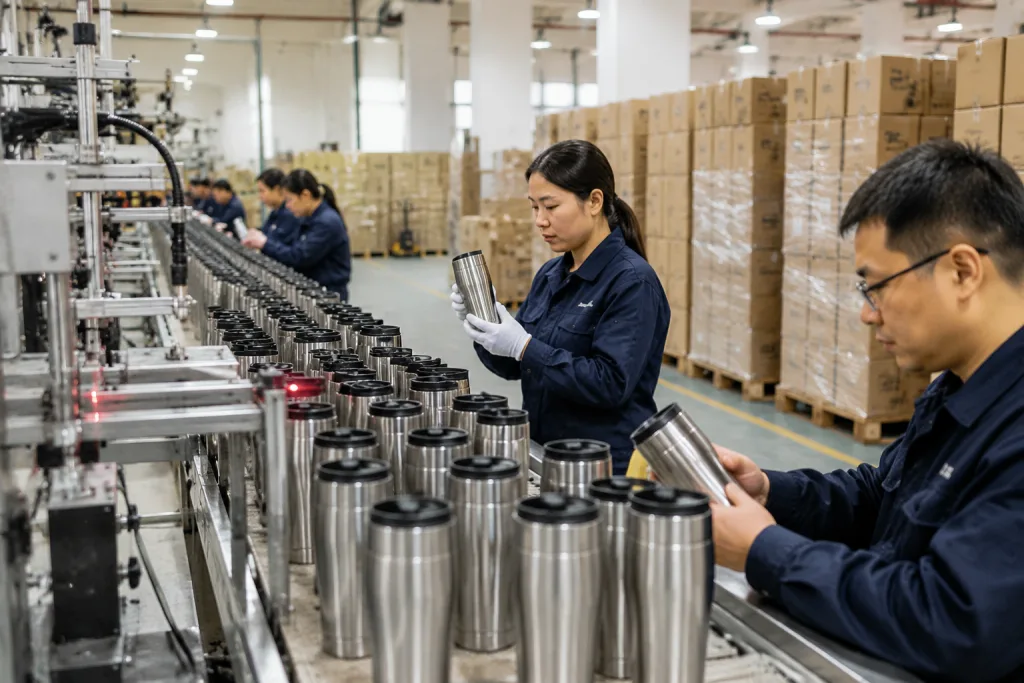
Key Takeaways
- Start travel mug bulk sourcing with 304 stainless steel, 0.4–0.5 mm inner wall, and a 1,000-piece MOQ baseline
- For coffee brands, leak resistance and mouthfeel usually matter more than adding another coating color
- Laser engraving is stable for 3,000+ piece runs; silk screen is cheaper for bold 1–2 color artwork
- Plan 35–45 days production after PP sample approval for standard custom travel tumbler orders
Buying travel mug bulk is not a shape-and-logo job. For a coffee brand, the mug sits beside a 250g bean bag and has to match the price point on the shelf. For a corporate-gift buyer, it carries the client’s name through cars, offices, airports, and 65°C dishwasher cycles. If the lid seeps, the powder coat scratches after 30 cross-hatch tape pulls, or the shipment misses the promo date, the buyer flags it to you first, not to the factory.
The better start is four early calls: insulation target in hours, lid style with leak-risk tolerance, logo process with real artwork limits, and packing route by carton size. BottleForge Industrial manufactures in Zhejiang, China, with regular MOQ from 1,000 pieces per color, sample lead time of 7–10 days, and monthly tumbler capacity around 450,000 units. We run this math before tooling or sampling because a 24-piece master carton, a 9.5 kg gross weight, or one wrong Pantone code on the PO can decide whether your launch margin works.
Decide the cup architecture first
Before you ask a coffee mug supplier for a quote, decide what drinking habit you are selling. This is the wrong question to ask: “What is your cheapest travel mug?” Start with the cup architecture. A handled travel mug needs handle welding and a wider carton layout; we run a 30 N pull check on the handle before packing. A slim car-cup tumbler must pass the 68 mm cup-holder check we use on the line. A wide-mouth commuter cup changes the lid diameter, gasket cost, and how easily the user can drink hot coffee in a car.
For coffee brands, 12 oz, 16 oz, and 20 oz are the safe capacities, but they do not ship the same. A 12 oz mug fits espresso-based drinks and gift boxes; our packing team usually checks it against a 90 mm retail box window before mass production. A 16 oz bulk coffee travel mug is the mainstream commuter size in North America, and buyers ask for it most often after one sample round. A 20 oz bulk travel tumbler looks better on the shelf, but the math can go sideways: one buyer flagged that the carton cube jumped from 0.086 CBM to 0.118 CBM per master carton after the diameter changed.
Name the body material clearly in the RFQ. Ask for food-contact 304 stainless steel for the inner wall and 201 or 304 stainless steel for the outer wall, depending on your price target. Common wall thickness is 0.4 mm to 0.5 mm; QC checks it with a digital micrometer, not by hand feel. Going thinner may save a few cents, but dent resistance drops, and we have seen 0.35 mm bodies fail drop inspection on the rim. Going thicker improves feel, but your FOB price and weight rise.
Vacuum insulation is the default for a serious bulk coffee tumbler. A single-wall mug can work for low-cost coffee mug promotional products, but it sweats with cold drinks and loses heat fast. For a premium coffee mug custom made project, specify double-wall vacuum, copper lining if needed, and a target test such as 60°C water remaining above 40°C after 6 hours at 20°C room temperature. We record that test with a probe thermometer at 0, 3, and 6 hours; if the lid seal is loose, QC pulled the sample before the buyer ever sees it.
Match lids to real usage
The lid is where 6 out of 10 coffee mug custom projects get into trouble. Buyers spend 30 minutes arguing Pantone color and logo size, then sign off a lid that leaks in a backpack or feels thin at the drinking edge. We see it in sample reviews. QC pulled one 480 ml tumbler last month, shook it upside down for 45 seconds, and found coffee drops around the slider rail. For travel mug bulk orders, classify the lid as spill-resistant, leak-resistant, or sealed. Same words? No. The math doesn't work if the sales page promises “leak-proof” and the lid was only built for desk spills.
A sliding lid is simple, low cost, and fine for desk use or a corporate conference giveaway. It is usually spill-resistant, not leak-proof. A flip lid with silicone plug gives commuters better control, especially in a car cup holder or metro bag. A screw lid with a gasket holds better during transit, but the buyer often flags “needs two hands” during the first sample call. We run this check with 55°C water, a 180-degree inversion, and a plain white tissue under the mouth opening. If your product ships with roasted coffee or subscription boxes, choose a screw lid or push-button lid with a replaceable silicone gasket.
Ask the coffee mug manufacturer to show the gasket material and test method, not just a clean product photo. Food-grade silicone should pass LFGB or FDA food-contact expectations depending on your market. For Europe, retailers may request REACH and LFGB documentation. For the United States, buyers often ask for FDA food-contact compliance and, for some children’s or promotional channels, ASTM-related documentation. On our sample table, we mark gasket hardness in Shore A and check the PO line item, because one typo like “PP lid, no silicone” can turn into 5,000 wrong lids.
There is a trade-off: the more complex the lid, the more parts can fail. A three-part lid may add USD 0.25–0.60 FOB compared with a simple slider lid. It can also slow assembly during production in China; one extra gasket press can mean 12 days vs 18 days on a 20,000 pcs run if the line is already booked. At our Zhejiang facility, we run lid leak checks by batch before final packing, using a 0.8 mm feeler check on the gasket seat when the fit looks off. One bad gasket lot can damage a whole coffee mug private label launch. We've seen this go sideways.
Choose branding by margin risk
Branding is a design choice, but it also decides margin and scrap. Same 500 ml body, different risk. We run the same tumbler shell for café chains, tech gift orders, and retail coffee brands, then change the logo process after checking the artwork on a 1:1 paper wrap around the cup.
Laser engraving is the safer pick on powder coating or bare 304 stainless steel when the logo repeats across 3,000 or 10,000 units. Edges stay clean, there is no ink migration, and QC can check depth with a 10x loupe in under 20 seconds per sample. The catch is color: the mark usually shows stainless silver or a softer contrast, depending on coating thickness. For a premium coffee mug customized program, laser is usually where the math works.
Silk screen printing fits bold logos, event artwork, and lower-cost coffee mug promotional orders. One-color printing can add roughly USD 0.08–0.18 per unit depending on area and volume. On a curved body, the line hates tiny 1.5 mm text and tight multi-color registration; we have seen a buyer approve a digital mockup, then reject the first sample because the slogan blurred near the taper. If your brand guide demands exact Pantone matching, ask for a printed pre-production sample, not a screen image.
Heat transfer and UV printing give more detail for retail packs or seasonal graphics. Nice on shelf. The trade-off is abrasion resistance, so ask for tape test, cross-hatch adhesion, and dishwasher simulation if that claim affects your listing. QC pulled one UV sample after 30 dishwasher cycles because the edge lifted 2 mm near the seam, and that is the kind of issue that turns a low logo cost into a credit note.
For coffee mug private labeling, check the bottom mark before carton artwork is locked. You may need capacity, material, country of origin, recycling icons, and batch code, often inside a 28–35 mm print circle. Factory-direct buyers forget this; we once got a PO with “Made in Chian” copied into the artwork, and the buyer flagged it after films were made. A good coffee mug oem manufacturer should ask about labeling rules before mass production starts.

Build the quote around landed cost
A low FOB price can bury expensive choices. Compare the same spec line by line before you put a coffee mug factory direct quote next to a trader offer or coffee mug supplier directory listing. We see this every month. A USD 3.10 FOB mug with 0.18 mm paint, a basic PP lid, and white box is not the same product as a USD 4.20 FOB mug with 304/304 steel, powder coating, laser logo, and retail carton. QC pulled one sample last season where the PO said “powder coating,” but the approved sample was spray paint. The buyer flagged it after 600 cartons were packed.
For a normal 16 oz bulk travel mug from China, factory-direct FOB pricing often sits around USD 3.20–5.80 depending on steel grade, lid tooling, coating thickness, logo process, and packaging. A simple bulk coffee mug for promotion can be below that if we run shared lids and plain egg-crate packing. A premium coffee mug custom made retail item with a molded lid, handle, gift box, and insert card can go above it, especially when the insert card needs 4C printing and a separate bar code sticker. The math doesn’t work if you compare only the mug body price. Ask for the quote sheet by BOM, not a one-line number.
Freight can flip the decision. A 20 oz tumbler may look better on a buyer deck than a 16 oz tumbler, but if carton dimensions push container loading down by 18–25%, your landed cost rises fast. We run carton trials with a tape measure and digital scale before final packing; 1 cm added to the master carton height can cut 40HQ loading by 1,200 pieces. Ask for master carton size, pieces per carton, gross weight, and HS code before you approve the quote. For Amazon or distributor warehouses, ask whether the factory can apply FNSKU, suffocation labels, carton marks, and pallet labels, because a missed 30 mm FNSKU sticker has delayed shipments at our line.
Payment terms also affect risk. A common structure is 30% deposit and 70% balance before shipment. For established coffee mug distributors or larger corporate-gift programs, LC or staged payment may be discussed, but do not expect that on a 1,000-piece first order. In Zhejiang, China, most factories buy 304 stainless sheet, lids, and cartons after deposit, so late payment usually means late shipment. We’ve seen this go sideways: one buyer paid the balance 9 days late, then asked us to ship 12 days earlier than the booked vessel. That schedule cannot hold.
Set quality checkpoints before deposit
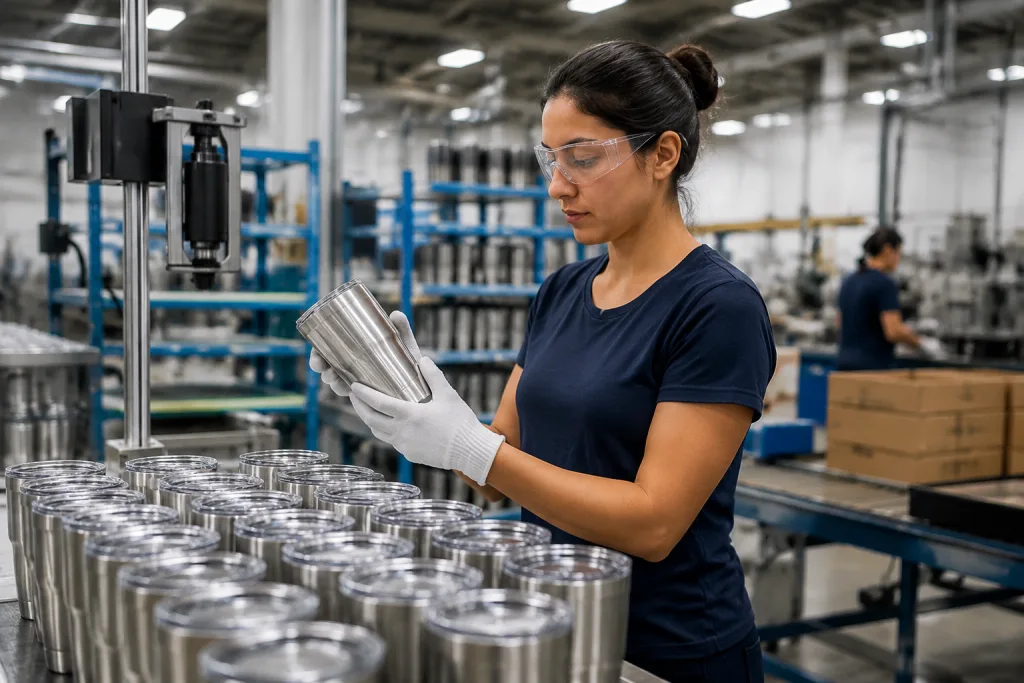
Write quality control terms before the purchase order. After production, the math doesn't work. If you are buying coffee mug in bulk for a coffee brand, put the checkpoints on the PO: PP sample sign-off with photos, 304 stainless incoming check by handheld XRF, line inspection every 2 hours, final AQL inspection, and carton drop testing when the shipping carton is over 12 kg or the buyer asks for it.
For stainless travel tumblers, check the simple stuff first. QC should put the body on a flat glass plate and reject rocking over 1 mm. The rim needs to pass a cotton-wipe test without snagging. The lid should thread cleanly or press down evenly, depending on the design. Powder coating cannot show pinholes, fisheyes, heavy orange peel, or color drift beyond the approved Pantone chip. Interior weld marks should look clean after polishing, and the sample needs a hot-water odor check after 30 minutes.
AQL levels depend on the sales channel. For about 70% of B2B drinkware orders we ship, AQL 2.5 for major defects and 4.0 for minor defects is accepted. National retail buyers often push for tighter sampling, third-party inspection, BSCI audit information, ISO 9001 documentation, or REACH reports before they open the vendor file. Do not assume every coffee mug factory has these ready. Ask before you send a deposit; we have seen orders stall for 9 days because the buyer flagged a missing REACH file after the artwork was already on the line.
Thermal testing needs one written method, not five opinions in a WhatsApp chat. One clean method is this: fill with 95°C water, close the lid for 5 minutes to preheat, refill to capacity, then measure after 3 and 6 hours in a 20°C room with a calibrated probe thermometer. Leak testing should include inversion and shaking, but the lid decides the test. A slider lid cannot be judged like a sealed screw lid. QC pulled a slider sample last month that passed a 10-second inversion test but leaked after 20 shakes in a PE bag.
At BottleForge Industrial, typical production lead time is 35–45 days after PP sample approval for repeatable models. First projects with new tooling, custom molded handles, or unusual coatings can take 55–70 days. That is normal manufacturing math, not a sales delay. If a buyer asks for 18 days on a new powder-coated handle mold, the line can run faster, but the coating cure, salt-spray check, and carton compression test still need their time.
Plan packaging for the channel
Packaging is where coffee brands and corporate-gift buyers split fast. A coffee roaster selling a bulk coffee tumbler in a gift set usually asks for a color box, molded paper insert, EAN-13 barcode, and 105 x 148 mm care card. A corporate-gift buyer often pushes back: “Don’t quote retail packing, it’s for a 2-day event.” Then a white box and K=A export carton is enough. Both specs work. The wrong question is “which packing is best?” We need the sales channel first, because the packing spec affects carton size, CBM, and the quote from day one.
Standard options include individual polybag, kraft box, white box, color retail box with 350 gsm paper, egg-crate divider for 24 pcs, or a mailer box for single-piece shipping. If your channel cuts plastic, ask for paper wrap or recycled kraft before we run the PI, not after the line has booked materials. For sustainability claims, go slow. Recycled paper content, FSC paper, and plastic-free packaging are separate claims, and QC will ask for different documents from the box supplier. Last month we rejected 600 kraft boxes because the FSC logo was printed 4 mm too close to the trim line.
If you sell online, carton strength matters more than shelf photos. A thin color box can look clean in a listing image and still get crushed in parcel delivery. We ship e-commerce projects with 5-ply master cartons, corner protection when the tumbler has a gift box, and a simple drop-test record from 76 cm. For fulfillment centers, confirm carton weight limits and label placement before carton sealing. We’ve seen this go sideways: QC pulled the sample, cartons were taped, then the buyer flagged missing FNSKU labels and we lost 3 days reopening 128 cartons.
For retail, barcode type, country-of-origin statement, capacity marking, care instructions, and warning text should be approved with the artwork. If you work through a coffee mug distributor, decide who signs the final PDF. Simple rule: one owner, one file name, one signed version. If 3 parties approve different PDFs, the factory prints the latest signed file in the job folder, not the version someone mentioned in a 17-message email thread. We once caught a PO typo where “Matte Black” became “Matt Black” on the box side panel, and pre-press only found it because the dieline proof was checked at 100% scale.
Pick suppliers with evidence
A coffee mug supplier list helps with market mapping, but it does not prove control of the line. When we check coffee mug manufacturers, we ask one blunt question: what is done in-house? Body forming, polishing, vacuum testing, powder coating, printing, assembly, packing—some plants run all 7 steps under one roof, while others send coating or logo work to a partner 12 km away. Both can work. The wrong question is “factory or trader?”; the better question is where the defect can hide, such as a 0.4 mm wall thickness drift found by caliper before coating.
A real coffee mug factory should show production photos, QC flow, machine list, audit documents, and recent shipment references by product type. Ask for proof from the last 3 similar orders, not a pretty catalog. Be careful if a supplier sells bottles, bags, caps, umbrellas, kitchen items, pet bowls, and phone cases but cannot explain vacuum rejection rate or lid tooling. We’ve seen this go sideways: QC pulled the sample, the lid rocked by 1.2 mm on the thread gauge, and the supplier still called it “normal tolerance.” That is usually a trading catalog, not a focused coffee mug manufacturer.
For a first travel mug bulk order, ask for a gold sample, signed specification sheet, and pre-production sample. The spec sheet should include capacity tolerance, steel grade, coating type, logo process, Pantone number, lid material, gasket material, packing, carton size, and inspection standard. Boring paper saves money. On one 5,000 pcs order, the buyer flagged a PO typo: “matte black” in the email, “gloss black” on the spec sheet. Without that signed sheet, the argument would have started after 40 cartons were sealed.
Factory direct sourcing from China can save margin, especially for repeat bulk coffee mug programs above 3,000 pieces. It also pushes decisions earlier: logo artwork, carton mark, barcode position, and spare lid ratio need locking before the line books powder coating. If you want a coffee mug distributor to hold inventory, split shipments, and handle local service, you pay more but cut the daily follow-up. The math doesn’t work if your forecast changes every 2 weeks or your launch date leaves only 18 days for sampling, production, inspection, and vessel booking.
Send your travel mug brief for factory pricing
Share capacity, logo, quantity, packaging, and destination. We will return a practical spec sheet, MOQ, FOB quote, and lead time.
Frequently asked questions
What MOQ should I expect for travel mug bulk orders?
For most stainless steel travel mug bulk projects, 1,000 pieces per color is a realistic MOQ. Some coffee mug factory direct programs can accept 500 pieces if you use an existing body color and simple laser logo, but the unit price will be higher. Custom powder coating, molded lids, or retail color boxes usually make 1,000–3,000 pieces more practical. If you need coffee mug custom made tooling, expect a much higher commitment because molds and testing must be amortized across production.
How much does a custom bulk coffee travel mug cost?
A standard 16 oz bulk coffee travel mug from China often ranges from USD 3.20 to USD 5.80 FOB. The lower end usually means existing mold, simple lid, standard coating, and basic packing. Add laser engraving, retail box, handle, premium lid, or 304/304 stainless steel construction and the cost moves upward. Freight, duty, inspection, and domestic trucking can add 15–35% to landed cost depending on destination and shipment size, so compare landed cost, not only FOB.
Which logo method is best for coffee mug promotional products?
For coffee mug promotional products, silk screen printing is usually the best cost-performance choice when the artwork is simple and 1–2 colors. It is affordable, fast, and visually strong on powder coating. Laser engraving is better if durability matters and you accept a single engraved look. UV printing or heat transfer works for detailed retail artwork but should be tested for abrasion. For orders above 3,000 pieces, always approve a physical PP sample before production.
Can I order coffee mug private labeling with retail packaging?
Yes. Coffee mug private labeling can include logo on the tumbler, bottom mark, care card, barcode, color box, master carton marks, and pallet labels. You should prepare artwork files in AI or PDF format and confirm Pantone colors, barcode size, country-of-origin wording, and warning text. For most retail packaging, allow 5–7 extra days for artwork proofing and box sampling. If the order needs FNSKU labeling, send the labels before mass packing starts.
How do I compare a coffee mug supplier directory with a factory?
Use a coffee mug supplier directory or coffee mug supplier list to find options, then verify who controls production. Ask whether the supplier owns the factory, works as a trading company, or coordinates subcontractors. Request photos of vacuum testing, coating lines, packing area, and QC records. A capable coffee mug oem manufacturer should answer questions on steel grade, AQL, lead time, carton size, and compliance without vague promises. If they cannot explain defects and tolerances, price alone is not enough.