Key Takeaways
- A practical MOQ for custom stainless drinkware is usually 1,000-3,000 units per SKU and color
- 304 stainless steel at 0.45-0.55 mm wall thickness is the safer default for premium wholesale drinkware
- Lead time is typically 25-35 days after PP sample approval for standard repeatable builds
- AQL 2.5/4.0 inspection catches most visible defects before balance payment
You do not buy top wholesale water bottles because the catalog render looks clean. You buy them because 10,000 units must hit the vessel date, pass AQL 2.5, protect your margin, and still look decent after a gym bag beating. We have seen this go sideways: QC pulled the sample, found a 0.4 mm lid gap on 18 pieces out of 200, and the buyer’s “cheap upgrade” became a rework bill.
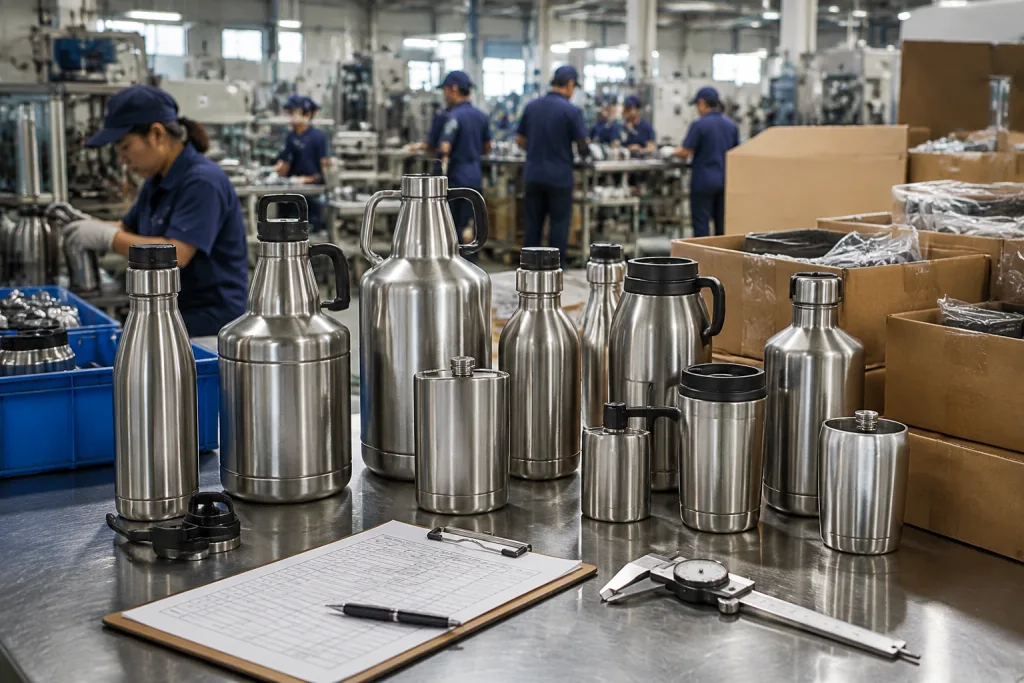
From our factory network in Zhejiang, China, we see buyers compare stainless tumblers, sports bottles, canteens, growlers, and flasks like they can share one spec sheet. Wrong question. The right wholesale drinkware choice comes down to lid leakage rate after 24-hour inversion testing, coating durability on the cross-cut tape test, carton cube for a 40HQ, decoration method, food-contact compliance, and the channel you sell into. We run different lines for powder-coated 304 stainless bottles and plastic sports bottles for a reason.
The buyer comparison table
If you are sourcing top wholesale water bottles, start with the job it must do, not the silhouette. This is the wrong question to ask on a first RFQ. A 600 ml sports bottle, a 1.9 L beer growler, and a 180 ml alcohol flask bulk order all fall under drinkware wholesale, but on the line they do not run the same way. Last month QC pulled a 600 ml Tritan sample with a 0.4 mm flash on the lid thread; that issue would never show up on a welded stainless growler.
| Product type | Typical capacity | Best channel fit | Common MOQ | FOB China guide price |
|---|---|---|---|---|
| Vacuum stainless bottle | 500-1,000 ml | Retail shelf, corporate gift, outdoor kits | 1,000 pcs | US$3.20-6.80 |
| Plastic sports bottle | 600-900 ml | Race events, gyms, school programs | 3,000 pcs | US$0.85-2.40 |
| Wholesale canteen | 750-1,200 ml | Outdoor retail, tactical packs, camping sets | 1,500 pcs | US$2.80-5.60 |
| Wholesale growler | 1.0-1.9 L | Breweries, member clubs, hospitality counters | 1,000 pcs | US$5.50-11.80 |
| Alcohol flask wholesale | 120-240 ml | Gift sets and promotional packs | 2,000 pcs | US$1.10-3.20 |
These numbers are not promises. They are sane starting points from China export production. In Zhejiang, a medium drinkware line may run 300,000-500,000 units/month, but that capacity gets split by mold changeovers, coating racks, polishing wheels, pad-print fixtures, and carton packing. We run into this often: a buyer asks for 12 colors at 500 units each, then pushes back on a 28-day lead time. The math does not work as cleanly as 6,000 units in two colors, which we can usually plan with fewer color-change stops and less scrap.
For a best wholesale drink bottle program, I would rather see you cut the range and lock the specs than launch eight weak SKUs. Fewer SKUs make QC cleaner, cartons more uniform, and replenishment easier. On one PO, the buyer typed “matte black” on the item line but “gloss black” in the artwork note; the line stopped for 3 hours while sales confirmed the finish. Small mismatch. Big delay.
Stainless, plastic, glass, or hybrid
Material choice is where bulk drinkware projects go sideways. On our line, 7 of the last 20 cost-down requests started with “same look, cheaper material” on the PO. Stainless steel costs more upfront, but it gives stronger shelf value, lower return risk, and wider decoration choices. For vacuum bottles, 304 stainless steel inside and outside is the normal export-grade build. Some buyers use 201 stainless outside to cut US$0.15-0.35 per unit. I push back on that for humid coastal markets because one rust photo from a retailer costs more than the saving. QC checks incoming shells with an XRF gun before polishing, not after packing.
Plastic bottles work when price and weight beat insulation. Tritan, PP, and PE are the usual picks, but they are not interchangeable. Tritan gives a clear, glass-like look and survives rougher handling, PP handles heat at a lower cost, and PE fits soft-squeeze sports bottles where the wall needs flex. Last month a buyer flagged a 0.4 mm color drift between Tritan caps and PP handles, so color approval needs real molded parts, not just a Pantone number. If you sell in Europe, ask for LFGB or EU 10/2011 food-contact support. For North America, FDA food-contact declarations and, where relevant, California Prop 65 screening should be settled before mass production.
Glass bottles look clean and fit wellness brands, but freight damage and silicone sleeve fit need tight control. A 3% breakage allowance sounds harmless until you ship to 40 retail locations and every store sends photos. We’ve seen this go sideways. Glass also makes carton drop tests a serious checkpoint. We normally test from 76 cm on export cartons unless the customer has a stricter retail protocol, and QC pulled one sample last week because the sleeve mouth was 1.2 mm loose after the drop.
Hybrid products sit in the middle: plastic lid, stainless body, silicone boot, steel straw, PP handle. They sell well, but each added component adds another supplier, color match, and failure point. For drinkware bulk orders, specify material grade on every part, not just the main body. The math does not work if a US$0.03 gasket creates a 2% leak claim. We run a 24-hour inverted leak test on pre-production samples because a nice bottle with a cheap gasket is still a leaking bottle.
Use-case fit beats catalog choice
The best wholesale drinkware programs start with the use case, not the catalog page. A gym chain we ship for asks for one-hand opening, 600-800 ml capacity, and a lid that survives a 1.2 m drop onto rubber flooring. QC pulled one sample last quarter with a cracked flip button after 6 drops. That design got cut. A corporate gifting buyer cares more about 18-20 μm powder coating, clean laser engraving, and a gift box that does not collapse under a 12 kg carton stack. A brewery ordering beer growler wholesale bulk needs a pressure-safe closure, low odor after filling, and a handle that still feels balanced at full weight.
Here is the split we use on the line. Pick sports bottles for giveaways, schools, fitness orders, and retail programs where the buyer is fighting for a $1.20-$2.80 FOB range. Pick vacuum stainless bottles for premium retail, outdoor, office, and private label, especially when the PO calls for 304 stainless and color matching by Pantone chip. Pick canteen wholesale for camping, military-style, hiking, and field-use stories, where a 0.6 mm body wall and shoulder strap hardware matter. Pick growler wholesale for breweries, taprooms, clubs, and hospitality. Pick alcohol flask wholesale bulk when it sits inside a gift set with funnels or cups, not when the buyer needs a hydration SKU.
Buyers often ask if a bulk canteen can replace a normal stainless bottle. Wrong question. Sometimes it works, but canteen bulk products need a flatter profile, a stronger cap tether, and often a cup set or pouch. That changes the tooling, the insert tray, and the carton size; we have seen a 24 pcs carton jump from 13 kg to 16.5 kg after adding a pouch set. The math does not work if the buyer still expects the same freight cost. A wholesale canteen also promises rugged use, not desk use.
For growler bulk, check the cap seal before you talk colors. Beer growler in bulk projects should use food-grade silicone gaskets and pass a 24-hour inverted leak test; on our bench we mark the fill line with a caliper and reject any neck that shows seepage at the thread. Beer tumbler wholesale is a different spec. You are selling drinking comfort, foam control, and cold retention, not transport storage. Treat beer tumbler bulk and beer growler bulk as 2 separate drawings, or the buyer will flag it during pre-shipment inspection.

Specs that decide landed cost
FOB unit price gets the argument, landed cost decides the margin. We’ve had two bottles quoted at US$4.20 FOB Ningbo: one packed 24 pcs/carton at 0.086 CBM, the other packed 12 pcs/carton because the handle stuck out 38 mm. Different freight bill. Carton cube matters, so we run CBM per 1,000 pcs on the packing table before we lock the color box or master carton.
Wall thickness is the quiet cost driver buyers miss. For stainless vacuum bottles, 0.45-0.55 mm is a common body thickness range. Thinner steel cuts price, then QC pulled the sample after a 76 cm drop test and found shoulder dents on 7 of 32 pcs. For 1.9 L growlers, chasing the thinnest gauge is the wrong question to ask unless your channel accepts a budget feel.
Lid design changes tooling cost fast. A basic screw lid often fits an existing platform, so no new mold is needed after we check the thread with a go/no-go gauge. A flip straw lid with a locking button and silicone dust cover can need US$1,500-6,000 in tooling depending on the hinge, spring, and leak-test target. That math works for 20,000 units. It goes sideways at 1,500 units.
Decoration changes cost too. One-color silkscreen may add US$0.08-0.18 per unit, and our line checks position with a 0.5 mm logo jig before mass printing. Laser engraving may add US$0.12-0.35 depending on logo size and run speed. Full wrap heat transfer can add US$0.45-0.90 and needs stricter artwork control, especially when the buyer sends a PDF with one Pantone code on the PO and another in the AI file. For alcohol flask in bulk, embossing or debossing looks premium but usually requires tooling and 12 days vs 18 days pre-production time.
Packaging is not a footnote. A white box can be US$0.12-0.25. A printed retail box may be US$0.35-0.90, and the buyer often flags crushed corners after the first courier sample if the E-flute board is too soft. Gift sets with foam inserts, funnels, and cups can move an alcohol flask wholesale order from cheap promotion to decent retail item, but we still run a 15 kg carton compression check before shipping.
Compliance and inspection reality
Compliance is not a PDF collection job. It is product-risk control. For Europe, ask for REACH, LFGB or EU food-contact documentation, plus packaging material declarations when the retail carton or polybag touches local rules. For North America, ask for FDA food-contact support, Prop 65 screening if the order ships into California, and ASTM or CPSIA checks for kids products. If the bottle is for children, this is the wrong question to ask: “Is it normal drinkware?” No. QC pulled one kids straw lid last year where the silicone bite valve came off at 18 N on the pull gauge, so we treat children’s bottles as a separate spec from day one.
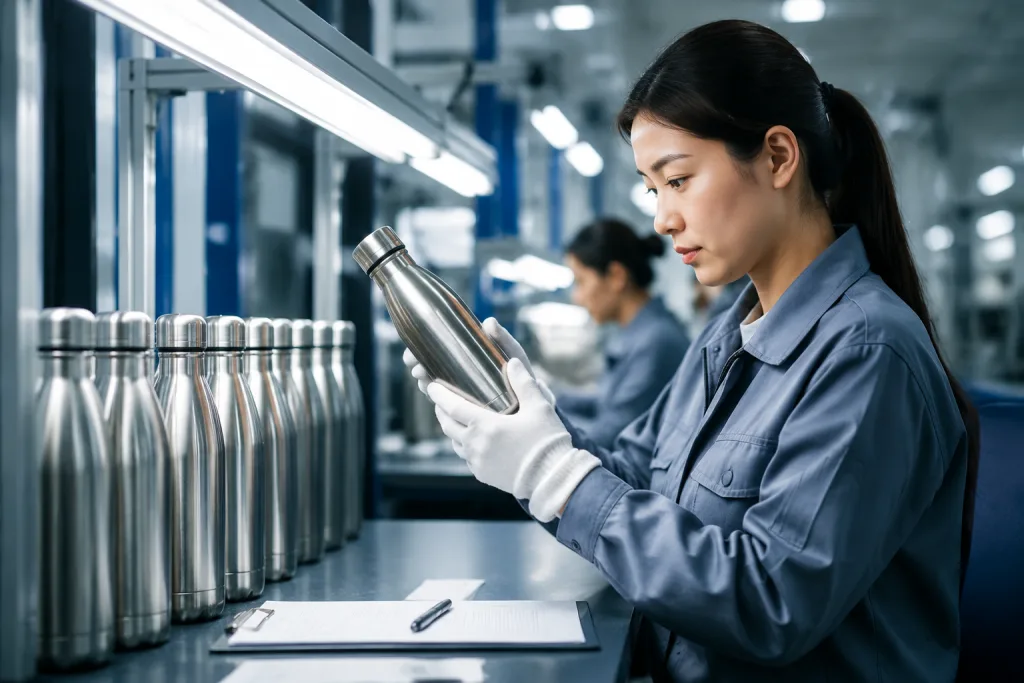
Factory audits matter, but read them with clear eyes. BSCI, Sedex, ISO 9001, and similar documents tell you about management systems, not whether your specific lid leaks after 30 minutes upside down. For that, you need product testing and inspection. A reasonable pre-shipment inspection plan for wholesale drinkware is AQL 2.5 for major defects and 4.0 for minor defects. Critical defects should be zero. We run this with a carton pull from finished goods, not from the clean sample shelf, because the line is where loose gaskets and 1.5 mm print shifts show up.
What should inspectors check? Start with appearance, coating scratches, dents, printing position, and logo adhesion, then move into capacity, odor, lid fit, leak test, vacuum retention, barcode scan, carton markings, and gross weight with a calibrated scale. For vacuum bottles, we typically use a hot water retention test: fill at 95°C, measure after 6 hours, and compare against the agreed standard. A cheap claim like “keeps hot 24 hours” means nothing unless you define starting temperature, room temperature, fill level, and pass mark. We have seen this go sideways when a PO said “500 ml” but the approved sample held 470 ml to the brim; the buyer flagged it only after the first carton arrived in Hamburg.
For beer tumbler in bulk or beer tumbler wholesale bulk, check rim smoothness and coating around the lip with a finger wipe and 3M tape test. For beer growler wholesale, add cap torque and inverted leakage; our line usually records cap torque in kgf·cm on the inspection sheet. For alcohol flask bulk, check weld polish, cap threading, and any internal odor after rinsing. China factories can build to high standards, but the math does not work if the standard is added after deposit. Write it into the purchase order before the tooling, artwork, or 3,000 pcs MOQ production slot is released.
How to brief a factory
A solid RFQ saves both sides 4–6 working days. Send only a photo with “best price” and the quote will come back fast, but it will be full of silent guesses: 500 ml or 750 ml, 201 or 304 stainless, silk print or laser, color box or white box. For top wholesale water bottles, brief the factory on capacity, material, lid type, coating, logo method with artwork size, packaging, target market, test requirements, order quantity, shipping term, and delivery deadline. We run RFQs through a one-page spec sheet; last month QC pulled a sample because the buyer wrote “matte black” but the PO said “gloss black.”
Use wording a merchandiser can price without chasing you for 12 emails. “750 ml 304 stainless vacuum bottle, powder coated black and white, laser logo 40 x 25 mm, individual white box, EU market, REACH and LFGB support, MOQ 3,000 pcs split two colors, FOB Ningbo, delivery 35 days after PP sample approval” gives the line enough detail to check material, coating loss, packing volume, and logo fixture cost. A Zhejiang factory can price that seriously. “Need bottle like picture, cheap” is not sourcing. The math doesn’t work.
Samples need a locked sequence. Approve an existing stock sample first for shape, grip, lid feel, and whether the 750 ml body fits a 75 mm car cup holder. Then approve a pre-production sample with your coating, logo, lid, and packaging. Release mass production only after the signed PP sample is sealed in the sample room with the order number on the hang tag. If you skip the PP sample to save 7 days, we’ve seen this go sideways: wrong silicone ring color, logo 3 mm off center, cartons printed before anyone noticed.
Payment terms vary, but 30% deposit and 70% before shipment is common for new China orders. Larger repeat customers can negotiate better terms after 3–5 clean shipments with no overdue balance and no AQL 2.5 disputes. If you need Amazon FBA labels, FNSKU stickers, carton labels, or pallet specs, put them on the PO before production; the buyer flagged it once after final inspection, and our packing team had to reopen 186 cartons with a utility knife. Adding labels after inspection can delay shipment by 3-5 days and dent cartons before loading.
Where each product wins
If you want broad retail coverage, start with a 500-750 ml stainless vacuum bottle and a standard screw lid. Boring sells. That size covers office, gym, school, and travel shelves without forcing buyers into a niche. On our line, the 500 ml body usually runs through the same leak tester and height gauge setup for 3 colors, so QC sees fewer surprises than with flip lids and straw assemblies. For corporate gift buyers, a 600 ml tumbler or 500 ml bottle with clean laser engraving beats a clever lid with 6 small parts. For outdoor and camping brands, wholesale canteen products and rugged carry systems make more sense than glossy office bottles; the buyer flagged a 0.8 mm handle gap last month because gloves could not grip it well.
For breweries and hospitality, split growler wholesale from beer tumbler wholesale at the start. A growler carries beer. A beer tumbler serves it. Beer growler wholesale bulk needs seal performance, real capacity, and cap torque control; we check 1.9 L growlers on a digital scale because a 60 ml short-fill claim turns into a chargeback fast. Beer tumbler wholesale bulk needs hand feel, rim finish, and coating that survives washing. QC pulled the sample once for a sharp 0.3 mm rim burr, and the brewery buyer was right to reject it. Mixing those requirements creates an average product that satisfies nobody.
For promotional programs, plastic sports bottles still have a place. They are light, low-cost, and quick to run. A 10,000 pcs PP bottle order can leave the molding room in about 12 days, while a custom-color stainless vacuum bottle often needs 18 days after powder approval. The math changes if the brand sits in a premium channel. Cheap plastic is the wrong question to ask when the buyer needs repeat orders; we have seen a US$0.68 bottle create more email complaints than a US$1.88 stainless upgrade. The line can save cents with a thinner wall, but the shelf does not forgive a soft bottle body.
For gift sets, alcohol flask wholesale can work well, especially with funnels, cups, and a rigid box. Check market rules and platform policies early because alcohol-related accessories can hit category restrictions. If you need alcohol flask wholesale bulk for North America or Europe, confirm labeling, claims, and retail presentation before cartons are ordered. We once caught a PO typo that changed “brushed 304 stainless” to “mirror finish” after the box artwork was already on CTP plates. That kind of mistake costs 5 days and makes nobody look smart.
The practical answer is simple: match the bottle to the channel, then engineer the details hard. BottleForge Industrial in Hangzhou, Zhejiang works this way because it cuts down rework before mass production. We check use case, compliance, inspection, and packaging before price negotiation, not after the deposit. A buyer who defines AQL 2.5 points, carton drop-test needs, barcode position, and lid structure early usually gets the better product from China, not just the lower quote. We have seen this go sideways when price leads the meeting.
Send your target bottle spec for a factory quote
Share capacity, material, logo, quantity, market, and deadline. We will return practical pricing, MOQ, sample timing, and compliance notes.
Frequently asked questions
What MOQ should I expect for top wholesale water bottles?
For custom top wholesale water bottles, a realistic MOQ is 1,000 pcs for stainless vacuum bottles using existing molds, 3,000 pcs for plastic bottles, and 1,000-1,500 pcs for growlers or canteens. If you need custom Pantone powder coating, expect the factory to prefer 1,000 pcs per color. For new lid tooling or special shapes, the practical first order is often 5,000-10,000 pcs because tooling, sampling, and line setup need enough volume to make sense.
How long does a wholesale drinkware order take from China?
For standard wholesale drinkware from China, plan 7-10 days for sampling, 25-35 days for mass production after PP sample approval, and additional ocean freight time of about 25-40 days to Europe or North America depending on port. Air freight is possible but often kills margin on heavy stainless items. If you need retail boxes, FNSKU labels, palletization, or special carton marks, add 3-7 days unless all files are approved before production starts.
Is stainless steel always better than plastic for bulk drinkware?
No. Stainless steel is better for premium retail, corporate gifting, insulation, and long-term brand value. Plastic is better for low-cost events, sports teams, school programs, and very light freight. A 750 ml stainless vacuum bottle may cost US$3.50-6.50 FOB, while a plastic sports bottle may be US$0.85-2.20. If your buyer expects a US$4.99 retail price, plastic may be the only workable option. If retail is US$19.99-29.99, stainless usually gives better margin and fewer perception issues.
What tests should I require before shipping canteen or growler bulk orders?
For canteen bulk and growler bulk orders, require leak testing, coating adhesion, capacity check, odor check, carton drop test, and appearance inspection under AQL 2.5/4.0. For beer growler wholesale, add a 24-hour inverted leak test and cap torque check. For vacuum growlers, add heat retention testing with defined conditions, such as 95°C starting water temperature and 20-25°C room temperature. Do not accept vague claims like “no leak” or “keeps hot all day” without a written test method.
Can I mix water bottles, beer tumblers, and alcohol flasks in one order?
You can, but it may not reduce cost as much as you expect. Water bottles, beer tumbler bulk, and alcohol flask in bulk orders often use different molds, polishing lines, printing jigs, packaging, and inspection criteria. A mixed container can save freight, but each SKU still has its own MOQ and setup time. If your first order is under 5,000 total units, keep the range tight: one bottle, one tumbler, or one flask set. Expand after you have sales data.