Key Takeaways
- Start RFQs with capacity, steel grade, lid type, coating, and target FOB price within 5 percent
- A realistic custom thermos MOQ is usually 1,000-3,000 pcs per color for factory-direct production
- Sample approval should cover logo size, vacuum retention, leak test, carton drop test, and packaging dielines
- A complete bulk PO should list AQL level, barcode rules, spare parts, carton marks, and shipping terms
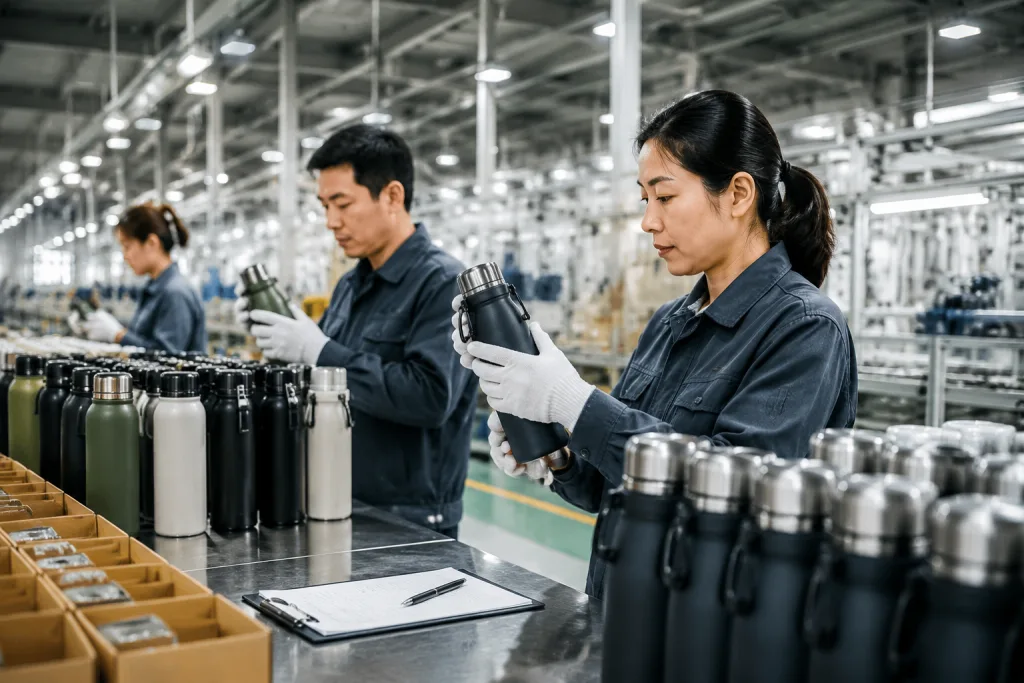
A top wholesale vacuum flask is not just a shiny bottle with your logo on it. For outdoor retailers and promo brands, it is a margin item and a complaint risk in the same master carton. We have seen a USD 0.18 cheaper quote turn into a 3% return claim after QC pulled 32 samples and found thin powder coating at the shoulder, only 45–55 μm against the buyer’s 70 μm spec. Cheap can get expensive fast. If capacity, 304 stainless grade, coating, test rules, and packaging are not fixed before deposit, the math does not work.
We manufacture stainless thermos programs in Hangzhou, Zhejiang, and most sourcing problems start before the sample room cuts the first laser logo. The RFQ says “500 ml bottle,” the PO misses the inner box material, or the approval sample is treated like a nice photo instead of a controlled reference with weight, color chip, lid torque, and carton drop test notes. We run into this every month. Here is the practical process we use with bulk thermos buyers from RFQ to mass production, including the checks on the line that stop small mistakes from becoming 5,000 bad units.
Start with a usable RFQ
Ask five thermos suppliers for “500 ml stainless bottle, best price,” and you will get five quotes that do not line up. We see it every week. One factory quotes 201 outer steel with 304 stainless inner wall, one trims 18 g from the body weight, and another leaves out the color box. Last month QC pulled a 500 ml sample that looked right on the table, but the caliper showed a 0.38 mm thinner shell than the approved sample. That quote was cheap for a reason. A top wholesale vacuum flask RFQ has to lock suppliers to the same bottle, not a cousin with the same silhouette.
State the buying role in the first RFQ. For an outdoor retail line, we check shelf box artwork, barcode position, and drop-test complaints because returns hurt the reorder. For a corporate promotional thermos campaign, the buyer usually flags logo color, event date, and whether the carton mark matches the PO. For distributor thermos stock, the real money is in repeat colors, spare lids that still fit after 6 months, and carton loading that does not waste 0.4 CBM per pallet. We have seen this go sideways when the PO says “blue” and the approved sample card says Pantone 7690C.
For a 500 ml or 750 ml customized thermos, put these PO-style line items into the RFQ before the supplier opens a costing sheet. The math does not work if the line quotes powder coat today and discovers full-wrap print after the deposit. We run the first check with a digital scale, lid torque tool, and water-fill gauge before sending a firm FOB Ningbo or Shanghai price.
- Capacity: 500 ml, 750 ml, or 1,000 ml, with tolerance if the fill line or retail claim matters.
- Material: 304 stainless steel inner wall, 201 or 304 outer wall, PP lid, silicone gasket.
- Construction: double-wall vacuum, copper coating if required, plus powder coat or spray paint finish.
- Performance: hot retention target, such as 60°C after 6 hours from 95°C water.
- Logo: laser engraving, silk screen, heat transfer, or full-wrap print, with logo size in mm.
- Packaging: white box, kraft box, color box, or mailer box, including carton drop-test request if needed.
- Commercials: MOQ, target FOB Ningbo or Shanghai price, requested lead time, payment terms.
At BottleForge Industrial in Zhejiang, our normal monthly output for stainless vacuum products is about 450,000 units across standard lines, with custom color MOQs commonly from 1,000 pcs per SKU. China factories can move fast when the RFQ is clean. Give the line a complete spec and we can usually confirm tooling-free samples in 7 days; send a vague request and costing can stretch from 12 days to 18 days because sales, engineering, and purchasing keep chasing missing details.
Quote the product, not the picture
A rendering helps the merchandiser sell the idea, but it is not a spec sheet. Quote the bottle, not the picture. When we price a thermos, we ask what sits inside the number: steel gauge, lid parts, coating yield, logo process, inner box. The same 750 ml bottle can move by USD 0.40-1.20 just from changing a push-button lid to a simple screw lid or switching from white powder coating to dark blue, where our line usually sees 3-5% more coating scrap. If the retail buyer checks only the outside, your warranty desk still gets the calls about leaks, dents, chipped paint, and heat loss; we saw this go sideways on a PO where the buyer wrote “same as photo” and forgot the silicone gasket color.
For outdoor retail, body thickness is one of the first checks. Some low-cost bottles save money by shaving stainless steel, and the math does not work after carton drops and warehouse handling. A practical range is around 0.40-0.50 mm for the inner wall and 0.45-0.55 mm for the outer wall, depending on shape and forming process. Thicker is not always better because weight goes up and the drawing machine leaves more wrinkle marks on sharp shoulders. Too light dents fast. Ask your manufacturer thermos partner for approximate wall thickness and finished unit weight; on our QC bench, a 500 ml sample under 285 g usually gets a second look with the digital caliper.
Then split the quote into the same fields you will later put on the PO. This is where buyers catch trouble early. We run quotes line by line because one missing “barcode label included” can add USD 0.03-0.06 per unit after artwork approval, and nobody wants to reopen pricing after the deposit. QC pulled the sample last month because the PO said matte spray, while the approved sample was powder coating; both looked black in the photo, but the tape test told a different story.
- Base item: model number, capacity, dimensions, net weight, and lid structure with part count, such as 3-piece screw lid or 6-piece flip lid.
- Material confirmation: food-contact steel grade, BPA-free plastic, and silicone gasket hardness if leakage risk matters.
- Surface: powder coating, matte spray, mirror polish, brushed steel, or rubber paint, with color code and expected scrap rate.
- Decoration: setup cost, unit logo cost, number of colors, logo position, and print area in mm.
- Packaging: box material, insert, manual, barcode label, and master carton strength, for example 5-layer K=K carton for outdoor channels.
- Testing: LFGB, REACH, FDA food contact, ASTM drop reference if requested, plus sample quantity and lab lead time.
For FOB pricing from China, a realistic wholesale range for a mid-grade 500 ml stainless custom thermos is often USD 3.20-5.80, before premium lids or gift packaging. A 1,000 ml outdoor model can run USD 5.50-9.50. If a supplier quotes below that, ask what disappeared: 304 stainless thickness, vacuum time, leak test, coating pass rate, or packaging. We ship mixed cartons every week from Ningbo, and a USD 0.28 “saving” can vanish once AQL 2.5 inspection finds 14 leaking lids in a 200-piece pull.
Lock artwork before sampling
Artwork is where 6 out of 10 promotional orders lose 3-5 days before sampling. A custom thermos sample should not be approved from a 96 dpi JPG pasted into an email; QC pulled one like that last Tuesday and the 38 mm logo turned into a soft-edged 41 mm print on the cup body. Your thermos vendor needs vector files such as AI or EPS, with a production PDF as backup and Pantone references if color matching matters. If the logo wraps around a curved bottle, confirm the safe print area on a dieline with seam position marked in mm, not from a flat mockup.
Choose the decoration method before you ask for pre-production samples. Laser engraving looks clean on powder coating and holds up well, but it cuts down to stainless steel or the base layer, so the math does not work if your buyer expects Pantone color. Silk screen is the better call for 1-2 color logos; we run a 200-mesh screen on the line, with a setup charge of USD 40-80 per color and unit costs around USD 0.08-0.25 depending on print size. Heat transfer or water transfer handles photo-style graphics, but the curing oven adds about 1 working day and QC often flags edge lift on bottles with a tight shoulder curve.
Your sample PO should be tighter than most buyers expect. We have seen this go sideways from one typo: the PO said logo height 60 mm, the approved dieline showed 50 mm, and the sample room followed the PO.
- Sample type: stock blank for hand feel, or a logo sample made on the same finish as bulk production.
- Quantity: 2-5 pcs for internal review, 8-12 pcs if your retailer needs drop, dishwasher, or cut-through tests.
- Artwork file: file name and version date, plus logo size in mm and print position measured from bottom or seam.
- Color target: Pantone code with acceptable Delta E if measured, or a signed visual standard kept with the QC sample.
- Packaging: plain sample box for fit check, or printed box prototype if the retailer reviews shelf presentation.
- Cost and timing: sample charge, mold charge if any, courier account, and a 7-12 day target written on the PO.
For a customizable thermos program, we usually ask the buyer to approve one blank structural sample first when the model is new, then one logo sample after dimensions and lid feel pass. It adds 3-4 days, but it avoids decorating a shape your team rejects later. QC checks the blank with a digital caliper at the mouth ID and a torque gauge on the lid; that 10-minute check has saved more orders than a pretty render ever has.
Test the sample like inventory
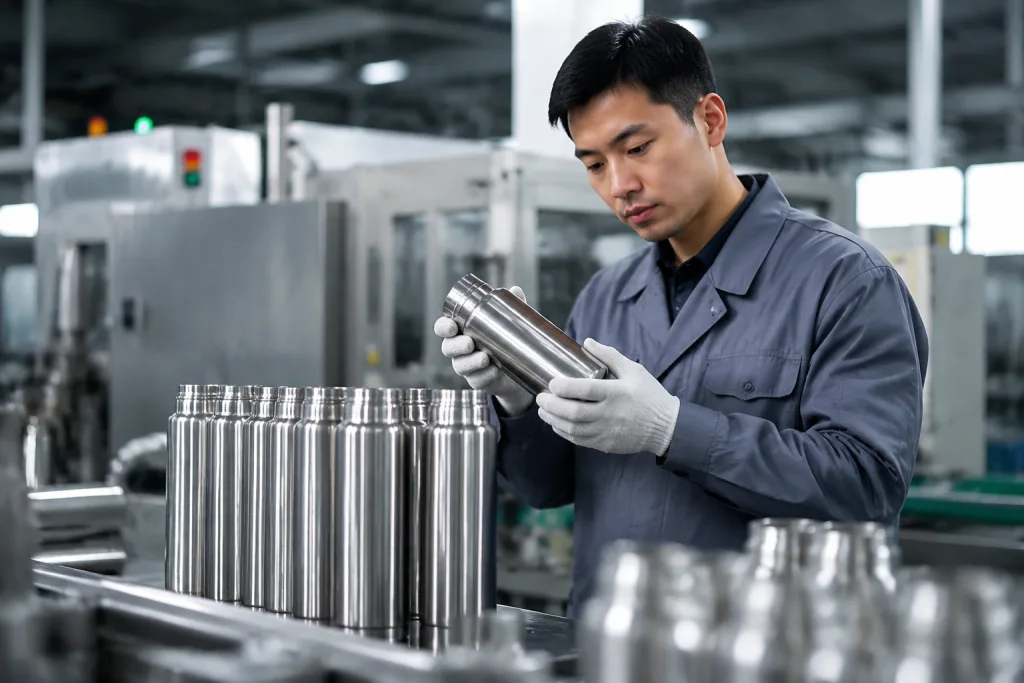
A sample is not a souvenir. It is the control piece for thermos bulk production, so test it like it came from carton 001 on the first mass-production pallet. We still see buyers spend 3 minutes on color and logo, then skip lid torque, mouth diameter, and box drop risk. That is the wrong question to ask. For a top wholesale vacuum flask program going into outdoor retail or corporate gift channels, QC should pull the sample, weigh it on a 0.1 g scale, and mark every finding before the line starts.
Start with function. Fill the bottle with 95°C water, close the lid properly, and measure temperature after 6 hours and 12 hours with the same probe depth each time. A slim 500 ml bottle will not behave like a wide-mouth 1,000 ml flask; the math changes with air gap, lid structure, and opening size. For common double-wall stainless models, 8 out of 10 buyers we ship for set a 6-hour hot retention target of 60-70°C depending on volume and lid design. We run this check on the sample bench with a calibrated thermometer, and QC writes the room temperature on the sheet because 18°C vs 28°C can change the reading.
Leak testing should stay simple and strict. Fill to nominal capacity, close the lid, invert for 30 minutes, then shake for 30 seconds over absorbent paper. For outdoor bottles with flip lids or straw lids, test closed position first, then run 200 open-close cycles before checking again. Small leaks show up fast. If the cap has a carry loop, hang a filled bottle for 30 minutes and check deformation; we had one buyer flag a 1.2 mm loop stretch after a warehouse test, and the tooling had to be adjusted before bulk.
For packaging, run a basic carton review before the bulk order. Check master carton dimensions, gross weight, export carton strength, inner box fit, and bottle-to-lid rubbing risk with accessories inside. A common 24 pcs carton for 500 ml bottles may sit around 45-55 cm on the long side and 10-15 kg gross weight, depending on packaging. The line should also do a quick 1.0 m corner drop on a packed carton; if the inner box collapses or the powder coating gets a rub mark, the carton spec is not ready for wholesale shipping.
Your approval record should list the sample code, date, photos, measured weight, coating finish, logo dimensions, leak result, heat result, and packaging version. If you are sourcing from Zhejiang or elsewhere in China, send back one signed sample or keep a sealed golden sample at the factory thermos line. Verbal approval is not a quality system. We once received a PO with “matte black” typed as “mate black,” and the sealed sample saved the order from a 3,000 pcs finish dispute.
Write the bulk PO carefully
The bulk PO is where your sourcing process either stays under control or turns into a 14-email argument after inspection. A good PO for manufacturers thermos production should read like a production sheet. If it only says “customized thermos, 5,000 pcs, black, logo,” it is not a purchase order. It is a future claim, and we have seen this go sideways when QC pulled the sample and the buyer said the lid was supposed to be push-button, not screw cap.
Put the product line item first: model number, capacity, color, finish, lid type, unit price, quantity, Incoterm, port, requested ship date, plus the approved sample date. If you have 3 SKUs, separate them clearly. Do not mix 500 ml matte black and 750 ml forest green under one loose description, because the line prints labels by SKU and carton mark, not by memory. For distributor thermos buyers, add reorder codes too; your warehouse and the China factory need the same SKU language 6 months later, especially when the repeat PO arrives with one digit missing.
Then add customization line items. Include logo method, logo file version, logo size in mm, logo position, Pantone or finish standard, packaging dieline version, barcode or FNSKU label rules, country-of-origin marking, carton marks, and whether the logo is laser, screen print, or heat-transfer. If this is an Amazon or marketplace-adjacent program, state whether FNSKU labels go on the unit box, polybag, or master carton. A missed label can cost more than the logo; one buyer flagged 1,200 cartons because the FNSKU was on the outer carton only, while their inbound rule required it on each unit box.
Quality terms belong on the PO, not in a separate email nobody opens at 9 p.m. For wholesale drinkware orders, we usually see AQL General Inspection Level II with critical 0, major 2.5, minor 4.0. Define critical defects as leakage, unsafe sharp edges, wrong material, contamination, and serious functional failure. Major defects can include visible dents, wrong logo size, coating scratches over 10 mm, poor assembly, or failed barcode scanning. The wrong question is “will the factory check quality?” The better question is what caliper, leak test time, and barcode scanner rule the inspector follows.
Commercially, state deposit, balance payment, and document requirements. A common structure is 30% deposit and 70% balance before shipment after passed inspection. If you need BSCI factory audit, REACH, LFGB, FDA food contact declaration, or ISO 9001 documentation, list it before deposit. Certifications take time. The math does not work if the cartons are packed on day 28, the vessel cut-off is day 31, and the buyer asks for LFGB paperwork that was never quoted.
Control production before cartons close
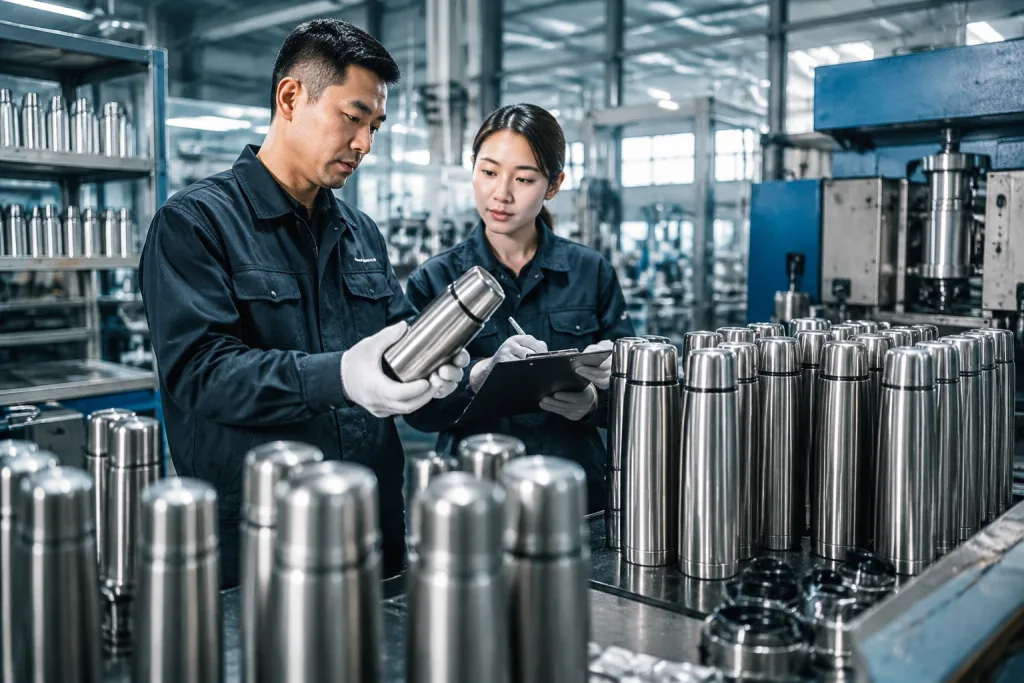
Mass production should not disappear until final inspection day. For a 5,000-20,000 pcs thermos custom order, ask your thermos supplier for three signed checkpoints: material start with 304 stainless coil label, first finished units with a caliper photo on the logo position, and packing start with the carton mark visible. You do not need 30 WhatsApp updates. You need proof the line is running the approved version, not the “almost same” version from an old sample rack.
The production timeline for a standard stainless thermos in China usually runs like this: 3-5 days for deposit and material scheduling, 7-15 days for coating and decoration preparation, 15-25 days for mass production depending on quantity, and 3-5 days for final inspection and booking. At BottleForge Industrial in Hangzhou, Zhejiang, we ship a typical 3,000 pcs custom color order in about 25-35 days after sample approval and deposit, assuming no new mold and no complicated retail box. If the buyer changes Pantone 18-1664 to 19-1664 after powder is ordered, the math does not work; we have seen that add 6 days before the spray line even starts.
Ask for first-article photos and 10-20 second videos before full-speed production. Check body color under neutral light, logo position with a ruler, lid color against the approved sample, gasket placement inside the cap, packaging layout with the dieline code, and carton mark against the PO. QC pulled the sample. If the first 50 pcs are wrong, we can stop the line and adjust the jig by 1-2 mm. If 5,000 pcs are already packed, every correction turns into labor, repacking cartons, and buyer pushback about who pays.
For inspection, use your own QC partner or request factory internal QC records plus random third-party inspection. A practical checklist should cover appearance and dimensions with a digital caliper, capacity and weight on a 0.1 g scale, odor check, leak test, vacuum heat test, coating adhesion, barcode scan, carton drop, and quantity count. For powder coating, run a cross-hatch adhesion test with 3M tape; the tested spot will look damaged, so do it on retained samples, not your hero photo units. For retail boxes, rub test the print 20 times with a dry white cloth and check glue seams for lifting.
Do not approve shipment based only on carton photos. Cartons hide defects too well.
If defects are found, split reworkable issues from non-reworkable ones. A wrong carton mark can be relabeled with a 60 mm sticker. A weak vacuum seal cannot be fixed in a warehouse, and this is where we have seen orders go sideways. Your PO should allow shipment only after reinspection when major functional defects exceed AQL, and the reinspection report should show the same SKU, carton range, and total quantity as the booking sheet.
Plan freight and reorder data
Freight planning starts before the line tapes the first master carton. Stainless vacuum flasks are bulky, not heavy; carton dimensions usually hit landed cost harder than first-time buyers expect. We had a buyer push back on freight after QC measured a 500 ml retail box at 83 mm wider than the kraft-box version. Same bottle, worse cube. If you are buying thermos promotional stock for a dated event, air freight might save 7 days, but the math often dies fast at USD 4.80/kg chargeable weight.
Ask for a packing list estimate at PO stage: units per carton with inner-box style, carton size measured in cm, gross weight after taping, net weight after removing packaging, and total CBM. For example, 5,000 pcs of 500 ml bottles packed 24 pcs per carton may produce around 209 cartons and roughly 8-12 CBM depending on the box. That can move by LCL. Still, if you run 4 colors plus spare lids, carton count jumps and the warehouse may bill extra handling per SKU; we saw this go sideways when a PO typo changed “black lid” to “black gift box.”
Clarify Incoterms before deposit. FOB Ningbo or FOB Shanghai is common for Zhejiang suppliers thermos shipments, and our forwarder normally asks for the booking 12 days before ETD, not 3 days before cargo ready. EXW can look cheaper on the quotation sheet, but local trucking, export handling, customs declaration, and port charges land on your side through the forwarder. DDP is convenient for promotional brands, but ask for the HS code and duty basis, and confirm who acts as importer of record.
Reorder control is where buyers lose money after a good launch. Keep the approved model number with lid version, Pantone or powder-coat color standard, logo file, packaging dieline, carton mark, test reports, and inspection report in one folder. QC pulled the sample last month because the buyer sent an old lid photo from Order 1, while the PO for Order 2 showed the upgraded push-button cap. For distributors thermos programs, assign a stable SKU and barcode at launch. Your second order should not restart from zero.
A reliable top wholesale vacuum flask program is built by documents, not luck. Good thermos manufacturers will ask annoying questions because it protects both sides: MOQ per color, carton drop-test requirement, spare-part ratio, and AQL 2.5 inspection point. If a thermos factory accepts every vague request without asking for a dieline or carton mark, be careful. Speed helps. Blind speed breaks orders.
Send your thermos RFQ for a factory review
Share capacity, logo file, target quantity, and destination. We will return a practical quote with MOQ, lead time, and packaging options.
Frequently asked questions
What MOQ should I expect for a custom stainless thermos order?
For factory-direct custom thermos production in China, a practical MOQ is usually 1,000-3,000 pcs per color and model. If you use an existing body, standard lid, and one-color logo, some suppliers can support 500 pcs, but the unit price will be higher and color options may be limited. Custom powder coating, Pantone matching, retail box printing, or a special lid normally pushes MOQ upward. For a fully customized thermos with new tooling, expect 3,000-10,000 pcs depending on mold cost and complexity. If you are testing a new outdoor retail line, start with a stock shape and custom branding before investing in tooling.
How long does sampling and bulk production usually take?
For an existing stainless vacuum flask model, a blank sample can often ship in 2-4 days. A logo sample usually takes 7-12 days after artwork approval, depending on laser engraving, silk screen, or heat transfer. Bulk production for 1,000-5,000 pcs normally takes 25-35 days after sample approval and deposit. Larger thermos bulk orders of 20,000 pcs may need 40-55 days, especially during peak seasons before summer outdoor campaigns or Q4 promotional programs. Add ocean freight time separately: roughly 25-40 days to many North American and European ports, depending on route and congestion.
Which logo method is best for outdoor retailers?
Laser engraving is usually the safest choice for outdoor retail because it is durable, clean, and resists scratching better than many printed logos. It works especially well on powder-coated stainless bottles, but it does not give a Pantone-colored logo. Silk screen is cost-effective for simple promotional thermos jobs, often around USD 0.08-0.25 per unit plus setup. Heat transfer is better for multi-color artwork or larger graphics, but it adds cost and needs tighter QC on adhesion. For retail, we usually recommend laser for premium minimalist designs and heat transfer only when the artwork really needs color.
What certifications do I need for selling stainless thermos bottles?
For Europe, buyers commonly ask for LFGB food-contact testing and REACH compliance for coatings, plastics, and restricted substances. For the United States, FDA food-contact compliance is typical, and some children’s items may require CPSIA or ASTM-related review depending on design and age claim. For factory social compliance, BSCI or Sedex audits are often requested by larger retailers. If the product is a kids bottle, requirements become stricter than a standard adult outdoor flask. Put required documents on the RFQ and PO before deposit, because updated lab testing can take 7-15 working days and costs vary by material set.
How do I compare quotes from different thermos suppliers fairly?
Build a quote table with the same technical fields: capacity, steel grade, wall thickness or unit weight, lid material, coating, logo method, packaging, MOQ, FOB port, lead time, sample cost, and testing included. A USD 3.60 quote and a USD 4.20 quote may not describe the same manufacturer thermos product. One may include a color box, 304 outer wall, and LFGB report, while the other uses plain box and lighter steel. Ask each thermos supplier to confirm assumptions in writing. The most useful comparison is landed cost plus risk, not just FOB unit price.