Key Takeaways
- A 500 ml stainless vacuum bottle usually ranges from USD 3.20-6.80 FOB China depending on steel, finish, cap, and packaging
- Practical MOQ starts at 1,000 pcs per color for simple logo work and 3,000-5,000 pcs for custom molds
- Normal lead time is 35-50 days after deposit and artwork approval, excluding sea freight
- AQL 2.5/4.0 inspection, REACH checks, and carton drop testing should be priced before purchase order approval
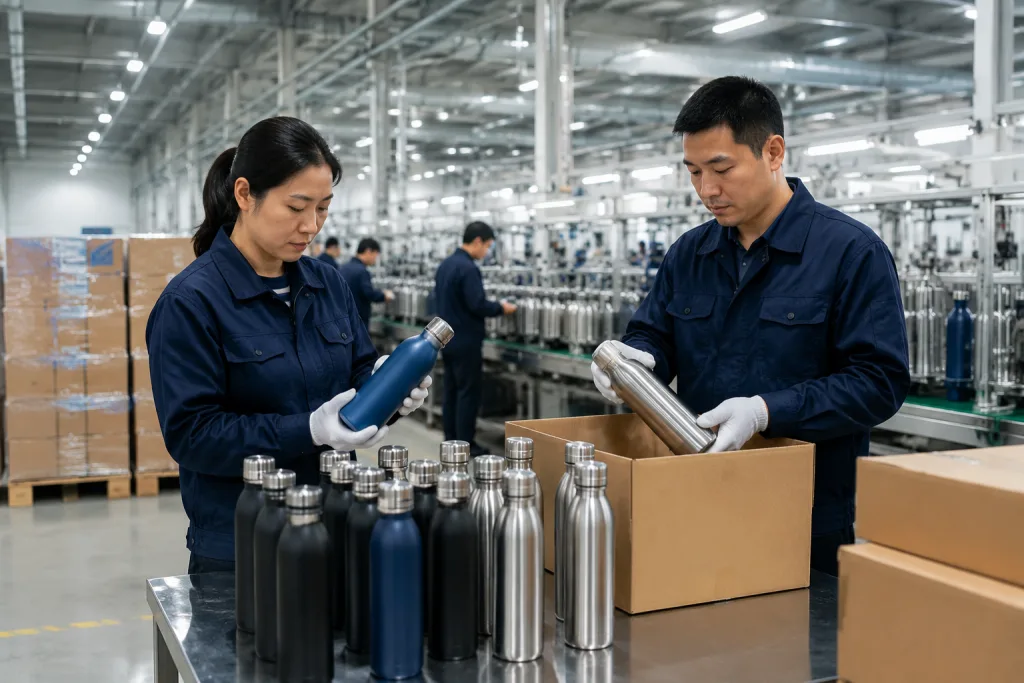
A top wholesale vacuum bottle is not a catalog bottle with a logo slapped on. For outdoor retailers and promo brands, the buyer’s real test is simple: can we hit the landed cost, launch date, packaging spec, and AQL 2.5 quality target without the line stopping on day 12 because the powder coating color failed the ΔE check?
At BottleForge Industrial in Hangzhou, Zhejiang, we see this 7 or 8 times a month: a buyer compares a USD 4.20 quote with a USD 5.10 quote and skips the steel grade, coating loss rate, carton spec, inspection level, and shipping plan. Bad move. QC pulled one sample last season where the PO said “mat black” instead of “matte black,” and that tiny typo almost turned a custom thermos order into air freight and a margin wipeout.
Where The Bottle Cost Starts
The base cost of a top wholesale vacuum bottle starts with the body, not the logo. For a 500 ml double-wall 304 stainless steel bottle, a realistic FOB China range is USD 3.20-4.60 for a simple powder-coated model with a standard lid and white box. A 750 ml or 1,000 ml outdoor bottle usually lands at USD 4.80-7.20 because we run more steel through the hydraulic drawing press, the vacuum chamber is larger, cartons move from about 9 kg to 13 kg per master, and the polishing line needs extra passes.
Wall thickness matters. Around 70% of promotional thermos projects we see use 0.4 mm inner wall and 0.5 mm outer wall. For outdoor retail bottles that get clipped to backpacks or tossed into pickup beds, 0.5 mm inner and 0.6 mm outer wall is the safer spec. That extra 0.1 mm looks tiny on a caliper, but it can add 6-10% to body cost. If a supplier thermos quote looks too low, this is the wrong question to ask: “Can you match the price?” Ask for actual wall gauge and net unit weight in grams. QC pulled a 500 ml sample last month that was quoted as 0.5 mm outer, but the Mitutoyo gauge read 0.43 mm at the shoulder.
The steel grade also changes the number. Most export-grade factory thermos orders use 304 stainless steel for the inner wall. Some buyers request 316 stainless steel for the inner wall for better corrosion resistance, especially for salty drinks or premium outdoor ranges. Expect 316 inner wall to add about USD 0.35-0.80 per unit depending on size and steel market pricing in China. We ask the mill for a material cert before blanking; one buyer flagged a PO typo that said “316 outside, 304 inside,” and the math didn’t work for the target shelf price.
Vacuum performance is another cost point. A typical bottle should keep water above 55°C after 12 hours under controlled testing from 95°C starting temperature. Higher insulation targets need tighter welding, better copper coating inside the vacuum layer, and more rejection during testing, so the unit price goes up because failed vacuum pieces cannot be shipped. Simple as that. On the line, we use a vacuum tester and hot-water hold test; if 18 pieces fail out of a 300-piece inspection batch, QC blocks the carton instead of letting sales “explain it later.”
Customization Costs You Should Separate
Do not accept a custom thermos quote that buries every charge inside one unit price. The math gets messy fast, and we have seen this go sideways when a buyer compares our EXW sheet with another factory’s FOB “all-in” number. Split the base bottle, decoration, packaging, tooling, and compliance testing. On our costing sheet, QC usually checks logo size in mm against the artwork before the merchandiser releases the PI. A simple one-position laser logo may add USD 0.12-0.25 per unit. One-color silk screen printing usually adds USD 0.08-0.18, while multi-color printing can reach USD 0.30-0.60 if registration is tight or the logo wraps around the body.
Powder coating is the standard finish for outdoor retail orders because it gives better hand grip and survives shelf knocks better than glossy paint. Normal matte powder coating is usually included in a mid-range quotation. Rubberized coating, gradient spray, metallic finish, or ceramic-like coating may add USD 0.25-0.90 per unit. These finishes reject more pieces on the line; last month QC pulled 37 bottles from a 1,000 pc gradient run for shade drift under the D65 light box. Plan sampling at 18 days instead of 12 days, and sign off color with a physical sample, not only a Pantone code on email.
For packaging, a plain white box can cost USD 0.08-0.15. A full-color retail box with E-flute board may cost USD 0.25-0.55 depending on print area and carton structure. If you need FSC paper, barcode labels, FNSKU stickers, warning inserts, or hang tags, price them line by line. We once had a PO typo where “FNSKU” was written as “FNSK,” and the buyer flagged it after 42 cartons were already labeled. Not fun. A promotional thermos for a 3-day event may not need retail packaging; a distributor thermos going into outdoor stores usually does.
Tooling is where buyers often ask the wrong question. They ask, “Can you make my own shape?” Better ask whether the extra sell-through pays back the mold. A custom lid mold may cost USD 1,200-3,500. A new body shape can cost USD 3,000-8,000 depending on size range and mold complexity. If your thermos customized project only needs a logo and color, avoid new molds and we run it on an existing 304 stainless body. If your brand needs a unique silhouette, allow budget for CNC samples, 2 rounds of engineering changes, and at least 25 days before pre-production approval.
MOQ Tiers That Actually Work
MOQ is not a sales trick; it comes from coating-line changeover, logo fixture setup, carton artwork plates, and steel purchasing. At BottleForge in Zhejiang, we usually quote 1,000 pcs per SKU for stock-shape bottles with laser engraving or a one-color logo. For custom powder coating, 1,000 pcs per color is the floor that makes sense; after QC pulled a matte black sample last month, the line lost 6 kg of powder during booth cleaning before we could run the next Pantone color.
For a bulk thermos program with mixed colors, 3,000 pcs total split into 3 colors of 1,000 pcs each is workable. Ask for 300 pcs each in 10 colors and the math doesn't work. The unit cost jumps, or the factory says no, because setup waste eats the margin; we had one buyer flag this after seeing a 14% coating surcharge on the PI. For retail packaging, printed box suppliers in China usually want 2,000-3,000 boxes per design, though digital short-run printing works when you accept the higher box cost and a 12-day print lead time instead of 18 days for offset.
Here is a practical way to read thermos bulk pricing before you push the supplier for a lower tier:
- 500-999 pcs: workable for pre-production samples or urgent promo jobs using stock color bottles; expect higher unit cost, simple laser marking, and no custom inner tray.
- 1,000-2,999 pcs: normal starting tier for logo customization and basic color selection; we run standard export cartons here, usually 24 pcs per master carton.
- 3,000-9,999 pcs: better tier for custom packaging or 3-5 color splits; FOB pricing improves because coating, assembly, and carton packing stay on the line longer.
- 10,000 pcs and above: stronger material purchasing power and reserved production schedule; this is where custom lids, silicone boots, or gift sleeves become easier to price.
Our Hangzhou-area production network can support about 450,000 stainless drinkware units per month across vacuum bottles, tumblers, and sports bottles. Capacity helps. It does not cancel MOQ logic. A thermos manufacturer still needs stable batch sizes to hold color within ΔE 1.0-1.5, keep welding fixtures set, and let inspection flow stay clean under AQL 2.5; we’ve seen this go sideways when a PO typo changed “1,000 pcs blue” into “100 pcs blue” two days before coating.
Lead Time By Project Type
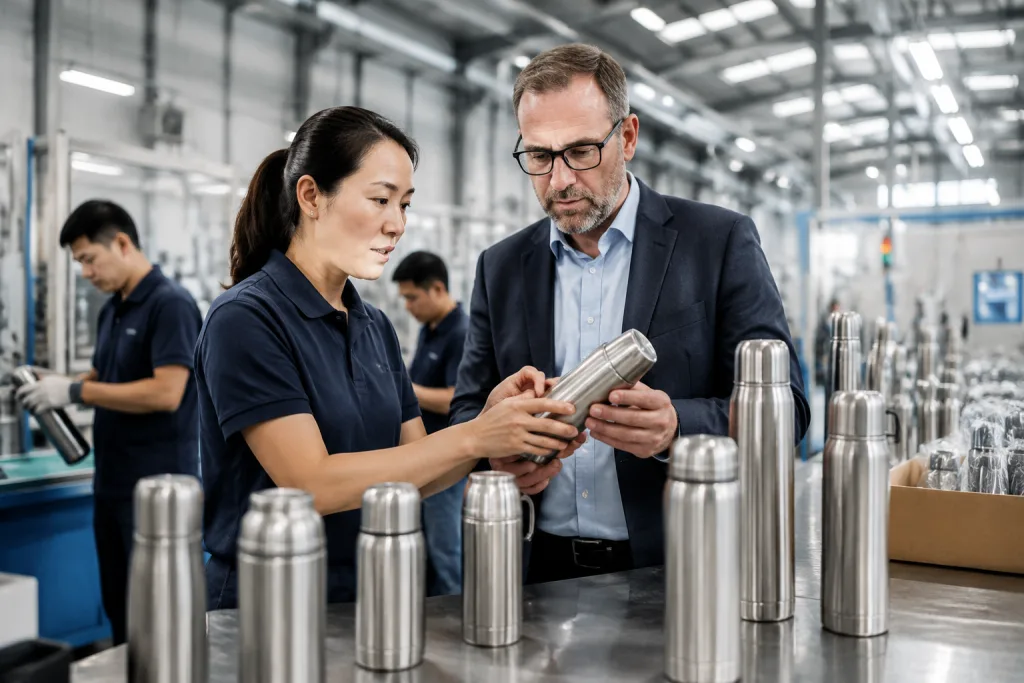
Lead time starts only after 3 items are done: deposit in our account, artwork signed back, and sample approved. Missing one? The clock is not running. For a standard manufacturers thermos order using an existing bottle shape, existing lid, and one logo, we run 30-40 days in production. Add 3-7 days for pre-production sample approval if the buyer replies within 24 hours; last month QC pulled a 500 ml sample because the logo was 2 mm lower than the signed PDF.
A customized thermos with new color, new retail box, and several logo positions usually needs 40-55 days. The added time is not just printing. Powder coating must be matched to Pantone or RAL under the D65 light box, packaging needs dieline approval, and the first finished units should be checked for color gap, cross-hatch adhesion, and barcode position. If your distributor thermos program has 6 SKUs, build 4-6 extra days into the schedule for packing list control; we have seen this go sideways when one PO says “matte black” and the carton mark says “black matte.”
New mold projects need a different calendar. A new cap mold may take 20-30 days for tooling, then 7-10 days for trial samples and adjustments. A new bottle body can take 35-50 days before stable samples are ready. After approval, mass production still takes another 35-50 days. The wrong question is “how fast can you mold it”; the better question is whether the leak test, thread fit, and drop test pass on the same sample set. On the line, one 0.3 mm mismatch at the cap thread can kill the schedule. If you need a new product on shelves for spring, do not start development in January and expect safe ocean delivery to Europe or North America.
Shipping adds its own clock. Sea freight from Ningbo or Shanghai to major European ports often runs 30-40 days port to port. To the US West Coast, 16-25 days is common; to the US East Coast, 30-40 days is safer. Air freight can move in 5-8 days, but it can add USD 1.20-3.00 per bottle depending on carton volume and season. We ship 24 pcs per master carton for many 500 ml bottles, and the math changes fast when the carton hits 13 kg gross weight and the forwarder charges by volume weight.
Quality Checks Worth Paying For
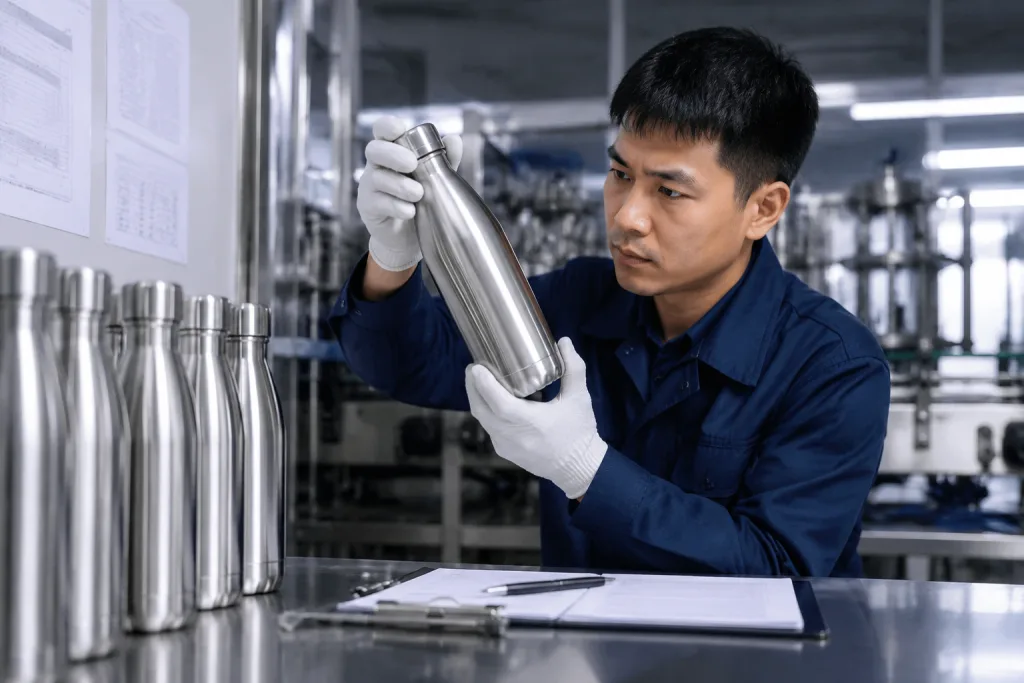
A cheap thermos supplier stops looking cheap when 8% of the shipment comes back with leaking caps or coating that scratches off under a fingernail. We ask buyers to lock the inspection plan before the first sheet of 304 stainless goes to the press. On our line, QC marks the sealed sample with a paint pen and keeps it beside the torque tester, because “same as approved sample” is where arguments start. We normally recommend AQL 2.5 for major defects and AQL 4.0 for minor defects. Critical defects, such as leakage, sharp edges, wrong material contact surface, or broken packaging for retail orders, should be zero tolerance. No debate there.
For stainless vacuum bottles, the checks are plain work, not fancy paperwork. The factory should test vacuum performance for 6 hours, run lid leakage with 100°C hot water, check coating adhesion, odor, capacity, logo position, carton strength, and barcode readability with a scanner, not just by eye. A 100°C hot water leak test catches more problems than a cold water shake test; we have seen lids pass cold water and fail after 3 minutes upside down in hot water. For powder coating, cross-hatch adhesion testing and 3M tape pull tests catch weak surface preparation before goods leave China. Last month QC pulled 32 samples and found 5 with poor pretreatment near the bottom radius.
Compliance depends on the market and the exact build. For the EU, buyers often request LFGB food-contact testing, REACH screening for coating and plastic parts, and BPA-free declarations for lids. For the US, FDA food-contact expectations and California Proposition 65 screening may apply. Kids bottles may need ASTM or CPSIA-related checks depending on design and age grading. Asking “Does your factory have a report?” is the wrong question to ask. We need the report to match the product construction, including color, PP lid grade, silicone ring, and coating supplier; the buyer flagged this once when a PO said matte black but the test report covered silver uncoated steel.
Third-party inspection usually costs USD 250-350 per man-day in China. That is small money next to a rejected retail delivery or a chargeback email sent at 11 p.m. For a 5,000 pcs thermos promotional order, that inspection cost is only about USD 0.05-0.07 per bottle. The math works. If your retailer has chargebacks, budget for inspection from the start, and tell the factory whether the inspector will use AQL cartons from the packed-goods area or pull bottles directly from the line.
FOB, Freight, And Landed Cost
Most first quotes for a top wholesale vacuum bottle come as FOB Ningbo or FOB Shanghai. FOB means we cover production, export packing, inland trucking to port, export customs handling, and loading responsibility up to the agreed point. After that, the bill is yours: ocean freight, destination port charges, import duty, broker fees, local trucking, and warehouse handling. We usually see Ningbo port cut 1-2 days off the schedule for Hangzhou-area orders versus Shanghai, unless the buyer’s forwarder has a fixed sailing. Check the port on the PI. One buyer flagged this after the PO said FOB Shanghai while the freight quote was built on Ningbo.
For landed cost, carton volume often hurts more than unit weight. A 500 ml vacuum bottle may weigh 280-360 g, but the carton still has to protect retail boxes from crushing. We run a common 24 pcs export carton at around 50 x 35 x 28 cm, with a 5-ply K=A board when the box print is easy to scuff. Add a handle lid or gift box and that same 24 pcs carton grows, so freight cost per unit jumps even if the bottle weight barely moves. Ask for carton dimensions and gross weight before approving the purchase order; this is where buyers lose USD 0.08-0.18 per pc and only notice after the forwarder sends the CBM.
Duty rates vary by destination and HS code classification. Stainless steel vacuum flasks and insulated drinkware may carry different duty rates depending on market rules and product details. Your customs broker should confirm the code before you lock the margin. This is the wrong question to leave until shipment week. A serious thermos manufacturer can provide product description, material breakdown, 304 stainless details if used, and packing data, but the importer remains responsible for classification. QC pulled one sample last month because the PO called it a “sports bottle,” while the invoice draft said “vacuum flask”; that small wording mismatch slowed the broker review by 2 days.
If you sell through online channels, add prep cost. FNSKU labeling, carton labels, polybagging of accessories, and master carton weight limits all hit packing labor. For Amazon-style programs, keep cartons under 15 kg when possible and confirm drop-test strength. We’ve seen this go sideways when a distributor thermos carton built for pallet delivery entered a parcel network; the line passed the carton with clean tape seams, but the courier hub crushed 3 corners after a 76 cm drop. Use stronger board or reduce pcs per carton if the math still works.
How To Compare Supplier Quotes
If two thermos suppliers quote different prices, don’t start by asking for a discount. That is the wrong question to ask. First compare the quote assumptions: steel grade, inner and outer wall thickness in mm, finished unit weight in g, lid material, silicone grade, coating type, carton structure, MOQ per color, sample cost, lead time, inspection standard, and FOB port. Last month QC pulled a 500 ml sample that looked the same in photos, but the body weight was 238 g vs 276 g and the lid used PP instead of Tritan. Same shape. Different bottle.
A professional manufacturers thermos quote should state payment terms in plain writing. We usually see 30% deposit and 70% balance before shipment, or balance against copy of bill of lading for accounts with shipment history. New buyers should not expect open account terms on the first order; the math doesn’t work for a factory buying 304 stainless coil before production. For large programs above 50,000 pcs, staged payments can be tied to material purchase, production start, and inspection pass. One buyer once sent a PO with “70% after sales,” probably a typo, but our finance team stopped the line until it was corrected.
Samples tell you how real the quote is. A stock sample can usually ship in 3-5 days. A custom logo sample may take 7-12 days, especially if we need a laser engraving fixture or a silk-screen plate. A new color sample often takes 10-15 days because powder coating must be scheduled with the coating line, not squeezed between two production colors. If a thermos factory promises complex samples in 2 days, they are likely showing something close, not exact. Fine for early review. Bad for final approval.
The safest buying process is boring: confirm the spec sheet, approve artwork, approve the pre-production sample, lock the packing method, run a mid-production check for large orders, then do final inspection before balance payment. Whether the buyer calls it a custom thermos, customizable thermos, thermos promotional item, or supplier thermos program, the risk stays the same. We’ve seen this go sideways when a buyer changed from white box to color box after the bottles were welded and packed; the order lost 4 days, and 32 cartons had to be reopened for repacking. Lock details early. Steel is cheap only before it is welded.
Price Your Custom Thermos Before Production Slots Fill
Send bottle size, quantity, logo method, packaging needs, and target delivery date. We will quote a practical FOB range and timeline.
Frequently asked questions
What is a realistic MOQ for a custom stainless thermos?
For an existing bottle shape with one logo, 1,000 pcs per color is a realistic MOQ from a China factory. Some stock-color orders can start at 500 pcs, but the unit price is usually higher and packaging options are limited. For custom retail boxes, expect 2,000-3,000 pcs per box design. For a new lid or body mold, 3,000-5,000 pcs is a more practical starting point because tooling, trial production, and defect control need enough volume to make commercial sense.
How much should a top wholesale vacuum bottle cost FOB China?
A standard 500 ml double-wall stainless vacuum bottle normally costs USD 3.20-4.60 FOB China with 304 stainless steel, powder coating, one logo, and basic box. A heavier 750 ml or 1,000 ml outdoor bottle often lands at USD 4.80-7.20 FOB. Add USD 0.25-0.90 for premium finishes, USD 0.25-0.55 for printed retail packaging, and USD 0.35-0.80 if you upgrade the inner wall to 316 stainless steel.
How long does a customized thermos order take?
For an existing model with logo only, plan 35-45 days after deposit, artwork approval, and sample approval. A customized thermos with new color, custom box, and multiple SKUs is safer at 45-60 days. New mold work adds much more time: a cap mold may need 20-30 days before trial samples, while a new body shape can need 35-50 days before stable sampling. Ocean freight then adds about 16-40 days depending on destination port.
Which logo method is better for promotional thermos orders?
Laser engraving is durable and clean, usually adding USD 0.12-0.25 per unit, but it gives a metallic mark rather than a color logo. Silk screen printing is cheaper at about USD 0.08-0.18 for one color and works well for simple promotional thermos designs. Heat transfer or UV printing can handle more colors, but expect USD 0.30-0.80 per unit and more testing for scratch resistance. For outdoor retail, laser or high-quality screen print is usually safer.
What quality standard should I put on the purchase order?
Use AQL 2.5 for major defects and AQL 4.0 for minor defects, with zero tolerance for critical issues such as leakage, sharp edges, wrong material, or unsafe odor. Specify vacuum heat retention, leak testing with hot water, coating adhesion, logo position tolerance, carton drop test, and barcode scan checks. For EU orders, confirm LFGB and REACH needs. For US orders, discuss FDA food-contact expectations and Proposition 65 screening before mass production starts.