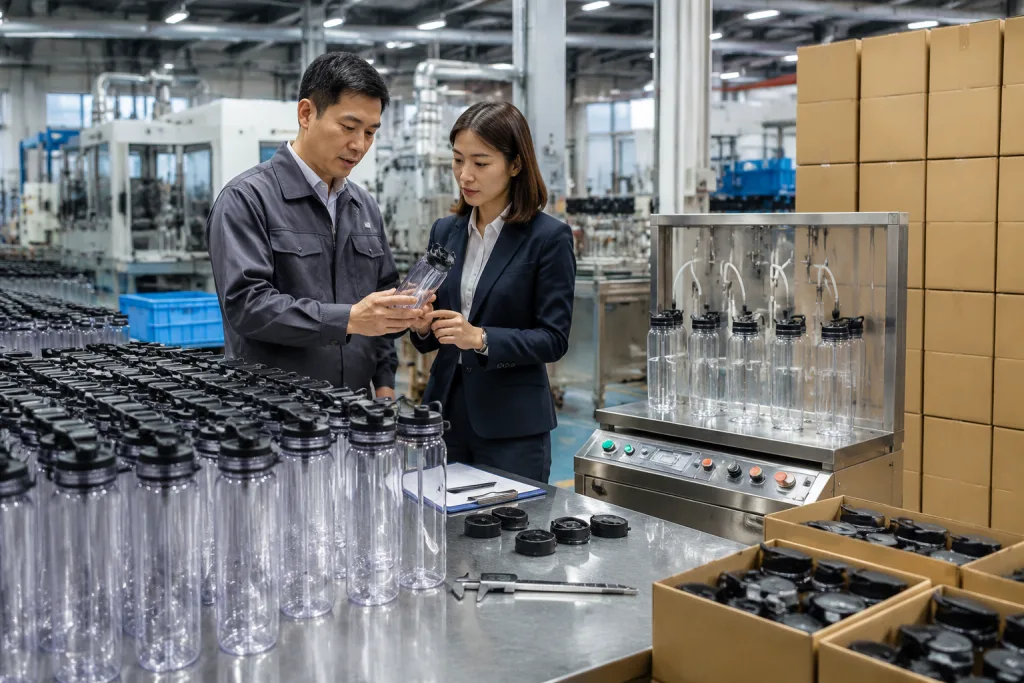
Key Takeaways
- For custom Tritan bottles, a practical MOQ is 3,000-5,000 units per color, with 10,000 units giving better FOB pricing.
- AQL should cover visual defects, leak testing, logo adhesion, carton drop testing, and barcode scans before balance payment.
- Expect 30-35 days for mass production after artwork, sample, deposit, and packaging files are approved.
- Tritan is useful for clear reusable drinkware, but not for hot-fill, microwave, or carbonated beer growler bulk applications.
You are buying more than a clear plastic bottle. You are buying a 0.8 mm wall that still looks clean under retail lighting, FDA/LFGB paperwork that matches the resin lot, a 5-ply export carton that survives a 14 kg drop test, and printing that does not shift 2 mm after lunch break. QC pulled a sample last month where the logo sat 3 mm high; the buyer flagged it before mass packing. That is the real test for a top wholesale tritan bottle project.
Let’s use one real order shape: 10,000 custom Tritan sports bottles for a North American fitness brand, shipped FOB Ningbo from Zhejiang, China. We run similar bulk drinkware jobs every month in Hangzhou, including canteen wholesale programs and beer tumbler wholesale bulk sets, but the math still needs checking line by line. On one PO, the buyer typed “Trian” instead of “Tritan,” and our merchandiser stopped the PI before the wrong resin code reached the workshop. The numbers below are the ones you should pressure-test before you approve a PI.
The order starts with use case
The buyer brief says “premium clear sports bottle, 750 ml, flip straw lid, logo printed, retail box.” Too thin. Before quoting, we ask 3 questions: sales channel, user age, and washing method. Last month a PO even had “750ML tiran” typed in the item line, and QC still had to decide whether the lid needed a child-safe bite valve. A gym bottle for adults and a school bottle for children can share the same spreadsheet photo, then fail for different reasons on the line.
For this job, call it a 750 ml Tritan bottle for gyms and online retail in the United States. Target retail is USD 14.99-19.99. The landed cost cannot act like a USD 1.20 giveaway bottle, but the math also does not work if you build it like stainless steel vacuum drinkware. For a top wholesale tritan bottle, we usually run a 2.2-2.8 mm body wall, PP or Tritan lid, silicone seal, and a carry loop that holds at least 5 kg in static load testing. QC pulls the loop sample with a hanging weight, not by “feeling it by hand.”
We would not recommend Tritan for boiling water, hot coffee, microwave heating, or pressured beer growler orders. Cold water is fine. Iced tea is fine. Protein drinks need a wider mouth if the buyer does not want powder stuck under the straw seat. If you are sourcing a bulk growler, wholesale growler, alcohol flask wholesale, or beer tumbler bulk program, keep those on separate spec sheets with separate test requests. We have seen this go sideways when one buyer asked us to use the same 70°C dishwasher note across Tritan bottles and beer tumblers.
A serious China factory will push you to define these limits early. Not because we enjoy paperwork. It saves the classic headache: the desk sample passes, then 2,000 customers put it in dishwashers at 70°C and leave one-star reviews. On our side, the warning usually starts when QC pulled the sample after 18 dishwasher cycles and found light whitening near the molded hinge pin.
Spec sheet before the price
A price without a spec sheet is a guess with a currency symbol. We see this on the line every month: a buyer asks for “750 ml Tritan bottle, best price,” then QC pulls the sample and the lid hinge, wall thickness, and carton spec are all different. For this order, lock capacity, resin grade, lid structure, logo method, color, packaging, test standard, and spare parts before sending RFQs to 3 factories. Otherwise the cheapest quote is usually quoting a different bottle.
A workable specification might read: 750 ml Eastman Tritan copolyester body, transparent smoke gray, 2.5 mm average wall thickness checked by digital caliper, PP flip lid, food-grade silicone gasket, one-color silkscreen logo at 60 x 35 mm, individual color box, 24 units per export carton, FOB Ningbo. If your brand needs REACH, LFGB, EU 10/2011, FDA food-contact declaration, or California Proposition 65 review, list it before quotation. Add it after the 30% deposit and the math doesn’t work; we may need a different resin COA, another lab slot, and 12 days instead of 18 days suddenly becomes impossible.
For logo work, silkscreen usually beats laser on cost because Tritan is plastic and transparent. A one-color print may add USD 0.06-0.12 per unit at 10,000 units, based on one fixture and normal curing time. Heat transfer or full-wrap artwork can add USD 0.20-0.45, depending on coverage and registration tolerance. Write the tolerance down. For drinkware bulk campaigns, we run ±1.5 mm position deviation and no exposed ink gaps over 0.5 mm; one buyer flagged a 2 mm logo shift on a PO photo, and the whole carton had to be re-sorted.
Packaging gets buyers into trouble. A retail box with 350 gsm white card and matte lamination is not the same as a brown kraft inner box, even if both look fine in a showroom sample. Carton strength should match your channel. For Amazon FBA or distributor warehouses, specify FNSKU label placement, carton barcode, master carton dimensions, and 5-ply export carton. Zhejiang factories can make clean bottles and still cost you money if a 13 kg carton crushes during LTL handling in Chicago or Rotterdam; we’ve seen this go sideways from one missing “5-ply” line on the PO.
Realistic MOQ and FOB target
For a private-label Tritan bottle, we usually quote a workable MOQ at 3,000-5,000 units per color when the buyer accepts an existing mold. At 10,000 units in one body color and one logo, FOB Ningbo for a mid-grade 750 ml custom bottle usually lands around USD 1.65-2.35. The swing comes from lid parts, Eastman Tritan resin price that week, insert card or color box choice, and whether the buyer needs FDA, LFGB, or third-party testing. Cheap quotes exist. Ask what was cut. Last month QC pulled a 750 ml sample with a 0.6 mm gap at the flip lid seal; that kind of saving comes back as a complaint claim.
At BottleForge Industrial in Hangzhou, Zhejiang, we run about 450,000 units/month across plastic and stainless drinkware. Custom Tritan lead time is normally 30-35 days after approved sample and deposit. Pre-production samples take 7-10 days from an existing mold, or 25-35 days when a new mold is needed. New mold cost can run USD 3,000-8,000 for a bottle body and lid set, and it climbs when the lid has a lock button, straw hinge, silicone valve, or spring pin. On the line, our mold tech checks the first shots with a Mitutoyo caliper before we release packing; a 0.3 mm neck thread drift is enough to make caps feel loose.
This is how the price talk should go. Ask for the base bottle cost without logo. Then add logo cost by process, such as one-color silk print, heat transfer, or laser marking on a metal lid plate. Add packaging cost with the exact carton quantity and carton CBM. Add compliance testing and inspection cost, including AQL 2.5 if your retailer requires it. Confirm FOB port. If a supplier gives one bundled price and refuses the breakdown, the math does not work for comparison. We have seen this go sideways when a buyer’s PO said “color box” but the quote assumed white box, adding USD 0.18 per unit after artwork approval.
Related categories use different MOQ logic. Canteen bulk and wholesale canteen projects can sit at lower mold pressure when the body shape is already standard, often 1,000-2,000 units per color for logo work. Beer growler wholesale and beer growler wholesale bulk orders usually shift to stainless steel or glass, so we check pressure, cap seal, and insulation with a vacuum tester and hot-water hold test. Alcohol flask bulk and alcohol flask in bulk programs use stainless steel, smaller capacity, and tighter polishing control; our inspector flags hairline scratches under a 600 lux lamp. Do not force all bulk drinkware into one costing template. It is the wrong question to ask.
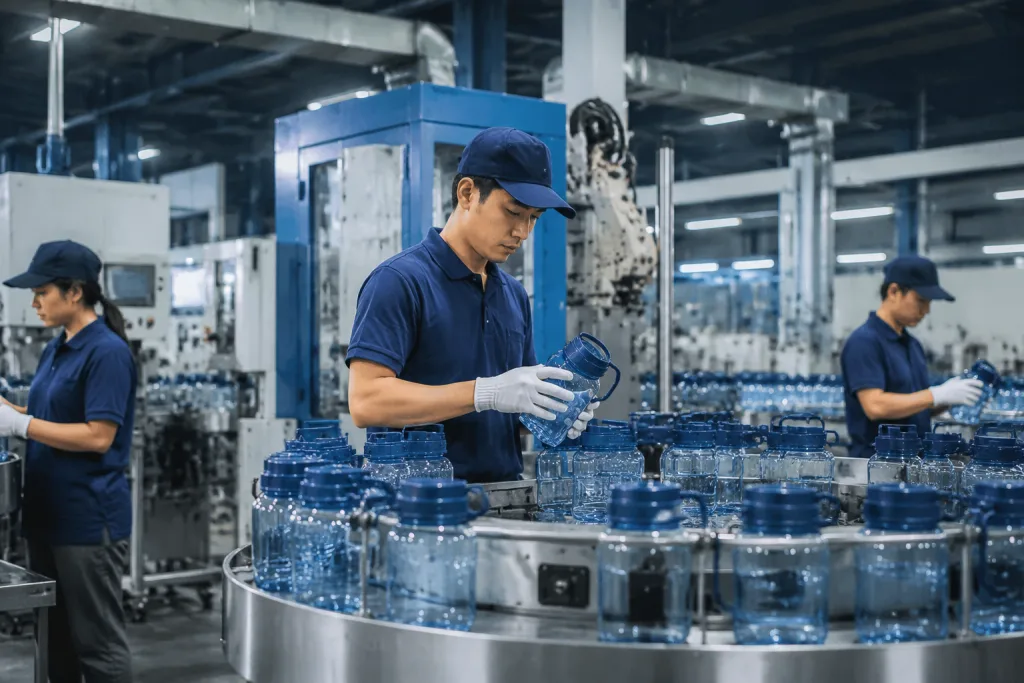
Sampling should try to break it
A golden sample that looks good under office lighting is not enough. Try to break the bottle before the factory makes 10,000 units. For this run, we send 3-5 pre-production samples: 1 for your product team, 1 for compliance review, 1 for packaging fit, and 1-2 for destructive checks. QC pulls these from the same mold and lid tooling, not from a nicer showroom batch.
Start basic. Fill the bottle to rated capacity and weigh the water on a 0.1 g bench scale; a claimed 750 ml bottle should not actually hold 680 ml. Check the scale marks if you have them, especially around the 250 ml and 500 ml lines where silk-screen drift shows up. Open and close the flip lid 500 times. Hold the filled bottle upside down for 4 hours. Shake it horizontally for 60 seconds. Drop it from 1.2 m onto plywood, first on the base, then on the side wall, then straight onto the lid button. Tritan is tough. The failures usually come from hinge pins, straw locks, or silicone seals, and we have seen a 0.3 mm loose pin turn into a full return claim.
Logo testing is simple, and buyers skip it too often. Rub the printed logo with a wet cloth for 50 cycles, then with 75% alcohol for 20 cycles if your market uses sanitizers in gyms or schools. Use a white cotton cloth, not a thumb wipe. If the logo fades on the sample, mass production will not fix it. The buyer sometimes asks us to approve a sticker mockup first; that is the wrong sample to approve for a wholesale drink bottle program. Brand owners should sign off on the real logo method.
Check packaging samples at the same time. Put the bottle in the color box, then load that color box into the master carton we plan to ship, for example 24 pcs per carton at about 12 kg gross weight. Shake the carton by hand. If you hear bottles moving, the insert or box tolerance is wrong. For online channels, ask for a carton drop test from 76 cm: one corner impact first, three edge impacts after that, then all six faces. This is not lab theater. It is cheap protection against dented boxes, cracked lids, and avoidable claims after we ship.
QC plan for mass production
Lock the mass production QC plan before the deposit. After defects show up, the math doesn't work and we've seen this go sideways. For a 10,000-unit order, we usually set one during-production inspection at 20-30% completion when the artwork is new, then a final random inspection after 100% of goods are finished and at least 80% packed. Use ANSI/ASQ Z1.4, general inspection level II, with AQL 2.5 for major defects and AQL 4.0 for minor defects. For critical safety defects, use zero tolerance. On our Hangzhou line, QC pulls the first 32 printed bottles under a 6500K light box before the second shift keeps running.
For Tritan bottles, the checklist should cover body clarity and black spots, flow marks and scratches, capacity measured with a 500 ml graduated cylinder, lid fit and gasket presence, leak performance and straw draw, logo position and adhesion, odor and color consistency, barcode scan, carton marking, and gross weight. If the order has mixed colors, sample each color. If it has mixed lids, sample each lid type. China factories often run lids and bodies on different schedules; last April a buyer flagged a blue flip lid matched with a smoke-gray body because the PO line said “GY” but the carton label showed “GR.”
Leak testing cannot be a stamp on paper. We run 100% air-pressure or water leak checks on assembled units, then ask the random inspector to verify again from sealed cartons. For our Zhejiang production line, operators do inline visual checks and gasket checks before packing, often with a 0.25 MPa air tester at the bench. Buyer-side AQL inspection still earns its fee. It catches packaging, marking, and batch shade issues that line workers may pass because “function is OK.”
Write defect definitions like the inspector will read them at 8:30 p.m. beside a pallet jack. A 3 mm scratch on the rear lower body may be minor. A 3 mm scratch across the front logo is major. A missing silicone ring is major because it causes leakage. A sharp plastic burr near the mouth opening is critical because it touches the user. Good QC wording cuts arguments because everyone knows what failed before the inspector opens carton No. 1.

Compliance paperwork is not decoration
Compliance for Tritan drinkware is workable, but certificates are not decoration for a buyer file. Ask which resin grade was tested, the test date, and whether the report matches the actual bottle: colored Tritan body, printed logo, PP lid, silicone ring, and straw if there is one. We run this check at sample sign-off; QC pulled one 650 ml bottle last month because the lab report covered a clear body, while the buyer’s PO showed smoke gray with a silicone seal.
For the US market, 7 of 10 retail buyers we see ask for an FDA food-contact compliance statement and a BPA-free declaration before artwork approval. Children’s items bring extra review, usually ASTM or CPSIA-related checks tied to age grading and small parts. For the EU and UK, EU 10/2011 usually covers plastic food contact, LFGB is common for Germany, REACH SVHC screening checks restricted substances, and packaging waste paperwork depends on the sales channel. Kids’ drinkware needs a thicker file. Adult gym bottles are simpler.
Social compliance matters once you sell into larger retailers. BSCI, Sedex/SMETA, ISO 9001, and retailer audits are not the same thing: BSCI checks social responsibility, SMETA digs into labor and safety, ISO 9001 checks quality systems, and retailer audits follow their own checklist. If your distributor asks for BSCI and the supplier says, “we can arrange later,” the math doesn’t work. Audit booking can take 2-6 weeks, and one missing fire-extinguisher tag on the line can trigger corrective action before shipment approval.
A direct China factory should say this plainly: testing costs money and calendar days. A fresh EU food-contact test for the final product may take 7-10 working days and cost a few hundred USD, depending on lab scope. We ship regulated retail orders only after the final BOM matches the test request form, down to the gasket material and lid color code. If you are buying drinkware wholesale for chain retail, put this into the project calendar. Saving USD 300 on testing is the wrong question to ask if it delays a USD 40,000 shipment at the port or blocks retailer intake.
Shipment handoff and reorder control
QC pass is not the handoff. We still chase the carton data from the scale sheet, shipping marks, CI and PL drafts, HS code notes, and the booking cut-off. For Tritan plastic bottles, 7 out of 10 buyers we ship for use plastic household or tableware-related classifications, but your customs broker must confirm the final HS code in your market. Do not let a supplier guess import compliance. We have seen this go sideways when a PO typo showed “PP bottle” while the sample and resin record were Tritan.
For the 10,000-unit scenario, assume 24 units per carton, about 417 cartons total. Our packing table usually shows 13-18 CBM after the outer carton is measured with a tape, not from the sales sheet. LCL works, but the math changes if you add beer tumbler in bulk with separate inner boxes, canteen bulk with heavier caps, or growler wholesale items with foam protection. A 20-foot container can be cleaner and cheaper per unit. FOB Ningbo is practical from Zhejiang because the truck run from Hangzhou is usually same day; Shanghai also works if your forwarder consolidates there.
Before balance payment, ask for final inspection photos, carton marks, pallet plan if used, and a short loading video for full-container shipments. We shoot the loading video at the dock door, with the container number and seal number in frame. For FBA-bound goods, confirm FNSKU labels, suffocation warnings if polybags are used, carton weight under channel limits, and no mixed SKU cartons unless your warehouse accepts them. QC pulled one sample last month because the FNSKU label was 2 mm too close to the carton edge, and the buyer flagged it before pickup.
Reorder control is where good suppliers earn repeat business. Keep a locked golden sample, resin grade record, Pantone color, logo file, carton dieline, and inspection checklist. If your next order is 20,000 units with two colors, the factory should not reinterpret the product. This is the wrong question to ask: “Can you make it the same as last time?” Ask for the same resin code, same mold cavity, same logo position in mm, and the same AQL checklist. That is how top wholesale tritan bottle sourcing becomes a stable program, not a one-time gamble.
Send your Tritan bottle brief for a real quote
Share capacity, logo, packaging, market, and target quantity. We will reply with MOQ, FOB pricing, lead time, and QC suggestions.
Frequently asked questions
What MOQ should I expect for a custom Tritan bottle?
For an existing mold, expect 3,000-5,000 units per color as a workable MOQ. At 10,000 units, you usually get better resin purchasing, printing setup efficiency, and carton pricing. If you need a new mold, the MOQ may still be 5,000 units, but mold cost can add USD 3,000-8,000 before production. For mixed color orders, ask whether the MOQ applies per color or total order. A quote for 10,000 units split across 5 colors may be rejected or repriced because each color creates setup loss and QC risk.
Is Tritan better than stainless steel for wholesale drinkware?
Tritan is better when you need a clear, lightweight, BPA-free reusable bottle for cold drinks. It is not better for heat retention, hot coffee, or rugged outdoor impact. Stainless steel is stronger for vacuum tumblers, alcohol flask wholesale bulk, and many wholesale growler programs. Tritan is often cheaper than double-wall stainless steel, with FOB pricing around USD 1.65-2.35 for a 750 ml custom bottle at 10,000 units, while stainless vacuum bottles usually cost more. Choose by use case, not by trend.
How long does a private-label Tritan bottle order take in China?
For an existing mold, plan 7-10 days for pre-production samples, 30-35 days for mass production after approval and deposit, and additional time for inspection and freight. Fresh compliance testing can add 7-10 working days. Sea freight to North America or Europe often adds 25-45 days depending on port pair and season. A safe calendar from artwork approval to warehouse arrival is usually 70-95 days. Rush orders are possible, but rush production increases the chance of printing, packing, and component-matching mistakes.
What QC tests should I require before shipment?
Use ANSI/ASQ Z1.4 with general inspection level II, AQL 2.5 for major defects and 4.0 for minor defects. Require checks for capacity, leakage, lid function, gasket presence, scratches, odor, logo adhesion, color consistency, barcode scanning, carton marks, and carton drop performance. For leak testing, the factory should run 100% inline checks, not only random checks. Your inspector should still verify samples from sealed cartons. A missing gasket, sharp mouth burr, or leaking lid should be treated as major or critical, not cosmetic.
Can I combine Tritan bottles with canteen or growler products?
Yes, but keep the specifications and QC plans separate. A Tritan sports bottle, wholesale canteen, beer growler wholesale, and beer tumbler wholesale bulk order may share one shipment, but they do not share the same material risks. Tritan focuses on transparency, lid sealing, and odor control. Stainless canteen wholesale and alcohol flask wholesale orders need welding, polishing, and metal thickness checks. Beer growler bulk projects may require cap seal and pressure-related review. Combining shipment can save freight, but combining QC criteria creates confusion.