Key Takeaways
- A practical stainless thermos MOQ is 1,000 units per color, with 35-45 days mass production after sample approval
- Specify 304 inner steel, 201 or 304 outer steel, 0.4-0.5 mm wall thickness, and copper-coated vacuum insulation
- Use AQL 2.5/4.0 inspection, 100% vacuum screening, and at least 24-hour heat retention spot checks
- FOB Ningbo or Shanghai often beats DDP quotes when carton volume exceeds 12-15 CBM
Your outdoor retail buyer asks for a 1 L stainless bottle for spring. Your promotional client asks for the same body with a logo, color box, and 90-day delivery window. On paper, it is one item. On the line, it becomes lid tooling, vacuum leak rate, powder-coat cross-hatch results, 18.5 kg master cartons, and whether 3,000 units can leave Ningbo before the campaign artwork expires. We’ve seen this go sideways when the buyer flagged a 2 mm logo shift after PP sample approval.
This section follows one real-style top wholesale thermos order from brief to final inspection. We run drinkware production in Hangzhou, Zhejiang, so the advice comes from factory checks: calipers on the mouth diameter, QC pulled the sample after a heat-retention test, and a PO typo that changed “matte black” into “metal black.” The goal is simple. Help you buy a custom thermos without paying for mistakes the factory should catch before mass production.
The buyer brief we start with
Picture the brief on my desk: one outdoor retail chain and one promotional buyer sharing the same top wholesale thermos platform. We need three sellable versions from one bottle body: plain retail with barcode sticker; co-branded event stock with a 35 mm laser logo; seasonal colors matched from Pantone chips under the D65 light box. Total volume is 10,000 units, split across 500 ml, 750 ml, and 1,000 ml sizes. Normal order size. Not huge. Still, a 2 mm logo shift or a wrong carton mark on the PO can turn into 300 cartons of rework.
The first call is body construction. For a serious custom thermos, we usually quote 304 stainless steel inside with 201 stainless outside when the buyer is watching cost, then move to 304 outside for marine shops, ski resorts, or high-humidity retail where rust complaints come back fast. A typical wall thickness is 0.4 mm on the inner liner and 0.5 mm on the outer shell; QC checks it with a digital caliper after the line cuts the shell. Thinner material saves USD 0.12-0.25 per unit, but the math doesn't work if retail staff dent 6 bottles per store during shelf handling.
For this buyer scenario, we run the working specification as a 750 ml vacuum bottle with a screw cup lid, powder coating, laser logo, and individual kraft box. Target FOB China price sits at USD 4.20-5.40, depending on lid complexity, finish, and steel grade. If a thermos vendor quotes USD 3.10 for the same brief, ask what disappeared: 304 stainless, coating thickness, vacuum time, 5-layer carton strength, or AQL 2.5 inspection. We’ve seen this go sideways. Last season QC pulled the sample after hot-water testing and found the cup lid leaking at the silicone gasket, which saved the buyer from shipping 10,000 units with a return problem already built in.
Turning the idea into specifications
A factory thermos order needs a written spec sheet before final price makes sense. On our side, we run the first costing from capacity, outer diameter in mm, target weight tolerance, 304 stainless or other steel grade, lid material, silicone grade, coating type, logo method, packaging, test standards, and shipping marks. No sheet, no clean quote. Last month QC pulled two “same” 750 ml samples from different suppliers; one was 286 g, the other 334 g, so the freight and steel cost were not even close. If the buyer only asks for “your best price,” this is the wrong question to ask.
For outdoor retail, the normal target is usable heat retention, not a lab trophy. We specify 95°C water loaded at 23°C room temperature, then record the 6-hour and 12-hour readings with a calibrated probe thermometer. A good 750 ml double-wall vacuum bottle should hold roughly 70°C after 6 hours and 55°C after 12 hours, depending on mouth diameter and lid design. Mouth size matters. Wide-mouth models are easier to clean, but we usually see a 3°C to 6°C drop at 12 hours versus a narrow-mouth version on the same line. Narrow-mouth models perform better, but buyers flag them when ice cubes or 38 mm cleaning brushes do not fit.
For a promotional thermos, logo method matters more than buyers expect. Laser engraving is clean and durable, and it works well when the brief calls for 1-color metal exposure. Silkscreen costs less for a 60 mm flat logo, but it goes sideways on curved powder coating if the ink mix and oven curing time are loose. Heat transfer handles multi-color artwork, but it adds setup cost and needs rub testing; we usually run 500 cycles with a cotton cloth before releasing the sample. For this order type, laser engraving is the safer thermos custom choice for outdoor retailers because it survives abrasion in backpacks and cup holders.
We also define compliance early. For Europe, ask for LFGB food-contact testing, REACH for coating and components, and BSCI or similar social audit if your retailer requires it. For North America, use FDA food-contact expectations and check ASTM-related packaging or child-use rules when the bottle is sold for school or youth programs. A manufacturer thermos quote that skips compliance is not complete. We have seen a PO typo list “FDA coating” instead of FDA food-contact, and the buyer flagged it during document review, costing 12 days versus 3 days for a normal approval.
Pricing the order without guessing
After the spec sheet is locked, the quote stops being a guessing game. In Zhejiang, China, we run about 450,000 units per month on our stainless thermos line across standard shapes, with a normal MOQ of 1,000 units per color for existing molds. For a customized thermos with a new lid, new mold cost may run USD 1,500-6,000, and development adds 20-30 days before mass production. Last week QC pulled a 500 ml sample because the silicone ring groove was 0.35 mm shallow on the caliper; that kind of detail changes both tooling time and cost.
For the 10,000-unit order, we quote by size and decoration, not by hope. A 500 ml stainless bottle may land around USD 3.60-4.50 FOB Ningbo. A 750 ml model may sit around USD 4.20-5.40. A 1,000 ml model can be USD 5.20-6.80, especially with a cup lid, carry handle, or heavier powder coating. Steel, exchange rate, carton cost, and coating yield move each week; the math does not work if a buyer asks us to hold a January price for a March PO. We check coating loss on the line with a 3M tape test, and a rough matte finish can lose 4-6% more than gloss during rework.
Payment terms change the risk on both sides. A common first order is 30% deposit and 70% balance before shipment after inspection. Established distributors thermos programs may move to 30/70 against bill of lading copy or partial credit terms after several clean shipments. If you are a thermos distributor building a seasonal catalog, do not over-order every color to chase a lower unit price. This is the wrong question to ask. Four colors at 2,500 units each are usually safer than ten colors at 1,000 units each unless you have confirmed sell-through; we have seen slow colors sit in the warehouse because the PO said “sand beige” but the artwork file named it “warm grey.”
FOB is usually the cleanest basis for comparison. DDP fits some small runs, but once thermos bulk cartons fill 12-15 CBM, your freight forwarder may beat bundled freight pricing and give better control over duties, FNSKU labeling, and delivery appointments. On one 12.8 CBM shipment, the buyer flagged a 9 kg carton limit for Amazon delivery, so we changed the master carton from 24 pcs to 18 pcs before booking Ningbo space.
Sampling before the deposit risk
The sample stage has one job: prove the bottle, artwork, packaging, and test method before money gets stuck in the line. For an existing thermos factory mold, a blank sample normally takes 3-5 days. A custom color sample takes 7-10 days after Pantone confirmation, and we usually check it under a D65 light box because “matte navy” has caused 2 buyer complaints in the past year. A pre-production sample with logo and packaging usually takes 10-15 days. If a supplier thermos team says mass production can start while the logo sample is still unapproved, push back. We have seen this go sideways, especially when the PO has the right SKU but the artwork file says “rev3-final-final.pdf.”
For this buyer scenario, we would make two samples per size: one functional sample for heat, leak, and fit tests, and one appearance sample for color, logo, and box review. Approve both. QC pulled the sample on a 500 ml cup last month and the coating looked clean, but the lid thread felt tight at the second turn on the GO/NO-GO gauge. A beautiful powder-coated bottle that leaks is scrap with better photos. A technically good bottle in the wrong matte black is still a problem when your retailer’s planogram already shows the SKU.
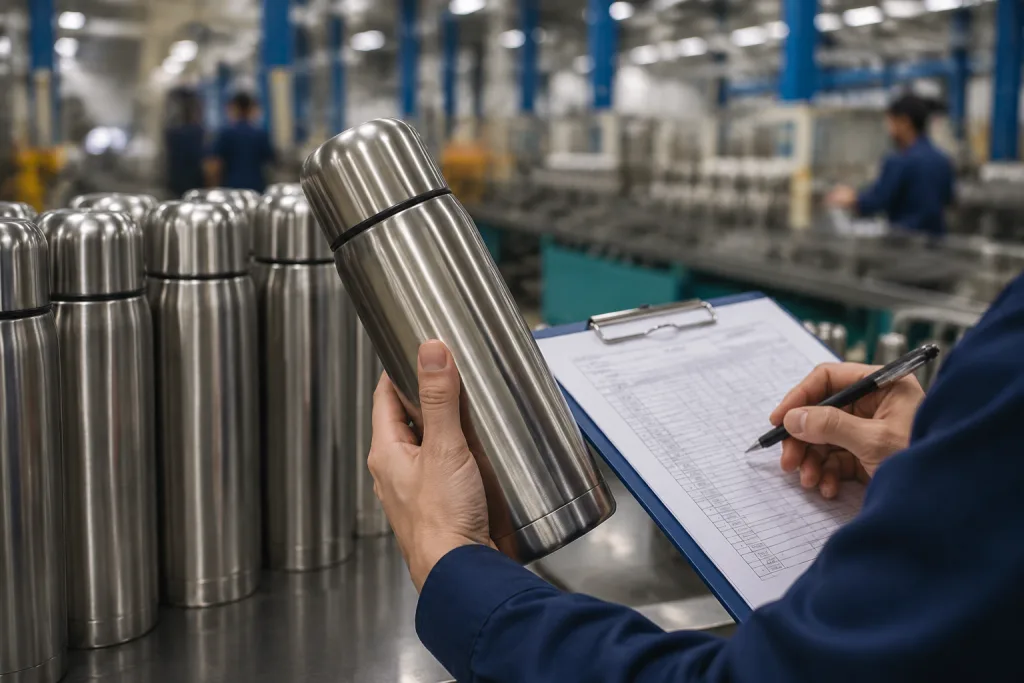
Sample checks are simple, but do them the same way every time. Fill the bottle with hot water, invert it for 30 minutes, shake it 20 times, then leave it on white paper overnight. Check cup lid threading, silicone smell, inside polishing, weld line, and mouth smoothness; we run a fingertip check around the rim because a 0.2 mm burr can still cut a lip. For coating, ask for cross-hatch adhesion testing and a 3M tape pull. For logos, rub with a dry cloth and then with a cloth lightly dampened with alcohol. Laser should not fade. Printed artwork should not smear or lift.
Good thermos manufacturers do not treat sampling as theater. It is the last cheap moment to change the specification. After steel cutting, polishing, coating, and assembly begin, every change is slower and more expensive: a logo move that takes 15 minutes on the sample table can cost 12 days once 8,000 coated bodies are waiting in cartons. The math does not work. Fix it before the deposit.
Production control on factory floor
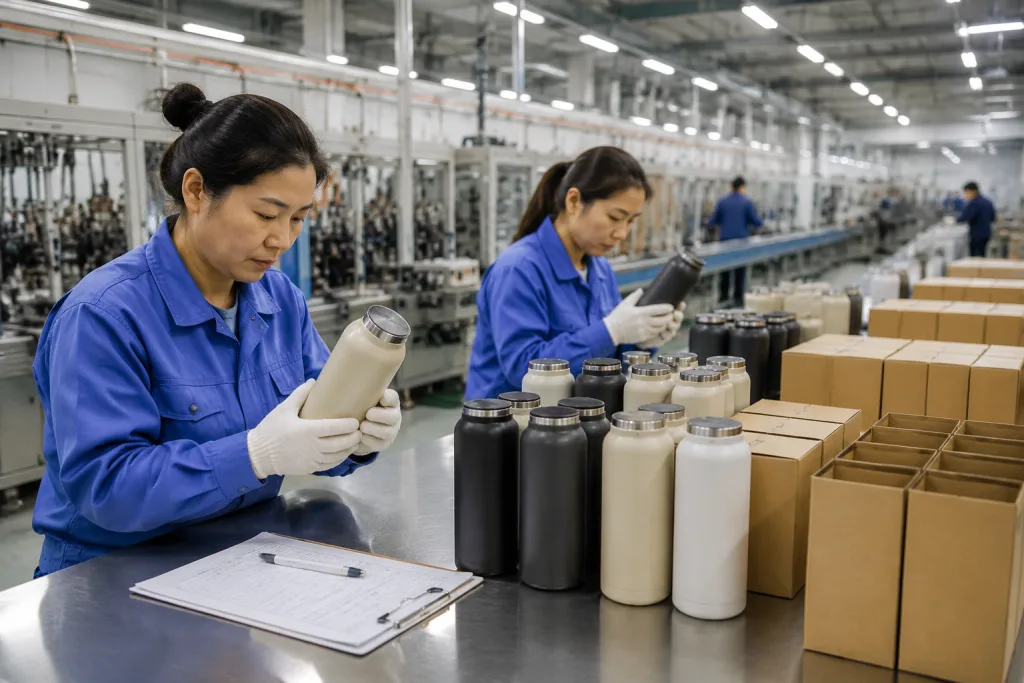
Mass production for a customizable thermos order is not one smooth “press start” job. We run it by stations: incoming 304 stainless coil check with a handheld thickness gauge, tube cutting, forming, welding, vacuuming, copper coating or reflective treatment, polishing, coating, logo application, assembly, and packing. Each station fails in its own way. Last month QC pulled 12 welded bodies from the line and found 1 pinhole under the water-pressure test, while the carton looked perfect. Checking only finished cartons is the wrong question to ask.
For vacuum bottles, insulation screening carries the order. We use 100% temperature screening after vacuum processing because random checks miss quiet failures. A weak vacuum body can pass visual inspection, sit nicely in the tray, then lose heat when the consumer fills it with coffee. For a 10,000-unit order, even a 2% vacuum defect means 200 unhappy buyers. The math does not work for outdoor retailers or promotional brands handing bottles to VIP clients. On our line, bottles sit in the hot-water test rack, and QC records the temperature drop after the set holding time before any logo work starts.
Coating is the second big risk. Powder coating thickness often sits around 60-80 microns, and we check it with a coating thickness meter before packing approval. Too thin, and the bottle scratches during a 60 cm table slide. Too thick, and the lid thread or car cup holder fit gets tight. Matte finishes show oil and scuffs more than glossy finishes. Light colors show black marks from assembly tables. If your brand wants cream, sage, or sand colors, require clean handling gloves and protective dividers during packing; we have seen one PO say “sand beige” while the artwork file said “warm ivory,” and the buyer flagged it only after pre-production samples.
Assembly control should cover silicone ring placement, lid torque, straw fit if used, stopper fit if used, and carton drop resistance. Small parts cause big returns. A distributor thermos order should also define spare parts before mass production, not after the first store complaint. We normally recommend 0.5-1% extra lids or silicone rings for after-sales support, especially when selling through outdoor stores. The cost is low, and it prevents a USD 5 part from creating a returned USD 25 retail product. On a 5,000 pcs shipment, we usually pack those spare rings in one marked master carton so the warehouse team does not lose them during unloading.
Inspection, packing, and shipment
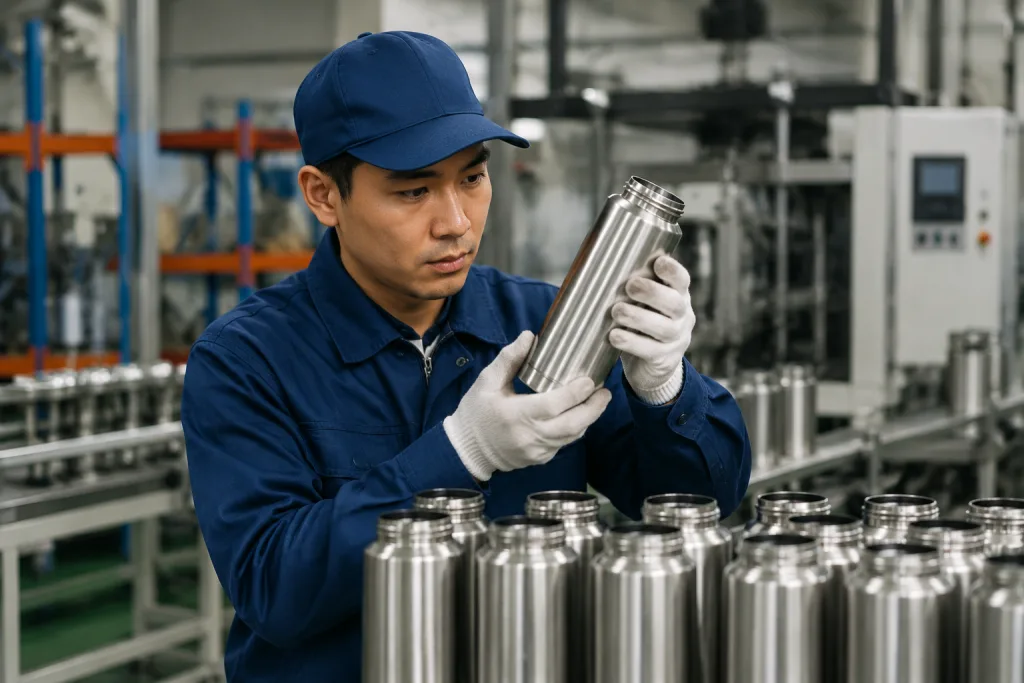
Run final inspection after 100% production is finished and at least 80% of cartons are sealed; below that, QC is guessing. Use AQL 2.5 for major defects and 4.0 for minor defects unless your retailer’s manual calls for tighter limits. Major defects include leakage, weak vacuum, sharp rims, wrong logo, wrong capacity, wrong barcode, or unsafe odor. Minor defects include 1-2 small coating specks, light carton rub marks, or polishing variation that still matches the signed sample. On our line, QC pulled 200 pcs from a 5,000 pcs lot last month and found 3 lids with burrs over 0.3 mm, so the lot stayed on hold until the trimming wheel was reset.
For this top wholesale thermos order, the checklist should cover capacity test with a graduated cylinder, net weight on a 0.1 g scale, carton quantity, barcode scan, FNSKU or item label check, logo position, D65 light color match, leak test, and heat retention spot check. Pull samples from 5-8 cartons across different pallets and production times, not from the top layer of one pallet. If you ship to thermos distributors or a retail warehouse, carton markings are not a small detail. SKU, color, quantity, gross weight, net weight, carton size, country of origin, and PO number must match the packing list; we once had a buyer flag “matte balck” on a PO label, and Amazon receiving treated it as a mismatch.
Typical carton packing is 24 pieces per master carton for 500 ml, 20 pieces for 750 ml, and 12-16 pieces for 1,000 ml depending on gift box size. Keep gross weight under 15-18 kg if warehouse staff unload by hand; the math doesn’t work when a 19.6 kg carton gets tossed from a container floor. We run a 5-ply K=A carton for heavier bottles, with edge crush checked before packing. A good bottle in a soft carton arrives with dented gift boxes, and the buyer will blame the product, not the carton gauge.
From our Zhejiang facility, FOB Ningbo is the cleanest route for most orders, while Shanghai works better when the buyer combines thermos, bags, and small kitchen items into one container. China export lead time after sample approval is normally 35-45 days for existing molds, plus 25-35 days ocean freight to many North American west coast ports or 30-40 days to major European ports. For a 10,000 pcs repeat order, we usually book space 12 days before ETD, not 3 days, because rolled vessels turn a neat shipment plan into 18 days of chasing. We’ve seen this go sideways.
What a repeat order changes
The second order should be easier and cheaper to run, but only if somebody kept the paper trail. We save the approved sample in a labeled carton, then match the Pantone code, steel grade, lid drawing, logo file, packaging dieline, carton mark, inspection report, and defect photos against the new PO. Last month QC pulled a 750 ml sample from our sample room and found the buyer’s repeat PO had one digit wrong in the Pantone number. That 5-minute check saved a full color rematch. This is how a supplier thermos relationship becomes predictable instead of starting from zero every season.
Repeat orders also show where the range needs trimming. If the 750 ml matte black sells through but the 1,000 ml cream color moves slowly, move 3,000 pcs from cream into black instead of copying last season’s split. If outdoor retailers say customers want one-hand opening, we run a new lid on the same bottle body and check the hinge gap with a 0.2 mm feeler gauge. If the promotional thermos program needs faster delivery, keep the bottle shape and change only color and logo. Same body, fewer surprises.
You should also review landed cost, not just FOB. Maybe the 1,000 ml bottle has a strong margin but poor carton efficiency. Maybe the gift box is 8 mm too tall for your pallet plan. Maybe your thermos suppliers packed 12 per carton when 16 would still pass drop testing from 80 cm. The math matters here; we have seen distributors thermos programs lose margin because nobody checked CBM before booking the container.
A good thermos supplier will push back when your request creates avoidable problems. If you ask for a low MOQ, five custom colors, retail boxes, and a 25-day lead time, the honest answer may be no. Better that than a yes that fails during inspection. On the line, five colors means five powder changes, five first-piece checks, and more chances for logo position drift. The best customized thermos programs are built on boring discipline: fixed specs, approved samples, controlled production, and inspection before the balance payment.
Send your thermos brief for factory review
Share capacity, logo, color, MOQ, destination, and deadline. We will return practical FOB pricing, sample timing, and QC suggestions.
Frequently asked questions
What MOQ should I expect for a top wholesale thermos order?
For existing stainless thermos molds, a realistic MOQ is 1,000 units per color and 3,000 units per shape if you want stable pricing. Some China factories accept 500 units, but the unit price often rises by 15-30% because coating, logo setup, and packing line changeover still cost the same. For custom thermos colors, 1,000 units per Pantone is a practical minimum. For a new lid or body mold, plan 5,000-10,000 units to spread tooling cost sensibly.
How long does a custom stainless thermos order take?
For an existing mold with custom color, logo, and retail box, plan 10-15 days for pre-production samples and 35-45 days for mass production after approval. Add 25-40 days for ocean freight depending on destination. If you need a new mold, add 20-30 days for tooling and testing before the normal production clock starts. For promotional thermos deadlines, approve artwork and packaging before paying the deposit; waiting 7 days on a dieline can easily push shipment by a full week.
Which logo method is best for outdoor retail thermos bottles?
Laser engraving is usually the safest choice for outdoor retail because it is permanent, clean, and does not peel from powder coating. It works best for one-color logos and gives a metal-exposed finish. Silkscreen costs less for simple large marks, but it needs good ink curing and rub testing. Heat transfer works for multi-color promotional thermos artwork, but setup is higher and durability depends on the film. For a 3,000-unit run, logo cost may range from USD 0.08 for basic laser to USD 0.35 or more for complex transfer.
How do I check if the thermos factory used the right steel?
Ask for material declarations and food-contact test reports, then verify during inspection with XRF testing if the order value justifies it. 304 stainless is standard for the inner liner because it contacts drinks. The outer shell may be 201 or 304 depending on corrosion requirements and price target. If the bottle is for coastal, marine, ski, or premium outdoor use, 304 outer steel is safer. XRF spot checks can confirm nickel and chromium content quickly, but agree on the steel grade in the purchase order first.
What defects should I reject before paying the balance?
Reject leakage, failed vacuum, wrong logo, wrong color outside approved tolerance, sharp mouth edges, strong silicone odor, barcode errors, contaminated interiors, and crushed retail boxes beyond the agreed AQL. Use AQL 2.5 for major defects and 4.0 for minor defects unless your customer requires stricter rules. For a 10,000-unit bulk thermos order, inspect when at least 80% is packed. Also run carton drop checks and scan every retail barcode format used by your warehouse or marketplace system.