Key Takeaways
- Start the RFQ with capacity, steel grade, wall thickness, lid type, finish, MOQ, and FOB port
- A realistic custom thermos MOQ is 1,000 pcs per color, with 25-35 day bulk lead time after sample approval
- Use AQL 2.5 for major defects and AQL 4.0 for minor defects on distributor thermos orders
- Lock PO line items before deposit: artwork file, carton spec, barcode, spare parts, inspection, and shipment terms
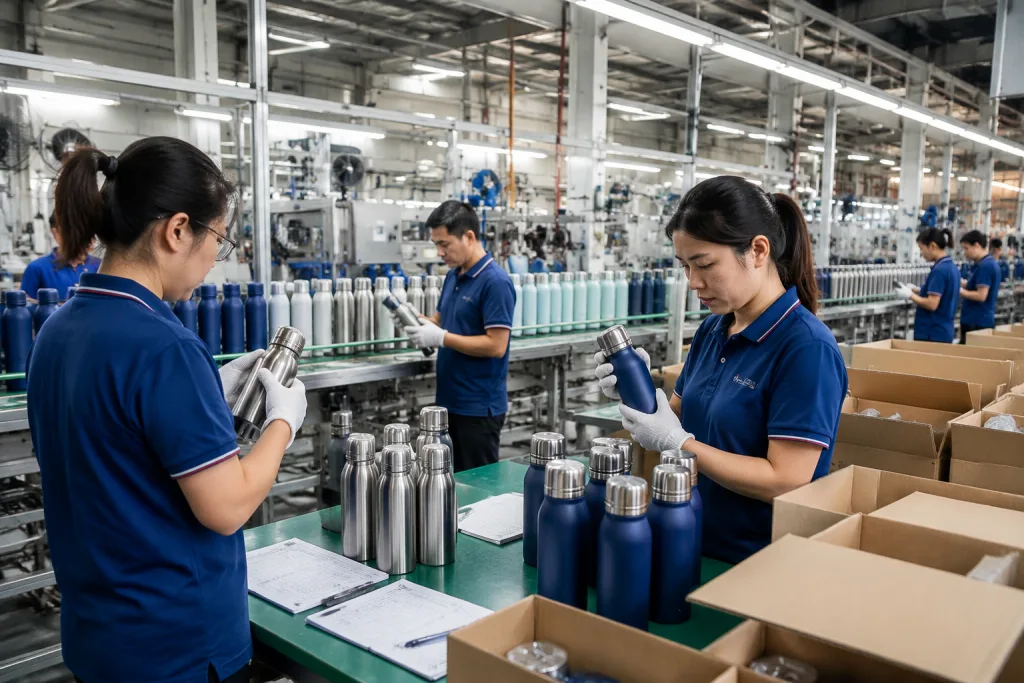
If you are buying a top wholesale thermos flask for an outdoor retail line or a promotional campaign, the hard part is not finding a clean bottle photo. The hard part is making that photo run the same way for 3,000 pcs: 500 ml capacity within tolerance, powder coat matched to the approved Pantone chip, lid thread fit checked with a go/no-go gauge, 5-layer K=A carton strong enough for sea shipment, and no surprise mold or artwork charge after the buyer signs the layout.
We manufacture stainless thermos flasks in Hangzhou, Zhejiang, and we see this go sideways at least 8 times a month. Buyers ask for “good quality, best price,” then receive five quotes with different steel thickness, lid materials, packing methods, and MOQ. The math doesn't work. A useful sourcing process starts with RFQ line items, moves to controlled samples, then locks a bulk PO with inspection rules such as AQL 2.5 and drop-test requirements; last week QC pulled the sample because the logo was 2 mm higher than the approved drawing. That is how you buy thermos bulk without gambling.
Begin with a usable RFQ
A top wholesale thermos flask RFQ should read like a production instruction, not a mood board. “500 ml stainless flask with logo” is the wrong brief to send. We saw one PO last March with “SS bottle” typed as the material; purchasing meant 304 stainless, while the quote sheet came back with 201 stainless outer wall. One factory thermos quote may use 201 stainless outer wall, another may use 304 inside and 201 outside, and another may quote a 0.38 mm body that looks clean in a photo but dents after 6 cartons ride loose in retail distribution.
For outdoor retailers and promotional brands, put these PO-style fields into the RFQ from day one. The buyer flagged this once after sampling, but by then QC had already pulled the sample, measured the wall with a Mitutoyo caliper, and the line had booked coating time.
- Capacity: 350 ml, 500 ml, 750 ml, 1,000 ml, or your target size tolerance, usually ±5%.
- Material: 304 stainless steel inner wall, 201 or 304 outer wall, food-contact silicone seal.
- Construction: double-wall vacuum insulation, copper coating if required, wall thickness such as 0.4 mm inner and 0.5 mm outer.
- Lid: screw cap, cup lid, straw lid, push-button lid, or handle lid. Lid tooling can move the unit price by 8-15%, so do not leave it as “standard lid.”
- Finish: powder coating with Pantone code, spray paint with gloss level, matte polish, mirror polish, or rubber coating with hand-feel sample approval.
- Branding: laser engraving, silk screen, heat transfer, full-wrap print, or debossed silicone. Send logo size in mm, not just the AI or PDF file.
- Packaging: white box, color box, kraft box, retail sleeve, or e-commerce drop-test carton. If Amazon drop test is needed, say 1.2 m or 1.5 m before carton pricing.
At BottleForge Industrial in Zhejiang, China, our normal MOQ for a customized thermos is 1,000 pcs per color for existing molds. For new tooling, we usually discuss 3,000-5,000 pcs because mold amortization has to make commercial sense. The math does not work on a 600 pcs trial order with a private lid mold. Our stainless thermos line can produce about 300,000 units/month across standard models, but that capacity only helps when we run steel, coating, lids, and cartons on the same schedule; one missing carton spec can turn a 12-day packing slot into 18 days.
Convert specs into quote lines
Do not judge a bulk thermos quote by unit price alone. A USD 4.20 FOB Ningbo quote and a USD 4.55 FOB Ningbo quote can hide two different builds. We see this on the line: the lower price might skip logo setup, use a 5-ply export carton instead of a 180 g corrugated e-commerce mailer, or quote a lid with a 1.8 mm silicone ring when our QC pulled the sample and measured 2.3 mm on the approved lid. Ask each thermos manufacturer to split the quote into line items so the included parts are visible.
A clean quotation for a top wholesale thermos flask should include:
- Product model, capacity, dimensions, and net weight, with the drawing revision shown, such as V3 or the PO line number the buyer used.
- Steel grade for inner and outer walls.
- Insulation claim, such as 6 hours above 68°C from 95°C start temperature at 20°C room temperature.
- Surface finish cost by color and process, including powder coat, spray paint, or raw stainless finish.
- Logo cost per position and setup charge, if any, with the print area in mm.
- Packaging cost, including insert, manual, barcode label, and master carton, plus carton size and gross weight.
- MOQ per SKU and color.
- Sample cost and sample lead time.
- Bulk lead time after deposit and approved pre-production sample.
- Incoterm, usually FOB Ningbo or FOB Shanghai for our Zhejiang factory shipments.
For existing 500 ml and 750 ml stainless models, a practical FOB China range is often USD 3.20-6.80 depending on lid complexity, coating, logo method, and carton. A promotional thermos with one-color logo and white box sits at the lower end. A retail outdoor flask with textured powder coat, handle lid, color box, and spare gasket lands higher. The math does not work if a thermos vendor hides the breakdown; we had one PO typo list “gift box” while the buyer expected a color box, and the buyer flagged it after carton artwork was already on the Epson proof. Then you are not comparing suppliers thermos performance. You are comparing guesses.
Approve samples without shortcuts
Sampling is where a custom stainless thermos stops being a catalog picture and starts becoming your SKU. For a normal thermos custom project, we run three sample stages: stock sample, logo sample, and pre-production sample with the PO artwork folder beside it. Skipping one stage saves 7-10 days, sometimes 12 days vs 18 days on the calendar, but the math doesn't work if QC pulls a lid sample and finds a slow leak at the silicone ring.
The first sample should confirm shape, capacity, lid feel, pouring behavior, and hand grip. A 500 ml model that looks fine on screen can feel top-heavy once the lid reaches 62 mm wide. This can be an unbranded stock sample shipped by courier. Expect 3-5 working days if the model is available. The second sample confirms your artwork. Laser engraving is usually fastest, about 5-7 days. Silk screen and full-wrap print can take 7-12 days because the screen mesh, film, or positioning jig has to be made before the line can print one clean bottle.
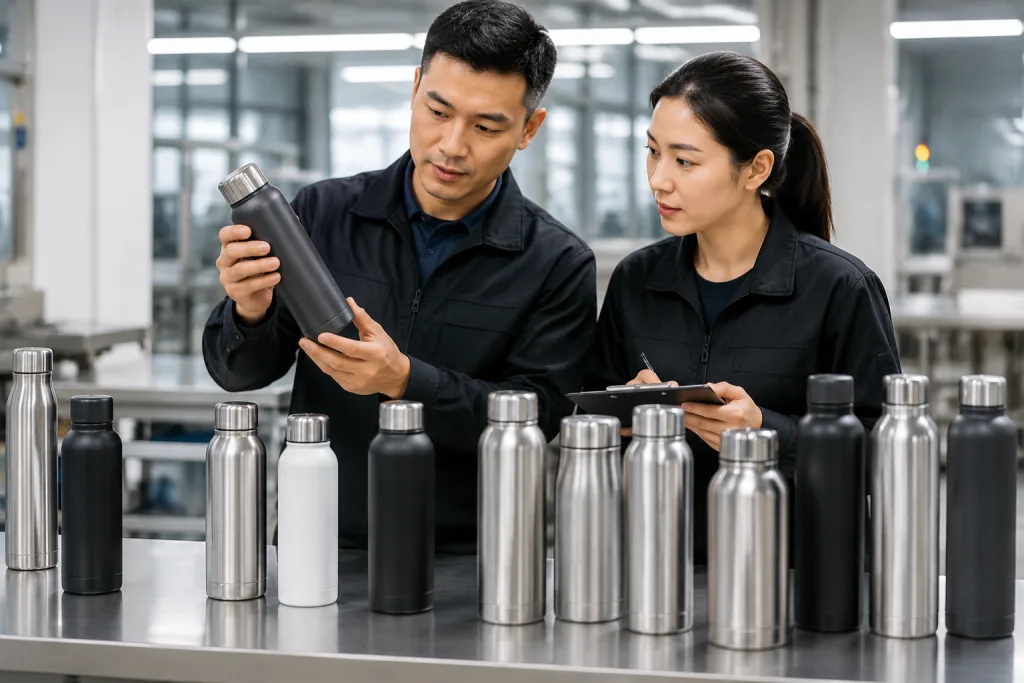
The pre-production sample is the one that matters for the PO. It should use the approved color, approved logo, correct packaging, barcode, instruction sheet, and carton mark. We have seen this go sideways over small things: one PO had “matte black” in the item line and “Pantone Black 6C gloss” in the remark column. If you are a distributor thermos buyer shipping to retailers, the pre-production sample should also include the hang tag, retail price sticker area, and compliance wording your customer requires.
Do basic checks yourself when samples arrive. Fill the flask with 95°C water, close the lid, invert it for 30 minutes, and weigh before and after on a 0.1 g kitchen scale. Put the bottle in a backpack side pocket and shake it 50 times. Scratch the coating lightly with a fingernail and then with a coin on a hidden area; QC pulled one sample last month where the powder coat marked after 3 coin passes. This is not a lab test, but it quickly shows whether the thermos manufacturers quote matches outdoor use. Formal checks can follow ASTM, LFGB, FDA food-contact, REACH, or BPA-free requirements depending on your market.
Build the PO like production
Your purchase order is not a price confirmation. It is the work order our line leader tapes beside the 12-head polishing station, the printing operator checks before screen setup, QC uses during inline pull, and export follows when booking cartons. A clean PO for a top wholesale thermos flask leaves no room for guessing. We have seen this go sideways on mixed-color SKUs when the PO said “blue” but the approved sample label said Pantone 2935C; QC pulled 32 samples before packing and the buyer flagged every carton sticker.
Build PO line items the same way production runs the job:
- SKU line: model number, capacity, color code, order quantity, unit price, total value, plus the carton split if one SKU ships in 2 packaging versions.
- Material line: 304 inner stainless steel, outer steel grade, silicone seal hardness if specified, PP or Tritan lid components if used, with any food-contact requirement tied to FDA or LFGB files.
- Logo line: artwork file name, Pantone color, print size in mm, print position measured from bottom edge or center line, and whether we run laser, silk screen, heat transfer, or powder-coat masking.
- Packaging line: individual box size, box material, manual language, barcode type, master carton size, gross weight limit, and FNSKU placement if Amazon or a retailer warehouse checks the inbound scan.
- Inspection line: AQL level, required tests, defect definitions, reinspection cost owner, and the exact test method, such as 6-hour heat retention, leak test at 45° tilt, or coating cross-cut tape test.
- Spare parts line: extra gaskets, replacement lids, display parts, packed quantity per polybag, and whether parts ship inside cartons or in a separate CTN marked “spares.”
- Shipping line: FOB Ningbo, FOB Shanghai, EXW Zhejiang, or DDP only after a freight quote is approved, with port cut-off date and pallet rule if the forwarder requires it.
Payment terms for a new customized thermos order usually sit at 30% deposit and 70% before shipment after inspection. For repeat distributor thermos programs with steady monthly volume, some China manufacturers will discuss better terms after 3 to 5 clean shipments, but open account on the first PO is the wrong question to ask; the math does not work for custom powder coating, private molds, and printed cartons. If your campaign date is fixed, write the latest shipment date and penalty discussion before deposit. Not after 486 cartons are sealed and the PO still has a typo in the consignee name.
Control quality before cartons close
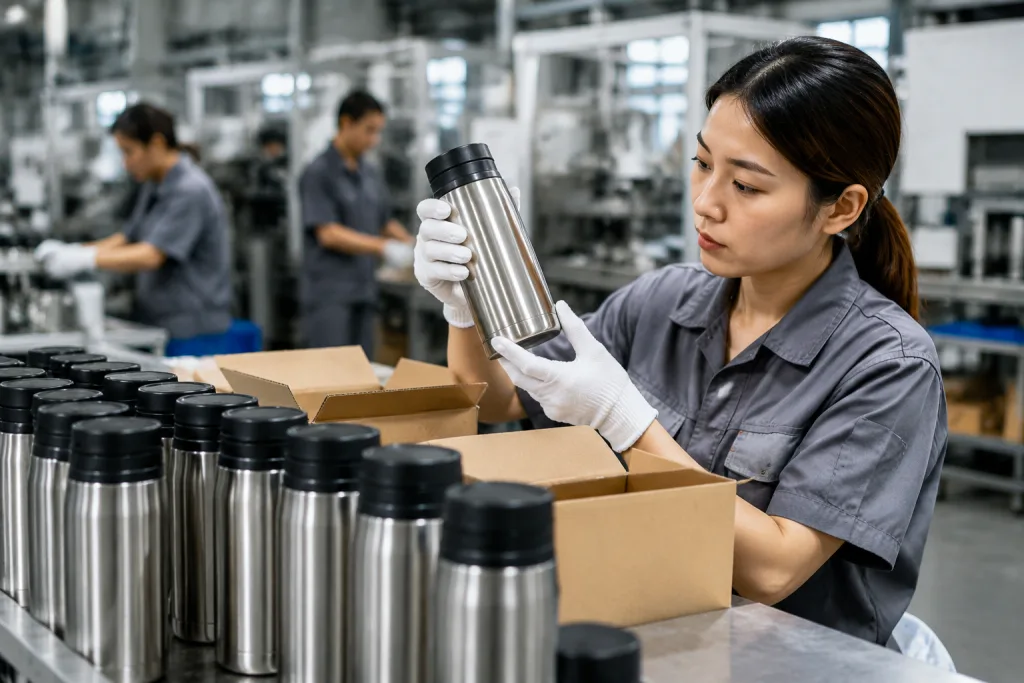
Quality control on a manufacturer thermos order has to start before cartons are taped and stacked on the pallet. For stainless vacuum flasks, the claims that hurt are leakage, weak heat retention, coating chips, logo drift, and crushed master cartons. QC can catch these early. On our line, QC pulled 32 samples after vacuuming last month and found 3 lids with silicone rings sitting 0.8 mm proud; if that waits until container loading, the math doesn't work.
We run incoming steel checks, patrol inspection after forming and welding, vacuum testing, coating inspection, logo position check, and final random inspection. For a 5,000 pcs thermos bulk order, a final inspection under General Inspection Level II with AQL 2.5 major and AQL 4.0 minor is a practical starting point. Critical defects such as leakage, sharp burrs, contamination, or unsafe lid failure should be zero tolerance. One buyer once pushed us to skip in-process checks to save 1 day; the weld seam pinhole rate jumped to 1.6%, and we spent 12 days reworking instead of shipping on day 18.
Ask your thermos factory for the actual test method, not just “passed QC.” Common production checks include a 95°C vacuum insulation test for 6 hours, 0.6 MPa air pressure leak test, lid torque check with a digital torque meter, coating adhesion cross-cut test, salt spray test for metal accessories, and drop test for packaging. If your order is for Amazon FBA or retailer distribution, carton strength and label accuracy sit almost at the same level as bottle quality. A perfect flask in a crushed carton still becomes a claim; we have seen this go sideways from one FNSKU digit typed wrong on the PO.
For outdoor retail, we would rather reject 2% of units at final QC than ship a weak lid into the market. Returns cost more than inspection.
Compliance should be confirmed before mass production, not after the deposit is paid and the powder coating is booked. For Europe, ask about LFGB, REACH, and food-contact declarations. For North America, FDA food-contact expectations, CPSIA if children are involved, and Prop 65 review may apply. A solid thermos suppliers partner will tell you what is standard and what needs paid third-party testing; in Hangzhou we normally need 7–10 working days for a fresh LFGB report after the lab receives the 3 sample bottles.
Move bulk orders without drama
After samples and PO lines are signed off, bulk production is a scheduling job, not magic. For existing molds, our normal lead time in Zhejiang, China is 25-35 days after deposit and approved pre-production sample. We run the first line check with a digital caliper on mouth diameter and lid thread fit before coating starts. Add 5-10 days for custom Pantone matching, full-wrap artwork that needs two screen passes, or retail boxes with 3 language versions. New tooling can add 20-35 days before the first approved sample.
Outdoor retailers usually book seasonal colors 90 days ahead. Promotional brands chase event dates and ask us why 18 days cannot replace 25 days. The math doesn't work. Both buyers need a production calendar with real checkpoints: steel cutting, body forming, polishing, coating, logo printing, assembly, inspection, and shipment booking. Ask for dates by process. If the factory gives only one final date, you will spot the delay after QC pulled the sample and found 0.4 mm coating build-up on the lid seat.
For shipment, FOB Ningbo is common for us because Zhejiang is close to Ningbo port. FOB Shanghai can work if your forwarder has better routing there. Air freight is fine for samples or 12 emergency cartons, not for 10,000 pcs of stainless flasks unless your margin can take the hit. A 500 ml bottle with box may weigh 380-520 g, and one buyer flagged this only after the forwarder quoted chargeable weight. Freight gets ugly fast.
If you are a thermos distributor serving several retail customers, consider neutral stock cartons with customer-specific labels applied at the end of the line. We ship this way often, using a Zebra label printer after final AQL 2.5 inspection. If you are buying thermos promotional goods for one campaign, lock the carton mark and delivery address early. The small details, including FNSKU, pallet height, carton drop-test requirement, and spare lids, decide whether a bulk order ships cleanly or sits in a warehouse waiting for correction; we have seen one PO typo on “lid color: balck” hold 86 cartons for a recheck.
Send your thermos RFQ for a line-item quote
Share capacity, logo, packaging, quantity, and target market. We will return practical FOB options, MOQ, sample timing, and production risks.
Frequently asked questions
What MOQ should I expect for a custom stainless thermos?
For existing molds, a realistic MOQ is 1,000 pcs per color for most custom thermos projects. If you need two colors, plan for 2,000 pcs total. Laser logo is usually fine at that level, while full-wrap printing or special powder coating may require 2,000-3,000 pcs because setup loss and color changeover are higher. New mold projects are different; expect 3,000-5,000 pcs minimum and tooling charges that can range from USD 1,500 to over USD 8,000 depending on lid complexity.
How long does sampling take before bulk production?
A stock sample can usually ship in 3-5 working days if the thermos factory has inventory. A logo sample normally takes 5-12 working days depending on whether you choose laser engraving, silk screen, heat transfer, or full-wrap artwork. A proper pre-production sample with final color, logo, box, barcode, and carton mark may take another 7-15 days. For a first customized thermos order, budget 3-4 weeks for sampling and approval before the 25-35 day bulk production clock starts.
What should be tested on a top wholesale thermos flask?
At minimum, test leakage, insulation, lid torque, coating adhesion, logo position, capacity, odor, and carton strength. A practical insulation check starts with 95°C water and records temperature after 6, 12, or 24 hours at 20°C room temperature. For final inspection, many buyers use AQL 2.5 for major defects and AQL 4.0 for minor defects. Critical issues such as leaking, sharp burrs, dirty interior, or unsafe lid failure should be treated as zero tolerance.
Which logo method is best for promotional thermos orders?
Laser engraving is durable and clean, especially on stainless steel or powder-coated surfaces, and it is often the safest choice for outdoor use. Silk screen is cheaper for simple one-color logos and can look bold on promotional thermos campaigns, but abrasion resistance depends on ink and curing. Heat transfer or full-wrap print gives more visual impact but adds setup cost and sample time. For 1,000-3,000 pcs, choose based on expected use: rugged retail product gets laser; event giveaway can use silk screen.
Can one thermos supplier handle retail and distributor packaging?
Yes, but you need to specify it in the RFQ and PO. Retail packaging may need color boxes, hang tags, multilingual manuals, EAN or UPC labels, and stronger master cartons. Distributor thermos orders may need mixed SKUs, pallet labels, customer carton marks, or FNSKU labels for e-commerce. Packaging can add USD 0.20-0.90 per unit depending on box material and insert design. Do not approve bulk production until the supplier sends dielines, carton dimensions, gross weight, and label placement for confirmation.