Key Takeaways
- A realistic 750 ml customized thermos lands around USD 4.20–6.80 FOB Ningbo at 3,000 units
- MOQ is usually 1,000 units per color for powder coating and 500 units for laser logo on stock colors
- Specify vacuum retention as 95°C to above 55°C after 12 hours, tested at 20°C room temperature
- Use AQL 2.5 major / 4.0 minor, plus 100% vacuum spot checks before carton sealing
You are not buying a sample bottle for your desk. You are placing a top wholesale thermos bottle order that has to survive 2% retail returns, a dropped carton at the forwarder’s warehouse, outdoor use, and a buyer who flags one missing inner box on the packing list. The hard part is not finding a thermos vendor in China. The hard part is locking the spec so the bulk thermos we run on the line matches the gold sample QC signed with a caliper, color chip, and weight sheet.
Here is the buyer case we see often: an outdoor retailer or promotional brand needs a 750 ml stainless vacuum thermos with a custom logo, color box, and 3,000 units for a fall campaign. BottleForge Industrial in Hangzhou, Zhejiang runs stainless drinkware at about 450,000 units/month, with typical custom thermos MOQ from 1,000 units per color and 30–45 days production after artwork approval. Sounds simple. It is not. We have seen this go sideways when the PO says “matte black” but the approved sample is Pantone Black 6C with 18–22 gloss units, so QC pulled the sample before mass packing and the buyer pushed back on 3,000 color boxes already printed.
Start with the actual selling job
The first mistake is asking a thermos supplier for “your best bottle.” Best for what? This is the wrong question to ask. A giveaway bottle for a trade-show bag is not the same SKU as a distributor bottle sitting in outdoor retail at USD 24.99. Before logo talk, define the selling job; last month a buyer flagged this only after our line had already made 12 pre-production samples with the wrong lid.
For this buyer scenario, we are talking about a 750 ml stainless steel vacuum bottle for hiking packs and work trucks, with enough grip for wet hands on a fishing boat. It needs one-hand pour performance, a cup lid, and a coating that still looks clean after 2 weekends rubbing against keys and a folding knife in a backpack. The target landed cost needs to support a wholesale price around USD 9.50–11.00 and retail around USD 21.99–29.99, depending on channel. We run a 500 g drop rub check on coated samples, because glossy “cheap black” is where we have seen this go sideways.
That points us toward a 304 stainless inner wall, 201 or 304 stainless outer wall depending on budget, copper-coated vacuum insulation, PP food-grade lid components, and a powder-coated exterior. For Europe, ask for LFGB or EU food-contact support where applicable, plus REACH checks for coatings. For North America, request FDA food-contact material declarations; for kids or youth channels, confirm whether any ASTM or CPSIA-related testing is needed. QC pulled one sample last quarter with a 0.35 mm inner wall against a 0.4 mm PO target, and the price looked good only because the math was not honest.
A manufacturer thermos project is easier when you write a one-page product brief. Keep it tight. Our sales team prints this sheet and puts it beside the caliper, weight scale, and Pantone book before quoting.
- Capacity: 750 ml actual fill, not just “about 25 oz.”
- Material: 304 stainless inner, 0.4 mm inner wall, 0.5 mm outer wall target.
- Finish: matte powder coating, Pantone-matched within practical tolerance.
- Logo: laser engraving or one-color silkscreen, artwork in AI or PDF vector.
- Packaging: retail color box, 24 units per master carton, barcode on box.
- Compliance: REACH, LFGB/FDA documentation, BSCI factory audit if your retailer asks.
Give this to thermos manufacturers in Zhejiang or elsewhere in China, and the quotes become comparable. Without it, you are comparing random factory thermos options and hoping the lowest price carries the same specification. It usually does not. We once saw a PO typo list 0.5 mm outer wall on page one and 0.45 mm on page three; that small mismatch changed lead time from 12 days to 18 days because the line had to wait for new shells.
Build the spec before pricing
For a top wholesale thermos bottle order, price follows the spec. A five-minute quote usually means the thermos factory is using a stock model and hiding assumptions in the unit price: 201 or 304 stainless, generic lid PP, plain white box, no drop test. Fine for a 3,000 pcs promo run. Risky for retail. We have seen this go sideways when the buyer flagged the lid gasket smell only after QC pulled the sample from the packed carton.
In our scenario, the buyer chooses a 750 ml double-wall vacuum bottle with a screw cup lid. The mouth opening is 45 mm, wide enough for ice cubes, not so wide that heat retention falls apart. The body diameter is about 78 mm, height about 285 mm, and empty weight around 430–480 g depending on steel gauge. On the line, we check the shell with a digital caliper before polishing because a 0.1 mm change shows up later as dents. A lighter bottle saves freight, but if the outer wall is cut too thin, dent claims climb. For outdoor retail, chasing the last USD 0.20 by thinning the shell is the wrong question to ask.
The vacuum performance target should be written as a test, not sales copy. Use this: fill with 95°C water, close lid, hold at 20°C room temperature, temperature after 12 hours must remain above 55°C. For cold retention: fill with 4°C water, hold at 20°C, after 12 hours must remain below 12°C. QC uses a probe thermometer and logs the bottle number on the test sheet, because “keeps hot all day” means nothing during inspection. Some premium structures beat these numbers, but these figures are honest for a mid-market bulk thermos with a cup lid.
For surface finish, powder coating is the safer pick for outdoor brands. Spray paint costs less, but abrasion resistance is weaker. If you need a customized thermos with a full wrap graphic, heat transfer can work, though MOQ and defect risk go up because the film edge can lift near the bottom radius. Laser engraving is durable and clean on powder coating, but the logo color becomes the exposed stainless or underlayer tone. Silkscreen gives controlled brand color, but run adhesion testing, especially on textured coating. We run 3M tape checks after curing; one buyer once rejected 600 pcs because the orange logo rubbed off after two alcohol wipes.
A good suppliers thermos quote should state capacity, steel grade, wall thickness, lid material, finish method, logo method, packaging, carton size, net/gross weight, MOQ, sample time, production lead time, Incoterm, and payment terms. If any of those are missing, ask before you compare FOB prices. Simple rule. One PO came in with “matte black” in the email and “gloss black” on the attachment, and the line stopped for 2 hours while sales chased confirmation.
Quote the order like a factory
Now we quote the order. The buyer asks for 3,000 units: 750 ml, one matte forest green color, one laser logo, individual color box, and 24 units per master carton. For a Zhejiang thermos manufacturer shipping FOB Ningbo, we would usually land at USD 4.20–6.80 per unit, depending on steel gauge, lid structure, coating, packaging, and testing. Our costing clerk checks the BOM in ERP, then QC pulls one 750 ml sample from the shelf to confirm wall thickness with a digital caliper. If you get a USD 3.20 quote for the same retail-ready bottle, don’t celebrate. Ask what disappeared.
The cost drivers are not mysterious. A 304 outer wall costs more than 201. A 0.5 mm outer wall costs more than 0.4 mm, and that 0.1 mm difference shows up fast when we run 3,000 bodies through the stretching line. Powder coating costs more than plain stainless or basic spray paint because the line needs pre-treatment, masking, curing, and color cleanup. A cup lid with inner thread, silicone seal, and smooth pour channel costs more than a simple screw cap. Retail packaging can add USD 0.25–0.60 per unit; last month one buyer flagged a 350 gsm box as “too soft” after carton drop testing, so we had to price a thicker paper grade.
MOQ changes the quote. For BottleForge Industrial, common MOQ is 1,000 units per color for custom powder coating and 500 units for logo on available stock colors. Full custom mold work is a separate job with tooling cost and a schedule that can move from 18 days to 45 days before mass production starts. We’ve seen this go sideways when a promotion team approves a new lid shape 3 weeks before launch. For a deadline-driven promotional thermos order, use an existing mold and customize color, logo, and box.
Payment terms for a first order from China are usually 30% deposit and 70% balance before shipment after inspection. FOB Ningbo or FOB Shanghai are common for Hangzhou and broader Zhejiang production; we ship both, but Ningbo is cleaner for most drinkware containers from our area. If you need DDP, say so early, because the math changes once duty, trucking, and delivery appointment fees sit inside the unit price. DDP can look neat on a PO. The buyer still pays for the risk somewhere. Experienced distributors thermos buyers often prefer FOB because their forwarder controls consolidation, customs entry, and warehouse appointments.
Ask your thermos supplier to split optional costs. Put bottle unit cost, logo cost, packaging cost, testing cost, and spare parts cost on separate lines, then you can see what you are buying instead of arguing over one blended number. On our side, the merchandiser also checks the PO for small traps; “matt green” instead of “matte green” caused a 2-day approval delay on one order. You might keep the better coating and simplify the box. Or accept 201 outer steel while locking 304 inner steel and stricter vacuum testing. That is real sourcing, not just pushing for a lower price.
Approve samples without fooling yourself
Sampling is where 6 out of 10 custom thermos projects get loose. A clean pre-production sample does not prove the order is safe unless it was made with the same 304 stainless, finish, logo process, PE bag, insert card, and export carton you plan to ship. For this buyer case, ask for two stages: first a blank construction sample if the model is new to your line, then a pre-production sample with final color, logo, and box. We run calipers on the mouth opening and thread pitch at this stage because a 0.3 mm lid mismatch becomes a leak complaint later.
Sample timing is usually 7–10 days for logo on an existing bottle, 10–15 days for custom color, and 18–25 days if a special lid or packaging structure is involved. International courier from China to Europe or North America adds 3–7 days; DHL from Hangzhou to Hamburg often lands in 4 days, while customs can eat the other 3. Put that on your calendar. If your retail launch is September 1, starting samples in late July is the wrong question to ask—the math doesn't work unless you accept air freight and rushed QC.
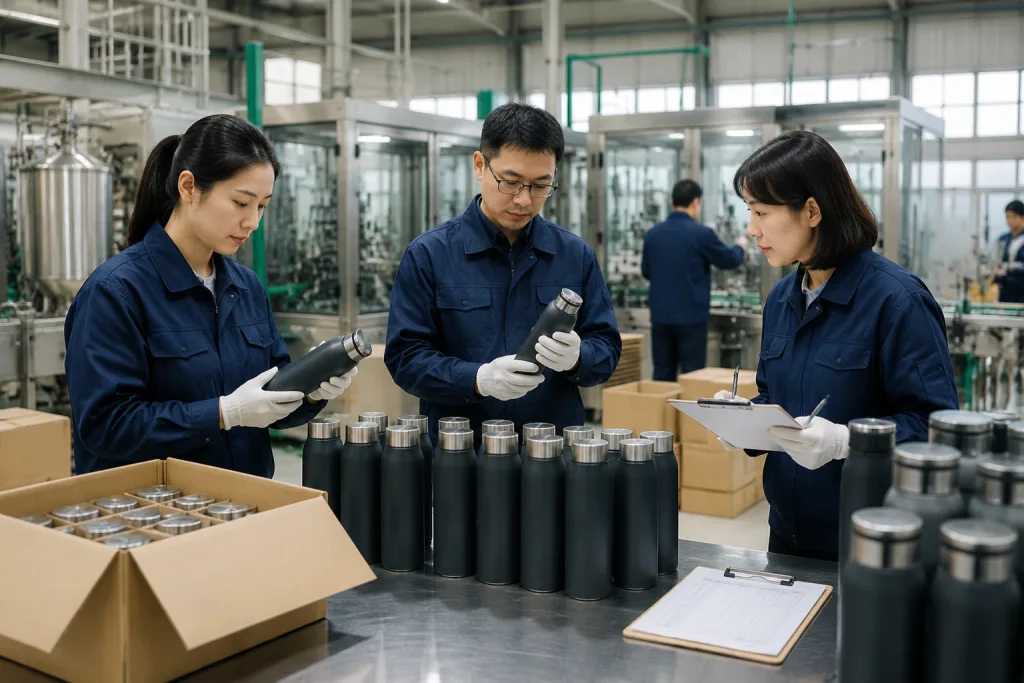
When the sample arrives, test it like a buyer, not like someone already in love with the logo. Weigh it on a 0.1 g scale. Measure height, diameter, mouth opening, and capacity with a caliper and measuring jug. Fill it with boiling water carefully and check external heat spots after 10 minutes; a hot patch usually signals vacuum failure, and QC pulled a sample last month for exactly that. Test the lid upside down for 30 minutes. Put it in a backpack with keys and shake it. Run a 3M tape adhesion test on the logo. Thread the cup lid on and off 20 times, because cheap-feeling threads are what buyers flag first in a showroom.
For color approval, use a physical Pantone reference or an approved master sample, not a phone photo. Powder coating on curved stainless will not match ink on paper 1:1, and a matte black can shift under 6500K light versus a warehouse LED. Set a workable tolerance. For retail packaging, scan the barcode or FNSKU if you sell through marketplace channels; we have seen one PO typo turn “0” into “O” and block receiving for 2,000 pcs. A wrong barcode is not a cosmetic defect. It stops the goods.
Do not approve a sample with “minor” issues unless you write exactly what must change in mass production. Factories repeat approved samples more faithfully than they interpret friendly emails, especially once the line has the golden sample taped beside the assembly bench.
Once approved, seal one signed sample at your office and one at the thermos factory. Use a marker across the label and carton tape so nobody swaps it after the meeting. The QC inspector should use that sample as the reference during pre-shipment inspection, not a WeChat photo from three weeks ago.
Control production while it is moving
After deposit, the job stops being sales talk and becomes production control. For a 3,000-unit manufacturer thermos order, we usually run 3–5 days for material preparation, 7–12 days for forming and welding, 5–8 days for vacuuming and temperature stabilization, 5–7 days for coating and logo work, then 3–5 days for packing and final inspection. Total lead time still lands around 30–45 days after sample and artwork approval. On the floor, the first warning sign is often simple: QC checks the 304 stainless coil thickness with a micrometer and finds 0.02 mm drift before deep drawing starts.
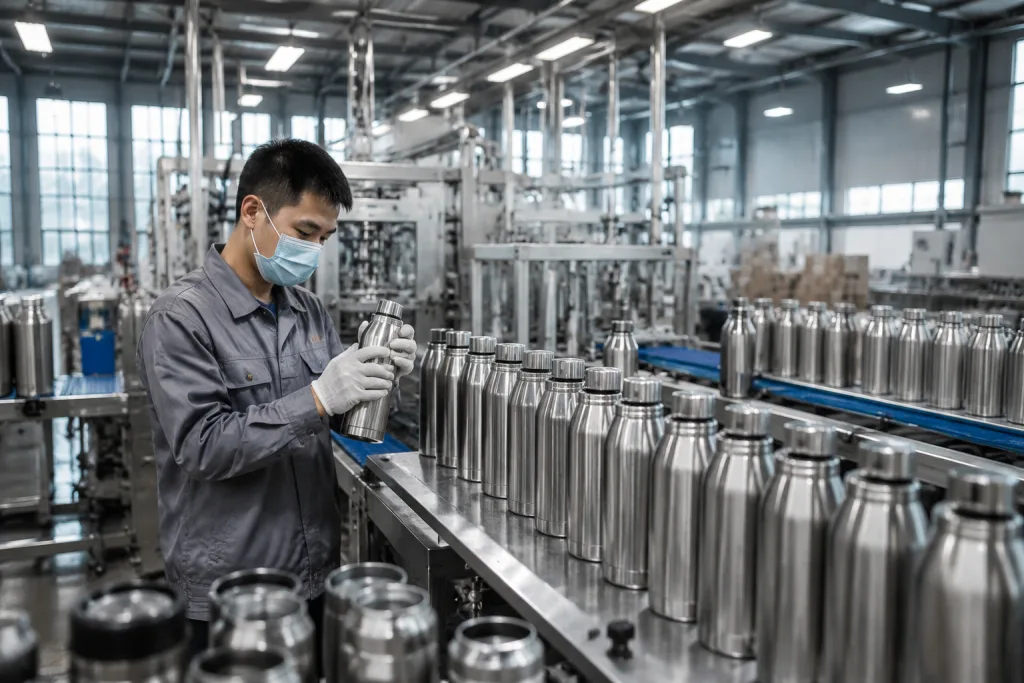
Stainless thermos production is not one clean magic line. Body forming and welding sit on one set of machines; vacuum sealing, polishing, coating, printing or engraving, lid assembly, and packing each need their own checkpoint. Catch it early. The final day is the wrong time to ask hard questions, because every carton is taped, the shipping mark is printed, and the buyer has already pushed us for an ETD before Friday’s vessel closing.
For outdoor retailers and promotional brands, the checkpoints that matter most are vacuum integrity, coating match, logo position, lid seal, and carton packing. BottleForge Industrial uses in-line vacuum checks and keeps inspection records by production batch. For a 3,000-unit order, a practical control plan may include 100% basic leak and vacuum screening during production, then final random inspection under AQL 2.5 major / 4.0 minor. We’ve seen this go sideways when a buyer only checks color photos; the vacuum gauge and 24-hour hot-water test tell more than a neat WeChat album.
Ask for production photos, but do not treat photos as QC. Photos show movement; inspection data shows control. Ask for a mid-production update when 30–50% of units are finished, with 6 close-up shots, logo position measured in mm, and one packing photo showing the inner box and master carton. If the matte green looks glossy or the logo has shifted 5 mm from the approved position, the line can still adjust the spray gun or fixture. If you wait until 100% packed, the choices are ugly: discount, rework, or delay.
For a thermos distributor building a repeat program, keep one golden sample and a small defect library with photos from past orders. Define the limits before production starts: a dust speck under coating below 0.5 mm can be minor; dented shoulder, leaking lid, crooked logo over 2 mm, or failed heat retention should be major or critical. Your supplier thermos partner needs these rules on the PO, not buried in an email thread. We once had a buyer flag “logo too low” after packing, then found the approved artwork file had the same position—bad control on both sides, and the math did not work for rework.
Inspect cartons before shipment
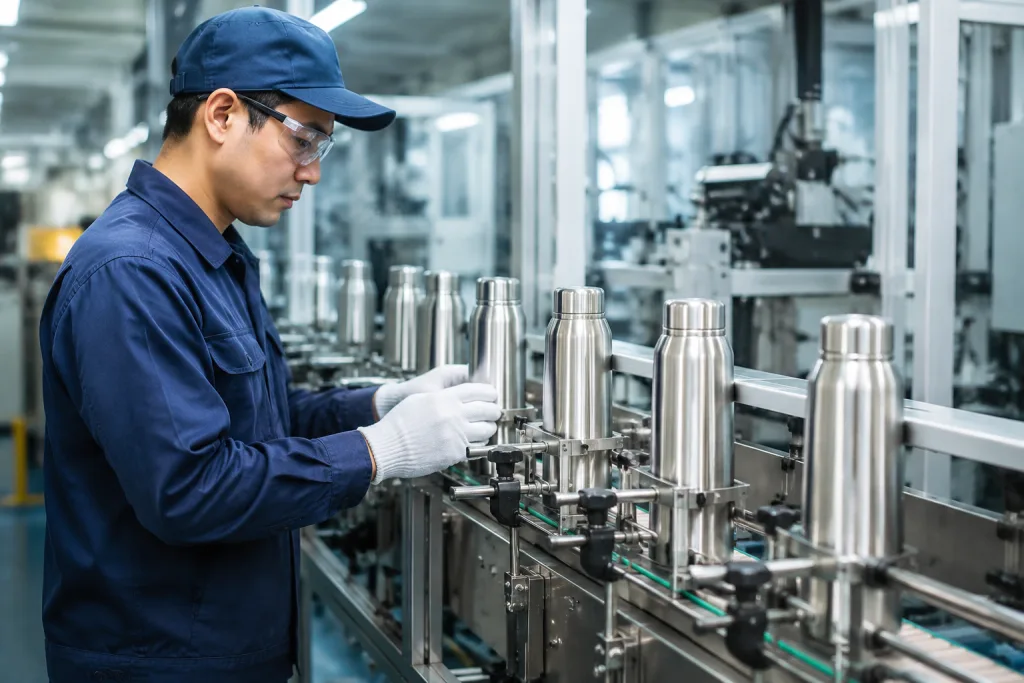
Pre-shipment inspection is not a formality. It is the last cheap moment to catch defects. Once the container leaves Ningbo or Shanghai, the math gets ugly: USD 900 return handling can turn into chargebacks, repacking labor at 0.6 USD per unit, missed launch dates, and those Monday morning calls nobody wants. We have seen QC pull a carton at final inspection and find 3 lids with silicone rings twisted out of the groove. Fix it on the line. Not after customs clearance.
For 3,000 units, a normal inspection setup is ANSI/ASQ Z1.4 general inspection level II. That usually puts the sample size around 200 units, depending on lot structure, with AQL 2.5 for major defects and 4.0 for minor defects. Critical defects should be zero tolerance. For stainless thermos, critical means unsafe sharp edges over the drinking lip, contamination inside the liner, leakage under shake test, broken glass components if any, or a material mismatch that breaks your compliance requirement. On our floor, the inspector uses a 0.05 mm feeler gauge around the lid fit and checks random cups under a 600 lux light box.
The inspector should check carton count first. If your purchase order says 3,000 units, 24 per carton, you expect 125 master cartons. Carton marks should match PO number, item number, color, quantity, gross weight, carton dimensions, and destination rules. One buyer once sent a PO with “matte blcak” on the color line, then flagged the carton mark spelling at warehouse receiving. Small typo. Big delay. For marketplace or retailer routing, confirm barcode and FNSKU before packing starts, plus suffocation warning if polybags are used. Pallet label rules should be printed and taped at the packing table, not buried in an email thread.
Functional tests need to be written into the inspection checklist. Pick samples for leak testing: fill to 90%, close, invert for 10 minutes, then shake 20 times. Check vacuum performance with a shorter screening method if full 12-hour testing is not practical at final inspection; we run surface temperature checks against batch records, and for stricter buyers we keep 3 retained samples for a full heat test. Check coating by visual review and cross-hatch or 3M tape adhesion on a limited sample if agreed. Do not let an inspector destroy 200 retail units with aggressive testing unless the contract says so. That is the wrong question to ask at final inspection.
Packaging drop testing is often skipped on thermos bulk orders. We’ve seen this go sideways. A basic ISTA-style carton drop sequence on one filled export carton gives quick feedback, especially for e-commerce or distributor shipments where cartons get handled 8 to 12 times before the buyer sees them. If color boxes crush at the corner after a 76 cm drop, the bottle may still pass, but the shelf presentation is already damaged. A good thermos suppliers relationship includes honest packaging feedback, not just “all packed, please pay balance.”
Ship for the channel you sell
Ship to the channel, not to a generic warehouse. Outdoor retailers will push back on weak 5-ply master cartons, crushed retail boxes, missed delivery windows, and missing compliance files. Promotional brands lose sleep over event dates and logo placement; we had a buyer flag a 2 mm lower laser mark on a black sample because it sat too close to the grip line. Marketplace sellers watch barcode rules, carton dimensions, FNSKU labels, and oversized storage fees. Same bottle, different risk. Plan for the wrong channel and the order can still fail.
For Europe and North America, 3,000 units of 750 ml stainless bottles may occupy roughly 8–12 CBM depending on box size. On our packing table, a 750 ml bottle with color box and egg-crate divider often lands around 53×42×48 cm per export carton, so we check CBM before the PI is signed. Sea freight is normally the sensible choice if you have 35–45 days for transit and delivery. Air freight can cost more than the bottle; the math doesn't work for a full wholesale run. If you must air ship 300 units for a launch event and send the remaining 2,700 by sea, lock that split before production packing so the line separates labels, cartons, and pallet marks correctly.
Documents should include commercial invoice, packing list, bill of lading or air waybill, plus any test reports or declarations your importer needs. If your retailer asks for BSCI, ISO 9001, REACH, LFGB, or FDA-related documents, confirm availability before deposit. QC pulled one 304 stainless sample last season where the lid gasket material was changed after sample approval, which meant the old LFGB file no longer matched the shipped product. Do not assume every thermos manufacturer in China has current reports for your exact material, coating, and lid combination.
A repeatable program also needs spare parts. For cup-lid thermos bottles, order 1–2% spare lids and silicone gaskets. They cost little during production; sourcing 80 matching gaskets six months later is where we've seen this go sideways. We run spare parts in a separate polybag with the PO number and lid code printed on a 40×60 mm label. If you are a thermos distributor supporting dealers, spare parts reduce returns and make your dealer desk look organized.
The final handoff is simple: approved sample, signed PI, production checklist, inspection report, carton photos, shipping documents, and test documents all stored under one PO number. Our shipping clerk still checks the PO against the carton mark because one typo, such as “PO 2387” printed as “PO 2837,” can slow customs release or confuse a 3PL receiving team. That is how a customizable thermos project becomes a controlled wholesale program instead of a one-time gamble. BottleForge Industrial is based in Hangzhou, Zhejiang, and that local manufacturing cluster helps with stainless forming, coating, packaging, and Ningbo/Shanghai export access. The paperwork still matters. Good geography does not replace clear specifications.
Send your thermos brief for factory pricing
Share capacity, logo, color, quantity, market, and deadline. We will return a practical FOB quote and QC plan.
Frequently asked questions
What is a realistic MOQ for a custom stainless thermos order?
For an existing stainless thermos mold, expect 500 units if you choose a stock bottle color and add laser engraving or one-color printing. For custom powder coating, 1,000 units per color is a more realistic MOQ because the coating line needs setup, color change, and curing control. For full customized thermos work involving a new lid, body shape, or private mold, the MOQ can move to 3,000–10,000 units plus tooling. At BottleForge Industrial in Zhejiang, many outdoor retail orders start at 1,000–3,000 units, which is enough volume to control unit cost without forcing you into container-load inventory on the first buy.
How much should a top wholesale thermos bottle cost FOB China?
For a 750 ml stainless vacuum bottle with 304 inner steel, powder coating, one logo, and retail color box, a practical FOB China range is about USD 4.20–6.80 at 3,000 units. The low end usually means simpler lid, thinner wall, basic packaging, or 201 outer steel. The high end may include heavier gauge steel, better coating, stronger carton, special color, or more testing. A promotional thermos can be cheaper if packaging is simple and stock colors are used. Always ask the thermos supplier to list steel grade, wall thickness, coating type, and packaging cost, or the quote is not comparable.
Which logo method is best for an outdoor custom thermos?
Laser engraving is the safest logo method for outdoor use because it does not peel and handles abrasion well. It works best for clean brand marks, text, and simple graphics. Silkscreen printing is better when you need a specific logo color, but you should request tape adhesion and rub testing on the finished coating. Heat transfer allows larger graphics, but it raises cost and defect risk, especially on curved bodies. For a 3,000-unit thermos promotional order, many brands choose laser engraving on matte powder coating because the result looks durable and inspection is straightforward.
What QC standard should I use for thermos bulk orders?
Use ANSI/ASQ Z1.4 or ISO 2859-1 sampling with AQL 2.5 for major defects and 4.0 for minor defects. Critical defects should be zero acceptance. For thermos bulk orders, major defects include leaking lids, failed vacuum, dents, crooked logos beyond agreed tolerance, wrong color, and barcode errors. Minor defects include small coating specks, light scratches within limit, or slight box scuffing. Add functional checks: leak test, capacity check, lid threading, coating adhesion, and heat-retention spot test. For a 3,000-unit lot, inspection sample size is commonly around 200 units under general level II.
How long does a customized thermos order take from China?
For an existing model, plan 7–15 days for samples and 30–45 days for mass production after sample approval and deposit. Sea freight to North America or Europe commonly adds 30–45 days depending on port, season, and inland delivery. That means a safe retail schedule is often 75–105 days from first approved artwork to warehouse arrival. If you need a promotional event date, add a buffer or split shipment: for example, air ship 300 units and sea ship 2,700 units. Rushing a thermos factory at the coating or QC stage usually creates more problems than it solves.