Key Takeaways
- 304 stainless steel at 0.45-0.55 mm body thickness is the normal baseline for export thermal bottles
- A practical custom MOQ is 1,000-3,000 units per model depending on logo, color, and packaging
- Vacuum retention should be checked at 95°C start temperature over 6, 12, and 24 hours
- Pre-shipment inspection at AQL 2.5/4.0 catches more cost than another USD 0.10 price cut
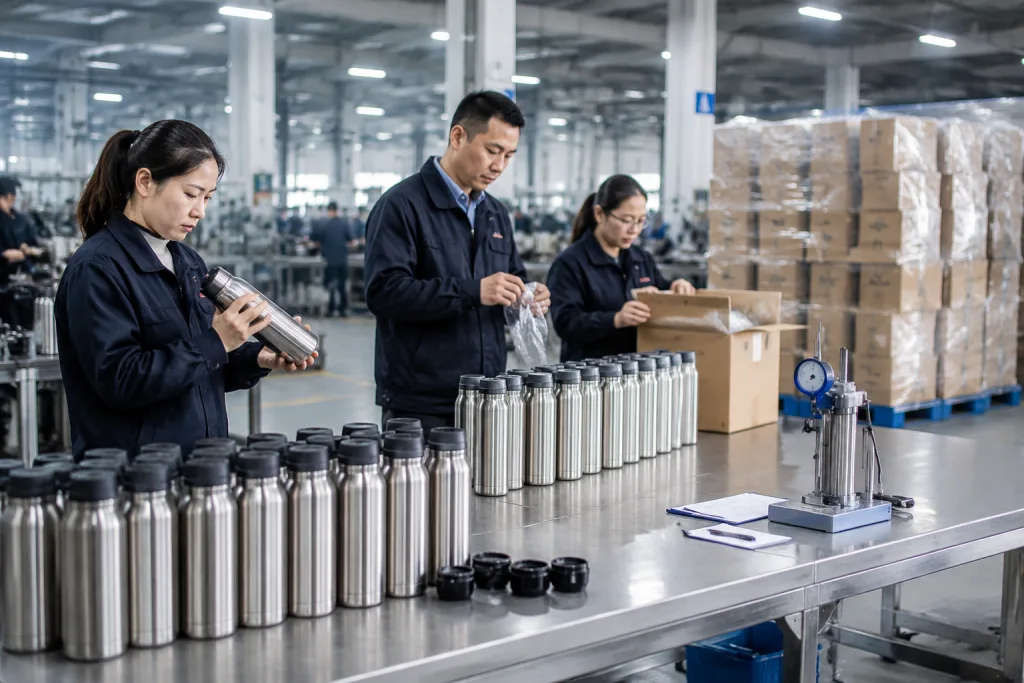
A top wholesale thermal bottle is not judged by the catalog photo. It is judged by the spec sheet, the sample we cut open with a pipe cutter, and whether the line can hold the same vacuum result after 20,000 units. If you buy bulk drinkware for a brand, retailer, distributor, or promotion program, a 0.2 mm steel change or a loose lid tolerance can eat the margin before the container leaves Ningbo.
From Hangzhou, Zhejiang, we see 6 or 7 Europe and North America buyers make the same mistake every quarter: they ask for the best wholesale drink bottle, then compare only capacity and unit price. Wrong question. Steel grade and vacuum performance need test data; lid material needs migration papers; coating adhesion needs a cross-cut test; carton strength, AQL, and FOB terms decide whether your wholesale drinkware order lands cleanly or becomes a claims file. Last month QC pulled the sample because the buyer flagged a 1 mm gap on the flip lid. The math does not work if that shows up after packing 186 cartons.
Capacity Is A Margin Decision
The first line on most spec sheets is capacity: 350 ml, 500 ml, 750 ml, 1,000 ml, 1.2 L, or 1.9 L. Buyers treat it like a label choice. Wrong question. Capacity changes the 304 stainless blank weight on our digital scale, lid diameter by 3-8 mm, carton cube, shipping cost, shelf fit, and the claim your sales team can defend without getting returns.
For a top wholesale thermal bottle program, 500 ml and 750 ml move fastest in drinkware wholesale channels; in our last 60 RFQs, they covered about 42 requests. They fit backpacks, most car cup holders, and standard retail shelves. A 1,000 ml canteen wholesale model sells better for outdoor, worksite, and sports accounts. We have seen this go sideways when a buyer approved a 92 mm body, then flagged it after the first PP sample failed their cup-holder check. If you are building a bulk canteen or canteen bulk order for field use, you may accept the wider body and higher freight per unit because the user wants volume, not cup-holder fit.
Growler capacity is a separate job. A bulk growler or wholesale growler starts around 1.2 L and goes to 1.9 L or 2 L. If you are buying beer growler wholesale or beer growler wholesale bulk, ask whether the cap is pressure-rated and whether the inside surface is electropolished enough to cut odor retention. QC pulled one 1.9 L sample last month because the silicone gasket sat 0.6 mm proud and leaked after the third pressure check. A beer growler in bulk is not a large bottle with a handle; carbonation and seal reliability decide whether the math works.
As a planning number, a 500 ml double-wall bottle may pack 24 pieces per export carton, while a 1.2 L growler may pack only 12 pieces. That gap hits container loading and landed cost. Before you approve a design, ask for carton dimensions, gross weight, and estimated units per 40HQ; our merchandiser measures the master carton with a tape after the line packs the first 10 cartons, not from a nice-looking drawing. The cheapest FOB price gets expensive once drinkware bulk volume reaches the freight calculator.
Steel Grade And Wall Thickness
The material line should be boring and specific: inner wall 304 stainless, outer wall 304 or 201 stainless, food-contact PP or Tritan where the lid needs it, silicone seal ring, BPA-free. If a supplier writes only “stainless steel,” push back. This is the wrong question to leave loose. We have seen POs arrive with “SS bottle” typed in one cell, then QC pulled the sample and the PMI gun showed 201 on the inner wall. In China, mills sell 20+ stainless grades, and several do not belong inside food-contact thermal drinkware.
For export to Europe and North America, our Zhejiang production team normally recommends 304 stainless steel for the inner wall. Coffee, tea, sports drinks, and acidic beverages are harder on the inner liner than buyers expect after 30 days of use. 201 outer can cut cost by about USD 0.12-0.25 on a 500 ml bottle, depending on sheet price that week, but the math does not work if your customer later asks for clean REACH, LFGB, and FDA-related documentation. For premium wholesale drinkware, we run 304 inner and 304 outer because the line is easier to control, and the sales file is easier to defend when the buyer flags material declarations.
Wall thickness is where a spec sheet starts telling the truth. A standard bottle usually starts from 0.40-0.50 mm stainless sheet before drawing and forming. Heavier-duty models move to 0.55 mm or more, especially for outdoor wholesale canteen and growler bulk programs above 1,000 pcs per color. Thin steel saves a few cents, then dents at the shoulder, feels cheap in hand, and can wrinkle near the base after the hydraulic press forms the shell. We have seen this go sideways on a matte powder-coated run: after polishing, QC found shallow flat spots that the coating booth could not hide.
Do not over-spec blindly. A 0.60 mm body on a 500 ml promotional bottle may be wasted steel if your price target is USD 3.20 FOB Ningbo. For a retail outdoor line at USD 6.50-9.00 FOB China, a stronger body, better base, and tighter welding control are worth the extra material. Ask for the actual gauge, not “heavy duty.” Ask the factory to confirm finished bottle weight within ±5%, then check it with a 0.1 g digital scale during pre-shipment inspection. If the approved sample is 286 g and bulk goods average 268 g, the buyer should stop the shipment and ask what changed.
Vacuum Performance Needs Numbers
“Keeps hot for 12 hours” is not a spec. It is catalog copy. Procurement needs the test setup written down: starting water temperature, room temperature, fill level, time interval, and the lowest final temperature you will accept. We had one buyer flag this after two quotes both said 12 hours, but one sample dropped to 39°C and the other held 52°C in our 20°C test room.
For a top wholesale thermal bottle, we run the test with water at about 95°C, fill to the shoulder line, and check the probe reading after 6, 12, and 24 hours at room temperature around 20°C. A solid 500 ml vacuum bottle may still show 65-70°C after 6 hours and 45-55°C after 12 hours, depending on body shape, neck diameter, lid stack-up, and copper coating. The line records the result on a simple thermometer log; if the neck ID moves from 35 mm to 48 mm, the math changes. A wide-mouth beer tumbler wholesale model loses heat faster because the opening is larger.
The vacuum layer is invisible to your customer, but a bad one shows up fast. Cold drinks sweat on the carton table, hot drinks cool early, and returns start. QC pulled one beer tumbler bulk sample last year with tiny condensation beads after 40 minutes with ice water inside, and that was enough to stop packing. For beer tumbler in bulk and beer tumbler wholesale bulk orders, cold retention is often the real target, not hot retention. Ask for ice retention testing and a condensation check.
Some factories offer copper plating inside the vacuum layer. It reflects radiant heat and can lift thermal performance, but it adds cost, so spell it out. Write it into the purchase order and golden sample approval, down to the plating requirement; a sales chat screenshot will not protect you when the buyer asks why the second batch runs 8°C lower. At BottleForge Industrial in Zhejiang, our typical thermal bottle capacity is up to 600,000 units per month, but we still lock vacuum performance by sample approval and batch testing. Big volume is not a reason for loose specs.
Lids Create Most Complaints
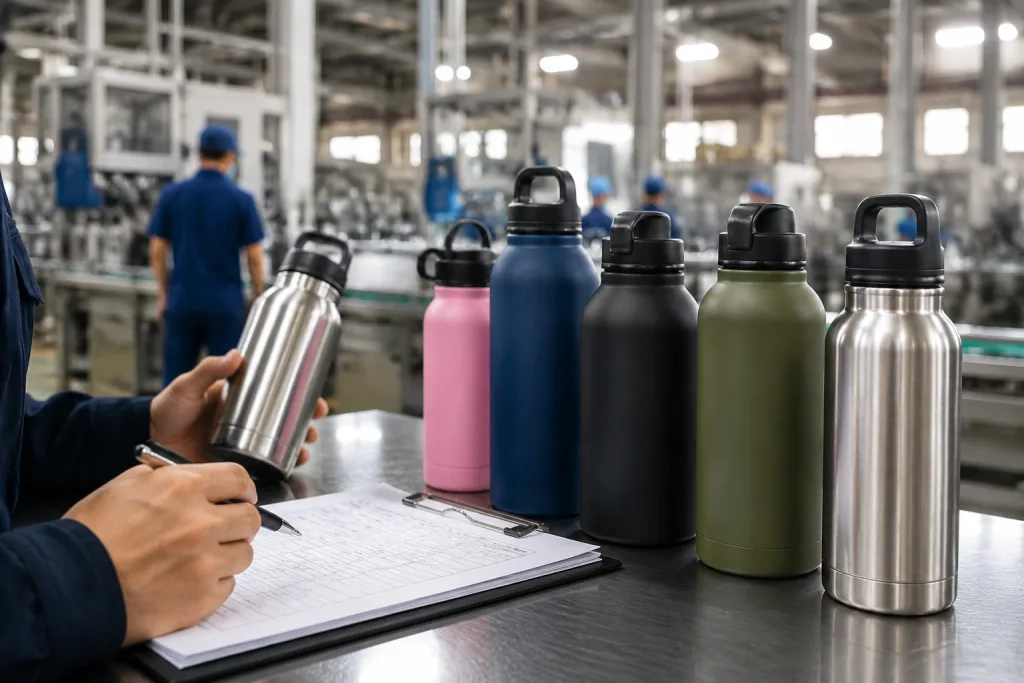
If one part deserves extra checking, make it the lid. That is where we see the threads, gasket seat, drinking spout, handle mount, straw port, push button, hinge pin, and pressure vent squeezed into a small plastic part. It is also where most leak claims start. We had a buyer flag 7 leaking lids from a 60-piece pre-shipment pull last year; the stainless body passed, but the lid torque was all over the place. A nice powder-coated bottle with a weak lid is not premium. It is a complaint your distributor has to answer.
For standard wholesale drinkware, we run PP food-contact lids with silicone gaskets and written temperature limits on the spec sheet. For straw lids, confirm whether the straw is PE, PP, or silicone, then ask for spare straw MOQ and packing method. A missing replacement straw line on the PO sounds small, until the buyer asks for 2,000 spare sets after goods leave Ningbo. For kids’ bottles, ASTM and choking hazard checks matter, and QC should measure small parts with a choke tube, not just eyeball them. For alcohol flask wholesale or alcohol flask wholesale bulk, cap fit and thread smoothness are critical because users carry spirits in a pocket or bag. If you buy alcohol flask in bulk, reject rough internal welding and low-grade seals that hold odor; the math does not work after the first return batch.
Thread design should be tested by repeated opening and closing, not by one smooth twist in the showroom. A practical factory test is 300-500 cycles on the same lid, followed by leak testing, and we log the result on the line sheet. For flip lids, QC pulled the sample and checks hinge pin movement plus button spring rebound with a simple 1 kg press test. For growler wholesale and beer growler bulk, test the cap under real handling: wet hands, side carry, and a filled bottle set down hard on a stainless table. A beer growler wholesale order going to taprooms gets different abuse than an office gift bottle.
Leak testing should not be decorative. Fill the bottle, close it, invert it, shake it for 20 seconds, then leave it sideways for at least 30 minutes on kraft paper so small seepage shows. For higher-risk programs, carton drop testing after filling a few units gives better information; we usually test 3 filled units before mass packing if the lid is new tooling. One leaking lid in a sample set is not “just a sample issue” unless the factory can identify the cause and show corrective action. We have seen this go sideways when the root cause was a 0.3 mm gasket gap, not operator handling.
Finish, Logo, And Real Durability
Surface finish is where brand owners get excited and where procurement managers should stay skeptical. Powder coating and full-wrap printing sell fast in a showroom; electroplating and gradient color look sharp under booth lights. Then cartons rub for 18 days on the water, retail staff handle samples with keys in hand, and the first complaint photo lands in your inbox. We see this on the line: QC pulled 12 black bottles last month after the carton divider left 3 mm rub marks near the shoulder.
For drinkware wholesale, powder coating is usually the safest premium finish. A standard dry film thickness may sit around 60-90 microns, and we check it with a coating thickness gauge before packing approval. Ask for cross-hatch adhesion testing, alcohol rub testing, and dishwasher guidance. Matte looks good, but test fingerprint resistance under real warehouse light. Soft-touch rubber paint feels nice in the hand, yet we have seen it scratch around the base ring after 500 cycles in a simple tumble test if the coating supplier cuts corners.
Logo method depends on positioning and budget. Laser engraving is durable and clean on stainless steel or powder coat, but it will not give you brand colors. Silkscreen works for one- or two-color logos, often with a lower setup cost; our printer still needs a clean AI file, not a 72 dpi JPG pulled from a website. Heat transfer and water transfer support complex artwork, but adhesion control gets stricter, so QC should run tape pull and alcohol rub before the bulk run. For a 1,000-unit custom order, laser may add roughly USD 0.15-0.40 per unit depending on logo size and machine time. Multi-color printing can add more.
If you are sourcing canteen wholesale for outdoor retail, avoid delicate finishes unless your customer accepts cosmetic aging. This is the wrong question to ask: “Which finish looks best?” Ask which finish survives the buyer’s channel. If you are sourcing beer tumbler wholesale for an event, bright printing may matter more than 3-year abrasion resistance, and the math can work at a 500 pcs MOQ. The right finish is not the most expensive one; it is the one matched to use case, price point, and complaint tolerance. Always approve a signed color swatch or Pantone target before mass production in China, because one typo on a PO, like “PMS 186C” entered as “PMS 168C,” can turn a clean reorder into a dispute.
MOQ, Lead Time, And Price Lines
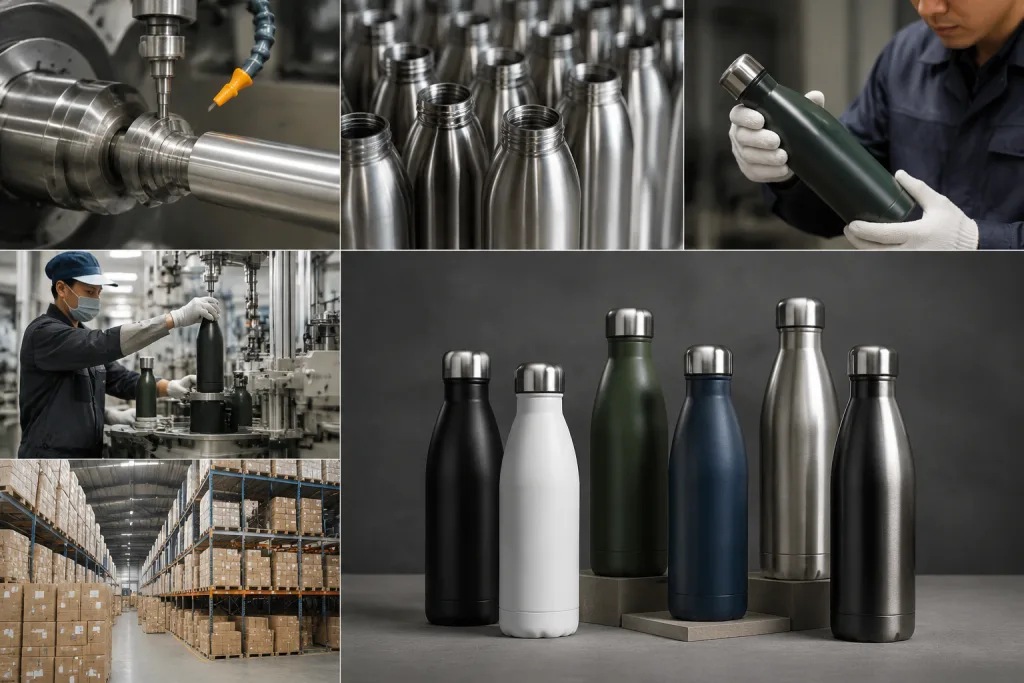
Spec sheets need to tie straight into the deal terms. We do not call a bottle sourced until MOQ, tooling cost, sample time, mass production lead time, payment terms, incoterm, and packing method are written on the quote. QC pulled a 500 ml sample last month with the right logo, but the PO missed “inner box,” and the buyer flagged it after seeing the carton photo. If those lines are blank, the quote is not ready for purchasing.
For most custom thermal bottles from China, a workable MOQ is 1,000-3,000 units per color for existing molds. Custom colors, custom lids, private mold bodies, and retail packaging can push that to 5,000 units per SKU, sometimes 10,000 if the lid uses a new injection tool. At BottleForge Industrial, a normal OEM order for bulk drinkware runs 35-45 days after deposit and sample approval. Stock-color orders can run closer to 25-30 days, but custom packaging often adds 7-12 days because cartons, inserts, barcode labels, and manuals must be printed, matched against the PO, and checked with a barcode scanner on the line.
FOB pricing moves with steel cost, coating yield, lid complexity, logo method, and inspection requirements. A simple 500 ml bottle may quote around USD 3.20-5.20 FOB Ningbo or Shanghai, while a larger 1.2 L growler bulk model may sit around USD 6.80-11.50 depending on handle, cap, coating, and packaging. Small change, big bill. We have seen a push-button lid add USD 0.35-0.60 because the silicone ring, spring, and leak test take more work than a basic screw cap. Beer tumbler in bulk can price lower if the body is simple, but premium lids and sliders eat the saving fast.
For alcohol flask bulk, price can look attractive because the product is smaller, but polishing and welding defects show up faster under a 600-lux inspection lamp. For alcohol flask wholesale, inspect finish consistency carefully, especially around the shoulder radius and welded seam. For beer growler in bulk and wholesale growler programs, carton strength and individual protection matter because dent claims destroy savings; we run a 12 kg stack test on export cartons before approving bulk packing. If a supplier quotes 18% below market, ask which spec line changed. Usually it is steel grade, wall thickness, coating quality, packaging, or inspection, and the math does not work for long.
Compliance And Inspection Before Shipment
Compliance is not a PDF folder you chase after the bottles are packed. We set it before PO confirmation, because the test lab needs the exact material list, gasket color, coating code, and printing ink; one PO last month even had “304 stainless” typed as “403,” and QC stopped it before sampling. For Europe, buyers usually ask for LFGB, REACH, and food-contact declarations. For North America, FDA food-contact expectations, California Proposition 65 screening, and ASTM requirements may apply by product type and age group. Kids’ bottles are a different job. The math doesn’t work if you quote them like standard adult drinkware and then discover CPSIA-style testing after the deposit.
Factory audits matter too. BSCI, Sedex, ISO 9001, and similar documents do not guarantee a clean order, but they show whether the factory understands export discipline. In Zhejiang and wider China, we see 3 out of 10 capable factories sell through trading companies, so ask who controls the line, inspection, rework, and corrective action. Simple question: whose name is on the test report? If the report says one factory and the carton mark says another, the buyer will flag it.
Pre-shipment inspection should use AQL, not a WeChat photo check. A common setup is AQL 2.5 for major defects and 4.0 for minor defects, with critical defects at 0. Inspection points should include capacity checked with a 1,000 ml measuring cylinder, weight on a 0.1 g scale, logo position within 1.5 mm, color against the approved swatch, coating defects under line light, lid fit, leak test, vacuum test sampling, barcode scan, carton drop condition, and shipping marks. For Amazon or marketplace channels, FNSKU labels and carton labels must be checked before loading.
Do not skip inspection because the first sample looked good. Mass production brings operator changes, material lot changes, coating line drift, and packing mistakes; we have seen 18 cartons pulled because the silicone rings were packed in the wrong color bin. A USD 250-350 third-party inspection is cheap compared with rejected pallets in Hamburg, Rotterdam, Los Angeles, or Toronto. Your supplier should welcome a clear inspection checklist. If they push back on basic AQL controls, this is the wrong question to debate after the container leaves China.
Send your bottle spec sheet for a factory review
We will check capacity, steel, lid, finish, MOQ, lead time, and FOB risks before you commit to production.
Frequently asked questions
What MOQ should I expect for a top wholesale thermal bottle?
For an existing mold, you should expect 1,000-3,000 units per color for a custom top wholesale thermal bottle. If you use a stock color with one-color logo printing, some factories may accept 500-1,000 units, but the unit price will be higher. Custom powder coating, retail boxes, special lids, or Pantone matching usually push MOQ to 3,000 units. Private mold projects are different; tooling can cost USD 2,000-8,000 or more, and the first order may need 5,000-10,000 units to make the economics work. For mixed drinkware bulk programs, ask whether the supplier can combine models under one shipment while keeping each SKU’s MOQ separate.
How do I compare FOB prices from different suppliers?
Do not compare FOB price until the specs are aligned. Confirm capacity, 304 or 201 stainless steel, wall thickness, lid structure, coating type, logo method, packaging, carton size, and testing requirements. A USD 4.10 FOB bottle and a USD 4.70 FOB bottle may not be the same product. The cheaper version may use thinner steel, weaker coating, basic polybag packing, or no copper plating. Ask each supplier for FOB port, sample cost, mass production lead time, MOQ, payment terms, and inspection allowance. For wholesale drinkware from China, FOB Ningbo and FOB Shanghai are common for Zhejiang factories, but inland transport can still affect the final quote.
Which products fit canteen, growler, and beer channels best?
For wholesale canteen or canteen bulk programs, 750 ml to 1,000 ml bottles with a carry handle, wide mouth, and durable powder coat usually fit outdoor and workwear channels. For wholesale growler or beer growler wholesale, 1.2 L to 1.9 L capacity is more common, with a strong cap seal and easy-clean interior. Beer tumbler wholesale programs often use 12 oz, 16 oz, or 20 oz double-wall tumblers with sliding lids. If you need beer growler wholesale bulk for taprooms, pressure handling and cleaning matter more than a fancy box. If you need beer tumbler bulk for events, logo visibility and fast lead time may matter more.
What testing should I require before mass production?
Start with a golden sample and a written test checklist. For thermal bottles, require vacuum performance testing at a defined starting temperature, leak testing, coating adhesion, logo rub testing, capacity check, weight check, and carton drop testing. For food-contact compliance, request relevant reports such as LFGB, REACH, or FDA-related documentation depending on your market. During production, ask for in-line checks, then arrange pre-shipment inspection under AQL 2.5/4.0. For alcohol flask wholesale bulk, add odor, polishing, and cap-thread checks. For beer tumbler in bulk, test lid fit and slider leakage. Testing is not bureaucracy; it prevents expensive returns.
How long does a custom bulk drinkware order take?
A normal custom bulk drinkware order takes about 35-45 days after deposit and final sample approval. Add 7-12 days for pre-production samples if you need custom color, logo, or packaging. Private mold development can add 30-60 days before mass production, depending on complexity and revisions. Sea freight to Europe or North America may add 25-45 days depending on port, season, and routing. If you need wholesale drinkware for a fixed launch date, work backward from the delivery date and leave at least 10-14 days for inspection, booking, and possible rework. Rush orders are possible, but they reduce your room for quality control.