
Key Takeaways
- 304 stainless steel at 0.45-0.55 mm wall thickness is the safer default for a top wholesale sport bottle
- Real factory MOQ is usually 1,000-3,000 units per color, not 100 units with custom coating
- AQL 2.5/4.0 inspection should be written into the PO before deposit
- FOB China pricing often moves 8-15% when lid type, coating, and carton spec change
A sport bottle quote looks simple until 3 suppliers price what looks like the same SKU. One writes 201 stainless steel, one quotes 304 stainless, and one leaves the lid material blank; last month QC pulled a pre-shipment sample with a PP lid marked “Tritan” on the buyer’s PO. That is where margin gets eaten.
If you are buying a top wholesale sport bottle for retail shelves, promo programs, team merch, or ecommerce bundles, treat the spec sheet like the contract. We ship bulk drinkware from Hangzhou, Zhejiang, and we usually run MOQs from 1,000 units per color with 35-45 day production lead times after sample approval; ask whether the master carton passes a 76 cm drop test before you argue over USD 0.08 per unit, because the math does not work when a North American DC flags crushed cartons.
Start With Body Material
The first line on the spec sheet should not be color. Put body material first. It drives dent resistance, food-contact paperwork, and the landed cost your buyer will argue about later. For a top wholesale sport bottle, we run 304 stainless steel as the normal choice for Europe and North America; 201 stainless steel looks cheaper on the PO, but we have seen it fail acidic drink discussions when QC pulled the sample for REACH, LFGB, and FDA file review.
For single-wall sports bottles, we usually see 0.45-0.55 mm body thickness. For vacuum insulated models, the outer wall may be 0.45-0.50 mm and the inner wall 0.35-0.40 mm. Ask for the grade and wall thickness in writing, not in a WeChat voice note. If a supplier only says “stainless steel,” the quote is not usable; last month we saw one PO typo list “SS304” in the title and “201 body” in the remarks, and the buyer flagged it before deposit. Good catch.
Plastic sport bottles still work for gym, school, and cycling channels, but the resin callout must be clear: Tritan, PP, PE, or PETG, with the temperature range and test report attached. “BPA-free” is the wrong question to ask by itself. Tritan usually costs more than PP, but it gives better clarity and odor resistance; on a 3,000 pcs MOQ promo order, that difference can decide whether the bottle feels retail-ready or like a cheap giveaway.
The same logic applies when your range includes canteen wholesale, wholesale canteen, or bulk canteen items. A military-style canteen bulk order may care more about dent resistance and cap retention than insulation; we test the cap strap with a simple pull check on the line before packing. A premium retail bottle needs cleaner finish, better hand feel, and logo placement that stays within 1.5 mm after heat-transfer or laser setup. Different use cases need different specs.
Capacity Changes More Than Volume
Capacity is not just the number printed on the master carton. It changes tooling, wall thickness, bottle weight, freight cube, shelf height, and the complaint emails your buyer forwards at 9 p.m. The sport bottle sizes we run most are 500 ml, 650 ml, 750 ml, 1,000 ml, and 1,200 ml; for North America, 18 oz, 22 oz, 25 oz, 32 oz, and 40 oz move faster because the buyer does not need a conversion chart. On the line, even a 6 mm body-height change can force a new gift box dieline.
If you source drinkware wholesale for mixed channels, the largest size is the wrong question to ask first. A 1,000 ml bottle looks good on Amazon images, but the buyer flagged cup-holder fit on a 32 oz sample last March, and QC measured the base at 78 mm with a digital caliper. A 750 ml bottle is the safer all-rounder for clubs and outdoor retailers. A 500 ml bottle works better for kids, hotel giveaways, and promo orders where the math breaks once air freight enters the PO.
Capacity also hits packaging cube. A 32 oz vacuum sport bottle usually ships around 24 units per export carton, depending on gift box size, EVA insert, and barcode label position. A 40 oz handle bottle may drop to 12 or 18 units per carton. Big difference. We have seen a buyer approve the FOB price, then reject the shipment plan after the carton came out at 62 x 46 x 31 cm and pushed the container count past budget.
For related lines such as bulk growler, growler wholesale, growler bulk, wholesale growler, beer growler bulk, beer growler in bulk, beer growler wholesale, and beer growler wholesale bulk, capacity gets even more sensitive. A 64 oz growler needs stronger handle welding, better lid sealing, and thicker carton protection; our welding jig gets checked before mass production because one weak handle turns into 500 returns fast. Beer buyers notice leakage immediately. Treat a growler like beverage hardware, not a novelty bottle.
Lids Decide Complaint Rates
Most complaint tickets start at the lid, not the bottle body. We’ve seen a 1.5% leak rate kill a reorder because shoppers remember a wet gym bag, not a clean powder coat. Put the lid spec on the quote: PP, Tritan, stainless steel, silicone gasket, straw material, carry loop material, and whether spare gaskets are included. Last month QC pulled 32 samples from the line and found 3 gaskets seated 0.4 mm off-center. That is where trouble starts.
For sport bottles, the usual lid choices are screw cap, straw lid, chug lid, flip lid, and handle lid. A screw cap is simple and stable, but slow during training. A straw lid drinks faster, then gives you bite valves, vent holes, straw length, and hinge pins to inspect. A chug lid works for outdoor and fitness buyers when the opening stays around 28 to 32 mm and the thread gauge passes cleanly. If you sell through ecommerce, skip clever lids unless you can hold 2% spare parts stock. We’ve seen this go sideways.
Ask for a 100% leak test on production if the bottle is marketed as leakproof. At BottleForge Industrial in Zhejiang, China, we normally run water inversion testing for 30 minutes, then random vacuum retention checks on insulated models. For premium orders, pressure testing at 0.3 MPa or 3 hot-water cycles at 85°C gives better proof before cartons close. It costs more, but the math doesn’t work if you are handling returns from the US or EU on a 5,000 pcs shipment.
The same lid discipline matters for alcohol flask wholesale, alcohol flask bulk, alcohol flask in bulk, and alcohol flask wholesale bulk projects. A flask with a loose hinge or weak gasket feels cheap in 2 seconds; buyers notice that before they read your logo. On one PO, the buyer wrote “leak proof” in the remarks but approved a loose cap sample, and QC flagged the mismatch before mass production. For beer tumbler wholesale, beer tumbler bulk, beer tumbler in bulk, and beer tumbler wholesale bulk, slider lids need a fit check after 20 dishwasher simulation cycles if your market expects dishwasher-safe use.
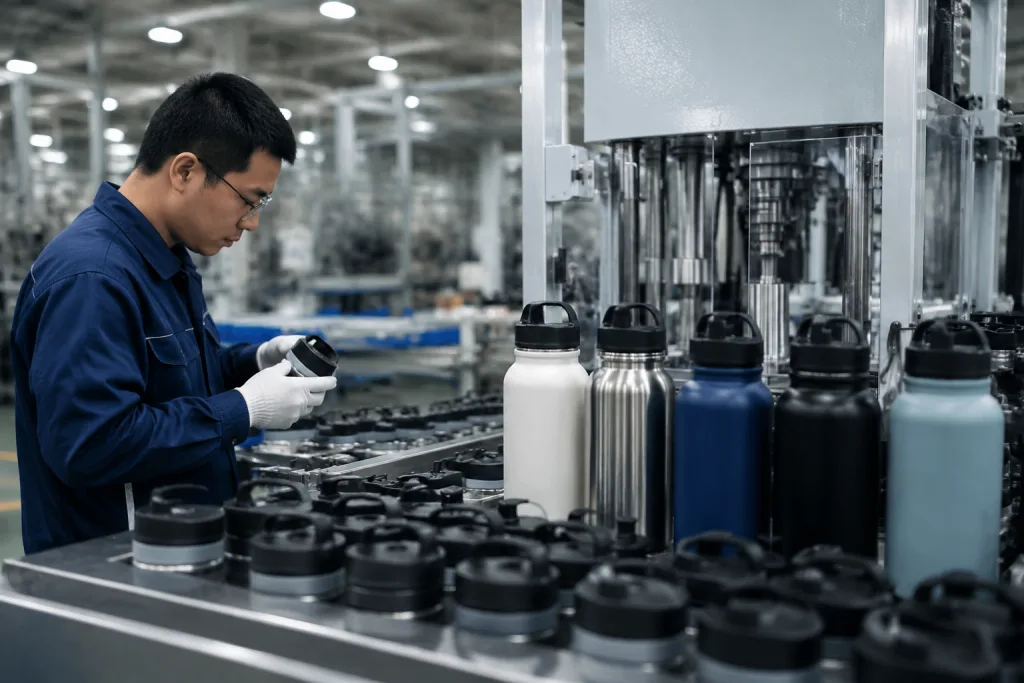
Surface Finish Is Not Decoration
Powder coating is not the same spec as spray paint, electroplating, mirror polish, or raw 304 stainless. Each one changes scratch marks, hand feel, color drift, and test cost. For a top wholesale sport bottle, we run powder coating most often for retail and promo orders because it gives a dry grip and survives bag abrasion better than gloss spray paint when the phosphate pretreatment and oven curve are controlled. On our line, QC checks the first 20 bottles after the 180°C cure; if the coating feels slick at the shoulder radius, we stop and adjust before cartons start piling up.
Ask for coating thickness and adhesion testing. Put the numbers on the PO. A common powder coat target is 60-80 microns, measured with a coating thickness gauge on the body, shoulder, and bottom edge. Cross-hatch adhesion should reach 4B or 5B under ASTM D3359, depending on your requirement. If the supplier cannot talk through adhesion, cure time, or tape brand, the math doesn't work for large drinkware bulk orders; we've seen this go sideways when a coating subcontractor changed powder without telling anyone.
Color matching needs a Pantone code or a physical master sample. Do not approve color by phone photos. Screens lie. For 3,000 units per color, we advise one pre-production color panel and one finished bottle sample before mass production. Last month a buyer flagged “navy blue” on a PO, but the approved chip was Pantone 2965 C; that one line saved us from producing 3,000 bottles in the wrong shade under mixed LED lighting.
Logo method is another spec line with real buyer impact. Silk screen keeps cost down for 1-2 color logos with clean edges, while laser engraving suits stainless exposure and long-term branding. Heat transfer or UV print works for full-color artwork, but we run abrasion testing when the bottle will be handled daily; QC pulled a sample after 500 rub cycles with a 1 kg load, and the weak UV print showed edge lift near the logo corner. The best wholesale drink bottle is not the one with the prettiest rendering. It is the one whose finish still looks acceptable after 90 days of use.
MOQ And Price Need Context
A low unit price means little if MOQ, packaging, and testing are missing from the quote. For custom wholesale drinkware from China, we usually run 1,000 units per color on existing molds and 3,000-5,000 units when the buyer asks for special coating or a new lid match. New tooling is a different animal: higher order commitment, then 20-35 days for mold work before we even send samples. Last month QC pulled a first-shot lid sample with a 0.35 mm flash on the thread, and that alone cost us 3 days.
FOB Ningbo or FOB Shanghai pricing for a 750 ml 304 stainless sport bottle might sit around USD 3.20 to USD 6.80, depending on insulation, lid type, coating, logo, and packaging spec. Ask the right question. A plastic Tritan sport bottle can be lower, often USD 1.40 to USD 3.50, but Eastman resin grade, silicone ring design, and whether the lid has a lock button move the number fast. These are working ranges, not promises, because steel, exchange rates, and order structure change monthly; our costing sheet changed 4 times in Q2 after buyers pushed for color box plus spare straw.
Be careful with canteen bulk and canteen wholesale quotes that look 15-20% cheaper than the rest. Sometimes the saving is real because the mold is simple and the line already has the right jig. Sometimes it is thinner steel, lower-grade plastic, no inner bag, weak carton, or skipped inspection. We’ve seen this go sideways: one buyer flagged a 9.2 kg master carton that should have been 11.5 kg, and the missing weight was not magic.
For mixed wholesale drinkware programs, combine SKUs with production in mind. A factory may accept 1,000 sport bottles, 1,000 tumblers, and 1,000 growlers as one project for scheduling, but not as one color MOQ if each item uses different coating lines. Our Hangzhou team plans by line capacity; a stable month can run about 600,000 units across bottles, tumblers, and growler wholesale projects, but coating bottlenecks still decide delivery. If the PO says “mat black” instead of “matte black,” we stop and confirm the Pantone or powder code before the line burns 2,000 wrong pieces.

Testing Belongs In The PO
If testing comes up after production, you are already late. Write the inspection standard into the purchase order, line by line. We run AQL 2.5 for major defects and AQL 4.0 for minor defects, with critical defects at 0. Critical means no debate: sharp rim found by a cotton-glove wipe, leakage over 3 ml in a 30-second inverted test, wrong material, visible contamination, or packaging that can cut a hand. Major defects cover dents seen at 50 cm, coating adhesion below the 3M tape pull standard, logo position off by more than 1.5 mm, or a lid that fails after 20 open-close cycles. Put it in the PO. Last April, QC pulled 8 samples from a 3,000 pcs sport bottle order and the buyer flagged logo drift that the PI never mentioned.
For Europe, ask for REACH, LFGB, and food-contact migration reports with the tested SKU or material code shown on the report, not a loose PDF from 2021. For the US, FDA food-contact compliance matters, and CPSIA comes into play if the bottle is sold for children. Kids’ bottles need ASTM checks and small-parts review; we use a small-parts cylinder on straw caps and silicone plugs before we release the sample. For insulated bottles, test temperature retention with hot water at 95°C, then record the reading after 6, 12, and 24 hours at controlled room temperature. The wrong question is “does it keep hot?” Ask for the actual chart. We have seen 500 ml bottles claim 12 hours, then come back at 48°C after 6 hours on the bench.
Factory audits still matter. BSCI, ISO 9001, and Sedex are not magic shields, but they show whether the supplier has working procedures beyond a polished sales deck. If your retailer requires social compliance, confirm audit validity before sample approval, including factory name, address, expiry date, and audit scope. Do not wait until goods are ready in China. We had one PO typo list “Sedex approved” while the buyer meant “Sedex 4-pillar”; that mismatch cost 12 days vs 18 days because the line had to hold 6,400 pcs in WIP racks while documents were corrected.
Packaging tests should match your channel. Ecommerce cartons need drop testing, usually 76 cm for individual packed goods under at least 3 retailer protocols we see from US buyers. Club store pallets need compression strength, with the bottom carton checked after a 24-hour stack test, not just a clean photo of the first layer. Amazon FBA needs FNSKU labeling, suffocation warnings for polybags, and master carton dimensions that do not create avoidable handling fees; the math does not work when a 13 kg carton is oversized by 20 mm. Bulk drinkware only makes money if it arrives sellable. We ship cartons through a carton clamp check and tape the sample box with the same 48 mm BOPP tape used on the line.
Packaging Controls Landed Cost
We see buyers fight 3 cents on the bottle body, then leave the carton spec blank. Wrong question. A USD 0.18 weaker gift box can cause USD 2.00 in downstream damage after corner crush, Amazon returns, or repacking labor. For wholesale drinkware, lock the inner PE bag thickness, egg-crate divider height in mm, gift box paper weight, master carton ply, carton burst strength, and pallet pattern before we run mass production. Last month QC pulled 12 master cartons from the line; 3 failed the drop corner because the buyer’s PO said “standard carton” with no burst test value. If your distributor breaks cartons by hand, spec cartons that survive at least 5 open-close cycles with a tape gun, not one clean warehouse photo.
Standard options are bulk pack, white box, kraft box, color box, or retail-ready window box, but each one needs a use case. Bulk pack is the low-cost choice for staff programs and event giveaways; we usually run 24 pcs per carton for 750 ml sport bottles, with separators if the powder coating is dark. It is weak for retail. A color box gives better shelf blocking and cleaner barcode scanning at receiving. For online sales, we’ve seen a 350 gsm kraft box with a molded pulp insert beat a glossy 300 gsm retail box because the insert holds the lid and bottle shoulder tighter during courier sorting. The math doesn’t work if the box looks nice but fails the first DHL belt.
Labeling has to be clean before production starts. UPC, EAN, FNSKU, country of origin, recycling marks, capacity, material, care instructions, and warning text should be approved in the artwork files, not typed into an email after the deposit. We once had a PO typo “FNSKU on carton only,” while the Amazon routing sheet required unit-level FNSKU; that cost 2 days of relabeling with a Zebra printer at our packing bench. For drinkware bulk headed to the US, “Made in China” placement needs a fixed size and position on the unit box or bottom label. For EU markets, confirm language requirements by destination country before plate making, especially for care warnings and capacity claims.
If you are building a range that includes sport bottles, beer tumbler wholesale bulk, alcohol flask wholesale, and wholesale growler items, use one packaging logic with size rules for each shape. Same barcode zone, same carton mark layout, same fragile icon position. Warehouse teams move faster when every carton face reads the same from 2 meters away. We ship mixed drinkware programs from Hangzhou with 6 to 10 SKUs in one container, and we’ve seen this go sideways when the flask carton used black marks, the growler carton used red marks, and the buyer flagged it at inbound. The bottle spec sheet is not just for the factory in Zhejiang. It is for your freight forwarder, warehouse, retail buyer, and customer service team too.
Send your sport bottle spec sheet for review
We will check material, MOQ, logo method, packaging, testing, and FOB assumptions before you commit deposit.
Frequently asked questions
What MOQ should I expect for a top wholesale sport bottle?
For an existing mold, expect 1,000 units per color as a practical starting point. If you need custom powder coating, a new lid color, or retail color box packaging, 3,000 units is more realistic. New tooling can push the commitment to 5,000-10,000 units depending on mold cost. Very small orders are possible for stock bottles, but custom logo placement, Pantone coating, and full inspection become inefficient below 500-1,000 units.
How long does production take after I approve the sample?
For a standard stainless sport bottle from China, plan 35-45 days after sample and artwork approval. Add 7-12 days for pre-production samples if the logo, coating, or lid color is custom. New mold projects can add 20-35 days before the first sample is ready. Ocean freight to Europe or North America usually adds 25-45 days depending on port, season, and customs handling.
Is 304 stainless steel always necessary?
For most European and North American retail programs, 304 stainless steel is the safer default. It supports better food-contact positioning and handles acidic drinks better than 201 stainless steel. If you are sourcing a low-cost promotional bottle for water only, 201 may be acceptable in some markets, but you must confirm compliance reports and label claims carefully. The price gap can be 8-18%, but the risk gap can be larger.
What inspection standard should I put on the purchase order?
Use AQL 2.5 for major defects and AQL 4.0 for minor defects, with critical defects set at 0. Define critical defects clearly: leakage, sharp edges, wrong material, contamination, unsafe lid parts, and failed food-contact requirements. For a 3,000-unit order, a third-party inspector will usually check a statistical sample, not every unit. If you need 100% leak testing, write that separately as an in-line factory requirement.
Can I combine sport bottles with growlers, canteens, and flasks?
Yes, but treat each item as its own spec sheet. A sport bottle, wholesale canteen, beer growler wholesale bulk item, and alcohol flask wholesale bulk item use different tooling, lids, testing points, and carton designs. You may combine them under one shipment to reduce freight administration, but MOQ is usually calculated by SKU and color. Ask for a loading plan early so carton sizes and pallet counts do not surprise you.