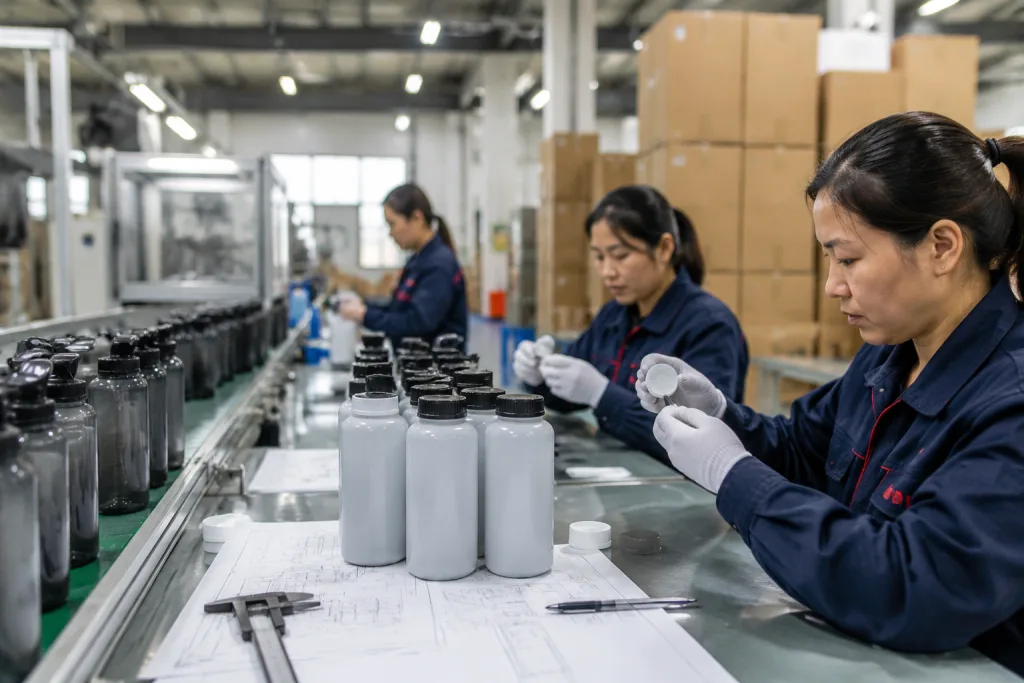
Key Takeaways
- Standard PP bottle MOQ is usually 3,000-5,000 units per color, with 25-35 day production after artwork approval
- Food-contact PP should be specified as BPA-free, LFGB or FDA-grade, and checked under AQL 2.5/4.0
- Single-wall PP is cheaper, but double-wall PP gives better hand feel and a higher perceived retail price
- Custom molds can add USD 2,500-8,000 upfront, so use existing tooling unless the annual volume exceeds 50,000 units
If you are sourcing a top wholesale polypropylene bottle, you are not buying 1 bottle. You are comparing landed cost, shelf impact, and the risk of a repeat batch coming back with warped caps or a plastic smell. PP looks simple on a sample table. On the line, a 0.3 mm wall-thickness swing, a loose cap thread checked with a torque tester, or poor venting in the mold can turn into 2% returns instead of 0.3%.
At BottleForge Industrial in Hangzhou, Zhejiang, we quote PP bottles next to stainless steel tumblers, canteens, growlers, and promo drinkware every week. “Which bottle is cheapest?” is the wrong question to ask; the math does not work if a buyer’s 5,000 pcs MOQ needs retail-ready printing, LFGB paperwork, and 12-day delivery instead of the normal 18 days. We run into this often: QC pulled the sample, the buyer flagged a faint resin odor, and one PO even listed “PP bottle with Tritan lid,” which changes the whole quote. This guide is for buyers who need practical numbers before sending a PO to China.
The real head-to-head specs
PP bottles get compared with several items in a wholesale drinkware program, sometimes in one RFQ. Last month we quoted 4 lines on the same buyer sheet: a PP bottle, a bulk canteen, a bulk growler, and a stainless beer tumbler bulk option. The buyer flagged the PP bottle as “too light” after checking a 92 g sample on a bench scale, which is the wrong question to ask if the order is for school events or budget retail. Compare them by channel, carton weight, lid failure risk, and landed cost.
| Product type | Typical capacity | FOB China range | Best fit | Main caution |
|---|---|---|---|---|
| Single-wall PP bottle | 500-900 ml | USD 0.75-1.45 | Events, schools, low-cost retail | Lower heat resistance than metal |
| Double-wall PP bottle | 450-750 ml | USD 1.35-2.40 | Brand promotions, fitness kits | More parts, slower assembly |
| PP canteen wholesale style | 600-1,000 ml | USD 1.10-2.10 | Outdoor sets, youth programs | Strap and cap strength matter |
| Stainless wholesale growler | 32-64 oz | USD 5.80-11.50 | Beer, camping, premium retail | Higher freight and carton weight |
| Alcohol flask wholesale | 4-8 oz | USD 1.80-4.20 | Gift sets, barware | Different age-gated positioning |
For a top wholesale polypropylene bottle, we run the safest spec at 650-750 ml, 0.8-1.2 mm body wall, screw cap with silicone gasket, and a carton pack below 14 kg gross weight. Simple wins. That spec keeps the unit cheap enough for drinkware wholesale while still passing normal drop checks on the line; QC pulled one 720 ml sample last week after a 1.0 mm wall area measured 0.74 mm near the shoulder with a digital caliper. If you need dishwasher claims, say it before tooling. In our last 18 logo-wash tests, 13 PP bottles handled top-rack dishwasher cycles, but 5 printed logos failed because the ink system and curing time were not locked on the PO.
Where PP beats metal and glass
PP is not the premium answer for every project. It is the practical answer when the brief says light weight, low breakage, flexible color, and a shelf price under USD 6.99. A 700 ml PP bottle can weigh 80-130 g before packaging. A comparable stainless bottle may weigh 220-330 g. That gap shows up fast: we once had a buyer push back on 24 pcs/carton because the stainless version crossed 15 kg gross weight, while the PP carton stayed easier for warehouse handling and FBA fee checks.
For drinkware bulk programs, PP gives tighter color control than buyers expect. Existing molds can usually run Pantone-matched resin, with tolerance locked by the pre-production sample. Ask for a resin chip and 1 physical pre-production unit, not only a PDF mockup. QC pulled the sample under a D65 light box on our line last month and caught a blue lid that looked fine on screen but drifted darker after the masterbatch ran through a 1.2 mm wall section.
PP is a poor choice for boiling water, carbonated pressure, and beer storage. If your line includes beer growler wholesale bulk or beer growler in bulk, use stainless steel or glass based on the sales channel. If your line includes alcohol flask wholesale bulk, PP is usually the wrong material; the math does not work once odor risk, migration questions, and buyer complaints enter the PO. For sports, school, giveaway, conference, and low-price retail, PP still wins, and we ship plenty of 3,000-10,000 pc runs for that lane.
Our opinion: do not force one material across every SKU. Use PP for lightweight hydration, stainless for beer tumbler wholesale and growler wholesale, and glass where clarity sells the product.
Use-case fit before price
A low quote means nothing if the bottle fails in the user’s hand. Start with the channel before asking for FOB Ningbo or FOB Shanghai pricing. We see buyers put wholesale canteen bottles, canteen bulk orders, and standard sport bottles on the same RFQ sheet; then the PO comes back with “canteen” typed in the item name but a sport-cap drawing attached. Wrong question. Ask how it will be used, packed, washed, and dropped before chasing the last USD 0.03.
Promotional and event orders
For a 5,000-20,000 unit event run, we run an existing single-wall PP mold and keep the artwork simple. One-color silkscreen or a heat-transfer label is enough. Expect USD 0.75-1.25 FOB China for a basic 600-750 ml bottle, depending on cap design and carton pack. QC pulled 80 pcs from a 10,000 pcs promo order last month; 3 failed the upside-down leak test after 30 seconds because the buyer changed to a cheaper gasket. For this use, the best wholesale drink bottle is the one that ships on the event date and passes the leak table.
Retail and brand programs
For branded retail, double-wall PP or a cleaner lid system earns the extra USD 0.40-0.90 if the shelf price supports it. Add a carry loop, matte texture, measuring marks, or a flip straw only when the customer will pay for the added mold time and inspection work. Every feature adds a check point: loop pull test at 8 kg, straw fit, lid torque, color match under the D65 light box. We have seen this go sideways when a buyer approved a matte sample, then flagged “too much hand oil showing” after mass production.
Outdoor and canteen wholesale sets
For bulk canteen projects, focus on impact resistance and strap pull strength first. Cap tether durability comes next. A canteen body with 1.2 mm average wall thickness feels better in hand than a thin 0.7 mm body, and the drop-test result usually proves it. On the line, we check wall thickness with a digital caliper at the shoulder, waist, and base; thin spots near the mold parting line are the first place QC finds stress whitening. If you sell to camps or school programs in North America, ask about ASTM-related testing where relevant.
Beer and barware extensions
Do not position PP as beer growler bulk. The math does not work, and the material story is wrong. For beer tumbler in bulk, beer tumbler wholesale bulk, wholesale growler, or growler bulk programs, move to stainless steel with food-grade inner surface and a properly tested lid. We ship PP for low-cost hydration, not for beer storage claims; one buyer flagged this after their compliance team asked for pressure and odor-retention data that a PP hydration bottle was never designed to pass.

MOQ, tooling, and landed cost
Most Zhejiang and China drinkware factories quote PP bottles at 3,000-5,000 units per color when we run existing molds. Ask for 1,000 pcs in a custom Pantone and the math doesn’t work: the injection line still purges 18-25 kg of resin before the color sits clean, and QC will pull the first 20 shots for shade drift. That waste becomes a surcharge. For full custom tooling, mold cost usually lands between USD 2,500 and USD 8,000 for a simple bottle body, higher if the cap has a flip hinge, silicone bite valve, or straw lift mechanism.
At BottleForge Industrial, our Zhejiang partner lines can assemble about 300,000 PP bottle units per month across standard molds. Normal lead time is 25-35 days after deposit, color approval, and artwork sign-off. Real calendar, not sales talk. Before summer retail launches, the line gets packed with sports bottles and school bottles, and we’ve seen 7-10 days added because a buyer approved the lid color 4 days late. Do not treat the first quote lead time as locked until the PO is placed and the sample room has signed the color chip.
Landed cost needs more than FOB. A 700 ml PP bottle may pack 50-80 units per master carton depending on shoulder shape and cap height; last month QC measured one carton at 61 x 42 x 39 cm, which pushed the shipment into volume weight. If the bottle is bulky, you pay for air in the carton. For Europe, check REACH and food-contact documentation. For the United States, request FDA-grade material declarations and packaging marks if the product enters major retail. For Amazon or 3PL programs, ask whether the supplier can apply FNSKU labels, carton labels, and polybag warnings. That service might add USD 0.03-0.08 per unit, but it beats warehouse rework at USD 0.20 per unit after arrival.
If you are also sourcing drinkware wholesale categories like beer tumbler bulk, alcohol flask in bulk, or beer growler wholesale, consolidate cartons only when schedules match. We’ve seen this go sideways: PP bottles finished in 28 days, while stainless growlers waited 12 more days for powder coating touch-up after QC found 2 scratched lids under AQL inspection. Mixing slow metal production with fast PP production can hold the whole container.
Decoration choices that survive use
Logo durability is where about 3 out of 10 polypropylene projects fail quietly. The bottle body passes the drop test, then the buyer flags the artwork because the logo scratches after 14 days in a gym bag. PP has lower surface energy than stainless steel, so printing needs treatment before ink touches the part. We run corona treatment or flame treatment before printing to bring adhesion up; QC pulled one untreated sample last month and the 3M tape test lifted the edge in one pull. Ask your supplier which process is used. If they cannot answer, slow down.
For simple wholesale drinkware orders, one-color silkscreen is still the safest low-cost choice. A typical print area might be 60 x 90 mm on a cylindrical 700 ml bottle, and our pad-printing jig usually holds the body within about 1.5 mm. Multi-color silkscreen can work, but registration drift shows fast on curved walls, especially near the parting line. Heat-transfer labels give better gradients and photo-style artwork, but they add cost and we have seen wrinkles around tapered shoulders after the heat tunnel. In-mold labeling looks clean, but the MOQ and mold planning need to match the program. For a 5,000-piece promo, the math often does not work.
Laser engraving is the wrong question to ask for standard PP. It does not behave like stainless steel, and the mark usually looks weak or burned rather than premium. Debossed or embossed logos need mold changes, so they fit annual programs, not a small trial order. For a 3,000-unit trial order, pay for print, not tooling. For a 100,000-unit annual program, a custom mold mark can cut one decoration step on the line and make copycat generic stock harder to pass off as your item. We have seen this go sideways when a PO says “emboss logo” but the approved sample was printed.
Color needs discipline. Dark PP hides scuffs better, especially after carton rub in a 24-piece inner pack. Transparent or translucent PP can show flow marks and resin inconsistencies; QC sometimes catches cloudy streaks near the injection gate at 2 mm wall thickness. If you want a premium look at drinkware bulk pricing, choose matte solid colors with a cap contrast that matches the Pantone target within Delta E 2.0. Keep the logo clear of the seam line by at least 8 mm. Small detail, big headache avoided.
Quality checks buyers should require
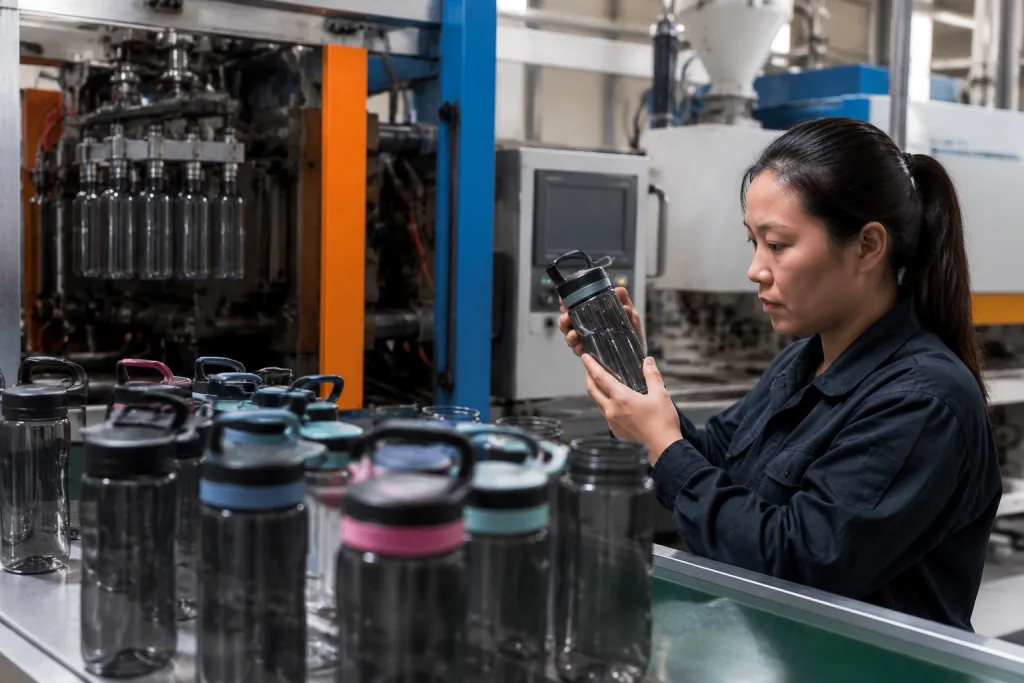
A PP bottle inspection should not read like “quality as per approved sample.” Put the checkpoints in the PO, line by line. We run AQL 2.5 for major defects and AQL 4.0 for minor defects unless the buyer sends a stricter retail manual. Critical defects get zero tolerance: sharp edges, contamination, serious leakage, wrong material, or unsafe odor. QC pulled 200 pcs from a 12,000 pc lot last month and found 3 caps with flash over 0.4 mm; the buyer was right to flag it before packing.
- Leak test: fill to rated capacity, invert for 30 minutes, then shake for 30 seconds; use room-temperature water and record any drip at the cap thread.
- Drop test: packed carton drop from 60-80 cm on edges and corners first, then one face drop if the carton spec allows it.
- Cap torque: check over-tightening with a torque meter and confirm easy-open feel across samples, not just the golden sample.
- Odor check: inspect after 24 hours sealed, especially for colored resin; we reject the batch if the smell stays after one hot-water rinse.
- Print adhesion: tape test plus wet rub test after curing; for screen print, we usually wait 24 hours before QC signs off.
Food-contact papers matter, but papers do not catch a loose gasket. This is the wrong question to ask: “Do you have the certificate?” Ask which resin grade went into this order and whether the warehouse mixed natural PP with colored regrind. For Europe, request LFGB or EU food-contact testing depending on the market. For North America, FDA-grade resin statements and, where relevant, California Proposition 65 review may be needed. If the order is for children, testing gets tighter; do not use adult promotional assumptions for kids’ bottles. We once saw a PO typo list “PP lid” while the approved sample used silicone gasket, and that 2-word mistake held shipment for 5 days.
For mixed programs that include canteen wholesale, wholesale growler, beer tumbler wholesale, and alcohol flask wholesale items, inspect by product type, not by one shared checklist. The math does not work. A stainless growler needs vacuum or leak checks that PP does not. A PP bottle needs resin, odor, and print checks that metal products do not have in the same way. On the line, we separate PP bottle cartons from stainless items by SKU sticker and carton weight; a 13.6 kg master carton sitting in the 9.8 kg PP stack usually means someone placed the wrong goods before final inspection.
How to brief the factory
A tight RFQ cuts three email rounds. Send the bottle size in ml, PP grade, Pantone code, lid drawing, print method, carton pack, sales country, and annual volume split by order. If the brief says only “quote top wholesale polypropylene bottle with logo,” the factory will price the cheapest open mold to get the first reply out before lunch. We see this a lot. Last month QC pulled a 650 ml sample from mold PP-18 that looked fine in photos, but the cap thread measured 0.35 mm loose on the go/no-go gauge.
Write the spec like a work order: 700 ml PP bottle, BPA-free, 1.0 mm target wall thickness, screw cap with silicone gasket, Pantone 289C body, white cap, one-color silkscreen logo 70 x 80 mm, individual OPP bag, 60 units per carton, AQL 2.5/4.0, FOB Ningbo, 5,000 units first order, repeat forecast 30,000 units. That gives a China factory enough detail to price without padding. The line leader can check wall thickness with a Mitutoyo caliper, purchasing can cost the gasket by gram weight, and packing can confirm whether 60 units fit a 56 x 38 x 42 cm export carton.
If you compare PP with bulk growler, growler wholesale, beer growler wholesale, beer tumbler wholesale, wholesale canteen, or alcohol flask bulk lines, split the briefs by material. One spreadsheet is fine. One generic drinkware standard is the wrong question to ask. Polypropylene needs drop and odor checks; stainless steel needs weld, vacuum, and rust checks; glass needs annealing and breakage control. We had one buyer flag this after a PO typo listed “PP growler” for a stainless item, and the sample room lost 2 days chasing the wrong lid.
Ask for one golden sample and keep it in your office, not just in a chat photo. The approved sample should lock color, lid feel, gasket fit, print placement, and packaging. When the shipment leaves Zhejiang, your inspection team needs that sample on the table beside the AQL 2.5 checklist and barcode scanner. Without it, disputes turn into opinions, and the math does not work when 80 cartons are already on the water.
Send your PP bottle RFQ for a practical quote
Share capacity, quantity, color, logo, market, and deadline. We will recommend the right mold, MOQ, testing plan, and FOB China price.
Frequently asked questions
What MOQ should I expect for a top wholesale polypropylene bottle?
For existing molds, expect 3,000-5,000 units per color. Some factories will accept 1,000-2,000 units if you use stock colors and simple packaging, but the unit price may rise by 8-18%. Custom Pantone resin usually needs higher MOQ because the injection machine must be cleaned before and after the run. If you need a custom mold, plan for at least 20,000-50,000 units annually to justify USD 2,500-8,000 in tooling. For BottleForge Industrial programs in Zhejiang, normal PP production lead time is 25-35 days after deposit and sample approval.
Is polypropylene safe for wholesale drinkware in Europe and North America?
Polypropylene can be safe for wholesale drinkware when the resin is food-contact grade and the production is controlled. For Europe, ask for EU food-contact or LFGB-related testing based on your destination market. For the U.S., request FDA-grade material declarations and confirm whether Proposition 65 review is needed. Specify BPA-free, even though PP normally does not rely on BPA chemistry, because retailers and consumers still expect the claim. Also test odor, migration, and colorant compliance. Do not accept only a generic material sheet if your order uses custom colors or recycled-content claims.
Can I use PP bottles for beer growler wholesale or alcohol flask wholesale programs?
Usually no. PP is good for water, sports hydration, school bottles, and promotional drinkware, but it is not the right default for beer growler wholesale, beer growler bulk, or alcohol flask wholesale programs. Beer can create pressure, flavor retention, and sealing questions. Spirits can raise odor and compatibility concerns. For beer growler in bulk or beer tumbler in bulk, stainless steel or glass is the safer material choice. If your catalog needs both, source PP hydration bottles separately from stainless wholesale growler and alcohol flask wholesale bulk items, then align packaging only at the carton or container level.
Which logo method works best on polypropylene bottles?
One-color silkscreen is the safest low-cost choice for 3,000-10,000 unit orders, especially on solid-color PP bodies. The surface should be corona-treated or flame-treated before printing to improve adhesion. Heat-transfer labels give better full-color graphics but add cost and can struggle on tapered bodies. Embossed logos require tooling changes, so they make sense for repeat programs above roughly 50,000 units per year. Always require a tape test and wet rub test after curing. For dishwasher claims, test the decorated bottle, not just the plain bottle, because ink failure is more common than body failure.
How do I compare PP bottle pricing with canteen wholesale and tumbler quotes?
Compare by landed cost and use case, not just FOB unit price. A 700 ml PP bottle might quote at USD 0.95 FOB China, while a stainless beer tumbler wholesale item may quote at USD 4.50-7.50 and a wholesale canteen may sit between USD 1.10 and USD 3.20 depending on material. PP is lighter and cheaper to ship, but it cannot replace insulated metal for hot drinks or beer positioning. Put capacity, carton quantity, gross weight, compliance tests, logo method, and packaging into the same comparison sheet. That reveals the real margin difference.