Key Takeaways
- Glass bottles usually need 1,000-3,000 pcs MOQ per color, depending on cap and sleeve choice
- Stainless steel wins on drop resistance but costs 18-45% more than standard soda-lime glass
- Tritan is lighter for FBA and events, but you must confirm food-contact documentation by market
- A Zhejiang factory lead time of 30-45 days is realistic after artwork, deposit, and sample approval
If you are sourcing a top wholesale glass bottle, glass type is only one line on the RFQ. We check breakage allowance, logo registration within 0.5 mm, retail target, carton weight, and whether the end user will carry it daily or park it on a shelf. This is where the math gets ugly. Last month QC pulled 32 samples from a 3,000 pcs pilot run, and the buyer flagged chipped mouths before we even got to the logo test.
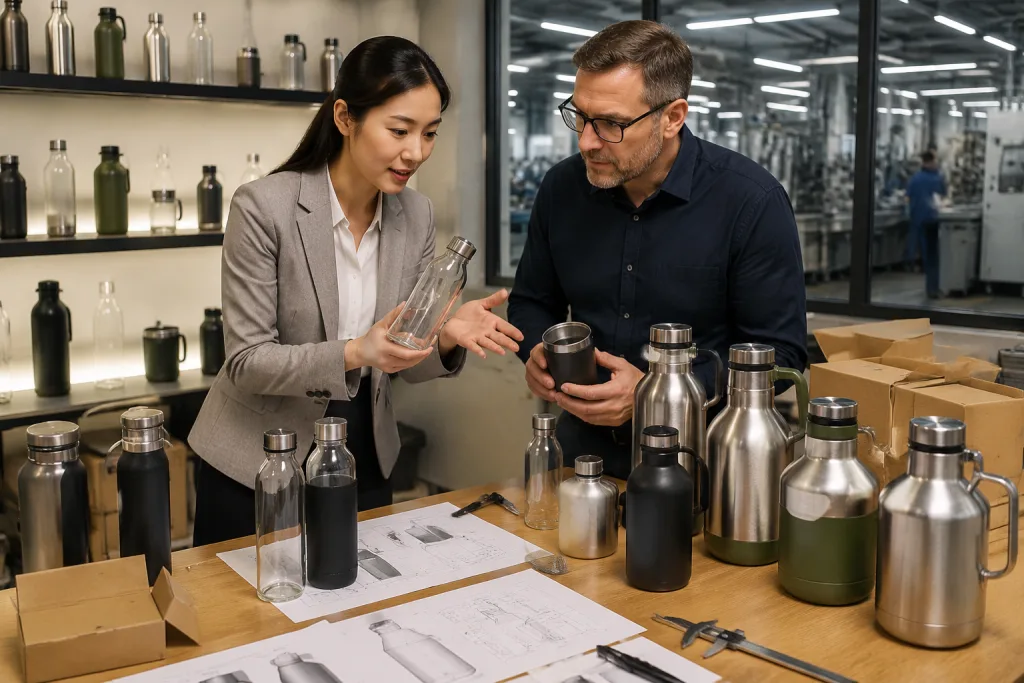
From our Zhejiang production and sourcing base, we hear the same buyer question about 4 times a week: should the range be glass, stainless steel, Tritan, or a mixed line? Wrong question to ask first. Channel decides. A spa brand and a grocery retailer do not need the same bottle; neither does a brewery, school program, or Amazon seller. Before you issue the RFQ, we would sort the project by use case, MOQ, freight cost per carton, and the complaint you can least afford after delivery.
The spec table buyers need
A top wholesale glass bottle project should start with the cost sheet, not the catalog photo. We run this check before quoting: bottle weight in grams, inner box size in mm, master carton drop-test result, and the decoration scrap rate from the last line trial. The bottle that looks cheap in a supplier PDF gets expensive after 5-layer cartons, 2% breakage allowance, and ocean freight. For procurement managers, “glass versus plastic” is the wrong question to ask. Compare shelf price, carton survival, print yield, and compliance risk.
| Option | Typical capacity | Unit FOB China | MOQ | Best use-case fit |
|---|---|---|---|---|
| Borosilicate glass bottle | 350-750 ml | USD 1.35-3.20 | 1,000-3,000 pcs | Wellness, office, premium gifting |
| Soda-lime glass bottle | 250-1,000 ml | USD 0.85-2.10 | 3,000-5,000 pcs | Retail multipacks, grocery, promo |
| Stainless steel bottle | 500-1,200 ml | USD 3.20-7.80 | 1,000-2,000 pcs | Outdoor, school, travel, sports |
| Tritan bottle | 500-1,000 ml | USD 1.60-3.80 | 2,000-5,000 pcs | Events, gyms, lightweight retail |
| Glass growler | 1 L-2 L | USD 2.20-5.60 | 1,000-3,000 pcs | Brewery, refill, hospitality |
These are working FOB ranges from China, not blank-check promises for every shape. A bamboo cap, silicone boot, powder-coated sleeve, color box, or EU-style recycled paper tube can move cost by USD 0.20-1.10 per piece. We’ve seen this go sideways when the PO says “gift box” but the buyer expects 350 gsm art paper with matte lamination; QC pulled the sample, and the carton cube jumped 14%. If you are buying bulk drinkware for a margin-sensitive channel, lock the packaging spec early. Packaging decides the math.
Glass bottle versus steel bottle
Glass sells on purity. Buyers like that it does not hold coffee taste, stays clear after 30 dishwasher cycles, and shoots cleanly for wellness, beauty, and desk-use brands. Borosilicate glass handles thermal shock better than soda-lime glass, but this is where the math gets abused. A 550 ml borosilicate bottle with 1.8-2.2 mm wall thickness still needs a real drop standard; QC pulled one sample last month after a 0.8 m corner drop cracked the base ring. If your customer packs bottles into courier cartons, gym bags, or school backpacks, choose steel.
Stainless steel is the safer wholesale drinkware choice when dents are acceptable and breakage is not. For vacuum bottles, we run 304 stainless inner wall, 201 or 304 outer wall, 0.4-0.5 mm sheet thickness, copper coating on stronger insulation models, and leak testing at 100%. The line checks each lid with a 3-minute inverted water test before packing. Steel also gives more decoration room: laser engraving for logos under 40 mm, powder coating for matte retail colors, UV print for full-color artwork, plus silkscreen or heat-transfer graphics when the buyer wants a lower unit cost.
Glass usually wins the material story and shelf look. Steel wins warranty control. For a retail buyer asking for the best wholesale drink bottle under USD 4.00 FOB, glass can look attractive on the quote sheet. For a corporate distributor promising a 12-month customer service window, steel cuts complaints; we saw one rough-use glass program go sideways when the buyer flagged 27 breakage claims from the first 1,200 pcs. We manufacture and source both from Zhejiang and nearby China supply chains, so our advice is blunt: do not force glass into a rough-use program because the rendering looks clean.
Use glass when the buyer values taste neutrality and shelf appeal. Use steel when the buyer expects the bottle to survive 500 daily commutes; ask for a drop test note on the pre-production sample report.
Growler, canteen, and flask fit
Long-tail RFQs mix names all the time. We had one PO say “growler 64 oz,” while the attached photo showed a handled canteen with a 38 mm mouth and canvas strap. Another buyer asked for alcohol flask wholesale bulk, then wanted the same test file as a water bottle. Treat these as separate product families, or the math doesn't work.
- Bulk growler: usually 1 L, 1.5 L, or 2 L glass or stainless steel, used for beer, kombucha, cold brew, refill shops, and brewery merch packs.
- Beer growler bulk: needs cap seal focus; swing-top, screw cap, or stainless lid changes the torque setting, leakage risk, and pressure claim.
- Bulk canteen: often outdoor or military-inspired, with stainless steel, aluminum, or Tritan body options plus strap, pouch, or belt clip hardware.
- Alcohol flask bulk: usually 3 oz to 8 oz stainless steel hip flask, with a flatter logo area and a different compliance path from drink bottles.
- Beer tumbler bulk: normally stainless steel, 12 oz to 20 oz, often packed with a clear plastic lid for taproom retail shelves.
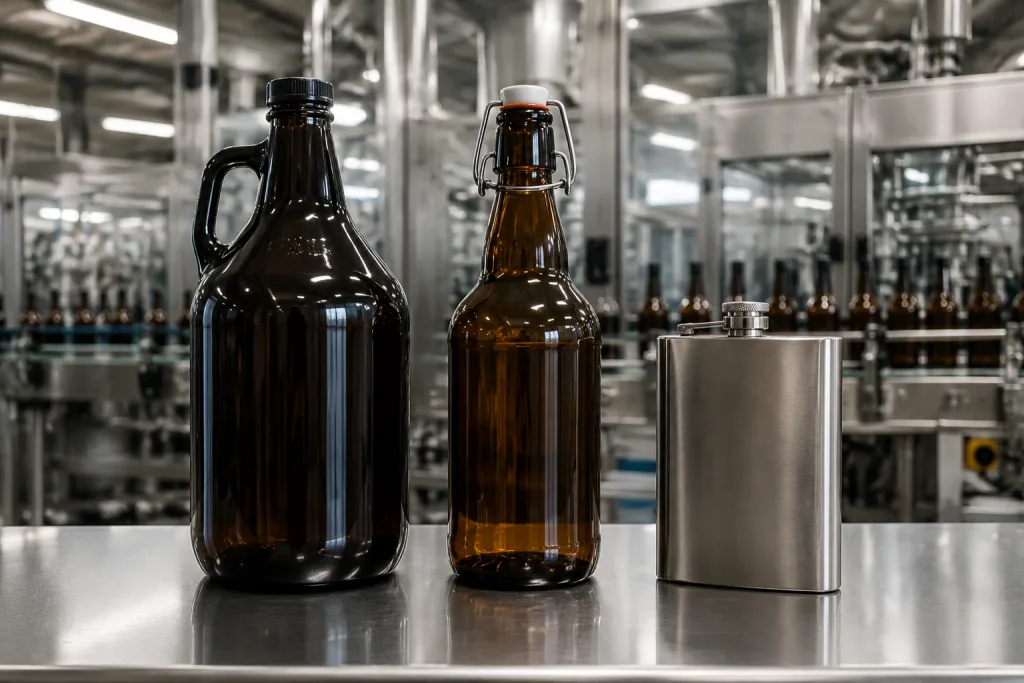
If your channel is brewery merchandise, beer growler wholesale and beer tumbler wholesale can run in one program. Glass growlers look right on a taproom shelf, but stainless growlers cut breakage when we ship 24 pcs per export carton. We’ve seen this go sideways when a buyer chose glass for outdoor event resale and QC pulled 7 cracked samples after a 76 cm drop test. If the channel is outdoor wholesale canteen or canteen wholesale, glass is the wrong core product. A canteen bulk order with straps, pouches, or carabiners needs abrasion testing and hardware checks, not only food-contact certificates.
For alcohol flask wholesale, MOQ can be lower, often 1,000 pcs for laser logo and 2,000 pcs for color coating. Short run, faster setup. On the line, we check the laser jig position within 1.5 mm because a crooked crest on a 6 oz flask is easy to spot. Do not confuse alcohol flask in bulk with children’s or daily hydration bottles. Retail labeling, capacity marking, and local sales restrictions may differ.
Decoration changes the real cost
Logo method is where 7 out of 10 drinkware wholesale quotations stop matching each other. A USD 1.80 glass bottle with one-color silkscreen is not the same offer as a USD 1.80 bottle with full-wrap UV print, silicone sleeve, and individual kraft box. Ask the factory to split bottle, cap, decoration, packaging, and testing costs line by line; last month QC pulled a sample where the PO said “black logo,” but the artwork file showed Pantone 426C. It makes negotiation cleaner.
For glass, the usual decoration choices are one-color silkscreen, decal, spray color, acid-etch look, silicone sleeve embossing, and paper insert packaging. Silkscreen works best for 1-2 colors, with a usual film/tooling cost of USD 30-80 per color, and we run it on a semi-auto screen printer with a 0.2 mm registration check. Decal handles richer artwork, but the labor cost is higher and output is slower, often 12 days vs 18 days once kiln time is counted. Spray color looks premium, but the math doesn't work if the buyer refuses adhesion testing, especially for bottles going into dishwashers.
For stainless steel drinkware bulk orders, laser engraving gives strong durability and low defect risk on powder coating. Full-color heat transfer can look sharp, but you need to accept a higher rejection rate on curved bodies; we’ve seen this go sideways on 500 ml tumblers when the seam drifted 1.5 mm. AQL should reflect this. We normally suggest AQL 2.5 for major defects and AQL 4.0 for minor defects, with 100% leak testing for bottles intended for bags.
If you are running one family across glass bottle, wholesale growler, beer tumbler wholesale bulk, and alcohol flask wholesale, keep the logo system consistent but not identical. A 35 mm front logo may work on a 750 ml bottle and look silly on a 6 oz flask. Send actual artwork before final pricing; good suppliers will ask for the AI or PDF file, cap color, print position in mm, and MOQ per SKU. Bad ones quote in 5 minutes, and the buyer flags the surprise charge after the pre-production sample.
Compliance is not one certificate
For Europe and North America, compliance changes by material and sales channel. This is where buyers ask the wrong question if they only say, “Do you have a certificate?” For a glass bottle, we usually need food-contact files for the glass body, cap liner, silicone ring, outer coating, and any straw or infuser; QC pulled one sample last year where the silicone ring was 0.6 mm thinner than the approved drawing, and the test report no longer matched the shipped part. For EU buyers, check LFGB, EU 1935/2004, REACH for restricted substances, and packaging rules. For the US, FDA food-contact suitability and California Proposition 65 screening depend on the retailer and state exposure risk.
Stainless steel bottles need 304 stainless steel confirmation, lead and cadmium testing on coatings, BPA-free statements for plastic lids, and migration tests for silicone parts. Tritan bottles need resin documents and food-contact reports that match the exact resin grade and colorant. Simple rule. Do not accept a five-year-old generic report for a new colored lid; we have seen this go sideways when a buyer changed from clear to smoky blue, then the lab asked for the color masterbatch code on the PO.
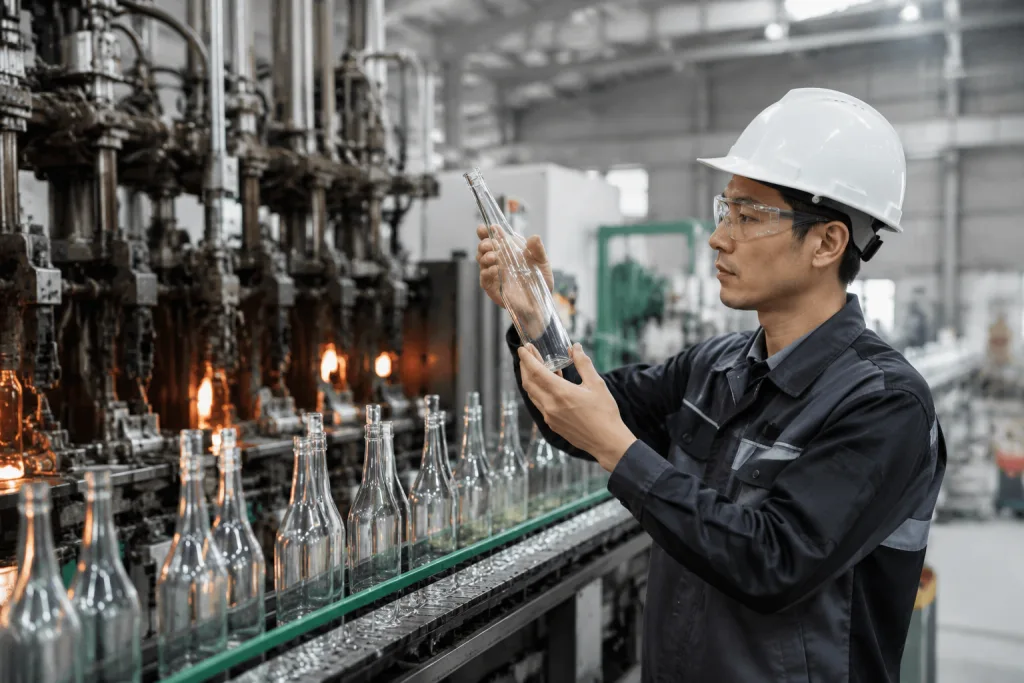
Factory audits matter too, especially for distributors selling into retail chains. BSCI, Sedex, ISO 9001, and retailer-specific audits do not replace product testing, but they lower sourcing risk when the order moves from sample room to the line. BottleForge Industrial works from Hangzhou, Zhejiang, and coordinates production with China factories that can support 80,000-150,000 units per month across glass, stainless steel, and related accessories depending on season. Normal custom drinkware lead time is 30-45 days after sample approval; for peak season, we book caps, cartons, and color powder 12-18 days earlier than off-season orders because the math does not work once kilns and coating lines are full.
For Amazon or marketplace sellers, add FNSKU labeling, carton drop test, master carton weight under 15 kg when possible, and barcode scan checks. We run the barcode scanner on the packed carton, not just the artwork file, because one buyer flagged a missing zero in the FNSKU after 320 cartons were sealed. A beautiful glass bottle that arrives with 4% breakage is not a sourcing success.
How to choose by channel
Start with the buyer’s use case, then work back to material. For a spa, yoga studio, skincare kit, or premium desk bottle, a top wholesale glass bottle with bamboo cap and silicone sleeve sells the right look; we run sleeve fit at ±0.5 mm because loose silicone gets flagged fast. For construction crews, schoolchildren, delivery drivers, or campers, glass is the wrong question to ask. Stainless steel or Tritan will survive the channel with fewer breakage claims.
For grocery and lifestyle retail, soda-lime glass works when the target shelf price matters more than thermal shock. Pack it like fragile stock: inner egg-crate dividers, 5-ply export carton, and 80 cm carton drop test for fragile SKUs. Last month QC pulled 12 cartons after one corner crush showed up on a 14.8 kg master carton. For corporate gifting, borosilicate glass gives a cleaner hand feel and a better unboxing, but budget for gift box compression testing before you sign off the artwork.
For breweries, the choice splits by route to customer. Beer growler wholesale bulk in amber glass looks traditional and keeps the craft feel, especially for taproom refills. Stainless steel growler bulk is the safer pick for outdoor events, refill clubs, and courier shipping; we have seen glass growlers go sideways when a distributor ships single units without molded pulp. Beer tumbler in bulk can pair with either, usually in 12 oz, 16 oz, or 20 oz stainless. If your distributor wants one supplier for beer growler in bulk and beer tumbler in bulk, confirm decoration consistency across glass and steel before sample approval, because laser on steel and screen print on glass will not match by accident.
For outdoor or promotional programs, wholesale canteen, canteen bulk, and bulk canteen products need real checks, not catalog photos. We test strap pull at 8 kg, lid torque with a digital torque meter, and coating abrasion after 50 dry rubs; the buyer flagged it once because the PO said “matte black” but the approved sample was satin black. For alcohol flask wholesale, focus on weld polish, cap thread smoothness, and logo position. The best wholesale drink bottle is not universal. It is the one that fits the complaint profile your channel can tolerate.
RFQ details that prevent rework
A good RFQ can fit on one page. It still needs hard data: capacity in ml, target FOB price, destination market, logo method, inner box or bulk pack, annual forecast, first order quantity, and required certificates. If the email says only “your best price for wholesale drinkware,” we quote a stripped-down anchor price, then the buyer flags the missing color box, FDA test, and 2-side logo after the PI is already typed. We saw one PO with “500ml” in the title and “550ml” in the spec table; QC pulled the sample before tooling because that 50ml gap changes the mold.
For glass bottle sourcing, give the wall thickness target in mm, cap material, silicone sleeve height, dishwasher claim, carton drop requirement, and spare lid ratio. A normal sleeve brief might say 95 mm height, 1.8 mm silicone, Pantone 7527C, packed 24 pcs per export carton. For drinkware bulk programs across several SKUs, tell the supplier which items must share the same color, logo size, and packaging style. Matching beige powder coating across a glass sleeve and a 304 stainless tumbler is not automatic; we run separate color panels, and the line can drift by 1–2 Delta E if nobody locks the standard.
For pricing, ask for MOQ at 1,000, 3,000, and 5,000 pcs. Ask whether the quote is FOB Ningbo, FOB Shanghai, or EXW Zhejiang. For 8 out of 10 China drinkware orders we ship from Hangzhou-area factories, FOB Ningbo is the cleanest routing because the truck is about 3.5 hours and the local forwarders know the bottle cartons. If you need DDP, say it on day one, but still request the FOB line; otherwise the math gets muddy when freight, duty, and product cost sit in one number.
Before mass production, approve one physical pre-production sample, not just a rendering. Check filled weight on a 0.1 g scale, lid torque with a torque tester, print alignment against the dieline, sleeve smell after 24 hours in a sealed PE bag, barcode scan, and packed carton dimensions. This is the wrong step to skip. We have seen a 2 mm logo shift pass on screen and fail on the bottle curve, which turns into 3,000 pcs of rework after shipment.
Send your glass bottle RFQ for a practical quote
Share capacity, logo, packaging, MOQ target, and destination market. We will price the realistic version, not a stripped-down catalog bait quote.
Frequently asked questions
What MOQ should I expect for a top wholesale glass bottle order?
For a standard clear glass bottle with an existing mold, MOQ is usually 1,000-3,000 pcs per logo. If you need custom color spraying, silicone sleeve color matching, bamboo cap branding, or a new box structure, expect 3,000-5,000 pcs. A new private mold can require 10,000 pcs or a mold fee from USD 1,500 to USD 8,000 depending on shape. For mixed bulk drinkware programs, we can sometimes combine glass bottles, growler wholesale items, and beer tumbler bulk SKUs in one shipment, but MOQ is still calculated by each factory line and decoration setup.
Is glass cheaper than stainless steel for wholesale drinkware?
Usually yes at the unit level, but not always after packaging and freight. A 550 ml glass bottle may quote at USD 1.35-2.60 FOB China, while a similar stainless steel single-wall bottle may be USD 2.20-4.20 and a vacuum bottle USD 3.80-7.80. Glass needs stronger cartons, inner protection, and often higher freight per sellable unit because of weight and breakage allowance. If your return cost is high, stainless steel may be cheaper over the full program. For retail shelf appeal, glass can still be the better value.
Can I source glass bottles, canteens, growlers, and flasks together?
Yes, but treat it as a coordinated sourcing project, not one identical product. Glass bottles, bulk canteen items, beer growler wholesale, beer tumbler wholesale, and alcohol flask in bulk may come from different production lines. The advantage is consistent artwork control, shared inspection planning, and combined export cartons or containers. The risk is assuming all items share the same MOQ, testing, or lead time. A practical first order might be 3,000 glass bottles, 1,000 stainless growlers, 1,000 beer tumblers, and 1,000 flasks, shipped FOB Ningbo after final inspection.
What tests should I require before shipping glass bottles?
At minimum, require food-contact testing for glass, cap, silicone, coating, and any straw or infuser that touches liquid. Add leak testing, thermal shock checks if you make hot-liquid claims, coating adhesion testing for sprayed bottles, and carton drop testing for export packaging. For inspection, AQL 2.5 major and AQL 4.0 minor is common, but fragile glass also needs packed-carton checks. If selling in Europe, ask about EU 1935/2004, LFGB where relevant, and REACH screening. For North America, request FDA-related food-contact documentation and Prop 65 review if your retailer requires it.
How long does a custom drinkware order take from China?
For existing molds, realistic timing is 7-10 days for sampling after artwork confirmation, then 30-45 days for mass production after deposit and sample approval. Sea freight to Europe or North America usually adds 25-40 days port to port, longer if you need DDP delivery or Amazon FBA preparation. Peak season before summer and Q4 gifting can add 10-20 days if caps, silicone sleeves, or color boxes are not booked early. From Zhejiang, FOB Ningbo or FOB Shanghai are both workable, but carton dimensions should be confirmed before freight quotation.