Key Takeaways
- Start with 3 product tiers: stock, semi-custom, and fully custom before discussing USD pricing
- Typical MOQ is 1,000 pcs for stock colors and 3,000 pcs for custom powder coating
- AQL 2.5/4.0 inspection is usually enough for drinkware bulk orders under 20,000 pcs
- Allow 35-50 days production after sample approval for stainless steel wholesale drinkware
Buying top wholesale drinkware is not hard because suppliers are scarce. It gets hard because 12 quotes can look fine until we check 0.45 mm vs 0.55 mm wall thickness, lid tooling fit on the caliper, carton drop-test photos, logo reject rate, and who absorbs the hit when 304 stainless jumps 6% before the line starts.
If you are sourcing from Zhejiang or another China production base, settle the buying rules before asking for prices. Pick the product family and order size first, then lock the decoration method and compliance route; last month QC pulled a sample where the PO said powder coating, but the artwork file named UV print, and that small mismatch added 5 days. We have seen this go sideways. Price first is the wrong question to ask.
Choose the product job first
Start with the job, not the material. Stainless versus plastic is the wrong question to ask at RFQ stage. A retail chain, a brewery distributor, an outdoor label, and a corporate gift buyer may all ask for bulk drinkware, but their risk is not the same. Last month QC pulled 12 samples from a mixed tumbler PO because the buyer wrote “matte black” in the email and “satin black” on the PO. Small typo. Big delay.
For outdoor and camping programs, a bulk canteen or wholesale canteen order needs a reinforced shoulder, a cap we can pressure-check on the leak tester, and powder coating that does not scratch after 300 backpack rub cycles. For beverage brands, a bulk growler or beer growler wholesale project is about fill capacity, pressure expectation, and a lid gasket that does not hold beer odor after washing. Event merchandising is different again. Beer tumbler wholesale usually gets judged on Pantone match, logo position within 1.5 mm, and whether we can ship 10,000 pieces in 12 days instead of 18.
Do not let a supplier push one catalog SKU into every channel. We’ve seen this go sideways. Ask for the construction by application: single-wall 0.5 mm stainless for low-cost promo, double-wall 304 stainless for retail, or glass inner liner only if your customers accept breakage risk. A 64 oz beer growler bulk program needs heavier cartons and a higher drop-test margin than a 20 oz travel tumbler. The math doesn’t work if the carton is built for 12 kg but the packed master carton comes out at 15.8 kg.
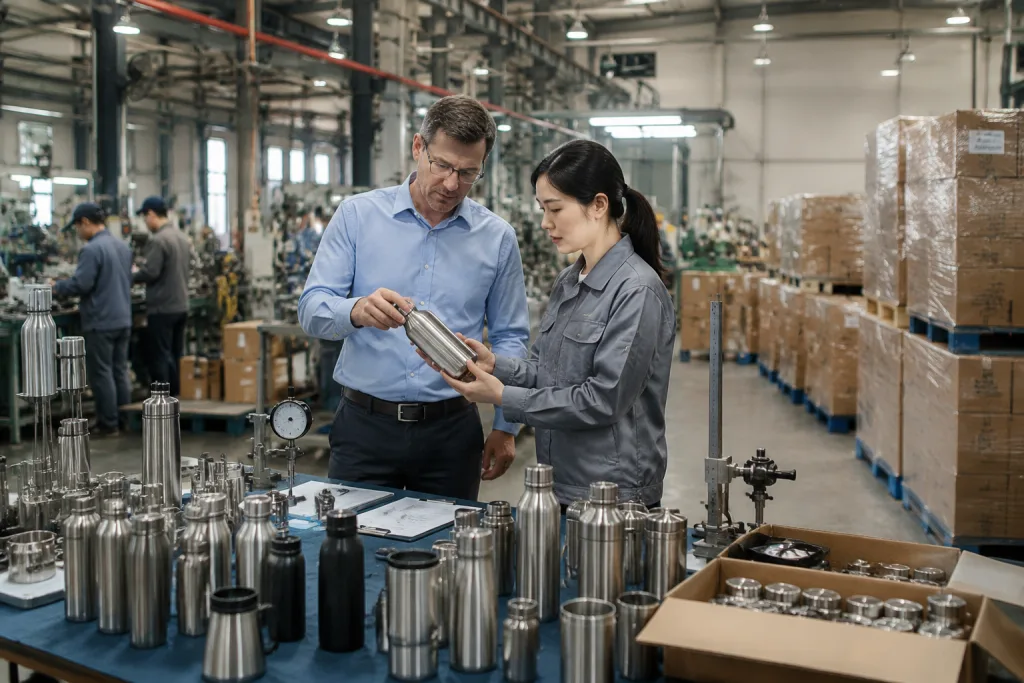
At BottleForge in Hangzhou, Zhejiang, we quote by product family because the line setup changes. Tooling, polishing, welding, and leak testing do not share the same bottleneck. We run about 450,000 stainless units/month across bottles, tumblers, growlers, and canteens, but capacity only matters when the right line is assigned to the job. On a growler run, for example, our inspector checks mouth roundness with a digital caliper before the lid fit test, not after packing.
Set MOQ against real demand
The second decision is order size. We see 7 out of 10 new buyers ask for the lowest MOQ first, then wonder why the unit price jumps. A 500 pc trial makes sense for market testing, but it rarely gives you clean wholesale drink bottle economics. The math doesn't work. Powder coating needs line wash-down and color matching against a Pantone chip; logo setup needs a laser jig and 1 approved sample; printed inner boxes need plate charges. Spread those fixed costs over 500 pcs and the quote looks ugly.
For most drinkware wholesale orders from China, we run these working numbers: 500-1,000 pcs for stock color with simple laser logo, 3,000 pcs for custom coating, 5,000 pcs for custom lid color, and 10,000 pcs or more if you want private mold changes. For canteen bulk and growler bulk programs, the realistic MOQ may be higher because caps and gasket sets often come from separate subcontracted components, and QC pulled one 64 oz growler sample last month for a 0.4 mm gasket gap at the lid seat.
There is a trade-off. Low MOQ protects your cash, but it weakens your control over color, carton, spare parts, and shipment scheduling. Higher MOQ gives better FOB pricing and more production priority, but you carry more inventory risk. If your distributor network is still unproven, split the first order into 2-3 colors rather than 8 colors. Eight colors at 500 pcs each sounds flexible; on the line, it means 8 powder changes, more masking checks, and more AQL inspection points. We've seen this go sideways.
For alcohol flask bulk orders, MOQ is usually more forgiving because the body size is smaller and polishing cycles are shorter. Still, alcohol flask wholesale bulk buyers should avoid mixing too many finishes in one PO; one buyer flagged brushed, mirror, and matte black on a 1,200 pc PO, and the polishing room lost 2 days just switching wheels and compound.
Compare construction, not catalog photos
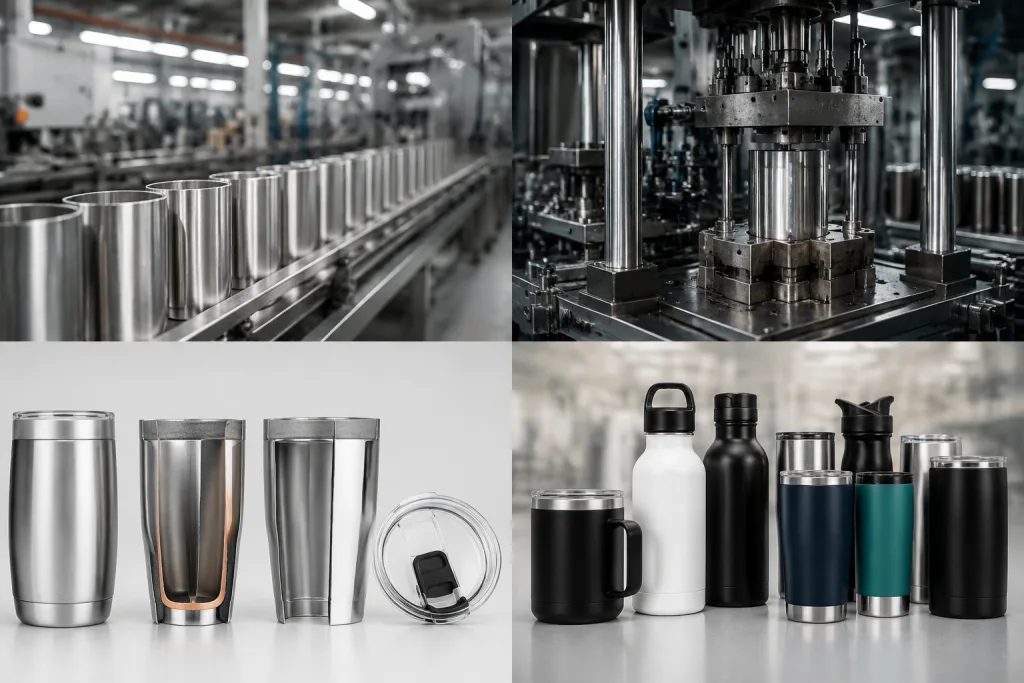
Catalog photos hide most of the cost. We have quoted two bottles that looked identical on a buyer’s PDF, then landed 15-25% apart in ex-factory price after we checked steel grade, vacuum hold, wall gauge, spray coating, and the lid bill of materials. On the line, our QC guy measures the cut shell with a 0.01 mm digital caliper before polishing; the photo will never show that.
For stainless wholesale drinkware, set 304 inner steel as the baseline. For acidic drinks, alcohol, or storage over 24 hours, 316 inner steel is safer, but the math does not work for every promotion order. A normal double-wall bottle may use 0.4-0.5 mm inner wall and 0.5-0.6 mm outer wall. Cheap versions drop below that. Then dents show up fast, and vacuum failures usually appear after carton drop tests, not during the sales call.
If you are buying beer tumbler in bulk, define the job: hold temperature for 6 hours, 12 hours, or just feel solid in hand at 280-340 g per piece. Paying for 12-hour performance on a giveaway tumbler is the wrong question to ask. If you are buying beer growler in bulk, ask whether the lid is built for carbonated beverages or only cold liquid storage. We had one buyer flag foam leakage after a 1.2 m drop test because the PO said “beer growler,” but the approved lid was a water-storage lid.
For alcohol flask wholesale, check the mouth welding and cap thread. A 6 oz flask with loose thread tolerance will leak in transit tests even when the body looks clean; QC pulled 32 pcs from one pilot run and found 5 caps with uneven bite after the torque check. For glass, Tritan, or aluminum, confirm LFGB for EU food contact, FDA for the U.S. market, REACH for chemical control, or California Proposition 65 if you sell into California. A serious Zhejiang factory will not be offended by material questions. Vague answers are a warning sign.
Decide how branding should last
The fourth decision is decoration. Brand owners often pick the best-looking mockup, then ask why the logo looks tired after 6 months in a dishwasher test. Wrong question. We check the real use first; last month QC pulled 12 scratched samples from a 500 pc pilot run because the artwork sat right on the cup’s hand-grip zone.
Laser engraving gives a neat mark and holds up well on 304 stainless steel bodies. It fits wholesale drinkware for corporate gifting and outdoor retail, where the buyer expects the logo to survive backpacks, car cup holders, and 20 wash cycles. Color is the limit. Silk screen printing costs less for one- or two-color logos, but the surface needs to be smooth within about 0.3 mm and the ink must cure properly; we run a 3M tape pull after baking. Heat transfer handles gradients, but cheap film scratches fast. Full-wrap sublimation works on coated cups, if the line controls color with a spectrophotometer instead of eyeballing it.
For beer tumbler wholesale bulk projects, we usually push laser for premium brewery merchandise and silk screen for event runs where the math is tighter. A 3,000 pc beer festival order does not need the same decoration budget as a 500 pc taproom gift box. For alcohol flask in bulk, laser engraving or debossing is safer than large printed artwork because the curved body shows every registration mistake; we have seen buyers flag a 2 mm logo drift on a 6 oz flask.
Ask the supplier for logo tolerance in millimeters, not just a nice photo from the sample room. We normally control laser logo placement within ±1.5 mm on straight-wall tumblers and ±2.0 mm on curved flasks, checked with a digital caliper on the first 10 pcs off the line. Also ask how many pre-production samples you receive. One sample is not enough if you have 5 colors and 3 decoration positions; ask for at least 6 pcs so sales, QC, and your buyer can all mark up the same version.
A practical rule: if the item is expected to last 2 years, choose the decoration like it must last 2 years. Short campaign? Save the money. We ship plenty of 30-day promo cups, but pretending a low-cost print will behave like laser is how projects go sideways.
Control quality before production starts
Quality control does not belong at the finish line. By final inspection, the factory has bought 304 stainless sheet, welded and polished bodies, sprayed powder coating, printed logos, packed 5-layer export cartons, and booked the Ningbo container slot. At that point, the math doesn't work. We run better control before the line starts, when changing a 0.3 mm rim burr or a wrong Pantone code still costs hours, not 12 days of rework.
For drinkware bulk orders, lock one golden sample and one written specification sheet before deposit. Include capacity tolerance, body weight, steel grade, coating color, logo size, lid material, gasket type, carton size, and barcode position, with numbers where possible: 500 ml capacity, ±5% tolerance, 285 g body weight, logo 42 mm wide, carton 58 x 39 x 27 cm. If you sell through retail or marketplace channels, put FNSKU or UPC placement into the packing instruction. We have seen one PO typo, “right side” instead of “front side,” hold 3,000 cartons at the warehouse gate. Small packing mistakes can delay a warehouse appointment by 7-14 days.
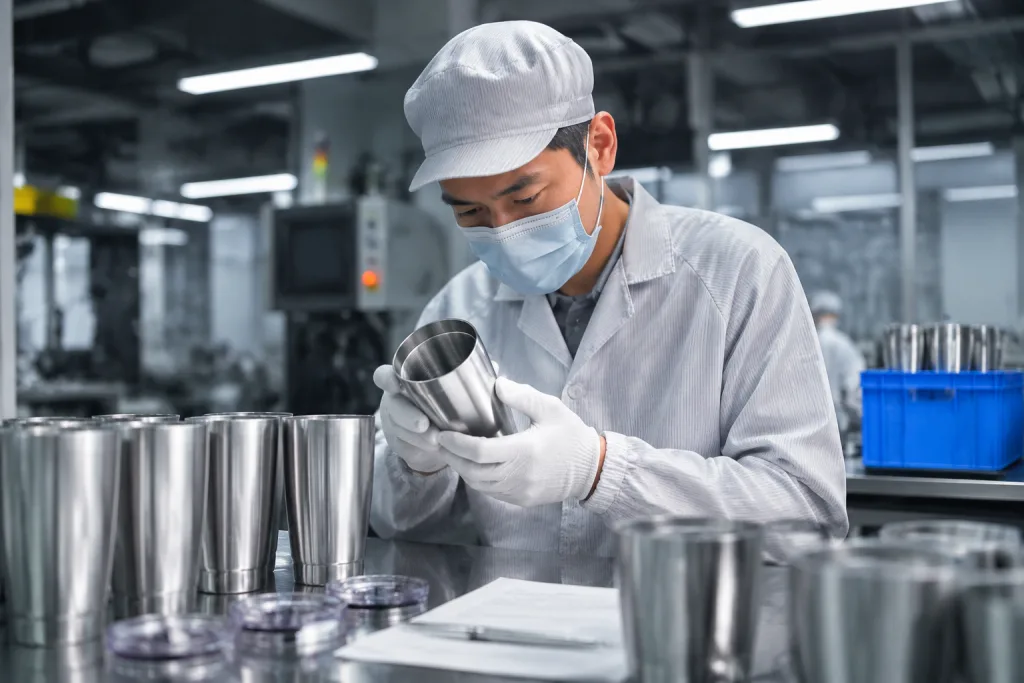
Use AQL inspection. A common standard is AQL 2.5 for major defects and 4.0 for minor defects, with critical defects set at 0. For drinkware, critical means leakage, sharp edges, contamination, wrong material, or unsafe packaging. Major defects include visible dents, poor printing, coating peel, wrong capacity, and lid mismatch. Minor defects include small cosmetic marks outside the logo area. QC pulled the sample with a 600 ml measuring cup and digital scale last month, and the buyer flagged a 22 g weight gap between two colors; that is the right time to catch it.
For wholesale growler and beer growler wholesale bulk orders, add leak testing and lid torque checks. We usually test filled samples upside down for 30 minutes and check caps with a torque meter, because a loose lid looks fine in photos and fails in the buyer's warehouse. For kids or food-contact items, add migration testing where required. If the supplier has BSCI, ISO 9001, or audited social compliance, good. Certificates help screen factories, but they do not replace batch inspection. A clean certificate from China does not guarantee your specific PO was packed correctly last Friday.
Price freight and payment together
FOB unit price is one line in landed cost, not the decision. We’ve seen buyers compare supplier A at USD 4.20 FOB Ningbo against supplier B at USD 4.05 FOB Shanghai, then miss carton cube, 2% defect allowance, 30/70 payment terms, and a 7-day coating delay. The math doesn’t work. On one PO last April, the buyer even typed “FOB Shanghai” in the header and “ship from Ningbo” in the remarks; our merchandiser caught it before the PI went out.
For a 20 oz double-wall tumbler, one export carton might hold 25 pcs and measure around 58 x 58 x 28 cm. For a 64 oz bulk growler, the carton eats more CBM, and freight can wipe out a USD 0.15 factory-price saving fast. QC pulled the packed sample once and found the supplier quoted without the inner white box, which changed the carton height by 22 mm. If you are buying beer growler bulk, ask for packed carton dimensions before you approve the quotation.
Standard payment from China is 30% deposit and 70% balance before shipment, though buyers with 6+ repeat orders may push for 30/70 after inspection or a small credit balance. Custom molds and odd Pantone colors are different. The factory has stainless bodies, powder, lids, and silicone rings tied up before the first carton is sealed, so the deposit has less room to move. We had one buyer flag this as “too strict,” but after 3,000 pcs of matte lavender coating sat on the line for 12 days, they understood the risk.
Lead time changes price too. A normal semi-custom order from our Zhejiang plant runs 35-50 days after sample approval, and we usually count from the signed PP sample, not from the first email. Urgent canteen wholesale or alcohol flask wholesale bulk orders can move faster with stock bodies and stock lids, but rushing coating and curing is where defects show up. We run 180°C curing checks on the line; skip 18 minutes there, and the tape test fails. If a supplier promises 15 days for a complex custom order in peak season, ask which step they plan to skip.
Build the supplier scorecard
After product spec, MOQ, construction, branding method, quality target, and landed cost are fixed, put suppliers into a numbered scorecard. Fast replies are nice. Pretty PDFs do not ship cartons. We run into trouble when buyers rank a factory by inbox speed instead of the 6 items that can break a launch: wrong lid fit, late mass production, weak testing, missing reports, color drift, or carton damage. On our line, QC once pulled a 600 ml tumbler sample that looked perfect in photos, then the go/no-go gauge caught a 0.4 mm lid tolerance issue.
One practical split is 25% product fit, 20% quality system, 15% price, 15% lead time, 10% communication accuracy, 10% compliance readiness, and 5% after-sales support. If you are sourcing top wholesale drinkware for a national retail program, the math does not work if you chase a USD 0.08 saving and accept weak FDA, LFGB, REACH, or ASTM support. For a short-run event order, speed and MOQ can carry more weight; we have shipped 3,000 pcs in 12 days when the buyer accepted 2 stock colors and laser logo only.
Ask every supplier the same set of questions, word for word. What is the MOQ by color? Which FOB port is quoted, Ningbo or Shanghai? How many days from approved sample to mass production, 18 days or 30 days? What AQL level is included? Can they provide FDA, LFGB, REACH, or ASTM reports if needed? How many spare lids or silicone gaskets are packed, 1% or 3%? What happens if 3% of the order fails leakage testing on the 30 kPa air-pressure tester? Small detail: we once caught a PO typo that changed “matte black” to “metal black,” and the buyer flagged it only after pre-production sample photos.
This is where experienced China sourcing gets less romantic and more useful. Cheapest is the wrong question to ask. The best partner is not always the lowest-price factory in Zhejiang, and not always the plant with 40 polishing stations. It is the supplier whose process matches your risk, sales channel, and delivery calendar. We have seen this go sideways when a brand chose a big factory for a 1,200 pcs custom color order, then waited 28 days for a line slot. A good scorecard turns wholesale drinkware from a one-off buy into a sourcing system you can repeat.
Send your drinkware brief for a factory quote
Share product type, MOQ, logo method, destination port, and compliance needs. We will return practical options with FOB pricing and lead time.
Frequently asked questions
What MOQ should I expect for top wholesale drinkware?
For stock stainless bottles or tumblers, 500-1,000 pcs is realistic if you accept existing colors and a simple laser logo. For custom powder coating, plan on 3,000 pcs per color. For private mold work, 10,000 pcs is a more honest starting point because tooling, trials, and scrap must be absorbed. Canteen bulk and growler wholesale orders may need higher MOQ when caps, handles, or silicone parts are custom. If a factory quotes 200 pcs for fully custom drinkware wholesale, check whether they are using a trading stock item rather than making it to your specification.
How do I compare bulk canteen and wholesale growler pricing?
Compare packed landed cost, not just FOB unit price. A bulk canteen may look cheaper because the body is simpler, but a wholesale growler often uses larger cartons, stronger lids, and more leak testing. Ask for steel grade, wall thickness, body weight, cap material, carton dimensions, and pcs per carton. Then calculate sea freight by cubic meter. A USD 0.20 lower FOB price can disappear if the carton cube is 18% larger. For beer growler wholesale, also confirm whether the lid is suitable for beer service or only for cold water storage.
Which logo method is best for drinkware bulk orders?
Laser engraving is usually the safest method for stainless drinkware bulk orders because it does not peel and it handles daily use well. Silk screen is cost-effective for simple one- or two-color logos, especially on event tumblers. Heat transfer is better for multi-color artwork, but you should test scratch resistance before approving mass production. For alcohol flask bulk orders, laser is normally cleaner because curved surfaces make printing harder. Ask for logo placement tolerance, curing process, and at least one pre-production sample per body color before starting a 3,000 pc run.
What certifications matter for wholesale drinkware in Europe and North America?
For Europe, ask about LFGB food-contact testing and REACH for restricted substances. For the United States, FDA food-contact expectations are common, and some buyers require California Proposition 65 screening. Kids items may need ASTM or CPSIA-related checks depending on design and age grading. Factory audits such as BSCI or ISO 9001 help assess process control, but they do not replace product testing. If you are buying beer tumbler in bulk or beer growler in bulk for alcohol-related retail, also confirm material safety for acidic beverages and long contact time.
How long does alcohol flask wholesale or beer tumbler wholesale production take?
For semi-custom alcohol flask wholesale orders using stock molds, 25-40 days after sample approval is common. Beer tumbler wholesale orders with custom powder coating usually take 35-50 days, depending on color, logo method, and order size. Add 5-10 days for sample development and 2-4 days for final inspection. Sea freight to Europe or North America can add 25-40 days port to port. If you need alcohol flask wholesale bulk or beer tumbler wholesale bulk for a fixed launch date, work backward from delivery, not from factory production time.