Key Takeaways
- Set target use, material, logo, and packaging before requesting prices; these 4 decisions drive 80% of cost variance
- A practical OEM MOQ is usually 1,000-3,000 pcs per color, while private molds start higher
- For insulated stainless bottles, check 0.4-0.6 mm wall thickness, 304 inner steel, and leak testing at 100%
- Normal lead time from Zhejiang, China is 30-45 days after artwork approval for repeatable bulk drinkware orders
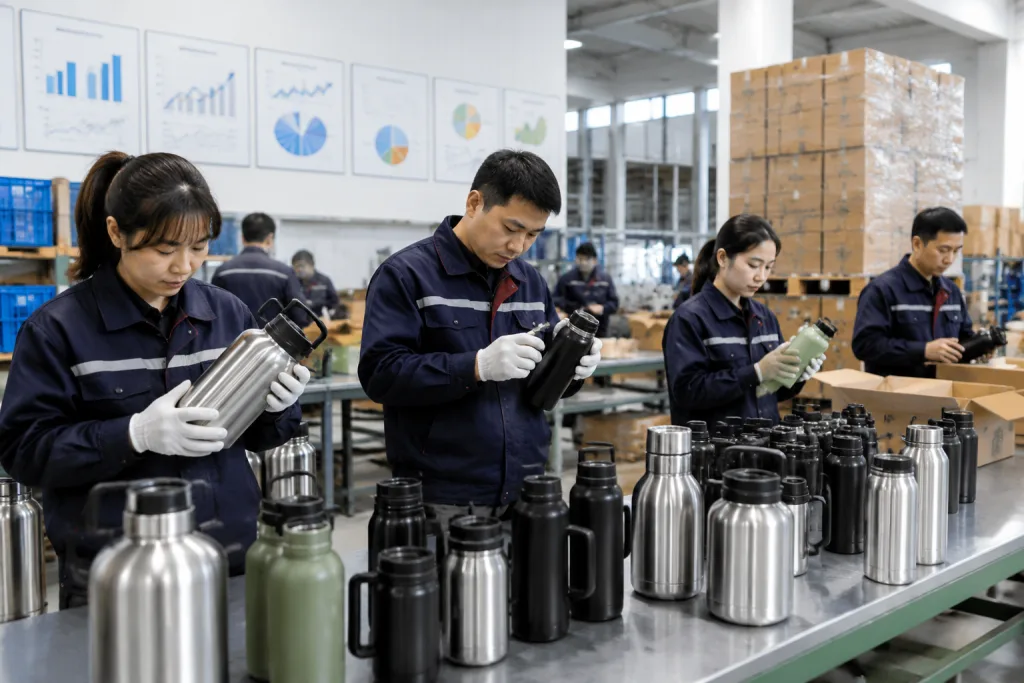
You are not buying “a bottle.” You are locking a product system: 304 stainless thickness, vacuum hold time, powder-coat adhesion, logo method, carton burst strength, compliance file, and a factory line that can repeat it 30,000 times without drama. We check this with a wall-thickness gauge and a 24-hour hot-water test before mass run. This is where 7 out of 10 wholesale drinkware projects lose money. A low unit price means little if the lid leaks, the coating chips after a 3M tape pull, or the master carton fails a 76 cm drop test before Q4 delivery.
From our Hangzhou, Zhejiang production base, we see the same sourcing mistake about 15 times a month: buyers ask for the top wholesale drink bottle before defining “top” for their channel. Wrong question. Retail shelf needs clean finishing and barcode discipline; corporate gifting cares more about logo position and gift-box corners. Outdoor distribution, alcohol promotion, and Amazon FBA each push the spec in a different direction. Last week QC pulled a sample because the PO said matte black, but the approved sample was PMS Black 6C with a soft-touch finish. China can make these bottles well, but the purchase brief has to be tight.
Start With The Buying Decision
The first decision is not capacity or color. It is the selling job the bottle must do. A top wholesale drink bottle for a gym retail line is not the same order as a wholesale canteen for outdoor clubs, a beer growler wholesale program for breweries, or alcohol flask wholesale bulk for a spirits promotion. We see this on the quote desk every week: 2 buyers ask for “500 ml bottle, black, logo,” then QC pulls a sample and the lid, box, and barcode needs are all different. Define the sales channel first. The quote comes back cleaner, and the line avoids rework.
I would build the brief around four buying choices. Start with drinking use: cold water needs ice-friendly mouth size, hot coffee needs a sealed sip lid, beer needs growler pressure checks, and kids’ bottles need simpler parts. Then lock the material and safety standard: 304 stainless steel, 316 stainless for premium saltwater use, borosilicate glass, Tritan, PP, or food-grade silicone parts. Next, choose the branding level with real production detail: stock item with laser logo, custom powder color, full-wrap print, or private mold. Last, write the logistics clearly on the PO: master carton only, retail box, barcode, FNSKU, palletization, or direct-to-warehouse delivery. One buyer once typed “FNSK” on the PO, and our packing team stopped 38 cartons before labeling. Good catch.
The trade-off is simple. Stock drinkware wholesale ships faster and costs less, but the shelf look is easier to copy. A private lid, custom shape, or special coating can build margin, but it adds tooling cost, sampling time, and MOQ. For a first purchase, I usually push buyers toward one proven body shape with serious branding before paying for a mold. The math often does not work on custom tooling until the second order. We have seen this go sideways when a buyer spends 18 days chasing a new lid sample, while a stock mold with laser logo could have been approved in 12 days.
At BottleForge Industrial in Zhejiang, our standard monthly capacity is about 450,000 stainless drinkware units, with typical MOQ at 1,000 pcs per color for stock molds and 3,000 pcs per color for custom powder coating. That scale helps, but it will not fix a loose brief. On the factory floor, we run coating color checks under a D65 light box and measure logo position in mm before packing. If the buying decision is clear, we ship smoother.
Choose The Right Product Family
The drinkware family decides the line we run, the tests QC books, and the price band. Ask for drinkware bulk without naming the family and you get 28 rows of pricing that look tidy on Excel but fail in a real comparison. We had one PO last March that mixed a 750 ml single-wall sports bottle, a 1.9 L bulk growler, and a slim 12 oz beer tumbler bulk order on one RFQ; the buyer flagged the “same material, same price?” note, and the math didn’t work.
Sports bottles are sold on gram weight, lid action, grip feel, and color matching; we check the grip ribs with a 0.02 mm caliper because one soft-touch mold came out shallow by 0.4 mm. They fit fitness brands, schools, and corporate wellness programs. Travel tumblers need cup-holder fit, leak testing, and heat retention data; a 73 mm bottom diameter passes in most car holders, while 78 mm already gets pushback from U.S. promo buyers. Canteens need stronger carry loops and better dent resistance; canteen wholesale buyers should ask about body gauge and cap thread durability, not just the logo area. Growlers sit in another lane. A beer growler in bulk order needs pressure awareness, odor control, easy cleaning, and a cap that survives 500 open-close cycles without chewing up the silicone ring.
For alcohol-related lines, write the spec tightly. Alcohol flask bulk, alcohol flask in bulk, and alcohol flask wholesale orders often use 304 stainless at 5 oz, 6 oz, or 8 oz capacities, with mirror polish, brushed finish, PU sleeve, or gift box. If the flask ships with funnels or cups, list every accessory in the bill of materials; QC pulled one sample where the funnel was 18 g lighter than the approved sample, and the gift box insert no longer held it in place. For beer growler wholesale bulk, 32 oz and 64 oz are the common sizes, but wall thickness and cap seal quality beat capacity in the first 10 minutes of inspection.
Do not chase the best wholesale drink bottle as a universal SKU. Wrong question. Pick the product family that matches your channel’s repeat purchase behavior. Distributors usually need dependable replenishment, so we ship the same lid color and carton mark every 30 days without drama. Brand owners usually need a visible difference, maybe a new powder coat, a custom strap, or a private mold lid. Procurement teams need both, but the weighting changes by project; we have seen this go sideways when a 3,000 pcs trial order was treated like a 50,000 pcs annual program.
Materials Decide Price And Risk
Material choice is where cheap quotes hide problems. For stainless vacuum bottles, the normal spec is 304 stainless steel on the inner wall and 201 or 304 on the outer wall. Premium programs run 304/304 or 316 inner steel. On wholesale drinkware orders, we see about 7 out of 10 buyers accept 304 inner and 201 outer when the powder coating passes cross-cut tape test and the bottle is not going near salt air. For coffee, tea, and beer, I push for 304 inner at minimum. The buyer once flagged a 201 inner sample after 48 hours with hot tea; the smell test failed before the lab report came back.
Wall thickness should be written on the PO, not guessed. Most insulated bottles use 0.4-0.5 mm stainless sheet. Large growler bulk projects often need 0.5-0.6 mm to cut dent claims, especially when the packed carton is over 14 kg. Single-wall bottles can be lighter, but 0.28 mm bodies feel cheap and buckle during carton compression. Bad math. For plastic lids, ask whether the material is PP, Tritan, ABS, or PC, and make the factory mark it on the BOM. For Europe and North America, vague “food grade” claims without test reports do not pass our QC desk.
Your compliance file should match the market. For Europe, buyers commonly ask for LFGB, EU 1935/2004, REACH, and sometimes BPA-free declarations. For the United States, ask for FDA food-contact compliance, California Proposition 65 screening where relevant, and ASTM or CPSIA checks for children’s items. If you are ordering kids bottles, do not treat them like adult promotional drinkware. This is the wrong place to save USD 0.08. QC pulled a straw-lid sample last month because the silicone straw slipped out under a 2 kg pull test.
China factories can give solid compliance support, but the requirement must be priced from day one. A quote without third-party testing is not the same quote as one including SGS, TÜV, Intertek, or BV testing. For a new drinkware bulk project, budget USD 250-800 per test group depending on materials, colors, and market scope. We usually add 5-7 working days for sample testing before bulk approval; skipping that step can turn a 12-day sample stage into an 18-day argument after the buyer’s lab rejects the shipment. We’ve seen this go sideways.
Branding Changes The Whole Quote
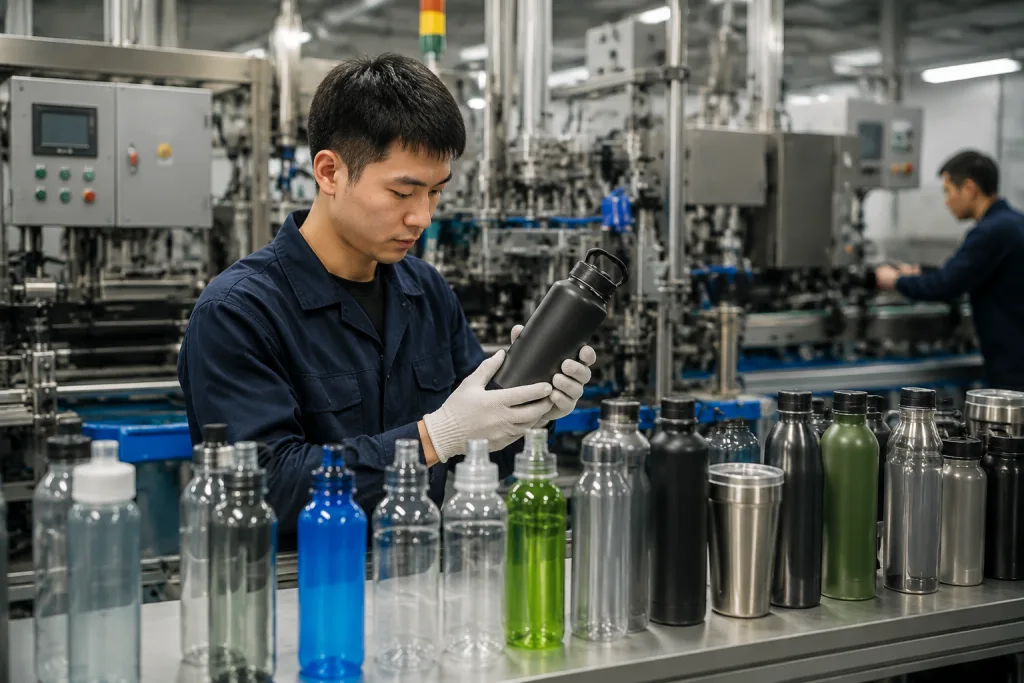
Logo method is not decoration after the quote; it changes the manufacturing route. Laser engraving runs clean on 304 stainless and survives dishwasher claims better than print, usually adding USD 0.08-0.25 per unit depending on logo size and positioning. Silk screen printing is cheaper for a one-color mark, roughly USD 0.05-0.18 per unit, but the line still checks ink adhesion, body curve, and curing time under the UV tunnel. Heat transfer gives stronger shelf color; full-wrap printing needs tighter artwork control. QC pulled one 20 oz sample last month because a 0.6 mm logo line filled in after coating.
Powder coating is common for top wholesale drink bottle programs because it gives better hand feel and deeper color than basic spray paint. The trade-off is MOQ. A custom powder color often starts at 3,000 pcs per color because the coating line loses powder during cleaning and setup. We normally see 45-60 minutes of booth cleaning when switching from black to a light cream color, and the math doesn't work on a 1,000 pcs trial order. Use existing factory colors first, then spend budget on logo placement or retail packaging.
For canteen bulk and wholesale growler orders, the branding area gets squeezed by curves, handles, ribs, and caps. A logo that looks sharp on a flat PDF can stretch on a 64 oz body, especially near the shoulder radius. Ask for a 1:1 artwork layout and a pre-production sample; we print the layout on clear film and wrap it around the bottle before opening the screen. For beer tumbler wholesale bulk, check whether the logo faces the drinker or the gift-box window. Small detail. The buyer flagged it on a 2,400 pcs gift set because the logo faced the barcode side in the box.
Private mold is the expensive branding choice. A custom lid may cost USD 1,500-5,000 in tooling. A new bottle body can cost USD 8,000-25,000 depending on shape, mold cavities, and testing. We run DFM checks with wall thickness in mm before cutting steel, because one bad thread fit can delay shipment 12 days vs 18 days after rework starts. Private tooling makes sense when repeat orders are above 20,000-50,000 units per year. If you are still guessing at color demand, this is the wrong question to ask.
Check Factory Control Before Price
A cheap FOB looks good on a spreadsheet, but it means nothing if the factory cannot repeat the same bottle in the second container. For bulk drinkware, ask how the mill cert for incoming steel is checked, how the vacuum station logs insulation results, and where leak-test records are kept. At our Zhejiang facility, we run 100% leak testing on vacuum bottles, then QC pulls insulation samples before packing. Standard export orders follow AQL 2.5 for major defects and AQL 4.0 for minor defects unless the buyer writes tighter limits on the PO. We have seen one buyer flag a 304 stainless clause because the PO had “304 stainess” typed wrong. Small typo. Big argument.
For stainless insulated bottles, use a simple heat test: fill with hot water at 95°C, then measure after 6 hours or 12 hours based on the claim printed on the box. “Keeps hot 24 hours” is the wrong question to ask unless the test condition is written down. A 500 ml bottle and a 1.9 L beer growler bulk item will not hold temperature the same way. The line checks mouth diameter with a caliper, and a 42 mm mouth behaves differently from a narrow-mouth travel bottle. Lid structure, vacuum quality, and room temperature change the number fast.
Surface defects need photos and limit samples, not loose wording like “nice finish.” Powder coating can show pinholes, orange peel, dust marks, color variance, or adhesion failure, so we keep approved panels beside the coating line. For adhesion, a cross-hatch tape test is a common check; QC uses a 1 mm cutter and 3M tape, then records the pull result. For printing, alcohol rub or dry-cloth rub catches weak curing before cartons are sealed. For cartons, ask for 5-ply export cartons if the order is heavy, especially for canteen wholesale or growler wholesale shipments. A 64 oz stainless growler will punish weak cartons, and we have seen corners crush after one 18 kg drop-stack test.
Audits matter, just not in the way some buyers expect. BSCI, Sedex, ISO 9001, or a buyer’s own social compliance audit will not turn a bad bottle into a good one, but they lower operational risk before the deposit is paid. If your retailer requires a current audit, tell the factory before sampling. We ship audit documents with the sample file when asked, including the expiry date, because this has gone sideways before. Retrofitting compliance after price negotiation usually burns 14 days, and the math does not work when the promotion date is already fixed.

Understand MOQ And Landed Cost
MOQ is not a trick number. We calculate it from 304 stainless coil buying, powder coating line setup, laser logo jig setup, carton printing, and the weekly production board. For stock wholesale drinkware, 500 pcs can work for a one-position logo if the buyer accepts our existing body color; 1,000 pcs gives the line less stop-start loss. For custom color drinkware bulk, 3,000 pcs per color is the safer floor because one powder booth changeover takes 45-60 minutes and QC pulled samples will still need shade checks under a D65 light box. For private mold projects, expect 5,000-10,000 pcs initial production, depending on the product.
Unit price must be read with Incoterms. FOB Ningbo or FOB Shanghai is common for Zhejiang and nearby China production. EXW looks cheaper on a quote sheet, then your team owns the truck from Hangzhou, export declaration, and local handling fees. DDP is easy for small importers, but the freight and duty math sits inside the supplier’s margin. Compare FOB first. Then calculate freight, duty, customs brokerage, insurance, warehouse handling, and expected defect allowance; we had one buyer flag a USD 0.26 gap that disappeared after brokerage and pallet fees were added.
Here is a practical price sense, not a promise. A basic 500 ml stainless sports bottle with logo may fall around USD 2.20-4.50 FOB depending on finish and lid. A 20 oz insulated tumbler may sit around USD 3.20-6.80. A 64 oz stainless wholesale growler may run USD 7.50-14.00. Alcohol flask wholesale items can range from USD 1.20-3.80 depending on gift set and finish. Beer tumbler in bulk programs often land between USD 2.80-6.50. Last month our caliper check found a 0.18 mm wall difference between two “same price” samples, so this is the wrong question to ask if the quote does not list steel grade, coating, lid material, and carton spec.
The cheapest quotation often cuts something you need: 304 stainless, a 5-layer export carton, retail barcode label, color consistency, or inspection time. Ask suppliers to itemize options. A USD 0.12 stronger carton or USD 0.18 better lid seal can protect the whole shipment. We’ve seen this go sideways when a PO said “white box” but the artwork file showed color box; QC caught it before packing, and the buyer still lost 3 days approving the fix.
Sampling To Delivery Timeline
A real timeline starts after artwork approval, not after the first “Hi, please quote” email. Stock sample with laser logo: 5-7 days if the logo file is clean. We run the fiber laser only after checking the AI file size and logo position in mm; one buyer once sent a PO with “mat black” instead of “matte black,” and QC held the sample for 2 days. Custom color sampling usually needs 10-15 days because the powder coating has to be matched, sprayed, baked, and checked under a light box. New mold work is a different case: prototype and tooling can take 25-45 days before mass production starts. If a supplier says one week for everything, that is the wrong promise to trust. Ask what step is being skipped.
After sample approval, mass production for wholesale drinkware usually takes 30-45 days in China. Peak season, audit requirements, complicated packaging, or multiple colors can push that to 50-60 days; we have seen 6-color orders lose 4 days just on line changeover and oven cleaning. Sea freight to the US West Coast may take roughly 18-28 days port-to-port, while Europe often takes 30-40 days depending on route. Add customs and warehouse receiving time. A retail launch should not be planned on vessel ETA alone. The math does not work when the buyer books ads for Monday and the container is still waiting for CFS release on Friday.
Pre-shipment inspection should happen when at least 80% of goods are packed and 100% are produced. QC pulled the sample from a packed carton, not from the showroom shelf; that is where you find real problems like scuffed powder coating, loose straw brushes, or a 14.8 kg carton marked as 12 kg. For Amazon-style delivery, confirm FNSKU labels, carton labels, suffocation warnings for polybags, carton weight limits, and pallet specs. For distributors, confirm spare lids, inner carton quantities, and mixed SKU packing. Beer growler wholesale and beer tumbler wholesale orders often need stronger retail packaging because gift buyers punish dented boxes.
The cleanest projects use one decision sheet: SKU and capacity, steel grade and finish, logo method and artwork size, packaging, test standard, AQL level, barcode, Incoterm, shipment date, and inspection party. Send that sheet with your RFQ. We ship cleaner orders when the buyer locks these points before deposit; otherwise the line waits while sales, packing, and QC argue over which version of the carton mark is final. You will get fewer vague answers, and the factory will know you are buying professionally.
Send your drinkware brief for a factory quote
Share capacity, material, logo, packaging, MOQ, and destination. We will return practical FOB options, lead time, and sampling steps.
Frequently asked questions
What MOQ should I expect for a top wholesale drink bottle order?
For a stock stainless bottle with one logo, expect 1,000 pcs per SKU as a practical MOQ, though some factories may accept 500 pcs with a higher unit price. Custom powder coating usually starts around 3,000 pcs per color because the coating line has setup loss. Private mold orders are different: 5,000-10,000 pcs is more realistic for the first run. If you need 12 colors at 300 pcs each, do not force a custom program. Use existing colors, reduce SKU count, or accept a surcharge. MOQ is not only about bottle bodies; lids, cartons, inserts, silicone parts, and printed packaging all have their own minimums.
How do I compare quotes from different drinkware wholesale suppliers?
Put every quote into the same format: capacity, material grade, wall thickness, lid material, finish, logo method, packaging, test reports, MOQ, lead time, and Incoterm. A USD 3.10 FOB quote and a USD 2.85 EXW quote are not equal. Also check whether the supplier includes pre-production sampling, carton printing, barcode labels, and third-party testing. For stainless vacuum bottles, ask if the inner wall is 304 stainless and whether leak testing is 100%. For bulk drinkware, a clean comparison sheet usually exposes why one price is lower: thinner steel, cheaper lid, weaker carton, or no compliance testing.
What is the best product type for canteen wholesale programs?
For canteen wholesale, start with the user environment. Outdoor and worksite buyers usually need 750 ml, 1 L, or 1.2 L sizes with a strong carry handle, dent-resistant body, and reliable cap tether. If the product will be clipped to bags, test the loop and hinge at least 3,000 open-close cycles. For canteen bulk orders, 304 stainless inner wall is a safe baseline, and 0.5 mm body thickness is better than ultra-light construction. If the canteen is for promotional giveaways, stock colors with laser logo keep cost under control. For retail, custom powder coating and a printed box improve shelf value.
Are growlers and beer tumblers handled like normal bottles?
No. Growler wholesale and beer tumbler wholesale projects need different checks. A 64 oz beer growler bulk order needs stronger caps, good odor control, easy cleaning, and thicker cartons because each unit is heavy. If the growler is used for carbonated beer, clarify the intended pressure conditions and do not assume every lid is suitable. Beer tumbler in bulk orders need attention to rim comfort, coating adhesion, and cup-holder fit if used at events. For beer growler wholesale bulk or beer tumbler wholesale bulk, I would request pre-shipment inspection plus carton drop testing, especially for gift-box packaging.
How long does a custom wholesale drinkware project take from China?
For a stock mold with custom logo, plan 5-7 days for sample preparation and 30-45 days for mass production after approval. Add sea freight time: roughly 18-28 days to the US West Coast and 30-40 days to many European ports. Custom powder coating can add 5-10 days during sampling. Private mold projects may add 25-45 days before mass production. From Zhejiang, China, a well-managed repeat order can ship faster, but first orders need time for artwork, compliance review, packaging confirmation, and inspection booking. For a retail launch, build a 10-14 day buffer.