Key Takeaways
- For an 8,000-unit 750 ml stainless canteen order, expect 35-45 days after artwork and deposit approval
- A realistic MOQ for custom drinkware is 1,000-3,000 units per color, depending on finish and lid tooling
- Use AQL 2.5 for major defects and 4.0 for minor defects on promotional water bottle inspections
- FOB Ningbo or Shanghai pricing is only useful after you lock capacity, wall thickness, coating, and logo method
You have a spring campaign, 8,000 units to buy, and three people pushing different targets: marketing wants a bottle that feels premium, finance wants the lowest FOB China price, and logistics wants cartons that will not wreck the freight budget. This is where 6 out of 10 top promotional water bottles projects start to slip; last month the buyer flagged a 42 × 32 × 28 cm carton plan because the CBM math killed their landed cost.
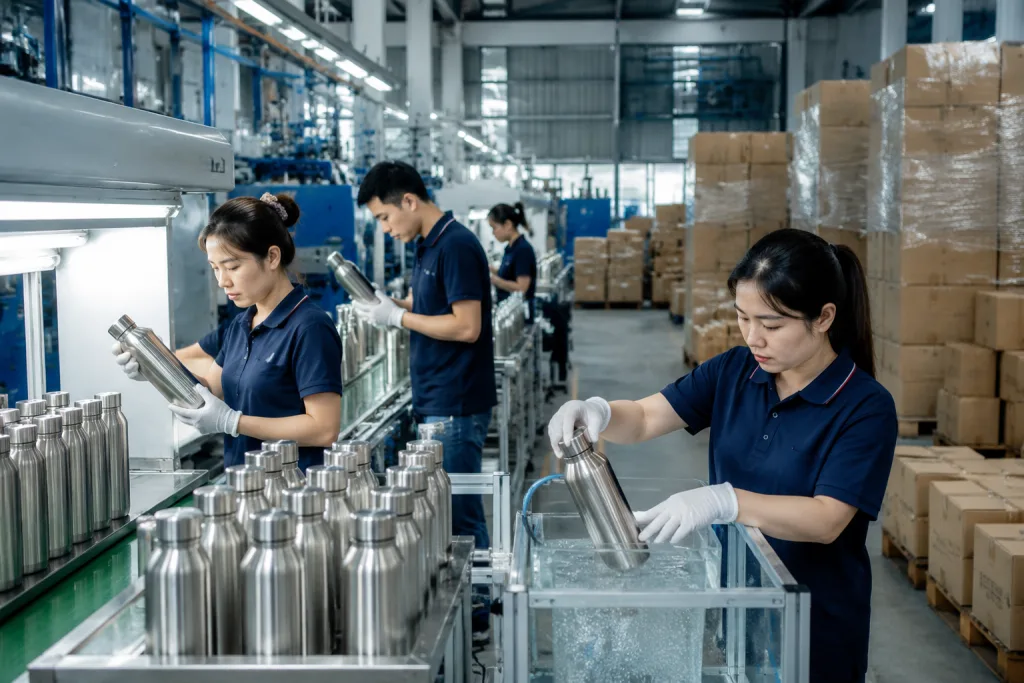
Use one real order as the reference point: a 750 ml stainless canteen customized for a European outdoor retailer, from RFQ to shipment. We manufacture in Hangzhou, Zhejiang, and we run this type of job on the line every week, so the view is practical: what a canteen factory asks first, where buyers lose 12 days vs 18 days, and which QC checks catch trouble before China export cartons leave the dock. QC pulled the sample with a digital caliper, checked the 0.5 mm logo position shift, and stopped the approval before the wrong artwork went into mass printing.
Start with the campaign brief
The brief usually lands too loose: “premium outdoor bottle, matte green, logo, good price.” We can’t quote that cleanly. Before asking canteen manufacturers for FOB pricing, turn the campaign idea into items the factory can measure: capacity, steel grade, lid material, coating, logo process, carton pack, and target delivery week. Last month QC pulled a matte sample because the buyer’s “green” meant Pantone 5535 C, while the PO only said dark green.
For this order, the working spec is a 750 ml single-wall stainless steel canteen promotional bottle with a food-grade 18/8 stainless steel body, PP lid, silicone gasket, powder-coated exterior, and one-position logo. The retail campaign value sits at USD 12-15, but the landed promotional budget is closer to USD 4.20 per unit. The math is tight. FOB China should land around USD 2.20-2.80, depending on whether you choose an OPP bag, white box, or printed kraft box, and whether the forwarder is quoting 12 days vs 18 days on the water.
Capacity matters more than buyers think. A 500 ml bottle is cheaper and packs better, but outdoor promotions in Europe and North America usually ask for 650-900 ml; we see 750 ml flagged on about 6 of every 10 RFQs for trail, gym, and campus campaigns. A custom canteen at 750 ml gives enough shelf value without pushing carton weight too high. For stainless single-wall construction, a common body wall thickness is 0.5 mm; dropping to 0.4 mm saves cost, but we’ve seen this go sideways when warehouse teams stack 14 kg cartons and the lower row gets dent marks.
At BottleForge Industrial in Zhejiang, our normal MOQ for this type of customized drinkware is 2,000 units per color, with monthly capacity around 450,000 stainless bottles across standard models. If you need four colors at 1,000 units each, say it early. Some canteen vendors will take it, but the unit price may rise by USD 0.12-0.25 because coating line changeovers are not free; the line needs powder cleanout, gun adjustment, and a first-piece check with a film thickness gauge before we run bulk.
Choose the bottle architecture first
Pick the bottle body before anyone opens the logo file. We see buyers jump to Pantone chips and lid colors, then QC pulls the sample and it is the wrong fit for the crowd. For top promotional water bottles, “nice or cheap” is the wrong question to ask. First choose single-wall, double-wall, or growler-style capacity; that one call changes weight, carton cube, testing, and landed cost.
A single-wall stainless canteen is our usual pick for mass promo runs of 3,000 to 20,000 pcs. It is lighter, cheaper to run on the line, and simpler in drop testing because there is no vacuum layer to collapse. A double-wall vacuum bottle feels premium and holds temperature, but we have seen the FOB price move from USD 2.40 to USD 4.80 on a similar 750 ml shape after adding vacuum, copper lining, and a tighter lid spec. A custom growler or customized growler works for breweries and outdoor clubs; the math changes fast at 1.2 L or 1.9 L, with bigger cartons, higher lid torque, more leak complaints, and freight cost that buyers often forget until the forwarder sends the CBM.
For this buyer, I would not push a customizable growler. The campaign is an outdoor membership giveaway, so a 750 ml canteen customizable in two colors wins. It gives enough print area for a clean 55 mm logo, fits bike bottle cages only sometimes, and still works for hiking and campus use. We’ve seen this go sideways when a buyer insists on a 1.9 L growler, then flags that the carton is too heavy for event staff at 18 kg.
- Body material: SUS304 / 18/8 stainless steel for food contact; we run incoming wall-thickness checks with a digital caliper before forming.
- Exterior: matte powder coating, 60-80 micron typical coating thickness; QC checks adhesion with a cross-cut tape test on pre-production samples.
- Lid: screw lid with silicone gasket, tested for leakage after 24 hours inverted; the buyer should approve torque feel, not just the lid color.
- Packaging: individual white box or kraft box, 24 units per export carton; confirm barcode placement because one PO typo once put the FNSKU on the short side.
A good canteen manufacturer should flag regulatory needs before the deposit lands. For Europe, ask about LFGB, REACH, and food contact declarations. For the United States, ask about FDA food contact compliance and California Proposition 65 risk review if applicable. Certificates are not wall art; ask whether the exact SUS304 batch, silicone gasket, powder coating, and ink system are covered.
Quote like an engineer
Send the RFQ like you expect the factory to build from it. “Please quote 8,000 custom bottles with logo” is not enough. We see that line about 6 times a month, and the quote always comes back padded because the sales engineer has to guess the coating, carton, logo size, and inspection level. Give canteen suppliers the same spec sheet so procurement gets three prices that can actually be compared. This is the wrong place to save 10 minutes; one missing line on a PO once turned “matte black” into “black PMS 6C gloss” before QC pulled the pre-production sample.
For this buyer scenario, write it out: 8,000 units total, 4,000 matte forest green and 4,000 matte black, 750 ml capacity, single-wall SUS304 body, powder coating, one-color silkscreen logo at 45 x 60 mm, individual kraft box, 24 pieces per master carton, FOB Ningbo, target ship date, and requested AQL level. If you need Amazon prep, FNSKU labels, suffocation warnings, or carton routing labels, put them in the RFQ now. We run those labels through a Zebra printer on the packing line, and a missing FNSKU file can hold 320 cartons in the warehouse for 2-3 days after bottles are finished. Distributor drinkware orders go sideways when FBA or retailer label rules arrive after production has started.
At this volume, a realistic FOB Ningbo quote might be USD 2.35-2.75 per unit for a standard mold, depending on steel thickness, lid choice, coating, and packaging. Ask the factory to state the body thickness in mm; 0.45 mm and 0.50 mm do not feel the same in hand, and the math changes fast across 8,000 pcs. Laser engraving may add USD 0.18-0.35 per unit. Full-wrap heat transfer can add USD 0.40-0.80 and needs tighter artwork control, especially at the seam where our line checks overlap with a 0.2 mm feeler gauge. A custom mold lid or new body shape can require USD 1,200-5,000 in tooling and 20-30 extra days.
Cheap quotes usually hide one of four things: thinner steel, weak coating, light packaging, or no real inspection plan.
If you are a canteen distributor or distributor canteen buyer, ask the factory to separate costs: bottle, decoration, packaging, inner carton, export carton, and any test fees. That breakdown protects your margin when your own customer changes the brief late. We had a buyer flag a kraft box upgrade after deposit; with separate costing, we changed only the box line item by USD 0.16 instead of reopening the whole quote. Clean numbers save arguments.
Approve samples without rushing
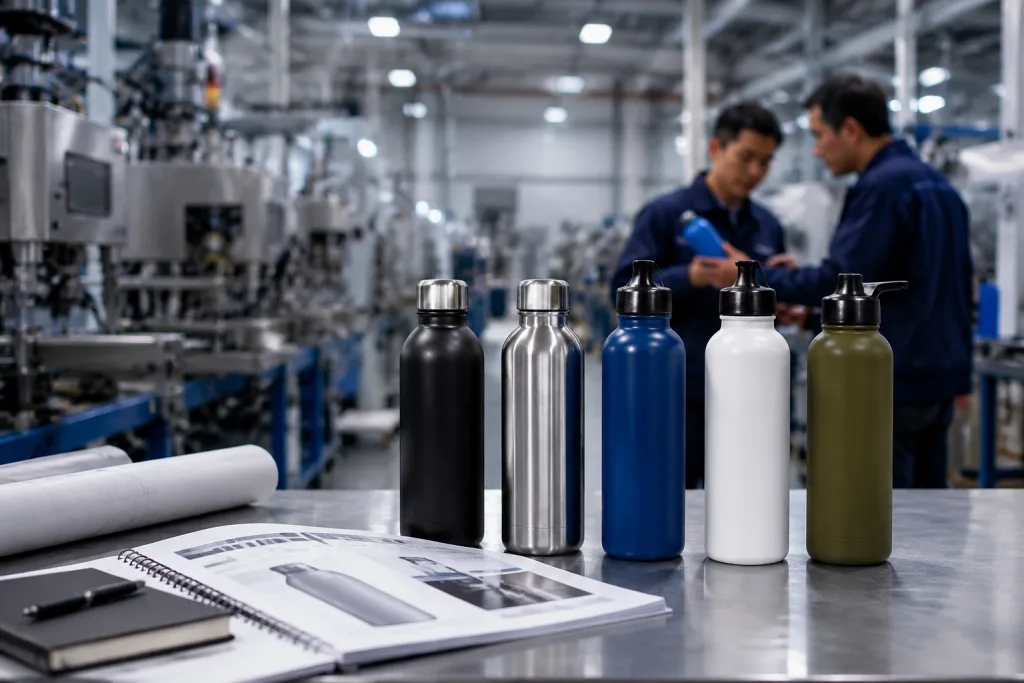
Sampling is where the project stops being a PDF and starts costing money. For a canteen customized with your logo, we run two sample stages: one existing blank sample for hand feel, lid fit, and weld quality; one pre-production sample with final color and branding. Skipping that second sample saves maybe 7 days. The math doesn't work if QC later opens cartons and finds 8,000 wrong bottles.
For this order, the buyer receives two blank samples in 5 days by courier from Zhejiang, China. They put them on a 0.1 g digital scale, fill to the 750 ml mark, twist the lid 20 times, rub the rim with a cotton pad, and check wobble on a glass plate. The bottle weighs 178 g without packaging, which is acceptable for the target. QC pulled the sample from the line, then the buyer approves a pre-production sample using matte forest green coating and silkscreen logo.
Color approval needs discipline. “Looks close” under office lighting is the wrong standard. Use a Pantone reference, then allow a practical tolerance because powder coating on stainless is not paper printing. A Delta E target below 2.0 is tight; for promotional drinkware, about 7 of 10 buyers accept Delta E 3.0-4.0 if the color stays stable across the batch. If your brand color is strict, tell the canteen factory before we hang bodies on the coating rack, not after 3,000 pcs are sprayed.
Logo size needs a production reality check too. On a curved 750 ml canteen, a 70 mm wide logo may distort or wrap awkwardly when the screen frame sits on the body. A 45-55 mm width is safer for silkscreen. For laser, fine lines below 0.2 mm can disappear or look dirty after engraving; we once had a buyer flag the registered trademark symbol because it filled in at 0.15 mm. Good canteen manufacturers push back here. That is not being difficult; it is avoiding a complaint later.
Lock production controls early
After the pre-production sample is signed off, we lock the control file. A solid canteen manufacturer should issue one production file covering material spec, approved artwork, Pantone or coating reference, packaging drawings, carton marks, inspection standard, and shipment terms. We print that file at the line leader’s desk and attach the golden sample tag; if the details live only in six email threads, the math doesn't work. One typo on a PO, such as “mat black” instead of “matte black,” can turn into 8,000 wrong bottles.
For the 8,000-unit order, we run production for 40 days after deposit and sample approval. The first 7-10 days go to material preparation and bottle forming, including incoming sheet checks with a 0.01 mm caliper. Coating and curing take another week when the spray line is not overloaded. Then come printing, assembly, leak testing, packing, and final inspection. Zhejiang factories usually ship from Ningbo or Shanghai; for this order FOB Ningbo is cleaner because the truck from Hangzhou is about 2.5 hours instead of a full-day Shanghai run when traffic is bad.
Ask how the factory controls the gasket. Boring question. Still, it is where we have seen promotional orders go sideways. A loose or uneven silicone ring creates leak complaints, and buyers do not care that the bottle body passed. We run 100% visual gasket check during assembly, then QC pulls random inverted leak tests on the inspection table. For a promotional order, we normally test at least 80-125 units during final QC depending on lot size and AQL sampling plan, with any critical leak defect treated as a fail.
Packaging needs the same early lock. A 24-piece carton for 750 ml stainless bottles may measure around 49 x 33 x 29 cm and weigh 6-7.5 kg gross, depending on box and bottle weight. If your warehouse uses automated sorting, confirm carton burst strength before mass packing; one US buyer flagged crushed corners after a conveyor drop test at 760 mm. A 5-ply export carton is safer than thin 3-ply for North American distribution, since a canteen distributor may reship the same order to 12 regional customers.
Inspect before the balance payment
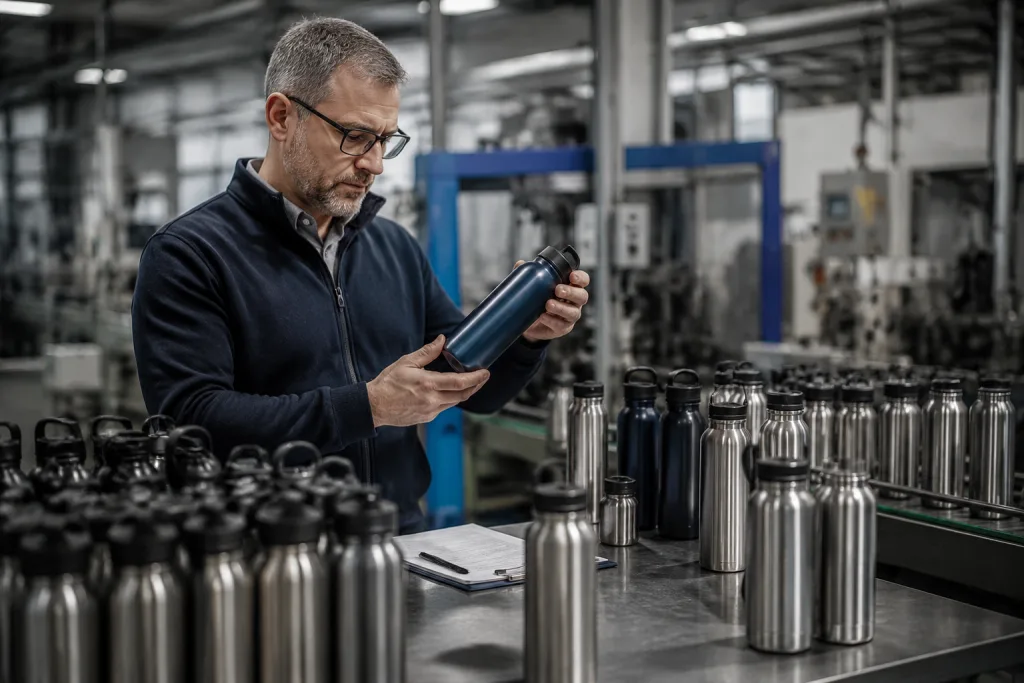
Run final inspection after 100% production is finished and at least 80% of cartons are packed. Don’t inspect early just because ETD is getting tight. This is the wrong question to ask. If QC only sees loose bottles on the line, they cannot check the 45 x 32 x 28 cm master carton, FNSKU or EAN barcode stickers, inner polybag direction, or pallet stacking height. We’ve seen this go sideways when a buyer approved bottles on Tuesday, then flagged mixed carton marks after the balance payment.
For this order, use ANSI/ASQ Z1.4 single sampling, normal inspection, general level II. At 8,000 units, that often means a sample size of 200 pieces. Set AQL 0 for critical defects, 2.5 for major defects, and 4.0 for minor defects. Critical defects mean sharp mouth rims found by a cotton swab check, black dust inside the bottle, leakage after 30 minutes inverted, wrong material, or unsafe packing. Major defects cover logo position off by more than 2 mm, coating peel, deep dents, missing silicone gasket, or failed capacity tolerance. Minor defects are small print specks under 0.5 mm, slight color shade shift against the approved Pantone chip, or light carton scuffing that does not affect selling.
Basic QC checks should cover capacity fill test with a graduated cylinder, lid torque feel by hand and torque meter where agreed, inverted leak test, cross-hatch adhesion test on coating, rub test for printing, barcode scan if retail labels are used, and carton drop test if the packaging is new. For powder coating, we run a 3M tape adhesion check after cross-hatch cutting; weak curing shows up fast when the tape lifts paint squares. For silkscreen, 50 dry-cloth rubs and 20 alcohol rubs are a practical screen, but the pass line must match the signed sample and PO standard. QC pulled the sample last month and found the logo survived dry rubs but blurred after 12 alcohol rubs.
If inspection fails, don’t argue by email for 2 days. Ask for defect photos, defect counts, and a corrective action plan with sorting manpower. Sorting 8,000 units usually takes 1-2 days with 6 workers at two tables. Reprinting or recoating can take 5-10 days, and the math doesn’t work if the vessel cutoff is tomorrow afternoon. A good canteen supplier in China will give the real delay, not promise “tomorow” on the PI typo and then miss the vessel.
Ship with fewer surprises
Once inspection passes, balance payment and shipment booking move fast. For FOB Ningbo, we run export customs and deliver to the port warehouse or terminal based on the forwarder’s SO. Before the truck leaves Hangzhou, check the commercial invoice, packing list, HS code, carton count, gross weight, net weight, and shipping marks. Sounds basic. Last month QC pulled a passed lot where the PO said “matte black,” but the carton mark file had “matt black,” and the buyer flagged it before Ningbo receiving scanned the labels.
The 8,000-unit order packs into roughly 334 cartons at 24 pieces per carton. If each carton is about 0.047 cubic meters, total volume is around 15.7 CBM before palletizing. Pallets protect corners during forklift handling, but the math changes fast: 15.7 CBM floor-loaded can become 18.2 CBM on pallets, depending on carton height and pallet pattern. For Europe, untreated wood packaging must follow ISPM 15. For North America, your distributor drinkware customer may push for floor-loaded cartons to cut freight. We get the request. If the carton is only 5-ply and under 8 kg burst strength, we’ve seen this go sideways with crushed bottom rows.
Plan spare parts early. For canteen promotional orders, 1% spare lids and gaskets are cheap insurance, especially for distributors who handle end-user complaints after delivery. On an 8,000-unit run, that means 80 spare lids and 80 gasket sets, packed in a marked inner carton so the warehouse does not treat them as overage. If the buyer is building a long-term distributor growler or custom canteen program, we recommend locking spare lid compatibility for at least 12 months. Changing lid molds every season is the wrong place to save tooling cost; after-sales calls cost more.
The best shipment is boring: approved sample matches bulk goods, cartons scan correctly, port documents line up, and the campaign launches on time. That does not happen because a canteen vendor says “trust us.” It happens because you specify the bottle, freeze the artwork, inspect with AQL, and treat custom drinkware like a manufactured product rather than a giveaway trinket. On our line, QC checks the first 20 packed cartons against the master carton label before sealing the batch, because one wrong SKU sticker can hold a container for 2 days vs 20 minutes at the warehouse gate.
Send your bottle spec before you request quotes
We will review capacity, logo method, MOQ, packaging, and QC points before your next custom drinkware order moves into production.
Frequently asked questions
What MOQ should I expect for top promotional water bottles?
For standard stainless promotional water bottles, a practical MOQ is usually 1,000-3,000 units per color. At BottleForge Industrial in Zhejiang, many standard custom canteen models start at 2,000 units per color for powder coating and logo printing. If you accept existing body colors and use laser engraving, some projects can run lower, but the unit cost rises. For a new lid, new body shape, or special coating, expect higher MOQ and tooling charges. Buyers often ask for 500 units, but setup time, coating loss, printing alignment, and export packing make that inefficient for most China factories.
Which logo method is best for customized drinkware?
For a 750 ml stainless canteen, silkscreen is usually the best balance for one- or two-color promotional logos. It is clean, affordable, and works well when the logo is under about 55 mm wide on a curved surface. Laser engraving costs more, often USD 0.18-0.35 per unit extra, but it is durable and looks better on matte coating. Heat transfer is useful for full-color graphics, but it adds cost and needs stricter QC for wrinkles and edge lifting. For large orders, approve a real pre-production sample instead of judging from a digital mockup.
How long does a custom canteen order take from China?
For a standard canteen customized with logo and color, plan 35-45 days for production after deposit, artwork approval, and pre-production sample approval. Sampling usually takes 5-10 days for blank samples and 7-12 days for decorated samples, excluding courier time. Ocean freight to Europe or North America can add 25-45 days depending on port and season. If you need a custom growler mold, special lid, or new packaging structure, add 20-30 days before mass production. The safest buying calendar is 90 days from RFQ to warehouse arrival.
What should I check during factory QC?
Use AQL inspection instead of only checking photos. For an 8,000-unit order, general level II often samples 200 pieces. Set AQL 0 for critical defects, 2.5 for major defects, and 4.0 for minor defects. Check capacity, leakage, gasket presence, coating adhesion, logo position, print rub resistance, carton marks, barcode scanning, and packaging strength. For stainless bottles, also check sharp rims, dents, odor, contamination, and lid thread smoothness. If the order is for retail or distributor drinkware, verify carton labels and inner box artwork before paying the balance.
How do I compare canteen suppliers fairly?
Give every canteen supplier the same RFQ: capacity, material grade, wall thickness, lid type, coating, logo method, packaging, quantity by color, inspection standard, Incoterm, and destination requirement. A USD 0.20 cheaper quote may simply use 0.4 mm steel instead of 0.5 mm, thinner cartons, or no reliable coating test. Ask for FOB Ningbo or FOB Shanghai pricing, sample lead time, production lead time, monthly capacity, audit status such as BSCI if needed, and food-contact documents for your market. Comparable quotes start with comparable specifications.