Key Takeaways
- A 500-750 ml stainless bottle is usually the safest top promotional water bottle for MOQ 1,000-3,000 pcs
- Double-wall vacuum items cost more but protect perceived value above USD 4.20 FOB China
- Canteen customized projects need cap, strap, and coating checks because accessories cause many AQL failures
- For Europe and North America, plan 25-35 days production after artwork approval and sample sign-off
You do not need the cheapest bottle. You need the top promotional water bottle that fits your sales channel, budget, logo size, and ship date. We see this go sideways about 6 times a month: the buyer chases a USD 0.08 saving, then QC pulled the sample and found a cap leak at 45° tilt, a 38 mm logo panel that cannot hold the artwork, or a 5-layer export carton failing the 1.2 m drop test 18 days before ETD.
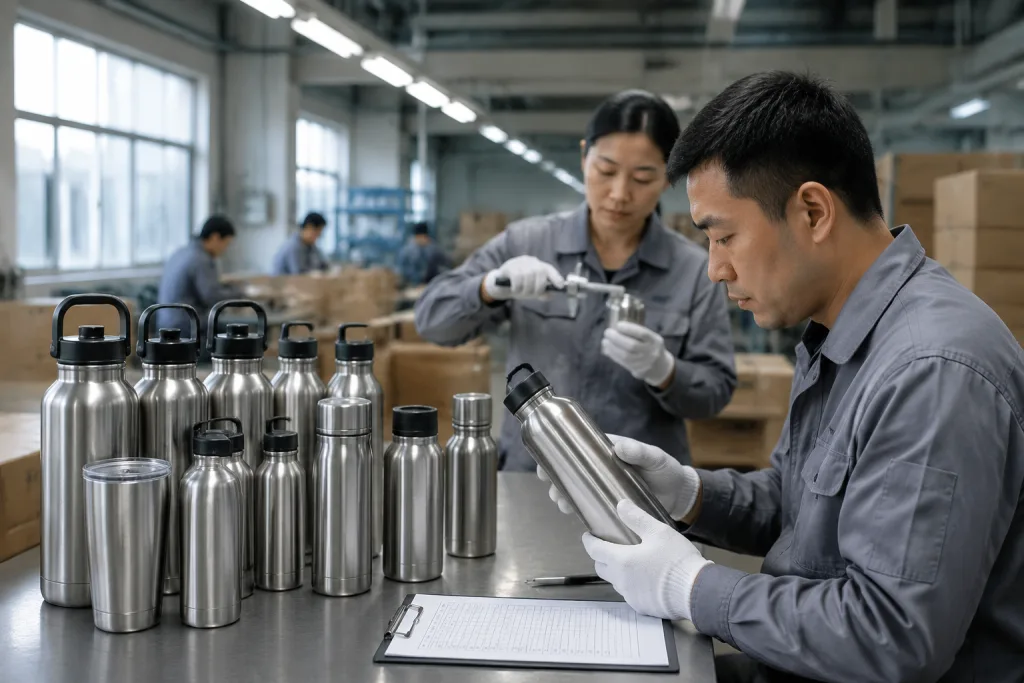
From our Hangzhou, Zhejiang production base, we run this choice every week: custom canteen, sports bottle, travel tumbler, or custom growler. All four can sell. All four can be the wrong pick. The math doesn't work if a 750 ml sports bottle is packed for a premium retail shelf, or if a powder-coated tumbler is ordered with artwork that needs 0.2 mm line detail. The practical call depends on liquid type, target retail price, print process, compliance market, and whether you buy as a brand owner, canteen distributor, or corporate gift supplier.
The head-to-head spec table
If you are choosing the top promotional water bottle for a campaign, start with the product format, not the catalog photo. This is the wrong question to ask first. A bottle can look sharp in a PDF and still fail a distributor program with gym users, office staff, and school buyers mixed in one order. Before we quote molds, powder colors, or logo method, we put this table in front of the buyer; last month QC pulled a 750 ml sample because the lid thread measured 0.35 mm loose on the go/no-go gauge.
| Format | Typical capacity | Material | FOB China range | Best use-case fit |
|---|---|---|---|---|
| Single-wall sports bottle | 600-900 ml | 304 stainless or Tritan | USD 1.80-3.20 | Mass events, gyms, school campaigns |
| Vacuum bottle | 500-750 ml | 304/316 stainless | USD 3.80-6.80 | Corporate gifts, retail shelves, employee kits |
| Custom canteen | 600-1,200 ml | 304 stainless, aluminum, or PP | USD 2.40-5.90 | Outdoor, military-style, youth camps, lifestyle brands |
| Travel tumbler | 350-600 ml | Double-wall stainless | USD 4.20-7.50 | Commuter, coffee, office programs |
| Customizable growler | 1.2-1.9 L | 304 stainless | USD 8.50-15.00 | Breweries, outdoor retail, premium loyalty gifts |
Our Zhejiang factory runs about 420,000 stainless drinkware units per month, with standard MOQ at 1,000 pcs per color for existing molds and 3,000 pcs when you need a new powder-coated Pantone color. Capacity is not a vanity number. We have seen orders go sideways when a canteen supplier says yes to 600 pcs, then parks the job for 18 days because a 40,000 pcs retail run owns the welding line and powder room.
For broad promotional use, a 500 ml to 750 ml vacuum bottle usually wins. The math works. For a canteen promotional campaign, the canteen custom shape makes sense when the brief says outdoor, scout, camping, or field sales; we check strap rivets with a 5 kg pull test before packing. For a brewery or high-ticket retail bundle, a customized growler feels heavier in the hand and carries more value, but we ship it only after better carton drop protection and tighter leak testing, because one wet master carton gets flagged fast by the buyer.
When canteens beat standard bottles
A canteen is not an old bottle with a strap. For B2B custom drinkware, it gives the buyer a shape they can spot from 3 meters away on a retail peg or event table. A round or kidney-shaped canteen with a 25 mm woven strap, matte military green powder coat, and laser logo usually looks more planned than another straight cylinder. We see canteen distributors ask for this style in camping, charity trek, national park, and youth organization programs; one buyer flagged our first artwork because the strap color was closer to olive 5743C than the Pantone 5605C on the PO.
The trade-off is parts count. A canteen customizable project may include a metal body, threaded cap, silicone gasket, polyester strap, buckle, and sometimes a cup attachment, so QC has more places to catch trouble. At AQL 2.5 for major defects and AQL 4.0 for minor defects, the defects we pull are often not on the bottle body. They are in 7 mm uneven strap stitching, loose rivets after a 5 kg pull test, cap color mismatch, or gasket deformation found when QC pulled the sample from the third carton.
If you are a canteen vendor selling to corporate buyers, keep the specification conservative. This is the wrong question to ask: “How many accessories can we add?” A 750 ml 304 stainless single-wall canteen with 0.5 mm body thickness, screw cap, and one-color silkscreen logo is easier to run on the line than a gift set with cup, pouch, compass buckle, and custom carabiner. If the end user needs cold retention, move to double-wall vacuum construction, but expect weight to increase by 80-140 g and FOB cost to rise by roughly USD 1.60-2.40 per unit; we ship those in stronger 5-layer cartons because dent claims go sideways fast.
Aluminum canteens can look good on price, sometimes under USD 2.50 FOB at 3,000 pcs, but they need an internal food-grade coating and tighter impact control. The math does not work if the buyer saves USD 0.30 and then fails incoming inspection over coating scratches inside the neck. For Europe, check LFGB or relevant food contact documentation. For North America, confirm FDA food contact compliance and, where applicable, California Proposition 65 review; last season we saw one PO typo list “FDG” instead of FDA, and that small mistake delayed document approval by 2 days.
Where tumblers and growlers win
A travel tumbler beats a canteen when the brief is coffee at 8:30, car commuting, and desk use after lunch. Better hand feel in a 74 mm car cup holder. Bigger logo face too; on a 500 ml vacuum tumbler we usually get a clean 55 x 70 mm print area, while a curved canteen shoulder makes the artwork fight the shape. For a customized drinkware program aimed at employees, SaaS renewals, bank clients, or trade show VIPs, the 500 ml vacuum tumbler with a sliding lid often gets used 5 days a week. QC pulled one sample last month after the buyer flagged the logo sitting 3 mm too low near the taper. Small issue, but it changes how premium the gift feels.
The main risk is lid performance. A press-fit coffee lid is not a leakproof bottle lid, and this is where we have seen projects go sideways. Procurement sometimes writes “no leak” on the PO and then selects a tumbler with an open drinking slot. The math does not work. If the item goes into backpacks, use a screw lid with a silicone seal and run inverted leak testing for at least 30 minutes; we run 10 pcs from the pilot lot before bulk packing. If the item is for desks and cars, “spill-resistant” is the honest wording. Put that wording on the purchase order, not only in the email thread.
A custom growler or customizable growler wins for a different buyer. It is not a mass giveaway. A 1.9 L stainless growler with double-wall insulation, 0.6 mm outer wall, swing cap or screw cap, and laser engraving can sit at USD 10-15 FOB China before freight. That price works for breweries, outdoor stores, club memberships, and premium distributor growler programs where the unit is sold or gifted to a known customer. It fails as a 20,000 pcs low-budget conference handout. We had one PO typo come through as “1.9 ml” instead of “1.9 L”; the line caught it during artwork approval because the carton spec showed 12.8 kg gross weight.
Growlers also need stronger packaging. A standard 5-layer export carton may pass for pallet shipments, but inner egg-crate dividers or molded pulp trays cut dent claims when cartons move through courier hubs. We recommend carton drop testing from 76 cm for retail-style shipments and random leak testing after packing; our usual check is 8 pcs per carton batch after the swing caps are torqued. For Amazon or marketplace distribution, add FNSKU labeling and carton weight control before production starts. Do not leave it to the last 2 days, because relabeling 600 cartons on the warehouse floor is slow, messy, and easy to get wrong.
Logo methods change the winner
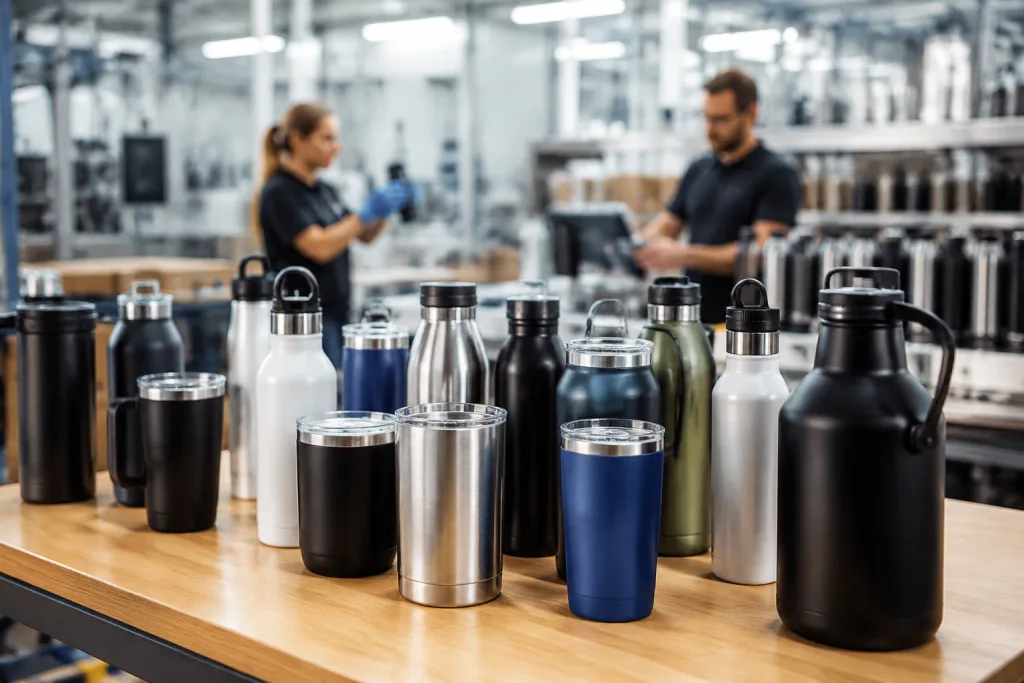
The top promotional water bottle is often decided on the logo table, not by the bottle shape. If the artwork is one bold mark, we run laser engraving on powder-coated 304 stainless because it is clean, durable, and easy to repeat across a 3,000 pcs order. If the file has four-color artwork, gradients, or campaign graphics, heat transfer or UV printing is usually the better call. For buyers chasing the lowest landed cost at 5,000 pcs, one-color silkscreen still works, but the math breaks if the logo wraps too close to the shoulder radius.
Here is the practical split. Laser engraving normally adds USD 0.20-0.45 per unit depending on logo size and location; last month QC pulled a 38 mm logo sample because the mark sat 6 mm too high under the cap line. One-color silkscreen can be USD 0.08-0.18 per position at volume, but curved canteen bodies need a tighter jig than straight tumblers. UV printing gives strong detail, often USD 0.35-0.80 per unit, but abrasion resistance must be tested on the final coating with a 3M tape pull and a 500-cycle rub test. Do not approve decoration based only on a flat metal swatch.
For canteen manufacturers, the logo area is where we see projects go sideways. A rounded canteen body may leave a 45 mm safe print window while a straight bottle gives 70 mm, even when both bottles look similar in the catalog. Straps, caps, and welded seams can block the logo position; the buyer flagged this once after the PO typo said “front center” but the mockup showed “front lower.” Ask your canteen manufacturer for a 1:1 dieline showing maximum print size, orientation, and distance from curved edges. A good canteen factory sends this before sampling, not after your sales team has sold the design to the customer.
For premium customized canteen and customized growler work, laser engraving is usually safer than large-area print because it survives handling, dish racks, and retail display better. We have seen a 64 oz growler print pass the first photo check, then fail after cartons rubbed during a 12-day warehouse hold before shipment. For colorful school or event programs, silkscreen is still the practical answer. Pick the wrong decoration method and a solid bottle turns into a complaint file.
Compliance and inspection are not optional
European and North American buyers should put compliance into the spec sheet on day 1, not chase it after the PO is signed. For stainless bottles, we usually run 304 stainless on the inner wall, with 201 or 304 on the outer wall when the buyer is fighting for a lower FOB. A 500 ml vacuum bottle might use 0.40 mm inner steel and 0.50 mm outer steel, checked with a digital thickness gauge at incoming QC. For acidic drinks or premium retail, 316 inner stainless is an option. The math does not work for most water bottle programs.
For Europe, ask for food contact testing aligned with LFGB or EU 1935/2004 expectations, plus REACH screening for powder coating, silicone rings, plastic lids, and printed logos. For North America, ask for FDA food contact statements, ASTM-related physical safety checks where relevant, and Prop 65 review if the bottles ship into California. Kids' bottles need tighter control: small parts, coating adhesion, lead/cadmium limits. QC pulled one 350 ml straw-lid sample last year because the silicone plug came loose after 50 open-close cycles on the test bench.
Factory audits matter, but do not treat them like a magic stamp. BSCI, Sedex, ISO 9001, or similar systems do not guarantee a clean shipment, but they show whether the supplier can repeat the same process across 3,000 cartons. A canteen supplier with no inspection records, no incoming material checks, and no retained samples is still a risk even if the price is 8% lower. We have seen this go sideways: the buyer flagged rust dots on 27 pcs from a trial order, and the factory had no steel coil batch record to trace.
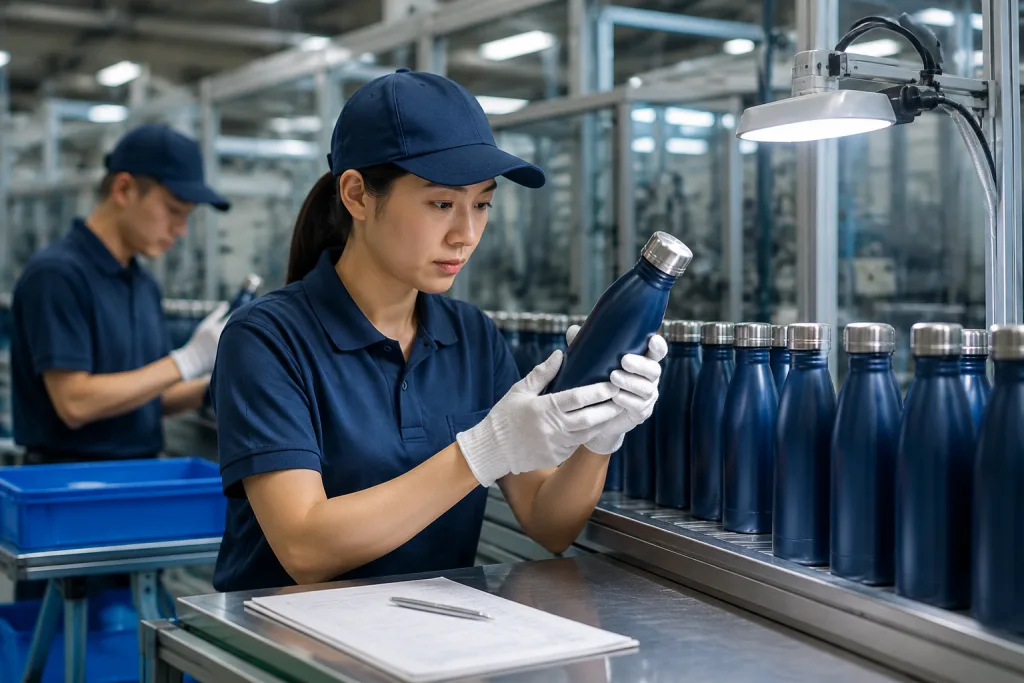
Use pre-shipment inspection with clear checkpoints: capacity tolerance, wall thickness, vacuum retention, coating adhesion, print registration, cap torque, leak test, barcode scan, carton marking, and AQL sampling. For vacuum bottles, we test insulation using hot water at 95°C and check temperature drop over 6-12 hours depending on product class; the line logs each sample with a probe thermometer and carton number. For single-wall canteens, leak and coating checks matter more than insulation. A 3 N·m cap torque test and 30-minute inverted leak check catch more trouble than a nice showroom photo.
MOQ, lead time, and pricing reality
A real quote needs MOQ, sample time, mass production time, packing, Incoterms, and decoration method. Unit price alone is not a quote. At BottleForge Industrial in Hangzhou, Zhejiang, we run existing molds with standard colors at 5-7 days for samples; custom coating or a new lid-and-straw set takes 10-14 days because QC pulled the sample for tape test and color ΔE check before we send photos. Mass production is usually 25-35 days after deposit and artwork approval.
MOQ depends on what you change. For existing bottle molds and standard colors, 1,000 pcs per SKU is workable. For Pantone powder coating, 3,000 pcs is the cleaner number because the coating line loses powder during setup, and the first 20-30 bottles often get scrapped after the film-thickness gauge reads uneven at the shoulder. For a new cap, new mold, or special canteen customized shape, expect 5,000-10,000 pcs before the tooling math works. A custom growler with new mold tooling can require higher volume or a separate tooling charge.
FOB China pricing moves fast with stainless steel coil prices, exchange rate, and packaging requirements. A 500 ml vacuum bottle that quoted at USD 4.25 in March may be USD 4.55 in July if steel and cartons rise. Serious canteen suppliers state quote validity, usually 15-30 days. If you need DDP pricing to Germany, Canada, or the United States, confirm HS code, duty rate, carton dimensions, and whether the forwarder includes customs clearance and last-mile delivery; we have seen a PO typo list 58×38×42 cm cartons as 85×38×42 cm, and the freight quote jumped for no good reason.
For distributor canteen and distributor drinkware programs, build in margin for replacement units. We normally suggest ordering 1-2% over the required sellable quantity for corporate programs, and more if the goods split across 6 or 8 warehouses. Ordering exactly 1,000 pcs to save USD 80 is the wrong question to ask. We ship cartons that pass AQL, but one wet pallet, one crushed master carton, or one late truck can leave the buyer needing 996 perfect units for an event while four cartons sit at the wrong depot.
How to choose without overbuying
If your audience is mixed and the buyer has almost no user data, we normally steer them to a 500-750 ml vacuum stainless bottle with powder coating and a laser logo. Safe choice. It works for office desks, train commutes, gym bags, and school handouts without looking like a bottle made for only one crowd. On our line in Hangzhou, this size also packs cleanly: 24 pcs per export carton is common, and QC can check logo position with a 0.5 mm tolerance gauge before sealing cartons. If the campaign story is outdoor use, a customizable canteen makes sense. If the buyer is a brewery, camping retailer, or paid membership club, a customizable growler can carry the higher unit price.
Do not over-spec the bottle just to impress the committee. This is where we have seen projects go sideways. A 316 stainless inner wall, copper plating, carry pouch, gift box, spare gasket, plus four-color print may look strong on a slide, but each added feature adds cost, days, and one more place for QC to pull a defect. The math often does not work. For most promotional orders, reliability beats novelty: 304 stainless, 0.5-0.6 mm wall thickness, a cap seal that passes a 30-minute inverted leak test, and a logo that survives tape testing will create fewer complaint emails.
Your supplier shortlist should include at least one direct canteen manufacturer or drinkware factory, not only trading companies. Trading companies have a place, especially when the PO mixes bottles with tote bags or notebooks, but the factory answers technical questions faster: powder coating thickness in microns, vacuum rejection rate from the last batch, cap torque range from the torque meter, weld inspection method, and carton compression data. Ask canteen vendors for current production photos. Not catalog renders. Last month a buyer flagged a “matte black” sample because the approved PP sample was 8 gloss units lower than bulk production, and the trading company had no answer until we checked the coating room record.
Our practical rule: if the bottle will be used daily, prioritize cap performance and coating durability; if it will be displayed or gifted once, prioritize shape, packaging, and logo finish.
Send your supplier a complete brief: target market, quantity, delivery date, budget range, logo file, compliance need, packing method, and preferred Incoterm. A vague request gets a vague quote. We still see POs where “Pantone 286C” becomes “286U” after one typo, then the buyer asks why the blue looks dull under the light box. A clear brief lets canteen manufacturers and custom drinkware factories quote a price you can use, with lead time shown as 12 days for sample approval and 18 days for mass production instead of a soft “about 30 days.”
Send your bottle brief for a practical quote
Share quantity, target market, logo file, budget, and delivery date. We will recommend the safest format before quoting production.
Frequently asked questions
What is the best capacity for a top promotional water bottle?
For most B2B promotions, 500-750 ml is the safest range. A 500 ml bottle fits office bags, car holders, and gift boxes more easily, while 750 ml works better for sports, outdoor, and school campaigns. Above 900 ml, the bottle feels more useful for fitness but becomes heavier and more expensive to ship. For canteen promotional programs, 750 ml is a strong middle point because it has enough outdoor credibility without the bulk of a 1.2 L field canteen. If your audience is mixed and you do not have end-user data, choose 500 ml vacuum stainless for corporate gifts or 750 ml single-wall stainless for events.
What MOQ should I expect from a canteen factory in China?
For an existing mold and standard color, many China drinkware factories can quote from 1,000 pcs per color, though pricing improves at 3,000 pcs and 5,000 pcs. If you need Pantone powder coating, a realistic MOQ is usually 3,000 pcs because the coating line has setup loss. If you need a new cap, new strap system, or fully customized canteen shape, expect 5,000-10,000 pcs plus tooling. Be careful with very low MOQ offers on complex canteen customized projects. They may use stock parts with limited quality control, or the supplier may raise the price after sampling.
Is laser engraving better than silkscreen printing?
Laser engraving is better when you want durability, a premium look, and a simple logo on powder-coated stainless steel. It usually adds about USD 0.20-0.45 per unit depending on size and position. Silkscreen printing is better for low-cost, one-color artwork, especially at 3,000 pcs or more, and can cost around USD 0.08-0.18 per position. For curved custom canteen bodies, the safe print area can be smaller than on straight bottles, so ask for a 1:1 artwork dieline. For colorful graphics, UV printing or heat transfer may be better, but abrasion testing is important before mass production.
Should I buy from canteen suppliers or a trading company?
If you need one drinkware item with technical requirements, a direct canteen manufacturer or stainless drinkware factory is usually better. You get faster answers on wall thickness, coating, cap seal, vacuum testing, and AQL inspection. If you need a mixed promotional kit with bags, notebooks, pens, and bottles, a trading company can coordinate the package. For distributor canteen or distributor growler programs, ask who controls production, inspection, and after-sales claims. A good supplier should provide factory photos, test reports, sample records, and a clear production schedule. Price alone is not enough to judge canteen suppliers.
How long does a customized drinkware order take?
For existing molds, standard colors, and normal logo work, plan 5-7 days for pre-production samples and 25-35 days for mass production after sample approval and deposit. Custom coating, special packaging, or new accessories can add 7-15 days. Ocean freight to Europe or North America often adds 25-45 days depending on port and season, while air freight is faster but expensive for stainless bottles. If you need delivery for a fixed event, lock artwork, carton marks, barcode labels, and compliance documents before production starts. Late changes are the main reason customized drinkware orders miss delivery windows.